Since we’re talking a lot about podcasts these days, it seemed reasonable to mention that our foreign language lesson podcasts got a little mention on the latest episode (#77) of Diggnation, the weekly podcast put out by Kevin Rose, founder of Digg.com, and Alex Albrecht. Our podcast collection now has 1877 “diggs,” and so it got their attention and gave them a good platform to goof on Kevin’s command of Arabic. You can check out the episode here — iTunes, Rss feed.
It’s not quite “Car Talk,” but it’s not terribly far away. Philosophy Talk, a weekly public radio program presented by two Stanford philosophy professors, offers a “down-to-earth and no-nonsense approach” to philosophy that’s engaging, if not entertaining. The show, which can be streamed from the web site, tends to range widely. In recent weeks, they’ve taken a look at neuroscience, American pragmatism, quantum reality, war crimes, belief in God, and dreaming, each time interviewing a leading thinker in the field and also posting helpful, related information on the The Philosophy Talk blog.
To get a feel for how Ken Taylor and John Perry run their show, you may want to check out an episode that deals with intelligent design, a theory that has emerged out of America’s culture wars to compete philosophically or ideologically (depending on how you see things) with evolution. Here, the hosts are joined by Daniel Dennett, the Director of the Center for Cognitive Studies at Tufts University and the author of Darwin’s Dangerous Idea. Together, they tackle the essential questions: “Is there any reason to
think the cause or causes of order in the universe bear an even remote analogy to human intelligence? Even if they did, would that mean these intelligent causes had the benevolence and sense of justice required of a Christian God? Is this whole issue one of science, religion, or philosophy?” You can catch the episode on iTunes or stream it through Real Player. (Also check out the resources at the bottom of this page.)
This is just a quick heads up that we have added audiobook podcasts to our larger podcast collection. You’ll find here 40+ major literary and philosophical works. Mark Twain, Shakespeare, Jane Austen, Friedrich Nietzsche, Franz Kafka, Arthur Conan Doyle, Edgar Allen Poe — they are all here, and the list will continue to grow. In the meantime, if you would like to see a particular text added to the list, feel free to let us know. Audiobook Podcasts Complete Podcast Collection
Let’s go into Christmas on the right note, with a free podcast of Charles Dicken’s A Christmas Carol. (Find it here on iTunes.) Written in 1843, Dicken’s tale remains one of the most popular Christmas stories of all time. It gave us the indelible characters of Ebenezer Scrooge, Tiny Tim, and the Ghosts of Christmas Past, Present, and Future. And it invented the notion of “christmas spirit.” This podcast is rather well read. If you’d like to read along with the actual text, you can get a free etext here, courtesy of Project Gutenberg.
Also, you can find other free Christmas stories at Librivox. On this page, you can stream mp3s of many different holiday tales.
For more free audio books, check out our Audio Book Podcast Collection. We now have over 40 classics listed and ready to download. Happy holidays.
If you want to know what the world’s leading thinkers are saying, you’ll want to check out the University Channel. Organized by Princeton, but accessing materials from other major academic institutions across the world, the University Channel puts online important speeches made by prominent figures, often coming from the world of public and international affairs. In recent weeks, just to give a few examples, the Channel has featured Noam Chomsky talking about the current crisis in Middle East, Christine Todd Whitman offering her views on politics and the environment, Peter Singer discussing the ethics of food, and Vaclav Havel and Bill Clinton talking together about the challenges facing new democracies. Conveniently, all talks are available in audio and video formats, both on iTunes (audio — video) and as feeds (audio — video). The University Channel offers a great way to pack your iPod with talks that deal with the pressing issues of our time.
This past week, TIME Magazine named “you” — the one of many millions of web users — the person of the year. TIME’s current cover story
explains why the story of 2006 wasn’t one shaped by a “great man,” as
it usually is, but by a community of web users “on a scale never seen
before.” It’s a story, TIME says, “about the cosmic compendium of
knowledge Wikipedia and the million-channel people’s network YouTube
and the online metropolis MySpace. It’s about the many wresting power
from the few and helping one another for nothing and how that will not
only change the world, but also change the way the world changes.”
If these grand declarations happen to move you, or if you’re looking
for some more elaboration on how TIME gave you this honor, you can
always listen to TIME’s latest piece on iTunes which features a roundtable discussion of their annual edition.
Here is a quick tidbit for the reader who doesn’t like buying books sight unseen. Each week, The New York Times posts on its web site the full text of the first chapter of books reviewed in The New York Times Book Review, or which otherwise appear on the NYT bestseller lists. You can find some of the recently highlighted texts on The Times’ First Chapters page. Or for a complete list, you can turn to this less designed page and work through a list of books arranged in clear, alphabetical order.
More Free Texts: Within our Educational Web Resources compilation, we have included many other sites that provide access to free online texts. Simply look under the first section called “Online Texts & Text Search,” and you will be on your way.
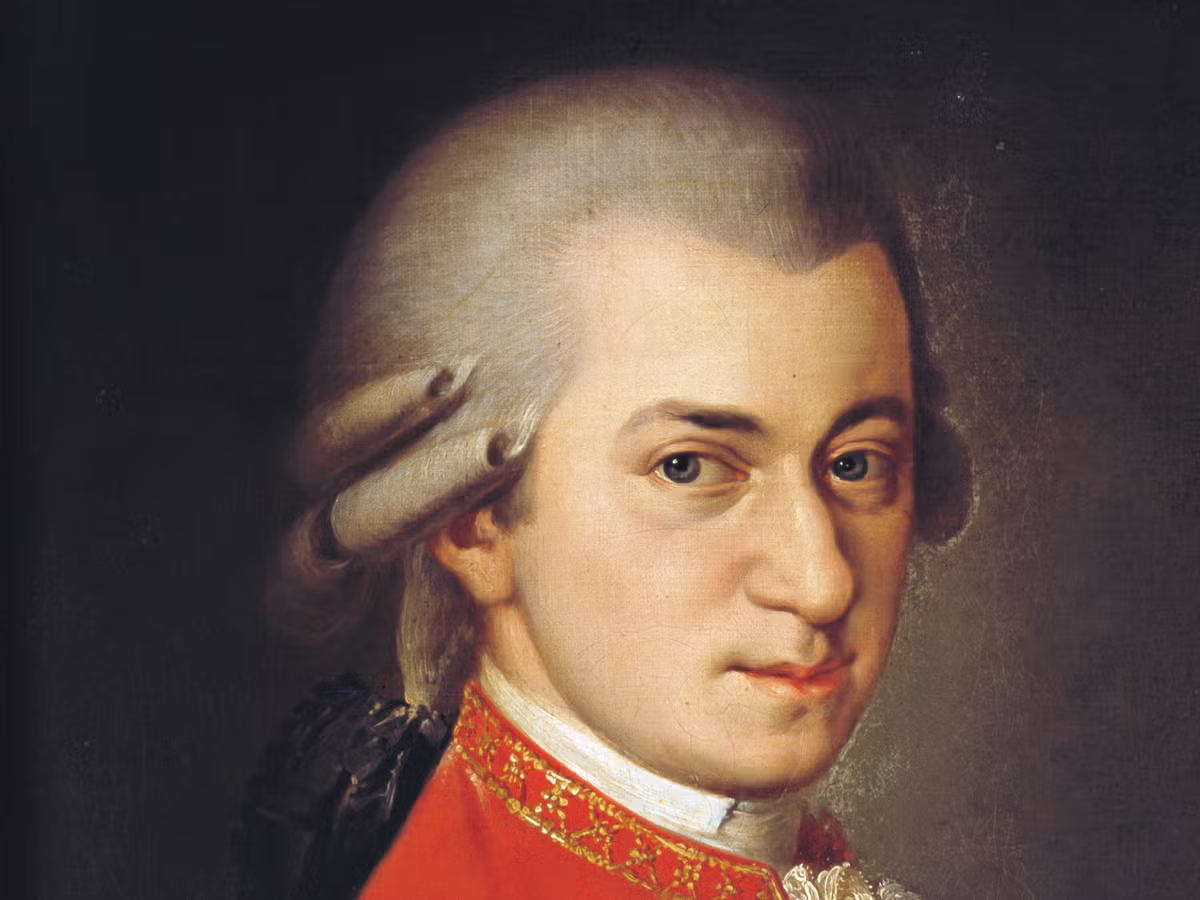
As the celebration of Mozart’s 250th birthday winds down, the International Mozart Foundation has offered up a nice gift to Mozart enthusiasts by putting online the master’s full body of work. This web site, called the Neue Mozart-Ausgabe, lets visitors explore over 600 individual works, or 24,000 pages of music, which were formerly available only in print. You can access the site in English, and you can peruse it as much as you like. The only caveat is that users must agree to use the collection only for personal purposes and not to download the works in wholesale fashion. So far, the public response to this offering has been overwhelming. In the first 12 hours after the launch, the online collection received more than 400,000 hits. And over the next four days, it received more than 12 million. With traffic levels easing up, now might be a good time to take a look.
Yes, we’re on a little bit of an iTunes roll here this week. But no one
seems to be complaining. Next up from Stanford, it’s The Historical Jesus. Like the Modern Theoretical Physics course that we previewed earlier, this class was originally taught in Stanford’s Continuing Studies Program, and it’s also aimed at the general public. Right now, you can download the first of ten installments. New installments will come out once a week.
Here is a complete description of what ground the course covers:
“Who was the historical Jesus of Nazareth? What did he actually say and do, as contrasted with what early Christians (e.g., Paul and the Gospel writers)
believed that he said and did? What did the man Jesus actually think of himself and of his mission, as contrasted with the messianic and even divine claims that the New Testament makes about him? In short, what are the differences — and continuities — between the Jesus who lived and died in history and the Christ who lives on in believers’ faith?
Over the last four decades historical scholarship on Jesus and his times — whether conducted by Jews, Christians, or non-believers — has arrived at a strong consensus about what this undeniably historical figure (born ca. 4 BCE, died ca. 30 CE) said and did, and how he presented himself and his message to his Jewish audience. Often that historical evidence about Jesus does not easily dovetail with the traditional doctrines of Christianity. How then might one adjudicate those conflicting claims?
This is a course about history, not about faith or theology. It will examine the best available literary and historical evidence about Jesus and his times and will discuss methodologies for interpreting that evidence, in order to help participants make their own judgments and draw their own conclusions.”
This is hot off the press, so to speak. Today, Stanford posted a new podcast of a course called Modern Theoretical Physics: Quantum Entanglement. It’s intriguing on several different levels. First, it’s in video. Second, the course is presented by Leonard Susskind, who is generally considered the father of string theory, a controversial innovation in physics that squares quantum theory with relativity and explains the nature of all matter and forces. Now, when Susskind gets into quantum entanglement, he is surely getting into some heady, cutting-edge stuff. But the good thing — and now for my third point — is that he has presented this course through Stanford’s Continuing Studies Program (where I work, just to put my cards on the table), and it was geared toward the general public. And, to boot, it was the most popular course in the program. You can find a slightly more involved course description here.The podcast will be rolled out in weekly installments, and the first is available starting today. Since this is a video podcast, you should be able to watch it on your Ipod’s video screen if you have one of the latest models. Or you could always just watch it on your computer screen, within iTunes itself.
What’s the most popular podcast in the Higher Education section of iTunes? Ahead of all the podcasts from Princeton, and all of those from Yale, and ahead of the Understanding Computers course from Harvard, and even the psychology course from UC Berkeley, is an unexpected podcast called Twelve Byzantine Rulers: The History of the Byzantine Empire. The course, which focuses on the Greek-speaking Roman Empire of the Middle Ages, is taught by Lars Brownworth, who teaches high school at The Stony Brook School on Long Island, New York. And it gets rave reviews. “I’m disappointed because I don’t think I’ll ever find a podcast that I enjoy as much as this one.” “This podcast has quickly become a hit with me and all of my friends, even those who don’t like history so much.” You get the gist.
The success of this course makes us think that companies that sell digital lectures for a fee might not be long for this world. Take The Teaching Company for example. They’re in the business of selling polished, lecture-based courses, which can often be very well done. And, yes, they offer too a course on the Byzantine Empire that retails in audio download form for $129. So what will the savvy consumer do? Download Brownworth’s course for free? Or pay $129? This is not a knock on what The Teaching Company is doing. I like their product and can appreciate their need to sell products to recoup their costs. But you can’t compete with free. With so many university courses now taping their courses and allowing people to download them to the ubiquitous iPod (see our full list of university podcasts), you have to wonder whether The Teaching Company is just another once viable business model that is being steadily commoditzed by the Internet.
We're hoping to rely on loyal readers, rather than erratic ads. Please click the Donate button and support Open Culture. You can use Paypal, Venmo, Patreon, even Crypto! We thank you!
Open Culture scours the web for the best educational media. We find the free courses and audio books you need, the language lessons & educational videos you want, and plenty of enlightenment in between.