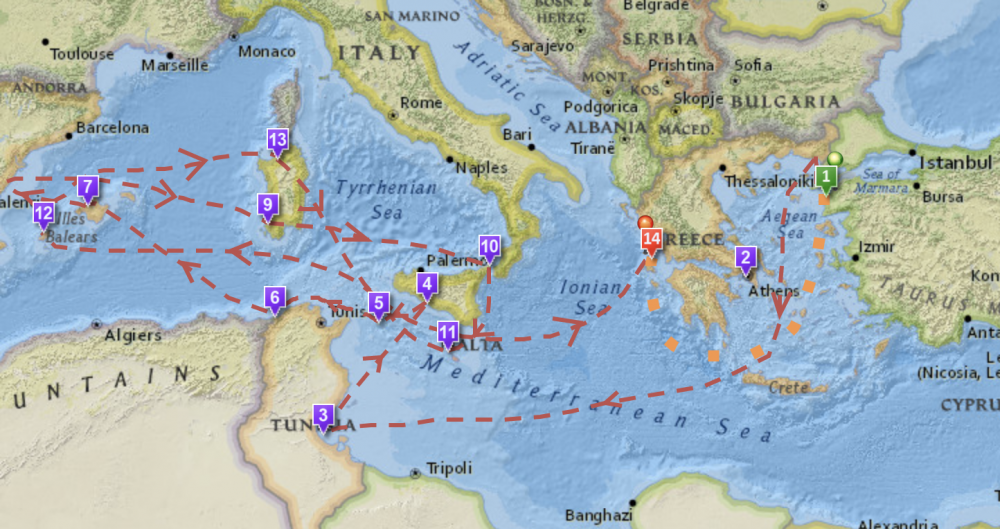
The Odyssey, one of Homer’s two great epics, narrates Odysseus’ long, strange trip home after the Trojan war. During their ten-year journey, Odysseus and his men had to overcome divine and natural forces, from battering storms and winds to difficult encounters with the Cyclops Polyphemus, the cannibalistic Laestrygones, the witch-goddess Circe and the rest. And they took a most circuitous route, bouncing all over the Mediterranean, moving first down to Crete and Tunisia. Next over to Sicily, then off toward Spain, and back to Greece again.
If you’re looking for an easy way to visualize all of the twists and turns in The Odyssey, then we’d recommend spending some time with the interactive map created by Gisèle Mounzer. “Odysseus’ Journey” breaks down Odysseus’ voyage into 14 key scenes and locates them on a modern map designed by Esri, a company that creates GIS mapping software.
Meanwhile, if you’re interested in the whole concept of ancient travel, we’d suggest revisiting one of our previous posts: Play Caesar: Travel Ancient Rome with Stanford’s Interactive Map. It tells you all about ORBIS, a geospatial network model, that lets you simulate journeys in Ancient Roman. You pick the points of origin and destination for a trip, and ORBIS will reconstruct the duration and financial cost of making the ancient journey.
If you would like to support the mission of Open Culture, consider making a donation to our site. It’s hard to rely 100% on ads, and your contributions will help us continue providing the best free cultural and educational materials to learners everywhere. You can contribute through PayPal, Patreon, and Venmo (@openculture). Thanks!
Note: An earlier version of this post appeared on our site in December, 2013.
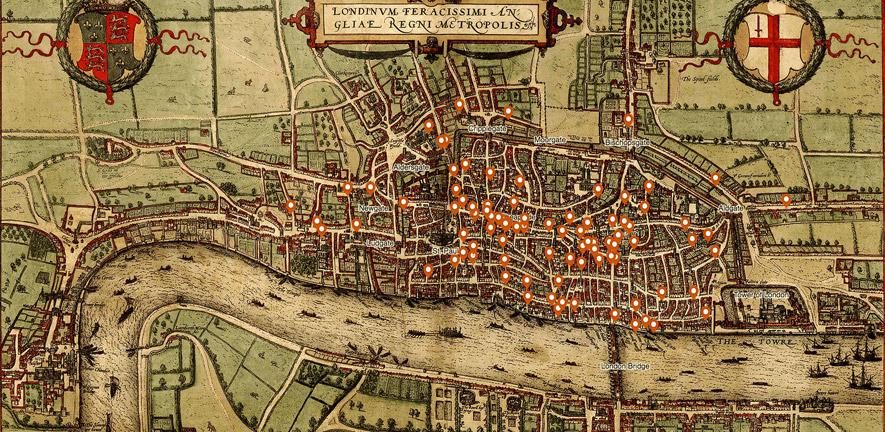
The data containing info of 142 homicides comes from surviving coroner’s rolls from the first half of the 14th century. A coroner during this time was a bit closer to a police detective in ours, called to the scene of any sudden and unnatural death. And if it looked liked foul play a neighborhood jury of somewhere between 12 and 50 people were called to offer a verdict.
Hover over a marker on the map and you can discover what happened at that location. Here are a few examples:
On the evening of July 20, 1325, Peter Clark, a baker, was stabbed in the heart by a fellow baker called Walter after an argument. Walter took sanctuary in a church, confessed to the crime, and a month later made his way out of the country by boat.
On December 21, 1325, Roger Scott, a tailor, was quarreling with Robert de Oundle in the streets of Bishopgate, when Robert stabbed Roger with a hidden knife, killing him instantly. He also fled, to where nobody knew.
On February 13, 1324, William Warrock and William de Northamptone were arguing in the high street of Castle Baynard, when the former stabbed the latter in the heart. Warrock, who had no belongings, disappeared.
Sensing a theme here? We’ll never know the reason for these fatal altercations, but the knife industry was doing well out of it. The study crunched the numbers and found some statistics: the time of year did not seem to be a factor, but like today, the weekend was a deadlier time. And the hours between early evening and the first hour of London’s curfew, when the city insisted all fires be extinguished and people go to bed.
A whopping 52% of murders happened in the public square or the high street. No other location cracks 10%. And long knives were the weapon of choice at 35%, second only to short knives at 20%. And though it wasn’t reflected in the three random examples, most people got stabbed in the head. Unsurprisingly men committed the majority of the crimes, and all classes of society and profession murdered their way around London, including priests. (One example is given of a priest who stabs a gardener to death when the latter discovered him stealing apples.)
“The events described in the Coroners’ Rolls show weapons were never far away, male honour had to be protected, and conflicts easily got out of hand. They give us a detailed picture of how homicide was embedded in the rhythms of urban medieval life.”
And in fact, given the proportion of crime to the general population, London was pretty deadly, about 15–20 times higher than a modern British city.
But Eisner notes the comparisons can only go so far: “We have firearms, but we also have emergency services. It’s easier to kill but easier to save lives.”
Ted Mills is a freelance writer on the arts who currently hosts the artist interview-based FunkZone Podcast and is the producer of KCRW’s Curious Coast. You can also follow him on Twitter at @tedmills, read his other arts writing at tedmills.com and/or watch his films here.
To be a non-believer in some parts of the world, and in much of Europe for many centuries, means to commit a crime against the state. Even where unbelief goes unpunished by the law, “atheists, agnostics, and other non-believers,” writes Scotty Hendricks at Big Think, “are among the most disliked, untrusted, and misunderstood people.” Identified with Satanists (who are equally misunderstood), non-believers are presumed to be anti-theists, hell bent on destroying, or at least maiming, religion with their know-it-all dogmatism and hatred of different beliefs.
There may be some projection going on here, and maybe it goes both ways at times, though the balance of power, at least in the U.S., decidedly tips in favor of certain dogmatic religions. But as a new whitepaper from the UK group Understanding Unbelief found, in a wide-ranging survey of non-believers in six countries around the world, “popular assumptions about ‘convinced, dogmatic atheists’ do not stand up to scrutiny.” The outlier here is the religiously inflamed U.S. “Although American atheists are typically fairly confident in their views about God, importantly, so too are Americans in general.”
The paper’s authors are professors in theology, psychology, anthropology, and religious studies from four major U.K. Universities. They outline their eight key findings at the outset, then get into specifics about what the data says and how it was obtained, with large, full-color charts and graphs. The study shows more agreement than most of us might assume between the religious and non-religious on “the values most important for ‘finding meaning in the world and your own life.’”
“Family” and “Freedom” ranked highly. “Less unanimously so,” did “’Compassion,’ ‘Truth,’ ‘Nature,’ and ‘Science,’” which may come as little surprise. The social and political identifications of non-believers fluctuate widely between the six countries—Brazil, Denmark, Japan, China, the U.S., and the U.K.—but, “with only a few exceptions, atheists and agnostics endorse the realities of objective moral values, human dignity, and attendant rights, and the ‘deep value’ of nature.”
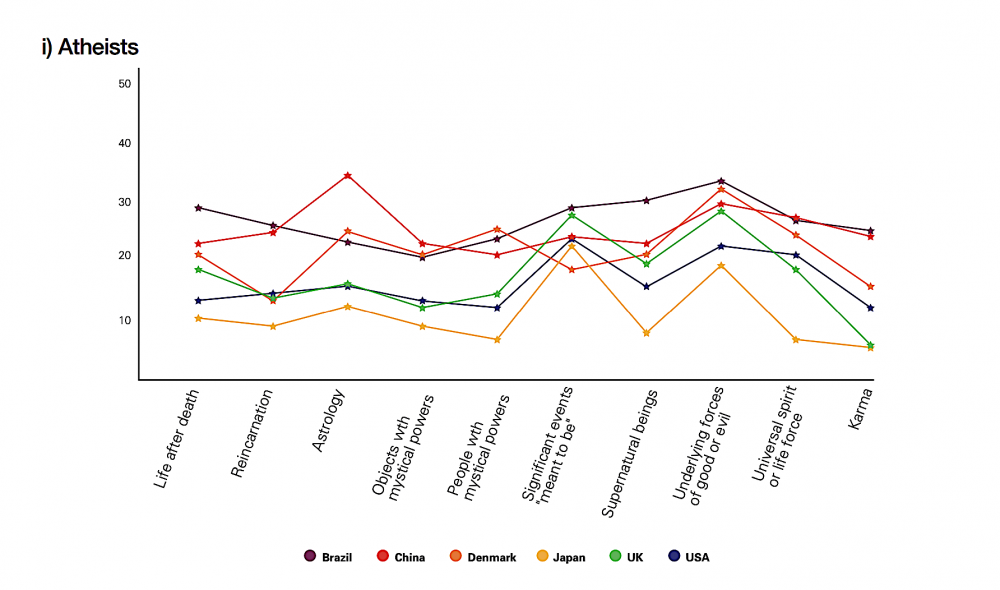
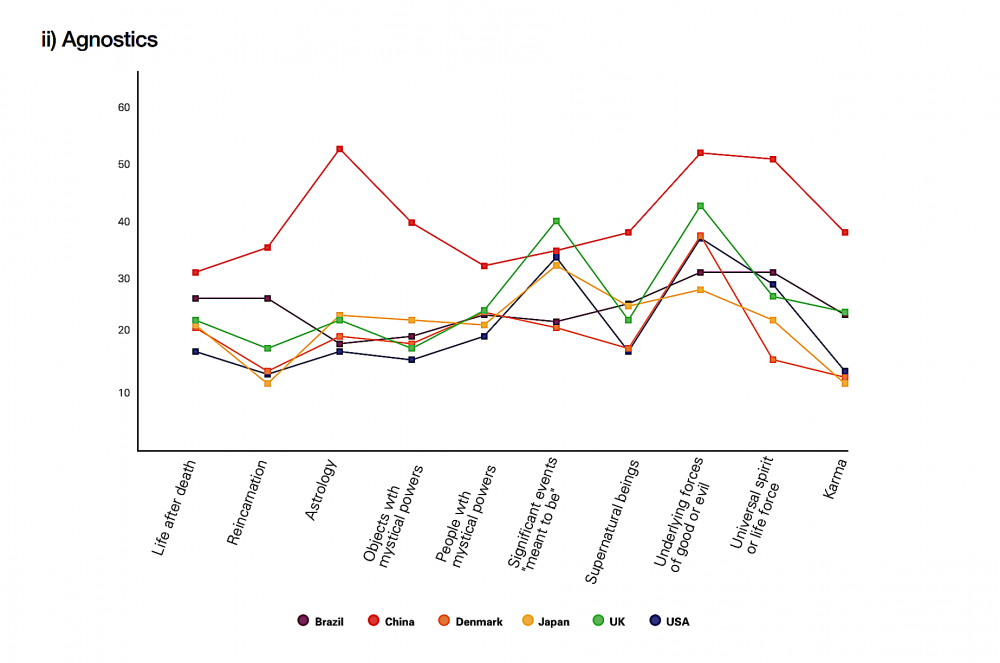
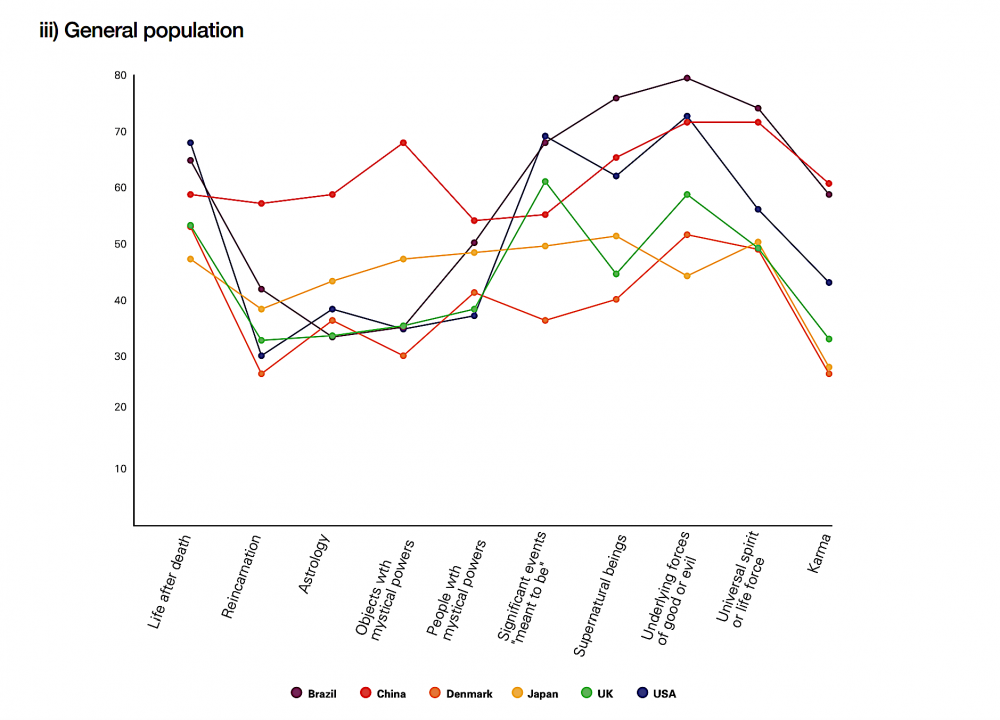
These conclusions should interest non-believers and believers alike in the six countries surveyed, but the most sensational research finding states that “despite rejecting or at least questioning the notion of gods, unbelievers aren’t wholly divorced from superstitious belief,” writes Hendricks. The study’s authors put things in a more measured way: “only minorities of atheists or agnostics in each of our countries appear to be thoroughgoing naturalists,” ruling out the supernatural entirely.
Hendricks lists some examples:
Up to third of self-declared atheists in China believe in astrology. A quarter of Brazilian atheists believe in reincarnation, and a similar number of their Danish counterparts think some people have magical powers.
These findings might be consistent with the study’s methodology, which surveyed people who agreed with either 1. I don’t believe in God [or other divinity or spirit] or 2. I don’t know whether there is a God, and I don’t believe there is any way to find out. Neither of these mutually excludes the à la carte spiritualism of astrology, reincarnation, or magic, a fact that many religious believers cannot wrap their heads around.
In the 19th and early 20th centuries, for example, belief in seances, tarot, mesmerism, and other seemingly supernatural phenomena flourished, quite often independently of particular religious belief systems. One of the most rational minds of the time, or the creator of the most rational mind of the time, Sir Arthur Conan Doyle, believed in fairies. Pierre Curie “was an atheist who had an enduring, somewhat scientific, interest in spiritualism.”
The study’s findings are “in line,” Hendricks points out, “with previous studies that show non-believers are just as prone to irrational thinking as their religious counterparts.” Significant percentages of atheists and agnostics express some belief in astrology, karma, “a universal spirit or life force,” and other supernatural phenomena. Hendricks quotes Michio Kaku’s suggestion that there may be “a gene for superstition, a gene for hearsay, a gene for magic.” I don’t believe geneticists have found such a thing. But culture, at any rate, is not reducible to biology.
The fact that humans see, hear, feel, and believe things that may not actually exist seems to be an evolutionary trait. What may be equally, if not more, interesting is the way those supernatural things, whatever they are, both resemble and vastly differ from each other, their cultural specificities woven inextricably into the texture of language and custom. What and how we think cannot be fully separated either from our genes or from the conceptual apparatus we inherit, and that forms our picture of the world. Read the full Understanding Unbelief study here.
We all have bodies, but how many of us truly know our way around them? Plenty of books explain in detail the functions of and relationships between each and every part of our anatomy, but few of them do it in a way the layman — and especially the layman not yet accustomed to the sight of human viscera laid bare — can readily grasp. We need a visualization of the human body, but what kind of visualization can best represent it with a maximum of clarity and a minimum of misleading distortion?
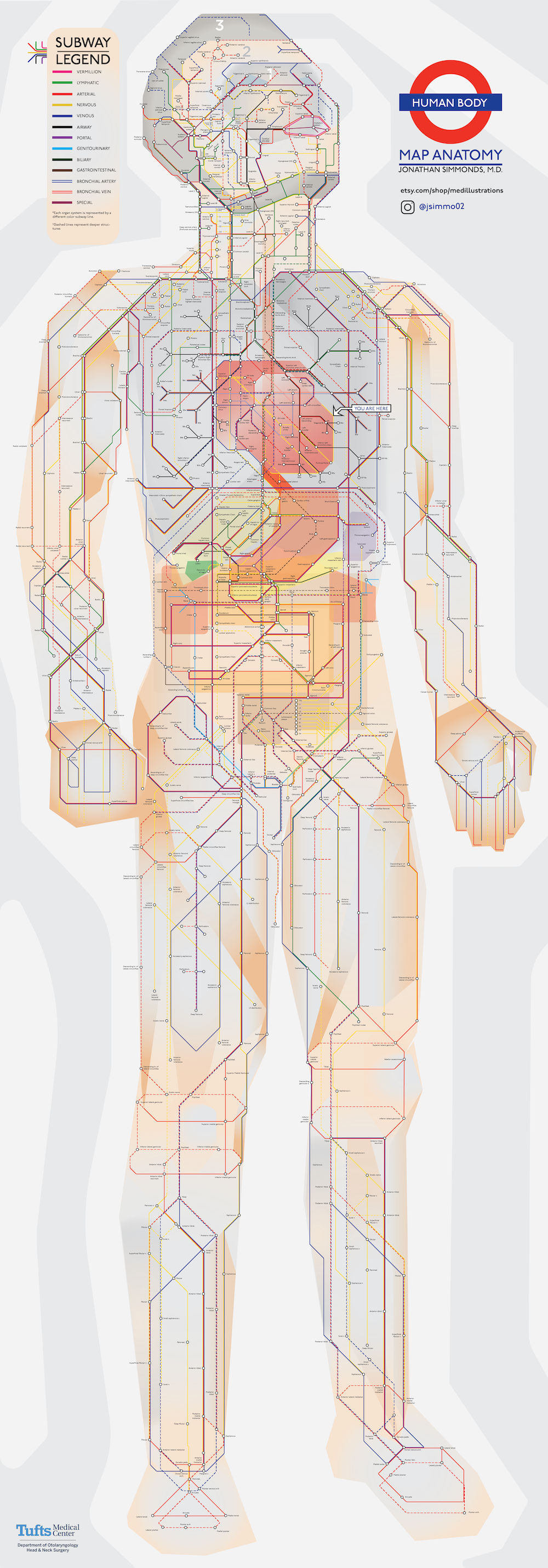
“Most people might imagine an intricate network of blood vessels or the complex neural circuits of the brain,” writes Visual Capitalist’s Iman Ghosh. “Or we might picture diagrams from the iconic medical textbook, Gray’s Anatomy.” But how about a visualization of the body in the style of a classic piece of information design we’ve all seen at least once, the London Underground map? “Created by Jonathan Simmonds M.D., a resident physician at Tufts Medical Center,” Ghosh writes, “it’s a simple yet beautifully intuitive demonstration of how efficiently our bodies work.”
Just as Harry Beck’s original 1933 London Underground map straightened out and color-coded each of the lines then in operation, Simmonds’ anatomical map traces thirteen different “lines” through the body, each of which represents a different system of the body: the nervous system in yellow, for example, the airway system in black, and the lymphatic system in green. “While dashed lines represent deeper structures, sections with ‘transfers’ show where different organ systems intersect,” Ghosh writes. If you’re wondering where to start, she adds, “there’s a helpful ‘You Are Here’ at the heart.”
You can take a close look at Simmonds’ work in a large, high-resolution version here. Not only does following the model of the London Underground map introduce a degree of immediate legibility seldom seen (at least by non-medical students) in anatomical diagrams, it also underscores an aspect of the very nature of our human bodies that we don’t often consider. We might instinctively think of them as sets of discrete organs all encased together and functioning independently, but in fact they’re more like cities: just as busy, just as interconnected, just as dependent on connections and routines, and just as improbably functional.
Based in Seoul, Colin Marshall writes and broadcasts on cities, language, and culture. His projects include the book The Stateless City: a Walk through 21st-Century Los Angeles and the video series The City in Cinema. Follow him on Twitter at @colinmarshall, on Facebook, or on Instagram.
This strategy will not work in most ransomware attacks—if your personal data is stolen, releasing all of it to the public for a small fee might diffuse the blackmailer’s bomb, but your problems will only have just begun. But for Radiohead, releasing 18 hours of demo material from minidisks recorded between 1995 and 1998, during the making of their landmark OK Computer, turned out to be just the thing. For a limited time, 18 days from the announcement, you can buy all 18 hours of that material on Bandcamp for the low price of £18 (about $23), with all proceeds benefiting the climate change advocacy group Extinction Rebellion. The music can also be streamed for free (click on the player above) during that time.
The minidisk archive was stolen from Thom Yorke by a hacker who demanded $150,000 or threatened to release them. Guitarist Jonny Greenwood announced the theft on Twitter and Facebook. “We got hacked last week—someone stole Thom’s minidisk archive from around the time of OK Computer…. For £18 you can find out if we should have paid that ransom.”
He prefaced the demos with some modest commentary: “Never intended for public consumption (though some clips did reach the cassette in the OK Computer reissue) it’s only tangentially interesting. And very, very long. Not a phone download. Rainy out, isn’t it though?”
Although bands release demo material all the time—or their record companies do, at least—few go out of their way to talk up alternate takes, sketches, skeletal early versions, and rejected songs. But fan communities often treat such material as akin to finding lost ancient literary sources. Witness the 65-page document titled OK Minidiscalready published online, a detailed analysis of the demos by a group from online Radiohead fandom that will likely now forever feature in the band’s accumulated lore.
The demo collection, simply called MINIDISCS [HACKED], will give Radiohead scholars lay and professional a wealth of evidence to draw on for decades—insights into their production process and the evolution of Thom Yorke’s writing. (The first track is an early version of OK Computer’s “Exit Music (For a Film)” with mopey, self-pitying lyrics that might have fit better on the band’s debut album).
As a listening experience, sitting through 18 hours of outtakes may be “only tangentially interesting” and certainly “very, very long.” But when it comes to an album as widely and deeply worshipped as OK Computer, this material might as well be Dead Sea Scrolls.
Surely the minidisk archive’s kidnapper(s) counted on the massive profile of the 1997 album when they named their price, but they didn’t know quite who they were dealing with. Contribute to climate action and become an independent Ok Computer scholar yourself by buying and downloading (with a solid broadband connection) all 18 hours of the MINIDISCS [HACKED] collection at Bandcamp. Or stream it all above.
Owing to its simplicity and inexpensiveness, the recorder has become one of the most commonly taught instruments in grade-school music classes. But that very position has also, perhaps, made it a less respected instrument than it could be. We may vividly remember the hours spent fumbling with the holes on the front of our plastic recorders in an attempt to master the basic melodies assigned to us as homework, but did we ever learn anything of the instrument’s long history — or, for that matter, anything of what it can sound like in the hands of a virtuoso instead of those of a frustrated ten-year-old?
The recorder goes back at least as far as the Middle Ages, and with its pastoral associations it remained a popular instrument throughout the Renaissance and Baroque periods. But then came a period of widespread disinterest in the recorder that lasted at least until the 20th century, when musicians started performing pieces with instruments from the same historical periods as the music itself.
Despite the instrument’s going in and out of style, the list of composers who have written for the recorder does boast some formidable names, including Johann Sebastian Bach, George Frideric Handel, Claudio Monteverdi, Henry Purcell, and Antonio Vivaldi, whose Recorder Concerto in C Major you can see performed in the video at the top of the post.
“After a few measures, musician Maurice Steger stepped up to the microphone and with amazing skill, shredded several serious solos on the recorder,” Laughing Squid’s Lori Dorn reports of the spectacle. “Steger rested for a few bars to catch his breath and then start all over again. Simply a wonder to behold.” We also, in the video just above, have Lucie Horsch’s also-virtuosic performance of Vivaldi’s Flautino Concerto in C Major, albeit transposed to G major transposition for soprano recorder. Even among those who learned to despise the recorder in school, there will be some who now can’t get enough. But even if it hasn’t become your favorite instrument, you’ve got to admit that we’re a long way indeed from “Hot Cross Buns.”
Based in Seoul, Colin Marshall writes and broadcasts on cities, language, and culture. His projects include the book The Stateless City: a Walk through 21st-Century Los Angeles and the video series The City in Cinema. Follow him on Twitter at @colinmarshall, on Facebook, or on Instagram.
It may seem like a bizarre question, but indulge me for a moment: could it be possible that the most famous artist of the Renaissance and maybe in all of art history, Leonardo da Vinci, is an underrated figure? Consider the fact that until relatively recently, a huge amount of his work—maybe a majority of his drawings, plans, sketches, notes, concepts, theories, etc.—has been unavailable to all but specialized scholars who could access (and read) his copious notebooks, spanning the most productive period of his career.
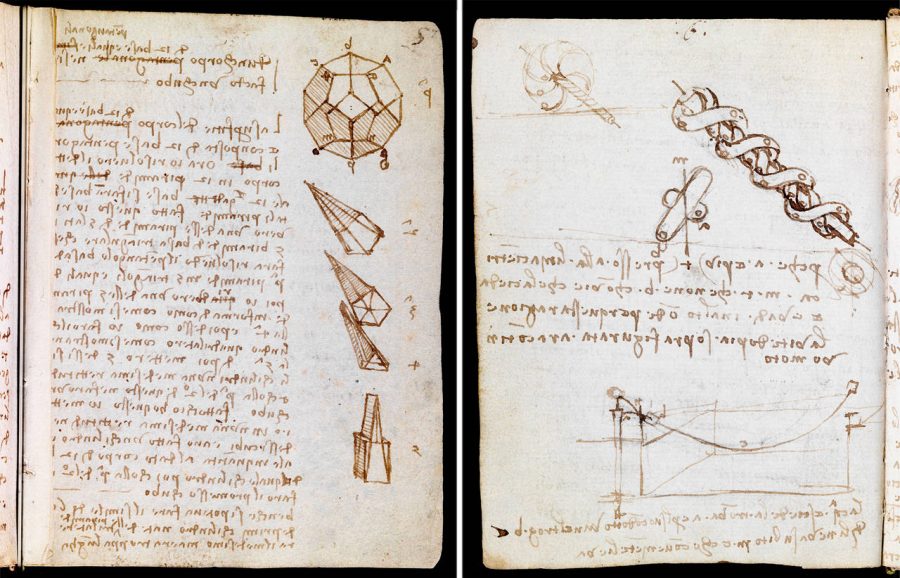
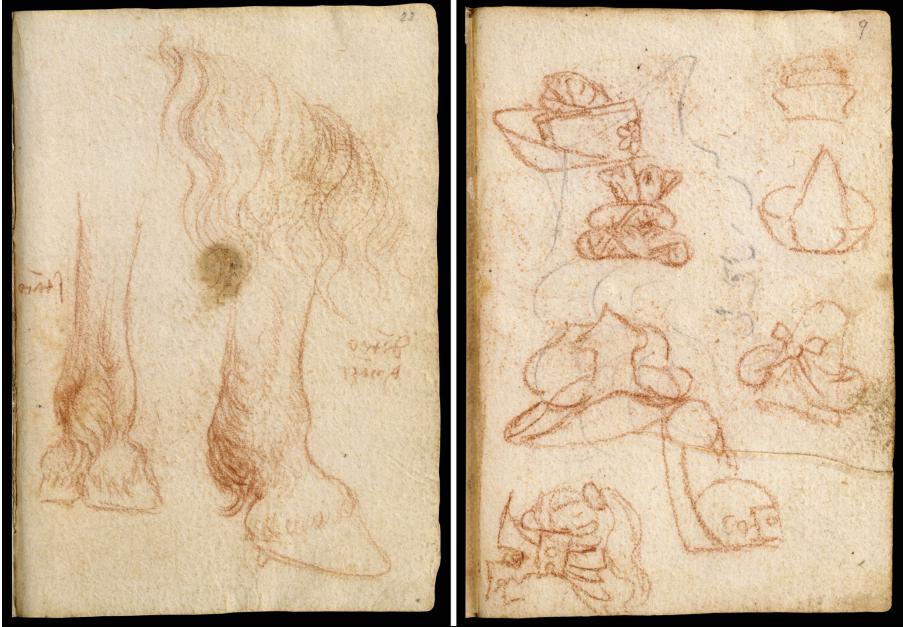
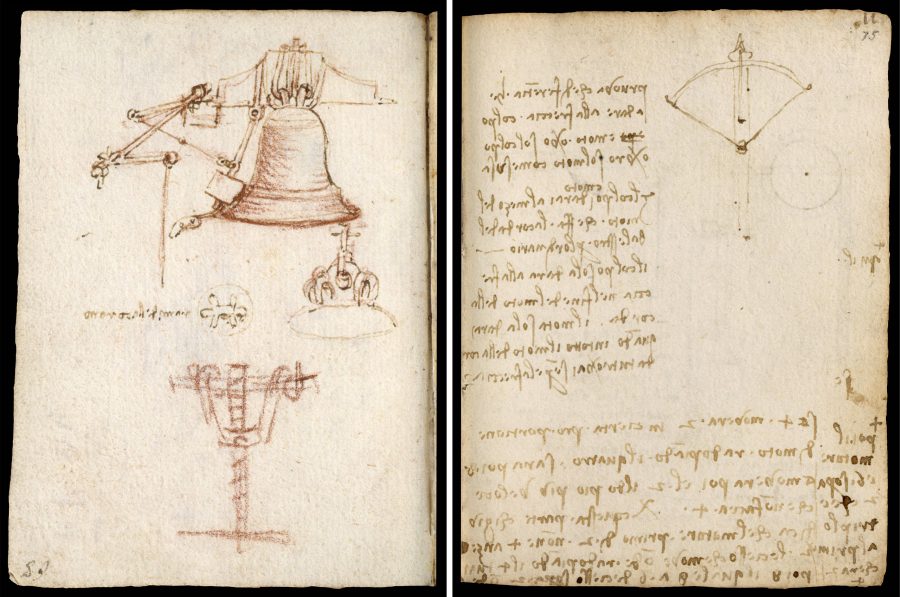
“Leonardo seems to have begun recording his thoughts in notebooks from the mid-1480s,” writes the Victoria & Albert Museum (the V&A), “when he worked as a military and naval engineer for the Duke of Milan. None of Leonardo’s predecessors, contemporaries or successors used paper quite like he did—a single sheet contains an unpredictable pattern of ideas and inventions.” He worked on loose sheets, which were later bound together in books, or codices, by the artists who inherited them. As we have been reporting, these notebook collections have been coming available online in open, high-resolution digital versions.
Now the V&A has announced that all three of its Leonardo codices, called the Forster Codices after the collector who bequeathed them to the museum, are available to view “in amazing detail.” Click here to see Codex Forster 1, Codex Forster 2, and Codex Forster 3. Here we see further evidence that Leonardo was a supreme draughtsman. As Claudio Giorgione, curator at the Leonardo da Vinci National Science and Technology Museum in Milan, points out, “Leonardo was not the only one to draw machines and to do scientific drawings, many other engineers did that,” and many artists as well. “But what Leonardo did better than others is to make a revolution of the technical drawing,” almost defining the field with his meticulous attention to detail.
What’s more, notes University of Oxford Professor Martin Kemp, “while other artists might have been probing some aspects of anatomy—muscles, bones, tendons—Leonardo took the study to a new level.” Such a level, in fact, that he “can be regarded as the father of bioengineering,” argues John B. West in the American Journal of Physiology.
Little attention has been paid to [Leonardo] as a physiologist. But he was an outstanding engineer, and he was one of the first people to apply the principles of engineering to understand the function of animals including humans.
Giorgione warns against seeing Leonardo as a prophetic visionary for his innovations. He was not a man out of time; “the artist engineer is a known figure in Renaissance Italy.” But he perfected the tools and methods of this dual profession with such restless ingenuity and skill that we still find it astonishing over 500 years later. His lengthy explanations of these exceptional technical drawings are written, naturally, in his famous mirror writing.
Of Leonardo’s odd writing system, we may learn something new as well, though we may find this part, at least, a little disappointing. As the V&A points out, his idiosyncratic method might not have been so unique after all, or have been a sophisticated device for Leonardo to hide his ideas from competitors and future curious readers. It might have come about “because he was left-handed and may have found it easier to write from right to left…. Writing masters at the time would have made demonstrations of mirror writing, and his letter-shapes are in fact quite ordinary.”
Nothing else about the man seems to warrant that description. See all three Forster Codices the Victoria & Albert Museum site here: Codex Forster 1, Codex Forster 2, and Codex Forster 3. And see one codex from the collection, as the V&A announced on Twitter, live in person at the British Library’s Leonardo da Vinci: A Mind in Motion exhibit.
We may know a few names of historic women photographers, like Julia Margaret Cameron, Dorothea Lange, or Diane Arbus, but the significant presence of women in photography from its very beginnings doesn’t get much attention in the usual narrative, despite the fact that “by 1900,” as photographer Dawn Oosterhoff writes, census records in Britain and the U.S. showed that “there were more than 7000 professional women photographers,” a number that only grew as decades passed.
As photographic equipment became smaller, lighter, and more portable, photographers moved out into more challenging and dangerous situations. Among them were women who “fought tradition and were among the pioneer photojournalists,” working alongside men on the front lines of war zones around the world.
War photographers like Lee Miller—former Vogue model, Man Ray muse, and Surrealist artist—showed a side of war most people didn’t see, one in which women warriors, medical personnel, support staff, and workers, played significant roles and bore witness to mass suffering and acts of heroism.
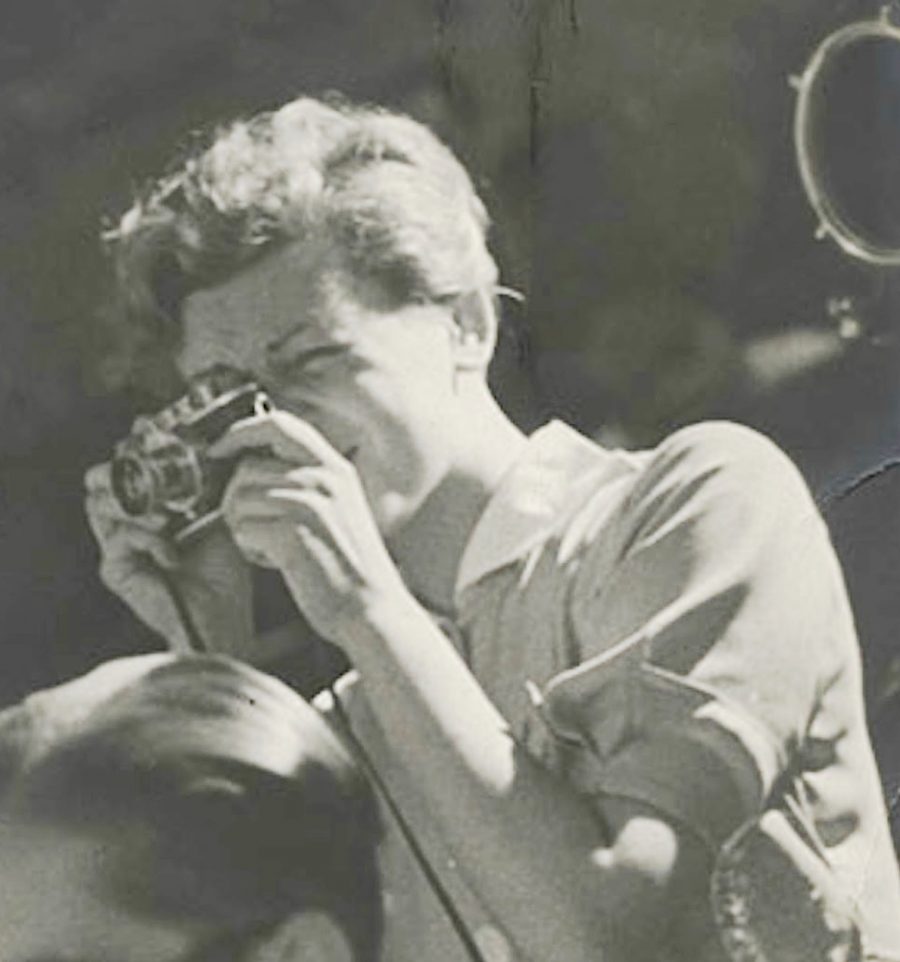
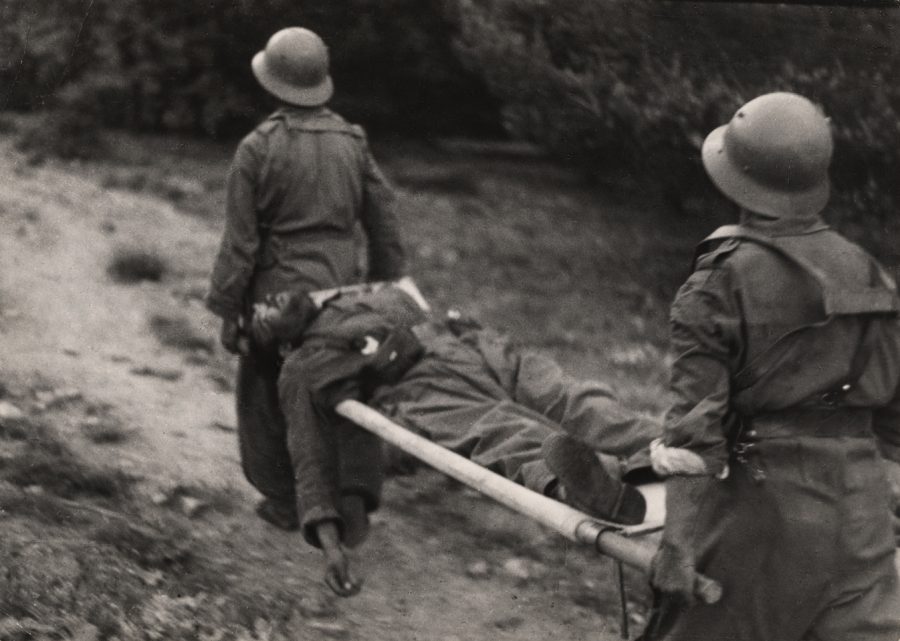
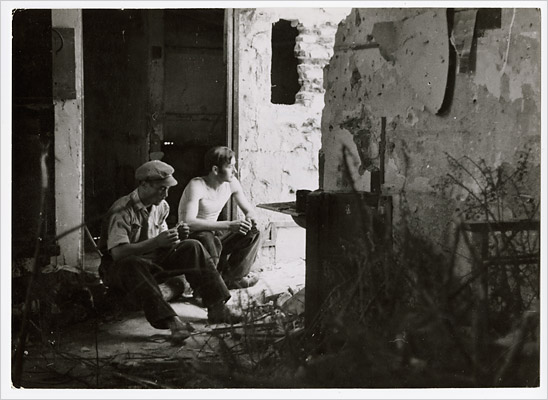
Before Miller captured the devastation at the European front, the horrors of Dachau, and Hitler’s bathtub, another female war photographer, Gerda Taro, documented the front lines of the Spanish Civil War. “One of the world’s first and greatest war photographers,” writes Giles Trent at The Guardian, Taro “died while photographing a chaotic retreat after the Battle of Brunete, shortly after Franco’s troops had one a major victory,” just days away from her 27th birthday. She was the first female photojournalist to be killed in action on the frontline and a major star in France at the time of her death.
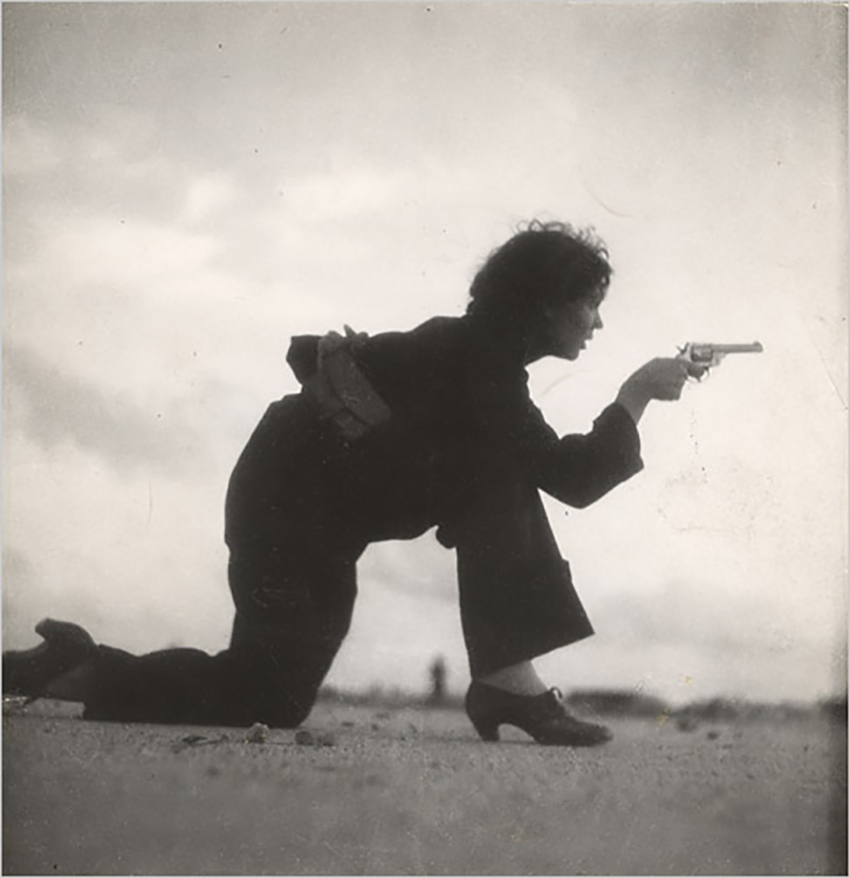
Woman Training for a Republican Militia, by Gerda Taro, via Wikimedia Commons
“On 1 August 1937,” notes a Magnum Photos bio, “thousands of people lined the streets of Paris to mourn the death” of Taro. The “26-year-old Jewish émigré from Leipzig… was eulogized as a courageous reporter who had sacrificed her life to bear witness to the suffering of civilians and troops…. The media proclaimed her a left-wing heroine, a martyr of the anti-fascist cause and a role model for young women everywhere.” Taro had fled to France in in 1933, after being arrested by the Nazis for distributing anti-fascist leaflets in Germany. She was determined to continue the fight in her new country.
Republican Soldiers at the Navacerrada Pass, by Gerda Taro, via Wikimedia Commons
Taro met another Jewish émigré, well-known Hungarian photographer Robert Capa, just getting his start at the time. The two became partners and lovers, arriving in Barcelona in 1936, “two-and-a-half weeks after the outbreak of the war.” Like Miller, Taro was drawn to women on the battlefield. In one of her first assignments, she documented militiawomen of the Unified Socialist Party of Catalonia training on a beach. “Motivated by a desire to raise awareness of the plight of Spanish civilians and the soldiers fighting for liberty,” her clear sympathies give her work depth and immediacy.
Republican Dinamiteros, in the Carabanchel Neighborhood of Madrid, by Gerda Taro, via Wikimedia Commons
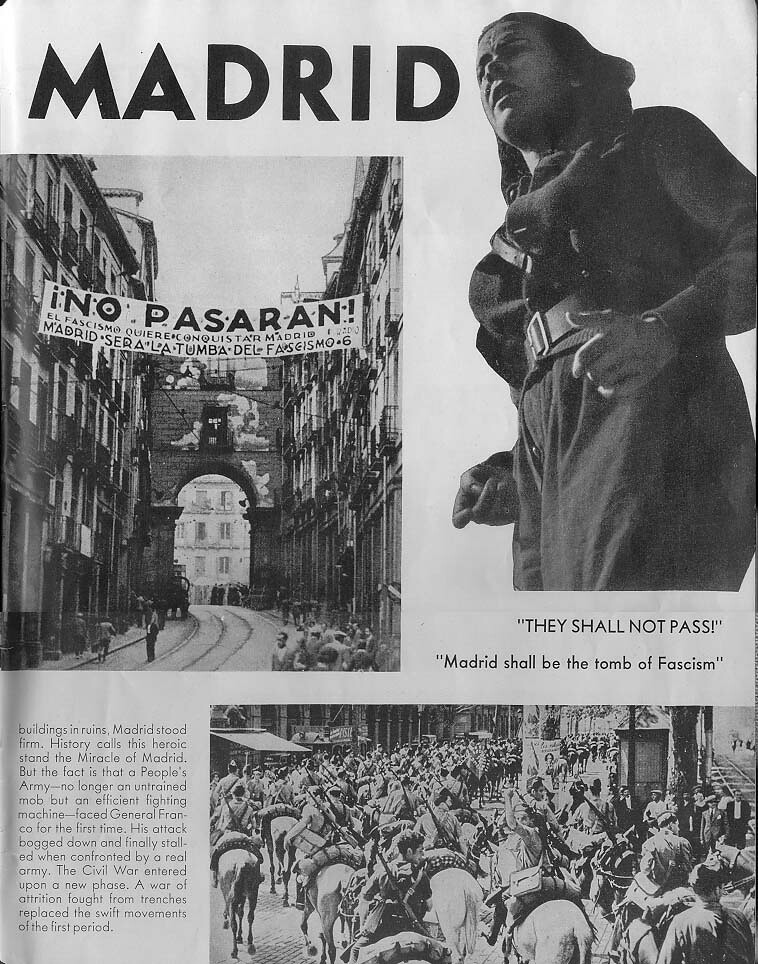
Taro’s photographs “were widely reproduced in the French leftist press,” points out the International Center of Photography. She “incorporated the dynamic camera angles of New Vision photography as well as a physical and emotional closeness to her subject.” After she was crushed by a tank in 1937, many of her photographs were incorrectly credited to Capa, and she sank into obscurity. She has achieved renewed recognition in recent years, especially after a trove of 4,500 negatives containing work by her and Capa was discovered in Mexico City.
Although she had been warned away from the front, Taro “got into this conviction that she had to bear witness,” says biographer Jane Rogoyska, “The troops loved her and she kept pushing.” She paid with her life, died a hero, and was forgotten until recently. Her legacy is celebrated in Rogoyska’s book, a novel about her and Capa by Susana Fortes, an International Center of Photography exhibition, film projects in the works, and a Google Doodle last August on her birthday. Learn more about Taro’s life and see many more of her captivating images, at Magnum Photos.
Early European explorers left the continent with visions of gardens in their heads: The Garden of Eden, the Garden of the Hesperides, and other mythic realms of abundance, ease, and endless repose. Those same explorers left sickness, war, and death only to find sickness, war, and death—much of it exported by themselves. The garden became de-mythologized. Natural philosophy and modern methods of agriculture brought gardens further down to earth in the cultural imagination.
Yet the garden remained a special figure in philosophy, art, and literature, a potent symbol of an ordered life and ordered mind. Voltaire’s Candide, the riotous satire filled with gardens both fantastical and practical, famously ends with the dictate, “we must cultivate our garden.” The tendency to read this line as strictly metaphorical does a disservice to the intellectual culture created by Voltaire and other writers of the period—Alexander Pope most prominent among them—for whom gardening was a theory born of practice.
Exiled from France in 1765, Voltaire retreated to a villa in Geneva called Les Délices, “The Delights.” There, writes Adam Gopnik at The New Yorker, he “quickly turned his exile into a desirable condition…. When he wrote that it was our duty to cultivate our garden, he really knew what it meant to cultivate a garden.” Enlightenment poets and philosophers did not dwell on the scientific reasons why gardens might have such salutary effects on the psyche. And neither does neurologist Oliver Sacks, who also wrote of gardens as health-bestowing havens from the chaos and noise of the world, and more specifically, from the city and brutal commercial demands it represents.
For Sacks that city was not Paris or London but, principally, New York, where he lived, practiced, and wrote for fifty years. Nonetheless, in his essay “The Healing Power of Gardens,” he invokes the European history of gardens, from the medieval hortus to grand Enlightenment botanical gardens like Kew, filled with exotic plants from “the Americas and the Orient.” Sacks writes of his student days, where he “discovered with delight a very different garden—the Oxford Botanic Garden, one of the first walled gardens established in Europe,” founded in 1621.
“It pleased me to think,” he recalls, referring to key Enlightenment scientists, “that Boyle, Hooke, Willis and other Oxford figures might have walked and meditated there in the 17th century.” In that time, cultivated gardens were often the private preserves of landed gentry. Now, places like the New York Botanical Garden, whose virtues Sacks extolls in the video above, are open to everyone. And it is a good thing, too. Because gardens can serve an essential public health function, whether we’re stressed and generally fatigued or suffering from a mental disorder or neurological condition:
I cannot say exactly how nature exerts its calming and organizing effects on our brains, but I have seen in my patients the restorative and healing powers of nature and gardens, even for those who are deeply disabled neurologically. In many cases, gardens and nature are more powerful than any medication.
“In forty years of medical practice,” the physician writes, “I have found only two types of non-pharmaceutical ‘therapy’ to be vitally important for patients with chronic neurological diseases: music and gardens.” A garden also represents—for Sacks and for artists like Virginia Woolf—“a triumph of resistance against the merciless race of modern life,” as Maria Popova writes at Brain Pickings, a pace “so compulsively focused on productivity at the cost of creativity, of lucidity, of sanity.”
Voltaire’s prescription to tend our gardens has made Candideinto a watchword for caring for and appreciating our surroundings. (It’s also now the name of a gardening app). Sacks’ recommendations should inspire us equally, whether we’re in search of creative inspiration or mental respite. “As a writer,” he says, “I find gardens essential to the creative process; as a physician, I take my patients to gardens whenever possible. The effect, he writes, is to be “refreshed in body and spirit,” absorbed in the “deep time” of nature, as he writes elsewhere, and finding in it “a profound sense of being at home, a sort of companionship with the earth,” and a remedy for the alienation of both mental illness and the grinding pace of our usual form of life.
They say creativity is born of limitations. If that’s true, then is any animator working today more creative than Don Hertzfeldt? “The stars of his movies are all near-featureless stickmen with dots for eyes and a single line for a mouth,” writes TheGuardian’s David Jenkins in an appreciation of Hertzfeldt, whose “method of making grand existential statements with almost recklessly modest means” — animating everything himself, and doing it all with traditional hand-drawing-and-film-camera methods that at no point involve computer-generated imagery — “has made his cinematic oeuvre one of the most fascinating and enjoyable of all contemporary American directors.”
As an example Jenkins holds up 2005’s The Meaning of Life, which “tackled nothing less than the nature of organic life in the known universe, addressing the painstaking development of the human form through a series of (often highly amusing) Darwinian transmutations.”
You can glimpse its four-year-long animation process, which appears to have been almost as painstaking, in time-lapse making-of documentary Watching Grass Grow. At Short of the Week, Rob Munday writes that, though The Meaning of Life takes on “a subject already familiar to the format (evolution has also been portrayed in short film by animators Michael Mills, Claude Cloutier and I’m sure many more),” it also sees Hertzfeldt adding “his own distinct take to proceedings with his unmistakable style and injections of dark humor.”
That special brand of humor has long been familiar to the many viewers who have stumbled across Hertzfeldt’s earlier Rejected, a short composed of even shorter shorts originally commissioned — and, yes, rejected — by the Family Learning Channel. As one of the first animations to “go viral” in the Youtube era, Rejected not only made Hertzfeldt’s name but paved the way for projects at once more ambitious, more surreal, more comic, and more serious: take the 65-minute It’s Such a Beautiful Day, which follows one of his signature stickmen into prolonged neurological decline. The Meaning of Life might seem positive by comparison, but its cosmic sweep belies Hertzfeldt’s underlying critique of all that evolution has produced. As Jenkins paraphrases it, “Were we really worth all that effort?”
Based in Seoul, Colin Marshall writes and broadcasts on cities, language, and culture. His projects include the book The Stateless City: a Walk through 21st-Century Los Angeles and the video series The City in Cinema. Follow him on Twitter at @colinmarshall, on Facebook, or on Instagram.
What, exactly, is Canada? The question sometimes occurs to Americans, living as they do right next door. But it might surprise those Americans to learn that Canadians themselves ask the very same question, living as they do in a country that could be defined by any number of its elements — its vastness, its multiculturalism, The Kids in the Hall — but never seems defined by any one of them in particular. Many individuals and groups throughout Canadian history have participated in the project of explaining Canada, and indeed defining it. Few have done as much as the National Film Board of Canada and the filmmakers it has supported, thanks to whom “three thousand films, from documentaries to narrative features to experimental shorts, are available to stream free of charge, even for Americans.”
Those words come from The Outline’s Chris R. Morgan, who writes that, “for the ‘Canuckophile’ (not my coinage but a term I happily own), the NFB’s Screening Room is one of the supreme pleasures of the internet. Since 1939, the NFB has facilitated the telling of Canada’s story in its people’s own words and images.”
Morgan points up to such NFB-supported productions as 1965’s Ladies and Gentlemen … Mr. Leonard Cohen, which “follows the titular 30-year-old poet giving witty readings, partying, and living around Montreal,” and the 2014 Shameless Propaganda, described at the Screening Room as an examination of “Canada’s national art form.” That art form developed in the years after the NFB’s founding in 1939, a time when its founding commissioner John Grierson called documentaries a “hammer to shape society.”
Not that most of what you’ll find to watch in the NFB’s screening room comes down like a hammer — nor does it feel especially propagandistic, as we’ve come to understand that term in the 21st century. Take, for instance, the documentary portraits of Canadian writers like Margaret Atwood and Jack Kerouac.
The latter lead a life described by filmmaker Herménégilde Chiasson as “a Franco-American odyssey,” which will remind even the most Canada-unaware Americans of one thing that clearly sets Canada apart: its bilingualism. That, too, provides material for a few NFB productions, including 1965’s Instant French, a short about “the adventures of a group of businessmen who are forced into taking French lessons to stay competitive in their field.”
“At first put out by this news,” continues the description at the Screening Room, “one by one they begin to realize that gaining fluency in another language has its benefits.” Hokey though it may sound — “definitely a product of its time,” as the NFB now says — a film like Instant French offers a glimpse into not just Canada’s past but the vision for society that has shaped Canada’s present and will continue to shape its future. You can browse the NFB’s large and growing online archive by subject (with categories including literature and language, music, and history) as well as through playlists like “Expo 67: 50 Years Later,”“Extraordinary Ordinary People,” — and, of course, “Hockey Movies,” which reminds us that, elusive though Canadian culture as a whole may sometimes feel, certain important parts of it aren’t that hard to grasp.
Based in Seoul, Colin Marshall writes and broadcasts on cities, language, and culture. His projects include the book The Stateless City: a Walk through 21st-Century Los Angeles and the video series The City in Cinema. Follow him on Twitter at @colinmarshall, on Facebook, or on Instagram.
We're hoping to rely on loyal readers, rather than erratic ads. Please click the Donate button and support Open Culture. You can use Paypal, Venmo, Patreon, even Crypto! We thank you!
Open Culture scours the web for the best educational media. We find the free courses and audio books you need, the language lessons & educational videos you want, and plenty of enlightenment in between.