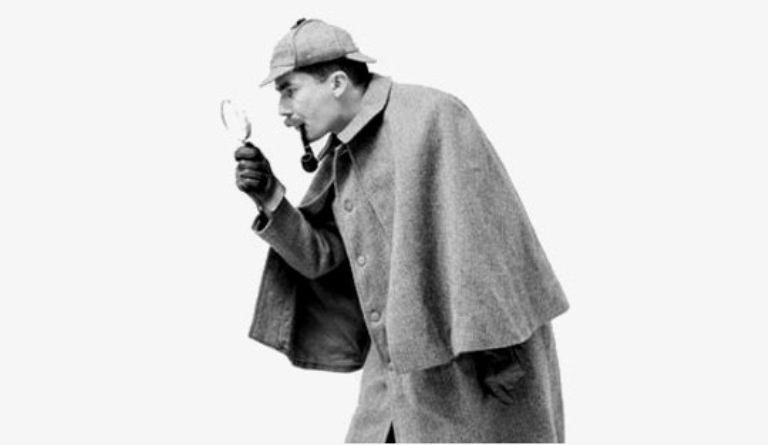
Chief Judge Rubén Castillo of the United States District Court of the Northern District of Illinois has ruled that the characters and story lines used in 50 Sherlock Holmes texts published by Arthur Conan Doyle before Jan. 1, 1923 “are no longer covered by United States copyright law and can be freely used by creators without paying any licensing fee to the Conan Doyle estate,” reports The New York Times. This gives contemporary authors the ability to write their own Sherlock Holmes mystery stories and keep contributing to a rich tradition of detective fiction. It would also seemingly put pre-1923 texts firmly in the public domain. (You can find The Adventures of Sherlock Holmes and other related stories in our Free eBooks and Free Audio Books collections. ) Leslie S. Klinger, the editor of The Complete Annotated Sherlock Holmes, who filed the civil suit, praised the judge’s decision, saying “People want to celebrate Holmes and Watson, and now they can do that without fear.” Now it’s time for them to write something that can hold a candle to what Conan Doyle created those many years ago.
Don’t miss anything from Open Culture. Sign up for our Daily Email or RSS Feed. And we’ll send cultural curiosities your way, every day.
When I saw William Blake’s illustrations for the book of Job and for John Milton’s L’Allegro and Il Penserosoat the Morgan Library a few years ago, I was first struck by how small the intricate watercolors are. This should not have been surprising—these are book illustrations, after all. But William Blake (1757–1827) is such a tremendous force, his work so monumentally strange and beautiful, that one expects to be overpowered by it. In person, his drawings are indeed impressive, but they are equally so for their careful attention to design and composition as for their heavy, often quite terrifying subjects.
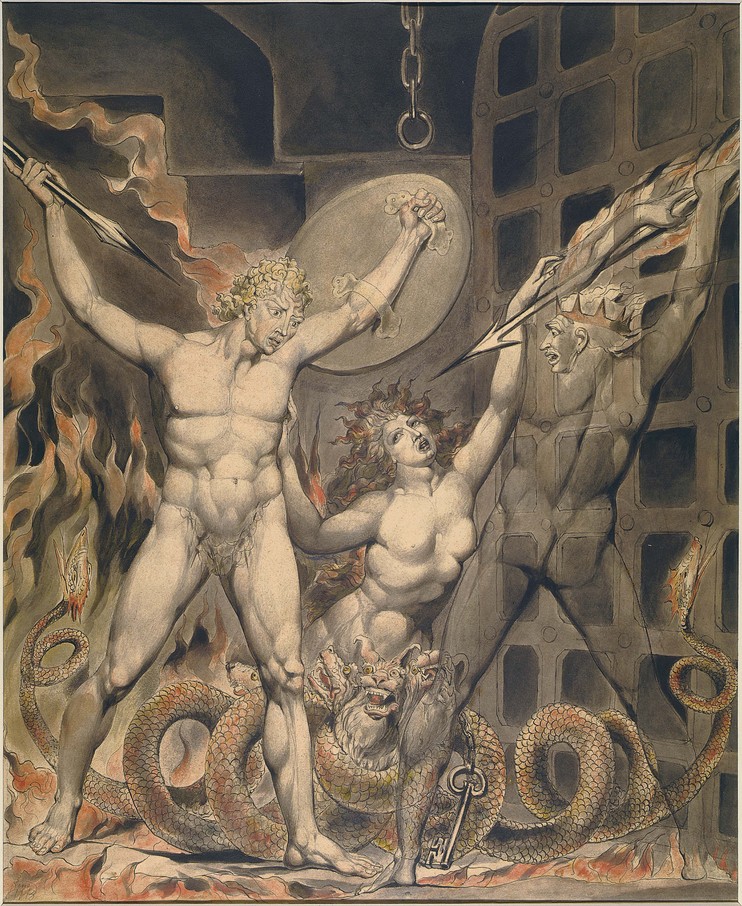
Look, for example, at the play of patterns behind the figures in the illustration above, from an edition of Milton’s Paradise Lost. The figure in the center depicts Milton’s grotesquely graphic allegorical construction of Sin. In Milton, this character “seemed woman to the waist, and fair,”
But ended foul in many a scaly fold Voluminous and vast, a serpent armed With mortal sting: about her middle round A cry of hell hounds never ceasing barked With wide Cerberian mouths full loud, and rung A hideous peal: yet, when they list, would creep, If ought disturbed their noise, into her womb, And kennel there, yet there still barked and howled, Within unseen.
Blake spares us the horror of the latter image—in fact he gets a little vague on the details of the creature’s netherparts, which were always difficult to imagine, and emphasizes the “fair” parts above (in the version below, the serpent/dog thing looks like a costume prop). Milton’s description always seemed to me one of the cruelest, most misogynistic renderings of the female body in literature. Blake’s portrait relieves Milton’s nastiness, making Sin sympathetic and, well, kinda hot, a Blakean feat for sure. The characters to her left and right are Satan and Death, respectively.
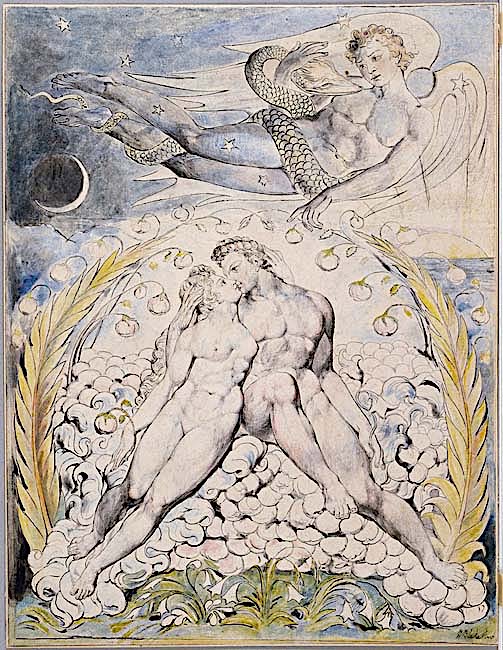
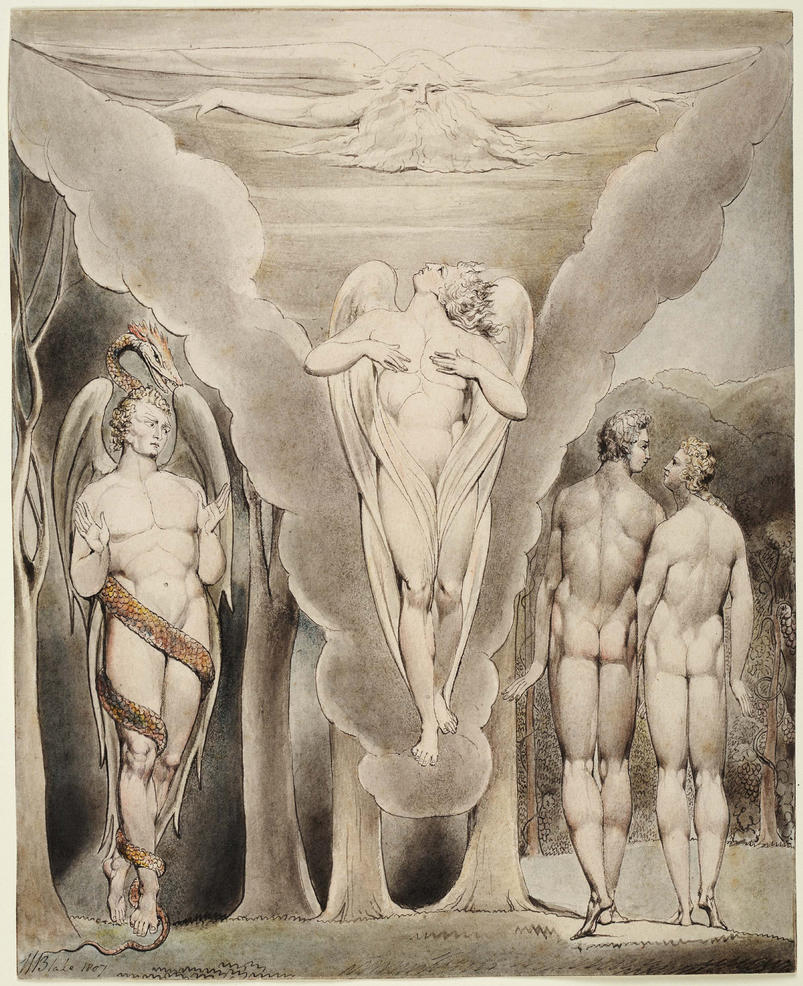
Blake loved Milton, and illustrated his work more than any other author. And he illustrated Paradise Lost more than any other Milton, in three separate commissions (peruse them all here). The first set dates from 1807, commissioned by Joseph Thomas. (The Satan, Sin, and Death scene above comes from the Thomas set.) The second set, from which the image at the top comes, was commissioned in 1808 by Thomas Butts. Blake patron John Linnell commissioned the third set of illustrations in 1822. Only three of the Linnell paintings survive—none of the scene above. In one of the 1822 illustrations (below), Satan spies on Adam and Eve as they canoodle in the garden.
Blake’s obsession with Paradise Lost inspired his own cracked theological fable, Milton: a Poem in Two Books, with its bizarre preamble in which Blake promises to “buil[d] Jerusalem / In England’s green and pleasant land.” One writer calls Blake’s Milton “a lengthy and difficult apocalyptic poem with a fascinating hallucinatory quality.” The poem caused many of Blake’s contemporaries to conclude that “he was quite mad.” But I think his work shows us a man with all of his faculties, and maybe a few extra besides, although his paintings, like his weirder poetry, can also seem like crazed hallucinations. He meant his various Paradise Lost illustrations to correct earlier renderings by other artists, including a political satire by cartoonist James Gillray in 1792 and a 1740 painting by William Hogarth that today resembles the cover of a bad fantasy novel. See both of those earlier versions here.
Woody Allen once said that “sex without love is a meaningless experience, but as far as meaningless experiences go it’s pretty damn good.” Most readers would be compelled to think that Allen’s slight frame, trademark horn-rimmed glasses, and stuttering delivery would preclude his characters from achieving much of anything in the sexual realm. After all, how could the consummate nebbishes that Allen portrays in most of his films possibly impress a member of the fairer sex? Somehow, however, in spite of their whinging neuroticism, Allen’s geek incarnates transform into gallants of prodigious proportions in almost every role. Those wanting concrete evidence may take a look at Take the Money and Run(1969), Annie Hall (1977), or Manhattan (1979), among myriad others, and note that Allen’s characters repeatedly end up with women who seemed to make a gross error in sexual selection.
If you would like to support the mission of Open Culture, consider making a donation to our site. It’s hard to rely 100% on ads, and your contributions will help us continue providing the best free cultural and educational materials to learners everywhere. You can contribute through PayPal, Patreon, and Venmo (@openculture). Thanks!
In July of 1988, Ingmar Bergman—retired from film—turned 70. He had every reason to believe that his best work lay behind him. After all, he had won three Academy Awards (and the Irving G. Thalberg Memorial Award), two BAFTAs, seven Cannes prizes, six Golden Globes, and a host of other honors. His oeuvre included such seemingly unsurpassable achievements as Wild Strawberries, The Seventh Seal, Fanny and Alexander, and too many more to name, and that year he published his memoirs, The Magic Lantern, in which he confessed “I probably do mourn the fact that I no longer make films.”
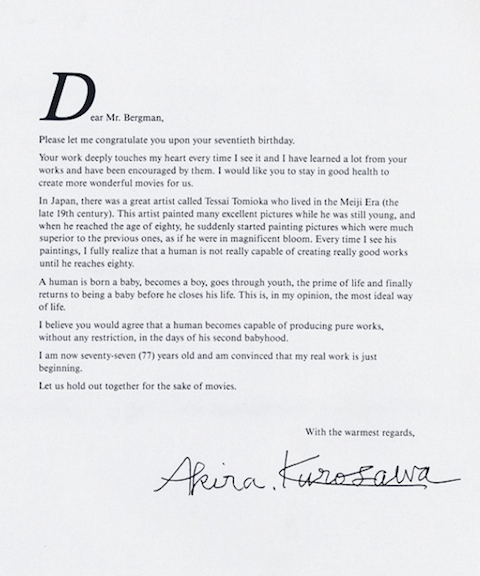
But no!, writes the Swedish director’s Japanese counterpart, Akira Kurosawa, the “real work is just beginning.” At least that’s how Kurasawa, then 77, felt about his “second babyhood.” Kurosawa wrote the letter above to Bergman on his birthday, professing his deep admiration. The feeling went both ways. The typically self-deprecating Bergman once called his The Virgin Spring a “a lousy imitation of Kurosawa” and added, “at the time my admiration for the Japanese cinema was at its height. I was almost a samuri myself!” Read the full transcript of Kurosawa’s birthday wishes to Bergman below (originally published in Chaplin magazine).
Dear Mr. Bergman,
Please let me congratulate you upon your seventieth birthday.
Your work deeply touches my heart every time I see it and I have learned a lot from your works and have been encouraged by them. I would like you to stay in good health to create more wonderful movies for us.
In Japan, there was a great artist called Tessai Tomioka who lived in the Meiji Era (the late 19th century). This artist painted many excellent pictures while he was still young, and when he reached the age of eighty, he suddenly started painting pictures which were much superior to the previous ones, as if he were in magnificent bloom. Every time I see his paintings, I fully realize that a human is not really capable of creating really good works until he reaches eighty.
A human is born a baby, becomes a boy, goes through youth, the prime of life and finally returns to being a baby before he closes his life. This is, in my opinion, the most ideal way of life.
I believe you would agree that a human becomes capable of producing pure works, without any restrictions, in the days of his second babyhood.
I am now seventy-seven (77) years old and am convinced that my real work is just beginning.
In December of 1968, the crew of Apollo 8 became the first people to leave our home planet and travel to another body in space. But as crew members Frank Borman, James Lovell, and William Anders all later recalled, the most important thing they discovered was Earth.
Using photo mosaics and elevation data from Lunar Reconnaissance Orbiter (LRO), this video commemorates the 45th anniversary of Apollo 8’s historic flight by recreating the moment when the crew first saw and photographed the Earth rising from behind the Moon. [See the original photo here.] Narrator Andrew Chaikin, author of A Man on the Moon, sets the scene for a three-minute visualization of the view from both inside and outside the spacecraft accompanied by the onboard audio of the astronauts. The visualization draws on numerous historical sources, including the actual cloud pattern on Earth from the ESSA‑7 satellite and dozens of photographs taken by Apollo 8, and it reveals new, historically significant information about the Earthrise photographs. It has not been widely known, for example, that the spacecraft was rolling when the photos were taken, and that it was this roll that brought the Earth into view.
The visualization establishes the precise timing of the roll and, for the first time ever, identifies which window each photograph was taken from. The key to the new work is a set of vertical stereo photographs taken by a camera mounted in the Command Module’s rendezvous window and pointing straight down onto the lunar surface. It automatically photographed the surface every 20 seconds. By registering each photograph to a model of the terrain based on LRO data, the orientation of the spacecraft can be precisely determined.
This video above is public domain and can be downloaded here. In 1972, astronauts took another famous picture of the Earth, known as The Big Blue Marble. You can watch a film (“Overview”) that commemorates that photograph and explores the whole concept of seeing the Earth from afar. And, of course, you should always see the Carl Sagan-narrated film, The Pale Blue Dot, too.
As an American, I admit that only an outsider can view my country with the greatest clarity. And as long as we want to look at the United States through foreign eyes, why not look through those of Werner Herzog? Even aside from his wildly creative body of work as a feature filmmaker — he made Aguirre, the Wrath of God; he made Fitzcarraldo; he made Bad Lieutenant: Port of Call New Orleans — Herzog the documentarian has offered up a host of his own rich and surprising perceptions. He’s traveled the globe, from the Lesser Antilles (La Soufrière) to Antarctica (Encounters at the End of the World) to southern France’s prehistoric caves (Cave of Forgotten Dreams), looking intensely and commenting even more intensely on people, from champion ski jumpers (The Great Ecstasy of the Woodcarver Steiner) to Vietnam prisoners of war (Little Dieter Needs to Fly) to wildlife filmmakers eaten by bears (Grizzly Man). By comparison, most of us might consider places like the auction houses and televangelical broadcast studios of America comparatively unexotic territory.
Not Herzog, however: when he watches a livestock sale, he hears in the rapid-fire babble of the auctioneer “the last poetry possible, the poetry of capitalism,” and when he watches a television preacher, he sees an appeal to “the paranoia and craziness of our civilization.” Here we have two fruits of these strands of Herzog’s fascination with his now-adopted homeland of America: 1976’s How Much Wood Could a Woodchuck Chuck and 1981’s God’s Angry Man. Like many other documentaries of Herzog’s, and not a few of his fiction films, these documentaries deal with pursuits so specialized, obsessive, or both that watching them in practice becomes mesmerizing. The first witnesses a series of auctioneers as their obscure, quasi-musical patter keeps one highly particular gear of the economy spinning. The second, one even more concerned with money and with an original title of Creed and Currency, looks into the world of Los Angeles’ flamboyant, donation-demanding, FCC-hating, seemingly untiring religious broadcaster Dr. Gene Scott. Do cowboy-hatted rural businessmen and manic televangelists accurately represent America? Hardly. But interpreted by Herzog, they show you the country in a way nobody else could.
The Strong National Museum of Play, located in Rochester, NY, is a fun children’s museum. But the institution also has serious research archives, stuffed with toys, games, and records of the toy industry. Its online collections, which currently boast 55,068 objects, take a holiday browser on a trip into a figurative grandma’s attic, chock-full of the playthings people loved in the nineteenth and twentieth centuries.
The online archives are divided into four categories: “Toys”, “Dolls”, “Games”, and “More.” Each of these four sections is further subdivided into topically-specific groups, chosen by the archivists.
The collection’s strength is also its weakness: there are so many toys that it can be easy to get overwhelmed. The subject divisions are helpful here. As somebody with an interest in gender and childhood, I found myself fascinated by the housekeeping toys—kids used to use ovens that were heated with real coals!—and that was an easy way to narrow down my browse. Subject groupings for toy soldiers, celebrity dolls, and board games also piqued my interest.
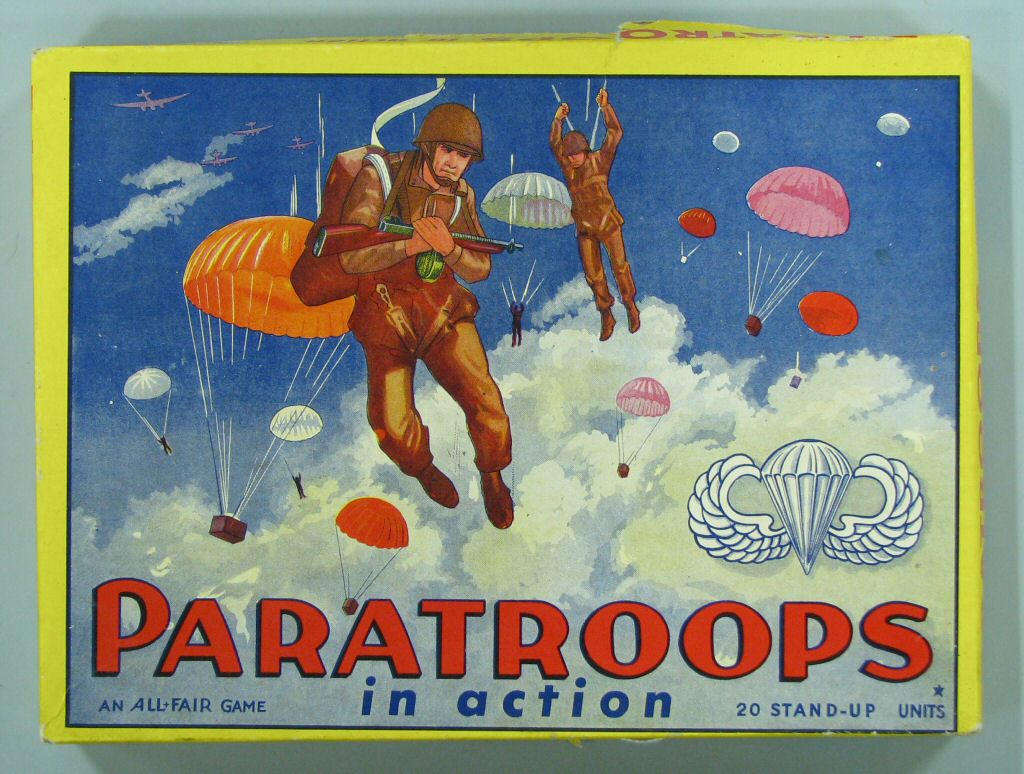
It’s fun to look around for toys from your own childhood (I found a few), but if you’re interested in history, you might find the echoes of historical events to be even more intriguing. Late-nineteenth-century kids played with a paper doll inspired by the circus celebrity Tom Thumb; children of the 1930s had licensed dolls of the media-sensation Dionne Quintuplets; a playset from 1940 featured grim, suited-up “Paratroops in Action.”
Mousing over the thumbnails will allow you to see the item’s name. If you see a blue “Learn More” tag, be sure to click through; that means that the item’s image will be accompanied by an interpretive historical note written by the Strong’s archivists. These vary in length, and contain intriguing tidbits. Did you know, for example, that Holly Hobbie was a real person: the artist Holly Ulinkas Hobbie? Or that the famous artist Charles Dana Gibsonhad a now-forgotten follower, Nell Brinkley, who illustrated the flapper era?
Rebecca Onion is a writer and academic living in Philadelphia. She runs Slate.com’s history blog, The Vault. Follow her on Twitter: @rebeccaonion.
In “David Lynch Keeps His Head” (uncut version here), David Foster Wallace’s Premiere magazine report from the set of Lost Highway, Wallace rattles off the “entertainments David Lynch has created and/or directed” including “Eraserhead (1978), The Elephant Man (1980), Dune (1984), Blue Velvet (1986), Wild at Heart (1990), two televised seasons of Twin Peaks (1990–92), Twin Peaks: Fire Walk With Me (1992), and the mercifully ablated TV show On the Air (1992).” (To ablate, a verb Wallace uses again in the article in reference to a severed head, means “to remove or dissipate by melting, vaporization, erosion, etc.”) Even Lynch die-hards may never have caught a glimpse of On the Air, which Wallace later describes as “bottomlessly horrid” and “euthanatized by ABC after six very long-seeming weeks.” Clearly the author of Infinite Jest, despite greatly respecting Lynch’s unprecedentedly surreal primetime drama Twin Peaks (its first season, at least) and crediting Blue Velvet with revealing to him the very possibilities of art, couldn’t stomach this show. Now you can watch all seven episodes of On the Air on Youtube, three of which aired in the United States, and judge for yourself.
The series, which debuted and ended in the summer of 1992, takes place in 1957, peering behind the scenes at the fictional Zoblotnick Broadcasting Company, producers of the hapless variety program The Lester Guy Show. Lester Guy himself, an alcoholic silver-screen leading man who rose to fame by staying out of the Second World War, spends most episodes vying for popular supremacy against his cast’s blonde ingenue Betty Hudson, who may remind you of an even simpler version of Sandy Williams, the Laura Dern character in Blue Velvet. The series appeared as the second collaboration between Lynch and Mark Frost, co-creator of Twin Peaks, which brought their signature sensibility of intense vividness and vaguely haunting unreality to the detective genre. On the Air brings it to the classic goofball sitcom. Watch the first episode (ranked as #57 on TV Guide’s “100 Greatest TV Episodes of All Time” list) and, to experience either the utter genius or the utter trainwreck, you’ll want to watch the following six. “There was a lot of laughter on the set,” remembers Ian Buchanan, who played Lester Guy. “Maybe we were too happy. Everybody I knew on successful shows was miserable.”
(日本人 Lynch-heads, take note: each episode includes Japanese subtitles.)
Just in time for a hard-drinking Christmas, the Village Voice brings us the “top secret” eggnog recipe from “Angry Man of Jazz” Charles Mingus. Despite his generally irascible temperament, Mingus had a legendary “zeal for parties and drink” and “felt the yuletide spirit—or spirits, if you will—according to biographer Janet Coleman.” Mingus passed his recipe to Coleman over the phone, and she published it in Mingus/Mingus: Two Memoirs. The ‘nog, the Voice tells us, “calls for enough alcohol to put down an elephant,” so if you happen to be hosting one, this might just come in handy. Humans seem to dig it too. Coleman called it “a concoction so delicious and mind-blowing, you would do anything to make sure you saw him at Christmas.”
Charles Mingus’ “Top Secret” Eggnog
* Separate one egg for one person. Each person gets an egg. * Two sugars for each egg, each person. * One shot of rum, one shot of brandy per person. * Put all the yolks into one big pan, with some milk. * That’s where the 151 proof rum goes. Put it in gradually or it’ll burn the eggs, * OK. The whites are separate and the cream is separate. * In another pot- depending on how many people- put in one shot of each, rum and brandy. (This is after you whip your whites and your cream.) * Pour it over the top of the milk and yolks. * One teaspoon of sugar. Brandy and rum. * Actually you mix it all together. * Yes, a lot of nutmeg. Fresh nutmeg. And stir it up. * You don’t need ice cream unless you’ve got people coming and you need to keep it cold. Vanilla ice cream. You can use eggnog. I use vanilla ice cream. * Right, taste for flavor. Bourbon? I use Jamaica Rum in there. Jamaican Rums. Or I’ll put rye in it. Scotch. It depends. See, it depends on how drunk I get while I’m tasting it.
If you’re drinking tonight, make sure you drink responsibly!
If you’re seeking advice about making your first film, Kevin Smith is a good place to start. The comedic director of Jay and Silent Bob Strike Backand Chasing Amyfame was a Hollywood outsider when he made his debut with the critically acclaimed Clerksin 1994. The black and white feature went on to gross $3.1 million — not bad for a Vancouver Film School dropout who shot the movie in the convenience store where he once worked, on a total budget of $27,575.
In the clip above, Smith dispenses a dose of rambling advice to Canadian filmmaker and video producerGavin Michael Booth. We’ve summed it up in three main points. Our summary lacks the expletives that makes Smith’s talk rather colorful.
1 – “You have to have a reasonable amount of unreasonability” – Smith suggests that filmmakers must possess an appropriate degree of self-belief and drive, regardless of the obstacles before them. If young filmmakers were reasonable about their chances of success, the only people making movies would be Los Angeles natives already entrenched in the film industry.
2 – “You have to know… what hills you’re willing to die on.” The reasonable amount of unreasonability also refers to knowing which battles are worth fighting for. A directorial vision is important, but at the end of the day it is subordinate to budget constraints.
3 – “You have to learn how to kill your babies.” Smith is an ardent believer in movies needing to be only as long as they must, and no longer. Including scenes because you like them unless they’re unequivocally essential is self-indulgent and does a disservice to the audience.
You may have read our post on the creative ways in which John Waters expresses his love for Christmas. We’d all like to receive one of the Christmas cards the Hairspray filmmaker has designed himself every year since 1964, but did you know that another famous creator, one also perceived as eccentric and possessed of his very own concepts of taste, embraced the season with equal artistic vigor? “Andy Warhol’s fondness for Campbell’s Soup cans is well documented,” writes Jennifer M. Wood at Mental Floss. “Less well known but equally ardent was his love of the holiday season. Yes, from poinsettias to Santa hats, the enigmatic artist who promised we’d all have our 15 minutes of fame spent much of the 1950s working as a commercial illustrator specializing in blotted line drawings, creating everything from shoe advertisements to greeting cards.”
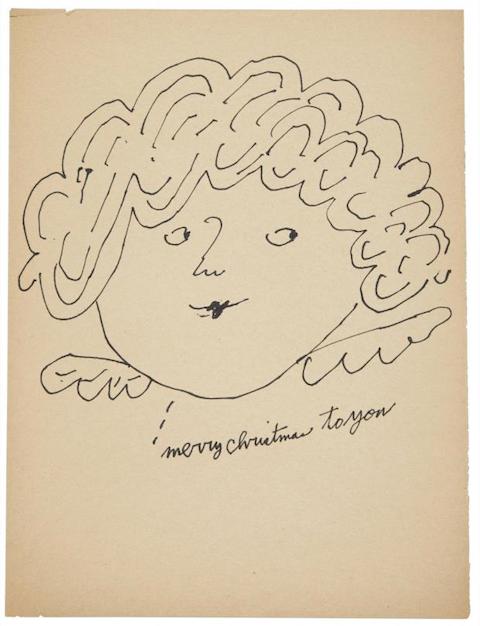
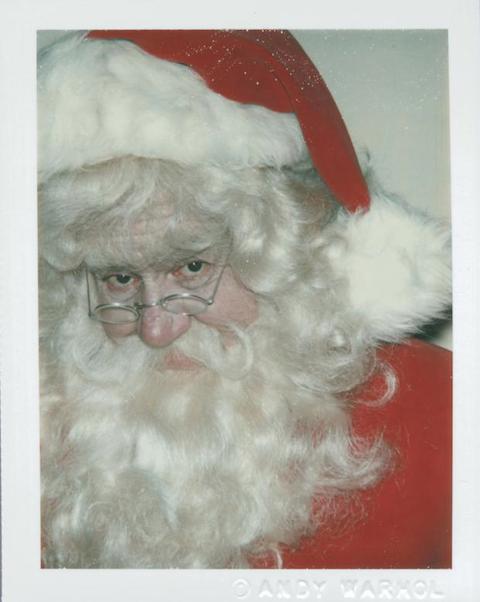
The article goes on to display the fruits of Warhol’s professional and personal interest in Christmas, which ran his personal gamut of both technique and visual sensibility. At the top, we have his simple 1954 ink-and-paper drawing of a “Christmas Fairy,” bearing the greeting “Merry Christmas to you.” Just above, you can see his color rendering, from three years later, of a Christmas ornament. Wood reports that such works went up for sale at two events this year from fine-art auction house Christie’s: “ ‘Warholiday,’ a pop-up event at the San Francisco Mulberry Store [which] featured 36 works by the late, great artist, some of them never-before-seen and all of them for sale,” and “ ‘A Christmas Thing,’ an online-only auction that featured 100 original photos, prints, and drawings from the master of Pop Art” benefiting The Andy Warhol Foundation for the Visual Arts.” And as we can call no presentation of Warhol’s work complete, even on Christmas Eve, without the inclusion of something that will get a viewer or two asking whether it counts as art at all, behold his 1981 Polaroid of Santa Claus:
We're hoping to rely on loyal readers, rather than erratic ads. Please click the Donate button and support Open Culture. You can use Paypal, Venmo, Patreon, even Crypto! We thank you!
Open Culture scours the web for the best educational media. We find the free courses and audio books you need, the language lessons & educational videos you want, and plenty of enlightenment in between.