From today on everybody around the world can access, study, print or remix a 3D dataset of Nefertiti’s head in high resolution. This data is accessible under a public domain without any charge, this torrent provides you a STL-file (100 MB)…
“Nefertiti Hack” goes on to say: “ ‘The Other Nefertiti’ is an artistic intervention by the two German artists Nora Al-Badri and Jan Nikolai Nelles. Al-Badri and Nelles scanned the head of Nefertiti clandestinely in the Neues Museum Berlin without permission of the Museum and they hereby announce the release of the 3D data of Nefertiti’s head under a Creative Commons Licence.… With regard to the notion of belonging and possession of objects of other cultures, the artists’ intention is to make cultural objects publicly accessible.”
As if not already controversial, this act of artistic vigilantism recently became more contentious when 3D scanning experts started questioning whether Al-Badri and Nelles could have produced such high quality scans with a Kinect hidden under a jacket (shown on a video here). It seems implausible, they say. And it has left some wondering, writes The New York Times, whetherAl-Badri and Nelles “somehow acquired the museum’s own scan of the bust, scanned a high-quality copy or produced the scan by some other means.” The answer is not yet clear.
In the meantime, according to Hyperallergic, the artists themselves used their scans “to create a 3D-printed, one-to-one polymer resin model” of the Nefertiti bust, which, they claim, “is the most precise replica of the bust ever made.” And that bust “will reside permanently in the American University of Cairo later this year as a stand-in for the original, 3,300-year-old work that was removed from its country of origin shortly after its discovery in 1912 by German archaeologists in Amarna.”
If there are updates to the story, I am sure Hyperallergic will have them.
If you would like to support the mission of Open Culture, consider making a donation to our site. It’s hard to rely 100% on ads, and your contributions will help us continue providing the best free cultural and educational materials to learners everywhere. You can contribute through PayPal, Patreon, and Venmo (@openculture). Thanks!
I just last week returned from a visit to Tokyo, where I did what I always do there: shop for magazines. Despite not paying the magazine shelves a whole lot of attention in Korea, where I live, and practically none at all in America, where I’m from, I can’t resist lingering for hours over the ones in Japan, a country whose print publishing industry seems much stronger than that of any other, and whose publications showcase the culture’s formidable design sensibility that has only grown more compelling over the centuries.
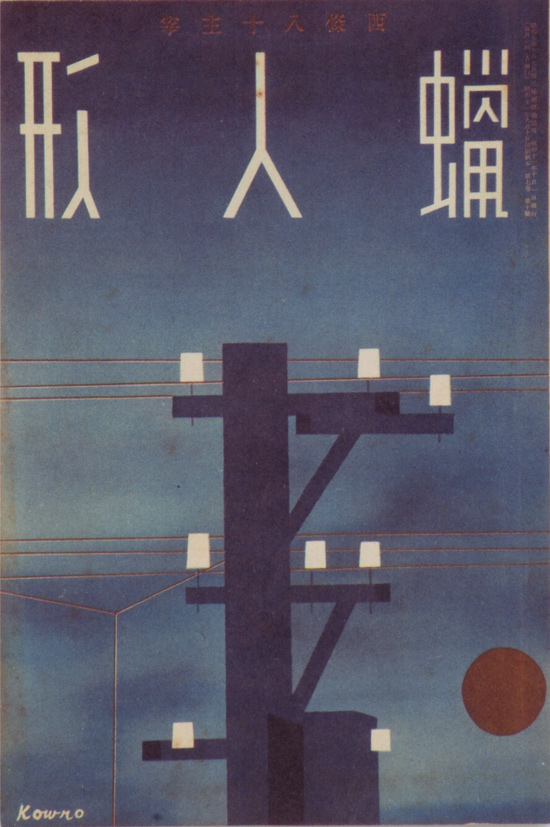
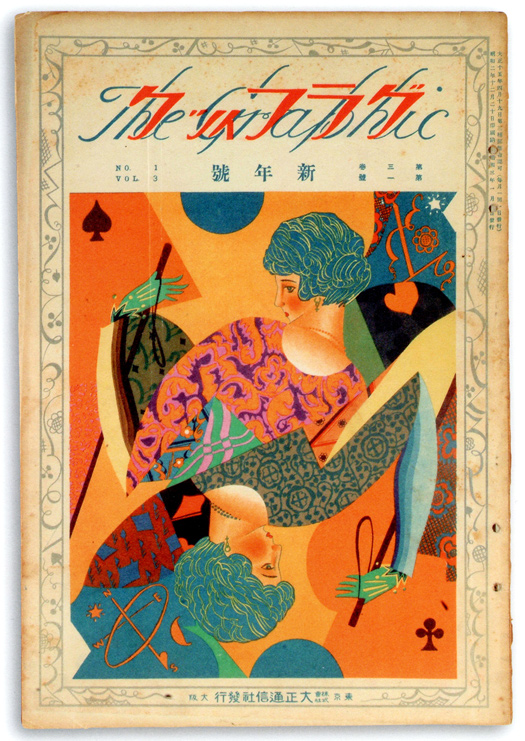
Will Schofield, who runs the international and historical book design blog 50 Watts, knows this, and he also knows that Japanese design has been making magazine covers interesting since Japan first had magazines to cover. The images here come from two of his posts, Extraordinary early 20th century magazine covers from Japan and 25 Vintage Magazine Covers from Japan. The earlier ones, which he describes as a mixture of “charming children’s covers with the creepy modernist covers,” come from Bookcover Design in Japan 1910s-40s. “Published in 2005 by PIE Books,” writes Schofield, “this incredible book is already out-of-print and becoming hard to find (it was actually hard for me to find and I spend hours per day searching for rare books).”
As for the more recent post, he writes that it “began as a compilation of magazine covers from the website of a Japanese antiquarian dealer. I dug through all 1500 or so images and saved (like a good little digital hoarder) hundreds to feature, though only 8 made the first cut.”
Both posts together present a curated collection of nearly 50 mostly prewar Japanese magazine covers, still vivid and of a decidedly high artistic standards these 70 to 103 years later. On my own shopping trip, I picked up an issue of Free & Easy, my favorite men’s style magazine published anywhere — its final issue, incidentally, and one whose cover, despite depicting no less an American icon than Dick Tracy, admirably carries this tradition of Japanese magazine art one step further.
It has long been thought that the so-called “Golden Ratio” described in Euclid’s Elements has “implications for numerous natural phenomena… from the leaf and seed arrangements of plants” and “from the arts to the stock market.” So writes astrophysicist Mario Livio, head of the science division for the institute that oversees the Hubble Telescope. And yet, though this mathematical proportion has been found in paintings by Leonardo da Vinci to Salvador Dali—two examples that are only “the tip of the iceberg in terms of the appearances of the Golden Ratio in the arts”—Livio concludes that it does not describe “some sort of universal standard for ‘beauty.’” Most art of “lasting value,” he argues, departs “from any formal canon for aesthetics.” We can consider Livio a Golden Ratio skeptic.
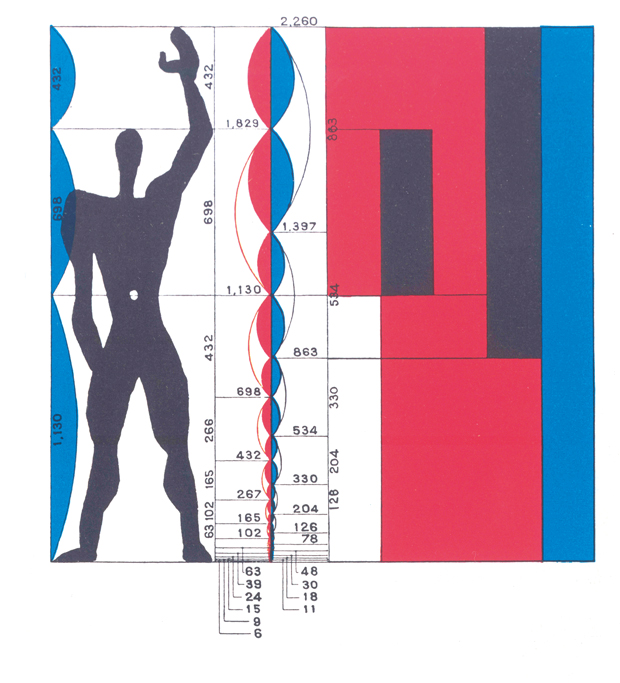
Far on the other end of a spectrum of belief in mathematical art lies Le Corbusier, Swiss architect and painter in whose modernist design some see an almost totalitarian mania for order. Using the Golden Ratio, Corbusier designed a system of aesthetic proportions called Modulor, its ambition, writes William Wiles at Icon, “to reconcile maths, the human form, architecture and beauty into a single system.”
Praised by Einstein and adopted by a few of Corbusier’s contemporaries, Modulor failed to catch on in part because “Corbusier wanted to patent the system and earn royalties from buildings using it.” In place of Leonardo’s Vitruvian Man, Corbusier proposed “Modulor Man” (below) the “mascot of [his] system for reordering the universe.”
Perhaps now, we need an artist to render a “Fractal Man”—or Fractal Gender Non-Specific Person—to represent the latest enthusiastic findings of math in the arts. This time, scientists have quantified beauty in language, a medium sometimes characterized as so imprecise, opaque, and unscientific that the Royal Society was founded with the motto “take no one’s word for it” and Ludwig Wittgenstein deflated philosophy with his conclusion in the Tractatus, “Whereof one cannot speak, thereof one must be silent.” (Speaking, in this sense, meant using language in a highly mathematical way.) Words—many scientists and philosophers have long believed—lie, and lead us away from the cold, hard truths of pure mathematics.
To determine whether the books had fractal structures, the academics looked at the variation of sentence lengths, finding that each sentence, or fragment, had a structure that resembled the whole of the book.
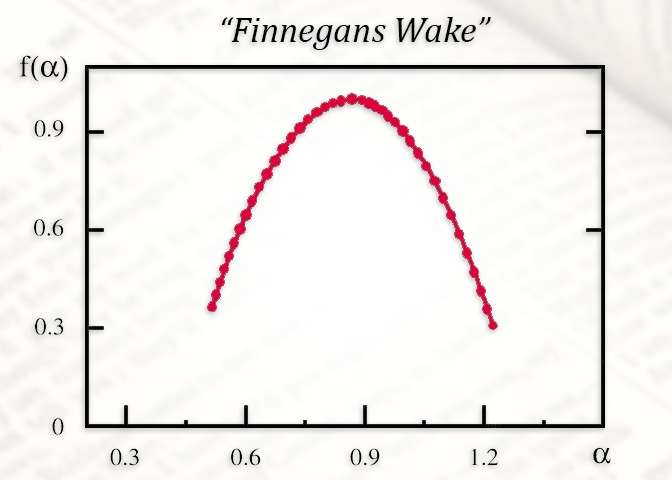
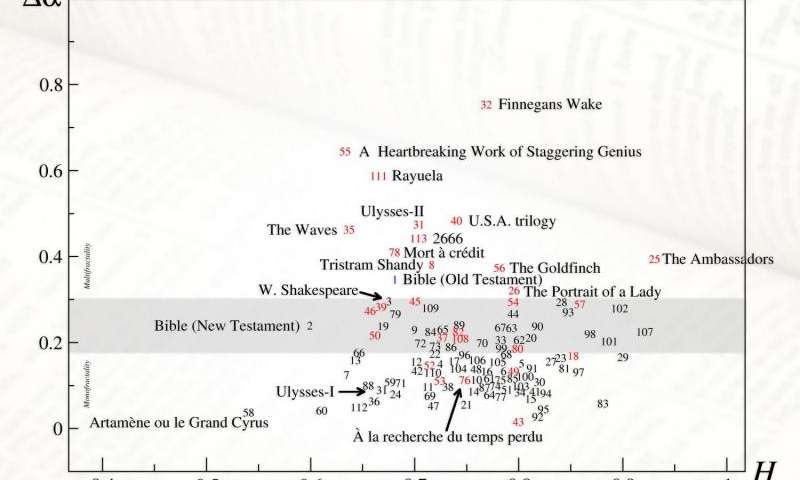
And it isn’t only Joyce. Through a statistical analysis of 113 works of literature, the researchers found that many texts written by the likes of Dickens, Shakespeare, Thomas Mann, Umberto Eco, and Samuel Beckett had multifractal structures. The most mathematically complex works were stream-of-consciousness narratives, hence the ultimate complexity of Finnegans Wake, which Professor Stanisław Drożdż, co-author of the paper published at Information Sciences, describes as “the absolute record in terms of multifractality.” (The graph at the top shows the results of the novel’s analysis, which produced a shape identical to pure mathematical multifractals.)
This study produced some inconsistencies, however. In the graph above, you can see how many of the titles surveyed ranked in terms of their “multifractality.” A close second to Joyce’s classic work, surprisingly, is Dave Egger’s post-modern memoir A Heartbreaking Work of Staggering Genius, and much, much further down the scale, Marcel Proust’s Remembrance of Things Past. Proust’s masterwork, writes Phys.org, shows “little correlation to multifractality” as do certain other books like Ayn Rand’s Atlas Shrugged. The measure may tell us little about literary quality, though Professor Drożdż suggests that “it may someday help in a more objective assignment of books to one genre or another.” Irish novelist Eimear McBride finds this “upshot” disappointing. “Surely there are more interesting questions about the how and why of writers’ brains arriving at these complex, but seemingly instinctive, fractals?” she told The Guardian.
Of the finding that stream-of-consciousness works seem to be the most fractal, McBride says, “By its nature, such writing is concerned not only with the usual load-bearing aspects of language—content, meaning, aesthetics, etc—but engages with language as the object in itself, using the re-forming of its rules to give the reader a more prismatic understanding…. Given the long-established connection between beauty and symmetry, finding works of literature fractally quantifiable seems perfectly reasonable.” Maybe so, or perhaps the Polish scientists have fallen victim to a more sophisticated variety of the psychological sharpshooter’s fallacy that affects “Bible Code” enthusiasts? I imagine we’ll see some fractal skeptics emerge soon enough. But the idea that the worlds-within-worlds feeling one gets when reading certain books—the sense that they contain universes in miniature—may be mathematically verifiable sends a little chill up my spine.
The late sixties and seventies produced an explosion of electronic music that arrived on the scene as an almost entirely new art form. So much so that when composer Wendy Carlos released an album of Bach compositions played on the Moog synthesizer, it was as though she had invented another genre of music, rather than played baroque pieces on a new instrument. We had foremothers like Delia Derbyshire, experimental bands like Silver Apples and Suicide, innovators like Brian Eno and David Bowie and Kraftwerk, disco pioneers like Giorgio Moroder and Donna Summer… the list of electronic musicians at work creating the genre before the 1980s could go on and on.
You won’t learn any of that from the 1983 documentary above, Discovering Electronic Music, which is not at all to damn the short film; on the contrary, what this presentation offers us is something entirely different from the usual survey course in great men and women of commercial music. With an understated, pedagogical tone, Discovering Electronic Music gently leads its viewers through a thoughtful introduction to electronic music itself—what it consists of, how it differs from acoustic music, what kind of equipment produces it, and how that equipment works.
There are many musicians featured here, but none of them stars. They demonstrate, with competency and professionalism, the ways various electronic instruments and (now seemingly prehistoric) computer systems work. We do hear lots of classical music played on synthesizers, though not by the enigmatic and reclusive Wendy Carlos. And we hear modern compositions as well, though few you’re likely to recognize, from “Jean-Claude Risset, Douglas Leedy, F.R. Moore, Stephan Soomil, Rory Kaplan, Geral Strang and more forgotten geniuses of early electronic music,” writes Electronic Beats.
Early in the film, its presenter talks about the specifically modern appeal of electronic music: composers can work directly with sound like a sculptor or painter, rather than composing on paper and waiting to hear that written music performed by musicians. Much of Discovering Electronic Music shows us composers and musicians doing just that, with the thoroughly matter-of-fact manner of the most compellingly dry public television documentaries and with the strangely soothing quality common to both Mr. Rogers’ Neighborhood and Bob Ross’s painting lessons. Like the sound of the analog synthesizers and antique computer sequencers it features, the documentary has an eerie beauty all its own.
Twitch.tv is launching a new Food Channel. And it’s getting things going with a marathon streaming of all 201 episodes of Julia Child’s now legendary TV series “The French Chef.”
Today, Twitch Creative is celebrating the joy of cooking with the launch of a brand new channel dedicated to all things food! Twitch.tv/Food will showcase cooking content 24/7 on Twitch Creative, and we’re kicking things off with an almighty marathon of all 201 episodes of Julia Child’s classic PBS cooking show, The French Chef.
If you would like to support the mission of Open Culture, consider making a donation to our site. It’s hard to rely 100% on ads, and your contributions will help us continue providing the best free cultural and educational materials to learners everywhere. You can contribute through PayPal, Patreon, and Venmo (@openculture). Thanks!
In the 1970s and 80s, a certain vivid, complex, and slightly frightening computer-graphics aesthetic rose in the zeitgeist. Though it has long passed into the realm of the retro, it remains imprinted on our minds, and we owe much of its look and feel to an artist named Lillian F. Schwartz. Trained in the art of Japanese calligraphy as a way of recovering from polio and later brought into the high technological ferment of late-1960s Bell Labs, Schwartz found herself well-placed to define what humanity would think of when they thought of the imagery generated by these promising new machines called computers.
Schwartz started creating a series of abstract films in the early 1970s, using not just computers but computers in combination with lasers, photographs, oil paints, and the full range of traditional film photography and editing gear.
You can watch 30 of her films on her web site, and at the top of this post you’ll find 1972’s Mutations. Schwartz’s site quotes the New York Times’ A.H. Weiler as describing its “changing dots, ectoplasmic shapes and electronic music” as “an eye-catching view of the potentials of the new techniques.”
Video-art fans will know the Paik video-synthesizer, or at least they’ll know Paik: Nam June Paik, that is, the Korean video artist who did plenty of artistic-technological pioneering of his own. Both he and Schwartz gave a great deal of thought to — and put a great deal of practice into — pushing the boundaries of technologies whose conventional uses the rest of us hadn’t quite learned yet. You can see Schwartz doing exactly that in The Artist and the Computer, the 1976 short documentary on her work, originally produced for AT&T, just above.
You can read more about Schwartz, back at Bell Labs and today, in the article “Art at the Edge of Tomorrow” by Jer Thorp. “I find it’s still an awesome experience to use a machine that — one can’t even fathom the speed,” she says in The Artist and the Computer as we watch her passing rows and rows of hulking mainframes with their racks of obscure peripherals and spinning reels of tape. “When you speak of nanoseconds, you can’t even grasp how fast these machines can work.” They work much faster now, of course, and we’ve grown used to it, even jaded about it — but Schwartz’s films capture our imaginations, in their inventive and eerie way, more than ever.
So, imagine that you’re John Malkovich. I know, you’ve seen this movie before, but hear me out: you’re one of the most venerated actors of your generation. You are entering your sixth decade and could probably coast into your golden years on accolades and prestige parts. But do you rest on your laurels? Or do you become a model and collaborator with photographer Sandro Miller, appear in an Eminem video… read Plato’s “Allegory of the Cave” over an ambient piece of music called “Cryogenia X,” then have the results remixed by Yoko Ono and Sean Lennon, Ric Ocasek, new wave icons Orchestral Maneuvers in the Dark, and other musical legends?
The answer is all of the above. You’re John Malkovich. You can do whatever you want. “When I have an idea for something,” says Malkovich, “I expect my collaborators to collaborate on that idea and if someone else has an idea, then I’ll certainly collaborate with them.” It’s that kind of disciplined, yet genial flexibility that made Malkovich perfect for the role of himself in Spike Jonze’s surreal comedy. Now the last of the projects in that extracurricular list above brings more surreality into Malkovich’s repertoire, in the form of a double LP’s‑worth of dreamlike recitations of Plato’s classical myth, called Like a Puppet Show, released on Black Friday of last year.
Ono and Lennon’s version “Cryolife 7:14,” the second track above, is, oddly, the most conventional of the three digital uploads we get to hear for free. Malkovich reads a portion of the text straight through, over wordless moans from Yoko and psychedelic lounge music from Lennon. In OMD and Ric Ocasek’s renditions, however, Malkovich’s voice gets cut-up into a series of disjointed samples. Rather than tell a story—that ancient 2,500-year-old story from Plato’s Republic about ignorance and awakening—these pieces suggest painful poses, emotional shocks, repetitive conditions, and weird ontological angles. What does it all mean for Malkovich?
It’s hard to say. He’s more steeped in process than interpretation. “Music,” says Malkovich, “creates its own kind of dream state.” If there’s any political subtext, you’ll have to supply it yourself. Malkovich—who gamely dressed as Che Guevara in one of his Sandro Miller recreations of famous photographs—has also been described as “so Right-wing you have to wonder if he’s kidding.” We know, of course, how Yoko feels about things. It’s part of what makes the collaboration so fresh and compelling—it doesn’t feel like one of those “of course these people got together” projects that, while satisfying, can suffer the fate of the supergroup: too many cooks.
Here, each collaborator—the 2,000-years-dead philosopher, the celebrated actor and photographer, and the legendary musicians—comes from such a different realm of experience and talent that their meeting seems more like a mountaintop conference of wizards than a celebrity jam session. If you like what you hear (and see), Malkovich, Alexandrakis, and Miller promise more. They’ve founded a record label, Cryogenia, and plant to release more musical/photographic projects in the near future.
Rock stars who became respected actors… the pool is a small one, perhaps outnumbered by the many musicians who have made less successful attempts at movie stardom. But without a doubt, the former category includes David Bowie. In his various musical guises, Bowie the cracked actor put to use the skills he honed for decades on movie after movie. Not every film is worth watching, but nearly every performance contains seeds of greatness.
What you may not know is that Bowie the actor and Bowie the musician grew up together. He had always been both, taking his first film role in a short horror flick, The Image, back in 1967, the same year he released his first, self-titled album. You can be forgiven for never hearing about either. Neither one made much of an impression (and Bowie more or less disavowed the album). But the movie did have the rare distinction at the time of receiving an X rating. “I think it was the first short that got an X‑certificate,” says writer and director Michael Armstrong, “for its violence, which in itself was extraordinary.”
Tame by today’s standards, the movie features 20-year-old Bowie as a painting come to life. He got the part not because Armstrong—a fan of his first album—considered him “perfect for the role. It was really to give him a job.” Armstrong described his star to The Wall Street Journal as “very pretty” and “flirtatious” and remembers Bowie’s impressive Elvis impersonation. Bowie seems to have found the whole thing very funny. On set, there were “a lot of issues with corpsing—bursting into laughter during a take,” writes Metro.co.uk. When the film appeared in theaters, viewers expected to see porn—not only because of its X‑rating but also because, writes Rolling Stone, it “briefly screened between two porn films at a London theater.” (The film’s star saw the movie by himself in a theater filled with lone men in raincoats.) Bowie, says Armstrong, “thought it was hilarious.”
The Image has only recently appeared online thanks to the WSJ, who received permission from the David Bowie Archive to show it. You can watch the almost 14-minute film up top. (You can see a Youtube version below it.) Like Bowie’s first album, it may not herald the birth of a new star—his abilities as an actor may not have been fully evident until his first feature-length starring part in The Man Who Fell to Earth. But as with music, so with acting: Bowie never stopped working at the craft, and the films that fell flat seemed only to inspire him to work harder and create even more ambitious characters.
If you would like to support the mission of Open Culture, consider making a donation to our site. It’s hard to rely 100% on ads, and your contributions will help us continue providing the best free cultural and educational materials to learners everywhere. You can contribute through PayPal, Patreon, and Venmo (@openculture). Thanks!
“In spite of your insistence that you are not into Frank Zappa, avid fan Roger Von Lee believes that you would change your mind if you heard the right album. ‘You’re prejudiced, because the only Zappa you know is “Valley Girl” and “Don’t Eat The Yellow Snow,“ ’ Von Lee says. ‘Seriously, you need to check out Hot Rats or Absolutely Free. Zappa and the Mothers were at their peak, and Zappa’s jazz-rock fusion experiments predate Bitches Brew. That’ll totally convince you that Zappa’s the shit.’ ” Or so reports a brief dispatch from The Onion, “Frank Zappa Fan Thinks You Just Haven’t Heard The Right Album,” which, like all their best work, resonated strongly with a certain segment of readers everywhere.
Like any artist who creates their own genre, Frank Zappa built up both a deeply loyal fan following and almost as deep a resistance among those who never found a way in. Or given Zappa’s prolificacy, which resulted in more than sixty albums recorded with his band The Mothers of Invention and otherwise, maybe we should say he created several of his own genres. And while this vastness and variety makes Zappa’s body of work that much richer and more rewarding to true believers, it also makes it even more intimidating to the neophyte. If you want a single experience that will give you a strong sense of just what makes Zappa’s musical journey so weird and wonderful — and what keeps fans coming back more than a quarter-century after the man’s death — have a listen to this Spotify playlist, Frank Zappa’s Musical Evolution (and if you don’t have Spotify, you can download and register free):
The playlist first appeared as a guest post on Spotify Classical, whose feats of musical curation we’ve featured before. “I assembled this playlist of 401 Zappa tracks that, for me, represent his best and most accessible musical compositions,” writes creator Kris Herbst, adding a bit about his own musical journey: “I became a Zappa fan in 1969, at the age of 13, when I was turned on to the We’re Only In It For The Money album by my Boy Scout troopmaster. Two years later, I went to my first Zappa concert, when the band included Flo and Eddie and Ian Underwood. Listening to Zappa helped open my mind to exploring a wide range of music, especially jazz.”
Feel free, as you listen to these 401 songs, to browse all the Zappa-related material we’ve previously featured linked below. And if you want to get a little more context, read the A.V. Club’s Frank Zappa primer, in which John Semley writes that, “like most of the things that attract and nurture the attention of pop-culture obsessives, Frank Zappa’s music is exceptionally rewarding. Zappa conceived of everything he did as part of a grand artistic mission,” a “comprehensive, totalizing concept of art that ranged between albums, concert films, and even interviews. Musical phrases, ideas, and even characters reappear across albums, providing theoretical and attitudinal connective tissue.”
And if that doesn’t intrigue you, well, just flip back to The Onion: “Von Lee added that if those two don’t get under your skin, he can recommend another 15 to 20 albums that will for sure.”
When I think of early drum machines, I think of the Roland TR-808, the machine that changed pop music in 1980. I also think of its sibling, the Boss DR-55, rivals like the E‑Mu Drumulator, and predecessors from the 60s and 70s like the Maestro Rhythm King. I do not think of the Rhythmicon, nor did I know it had existed until very recently. I doubt many people have ever heard of it, yet it can probably claim the title of the first drum machine—or at least first rhythm machine—ever built.
Although only three models of the machine were ever produced—one now lost—and Cowell only wrote a couple of pieces for the machine before losing interest, it remains, as musicologist Margaret Schedel has pointed out, “a conceptual leap” in instrument design and a direct ancestor of today’s rhythm and sequencing technology. The Rhythmicon was the first foray into what Schedel calls “interactivity,” meaning, Holslin writes that “you simply press a key to activate a sequence—much like you can do today with the arpeggiator of a keyboard….” The Rhythmicon used photoelectric technology:
The keys were each connected to a light that turned on when you pressed them. The lights then shined through a sequence of holes punched into two discs that rotated via a motor. On the other side of the discs was a photoelectric sensor that, when activated by the patterns of light, sent the Rhythmicon’s unique signals to a tube amp and thus to a speaker and out to dazzled audiences.
Audiences may have been impressed by the operation, but they were considerably less dazzled by the sound of the thing. One reviewer in 1932 described its range of tones as “a cross between a grunt and a snort” up to “an Indian war whoop.” As the video above shows, the third version of the machine—built by Theremin in the 60s from junk parts—“sounds like it’s making geese calls.”
Other, later rhythm machines were designed specifically to recreate live drums, rather than simply make rhythmic sounds. One notable entry in the history of drum machines is the Chamberlin Rhythmate, a tape loop drum machine designed in 1949 by Harry Chamberlin’s keyboard company. Meant to accompany an organ player, the device consisted of 14 tape loop recordings of real acoustic jazz drum kits, along with percussion instruments like claves, castanets, and bongos. If you’re familiar with the workings of another early electronic instrument—one that caught on in pop music thanks to the Beatles—you’ll recognize the mechanism here as nearly identical to that of the Mellotron. Chamberlin invented that strange, later electronic instrument using the same technology as he had for the Rhythmate.
After the Rhythmate came the Wurlitzer Sideman, designed for the same purpose—to give organists a rhythm section. Created ten years later in 1959, the Sideman is known as the first mass-produced drum machine. (The Rhythmate sold at most 100 models in the sixties.) Its technology recalls that of the Rhythmicon—it uses a series of vacuum tubes that produce a “sequenced” sound as a rotating metal disc makes contact with them. And as you can hear in the demo above, the Sideman hardly seems to be an improvement on Chamberlain’s tape loop machine; though its controls have much more variation, the machine’s operation is also much noisier, in an almost industrial way. We’ve likely all seen variations on this design in old organs from the 60s and 70s, which began to come standard with some form of electro-mechanical drum machine built in.
It would take nearly a decade after the Sideman for the development of drum machines that musicians deemed worthy of using as featured instruments. One such, the Vox Percussion King from 1966, became integral to one of the defining moments in electronic pop, Kraftwerk’s “Autobahn” (above) from 1974. By the early eighties, the floodgates of drum machine technology had opened, and dozens of commercial models burst onto the scene. But despite all its shortcomings, that very first rhythm machine, the homely Rhythmicon, set modern music on the road to “interactivity,” as Schedel writes, extending “performer’s musical capacities” and “anticipating the interactive computer music movement by several decades.” Yet another reason to remember the genius of Leon Theremin.
We're hoping to rely on loyal readers, rather than erratic ads. Please click the Donate button and support Open Culture. You can use Paypal, Venmo, Patreon, even Crypto! We thank you!
Open Culture scours the web for the best educational media. We find the free courses and audio books you need, the language lessons & educational videos you want, and plenty of enlightenment in between.