The March on Washington for Jobs and Freedom, one of the largest human rights rallies in American history, took place 50 years ago today in Washington, D.C.. Martin Luther King Jr. spoke that day, delivering his famous “I Have a Dream” speech. Joan Baez sang “We Shall Overcome,” the anthem of the civil rights movement, while Bob Dylan performed “When the Ship Comes In” and Odetta sang “I’m On My Way.”
In 1964, the director James Blue released a documentary called The March. Produced under the auspices of the United States Information Agency, the film proved to be a “visually stunning, moving, and arresting documentary of the hope, determination, and camaraderie embodied by the demonstration.” And while the film initially sparked some controversy (read the account here), it has had a big impact on audiences inside and outside the US throughout the decades.
In 2008, The March was selected for preservation in the United States National Film Registry by the Library of Congress. To celebrate the 50th anniversary of the The March for Jobs and Freedom, the US National Archives has completed a full digital restoration of the film. You can watch it free above, or find it in the Free Documentaries section of our collection of 550 Free Movies Online.
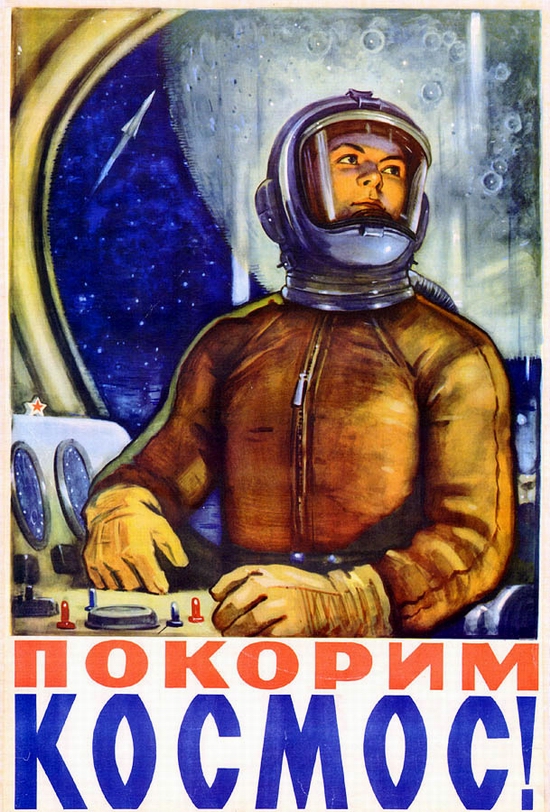
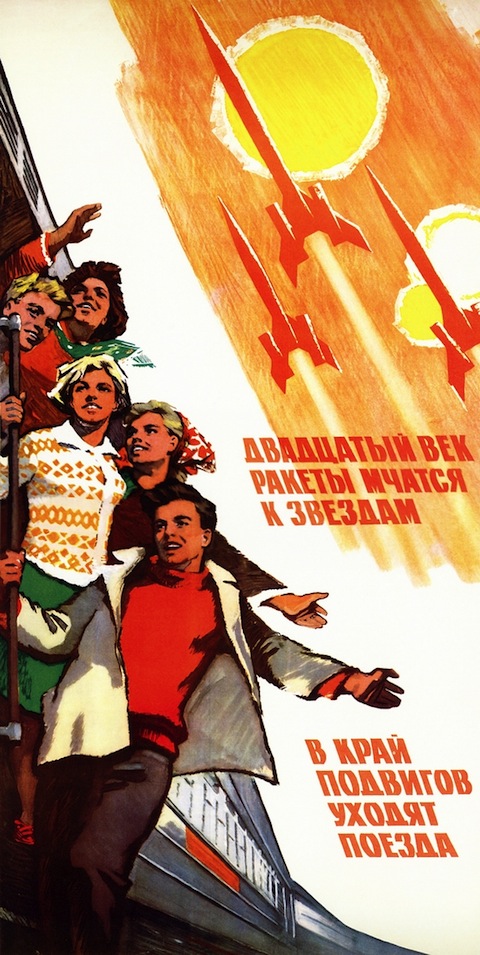
Walking around L.A. just yesterday, I noticed new banners emblazoned with illustrations touting subway stations now under construction. In bold, bright colors, they deliver clear, ambitious imagery of a bright future ahead: dedicated builders, focused students, noble working commuters, surging trains. Why, I thought, those look a bit like Soviet propaganda! I had no political comparisons in mind, only aesthetic ones, and this Retronaut post shows off many perfect examples of the Cold War-era Russian posters the Los Angeles Metro’s brought to my mind. They capture the imagination by exuding even more intense scientific, technological, educational, and social optimism — and doing so in even more visual detail — than I’d remembered.
And boy, speaking of ambition: “From student’s models to spaceships!” “To the Sun! To the stars!” “Glory to the conquerors of the universe!” Children inclined to accept these glorious slogans and the rapturous imagery they accompany could not possibly fail to believe that, thoroughly educated by their country, their generation would go on to usher in a new galaxy-spanning order of peace, prosperity, and socialism. Yet we in the rest of the world now know of the boredom, cynicism, and oppression that attended many Soviet citizens’ everyday lives. A Cold War-specialist college history professor of mine liked to tell a story about a trip to Moscow he took in the sixties, on which he kept seeing adolescents with nothing more productive to do than openly chugging vodka on street corners. Yet, seeing posters like these, you simply want to believe, just like I want to believe in the extension of Los Angeles’ subway — which, at times, seems about as plausible as the conquering of outer space.
“From student’s models to spaceships!”
“Glory to the workers of Soviet science and technology!”
“I am happy — this is my work joining the work of my republic”
“In the 20th century the rockets race to the stars”
“When you’re drowning,” John Lennon told Rolling Stone in 1970, “you don’t say, ‘I would be incredibly pleased if someone would have the foresight to notice me drowning and come and help me.’ You just scream.”
“Don’t Let Me Down” is Lennon’s anguished scream to his lover, Yoko Ono. When he and the Beatles recorded the song during the Let It Be sessions in late January of 1969, Lennon asked Ringo Starr to hit the cymbal very hard at the beginning, to “give me the courage to come screaming in.”
The Beatles were in the process of breaking apart when Lennon wrote the song. It was a dark time in my ways, and he was becoming more and more dependent upon Ono for personal and creative support. As Paul McCartney told writer Barry Miles in Many Years From Now:
It was a very tense period: John was with Yoko and had escalated to heroin and all the accompanying paranoias and he was putting himself out on a limb. I think that as much as it excited and amused him, at the same time it secretly terrified him. So ‘Don’t Let Me Down’ was a genuine plea, ‘Don’t let me down, please, whatever you do. I’m out on this limb, I know I’m doing all this stuff, just don’t let me down.’ It was saying to Yoko, ‘I’m really stepping out of line on this one. I’m really letting my vulnerability be seen, so you must not let me down.’ I think it was a genuine cry for help.
You can get a strong sense of Lennon’s anguish and vulnerability when you listen to the isolated vocal track above. And for the full arrangement, including Starr’s cymbal-crash near the beginning and Billy Preston’s brilliant electric piano playing, see below.
T.S. Eliot’s “The Love Song of J. Alfred Prufrock” contains some of the most unforgettable images in modern poetry: the “pair of ragged claws / Scuttling across the floors of silent seas”; the yellow fog that “rubs its back upon the window panes”; the evening “spread out against the sky / Like a patient etherized upon a table.” The poem’s sudden juxtapositions disrupted and dismantled the staid poetic conventions of its time. Like his beloved metaphysical model John Donne, Eliot pushed the resources of literary language to their outer extremes, while still maintaining a respectful relationship with traditional form, deploying Shakespearean pentameter lines whose music is deceptive, since they are the vehicles of such strange, neurotic content.
“Prufrock,” first published in 1915 in Poetry magazine—at the instigation of literary impresario Ezra Pound—caused a shock at its first appearance. Students today are apt to remember it as a bewildering swirl of references—to Dante, the Bible, Shakespeare—and as sardonic commentary on what Eliot saw as the profoundly enervated and impotent condition of modern man (and of himself). It is a daunting study, to be sure, but the poem’s first readers and critics tended to dismiss it as either shockingly anarchic or trivial and meandering.
By 1947, “Prufrock” was recognized as a modernist classic, and Harvard University recorded Eliot reading the poem (above). His thin voice may not carry the weight of the poem’s dense allusive grandeur, so we have Anthony Hopkins at the top of the post reading “Prufrock” as well. Hopkins seems to rush through the poem a bit, capturing, perhaps, the nervous energy of its title character’s psychic anguish.
In 2011 a group of film scholars developed MHDL, an updated resource for historians used to reading through microfilm archives of cinema and broadcast journals. At the time, their archive was a goldmine, pulling together the bounty of printed material chronicling the film industry. Now they’ve made it better, with more refined search, filtering and sorting tools. Plus you can download images and texts.
It may have been a rite of passage for film students to sequester themselves in a dark library carrel and scroll through microfiche reels of Moving Picture World, an influential trade journal until 1927, but Lantern brings venerable movie magazines dating up to the early ’70s into the light of day where anyone can access the images and articles of major trade and fan magazines, free of charge.
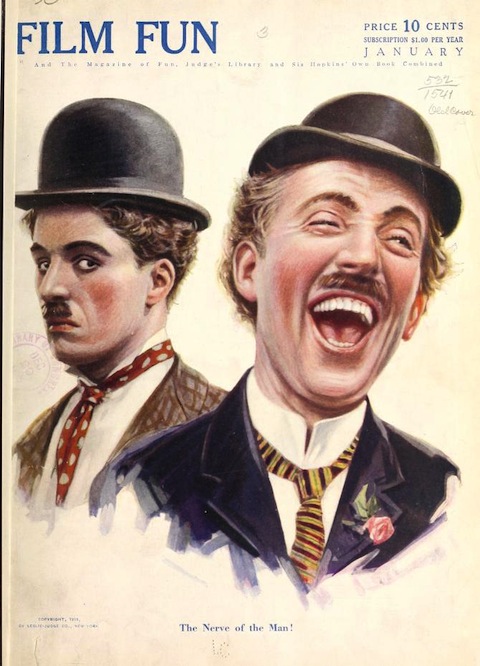
An early on-set chat rag, Film Fun, a magazine about “the happy side of the movies,” brought readers “intimate gossip of the profession told by the actors and actresses ‘between the reels.’” The images are gorgeous.
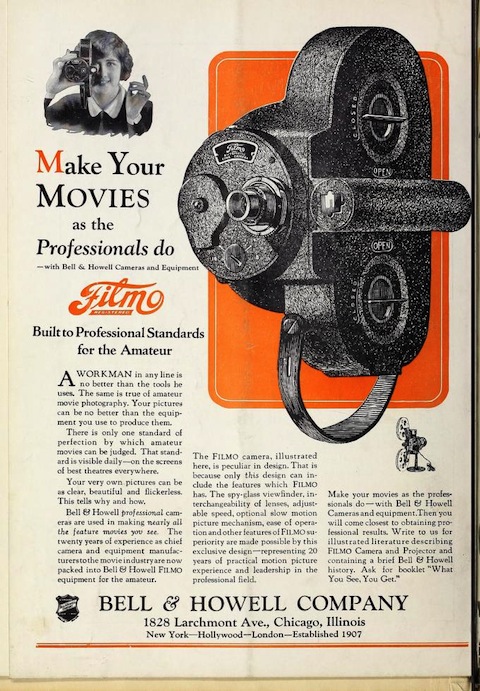
In the twenties a new amateur movie making industry thrived, with equipment and even tour packages available for buffs who wanted to tour exotic locales like Cuba with cameras and learn to shoot and preserve 16 mm motion pictures. A boom in DIY film magazines like Amateur Movie Makers targeted the early adopters.
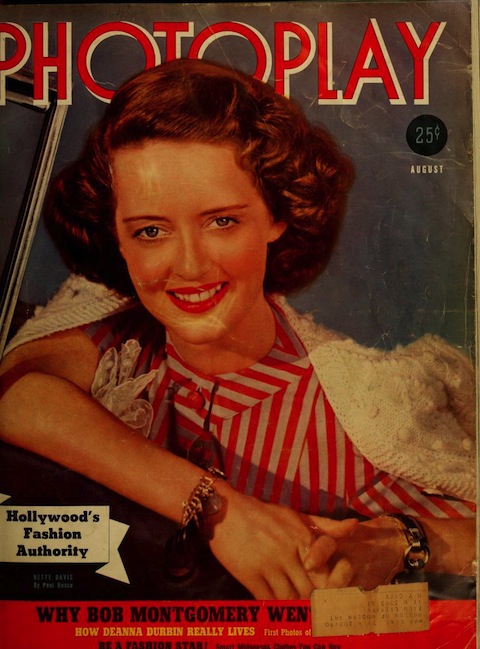
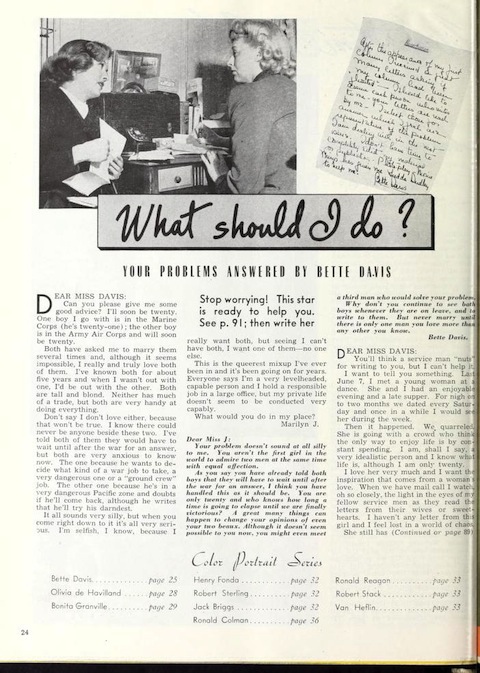
And lest we think that pulp celebrity mags like People and Us are lower brow than those of yesteryear, we should think again. I’m not sure about you, but I’m not sure four-times-married Bette Davis makes the best love advice columnist. But apparently Photoplay magazine did.
In this video we hear and see the evolution of Elton John’s voice and his often outlandish stage presence as he sings his breakthrough hit, “Your Song,” through his long career.
John wrote the love song with lyricist Bernie Taupin. He once said of their long-time collaboration, “I’m just a purveyor of Bernie’s feelings, Bernie’s thoughts.” “Your Song” was included on John’s 1970 second album, Elton John, and was released as the B‑side to the gospel-influenced “Take Me to the Pilot.” Disc jockeys preferred “Your Song,” so it was switched to the A‑side. The song eventually rose to number eight on the Billboard Hot 100 and number 7 on the UK Singles Chart.
In addition to record sales, the well-crafted song also earned John and Taupin the respect of their peers. “I remember hearing Elton John’s ‘Your Song,’ ” said John Lennon in his 1975 Rolling Stone interview, “heard it in America, and I remember thinking, ‘Great, that’s the first new thing that’s happened since we (The Beatles) happened.’ It was a step forward.”
If you would like to support the mission of Open Culture, consider making a donation to our site. It’s hard to rely 100% on ads, and your contributions will help us continue providing the best free cultural and educational materials to learners everywhere. You can contribute through PayPal, Patreon, and Venmo (@openculture). Thanks!
Many, if not, most writers teach—whether literature, composition, or creative writing—and examining what those writers teach is an especially interesting exercise because it gives us insight not only into what they read, but also what they read closely and carefully, again and again, in order to inform their own work and demonstrate the craft as they know it to students. Let’s take two case studies: exemplars of contemporary literary fiction, both of whom teach at Columbia University. I’ll leave it to you to draw your own conclusions about what their syllabi show us about their process.
First up, we have Zadie Smith, author of White Teeth and, most recently, NW: A Novel. In 2009, Smith lent her literary sensibilities to the teaching of a weekly fiction seminar called “Sense and Sensibility,” for which we have the full booklist of 15 titles she assigned to students. See the list below and make of it what you will:
Brief Interviews with Hideous Men, David Foster Wallace Catholics, Brian Moore The Complete Stories, Franz Kafka Crash, J.G. Ballard An Experiment in Love, Hilary Mantel Modern Criticism and Theory: A Reader, David Lodge The Screwtape Letters, C.S. Lewis My Loose Thread, Dennis Cooper The Prime of Miss Jean Brodie, Muriel Spark The Loser, Thomas Bernhard The Book of Daniel, E.L. Doctorow A Room with a View, E.M. Forster Reader’s Block, David Markson Pnin, Vladimir Nabokov The Quiet American, Graham Greene
Smith’s list trends somewhat surprisingly white male. She includes not a few “writer’s writers”—Kafka, J.G. Ballard, and of course, Nabokov, who also turns up as a favorite for another Russian expat writer and author of Absurdistan, Gary Shteyngart. In a Barnes and Noble author profile, Shteyngart lists two of Nabokov’s books—Pnin and Lolita—among his ten all-time favorites. Also on his list are Saul Bellow’s Herzog and Philip Roth’s Portnoy’s Complaint. All three authors appear in a 2013 Columbia course Shteyngart teaches called “The Hysterical Male,” a class specifically designed, it seems, to examine the neurosis of the white (or Jewish) male writer. With characteristic dark humor, he describes his course thus:
The 20th Century has been a complete disaster and the 21st century will likely be even worse. In response to the hopelessness of the human condition in general, and the prospects for the North American and British male in particular, the contemporary male novelist has been howling angrily for quite some time. This course will examine some of the results, from Roth’s Portnoy and Bellow’s Herzog to Martin Amis’s John Self, taking side trips into the unreliable insanity of Nabokov’s Charles Kinbote, the muddled senility of Mordecai Richler’s Barney Panofsky and the somewhat quieter desperation of David Gates’s Jernigan. We will examine the strategies behind first-person hysteria and contrast with the alternate third- and first-person meshugas of Bruce Wagner’s I’ll Let You Go. What gives vitality to the male hysterical hero? How should humor be balanced with pathos? Why are so many protagonists (and authors) of Jewish or Anglo extraction? How have early male hysterics given rise to the “hysterical realism” as outlined by critic James Wood? Is the shouting, sweaty male the perfect representation of our disastrous times, or is a dose of sane introspection needed to make sense of the world around us? How does the change from early to late hysterical novels reflect our progress from an entirely male-dominated world to a mostly male-dominated one? Do we still need to be reading this stuff?
I would hazard to guess that Shteyngart’s answer to the last question is “yes.”
In 1951, Carl Djerassi, a chemist working in an obscure lab in Mexico City, created the first progesterone pill. Little did he know that, a decade later, 1.2 million women would be “on the Pill” in America, exercising unprecedented control over their reproductive rights. By 1967, that number would reach 12.5 million women worldwide.
It was fortuitous timing, seeing that the post-war global population was starting to surge. It took 125 years (1800–1925) for the global population to move from one billion to two billion (see historical chart), but only 35 years (1925–1960) for that number to reach three billion. Non-profits like the Population Council were founded to think through emerging population questions, and by the mid-1960s, they began publishing a peer-reviewed journal called Studies in Family Planning and also working with Walt Disney to produce a 10-minute educational cartoon. You can watch Family Planning above.
Eventually translated into 25 languages, the film avoids anything sexually explicit. The family planning advice is vague at best and, perversely but not surprisingly, only male characters get a real voice in the production. But lest you think that Disney was breaking any real ground here, let me remind you of its more daring foray into sex-ed films two decades prior. That’s when it produced The Story of Menstruation(1946), a more substantive film shown to 105 million students across the US.
Johann Wolfgang von Goethe — the very name bespeaks literary mastery of the widest range. Not only did this best-known of all eighteenth- and — nineteenth-century German writers reach into poetry, the novel, the memoir, autobiography, criticism, science, philosophy, and even politics, but he did a bit of interpretation of classic folktales as well. The Faust and Sorrows of Young Werther author wrote a particularly lasting rendition of the adventures of Reynard the Fox, a trickster from medieval European myth. Had Goethe himself lived into the 20th century to experience the golden age of puppet animation, I feel certain his artistic mandate would have compelled him to film a version of The Tale of the Fox. Alas, the literary legend passed away in 1832, leaving the job, nearly a century later, to Russian animator Ladislas Starevich (also spelled Wladyslaw Starewicz).
Having pioneered the form of puppet animation with his 1912 film The Beautiful Lukanida, Starevich remains well-known among animation enthusiasts for shooting his pictures with animals playing the protagonists, or bugs, or seemingly whatever he happened to have at hand. The Tale of the Fox, by contrast, presented him with a comparatively vast set of resources. Produced in Paris over eighteen months in 1929 and 1930, the 65-minute animated feature, Starevich’s first and only the sixth ever made in the world at the time, tells the story of Reynard the Fox’s attempts to live his life of tomfoolery even as the lion king of this animal kingdom struggles to bring him to justice. When, seven years after completing photography, the film still lacked music, Germany’s National Socialist government, no doubt swollen with their version of Teutonic pride at seeing an adaptation of an adaptation penned by a German icon, provided a score and arranged for a Berlin premiere. But try not to think about that. Concentrate instead on the animation style used here by Starevich which, though he shot in stop-motion and used puppets, surely resembles no stop-motion animation or puppet show you’ve ever seen.
What would you do if you crossed paths with a jingling lost thing whose oven-shaped body, crustaceous claws, and fleshy tentacles would seem right at home in Hieronymus Bosch’s Garden of Earthly Delights?
Scream? Run? Release your bowels?
The anonymous narrator ofThe Lost Thing, a fifteen-minute animation born of Shaun Tan’s all-ages picture book, attempts, instead, to identify it empirically through careful observation, calibrated measurement, and controlled experimentation. When the scientific approach fails, he assumes responsibility for his strange find, leading it through a clanking, grimy landscape where sanitation crews deflate beach balls with pointy sticks after the joyless holiday crowds are dismissed—a vision of steampunk in defeat.
We’re loathe to hit you with any more spoilers. Suffice it to say that this is a fine example of innovatively adapted source material, and that eventually our stoic hero—voiced by British-born Australian comic Tim Minchin—and his charge arrive in a landscape that should cause the inhabitants of the Island of Misfit Toys to stop mooning over Santa.
We're hoping to rely on loyal readers, rather than erratic ads. Please click the Donate button and support Open Culture. You can use Paypal, Venmo, Patreon, even Crypto! We thank you!
Open Culture scours the web for the best educational media. We find the free courses and audio books you need, the language lessons & educational videos you want, and plenty of enlightenment in between.