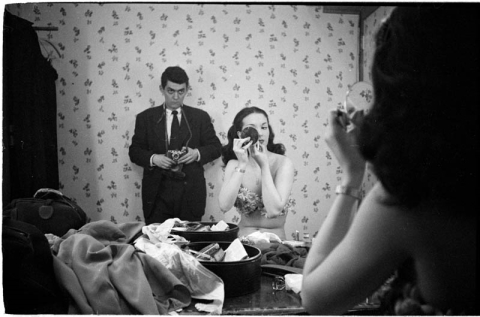
If you’re applying to Stanford, this is what you’re up against. Undergrads like Ravi Fernando (Class of 2014) who can solve a Rubik’s Cube … while juggling. You might want to have a safety school!
It should surprise few to learn that Abraham Lincoln wrote poetry. But this fact about his life is dwarfed by those events that defined his political legacy, and this is also no surprise. Nevertheless, in the midst of the current Lincoln revival, the man and the statesman, I think it’s fitting to attend to Abraham Lincoln the poet. Certainly scholars have read his poetry in relation to his skillful prose and oratory. But, on its own, this writing gives us insight into the sensitivity of Lincoln’s less public modes of expression.
Was he a great poet? Well, it appears that he had at least three phases—the first, a youthful one in his teens and early twenties when he produced some silly juvenelia, “a number of crude and satirical verses.” The most popular of these is called “Chronicles of Reuben,” a local satire Lincoln scholar Robert Bray describes as “a series of pseudo-biblical prose and verse pieces that are, out of their local Indiana context, so topical as to be neither funny nor comprehensible.” The piece, written in 1828 to avenge himself upon a rival Indiana family, apparently had great effect on the neighbors, however. One of them, Joseph C. Richardson, claimed that the poem was “remembered here in Indiana in scraps better than the Bible.”
We have to credit frontier oral tradition for our knowledge of some of Lincoln’s more serious poems in his second phase, after he joined “a Kind of Poetical Society” in Illinois sometime between 1837–39. One neighbor, James Matheny, remembered the following worldly lines from a Lincoln poem called “On Seduction”:
Whatever Spiteful fools may Say—
Each jealous, ranting yelper—
No woman ever played the whore
Unless She had a man to help her.
If this is truly a stanza from Lincoln’s pen, the satirist is still very much in evidence—Swift could have written these lines—but the self-described “prairie lawyer” has grown philosophical and left the adolescent boundaries of local feuds and pranks.
His third, most serious phase begins when Lincoln returned to Indiana, after leaving Illinois briefly in an attempt to help Henry Clay’s failed presidential bid against James Polk. Lincoln called Indiana “as unpoetical as any spot of the earth,” and yet it serves as a subject for a poem completed in 1846 called “My Childhood Home I See Again.” (The image above is of the first six stanzas of this long poem in Lincoln’s handwriting. Click here to see the remaining pages). Here in the first two stanzas (below), you can see the cutting wit of the younger, more confident man give way to a kind of wistful nostalgia worthy of Wordsworth:
Lincoln-as-poet continued in this thoughtful, mature voice in the remaining years of his life, though never equaling the poetic output of 1846. Somewhat out of character, the final documented piece of poetry from Lincoln comes from July 19, 1863. Written in response to the North’s victory in Gettysburg, “Verse on Lee’s Invasion of the North” is a short piece of doggerel that sees him returning to satire, writing in the voice of “Gen. Lee”:
Gen. Lee’s invasion of the North written by himself—
In eighteen sixty three, with pomp,
and mighty swell,
Me and Jeff’s Confederacy, went
forth to sack Phil-del,
The Yankees they got arter us, and
giv us particular hell,
And we skedaddled back again,
And didn’t sack Phil-del.
Surely the poem was written in a hurry, and with jubilant, triumphal glee, but if this is the last we heard from Lincoln the poet, it might be a shame, though it would not blot out the literary skill of poems like “My Childhood Home I See Again” and others like “The Bear Hunt” and “To Rosa,” which you can read here.
But there’s more to this story; in 2004, a historian discovered an unsigned poem called “The Suicide’s Soliloquy”—published in the August 25, 1838 issue of the Sangamo Journal, a Springfield newspaper—and believed the former president to be the poet. In the video above, listen to a moody, dramatic reading of the poem:
It is not known with certainty if Lincoln wrote this poem, but scholarly consensus inclines heavily in that direction, given its stylistic similarity to his other work from this period. “The Suicide’s Soliloquy” is as passionate and morbid as any of Edgar Allen Poe’s verse, and betrays Lincoln’s characteristic melancholy in its stormiest and most Romantic guise. NPR has the full poem and the story of its discovery.
Ah, the Proust Questionnaire: does it reveal everything about one’s personality, or nothing at all? Presumably Marcel Proust, who gave the questionnaire its name by filling it out so wholeheartedly, wouldn’t have cared either way. French interviewer Bernard Pivot must have seen some usefulness in it, since he applied its questions so regularly to guests on his literary television program Apostrophesthat it gained the second name of “Pivot Questionnaire.” Open Culture readers know James Lipton also adapted a version on Inside the Actors Studio. (See our previous post here.)And now, thanks to archivists at the University of Texas at Austin’s Harry Ransom Center, we have Proust Questionnaire answers from one more luminary: Sir Arthur Conan Doyle, creator of Sherlock Holmes.
Not that Conan Doyle responds with quite so much style as does Proust. His favorite qualities in a man? Manliness. In a woman? Why, womanliness. His favorite food and drink? Anything when hungry or thirsty — nothing when not. Favorite activity? Work. This all has a certain utilitarian charm, but if you read the questionnaire itself, you also find the particular flavor of half-hidden wit that Conan Doyle’s readers would expect. But we care about his responses, as we care about Proust’s, because of all the other words they wrote. And lest we get caught up in questionnaires, let us not forget that Swann’s Way, the first volume of Proust’s In Search of Lost Time, turns one hundred this year.
Colin Marshall hosts and produces Notebook on Cities and Culture and writes essays on literature, film, cities, Asia, and aesthetics. He’s at work on a book about Los Angeles, A Los Angeles Primer. Follow him on Twitter at @colinmarshall.
This eighteen minute documentary takes you inside the work of David A. Smith, an English artist who specializes in “high-quality ornamental hand-crafted reverse glass signs and decorative silvered and gilded mirrors.” (Got that? You may want to read that last part again.) In something of a departure from earlier projects, Smith designed an ornate “turn-of-the-century, trade-card styled album cover” for John Mayer’s album Born &Raised. His work is meticulous and exacting. And this “Behind The Scenes” film, complete with commentary from Mayer and Smith, captures the artist’s process in loving detail. Now please sit back and enjoy.
Find us on Facebook, Twitter and Google Plus and we’ll make it easy to share intelligent media with your friends!
Although he died in 1950, George Orwell seemingly escaped the reach of modern media. Orwell’s voice was never captured on audio. And his image never appeared on film. Historians and literature scholars lamented this for decades.
But then, in 2003, on the hundredth anniversary of Orwell’s birth, two researchers stumbled upon a tantalizing piece of footage in the The Pathay Film Library in London. The very brief footage — watch in full here, or at the 50 second mark in the video above — shows an 18-year-old Orwell, then named Eric Blair, marching across a sports field at Eton College, where he spent his formative years and studied French with Aldous Huxley. In the line of marching students, Orwell is the fourth student from the left.
Note: the video above comes from a British Pathe clip that features celebrities before they became famous. If you’re curious who appears in the film, see the list below the jump.
As gearheads go, Brendan Chilcutt’s a pretty sentimental guy, and not just because he signs his correspondence with “love.” In January, 2012, he founded the Museum of Endangered Sounds to keep outmoded technology’s most iconic noises from vanishing from the collective memory. Click on any image in the museum’s online collection to be transported in the Proustian sense.
Some of the exhibits—a manual typewriter, a rotary phone—were already amply preserved, thanks to a proliferation of cinematic appearances in their heyday.
Others might well have slipped away unnoticed, if not for Chilcutt’s curatorial efforts. Remember that number you could call to have a recorded voice inform you of the correct time? How about the static of an analog TV tuned to an empty station? The hum of a malfunctioning Discman, the chirp of a Tamagotchi…wait, what’s that I hear? The disconcerting whoosh of time speeding up?
Drown it out by activating all thirty exhibits at once. Let them sound their barbaric yawps simultaneously as the kids try to figure out what that racket is.
Filmmaker Tim Sessler got a little bored on his flight from San Francisco to Salt Lake City, to Philadelphia. He says: “After reading through the in-flight magazine, the Sky Mall and the airplane security details from front to back, upside down and backwards, I felt it was the right moment to pull out my camera” and start taking aerial footage of the cross-country voyage. The camera? It’s a Canon 5d mk3 with a 24–105mm and Nikon 50mm 1.2 lens (Tim tells us). The challenge? To keep the camera stable, using his knee, the seat, the window, etc., “while avoiding any vibration that would create some nasty rolling-shutter-wobble.” A good deal more stabilization took place in post-production. When you’re done watching Drift, you can check out Sessler’s prior attempt at shooting aerial art here.
This week David Bowie released the second single from his upcoming album, The Next Day. It’s called “The Stars (Are Out Tonight),” and the accompanying video (shown above) builds on Bowie’s lifelong exploration of androgyny.
Bowie is joined in the miniature film by actress Tilda Swinton, who plays his wife, and the models Andrej Pejic and Saskia De Brauw, who play a pair of young celebrities who mock and torment the aging couple. Swinton looks like Bowie, and Pejic and DeBrauw look like Bowie and Swinton.
The story “captures a twenty first century moment in its convergence of age, gender and the normal/celebrity divide,” according to a statement posted earlier this week on Bowie’s Facebook page. It was directed by the Italian-born filmmaker Floria Sigismondi, a prolific music video maker best known for her 2010 feature film, The Runaways.
One hundred years ago, America had only just begun talking about “avant garde” art. Before the famous “Armory Show,” no one was even using the term; after it, United States’ art-watchers had many reasons to. It’s what they saw on display at the exhibition, mounted by two dozen artists entirely without public funding. Properly called The International Exhibition of Modern Art, the show got its popular name by starting out in the 69th Regiment Armory on Lexington Avenue in New York. It then moved to Chicago and Boston, provoking shock, dismissal, and sometimes even appreciation across the East Coast and Midwest. A little Van Gogh, Gauguin, Cezanne, Picasso, Matisse, and Duchamp can do that to you.
Or at least, they do that to you if you live in 1913 and have never seen such bold destruction and reinvention of visual art’s established forms. To mark the Armory Show’s centennial, the Art Institute of Chicago has recreated its viewing experience on the web. There you can explore the galleries as Chicagoans actually saw them a century ago, albeit in black-and-white. The site also provides much in the way of context, offering articles on the exhibition’s genesis, program notes, legacy, and more. You can learn more about the impact of the Armory Show in this recent NPR piece, which quotes Museum of Modern Art curator Leah Dickerman on the subject: “It’s this moment in time, 100 years ago, in which the foundations of cultural practice were totally reordered in as great a way as we have seen. And that this marks a reordering of the rules of art-making — it’s as big as we’ve seen since the Renaissance.”
Colin Marshall hosts and produces Notebook on Cities and Culture and writes essays on literature, film, cities, Asia, and aesthetics. He’s at work on a book about Los Angeles, A Los Angeles Primer. Follow him on Twitter at @colinmarshall.
According to Freud, neurotics never know what they want, and so never know when they’ve got it. So it is with the seeker after fluent cultural literacy, who must always play catch-up to an impossible ideal. William Grimes points this out in his New York Times review of Peter Boxall’s obnoxious 1001 Books You Must Read Before You Die, which “plays on every reader’s lingering sense of inadequacy. Page after page reveals a writer or a novel unread, and therefore a demerit on the great report card of one’s cultural life.” Then there are the less-ambitious periodical reminders of one’s literary insufficiency, such as The Telegraph’s “100 novels everyone should read,” The Guardian’s “The 100 greatest novels of all time: The list,” the Modern Library’s “Top 100,” and the occasional, pretentious Facebook quiz etc. based on the above.
Grimes’ reference to a report card is relevant, since what we’re discussing today is the instruction in grand themes and “great books” represented by W.H. Auden’s syllabus above for his English 135, “Fate and the Individual in European Literature.” Granted, this is not an intro lit class (although I imagine that his intro class may have been punishing as well), but a course for juniors, seniors, and graduate students. Taught during the 1941–42 school year when Auden was a professor at the University of Michigan, his syllabus required over 6,000 pages of reading in just a single semester (and for only two credits!). Find all of the books at the bottom of this post.
While a few days ago we posted a syllabus David Foster Wallace created around several seeming easy reads—mass market paperbacks and such—Auden asks his students to read in a semester the literary equivalent of what many undergraduate majors cover in all four years. Four Shakespeare plays and one Ben Jonson? That was my first college Shakespeare class. All of Moby Dick? I spent over half a semester with the whale in a Melville class. And then there’s all of Dante’s Divine Comedy, a text so dense with obscure fourteenth century Italian allusions that in some editions, footnotes can take up half a page. And that’s barely a quarter of the list, not to mention the opera libretti and recommended criticism.
Was Auden a sadistic teacher or so completely out of touch with his students that he asked of them the impossible? I do not know. But Professor Lisa Goldfarb of NYU, who is writing a series of essays on Auden, thinks the syllabus reflects as much on the poet’s own preoccupations as on his students’ needs. Goldfarb writes:
“What I find fascinating about the syllabus is how much it reflects Auden’s own overlapping interests in literature across genres — drama, lyric poetry, fiction — philosophy, and music.… He also includes so many of the figures he wrote about in his own prose and those to whom he refers in his poetry…
“By including such texts across disciplines — classical and modern literature, philosophy, music, anthropology, criticism — Auden seems to have aimed to educate his students deeply and broadly.”
Such a broad education seems out of reach for many people in a lifetime, much less a single semester. Now whether or not Auden actually expected students to read everything is another matter entirely. Part of being a serious student of literature also involves learning what to read, what to skim, and what to totally BS. Maybe another way to see this class is that since Auden knew these texts so well, his course gave students the chance to hear him lecture on his own journey through European literature, to hear a poet from a privileged class and bygone age when “reading English Literature at University” meant, well, reading all of it, and nearly everything else as well (usually in original languages).
If that’s the kind of erudition certain anxious readers aspire to, then they’re sunk. Increasingly few have the leisure, and the claims on our attention are too manifold. At one time in history being fully literate meant that one read both languages—Latin and Greek. Now it no longer even means mastering only “European literature,” but all the world’s cultural productions, an impossible task even for a reader like W.H. Auden. Who could retain it all? Instead of chasing vanishing cultural ideals, I console myself with a paraphrase from the dim memory of my last reading of Moby Dick: why read widely when you can read deeply?
Find all of the books on Auden’s syllabus listed below:
Here’s a flawed but fascinating little film about the life of Vladimir Nabokov, examined through the prism of his most famous book.
How Do You Solve a Problem Like Lolita?first aired on British television in 2009. The host is Stephen Smith, a culture correspondent for BBC Newsnight. We don’t know the rest of Smith’s resume, but in watching the documentary we get the feeling he may have picked up a little of his journalistic sensibility from the British tabloids.
The problem referred to in the title is the sense–at least among Smith’s friends–that there is something “pervy” about Nabokov’s 1955 novel, Lolita, and that this raises certain questions about the author’s own sexual penchants. “Was it a morality play,” Smith asks at the outset, “or the fantasy of a dirty old man?”
It’s a contemptible point of departure. But How Do You Solve a Problem Like Lolita? manages to be worthwhile in spite of itself. It’s filled with interesting old footage of Nabokov talking about himself and his work, as well as contemporary footage of the writer’s old haunts in Russia, America and Switzerland. The film is a kind of travelogue. Watching it is like taking a one-hour tour through a fascinating landscape with an amiable but slightly annoying guide.
We're hoping to rely on loyal readers, rather than erratic ads. Please click the Donate button and support Open Culture. You can use Paypal, Venmo, Patreon, even Crypto! We thank you!
Open Culture scours the web for the best educational media. We find the free courses and audio books you need, the language lessons & educational videos you want, and plenty of enlightenment in between.