Earlier today, they laid Stephen Hawking to rest in a private funeral held at University Church of St. Mary the Great in Cambridge, England. Although the funeral itself was attended by only 500 guests, the streets of Cambridge swelled with onlookers who broke into applause as the coffin holding the physicist made its way into the church, leaving us with some proof that there’s still something right in a world tilting toward the wrong, that we can still appreciate someone who overcame so much, and left us with even more.
If you would like to support the mission of Open Culture, consider making a donation to our site. It’s hard to rely 100% on ads, and your contributions will help us continue providing the best free cultural and educational materials to learners everywhere. You can contribute through PayPal, Patreon, and Venmo (@openculture). Thanks!
Many a mocking critique floats around pointing out that some people who tell their multilingual neighbors to “speak English” seem to have a lot of trouble with the language themselves. I must confess, I find the observation more sad than funny. I’ve met many English speakers who struggle with understanding the peculiarities of the language and do not know its history. Increasingly, such things are not taught to those who don’t devote themselves to language study.
When people do learn how the language evolved, they can be shocked that for much of its history, English was unrecognizable to modern ears. Indeed, the study of Old English—or Anglo-Saxon, the language of Beowulf—satisfies foreign language requirements in many English departments. Originally written in runic before it incorporated the Latin alphabet (and retaining some of those early symbols afterward), this Germanic language slowly became more Latinate, and gave way among the reading classes in Britain to Anglo-Norman, a Germanic-French cousin, for a few centuries after 1066.
That’s the very short version. These strains and more eventually commingled to form Middle English, the language of Chaucer, which also sounds to modern ears like another tongue, though we recognize more of it. In the video above, Medievalist and MIT professor Arthur Bahr gives us demonstrations of both Old and Middle English in readings of Beowulf and Sir Gawain and the Green Knight as part of his 2014 course, “Major Authors: Old English and Beowulf.” (You can still visit the course site, read the syllabus and download course materials.)
Bahr reads the first 20 lines of the ancient epic poem, which begins:
Hwæt. We Gardena in geardagum, þeodcyninga, þrym gefrunon, hu ða æþelingas ellen fremedon.
“Besides being the language of Rohan in the novels of Tolkien,” he writes, “Old English is a language of long, cold, and lonely winters; of haunting beauty found in unexpected places; and of unshakable resolve in the face of insurmountable odds.” For all its distance from us, we can still recognize quite a lot in Old English if we listen closely. Much of its vocabulary and inflections survive, unchanged but for pronunciation and spelling, in modern English, including many of the language’s most basic words, like “the,” “in” and “are,” and most common, like “god,” “name,” “me,” “hand,” and even “old.”
After the Viking and Norman invasions, Old English became “the third language in its own country,” notes Luke Mastin at his History of English site. More spoken than written, it “effectively sank to the level of a patois or creole,” with several distinct regional variants. English seemed at one time “in dire peril” of dying out but “showed its resilience once again, and, two hundred years after the Norman Conquest, it was English not French that emerged as the language of England,” though it remained a diffuse collection of dialects. As you’ll hear in Bahr’s Middle English reading, it was also an English entirely transformed by the languages around it, as it would be once again a few hundred years later, when we get to the English of Shakespeare.
Do you ever long for those not-so-long-ago days when you skipped through the world, breathless with the anticipation of catching Pokémon on your phone screen?
If so, you might enjoy bagging some of the Pokeverse’s real world counterparts using Seek, iNaturalist’s new photo-identification app. It does for the natural world what Shazam does for music.
Aim your phone’s camera at a nondescript leaf or the grasshopper-ish-looking creature who’s camped on your porch light. With a bit of luck, Seek will pull up the relevant Wikipedia entry to help the two of you get better acquainted.
Registered users can pin their finds to their personal collections, provided the app’s recognition technology produces a match.
(Several early adopters suggest it’s still a few houseplants shy of true functionality…)
Seek’s protective stance with regard to privacy settings is well suited to junior specimen collectors, as are the virtual badges with which it rewards energetic uploaders.
While it doesn’t hang onto user data, Seek is building a photo library, composed in part of user submissions.
When he first spent time in Japanese cities, urban design and history professor Barrie Shelton “was baffled, irritated, and even intimidated by what I saw. Yet at the same time I found myself energized, animated, and indeed inspired by them. The effect was liberating and my intuition was quick to suggest that further exploration of their chaotic vitality might be extremely rewarding.” That exploration involved visits to “alleys, shrine and temple precincts, highways, railway stations (and their ‘magnetic’ fields), roof-tops, observation decks, arcades, underground streets, bars, gardens,” and so on, and no less essentially included “almost compulsive poring over city maps (old and new).”
It all culminated in Shelton’s book Learning from the Japanese City, a study that can help any Westerner better understand the likes of Tokyo, Osaka, Kyoto, Kanazawa, Hiroshima, Fukuoka, or indeed Nagomuru City. You won’t find that last, however, on any map of Japan, nor will you find it in the country itself. It exists in the land of Naira, which itself exists in the mind of Japanese graphic designer and cartographer Imaizumi Takayuki. Imaizumi’s painstaking, ongoing work has produced maps of Nagomuru City that look at it in different ways in different eras, which you can browse on Let’s Go to the Imaginary Cities! On this page you can explore scrollable maps of the city by first selecting one of its thirty regions; just below that, you can also download a large PDF map of the entire metropolis.
Imaizumi’s urban cartographic vision is so richly realized that it has produced art exhibitions, a book, and even a variety of physical artifacts. On one page, for instance, you’ll find photographs of the contents of several imaginary wallets lost on the imaginary streets of Nagomuru City by its imaginary citizens. On another appear the imaginary cash cards issued by the imaginary Nagomuru Bank, complete with a pair of imaginary mascots without which, as anyone with any experience of Japan knows, no card would be complete. These artifacts and others have all come as a result of the project Imaizumi began at just ten years old, a brief history of which Japanese-readers can take inhere.
“If I can imagine a fictive nation,” writes Roland Barthes in Empire of Signs, “I can give it an invented name, treat it declaratively as a novelistic object,” then “isolate somewhere in the world (faraway) a certain number of features (a term employed in linguistics), and out of all these features deliberately form a system. It is this system which I call: Japan.” Imaizumi chose to call his system Nagomuru City, but one imagines that all its carefully created and positioned features and details — the train lines and stations, the shrines and temples, the housing developments, the convenience stores, all the things celebrated in both Empire of Signs and Learning from the Japanese City — would have fired up Barthes’ imagination just as much as did the real Japan.
Based in Seoul, Colin Marshall writes and broadcasts on cities and culture. His projects include the book The Stateless City: a Walk through 21st-Century Los Angeles and the video series The City in Cinema. Follow him on Twitter at @colinmarshall or on Facebook.
Some of us are still reeling from the death this last January of Mark E. Smith, the frontman and acerbic brains behind The Fall, surely one of post-punk’s finest groups, and definitely its longest lasting. The band might not have scored that many Top 40 singles, but Britain’s music press loved and feared Smith in equal amounts. He was always good for a belligerent quote, or a beer-fueled interview down the pub. To paraphrase DJ John Peel, Smith was the yardstick against which other musicians were measured.
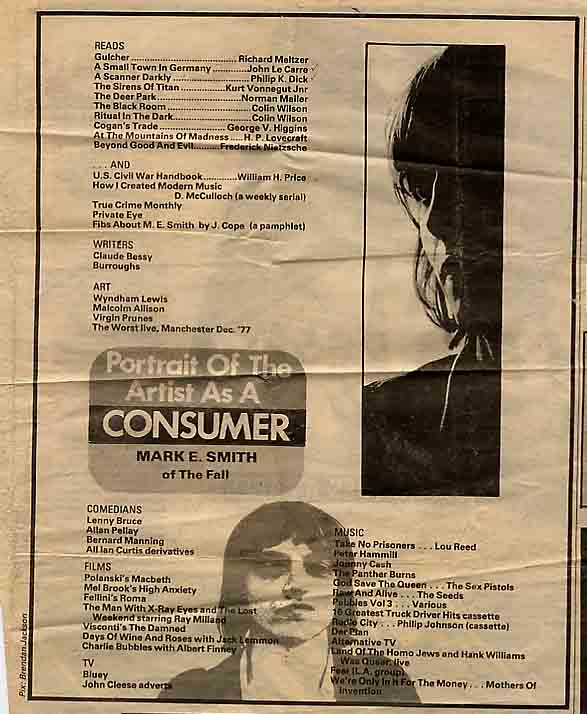
And his death has also brought out a treasure trove of clippings, including this one from the August 15, 1981 edition of NME. “Portrait of the Artist as a Consumer” was an occasional series, asking musicians for their favorite books, art, writers, comedians, films, and even other music. We’ve pasted the original scan above, but just in case, we’ve transcribed his lists with a little bit of commentary.
AND U.S. Civil War Handbook — William H. Price How I Created Modern Music — D. McCulloch (a weekly serial) True Crime Monthly Private Eye Fibs About M.E. Smith by J. Cope (a pamphlet)
Okay, for longtime fans of The Fall, the appearance of Philip K. Dick and H.P. Lovecraft should come as no surprise, as Smith referenced them often in his lyrics.Gulcher (subtitled Post-Rock Cultural Pluralism in America) was one of the first ever collections of serious rock criticism from one of the first ever rock critics. The blurb on Colin Wilson over at Amazon says he “wrote widely on true crime, mysticism and the paranormal” which sounds pretty much like Smith’s CV. George V. Higgins was also a crime writer, with a gift for mafioso gab. And as for The Deer Park by Mailer, Smith took the title for an early Fall song:
Of Smith’s fascination with the U.S. Civil War, I can think of his own visualizing between the North and South in his own beleaguered Britain, and the lyric from “The N.W.R.A.”:
“The streets of Soho did reverberate
With drunken Highland men
Revenge for Culloden dead
The North had rose again
But it would turn out wrong”
Don’t go looking for the McCulloch and Cope writings—they’re both jokes at the expense of fellow Mancunians Ian McCulloch (Echo and the Bunnymen) and Julian Cope, who Smith gigged with back in the day and went on to—as Smith no doubt saw it—sell out to the mainstream
[UPDATE: As one commenter has noted D. Culloch is actually Dave McCulloch, Ian’s brother and once the editor and writer for Sounds. However, he is a man that has dropped off the face of the Internet, and we’ll need some more digging to see if his serial even exists. Help us in the comments.]
WRITERS
Claude Bessy
Burroughs
Of William S. Burroughs much has been written, but Claude Bessy was a French writer who started and/or wrote for several punk fanzines, including Angeleno Dread and Slash, was the resident VJ at Manchester’s Hacienda Club, and directed—supposedly—music videos for The Fall (which ones, I can’t discern).
ART
Wyndham Lewis
Malcolm Allison
Virgin Prunes
The Worst live, Marchester Dec. ’77
Those who have seen Lewis’ writings for BLAST, the magazine of the vorticist movement in Britain, circa 1914, might be mistaken that they were looking at a M.E.S. lyric sheet.
The list is Smith’s joke over what is considered art: Malcolm Allison was an English football player and manager; the Virgin Prunes were an Irish post-punk band; The Worst was a little known punk band that shared the bill with The Fall and John Cooper Clark at the Electric Circus gig—the recording of which was the Fall’s first release.
COMEDIANS
Lenny Bruce
Alan Pellay
Bernard Manning
All Ian Curtis derivatives
Lenny Bruce and Bernard Manning are opposite ends of a very odd spectrum. More interesting is Alan Pellay aka Al Pellay aka Lana Pellay, who fronted a group I Scream Pleasures that often opened for The Fall, and whose angry declarations over dub tracks by Adrian Sherwood are sonic cousins to Smith.
FILMS
Polanski’s Macbeth
Mel Brook’s (sic) High Anxiety
Fellini’s Rome The Man with X‑Ray Eyes and The Lost Weekend starring Ray Milland
Visconti’s The Damned Days of Wine and Roses with Jack Lemmon Charlie Bubbles with Albert Finney
The most personal selection here is the last one, a 1968 film that starred Finney as a desperate but successful writer who returns to his childhood home…Salford, near Manchester, Smith’s own hometown.
TV
Bluey
John Cleese adverts
Of the two, Bluey is the rare one, a cult Australian cop drama from 1976 created by Jock Blair and Ian Jones. We also have no idea why he liked it.
MUSIC
Take No Prisoners — Lou Reed
Peter Hammill
Johnny Cash
The Panther Burns God Save the Queen — The Sex Pistols Raw and Alive — The Seeds Pebbles Vol. 3 — Various 16 Greatest Truck Driver Hits cassette Radio City — Philip Johnson (cassette)
Der Plan
Alternative TV Land of the Homo Jews and Hank Williams Was Queer, live — Fear (L.A. Group) We’re Only In It for the Money — Mothers of Invention
So, at last, the music list. No surprises seeing Lou Reed, Johnny Cash, The Pistols, or Zappa on here. The Panther Burns was a favorite group of Claude Bessy; The Seeds was a great garage rock band of the ‘60s; Pebbles is a compilation of American psyche rock; Alternative TV, Fear, and Der Plan had varying degrees of success in the punk and electronic genres.
Of note, two things: the 16 Greatest Truck Driver Hits cassette, which the band must have picked up somewhere on tour. A baffling release, it has songs not credited to any artist, so perhaps this is a studio band concoction of country covers. But it might have inspired Smith to write his own version of the American trucker song, “Container Drivers”:
Also Philip Johnson. Radio City was one of a dozen self-released cassettes by an early electronic artist, which DieorDIY described as “A fantastic cut up of various current affairs radio broadcasts, with the classic AM radio sound quality, made good by that cosily depressing ferric oxide degradation technique.” For those looking for the various influences on the genius of Mark E. Smith, this entire list gives you a good place to start.
Ted Mills is a freelance writer on the arts who currently hosts the FunkZone Podcast. You can also follow him on Twitter at @tedmills, read his other arts writing at tedmills.com and/or watch his films here.
So many of us, throughout so much of the 20th century, saw the nature of American-style democracy as more or less etched in stone. But the events of recent years, certainly on the national level but also on the global one, have thrown our assumptions about a political system that once looked destined for universality — indeed, the much-discussed “end” toward which history itself has been working — into question. Whatever our personal views, we’ve all had to remember that the United States, approaching a quarter-millennium of history, remains an experimental country, one more subject to re-evaluation and revision than we might have thought.
The same holds true for the art form that has done more than any other to spread visions of America: the movies. Martin Scorsese surely knows this, just as deeply as he knows that a full understanding of any society demands immersion into that society’s dreams of itself. The fact that so many of America’s dreams have taken cinematic form makes Scorsese well-placed to approach the subject, given that he’s dreamed a fair few of them himself. Taxi Driver, Raging Bull, Goodfellas, Gangs of New York, The Wolf of Wall Street: most of his best-known films tell thoroughly American stories, rooted in not just his country’s distinctive history but the equally distinctive politics, society, and culture that have resulted from it.
Now, along with his nonprofit The Film Foundation, Scorsese passes his understanding of America along to all of us with their curriculum, “Portraits of America: Democracy on Film.” It comes as part of their larger project “The Story of Film,” described by its official site as “an interdisciplinary curriculum introducing students to classic cinema and the cultural, historical, and artistic significance of film.” Scorsese and The Film Foundation offer its materials free to schools, but students of all ages and nationalities can learn a great deal about American democracy from the pictures it includes, the sequence of which runs as follows:
Module 1: The Immigrant Experience
Introductory Lesson: From Penny Claptrap to Movie Palaces—the First Three Decades
Chapter 1: “The Immigrant” (1917, d. Charlie Chaplin)
Chapter 2: “The Godfather, Part II” (1974, d. Francis Ford Coppola)
Chapter 3: “America, America” (1963, d. Elia Kazan)
Chapter 4: “El Norte” (1983, d. Gregory Nava)
Chapter 5: “The Namesake” (2006, d. Mira Nair)
Module 2: The American Laborer
Introductory Lesson: The Common Good
Chapter 1: “Black Fury” (1935, d. Michael Curtiz)
Chapter 2: “Harlan County U.S.A.” (1976, d. Barbara Kopple)
Chapter 3: “At the River I Stand” (1993, d. David Appleby, Allison Graham and Steven Ross)
Chapter 4: “Salt of the Earth” (1954, d. Herbert J. Biberman)
Chapter 5: “Norma Rae” (1979, d. Martin Ritt)
Module 3: Civil Rights
Introductory Lesson: The Camera as Witness
Chapter 1: King: A Filmed Record…Montgomery to Memphis (1970, conceived & created by
Ely Landau; guest appearances filmed by Sidney Lumet and Joseph L.
Mankiewicz)
Chapter 2: “Intruder in the Dust” (1949, d. Clarence Brown)
Chapter 3: “The Times of Harvey Milk” (1984, d. Robert Epstein)
Chapter 4: “Smoke Signals” (1998, d. Chris Eyre)
Module 4: The American Woman
Introductory Lesson: Ways of Seeing Women
Chapter 1: Through a Woman’s Lens: Directors Lois Weber (focusing on “Suspense,” 1913 and
“Where Are My Children,” 1916) and Dorothy Arzner (“Dance, Girl, Dance,” 1940)
Chapter 2: “Imitation of Life” (1934, d. John M. Stahl)
Chapter 3: “Woman of the Year” (1942, d. George Stevens)
Chapter 4: “Alien” (1979, d. Ridley Scott)
Chapter 5: “The Age of Innocence” (1993, d. Martin Scorsese)
Module 5: Politicians and Demagogues
Introductory Lesson: Checks and Balances
Chapter 1: “Gabriel Over the White House” (1933, d. Gregory La Cava)
Chapter 2: “A Lion is in the Streets” (1953, d. Raoul Walsh)
Chapter 3: “Advise and Consent” (1962, d. Otto Preminger)
Chapter 4: “A Face in the Crowd” (1957, d. Elia Kazan)
Module 6: Soldiers and Patriots
Introductory Lesson: Movies and Homefront Morale
Chapter 1: “Sergeant York (1941, d. Howard Hawks)
Chapter 2: Private Snafu’s Private War—three Snafu Shorts from WWII
Chapter 3: “Three Came Home” (1950, d. Jean Negulesco)
Chapter 4: “Glory” (1989, Edward Zwick)
Chapter 5: “Saving Private Ryan” (1998, d. Steven Spielberg)
Module 7: The Press
Introductory Lesson: Degrees of Truth
Chapter 1: “Meet John Doe” (1941, d. Frank Capra)
Chapter 2: “All the President’s Men” (1976, d. Alan J. Pakula)
Chapter 3: “Good Night, and Good Luck” (2005, d. George Clooney)
Chapter 4: “An Inconvenient Truth” (2006, d. Davis Guggenheim)
Chapter 5: “Ace in the Hole” (1951, d. Billy Wilder)
Module 8: The Auteurs
Introductory Lesson: Film as an Art Form
Chapter 1: “Modern Times” (1936, Charlie Chaplin)
Chapter 2: “The Grapes of Wrath”(1940, d. John Ford)
Chapter 3: “Citizen Kane” (1941, d. Orson Welles)
Chapter 4: “An American in Paris” (1951, d. Vincente Minnelli)
Chapter 5: “The Aviator” (2004, d. Martin Scorsese)
“Division, conflict and anger seem to be defining this moment in culture,” says Scorsese, quoted in a Film Journal International article about the curriculum. “I learned a lot about citizenship and American ideals from the movies I saw. Movies that look squarely at the struggles, violent disagreements and the tragedies in history, not to mention hypocrisies, false promises. But they also embody the best in America, our great hopes and ideals.” Few could watch all 38 of the films on his curriculum without feeling that the experiments of democracy and cinema are still on to something – and hold out the promise of more possibilities than we’d imagined before.
Based in Seoul, Colin Marshall writes and broadcasts on cities and culture. His projects include the book The Stateless City: a Walk through 21st-Century Los Angeles and the video series The City in Cinema. Follow him on Twitter at @colinmarshall or on Facebook.
A Pandora for the adventurous antiquarian, the highly underrated site Radiooooo gives users streaming music from all over the world and every decade since 1900. While it offers an aural feast, its limited interface leaves much to be desired from an educational standpoint. On the other end of the audio-visual spectrum, clever diagrams like those we’ve featured here on electronic music, alternative, and hip hop show the detailed connections between all the major acts in these genres, but all they do so in silence.
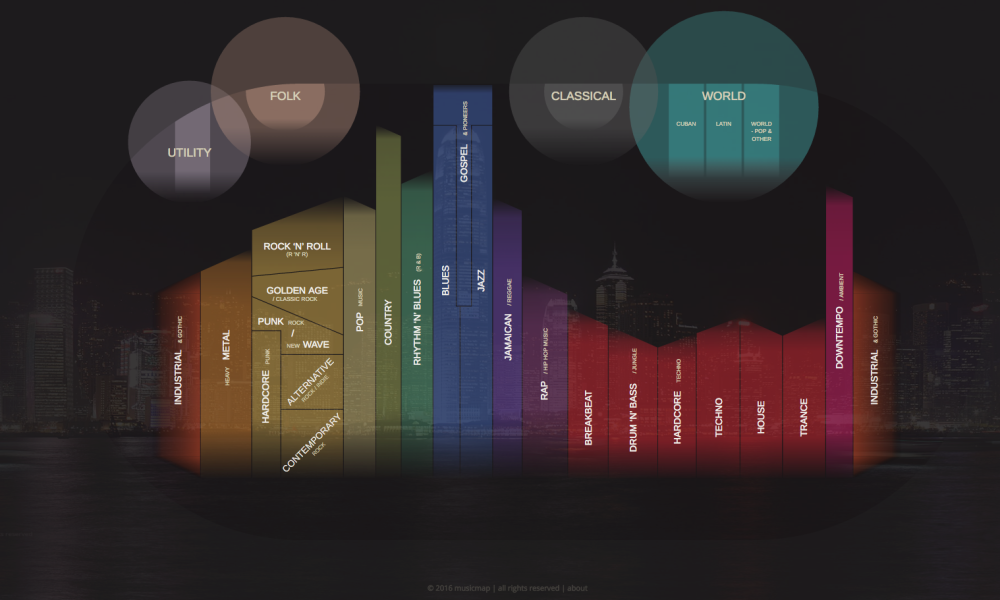
Now a new interactive infographic built by Belgian architect Kwinten Crauwels brings together an encyclopedic visual reference with an exhaustive musical archive. Though it’s missing some of the features of the resources above, the Musicmap far surpasses anything of its kind online—“both a 23and me-style ancestral tree and a thorough disambiguation of just about every extant genre of music,” writes Fast Company.
Or as Frank Jacobs explains at Big Think, Crauwels’ goal is “to provide the ultimate genealogy of popular music genres, including their relations and history.”
With over 230 genres in all—linked together in intricate webs of influence, mapped in a zoomable visual interface that organizes them all at macro and micro levels of description, and linked to explanatory articles and representative playlists (drawn from YouTube)—the project is almost too comprehensive to believe, and its degree of sophistication almost too complex to summarize concisely (though Jacobs does a good job of it). The Musicmap spans the years 1870–2016 and covers 22 major categories (with Rock further broken into six and “World” into three).
In an oval around the colorful skyscraper-like “super-genres” are decades, moving from past to present from top to bottom. Zoom into the “super-genres” and find “a spider’s web of links within and between the different houses” of subgenres. “Those links can indicate parentage or influence, but also a backlash (i.e. as ‘anti-links’).” Clicking on the name of each subgenre reveals “a short synopsis and a playlist of representative songs.” These two functions, in turn, link to each other, allowing users to click through in a more Wikipedia-like way once they’ve entered the minutiae of the Musicmap’s contents.
The map not only draws connections between subgenres but also between their relatives in other “super-genres” (learn about the relationship, for example, between folk rock and classic metal). On the left side of the screen is a series of buttons that reveal an introduction, methodology, abstract, several navigational functions, a glossary of musical terms, and a bibliography (called “Acknowledgments”). Aside from visually reducing all the way down to the level of individual bands within each subgenre, which could become a little dizzying, it’s hard to think of anything seriously lacking here.
Anything we might find fault with might be changed in the near future. Although Crauwels spent almost ten years on research and development, first conceiving of the project in 2008, the current site “is still version 1.0 of Music map. In later versions, the playlists will be expanded, perhaps even community-generated.” Crauwels also wants to sync up with Spotify. Although not a musician himself, he is as passionate about music as he is about design and education, making him very likely the perfect person to take on this task, which he admits can never be completed.
Crauwels does not currently seem to have plans to monetize his map. His stated motives are altruistic, in the same public service spirit as Radiooooo. “Musicmap,” he says, “believes that knowledge about music genres is a universal right and should be part of basic education.” At the moment, the education here only applies to popular music, although enough of it to acquire a graduate-level historical knowledge base.
The four categories at the top of the map—the strangely named “Utility” (which includes hymns, military marches, musicals, and soundtracks), Folk, Classical, and World—are zoomable but do not have clickable links or playlists. Given Crauwels’ completist instincts, this may well change in future updates. In the TED talk above, see him tell the story of how he created Musicmap, a DIY effort that came out of his frustration that nothing like it existed, so he had to create it himself.
Enter the Musicmaphere and try not to get lost for several hours.
What does it mean to “grow up”? Every culture has its way of defining adulthood, whether it’s surviving an initiation ritual or filing your first tax return. I’m only being a little facetious—people in the U.S. have long felt dissatisfaction with the ways we are ushered into adulthood, from learning how to fill out IRS forms to learning how to fill out student loan and credit card applications, our culture wants us to understand our place in the great machine. All other pressing life concerns are secondary.
It’s little wonder, then, that gurus and cultural father figures of all types have found ready audiences among America’s youth. Such figures have left lasting legacies for decades, and not all of them positive. But one public intellectual from the recent past is still seen as a wise old master whose far-reaching influence remains with us and will for the foreseeable future. Joseph Campbell’s obsessive, erudite books and lectures on world mythologies and traditions have made certain that ancient adulthood rituals have entered our narrative DNA.
When Campbell was awarded the National Arts Club Gold Medal in Literature in 1985, psychologist James Hillman stated that “no one in our century—not Freud, not Thomas Mann, not Levi-Strauss—has so brought the mythical sense of the world and its eternal figures back into our everyday consciousness.” Whatever examples Hillman may have had in mind, we might rest our case on the fact that without Campbell there would likely be no Star Wars. For all its success as a megamarketing phenomenon, the sci-fi franchise has also produced enduringly relatable role models, examples of achieving independence and standing up to imperialists, even if they be your own family members in masks.
In the video interviews above from 1987, Campbell professes himself no more than an “underliner” who learned everything he knows from books. Like the contemporary comparative mythologist Mircea Eliade, Campbell did not conduct his own anthropological research—he acquired a vast amount of knowledge by studying the sacred texts, artifacts, and rituals of world cultures. This study gave him insight into stories and images that continue to shape our world and feature centrally in huge pop cultural productions like The Last Jedi and Black Panther.
Campbell describes ritual entries into adulthood that viewers of these films will instantly recognize: Defeating idols in masks and taking on their power; burial enactments that kill the “infantile ego” (academics, he says with a straight face, sometimes never leave this stage). These kinds of edge experiences are at the very heart of the classic hero’s journey, an archetype Campbell wrote about in his bestselling The Hero with a Thousand Facesand popularized on PBS in The Power of Myth, a series of conversations with Bill Moyers.
In the many lectures just above—48 hours of audio in which Campbell expounds his theories of the mythological—the engaging, accessible writer and teacher lays out the patterns and symbols of mythologies worldwide, with special focus on the hero’s journey, as important to his project as dying and rising god myths to James Frazer’s The Golden Bough, the inspiration for so many modernist writers. Campbell himself is more apt to reference James Joyce, Carl Jung, Pablo Picasso, or Richard Wagner than science fiction, fantasy, or comic books (though he did break down Star Wars in his Moyers interviews). Nonetheless, we have him to thank for inspiring the likes of George Lucas and becoming a “patron saint of superheroes” and space operas.
We will find some of Campbell’s methods flawed and terminology outdated (no one uses “Orient” and “Occident” anymore)—and modern heroes can just as well be women as men, passing through the same kinds of symbolic trials in their origin stories. But Campbell’s ideas are as resonant as ever, offering to the wider culture a coherent means of understanding the archetypal stages of coming of age. As Hollywood executive Christopher Vogler said in 1985, after recommending The Hero with a Thousand Faces as a guide for screenwriters, Campbell’s work “can be used to tell the simplest comic story or the most sophisticated drama”—a sweeping vision of human cultural history and its meaning for our individual journeys.
You can access the 48 hours of Joseph Campbell lectures above, or directly on Spotify.
On the “Data is Beautiful” subreddit, a user named Udzu posted a visualisation of the Periodic Table of Elements that highlights the year and country in which each element was discovered. You can view it in a larger format here. Elaborating on how the graphic was made, he adds (his words, not mine, follow):
The year and country of discovery are taken from Wikipedia and are based on when the element was first observed or predicted rather than when it was first isolated.
The priority for the discoveries is often contentious. The visualisation uses the listings currently in the Wikipedia article, with no claim as to their accuracy.
The country is typically both the citizenship of the discoverer and the location of discovery. Exceptions include Hafnium (discovered by a Dutch and Hungarian duo in Copenhagen) and Radon (discovered by a British and American duo in Montreal); these are listed under location.
Countries and flags are of the modern equivalents when appropriate: e.g. Russia rather than the USSR, UK rather than England/Scotland, and Mexico rather than New Spain.
Dada demands explanation, yet it somehow also demands not to be explained. In the nearly 102 years since its inception, many attempts at summary and analysis of that early 20th-century European avant-garde movement have emerged; as you can see in the related links at the bottom of the post, we’ve featured a fair few of them here on Open Culture. But to truly understand Dada, you must, to the extent possible, get inside the heads of its founders, and one shortcut to that artistically rich destination takes the form of something any movement worth its salt — especially any early 20th-century European avant-garde movement — will have drawn up: its manifesto.
“The magic of a word – Dada – which has brought journalists to the gates of a world unforeseen, is of no importance to us,” wrote Romanian-French essayist, poet, and performance artist Tristan Tzara almost exactly a century ago.
To put out a manifesto you must want: ABC
to fulminate against 1, 2, 3
to fly into a rage and sharpen your wings to conquer and disseminate little abcs and big ABCs, to sign, shout, swear, to organize prose into a form of absolute and irrefutable evidence, to prove your non plus ultra and maintain that novelty resembles life just as the latest-appearance of some whore proves the essence of God. His existence was previously proved by the accordion, the landscape, the wheedling word. To impose your ABC is a natural thing — hence deplorable.
In this Dada Manifesto of March 23, 1918 (read it online here), Tzara goes on to define “Dada” as “a word that throws up ideas so that they can be shot down; every bourgeois is a little playwright, who invents different subjects and who, instead of situating suitable characters on the level of his own intelligence, like chrysalises on chairs, tries to find causes or objects (according to whichever psychoanalytic method he practices) to give weight to his plot, a talking and self-defining story.” And further down, just in case you haven’t quite got the picture: “DADA DOES NOT MEAN ANYTHING.”
Different translations of Tzara’s words, of which you can hear readings in the videos at the top of the post and just above, put it somewhat differently: “Dada means nothing,” says another. But whatever it means, exactly — or doesn’t mean, exactly — Dada burned brightly enough during its brief heyday to produce not just one manifesto, but two. “As in every human endeavor when two strong personalities meet, opinions may clash and an argument often ensues,” writes Eli Anapur at Widewalls. The German writer Hugo Ball actually wrote his own Dada manifesto before Tzara did, in 1916. “Both Manifestos are explanations of the Dada movement and its goals, but the content differs as long as the modes of spreading the movement throughout Europe and ultimately world, were concerned.”
Ball begins by describing Dada as “a new tendency in art. One can tell this from the fact that until now nobody knew anything about it, and tomorrow everyone in Zurich will be talking about it.” For the word itself he cites several dictionary definitions: “In French it means ‘hobby horse.’ In German it means ‘good-by,’ ‘Get off my back,’ ‘Be seeing you sometime.’ In Romanian: ‘Yes, indeed, you are right, that’s it. But of course, yes, definitely, right.’ ” Yet what a useful word it can be:
How does one achieve eternal bliss? By saying dada. How does one become famous? By saying dada. With a noble gesture and delicate propriety. Till one goes crazy. Till one loses consciousness. How can one get rid of everything that smacks of journalism, worms, everything nice and right, blinkered, moralistic, europeanized, enervated? By saying dada. Dada is the world soul, dada is the pawnshop. Dada is the world’s best lily-milk soap. Dada Mr. Rubiner, dada Mr. Korrodi. Dada Mr. Anastasius Lilienstein.
One hundred years on, the tenets of Dada may not look like an obvious route to eternal bliss, fame, or the excision of bothersome elements of life. But something about the notion at the movement’s core — of moving radically beyond sense as a response to the state of the world — still resonates today. The Europe of 1918 found itself in a bad spot, to put it mildly, but most of us in the early 21st century also feel, at least occasionally, surrounded by a reality that has lost its own sense. How much could it hurt to heed Ball and Tzara’s words and just say dada?
Based in Seoul, Colin Marshall writes and broadcasts on cities and culture. His projects include the book The Stateless City: a Walk through 21st-Century Los Angeles and the video series The City in Cinema. Follow him on Twitter at @colinmarshall or on Facebook.
All successful products are alike; every unsuccessful product is unsuccessful in its own way. Or so a modern-day Tolstoy might find himself inspired to write after a visit to the Museum of Failure, a movable feast of flops which began last year in Helsingborg, Sweden and has now opened its doors on Hollywood Boulevard in Los Angeles. The Donald Trump board game, Apple’s Newton, Nokia’s N‑Gage, Ford’s Edsel, Colgate Beef Lasagne, Harley-Davidson Cologne, New Coke, Google Glass: these and other shining examples of failure appear in the videos about the museum at the top of the post and just below.
Considered today, many of these products, whether well-known or thoroughly obscure, look hilariously ill-conceived. But the Museum of Failure’s founder, a psychologist named Samuel West, does have high praise for some of the products he’s collected in his institution.
As you’ll find out on a visit there, though, they’ve all got at least one fatal flaw — a design problem, bad timing, misjudgment of the market, falling into the cracks of existing offerings — that drove consumers away. You can’t say that any of them didn’t take a risk, but risks, by their very nature, burn out more often than they pay off.
“Why do I have all these failures?” asks West in his TED Talk. “The point of having the museum is that we can learn from these failures. I want us to start to admit our failures as companies, as individuals, so we can learn from it.” America’s relative lack of cultural stigmatization of failure often gets cited among the reasons for the country’s reputation for innovation and economic dynamism, but there, as anywhere else, an increased willingness not just to fail but to better understand the nature of individual failures wouldn’t go amiss. Nothing succeeds like success, so the saying goes, but the fascination that has built around the Museum of Failure so far suggests that we have much to gain from its opposite as well.
Based in Seoul, Colin Marshall writes and broadcasts on cities and culture. His projects include the book The Stateless City: a Walk through 21st-Century Los Angeles and the video series The City in Cinema. Follow him on Twitter at @colinmarshall or on Facebook.
We're hoping to rely on loyal readers, rather than erratic ads. Please click the Donate button and support Open Culture. You can use Paypal, Venmo, Patreon, even Crypto! We thank you!
Open Culture scours the web for the best educational media. We find the free courses and audio books you need, the language lessons & educational videos you want, and plenty of enlightenment in between.