The Paintings of Filmmaker/Visual Artist David Lynch

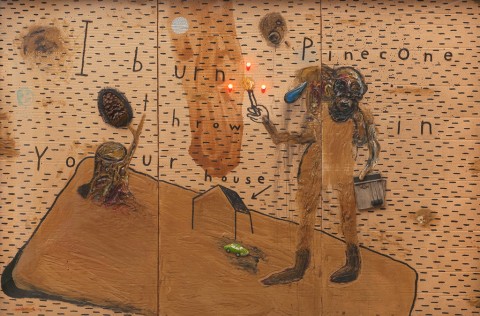
I Burn Pinecone and throw it in your house

David Lynch

It was 1967, and David Lynch, a stu­dent at the Penn­syl­va­nia Acad­e­my of the Fine Arts, was up late in his stu­dio when he had a vision. The plants in the paint­ing he was work­ing on seemed to be mov­ing. “I’m look­ing at this and hear­ing this,” he recalled, “and I say, ‘Oh, a mov­ing paint­ing.’ And that was it.”

That thun­der­bolt of an idea put him on the road towards cre­at­ing some of the most unset­tling and sur­re­al images in cin­e­ma from the danc­ing dream dwarf in Twin Peaks to those freaky lit­tle peo­ple in Mul­hol­land Dri­ve. His first step was the mul­ti­me­dia work “Six Men Get­ting Sick” – a large-scale work con­sist­ing of paint­ing, sculp­ture and a one-minute film loop, Lynch’s first for­ay into film. His sub­se­quent ear­ly film work, from The Grand­moth­er to Eraser­head, feels like an exten­sion of his fine art work. “As a painter, you do every­thing your­self, and I thought cin­e­ma was that way,” Lynch said, “like a paint­ing, but you have peo­ple help­ing you.” Of course, by the time he made his big bud­get dud Dune, he was thor­ough­ly dis­abused of that notion.

Yet while becom­ing one of Hollywood’s most influ­en­tial direc­tors, he con­tin­ued to paint. Last year his alma mater unveiled a ret­ro­spec­tive of his art­work from 1965 to the present called “David Lynch: The Uni­fied Field.” Much of the work is from the late-90s on, a time when Lynch found him­self detach­ing more and more from Hol­ly­wood. His last fea­ture film, Inland Empire, came out in 2006. Appar­ent­ly, he was spend­ing much of his free time in the stu­dio.

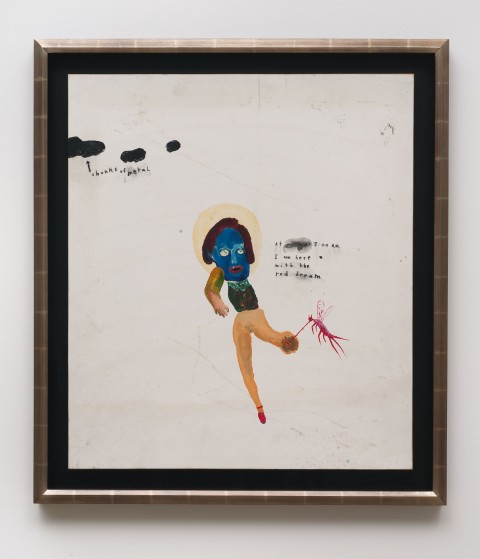
At 3 A.M. I Am Here With The Red Dream

David Lynch

His work dur­ing this peri­od is inten­tion­al­ly crude and child­like, com­bin­ing car­toon­ish images with preg­nant, semi-intel­li­gi­ble text. Sure, his paint­ings don’t have the pri­mal, psy­cho­sex­u­al pow­er of his movies, but there is still some­thing com­pelling about them. Take, for insis­tence, the mul­ti­me­dia work “I Burn Pinecone and throw it in your house” (top). It looks like a dement­ed children’s book nar­rat­ed by a crazed moun­tain man.

“At 3 A.M. I Am Here With The Red Dream” (mid­dle) looks like the prod­uct of a men­tal patient, com­plete with smudged out text and Hen­ry Darg­er-esque girl legs.

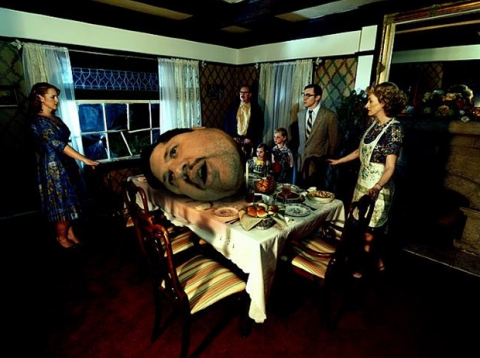
Grim Augury

David Lynch

Of course, Lynch didn’t restrict him­self to paint­ing. He has also worked in dig­i­tal pho­tog­ra­phy. In his 2009 work, Unti­tled (Grim Augury #1), (bot­tom) Lynch depicts a Sun­day din­ner gone hor­ri­bly, inex­plic­a­bly, wrong.

You can watch a video of the exhib­it below. Find an online gallery of Lynch’s artis­tic works here.

Relat­ed Con­tent:

David Lynch’s Unlike­ly Com­mer­cial for a Home Preg­nan­cy Test (1997)

David Lynch Teach­es You to Cook His Quinoa Recipe in a Weird, Sur­re­al­ist Video

What David Lynch Can Do With a 100-Year-Old Cam­era and 52 Sec­onds of Film

Jonathan Crow is a Los Ange­les-based writer and film­mak­er whose work has appeared in Yahoo!, The Hol­ly­wood Reporter, and oth­er pub­li­ca­tions. You can fol­low him at @jonccrow. And check out his blog Veep­to­pus, fea­tur­ing lots of pic­tures of bad­gers and even more pic­tures of vice pres­i­dents with octo­pus­es on their heads.  The Veep­to­pus store is here.

Stanford Launches Free Course on Developing Apps with iOS 8

i0s8 apps stanford

Quick note: When­ev­er Apple releas­es a new ver­sion of iOS, Stan­ford even­tu­al­ly releas­es a course telling you how to devel­op apps in that envi­ron­ment. iOS 8 came out last fall, and now the iOS 8 app devel­op­ment course is get­ting rolled out this quar­ter. It’s free online, of course, on iTunes.

You can now find “Devel­op­ing iOS Apps with Swift” housed in our col­lec­tion of Free Com­put­er Sci­ence Cours­es, which cur­rent­ly fea­tures 117 cours­es in total, includ­ing some basic Har­vard cours­es that will teach you how to code in 12 weeks.

As always, cours­es from oth­er dis­ci­plines can be found on our larg­er list, 1,700 Free Online Cours­es from Top Uni­ver­si­ties.

Fol­low us on Face­book, Twit­ter and Google Plus and share intel­li­gent media with your friends. Or bet­ter yet, sign up for our dai­ly email and get a dai­ly dose of Open Cul­ture in your inbox.

by | Permalink | Make a Comment ( 4 ) |

Arthur C. Clarke Predicts in 2001 What the World Will Look By December 31, 2100

Clarke_sm

“Clarke sm” by Amy Marash. Licensed under Pub­lic Domain via Wiki­me­dia Com­mons

When you want a vision of the future, I very much doubt you turn to Read­er’s Digest for it. But Arthur C. Clarke did once appear in its small-for­mat pages to pro­vide just that, and when Arthur C. Clarke talks about the future, you’d do well to lis­ten. Last year, we fea­tured a 1964 BBC doc­u­men­tary in which the sci­ence-fic­tion lumi­nary pre­dict­ed the inter­net, 3D print­ers, and trained mon­key ser­vants. Today, we’d like to link you up to his Read­er’s Digest pre­dic­tions from the com­par­a­tive­ly recent year of 2001 — one in which, for obvi­ous rea­sons, Clarke made the media rounds — which you can read in full at arthurcclarke.net. Some high­lights of his spec­u­la­tive time­line from 2001 to 2100:

  • By 2010, com­mer­cial nuclear devices, house­hold quan­tum gen­er­a­tors, and ful­ly re-engi­neered auto­mo­bile engines will have end­ed the Fos­sil Fuel Age. We’ll have seen the first acknowl­edged human clone and seen off the last human crim­i­nal.
  • By 2020, we’ll have dis­cov­ered a 76-meter octo­pus, fly on “aero­space-planes” (one of which will car­ry Prince Har­ry), and trade in “mega-watt-hours” instead of any now-known cur­ren­cies, and tsunamis caused by a mete­or will wreck the coasts of Green­land and Cana­da (prompt­ing the devel­op­ment of new mete­or-detect­ing tech­nolo­gies).
  • By 2030, arti­fi­cial intel­li­gence will have reached human lev­el, we’ll have land­ed on Mars, com­put­er-gen­er­at­ed DNA will make pos­si­ble a real-life Juras­sic Park, and the neu­ro­log­i­cal “brain­cap” will allow us the direct sen­so­ry expe­ri­ence of any­thing at all.
  • By 2040, the “uni­ver­sal repli­ca­tor” will allow us to cre­ate any object at all in the com­fort of our own homes, result­ing in the phase-out of work and a boom in arts, enter­tain­ment, and edu­ca­tion.
  • By 2050, Buck­min­ster Fuller-style self-con­tained mobile homes become a real­i­ty, and humans scat­tered as far as “Earth, the Moon, Mars, Europa, Ganymede and Titan, and in orbit around Venus, Nep­tune and Plu­to” cel­e­brate the cen­te­nary of Sput­nik 1.
  • By 2090, Hal­ley’s comet will have returned, and on it we’ll have found life forms that vin­di­cate “Wick­ra­mas­inghe and Hoyle’s cen­tu­ry-old hypoth­e­sis that life exists through space.” We’ll also start burn­ing fos­sil fuels again, both as a replace­ment for the car­bon diox­ide we’ve “mined” from the air and to fore­stall the next Ice Age by warm­ing the globe back up a bit.
  • By 2100, we’ll have replaced rock­ets with a “space dri­ve” that lets us trav­el close to the speed of light. And so, Clarke writes, “his­to­ry begins…”

You’ll notice, of course, that we’re already behind Clarke’s vision, accord­ing to which many a still-improb­a­ble devel­op­ment also lies ahead in the near future. In any case, though, the end of crime, the begin­ning of pri­vate space trav­el, and the era of the Dymax­ion home must come soon­er or lat­er, must­n’t they? And as Clarke him­self admits, one plays a mug’s game when one pre­dicts, even when one does it with uncom­mon astute­ness. “In 1971 I pre­dict­ed the first Mars Land­ing in 1994,” he remem­bers in the pre­am­ble to his list. “On the oth­er hand, I thought I was being wild­ly opti­mistic in 1951 by sug­gest­ing a mis­sion to the moon in 1978. Neil Arm­strong and Buzz Aldrin beat me by almost a decade.”

But to this day, Clarke’s score­card looks bet­ter than most of ours: “I take pride in the fact that com­mu­ni­ca­tions satel­lites are placed exact­ly where I sug­gest­ed in 1945, and the name “Clarke Orbit” is often used (if only because it’s eas­i­er to say than ‘geo­sta­tion­ary orbit’).” Who knows what he could tell us to watch out for now if, as he pre­dict­ed in 2001, he’d lived to see his hun­dredth birth­day aboard the Hilton Orbiter Hotel?

Relat­ed Con­tent:

Arthur C. Clarke Nar­rates Film on Mandelbrot’s Frac­tals; David Gilmour Pro­vides the Sound­track

Isaac Asi­mov Pre­dicts in 1964 What the World Will Look Like Today — in 2014

Free Sci­ence Fic­tion Clas­sics on the Web: Hux­ley, Orwell, Asi­mov, Gaiman & Beyond

Bet­ter Liv­ing Through Buck­min­ster Fuller’s Utopi­an Designs: Revis­it the Dymax­ion Car, House, and Map

Col­in Mar­shall hosts and pro­duces Note­book on Cities and Cul­ture as well as the video series The City in Cin­e­ma and writes essays on cities, lan­guage, Asia, and men’s style. He’s at work on a book about Los Ange­les, A Los Ange­les Primer. Fol­low him on Twit­ter at @colinmarshall or on Face­book.

Stream Classic Poetry Readings from Harvard’s Rich Audio Archive: From W.H. Auden to Dylan Thomas

harvard poetry

Found­ed in 1931, the Wood­ber­ry Poet­ry Room at Har­vard Uni­ver­si­ty fea­tures (among oth­er things) 6,000 record­ings of poet­ry from the 20th and 21st cen­turies. There you can find some of the ear­li­est record­ings of W. H. Auden, Eliz­a­beth Bish­op, T. S. Eliot, Denise Lev­er­tov, Robert Low­ell, Anais Nin, Ezra Pound, Robert Penn War­ren, Ten­nessee Williams and many oth­ers.

In the “Lis­ten­ing Booth,” a sec­tion of the Poet­ry Room web­site, you can lis­ten to record­ings of clas­sic read­ings by near­ly 200 authors, includ­ing John Berry­man, Robert Bly, Jorge Luis Borges, Joseph Brod­sky, Jorie Gra­ham, Sea­mus Heaney, Jack Ker­ouac, Adri­enne Rich, Anne Sex­ton, Wal­lace Stevens, Dylan Thomas, Anne Wald­man, William Car­los Williams and more. The sound files are all free to stream. And if this is your kind of thing, make sure you vis­it the Penn Sound archive at the Uni­ver­si­ty of Penn­syl­va­nia, which is an equal­ly rich and amaz­ing audio archive. We pre­vi­ous­ly fea­tured it here.

If you would like to sup­port the mis­sion of Open Cul­ture, con­sid­er mak­ing a dona­tion to our site. It’s hard to rely 100% on ads, and your con­tri­bu­tions will help us con­tin­ue pro­vid­ing the best free cul­tur­al and edu­ca­tion­al mate­ri­als to learn­ers every­where. You can con­tribute through Pay­Pal, Patre­on, and Ven­mo (@openculture). Thanks!

Relat­ed Con­tent:

1,000 Free Audio Books: Down­load Great Books for Free

Bill Mur­ray Reads Great Poet­ry by Bil­ly Collins, Cole Porter, and Sarah Man­gu­so

13 Lec­tures from Allen Ginsberg’s “His­to­ry of Poet­ry” Course (1975)

Son­ic Youth Gui­tarist Thurston Moore Teach­es a Poet­ry Work­shop at Naropa Uni­ver­si­ty: See His Class Notes (2011)

Down­load 55 Free Online Lit­er­a­ture Cours­es: From Dante and Mil­ton to Ker­ouac and Tolkien

An Illustration of Every Page of Herman Melville’s Moby Dick

md489_12112010

Her­man Melville’s Moby Dick, the work he is most known for in death, had the effect in life of ruin­ing his lit­er­ary rep­u­ta­tion and dri­ving him into obscu­ri­ty. This is but one of many ironies attend­ing the mas­sive nov­el, first pub­lished in Britain in three vol­umes on Octo­ber 18, 1851. At that time, it was sim­ply called The Whale, and as Melville.org informs us, was “expur­gat­ed to avoid offend­ing del­i­cate polit­i­cal and moral sen­si­bil­i­ties.” One month lat­er, the first Amer­i­can edi­tion appeared, now titled Moby Dick; Or, The Whale, com­piled into one huge vol­ume, and with its cen­sored pas­sages, includ­ing the Epi­logue, restored. In both print­ings, the book sold poor­ly, and the reviews—save those from a hand­ful of Amer­i­can crit­ics, includ­ing Melville’s fel­low Great Amer­i­can nov­el­ist Nathaniel Hawthorne—were large­ly neg­a­tive.

"God keep me! — keep us all!" murmured Starbuck, lowly.

Anoth­er irony sur­round­ing the nov­el is one near­ly every­one who’s read it, or tried to read it, will know well. We’re social­ized through visu­al media to approach the sto­ry as great, trag­ic action/adventure. As Melville’s friend, pub­lish­er Evert Augus­tus Duy­ck­inck, described it, the nov­el is osten­si­bly “a roman­tic, fan­ci­ful & lit­er­al & most enjoy­able pre­sent­ment of the Whale Fish­ery,” dri­ven by the revenge plot of mad old Cap­tain Ahab. And yet, it is not that at all, or not sim­ply that. Despite the fact that it lends itself so well to adven­tur­ous retelling, the nov­el itself can seem very obscure, pon­der­ous, and digres­sive to a mad­den­ing degree. The so-called “whal­ing chap­ters,” notably “Cetol­ogy,” delve deeply into the lore and tech­nique of whal­ing, the anato­my and phys­i­ol­o­gy of var­i­ous whale species, and the his­to­ry and pol­i­tics of the ven­ture.

Through­out the nov­el, ordi­nary objects and events—especially, of course, the whale itself—acquire such sym­bol­ic weight that they become almost car­toon­ish tal­is­mans and leap bewil­der­ing­ly out of the nar­ra­tive, forc­ing the read­er to con­tem­plate their significance—no easy task. Depend­ing on your sen­si­bil­i­ties and tol­er­ance for Melville’s labyrinthine prose, these very strange fea­tures of the nov­el are either indis­pens­ably fas­ci­nat­ing or just plain excess bag­gage. Since many edi­tions are pub­lished with the whal­ing chap­ters excised, many read­ers clear­ly feel they are the lat­ter. That is unfor­tu­nate, I think. It’s one of my favorite nov­els, in all its baroque over­stuffed­ness and philo­soph­i­cal den­si­ty. But there’s no deny­ing that it works, as they say, “on many lev­els.” Depend­ing on how you expe­ri­ence the book—it’s either an incred­i­bly grip­ping adven­ture tale, or a very dense and puz­zling work of his­to­ry, phi­los­o­phy, pol­i­tics, and zool­o­gy… or both, and more besides….

md001_08052009

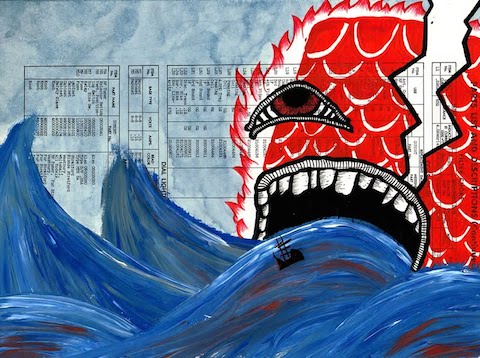
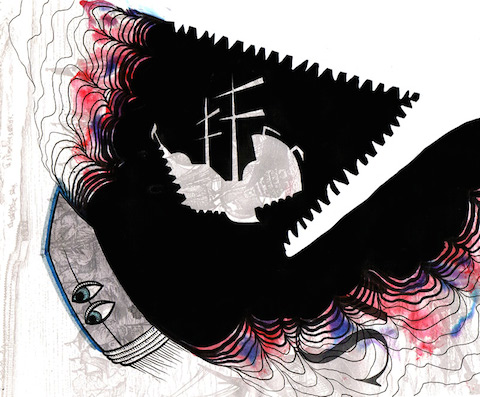
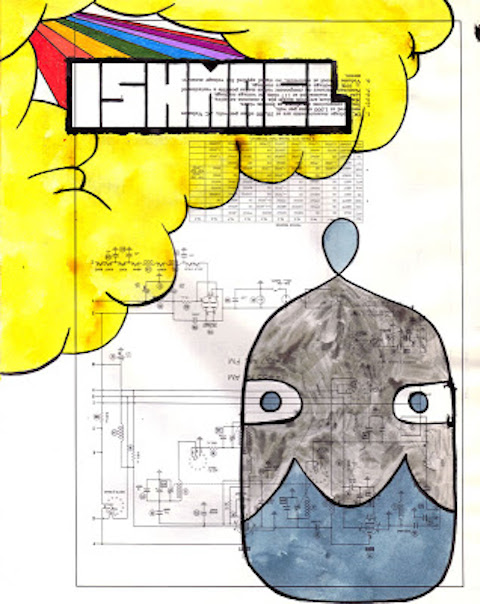
Rec­og­niz­ing the pow­er of Melville’s arrest­ing imagery, artist and librar­i­an Matt Kish decid­ed that he would illus­trate all 552 pages of the Signet Clas­sic paper­back edi­tion of Moby Dick, a book he con­sid­ers “to be the great­est nov­el ever writ­ten.” He began the project in August of 2009 with the first page, illus­trat­ing those famous first words—“Call me Ishmael”—above. (At the top, see page 489, below it page 158, and direct­ly below, page 116). Kish com­plet­ed his epic project at the end of 2010. He used a vari­ety of media—ink, water­col­or, acrylic paint—and incor­po­rat­ed a num­ber of dif­fer­ent graph­ic art styles. As he explains in the com­ments under the first illus­tra­tion, he chose “draw­ing and paint­ing over pages from old books and dia­grams because the pres­ence of visu­al infor­ma­tion on those pages would in some ways inter­fere with, and clut­ter up, my own obses­sive con­trol over my marks.” All in all, it’s a very admirable under­tak­ing, and you can see each indi­vid­ual illus­tra­tion, and many of the stages of draft­ing and com­po­si­tion, at Kish’s blog or on this list we’ve com­piled. (You can also find links to the first 25 pages at bot­tom of this post.) The entire project has also been pub­lished as a book, Moby-Dick in Pic­tures: One Draw­ing for Every Page, a fur­ther irony giv­en the obses­sive lit­er­ari­ness of Melville’s nov­el, a work as obsessed with lan­guage as Cap­tain Ahab is with his great white neme­sis.

md116_12282009

Nonethe­less, what Kish’s project fur­ther demon­strates is the seem­ing­ly inex­haustible trea­sure house that is Moby Dick, a book that so rich­ly appeals to all the sens­es as it also cease­less­ly engages the intel­lect. Kish has gone on to apply his won­der­ful inter­pre­tive tech­nique to oth­er clas­sic lit­er­ary works, includ­ing Joseph Conrad’s Heart of Dark­ness and Ita­lo Calvino’s Invis­i­ble Cities. These projects are equal­ly strik­ing, but it’s Moby Dick, “the great unread Amer­i­can nov­el,” that most inspired Kish, as it has so many oth­er artists and read­ers.

Relat­ed Con­tent:

The Moby Dick Big Read: Celebri­ties and Every­day Folk Read a Chap­ter a Day from the Great Amer­i­can Nov­el

A View From the Room Where Melville Wrote Moby Dick (Plus a Free Celebri­ty Read­ing of the Nov­el)

How Ray Brad­bury Wrote the Script for John Huston’s Moby Dick (1956)

Orson Welles Reads Moby Dick

Josh Jones is a writer and musi­cian based in Durham, NC. Fol­low him at @jdmagness

The Little Albert Experiment: The Perverse 1920 Study That Made a Baby Afraid of Santa Claus & Bunnies

The field of psy­chol­o­gy is very dif­fer­ent than it used to be. Nowa­days, the Amer­i­can Psy­cho­log­i­cal Asso­ci­a­tion has a code of con­duct for exper­i­ments that ensures a subject’s con­fi­den­tial­i­ty, con­sent and gen­er­al men­tal well being. In the old days, it was­n’t the case.

Back then, you could, for instance, con sub­jects into think­ing that they were elec­tro­cut­ing a man to death, as they did in the infa­mous 1961 Mil­gram exper­i­ment, which left peo­ple trau­ma­tized and hum­bled in the knowl­edge that deep down they are lit­tle more than weak-willed pup­pets in the face of author­i­ty. You could also try to turn a group of unsus­pect­ing orphans into stut­ter­ers by method­i­cal­ly under­min­ing their self-esteem as the folks who ran the apt­ly named Mon­ster Study of 1939 tried to do. But, if you real­ly want to get into the swamp of moral dubi­ous­ness, look no fur­ther than the Lit­tle Albert exper­i­ments, which trau­ma­tized a baby into hat­ing dogs, San­ta Claus and all things fuzzy.

Albert-and-rabbit-1024x718

In 1920, Johns Hop­kins pro­fes­sor John B. Wat­son was fas­ci­nat­ed with Ivan Pavlov’s research on con­di­tioned stim­u­lus. Pavlov famous­ly rang a bell every time he fed his dogs. At first the food caused the dogs to sali­vate, but after a spell of pair­ing the bell with din­ner, the dogs would even­tu­al­ly sali­vate at just the sound of the bell. That’s called a con­di­tioned response. Wat­son want­ed to see if he could cre­ate a con­di­tioned response in a baby.

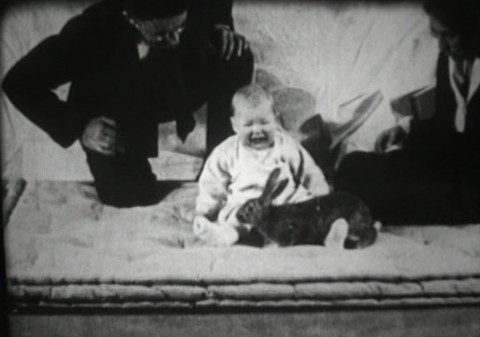
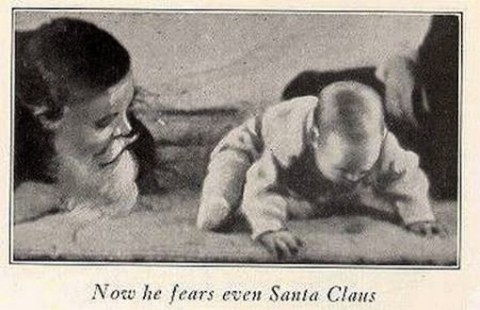
Enter 9‑month old Albert B., AKA Lit­tle Albert. At the begin­ning of the exper­i­ment, Albert was pre­sent­ed with a white rat, a dog, a white rab­bit, and a mask of San­ta Claus among oth­er things. The lad was unafraid of every­thing and was, in fact, real­ly tak­en with the rat. Then every time the baby touched the ani­mals, sci­en­tists struck a met­al bar behind him, cre­at­ing a star­tling­ly loud bang. The sound freaked out the child and soon, like Pavlov’s dogs, Lit­tle Albert grew ter­ri­fied of the rat and the mask of San­ta and even a fur coat. The par­tic­u­lar­ly messed up thing about the exper­i­ment was that Wat­son didn’t even both to reverse the psy­cho­log­i­cal trau­ma he inflict­ed.

Little-albert

What hap­pened to poor baby Albert is hard to say, in part because no one is real­ly sure of the child’s true iden­ti­ty. He might have been Dou­glas Mer­ritte, as psy­chol­o­gists Hall P. Beck and Shar­man Levin­son argued in 2009. If that’s the case, then the child died at the age of 6 in 1925 of hydro­cephalus. Or he might have been William Albert Barg­er, as Russ Pow­ell and Nan­cy Dig­don argued in 2012. He passed away in 2007 at the age of 87. He report­ed­ly had a life­long aver­sion to dogs, though it can­not be deter­mined if it was a last­ing effect of the exper­i­ment.

Lat­er in life, Wat­son left aca­d­e­mics for adver­tis­ing.

You can watch a video of the exper­i­ment above.

via Men­tal Floss

Relat­ed Con­tent:

Free Online Psy­chol­o­gy Cours­es

How To Think Like a Psy­chol­o­gist: A Free Online Course from Stan­ford

Watch Footage from the Psy­chol­o­gy Exper­i­ment That Shocked the World: Milgram’s Obe­di­ence Study (1961)

Her­mann Rorschach’s Orig­i­nal Rorschach Test: What Do You See? (1921)

Jonathan Crow is a Los Ange­les-based writer and film­mak­er whose work has appeared in Yahoo!, The Hol­ly­wood Reporter, and oth­er pub­li­ca­tions. You can fol­low him at @jonccrow. And check out his blog Veep­to­pus, fea­tur­ing lots of pic­tures of bad­gers and even more pic­tures of vice pres­i­dents with octo­pus­es on their heads.  The Veep­to­pus store is here.

Bill Nye the Science Guy Takes the Air Out of Deflategate

Did the weath­er have any­thing to do with those balls deflat­ing in New Eng­land dur­ing the AFC cham­pi­onship game? It’s unlike­ly, very unlike­ly. Bill Nye explains why with sci­ence, but not with­out putting the hyped con­tro­ver­sy into per­spec­tive first. Take it away Bill.

Relat­ed Con­tent:

The Physics of a Quarterback’s Pass

Bill Nye, The Sci­ence Guy, Says Cre­ation­ism is Bad for Kids and America’s Future

Watch the High­ly-Antic­i­pat­ed Evolution/Creationism Debate: Bill Nye the Sci­ence Guy v. Cre­ation­ist Ken Ham

by | Permalink | Make a Comment ( 2 ) |

Richard Dawkins Reads “Love Letters” from “Fans” (NSFW)

Richard Dawkins — some know him as the Oxford evo­lu­tion­ary biol­o­gist who coined the term “meme” in his influ­en­tial 1976 book, The Self­ish Gene; oth­ers con­sid­er him a lead­ing fig­ure in the New Athe­ism move­ment, a posi­tion he has assumed unapolo­get­i­cal­ly. In recent years, Dawkins has made his case against reli­gion though dif­fer­ent forms of media: books, doc­u­men­taries, col­lege lec­tures, and pub­lic debates. He can be aggres­sive and snide, to be sure. But he dish­es out far less than he receives in return. Just wit­ness him read­ing the “love let­ters” (as he euphemisti­cal­ly calls them) that he has received from the gen­er­al pub­lic. They are not safe for work. You can see him read­ing a pre­vi­ous batch of let­ters here.

Relat­ed Con­tent:

Grow­ing Up in the Uni­verse: Richard Dawkins Presents Cap­ti­vat­ing Sci­ence Lec­tures for Kids (1991)

Richard Dawkins’ Doc­u­men­tary The God Delu­sion Tack­les Faith & Reli­gious Vio­lence (2006)

Richard Dawkins Explains Why There Was Nev­er a First Human Being

Free Online Biol­o­gy Cours­es

Hear Gandhi’s Famous Speech on the Existence of God (1931)

A per­fect sym­bol of the mech­a­nisms of British rule over India, the Salt Acts pro­hib­it­ed Indi­ans from access and trade of their own resources, forc­ing them to buy salt from British monop­o­lies, who taxed the min­er­al heav­i­ly. In 1930, in one of the defin­ing acts of his Satya­gra­ha move­ment, Mohan­das Gand­hi decid­ed to defy the Salt Act with a very grand gesture—a march, with thou­sands of his sup­port­ers, over a dis­tance of over 200 miles, to the Ara­bi­an Sea. Once there, fol­low­ing Gandhi’s lead, the crowd pro­ceed­ed to col­lect sea salt, prompt­ing British colo­nial police to arrest over 60,000 peo­ple, includ­ing Gand­hi him­self.

The 1930 action, the first orga­nized act of civ­il dis­obe­di­ence after the Indi­an Nation­al Con­gress’ dec­la­ra­tion of inde­pen­dence, got the atten­tion of the Viceroy, Lord Irwin, who had been direct­ing harsh repres­sive mea­sures against the grow­ing inde­pen­dence move­ment, and in Jan­u­ary of 1931, after his release, Gand­hi and Irwin signed a pact. Gand­hi agreed to end the move­ment; Irwin agreed to allow the Indi­ans to make their own salt, and the Indi­ans would have an equal role in nego­ti­at­ing India’s future. British offi­cials were out­raged and dis­gust­ed. Win­ston Churchill, for exam­ple, staunch­ly opposed to inde­pen­dence, called the meet­ing of the two lead­ers a “nau­se­at­ing and humil­i­at­ing spec­ta­cle,” say­ing “Gand­hi-ism and every­thing it stands for will have to be grap­pled with and crushed.” (Churchill favored let­ting Gand­hi die if he went on hunger strike.)

The terms of the pact, of course, did not hold, and the move­ment would con­tin­ue until even­tu­al inde­pen­dence in 1947. But Gand­hi had not only suc­ceed­ed in incur­ring the wrath of the British colo­nial­ists; he had also won many sup­port­ers in Eng­land. One of them, Muriel Lester, invit­ed the Indi­an leader to stay with her in Lon­don at a com­mu­ni­ty cen­ter she had found­ed called Kings­ley Hall. “He enjoyed his stay here,” says the cur­rent Kings­ley Hall man­ag­er David Bak­er, “and it was wise because if he had stayed in the West End the press would have lam­pooned him. He wouldn’t have had a life, but here he was left alone and walked around in the streets. He want­ed to stay with the peo­ple that he lived with in India, i.e. the poor.” How­ev­er, Gand­hi wasn’t total­ly ignored by the press. While at Kings­ley, he deliv­ered a short speech, which you can hear above, and the BBC was there to record it.

In the speech, Gand­hi says absolute­ly noth­ing about Indi­an inde­pen­dence, British oppres­sion, or the aims and tac­tics of the move­ment. He says noth­ing at all about pol­i­tics or any world­ly affairs what­so­ev­er. Instead, he lec­tures on the exis­tence of God, “an inde­fin­able mys­te­ri­ous pow­er that per­vades every­thing,” and which “defies all proof.” Gand­hi tes­ti­fies to “an unal­ter­able law gov­ern­ing every­thing and every being that exists or lives,” though he also con­fess­es “that I have no argu­ment to con­vince through rea­son.” Instead relies on analo­gies, on things he “dim­ly per­ceives,” on the “mar­velous research­es of [Indi­an engi­neer and sci­en­tist] Sir J.C. Bose,” and on “the expe­ri­ences of an unbro­ken line of prophets and sages in all coun­tries and climes.” It’s not a speech like­ly to per­suade any­one who isn’t already some sort of a believ­er, I think, but it’s of much inter­est to any­one inter­est­ed in the his­to­ry of Indi­an inde­pen­dence and in Gandhi’s life and mes­sage.

You can read the full text of the speech here, and see footage of Kings­ley Hall and a filmed inter­view with Muriel Lester, dis­cussing Gandhi’s stay, here.

Relat­ed Con­tent:

Mahat­ma Gandhi’s List of the 7 Social Sins; or Tips on How to Avoid Liv­ing the Bad Life

Mahat­ma Gand­hi Talks (in First Record­ed Video)

Albert Ein­stein Express­es His Admi­ra­tion for Mahat­ma Gand­hi, in Let­ter and Audio

Josh Jones is a writer and musi­cian based in Durham, NC. Fol­low him at @jdmagness

Confusion Through Sand: A Short, Hand-Drawn Animation on the Terror & Confusion of War

Back in Octo­ber 2012, Ornana Films raised $30,000 through a Kick­starter cam­paign to pro­duce Con­fu­sion Through Sand, an ani­ma­tion that “explores the spec­trum of haze expe­ri­enced by today’s sol­diers in the desert.” It’s an inter­pre­ta­tion, Ornana tells us, “of what hap­pens when top train­ing encoun­ters cir­cum­stances beyond the realm of human con­trol, in both inte­ri­or and exte­ri­or con­flicts.” The action takes place “on the ground, under the hel­met of a 19 year-old infantry­man.” Once com­plet­ed, the film pre­miered at the 2013 SXSW film fes­ti­val and took home the Jury Award. Now, a year lat­er, it’s free online. And even bet­ter, it comes accom­pa­nied by a behind-the-scenes film that takes you inside the film­mak­ers’ artis­tic process, show­ing how they hand-ani­mat­ed the film with mark­ers on recy­cled paper. Enjoy both.

If you would like to sup­port the mis­sion of Open Cul­ture, con­sid­er mak­ing a dona­tion to our site. It’s hard to rely 100% on ads, and your con­tri­bu­tions will help us con­tin­ue pro­vid­ing the best free cul­tur­al and edu­ca­tion­al mate­ri­als to learn­ers every­where. You can con­tribute through Pay­Pal, Patre­on, and Ven­mo (@openculture). Thanks!

The Cahiers du Cinéma Names the 10 Best Films of the Year, from 1951 to 2014


cahiers2

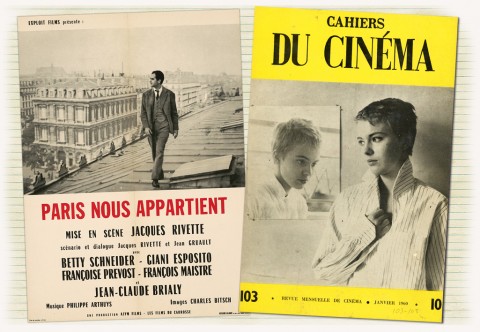
It’s hard to over­state the impact of Cahiers du ciné­ma on film his­to­ry.

In the ear­ly ‘50s, the great crit­ic André Bazin led a small coterie of film fanat­ics – guys with names like Jean-Luc Godard, François Truf­faut, Eric Rohmer and Jacques Riv­ette — who hung out at the Ciné­math­èque française. The­aters were flood­ed with Hol­ly­wood movies, real­ly for the first time since the begin­ning of World War II, and this group took the oppor­tu­ni­ty to watch any­thing they could get their hands on, from high brow art films to cut rate West­erns. They would watch any­thing.

In 1951, Bazin found­ed Cahiers and this band of cin­e­mat­ic out­siders became famous­ly bru­tal and uncom­pro­mis­ing icon­o­clasts. They praised low­ly genre films – film noir espe­cial­ly – as mas­ter­pieces while slam­ming the mid­dle­brow flicks the French film indus­try was crank­ing out at the time. Truf­faut was famous for being par­tic­u­lar­ly harsh, earn­ing the moniker “The Gravedig­ger of French Cin­e­ma.” His reviews were so acer­bic that he was the only French film crit­ic not invit­ed to cov­er the 1958 Cannes Film Fes­ti­val. (The fact that he then turned around and won the fest’s top prize the next year for his mas­ter­piece 400 Blows might be one of the great­est feats of badassery in cin­e­ma his­to­ry.)

Per­haps the Cahiers’ great­est con­tri­bu­tion was an arti­cle, writ­ten by Truf­faut in 1954, called “A Cer­tain Ten­den­cy of the French Cin­e­ma,” which was a man­i­festo for what would lat­er be called auteur the­o­ry – an idea that cer­tain direc­tors have such a com­mand of the medi­um that they impress their indi­vid­ual vision on a film, in the same way an author does to a book. This idea has been so com­plete­ly absorbed into pop­u­lar con­scious­ness that it’s hard to see just how rev­o­lu­tion­ary it was at the time. Before Cahiers, peo­ple gen­er­al­ly thought about movies in terms of the stars, not the direc­tor. Most would refer to Rear Win­dow, say, as a Jim­my Stew­art movie, not an Alfred Hitch­cock film. The con­cept result­ed in a basic reorder­ing in the way film­mak­ers thought about their art.

Truf­faut and com­pa­ny obsessed with film­mak­ers they con­sid­ered auteurs. Their top 10 list for 1955, the year after “A Cer­tain Ten­den­cy” was pub­lished, shows who in par­tic­u­lar they con­sid­ered auteurs – art house icons (Carl Drey­er and Rober­to Rosselli­ni), Hol­ly­wood rene­gades (Robert Aldrich and Nicholas Ray) and, of course, Hitch­cock.

1955
1. Voy­age To Italy (Rober­to Rosselli­ni)
2. Ordet (Carl Drey­er)
3. The Big Knife (Robert Aldrich)
4. Lola Montes (Max Ophuls)
5. Rear Win­dow (Alfred Hitch­cock)
6. Les Mau­vais Recon­tres (Alexan­dre Astruc)
7. La Stra­da (Fed­eri­co Felli­ni)
8. The Bare­foot Con­tes­sa (Joseph L. Mankiewicz)
9. John­ny Gui­tar (Nicholas Ray)
10. Kiss Me Dead­ly (Robert Aldrich)

1960 was the year that seem­ing­ly the entire edi­to­r­i­al staff at Cahiers du ciné­ma took cam­era in hand and became film­mak­ers, launch­ing the French New Wave. Truffaut’s 400 Blows in 1959 was fol­lowed up by Chabrol’s Les Bonnes Femmes and Godard’s ground­break­ing assault on cin­e­mat­ic form, Breath­less. Yet for their top 10 list, Cahiers put Japan­ese mas­ter Ken­ji Mizoguchi’s San­sho the Bailiff at the top. Hitch­cock also makes the list, num­ber 9, with a lit­tle film called Psy­cho.

1960
1. San­sho The Bailiff (Ken­ji Mizoguchi)
2. L’avven­tu­ra (Michae­lan­ge­lo Anto­nioni)
3. Breath­less (Jean-Luc Godard)
4. Shoot The Piano Play­er (François Truf­faut)
5. Poem Of The Sea (Alexan­der Dovzhenko/Julia Sol­ntes­va)
6. Les Bonnes Femmes (Claude Chabrol)
7. Nazarin (Luis Buñuel)
8. Moon­fleet (Fritz Lang)
9. Psy­cho (Alfred Hitch­cock)
10. Le Trou (Jacques Beck­er)

Start­ing from 1968 until the late-70s, the jour­nal became a Maoist col­lec­tive and renounced bour­geois con­cepts like “best of” lists, nar­ra­tive cin­e­ma and, y’know, fun. But in the ear­ly ‘80s, Cahiers shift­ed its edi­to­r­i­al focus back to the world of com­mer­cial film. They laud­ed movies by Nou­velle Vague vet­er­ans like Godard and Rohmer, film fes­ti­val dar­lings like Hou Hsiao Hsien and, to a per­verse degree, Clint East­wood. You can see all of Cahiers du ciné­ma’s top 10 lists here, includ­ing the most recent list for 2014 here.

Relat­ed con­tent:

Alfred Hitch­cock on the Filmmaker’s Essen­tial Tool: ‘The Kuleshov Effect’

Jean-Luc Godard Gives a Dra­mat­ic Read­ing of Han­nah Arendt’s “On the Nature of Total­i­tar­i­an­ism”

Jef­fer­son Air­plane Wakes Up New York; Jean-Luc Godard Cap­tures It (1968)

Jonathan Crow is a Los Ange­les-based writer and film­mak­er whose work has appeared in Yahoo!, The Hol­ly­wood Reporter, and oth­er pub­li­ca­tions. You can fol­low him at @jonccrow. And check out his blog Veep­to­pus, fea­tur­ing lots of pic­tures of bad­gers and even more pic­tures of vice pres­i­dents with octo­pus­es on their heads.  The Veep­to­pus store is here.


  • Great Lectures

  • About Us

    Open Culture scours the web for the best educational media. We find the free courses and audio books you need, the language lessons & educational videos you want, and plenty of enlightenment in between.


    Advertise With Us

  • Archives

  • Search

  • Quantcast