There will be a day — maybe it’s already here; maybe it was always here — when the Kindle will look incredibly retro. Mike Matas, once a designer of user interfaces at Apple and now co-founder of Push Pop Press, may make that day of visual reckoning come sooner rather than later. The demo above (which is easily worth a thousand words) lets you peer into the near future.. Text, images, audio, video and interactive graphics — they’ll come together in a seamless reading experience, making the traditional ebook look entirely one dimensional. You can download the book on display, Al Gore’s “Our Choice,” on iTunes here.
The Legend of Bluesman Robert Johnson Animated
Robert Johnson, the legendary bluesman, would have turned 100 this week. That’s well beyond the age he actually lived to – a very young 27. During his short life (1911–1938), Johnson recorded 29 individual songs. But they could not have been more influential. Songs like Cross Road Blues, Sweet Home Chicago, and Kind Hearted Woman Blues (all found in this newly-released Centennial Collection) had a remarkable influence on musicians growing up generations later. Keith Richards, Eric Clapton, Robert Plant – they all acknowledge a deep debt to Johnson.
Speaking of debts, you can’t talk about Robert Johnson without talking about the famous devil legend. The legend holds that Johnson made a Faustian bargain with the devil, selling his soul in exchange for boundless musical talent. It’s a great tale, and it all gets brought back to life in “Devilish Detail,” a new animated film (above) featuring illustrations by Christopher Darling. You can view it in a larger format on Nowness.com…
If you would like to support the mission of Open Culture, consider making a donation to our site. It’s hard to rely 100% on ads, and your contributions will help us continue providing the best free cultural and educational materials to learners everywhere. You can contribute through PayPal, Patreon, and Venmo (@openculture). Thanks!
64 Years of Posters for the Cannes Film Festival
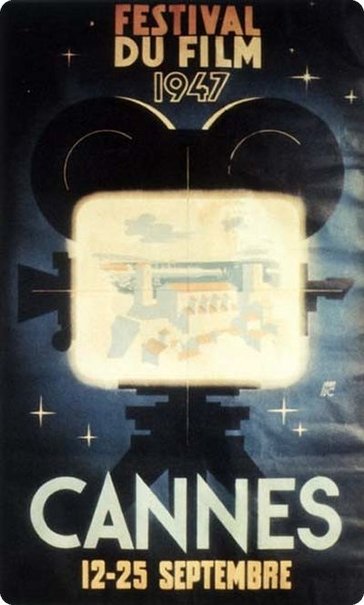
The 64th Annual Cannes Film Festival opens tonight, and the cineastes among you have probably already bookmarked the film site MUBI, where you can find all things Cannes (and all things international cinema, for that matter) at the site’s blog: the MUBI Daily.
Edited by Daniel Kasman, the MUBI Daily features stellar writers, including Glenn Kenny, Ignatiy Vishnevetsky, and the wonderful David Hudson, whom you may recognize from his days at Greencine and IFC. You’ll find review round-ups, commentary, interviews, updates, trailers for many films at Cannes, and finally, quirky entries like this one: Contributor Adrian Curry’s commentary on a L’Express collection of 64 year’s worth of official Cannes Festival posters. Curry highlights the best and worst of the lot (along with a special wince d’or for 1995’s pastel nightmare of a seascape, to which designer Ryszard Horowitz may as well have added rainbows and unicorns).
The site is definitely worth keeping tabs on, especially this week, when they’ll be offering a virtual ticket to the south of France, minus the lines, mobs, and high likelihood of laptop theft.
A last note: you can find several prize-winning films from the Cannes Film Festival (including two by Andrei Tarkovksy) in our collection of Free Movies Online.
via MUBI and A Life in Film
Sheerly Avni is a San Francisco-based arts and culture writer. Her work has appeared in Salon, LA Weekly, Mother Jones, and many other publications. You can follow her on twitter at @sheerly
via
David Lynch’s Organic Coffee (Barbie Head Not Included)
In one of his very best early essays, David Lynch Keeps His Head (1996), the late novelist and essayist David Foster Wallace did his best to pinpoint exactly what it is that makes Lynch such an odd and wonderful director. The article is pure pleasure (and a reminder of just how fresh and original Wallace was, and how rarely his imitators ever do him justice). One line in particular stands out — the writer’s now-famous comparison between Lynch and Tarantino: “Quentin Tarantino,” wrote Wallace, “is interested in watching someone’s ear get cut off. David Lynch is interested in the ear.”
We’re not quite sure what that line has to do with the director’s latest production (a commercial advertising his new coffee line and starring a severed Barbie head) except that we couldn’t stop thinking of either the quote or the essay as we watched it — appalled, dismayed, perplexed, and, as always with the films of Mr. Lynch, completely incapable of looking away.
Related Content:
David Lynch on his Favorite Movies and Filmmakers
via David Lynch
Sheerly Avni is a San Francisco-based arts and culture writer. Her work has appeared in Salon, LA Weekly, Mother Jones, and many other publications. You can follow her on twitter at @sheerly
World Literature in 13 Parts: From Gilgamesh to García Márquez
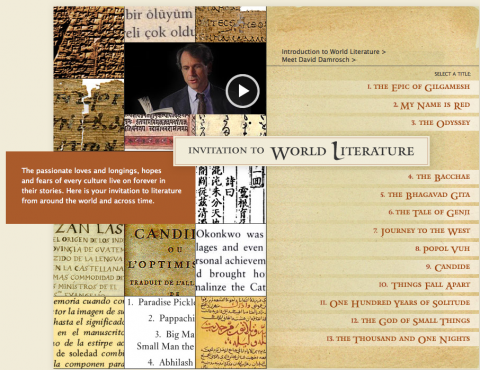 Love and longing, hope and fear — these threads run throughout all literature, whether we’re talking about the great ancient epics, or contemporary novels written in the East or the West. That’s the main premise of Invitation to World Literature, a multimedia program organized by David Damrosch (Harvard University), and made with the backing of WGBH and Annenberg Media.
The program features 13 half-hour videos, which move from The Epic of Gilgamesh (circa 2500 BCE) through García Márquez’s One Hundred Years of Solitude (1967). And, collectively, these videos highlight over 100+ writers, scholars, artists, and performers with a personal connection to world literature. Philip Glass, Francine Prose, Harold Ramis, Robert Thurman, Kwame Anthony Appiah — they all make an appearance.
Each video is accompanied by readings and related materials. You can get started with Invitation to World Literature here, or find a trailer introducing the series here.
This course will be added to our list of Free Online Literature Courses, a subset of our collection 1,700 Free Online Courses from Top Universities.
Related Content:
Free Literature Courses from Great Universities
Homer’s Iliad and Odyssey: Free Translations by Literary Greats
The Sounds of Ancient Mesopotamia
Short Film: “Nuit Blanche” Mixes Romance with Matrix-Style Visuals
If you’ve ever had doubts about the impact of videogame aesthetics on contemporary cinema — not just action movies, but video and independent film as well — this romantic short from Spy Films might well dispel them. The plot is basic: A man and a woman lock eyes in the street, and dream of what might have been, while sweet notes fill the air. But director and cinematographer Arev Manoukian updates the familiar story with a compelling visual style which seems inspired by equal parts Matrix trilogy and PlayStation 3. For more information about the special effects, there’s a “making of” video for your viewing.
Francophones/francophiles of more luddite tendencies might find themselves immediately rushing to play Georges Brassens’ ode to ephemeral street romance, “Les Passantes.” We strongly encourage you to do so, preferably at sunset, while sipping a hot cup of longing-infused tea.
Sheerly Avni is a San Francisco-based arts and culture writer. Her work has appeared in Salon, LA Weekly, Mother Jones, and many other publications. You can follow her on twitter at @sheerly.
William F. Buckley Explains How He Flogged Himself to Get Through Ayn Rand’s Atlas Shrugged
Ayn Rand’s Atlas Shrugged sold an estimated 25 million copies between its publication in 1957 and 2007. Early on, the book inspired a young generation of business leaders, and now, decades later, it holds appeal for a new class of conservatives. But it wasn’t always that way. Back in the 1950s, William F. Buckley, the enfant terrible of the conservative movement, launched the National Review and published a review by Whittaker Chambers — the Soviet spy who famously turned against Communism (and Alger Hiss), all while building a remarkable career at TIME Magazine. About Atlas Shrugged, Chambers wrote: ”I find it a remarkably silly book. It is certainly a bumptious one. Its story is preposterous.” And, what’s more, he adds: “Out of a lifetime of reading, I can recall no other book in which a tone of overriding arrogance was so implacably sustained. Its shrillness is without reprieve. Its dogmatism is without appeal.”
Rand never forgave Buckley for the review. Persona non grata, he was. Years later, in 2003, Buckley revisited the whole affair with Charlie Rose and made known his personal feelings for Rand’s book. “I had to flog myself to read it…”
Note: You can download Atlas Shrugged as a free audiobook if you sign up for a free 30-Day Trial with Audible.com. Find more information on that program here.
If you would like to support the mission of Open Culture, consider making a donation to our site. It’s hard to rely 100% on ads, and your contributions will help us continue providing the best free cultural and educational materials to learners everywhere. You can contribute through PayPal, Patreon, and Venmo (@openculture). Thanks!
Related Content:
Mike Wallace Interviews Ayn Rand (1959)
William F. Buckley v. Gore Vidal (1968)
Ayn Rand Talks Atheism with Phil Donahue
Wealthy Donors Paying Universities to Teach Rand
via Roger Ebert
The Existential Star Wars: Sartre Meets Darth Vader
A few weeks ago we directed you to a wonderful three-part BBC documentary about modern philosophy called Human, All Too Human, adding that we considered the chapter on Jean-Paul Sartre the most satisfying of the three.
Now we give you a light-hearted chaser for that documentary’s strong spirits: The French philosopher’s teachings as interpreted by the science fiction overlord Darth Vader. Perhaps more than any other 20th century supervillain, the disgraced Jedi knight tragically and perfectly embodies the Sartrian notion that “Freedom is what you do with what has been done to you.”
For those who might consider the Joker a better candidate, we humbly submit that with the Joker, it’s more of a Nietzschean thing.
Related Content:
Download 90 Free Philosophy Courses and Start Living the Examined Life
Walter Kaufmann’s Lectures on Nietzsche, Kierkegaard and Sartre (1960)
Sheerly Avni is a San Francisco-based arts and culture writer. Her work has appeared in Salon, LA Weekly, Mother Jones, and many other publications. You can follow her on twitter at @sheerly
Support Us
We're hoping to rely on loyal readers, rather than erratic ads. Please click the Donate button and support Open Culture. You can use Paypal, Venmo, Patreon, even Crypto! We thank you!

About Us

Open Culture scours the web for the best educational media. We find the free courses and audio books you need, the language lessons & educational videos you want, and plenty of enlightenment in between.
Advertise With Us

