Matthew Weathers teaches computer science and mathematics courses at Biola University in southern California, and, while wrapping up a lecture last week, the talk turned to Thanksgiving and, well, you can watch the rest.
On a more serious note, don’t miss our collection of 400 Free Online Courses.
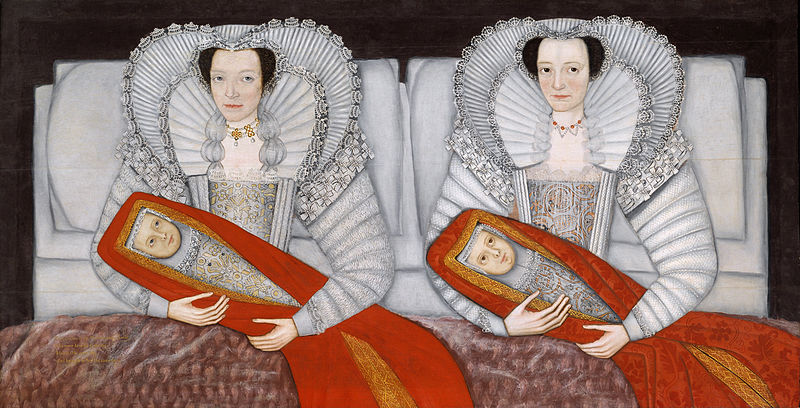
Phoebe and Lydia Lake are artists. They’re also identical twins, which means they know a thing or two about symmetry. So last year, when they were 20 years old, the Tate Britain decided to film their first encounter with one of the museum’s most famous holdings, The Cholmondeley Ladies, painted sometime around 1600–1610 by an unknown artist. An inscription describes the ladies as members of the Cholmondeley family (pronounced “Chumley”) who were born on the same day, married on the same day and “brought to bed” (gave birth) on the same day. The sharply defined, rigidly symmetric composition depicts two very similar but not identical women (perhaps fraternal twins) dressed in exquisite Jacobean finery, holding their babies. In his essay, “The Perception of Symmetry,” arts writer Michael Bird describes his own first reaction to the painting when he was a boy:
The two wintry revenants, propped elbow to elbow in bed with their glowing babies, made a deep impression. The blanched gorgeousness of their outfits, blooded by the hot royal red of the christening gowns, was part of it. So was the spooky incongruity of vivid faces looking out from the picture’s steam-ironed one-dimensionality, as though two people were standing behind it, sticking their heads through holes in the board. Mainly, though, it was their doubleness.
Occupy Wall Street and the global Occupy Movement have inspired some striking artwork. Graphic artists from around the world (including Shepard Fairey mentioned here earlier today) have contributed their talents to the movement. Many of their posters are available for free or at low cost, either directly from the artist or through organizations like Occuprint and OccupyTogether. You can post them in your town.
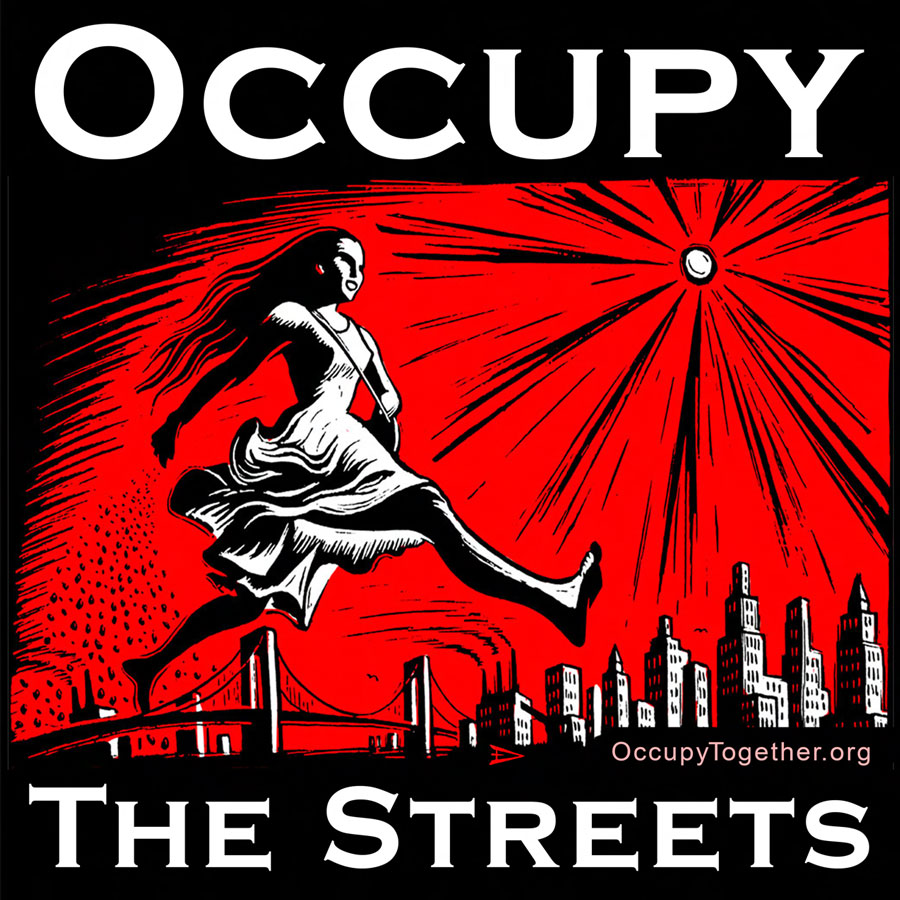
New Yorker cover artist and book illustrator Eric Drooker has created several beautiful posters, including the one above. You can download a high-resolution copy suitable for printing at OccupyTogether.org.
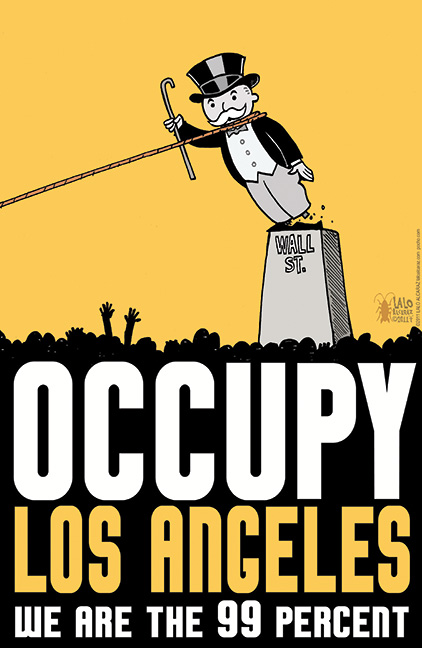
The noted Los Angeles graphic artist, cartoonist and radio personality Lalo Alcaraz created this parody of the toppling of the Saddam Hussein statue in Baghdad for Occupy Los Angeles. In a message on his website, Alcaraz invites people to distribute the image.
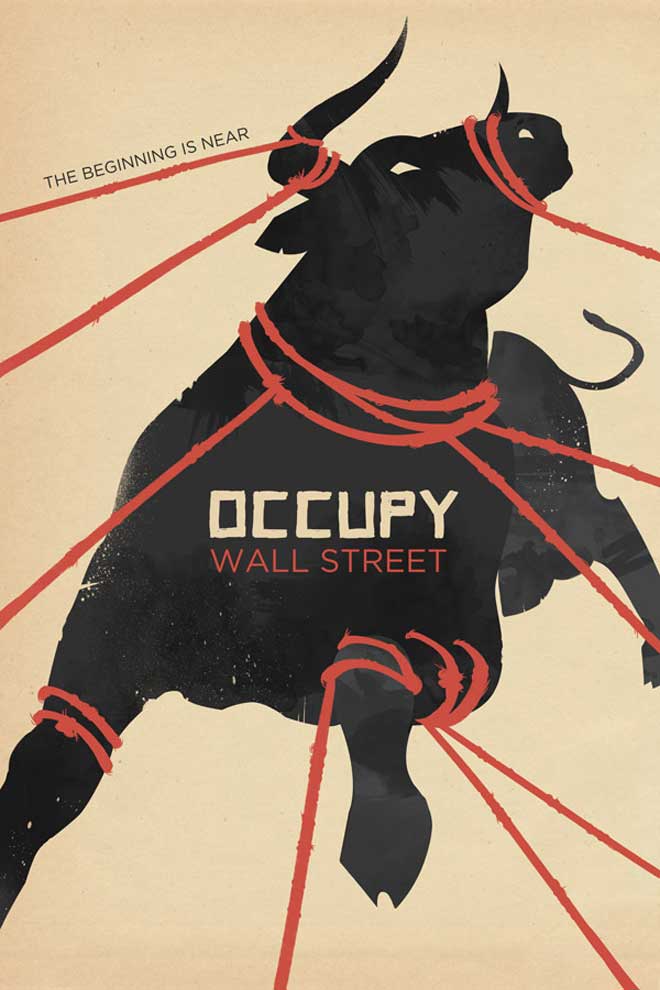
Alexandra Clotfelter is a student of advertising design and illustration at the Savannah College of Art and Design in Georgia. Since donating her design, “The Beginning is Near,” to Occuprint.org, it has become one of the most popular posters to emerge from the movement. In response to requests, Clotfelter is offering a high-quality Giclee print for sale, with a portion of the profits going to support Occuprint’s project of distributing free posters worldwide.
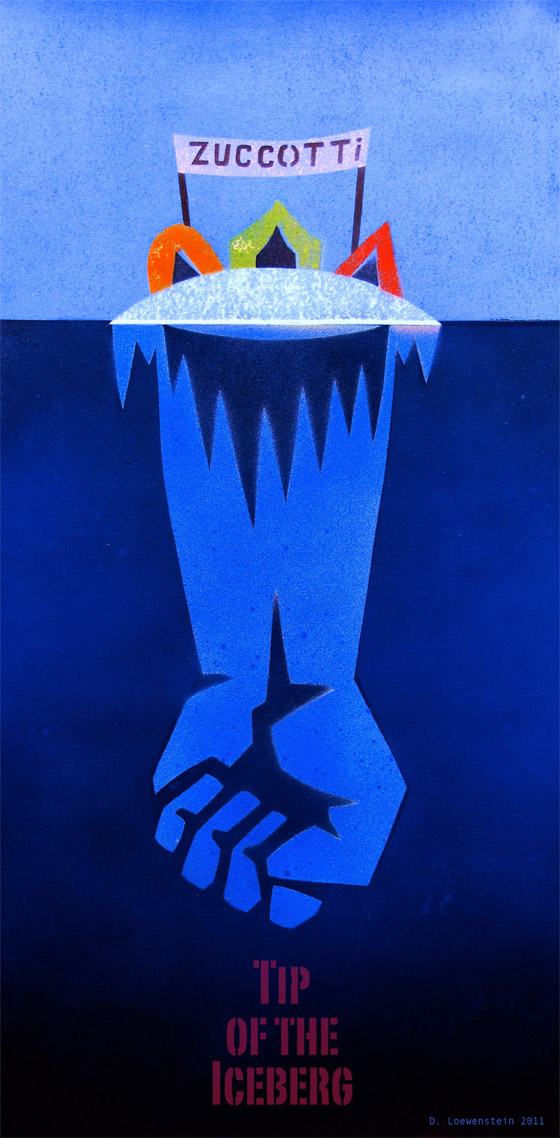
In this poster, Zucotti Park is portrayed as the “Tip of the Iceberg.” Indeed, the Occupy movement extends to places like Lawrence, Kansas, where muralist, printmaker and writer Dave Loewenstein is based. Loewenstein’s design is available for free at Occuprint.org.
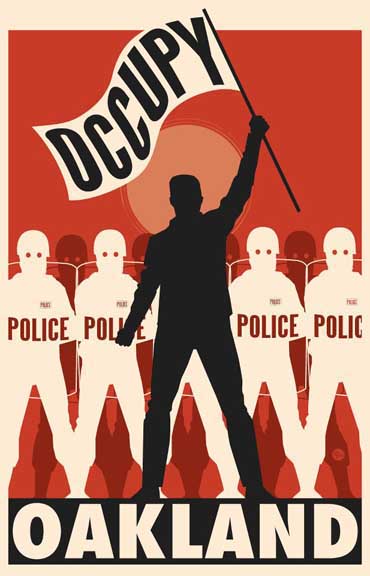
Poster artist Rich Black of Berkeley, California created this image for Occupy Oakland. It’s available for free download at Occuprint.org.
To see a variety of Occupy posters by other artists (and to download them for free) you can visitOccuprint.organdOccupyTogether.org.
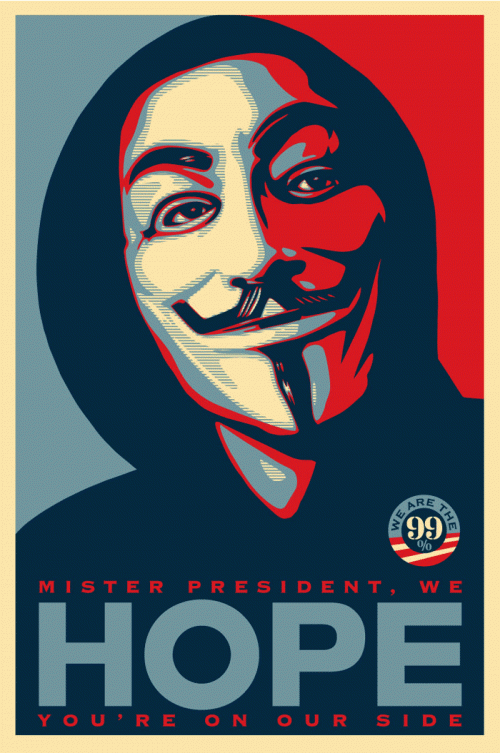
Shepard Fairey’s famous 2008 Obama “Hope” poster has been the source of countless imitations and parodies. Last week Fairey released his own parody for Occupy Wall Street, replacing Obama’s head with a hooded figure in a Guy Fawkes mask, along with the words, “Mister President, We HOPE You’re On Our Side.” As Fairey explained on his website, “I see Obama as a potential ally of the Occupy movement if the energy of the movement is perceived as constructive, not destructive.”
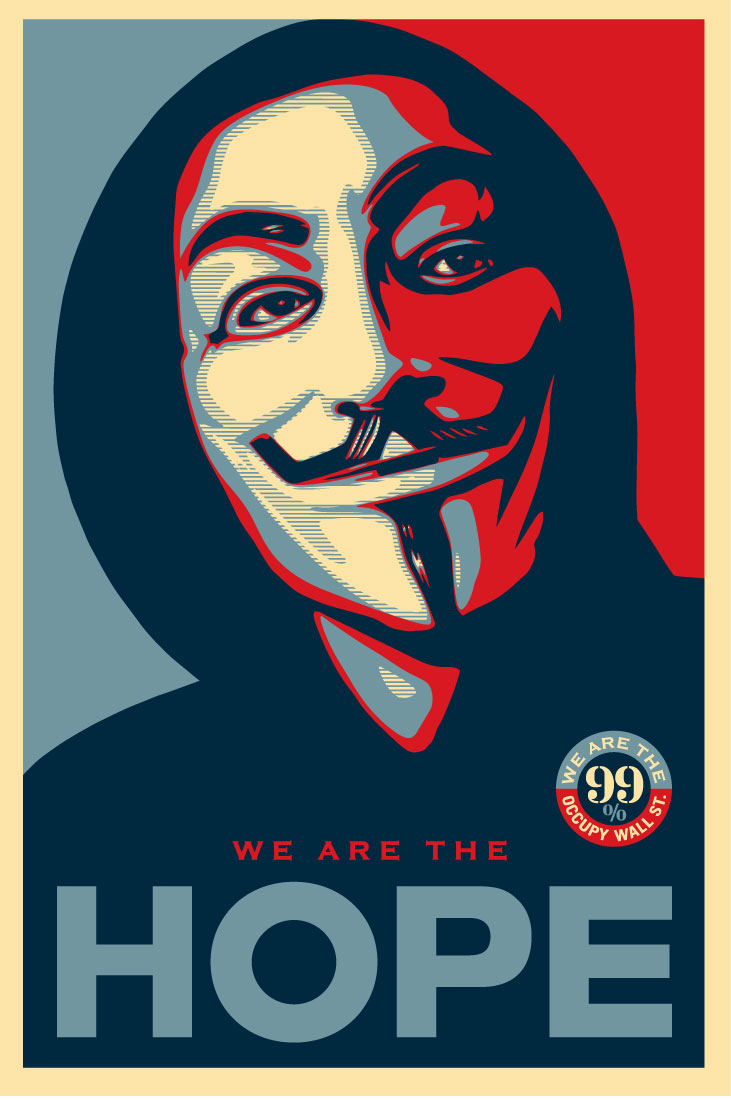
Not everyone agreed. Yesterday, after a series of discussions with one of the organizers of the purportedly leaderless movement, Fairey announced he was backing down and dropping the provocative message to the president and replacing it with “We Are The HOPE.” A few of the movement’s organizers reportedly thought Fairey’s poster implied that Occupy Wall Street either supported Obama or was begging for his support.
“As Obama has raised more money from Wall Street than any other candidate in history, it would make us naive hypocrites to support him under present circumstances,” the anonymous organizer wrote to Fairey. “As for the design, the fact that you put the 99% inside the Obama O is crossing a sacred line. While it definitely looks cool, whether intended or not, this sends a clear message that Obama is co-opting OWS.”
“I have no interest in pandering to Obama,” responded Fairey. “I see my image as a reminder to him that he has alienated his populist progressive supporters.”
But Fairey submitted to the pressure and changed his design anyway. You can read more about the exchange here, and see the altered version of Fairey’s poster below.
For more Occupy Wall Street posters, stay tuned for our post coming later today.…
Oliver Knill teaches calculus, linear algebra and differential equations at Harvard, and, several years back, he pulled together a fairly nifty collection of Mathematics Scenes in Movies. Over 150 films are represented here, everything from Good Will Hunting, A Beautiful Mind, Jurassic Park (above) to Alice in Wonderland (1951), The Maltese Falcon and Apocalypse Now. You can watch each scene in flash format on Knill’s site, or download them as a quicktime file. And, math buffs, don’t miss our collection of Free Online Math Courses, a subset of our meta list, 1,700 Free Online Courses from Top Universities.
If you would like to sign up for Open Culture’s free email newsletter, please find it here. It’s a great way to see our new posts, all bundled in one email, each day.
If you would like to support the mission of Open Culture, consider making a donation to our site. It’s hard to rely 100% on ads, and your contributions will help us continue providing the best free cultural and educational materials to learners everywhere. You can contribute through PayPal, Patreon, and Venmo (@openculture). Thanks!
On November 9th, Stephen Fry and friends came together in London to celebrate Christopher Hitchens’ life, loves and hates — all while Hitch watched from his hospital bed. Staged in London by Intelligence², the event brought together Richard Dawkins, Christopher Buckley, Salman Rushdie, Lewis Lapham, Martin Amis, poet James Fenton and actor Sean Penn, with some paying tribute in person, others via satellite.
Originally, the sell-out audience of 2,500 expected to see Hitchens and Fry talking together about politics, literature, and ‘the things that make life worth defending — foes like faith and false consolation.’ But at the last moment, Hitchens, already suffering from esophageal cancer, fell ill with pneumonia and plans changed. Now, instead of being an interlocutor, Fry became master of ceremonies, coordinating what oddly felt like a eulogy before the fact.
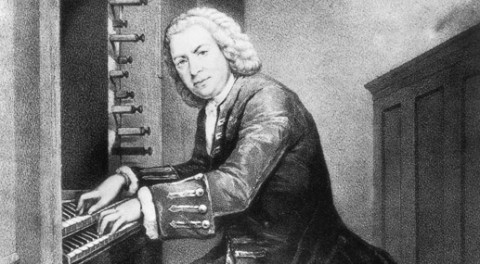
We mentioned this one long ago, and it’s time to mention it again: You can download for free the complete organ works of Johann Sebastian Bach. They were recorded by Dr. James Kibbie (University of Michigan) on original baroque organs in Leipzig, Germany. Feel free to start with a collection of Favorite Masterworks, or get the complete works that have been divided into 13 groups for easy download. Once you download these zip files, you will need to unzip them before playing the tracks. Enjoy, and don’t miss our related post: How a Bach Canon Works. It’s rather brilliant.
Los Angeles has long been known as the street mural capital of the world. But in the past few years the city has painted over more than 300 murals, according to the Los Angeles Times, enforcing a decade-old ordinance that makes it a crime to create murals on most private properties. “The mural capital of the world is no more,” street artist Saber told the Times. “They buff beautiful pieces, harass property owners and threaten us like we are in street gangs.”
Some of the problems started in 1986, when the city was looking for a way to alleviate the growing scourge of billboard blight. The city was being blanketed with unsightly commercial advertising, so the Los Angeles City Council adopted a code to reduce commercial billboards. The new restrictions exempted artwork. Advertisers responded by suing the city, arguing that they had the same right of free speech as the muralists. So in 2002 the Council “solved” the matter by amending the code to include works of art. “The law left many murals technically illegal,” wrote the Times in an Oct. 29 editorial, “no matter how talented the artist or how willing the owner of the wall or how inoffensive the subject matter.”
Since then, murals that were already in existence have come under increasing threat from two sides: from graffiti “artists” who mark their territory by defacing murals, and from a city that seems determined to find any pretext to paint over them. This is the subject of Behind the Wall: The Battle for LA’s Murals (above), a six-minute documentary by students in the Film and TV Production MFA program at the University of Southern California. It was directed by Oliver Riley-Smith, shot by Qianbaihui Yang, and produced and edited by Gavin Garrison.
Without addressing the issue head-on, the film makes some progress toward illuminating the distinction between street art and vandalism. Muralists like Ernesto De La Loza, who is featured in the film, receive permission from property owners and then spend months creating their art. Later, someone comes along with a can of spray paint and tags it. Should the muralist and the graffiti artist have equal cultural status?
We're hoping to rely on loyal readers, rather than erratic ads. Please click the Donate button and support Open Culture. You can use Paypal, Venmo, Patreon, even Crypto! We thank you!
Open Culture scours the web for the best educational media. We find the free courses and audio books you need, the language lessons & educational videos you want, and plenty of enlightenment in between.