No one is happy with Washington D.C. this week, and that includes filmmaker David Lynch, who gives you his commentary in sounds and images, not words. The symbolism? America is in a dark position and moving backwards? The deficit deal is flat out garbage?
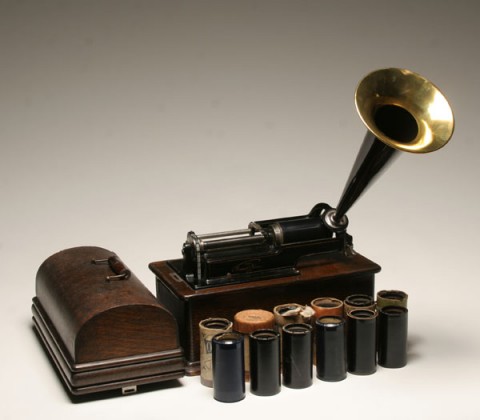
Head over to SoundCloud, and you’ll find 10 audio files that span three centuries. It’s a fairly random collection, we’ll admit. But two recordings from the 19th century immediately stand out.
For more on recordings from the 19th century, we’d recommend spending some time with a five-part BBC series called Gramophones & Grooves. It takes you into the early recording industry and lets you hear countless other voices.
Follow Open Culture on Facebook and Twitter and share intelligent media with your friends. Or better yet, sign up for our daily email and get a daily dose of Open Culture in your inbox. And if you want to make sure that our posts definitely appear in your Facebook newsfeed, just follow these simple steps.
Al Jazeera forced many Westerns viewers to take their reporting seriously during the Egyptian uprising this spring, and now the Qatar-based news network has released a timely reportage (Aug. 2) on the fault lines in America — on the gap between rich and poor that only grew wider this week. Alexis de Tocqueville they’re not. There’s no subtle sociology here. But, at the same time, I suspect that this foreign perspective on the U.S. won’t appear unfamiliar to many Americans. The program runs 24 minutes, and other shows in the Fault Lines series can be viewed on YouTube here. H/T @courosa
Richard Feynman was a once in a generation intellectual. He had no shortage of brains. (In 1965, he won the Nobel Prize in Physics for his work on quantum electrodynamics.) He had charisma. (Witness this outtake from his 1964 Cornell physics lectures available here.) He knew how to make science and academic thought available, even entertaining, to a broader public. (We’ve highlighted two public TV programs hosted by Feynman here and here.) And he knew how to have fun. The clip above brings it all together. Hope you enjoy, and don’t miss our collection of Great Science Videos, or many free physics courses in our big collection of Free Online Courses.
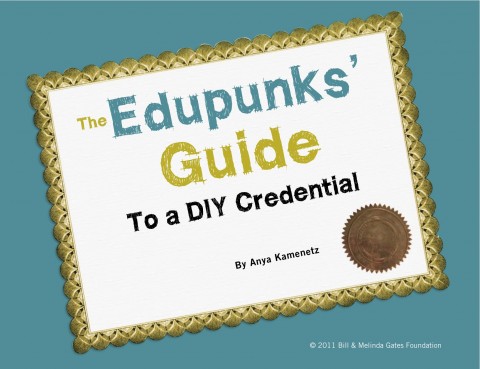
The new ebook offers a “comprehensive guide to learning online and charting a personalized path to an affordable credential,” and it comes complete with some handy-sounding tutorials: how to write a personal learning plan, how to teach yourself online, how to build your personal learning network, 7 ways to get college credit without taking a college course, etc.
The book also smartly features a long list of open educational resources, where the author was nice enough to give us a small mention.
You can read The Edupunks’ Guide to a DIY Credentialon Scribd, or alternatively you can download it in multiple formats (PDF, Kindle, ePub, RTF, etc.) at the bottom of this page.
Intelligence Squared (iTunes – Feed – Web Site) brings Oxford-style debating to America. Each debate features one motion, one moderator, and three panelists arguing for a motion, and three arguing against. Should Airports Use Racial and Religious Profiling? Is Islam A Religion Of Peace? Is The Two-Party System Making the U.S. Ungovernable? These are some of the recent topics that have been tackled.
Now, taking a page out of the RSA playbook, Intelligence Squared has produced a short animated video that gives artistic life to a debate held in October 2009. The motion — “The Catholic Church is a force for good in the world” — was supported by Ann Noreen Widdecombe, a former British Conservative Party politician turned novelist. And taking the contrary position was popular British actor and writer Stephen Fry.
On August 1, 1981, MTV took to the U.S. airwaves, forever changing the landscape of American music and pop culture. If you were around then, you’ll remember the Apollo 11 moon landing, the astronaut planting the MTV flag on the moon’s surface, and then the first aptly picked video — the Buggles’ “Video Killed the Radio Star.” Fast forward four years, and we were all saying, I Want My MTV.
A list of the first ten videos aired on MTV appears below. Click the links to take a walk down memory lane.
Wendy MacNaughton, an artist and illustrator living in San Francisco, wondered what snacks fueled some of our greatest writers. F. Scott Fitzgerald turned to apples and canned meats, and Kafka to milk, during their daily writing routines. How about Lord Byron, Emily Dickinson, Marcel Proust, John Steinbeck, Truman Capote or food writer Michael Pollan? MacNaughton tells you about their dietary habits in The New York Times Book Review. (And it just so happens you can find texts by many of these authors in our collection of Free eBooks.)
MacNaughton’s illustrated column, “Meanwhile,” appears regularly at The Rumpus.
We're hoping to rely on loyal readers, rather than erratic ads. Please click the Donate button and support Open Culture. You can use Paypal, Venmo, Patreon, even Crypto! We thank you!
Open Culture scours the web for the best educational media. We find the free courses and audio books you need, the language lessons & educational videos you want, and plenty of enlightenment in between.