The dream of flight fired the imagination of Leonard da Vinci in the early sixteenth century. In designing his famous flying machines, the painter, sculptor, architect, mathematician, engineer, inventor, anatomist — ah heck, let’s just call him a Renaissance man — closely studied the mechanics of birds in flight, noting the elegant ways in which they turn and glide. Centuries later the Wright Brothers got us off the ground, but never with equal grace. It has taken a long time, but finally engineers at the German company, Festo, have found a way to mechanically reproduce the beauty of birds in flight. They call their robot the SmartBird, and they showed it off last year at TED.
Remembering the Soulful Etta James
“When I’m singing blues,” Etta James once said, “I’m singing life.”
Hers was a difficult life. The legendary singer, who died this morning at the age of 73 after a long struggle with leukemia, was born Jamesetta Hawkins on January 25, 1938, to an unwed 14-year-old girl, and her life was marked by drug addiction and emotional volatility. Through it all, James rose to become one of the most influential and admired singers of the second half of the 20th century.
“There’s a lot going on in Etta James’ voice,” Bonnie Raitt told Rolling Stone in 2008. “A lot of pain, a lot of life but, most of all, a lot of strength. She can be so raucous and down one song, and then break your heart with her subtlety and finesse the next.”
Her greatest hit came in 1961, with the soulful ballad “At Last.” For another side of James’s versatile style, listen and watch above, as she performs the gospel-influenced “Something’s Got a Hold on Me” in 1962. To learn more about James, and to watch video highlights from her career, see today’s article by Ben Greenman on The New Yorker’s “Culture Desk” blog. And over at the Guardian, see Richard Williams selection of 10 Classic Etta James Performances.
In 1997, James summed things up in an interview with Rolling Stone: “Life’s been rough,” she said, “but life’s been good. If I had to go back and do it all over again, I would live it the exact same way.”
Willie and the Hand Jive, by the Late Great Johnny Otis
One of the catchiest grooves from the rhythm and blues of the late 1950s is “Willie and the Hand Jive,” by Johnny Otis. In this lively scene from his early TV show, Otis performs the song as Marie Adams and the Three Tons of Joy demonstrate the hand jive. Lionel Hampton joins in on the vibraphone.
Otis, known as “the godfather of rhythm and blues,” died Tuesday at the age of 90. The son of Greek immigrants, he grew up in a predominantly black neighborhood of Berkeley, California, and developed an early affinity for African American culture. “Genetically, I’m pure Greek,” Otis said in 1994. “Psychologically, environmentally, culturally, by choice, I’m a member of the black community.”
As a bandleader in the 1950s, Otis helped bring rhythm and blues to a mainstream audience. He discovered a number of important artists, including Big Mama Thornton (Otis produced her original 1952 recording of “Hound Dog”) and the great Etta James, who died this morning.
“Willie and the Hand Jive,” with its infectious Bo Diddley beat, was a top 10 pop hit for Otis in 1958, and was covered by a variety of well-known artists, including Eric Clapton. Otis continued to perform into his 80s, and worked at various times as a disc jockey, an ordained minister and an organic farmer. You can read more about his remarkable life in the New York Times obituary.
You can also watch the complete half-hour episode of The Johnny Otis Show (below) from which the clip above was taken. The Johnny Otis Show was broadcast on KTLA in Los Angeles from 1954 to 1961. This episode features great performances by Lionel Hampton (with the multi-instrumentalist Otis joining in on drums) and other artists, including more from Marie Adams and the Three Tons of Joy.
Christopher Walken Reads The Three Little Pigs, The Raven, and a Little Lady Gaga
Here we go again. We’re getting meta with readings by the great Christopher Walken. It all starts with the actor appearing on a 1993 broadcast of the British TV series “Saturday Zoo” hosted by Jonathan Ross, and he’s reading and riffing on the beloved fairy tale, The Story of the Three Little Pigs. The potentially terrifying story is uncharacteristically jolly. Walken goes for laughs, not chills. The same can’t be said for the next tale.
We’re not clear on the backstory of this reading. But we do know Walken is reading Edgar Allan Poe’s poem, The Raven, and stays true to the original text published in 1845. The Raven made Poe famous then, and it remains influential today — so much so they named a football team after the poem. How many other sports teams can make such a claim?
And then we come full circle again. Almost 16 years after Walken’s reading of The Three Little Pigs, the star returned to another show hosted by Jonathan Ross (BBC’s Friday Night) and served up a second comic reading. This time it’s “Poker Face” by the inescapable Lady Gaga.
Walken reading Where the Wild Things Are by Maurice Sendak? If only, if only .….
Everything You Wanted to Know About Coffee in Three Minutes
Coffee — it’s the fuel of the modern world and certainly this site. And, if you believe this video (apparently not made by Starbucks or the American coffee lobby), it’s the greatest, safest addiction around. Take it all with a grain of salt … while you drink your morning (or afternoon) cup of joe.
More Related Coffee Items:
How to Drink Coffee at Zero Gravity
David Lynch’s Organic Coffee (Barbie Head Not Included)
Follow us on Facebook, Twitter and now Google Plus.
A Rare Interview with Fritz Lang and His 1931 Masterpiece of Suspense, M
“I made my films with a kind of sleepwalking security,” says Fritz Lang. “I did things which I thought were right. Period.” Thus begins this fascinating interview with the great Austrian-born director.
The interview was conducted by William Friedkin, director of The French Connection and The Exorcist, in February of 1975, a little more than a year before Lang’s death. Lang talks about his early life as a runaway. (“Any decent human being should run away from home.”), his entry into theatre and film as a young man, his German masterpieces Metropolis and M, and a chilling encounter in 1933 with the Nazi Minister of Propaganda Joseph Goebbels that provoked him to flee Germany the same day.
The story of Lang’s escape has all the elements of a cinematic thriller, but biographers have cast doubt on its veracity, citing passport records which indicate that Lang left Germany some time after the meeting with Goebbels, and that he returned on brief trips several times that year. But the anecdote, along with Lang’s reflections on his life and on the nature of fate, provide a fascinating look into the great filmmaker’s character.
The conversation above, which runs 50 minutes, was edited down from a much longer set of interviews. According to the Torino Film Festival website, Friedkin originally intended to use the Lang material for a documentary on horror cinema, to be called A Safe Darkness, but there is no discussion of the horror genre in this version.
As an extra bonus from our collection of Free Movies Online, we present the film Lang most wanted to be remembered for, M. (See below.) The film was made in 1931, and was the first by Lang to incorporate sound. Peter Lorre makes his screen debut as a man guilty of unspeakable crimes. In its introduction to the film, the Criterion Collection writes: “In his harrowing masterwork M, Fritz Lang merges trenchant social commentary with chilling suspense, creating a panorama of private madness and public hysteria that to this day remains the blueprint for the psychological thriller.”
M, by Fritz Lang:
The Disney Cartoon That Introduced Mickey Mouse & Animation with Sound (1928)
In 1927, The Jazz Singer starring Al Jolson, one of the first great “talkies” to use synchronized singing and speech, hit American theaters and thrilled audiences. Knowing that change was afoot, Walt Disney spent $4,986 to create his first sound cartoon, Steamboat Willie (1928). Remembering the film many years later, Disney said:
The effect on our little audience was nothing less than electric. They responded almost instinctively to this union of sound and motion. I thought they were kidding me. So they put me in the audience and ran the action again. It was terrible, but it was wonderful! And it was something new!
These technical innovations make Steamboat Willie rather legendary. But the film retains landmark status for another reason. It marked the first public debut of Mickey Mouse and his girlfriend Minnie, two of the most recognized cartoon characters worldwide. Ub Iwerks, the celebrated Disney animator, first brought Mickey to life, and we have been living with him ever since — although, as you will see, his personality has softened over time.
You can see Mickey starring in two other early animations: Plane Crazy (1929) where the Mouse imitates America’s hero at the time, Charles Lindbergh. And The Gallopin’ Gaucho, another 1928 release.
Steamboat Willie appears in the Animation Section of our collection, 4,000+ Free Movies Online: Great Classics, Indies, Noir, Westerns, Documentaries & More.
If you would like to sign up for Open Culture’s free email newsletter, please find it here. It’s a great way to see our new posts, all bundled in one email, each day.
If you would like to support the mission of Open Culture, consider making a donation to our site. It’s hard to rely 100% on ads, and your contributions will help us continue providing the best free cultural and educational materials to learners everywhere. You can contribute through PayPal, Patreon, and Venmo (@openculture). Thanks!
Related Content:
How Walt Disney Cartoons Are Made
The Making of a Nazi: Disney’s 1943 Animated Short
Destino: The Salvador Dalí – Disney Collaboration 57 Years in the Making
Gertie the Dinosaur: The Mother of all Cartoon Characters
The Costa Concordia Shipwreck Viewed from Outer Space
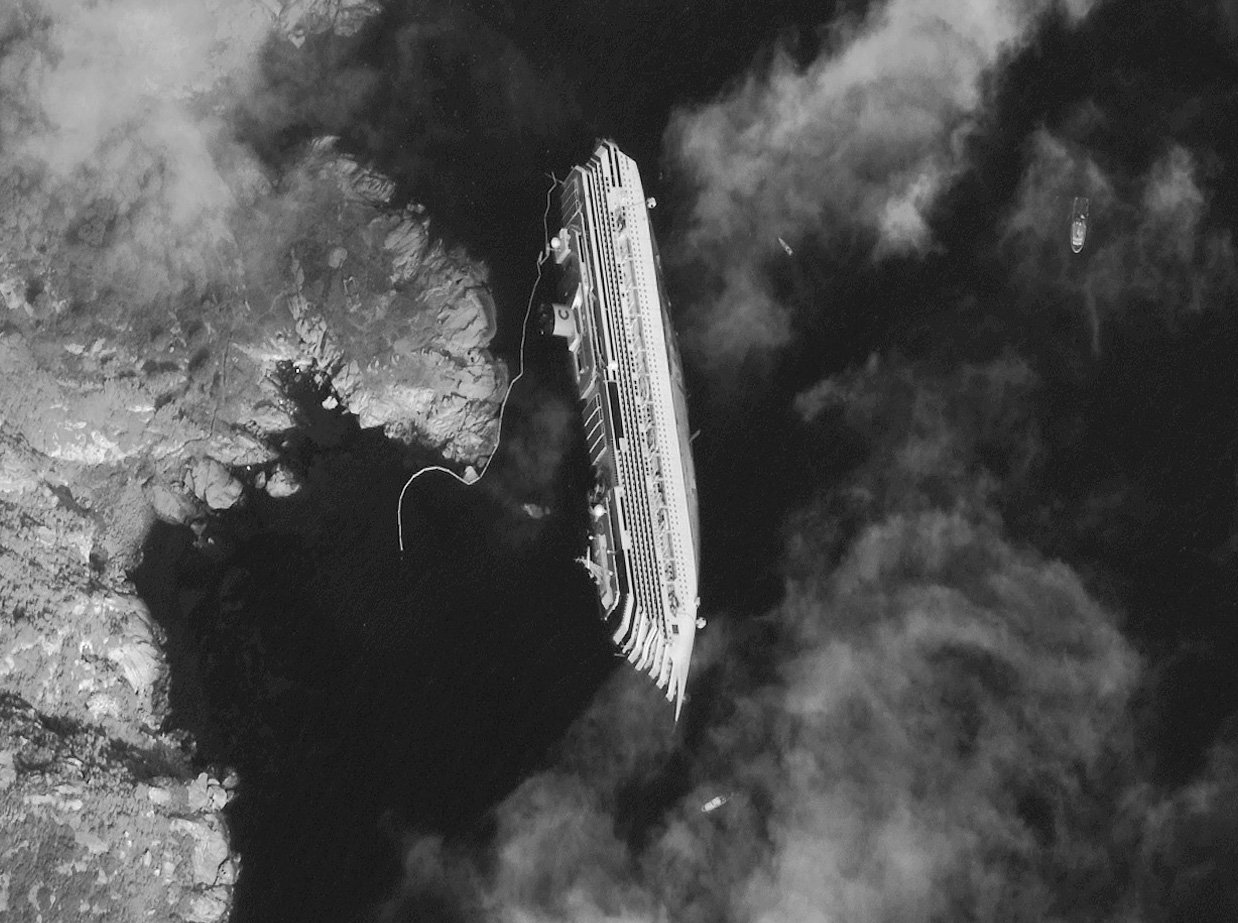
The search for survivors still goes on near the Tuscan island of Giglio, where the Costa Concordia hit rocks and listed helplessly to the side. The helplessness of the cruise ship has been captured in a remarkable image taken by Digital Globe from outer space. Click here (or above) to see the image in a rather stunning, enlarged format.
via Universe Today
Support Us
We're hoping to rely on loyal readers, rather than erratic ads. Please click the Donate button and support Open Culture. You can use Paypal, Venmo, Patreon, even Crypto! We thank you!

Receive our Daily Email
About Us

Open Culture scours the web for the best educational media. We find the free courses and audio books you need, the language lessons & educational videos you want, and plenty of enlightenment in between.
Advertise With Us


