In early 1964, Bob Dylan was at the apex of his journey as a socially conscious folk singer. The fleeting moment is preserved in this rare half-hour TV program, recorded on February 1 of that year. Within a week the Beatles would land in America. In a little over a month, Dylan would rent an electric guitar.
The television performance is from Quest, a Canadian Broadcasting Corporation series that ran between 1961 and 1964 and showcased a wide range of literary and performing arts. It was produced in Toronto by Daryl Duke, who went on to direct American television programs and feature films.
Dylan appears in his classic Woody Guthrie mode on a set made to look like a western bunkhouse. He plays six songs–half from The Times They Are a‑Changin’, his third album released just a few weeks before, and half from his previous album, The Freewheelin’ Bob Dylan. In order of appearance:
The Times They Are A Changin’
Talkin’ World War III Blues
Lonesome Death of Hattie Carroll
Girl From the North Country
A Hard Rain’s A‑Gonna Fall
Restless Farewell
“The Times They Are a‑Changin’,” as the program is titled, offers a unique glimpse of the early Bob Dylan, just before his music turned from social issues to personal ones, just before he put away the blue jeans and work shirts and began wearing Beatle boots and sunglasses. “Dylan’s appearance on Quest,” says writer and filmmaker Erek Barsczewski, “provides the closest approximation available of what his early performances in Greenwich Village would have looked and sounded like.”
Cinema went into its death throes on September 31, 1983. The instrument of its demise? The video remote control. When the “zapper” endowed the viewer with the ability to play, pause, stop, fast-forward, and rewind at will, the medium’s artists lost their absolute control over the rhythm, duration, and other chronological subtleties of the cinematic experience. Or so filmmaker Peter Greenaway claims in this lecture at UC Berkeley. Anyone fan enough to read all the interviews the director has granted — and I count myself in the group — will by now be familiar with, even weary of, Greenaway’s ideas about cinema’s technical and economic straitjacketing, its arbitrary aesthetic boundaries, and its squandered potential as a freestanding art form. Nowhere else, though, does he explain and elaborate upon these ideas in such detail, or in such an entertainingly oratorical manner.
“The death of cinema,” though? Really? Knowing how dramatic that sounds, Greenaway frames what’s happened in another way: perhaps cinema has yet to be born. What if the last century or so has offered only the prologue to cinema, and modern filmmakers must take it upon themselves to bring the real thing into the world? These may strike you as the thoughts of a crackpot, and maybe they are, but watch and listen as Greenaway recounts the stunted development of the art form in which he works. We’ve grown so accustomed to the limitations of cinema, so his argument goes, that we don’t even feel the pressure of the “four tyrannies” that have lorded over it since the beginning: the frame, the text, the actor, and the camera. Even if you loathe Greenaway’s films, can you help asking yourself whether the rarely questioned dominance of an elite class of essentially theatrical performers, following textually conceived instructions, viewed from one perspective at a time through a simple rectangle, holds the movies back?
Since his feature-length debut The Falls in 1980, Greenaway has struggled against what he sees as the barriers put up by cinema’s unhealthy entanglement with the narrative-driven forms of theater and literature. Trained originally as a painter, he wonders explicitly in public and implicitly through his work why films can’t enjoy the same freedom to explore the creative space at their disposal that paintings do. All his pictures, even the best-known like The Draughtsman’s Contract; The Cook, the Thief, His Wife and Her Lover; and 8½ Women, use settings, actors, images, words, and sounds like colors on a palette, applying them with infinitude of strokes, creating a whole from which no one element can be easily separated. In this lecture, Greenaway marshals footage from his projects conducted even farther out at the medium’s edge: his transformation of an actual Italian palace into one big non-narrative film, his collaborations with avant-garde composer David Lang, and, of course, his VJ-ing sessions.
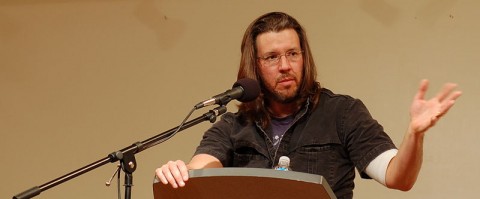
When we featured David Foster Wallace’s big, uncut interview yesterday, one important detail escaped us — the fact that the novelist would have turned 50 years old today. Kind of a stunning thought, especially if you vividly remember the wunderkind taking the literary world by storm with Infinite Jestin 1996. Seems like only yesterday.
To celebrate his 50th, we’re highlighting for you The David Foster Wallace Audio Project — a site that brings together most of the meaningful DFW audio available on the web. Built in 2009 by Jordyn Bonds and Ryan Walsh, a short while after the novelist committed suicide, the audio site is divided into four sections:
Last year, we featured a slick animation of Cross Road Blues by the legendary bluesman Robert Johnson. This morning, one of our Twitter friends highlighted for us a 2007 animation of Johnson’sMe and the Devil Blues, created by Dutch artist Ineke Goes. Recorded in 1937 in only two takes, the song helped cement the legend of the bluesman. According to the old tale, Johnson made a Faustian bargain with the devil, selling his soul in exchange for boundless musical talent. And that he had. But, of course, the devil eventually demands his payback. Johnson died in 1938.
If you would like to support the mission of Open Culture, consider making a donation to our site. It’s hard to rely 100% on ads, and your contributions will help us continue providing the best free cultural and educational materials to learners everywhere. You can contribute through PayPal, Patreon, and Venmo (@openculture). Thanks!
In 2003, an interviewer from German public television station ZDF sat down with novelist David Foster Wallace in a hotel room. The ensuing conversation, whose raw, unedited 84 minutes (find links to the complete interview below) made it to the internet after Wallace’s suicide, remains the most direct, expansive, and disarmingly rough-hewn media treatment of his themes, his personality, and the fascinating (if at times chilling) feedback loop between them.
You can also experience this conversation in short, thematically organized clips; above, we have “David Foster Wallace on Political Thinking in America.” Wallace expresses his concerns about the strong influence of television ads on elections, which means, he says, “we get candidates who are beholden to large donors and become, in some ways, corrupt, which disgusts the voters, makes them even less interested in politics, less willing to read and do the work of citizenship.” This he sees coupled with an individualistic marketing culture which stokes “that feeling of having to obey every impulse and gratify every desire” — “a strange kind of slavery.”
But as his pained, self-questioning expression reveals — especially when it retreats into strangely endearing post-answer cringes — Wallace did not believe he possessed the cure for, or even a precisely accurate diagnosis of, a sick society. Offering social criticism at a vast remove from the avuncular condemnation of a Noam Chomsky or the raised middle finger of a Bill Hicks, Wallace discusses his fears through a novelist’s consciousness that longs to, as he explains the desire elsewhere in the interview, “jump over the wall of self and inhabit someone else.” When the interviewer tells him about her peers’ frustration at feeling educated but “not being able to do anything with it,” Wallace puts himself in the mind of students who go from studying “the liberal arts: philosophy, classical stuff, languages, all very much about the nobility of the human spirit and broadening the mind” to “a specialized school to learn how to sue people or to figure out how to write copy that will make people buy a certain kind of SUV” to “jobs that are financially rewarding, but don’t have anything to do with what they got taught — and persuasively taught — was important and worthwhile.”
Underneath Wallace’s responses rushes a current of the questions his writing leads readers to think — and think hard — about: How far has entertainment evolved toward pure anesthetic? Can we still separate our needs from our wants, if we try? Has post-Gen X irony made us not just collectively ineffectual but that much easier to sell things to? Can we ever again use terms like “citizenship” without instinctively sneering at ourselves? To the David Foster Wallace novice, these clips make for a helpful thematic primer, but the full recording (see below) will thereafter become required viewing. The interview brims with the kind of asides that make it feel like a page from the notebook of one of Wallace’s own favorite literary craftsmen, Jorge Luis Borges. Wallace wonders aloud how much of what he says will get edited out, if he can discuss his all-consuming suspicion that “there’s something really good on another channel and I’m missing it” while he’s actually on television, and how to talk to the media about how difficult it is to talk to the media while pretending you don’t know you’re talking to the media. As he admits after unpacking one particularly difficult issue, “It’s all… complicated.”
On this day a half century ago, Mercury Astronaut John Glenn became the first American to orbit the Earth. On the morning of February 20, 1962, an anxious nation watched as Glenn climbed into his cramped Friendship 7 space capsule and was propelled by an Atlas 6 rocket high above the atmosphere. He circled the Earth three times before re-entering the atmosphere and splashing down in the Atlantic Ocean. As the veteran space program reporter John Noble Wilford wrote last week in The New York Times, “Perhaps no other spaceflight–all 4 hours, 55 minutes and 23 seconds of it–has been followed by so many with such paralyzing apprehension.”
You can get a sense of the drama and excitement of that day by watching the newsreel above, and by reading Wilford’s interesting piece in the Times. Also, NASA has put together an interactive online feature on the mission. At a time when America’s manned space program depends on Russian spacecraft to carry astronauts to and from the International Space Station, it’s all the more poignant to look back on the day 50 years ago when Glenn became, as writer Tom Wolfe put it, “the last true national hero America has ever had.”
There’s probably not a standup comedian bigger than Louis CK right now. His FX television show, Louie, earned him two Emmy Award nominations in 2011, and his recent comedy special, Live at the Beacon Theater, made history when CK distributed the show via the web (not HBO) and netted $1,000,000 in sales in a matter of days.
Louis CK is riding a good wave. But times weren’t always so easy. Back in 2010, CK spoke at a tribute to George Carlin (hosted at the venerable New York Public Library) and revisited his early days in the profession. For years — actually 15 long years — CK performed the same old act and spun his wheels. Then he looked to Carlin and turned his career around. As you might expect, the story is laced with some profanity. (Come on, it’s Louis CK talking about George Carlin!) But, when you strip the language away, you get a good life lesson. Perseverance counts. But so does perspective, getting the right perspective.
Louis CK’s talk appears above. You can find the full Carlin tribute here. And don’t miss a very related video where Carlin describes the turning point in his own life — the moment when he learned “not to give a shit” and his comic genius came into full bloom.
“Everybody knows that Einstein did something astonishing,” writes Bertrand Russell in the opening passage of ABC of Relativity, “but very few people know exactly what it was. It is generally recognized that he revolutionized our conception of the physical world, but the new conceptions are wrapped up in mathematical technicalities. It is true that there are innumerable popular accounts of the theory of relativity, but they generally cease to be intelligible just at the point where they begin to say something important.”
Eighty-seven years after it was written, ABC of Relativity still stands as one of the most intelligible introductions to Albert Einstein’s theories. Russell wrote the book in 1925 as a companion to his earlier volume, ABC of Atoms. The project of writing books for a general readership was born of necessity. Russell had no academic appointment, and needed the money. But as Peter Clark explains in his introduction to the Routledge fifth edition to ABC of Relativity, the early 1920s were also a time when Russell was becoming increasingly preoccupied with social and political issues. He believed that many of the social ills of the period, including the rise of nationalism, were consequences of a widespread and entrenched irrationality, born of ignorance and a lack of education. Writes Clark:
It was certainly a heroic period in Russell’s life, when he earnestly believed that the sort of blind unthinking prejudice–which he conceived to be fundamentally responsible for the horrors of the First World War–could be transcended by the dissemination of knowledge and the exercise in critical reasoning power by all classes of society. His huge output in this period was designed to bring within, as far as possible, everyone’s grasp the freedom of thought and action which knowledge and learning brings. That spirit of enlightenment certainly pervades the ABC of Relativity.
Thanks to UbuWeb, you can listen to an abridged audio version of ABC of Relativity online. The book is read by English actor Derek Jacobi (who also starred in the film we featured last week on Alan Turing: Breaking the Code). Jacobi reads one of the later editions of ABC of Relativity. In 1959, and again in 1969, Russell consented to revisions by physicist Felix Pirani. Chapter 11 was rewritten by Pirani to incorporate the expansion of the universe, which wasn’t announced by Edwin Hubble until four years after the first edition of Russell’s book. The one troubling thing about the text, as it now stands, is that Pirani didn’t limit himself to the revisions made under Russell’s supervision. He made more changes in 1985, fifteen years after Russell’s death.
Stellar courses focusing on Einstein’s physics can also be found in our big collection of Free Courses Online. Just scroll down to the Physics section.
We're hoping to rely on loyal readers, rather than erratic ads. Please click the Donate button and support Open Culture. You can use Paypal, Venmo, Patreon, even Crypto! We thank you!
Open Culture scours the web for the best educational media. We find the free courses and audio books you need, the language lessons & educational videos you want, and plenty of enlightenment in between.