What advantage, I recently asked a trilingual writer, could you possibly find in using such an improvised, confusing, irregular patchwork of a language as English? She replied that this very improvisation, irregularity, and even confusion comes from the vast freedom of expression (and of invention of new expressions) that English offers over other European tongues. This goes even more so for American English, the variant with whose combination of carefully shaded nuances and smashing colloquialisms David Foster Wallace so dazzled his readers. Like many writers, Wallace also taught writing, but those of us not lucky enough to receive his direct instruction can still behold his teaching materials, archived online at the University of Texas at Austin’s Harry Ransom Center.
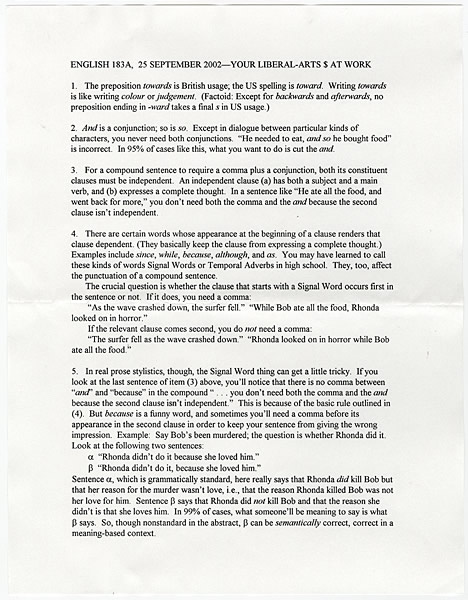
See, for instance, Wallace’s handout on five common usage mistakes, from his Fall 2002 section of English 183A at Pomona College (an advanced fiction writing class, taught last Spring by Jonathan Lethem). “The preposition towards is British usage; the US spelling is toward.” Fair enough. “And is a conjunction; so is so,” he continues. “Except in dialogue between particular kinds of characters, you never need both conjunctions.” Handy to know! Then, things get more technical: “For a compound sentence to require a comma plus a conjunction, both its constituent clauses must be independent.” As Wallace goes deeper, I feel even more sympathy for those who learn English as a second language, as I did when I read “Tense Present,” his Harper’s review of Bryan A. Garner’s A Dictionary of Modern American Usage. If the hardcore grammar talk tires you, feel free to peruse the Ransom Center’s other artifacts of Wallace’s time in the classroom—which we covered in a post last week—such as his syllabus for English 102: Literary Analysis, his guidelines for papers, and the marginalia in his copy of Carrie.
Colin Marshall hosts and produces Notebook on Cities and Culture and writes essays on literature, film, cities, Asia, and aesthetics. He’s at work on a book about Los Angeles, A Los Angeles Primer. Follow him on Twitter at @colinmarshall.
Jamaica Kincaid is out with her first novel in ten years, See Now Then, but she hasn’t been idle, steadily publishing non-fiction and essays in the span between 2002’s Mr. Potter and now. Kincaid is a many-faceted woman: Antiguan native, contented Vermont gardener, improbable literary success story, fierce critic of European colonialism. She is also, most likely, one of the most anthologized writers of the past few decades. Anyone who’s taken a writing or intro lit class recently has no doubt read her short story (or prose-poem) “Girl.”
With Kincaid in the news for her new book, the New Yorker’s Page-Turner blog caught up with one of her admirers, Haitian-American author and fellow New Yorker columnist Edwidge Danticat and asked her to read two of Kincaid’s classic stories, “Girl” and “Wingless,” published in the New Yorker in 1978 and ’79, for their fiction podcast. Danticat gladly obliged (hear the audio above), but not before briefly discussing her relationship to Kincaid and her work.
Last year, we posted on a song archive of novelist and anthropologist Zora Neale Hurston, who, it turns out, was also quite a singer. As she traveled through the American South and the Caribbean doing field research in the 1930s and ‘40s, Hurston collected and interpreted several folk songs and stories, sometimes working with folklorists Stetson Kennedy and Alan Lomax. Hurston dropped off the map for a few decades before a revival of her work in the 1970s caused literary scholars and historians to re-evaluate her place in American letters. One recent evaluation of her work and life, the 2008 PBS American Masters documentary Jump at the Sun, profiles the writer in all her independence, contrariness, and vigor. Unfortunately, the full documentary is not online, but you can order a copy of the award-winning film on DVD from California Newsreel or Amazon.
In the short clip above from Jump at the Sun, you can see footage Hurston shot herself, over which she sings, in her crystal clear alto, a bawdy old-time country blues song called “Uncle Bud.” Hurston called “Uncle Bud” a “jook song,” not the kind of thing sung around (or by) respectable ladies. The song comes from experiences with the infamous Chief Transfer Agent for the Texas prison system, “Uncle Bud” Russell, whose dreaded wagon, “Black Betty,” was possibly the reference for a work song immortalized by Lead belly, no stranger to Texas prisons (Russell also gets a name-check in Lead Belly’s “Midnight Special”).
Russell earned his notoriety, delivering 115,000 men and women to prison, including Clyde Barrow in 1930. The prison song, with equally profane, but slightly different lyrics, appeared on a 1960 album called The Unexpurgated Folk Songs of Men, compiled by Texas musicologist and folklorist Mack McCormick, and Texas bluesman Lightnin’ Hopkins had his own narrative of the lawman in “Bud Russell Blues.”
After Hurston’s brief rendition above, we see a photo montage of the author, smiling broadly, never without a rakishly cocked hat. Partly because of the work of folklorists and lovers of Americana like McCormick and Hurston, songs like “Uncle Bud” stayed in the lexicon of popular music, transmitted from obscure folk renditions to the blues and weaving together working-class black and white blues and folk traditions that were often never very far apart to begin with. Those worlds come together in Zydeco legend Boozoo Chavis’ take on “Uncle Bud,” but my favorite version by far is the lyrically cleaned-up, harmonica-driven stomper by Sonny Terry and Brownie McGhee, recorded in 1956 (below).
On Tuesday night, the San Francisco-Oakland Bay Bridge outshined The Golden Gate Bridge for the first time in 75 years. That happened when artist Leo Villareal flipped a switch and illuminated 25,000 lights, turning the 1.8‑mile expanse into the world’s largest L.E.D. light sculpture. According to The New York Times, the privately-funded project, estimated to cost $8 million, “has become a darling of moneyed Silicon Valley types.” And, it’s not hard to see why. As Villareal explains in the video above, “The Bay Lights” installation runs on custom-designed software (written in C) that captures the kinetic activity around the bridge and then uses the data to sequence the lights, creating patterns that never occur twice. You can visit the installation through 2015. Learn more here.
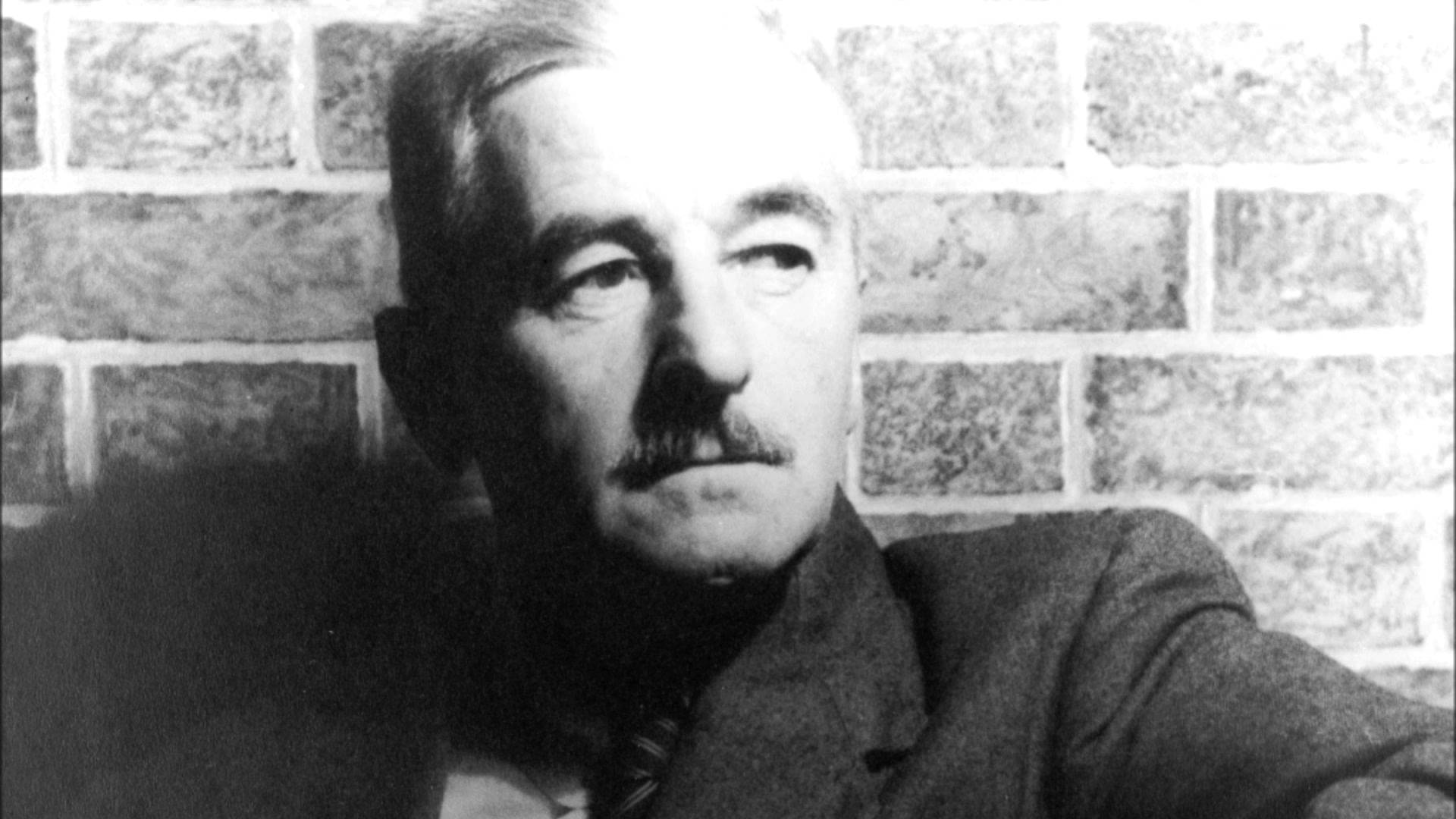
“The young writer would be a fool to follow a theory,” said the Nobel Prize-winning author William Faulkner in his 1958 Paris Review interview. “Teach yourself by your own mistakes; people learn only by error. The good artist believes that nobody is good enough to give him advice.”
All the same, Faulkner offered plenty of advice to young writers in 1957 and 1958, when he was a writer-in-residence at the University of Virginia. His various lectures and public talks during that time–some 28 hours of discussion–were tape recorded and can now be heard at the university’s Faulkner audio archive. We combed through the transcripts and selected seven interesting quotations from Faulkner on the craft of writing fiction. In most cases they were points Faulkner returned to again and again. Faulkner had a way of stammering when he composed his words out loud, so we have edited out the repetitions and false starts. We have provided links to each of the Virginia audio recordings, which are accompanied by word-for-word transcripts of each conversation.
1: Take what you need from other writers.
Faulkner had no qualms about borrowing from other writers when he saw a device or technique that was useful. In a February 25, 1957 writing class he says:
I think the writer, as I’ve said before, is completely amoral. He takes whatever he needs, wherever he needs, and he does that openly and honestly because he himself hopes that what he does will be good enough so that after him people will take from him, and they are welcome to take from him, as he feels that he would be welcome by the best of his predecessors to take what they had done.
2: Don’t worry about style.
A genuine writer–one “driven by demons,” to use Faulkner’s phrase–is too busy writing to worry about style, he said. In an April 24, 1958 undergraduate writing class, Faulkner says:
I think the story compels its own style to a great extent, that the writer don’t need to bother too much about style. If he’s bothering about style, then he’s going to write precious emptiness–not necessarily nonsense…it’ll be quite beautiful and quite pleasing to the ear, but there won’t be much content in it.
3: Write from experience–but keep a very broad definition of “experience.”
Faulkner agreed with the old adage about writing from your own experience, but only because he thought it was impossible to do otherwise. He had a remarkably inclusive concept of “experience.” In a February 21, 1958 graduate class in American fiction, Faulkner says:
To me, experience is anything you have perceived. It can come from books, a book that–a story that–is true enough and alive enough to move you. That, in my opinion, is one of your experiences. You need not do the actions that the people in that book do, but if they strike you as being true, that they are things that people would do, that you can understand the feeling behind them that made them do that, then that’s an experience to me. And so, in my definition of experience, it’s impossible to write anything that is not an experience, because everything you have read, have heard, have sensed, have imagined is part of experience.
4: Know your characters well and the story will write itself.
When you have a clear conception of a character, said Faulkner, events in a story should flow naturally according to the character’s inner necessity. “With me,” he said, “the character does the work.” In the same February 21, 1958 American fiction class as above, a student asked Faulkner whether it was more difficult to get a character in his mind, or to get the character down on paper once he had him in his mind. Faulkner replies:
I would say to get the character in your mind. Once he is in your mind, and he is right, and he’s true, then he does the work himself. All you need to do then is to trot along behind him and put down what he does and what he says. It’s the ingestion and then the gestation. You’ve got to know the character. You’ve got to believe in him. You’ve got to feel that he is alive, and then, of course, you will have to do a certain amount of picking and choosing among the possibilities of his action, so that his actions fit the character which you believe in. After that, the business of putting him down on paper is mechanical.
5: Use dialect sparingly.
In a pair of local radio programs included in the University of Virginia audio archive, Faulkner has some interesting things to say about the nuances of the various dialects spoken by the various ethnic and social groups in Mississippi. But in the May 6, 1958 broadcast of “What’s the Good Word?” Faulkner cautions that it’s important for a writer not to get carried away:
I think it best to use as little dialect as possible because it confuses people who are not familiar with it. That nobody should let the character speak completely in his own vernacular. It’s best indicated by a few simple, sparse but recognizable touches.
The only rule I have is to quit while it’s still hot. Never write yourself out. Always quit when it’s going good. Then it’s easier to take it up again. If you exhaust yourself, then you’ll get into a dead spell and you’ll have trouble with it.
7: Don’t make excuses.
In the same February 25, 1957 writing class, Faulkner has some blunt words for the frustrated writer who blames his circumstances:
I have no patience, I don’t hold with the mute inglorious Miltons. I think if he’s demon-driven with something to be said, then he’s going to write it. He can blame the fact that he’s not turning out work on lots of things. I’ve heard people say, “Well, if I were not married and had children, I would be a writer.” I’ve heard people say, “If I could just stop doing this, I would be a writer.” I don’t believe that. I think if you’re going to write you’re going to write, and nothing will stop you.
Name the three figures, living or dead, with whom you would most like to sit down to dinner. Though perhaps a little tired, the challenge still reveals something worth knowing about the respondent’s personality. If I know the personalities of Open Culture readers at all, I’d wager that more than a few of you would choose to set places at the table for Carl Sagan, Stephen Hawking, and Arthur C. Clarke. Anyone interested in asking the big, existential questions and understanding the science underneath them would have the time of their lives at such a meal, especially if astrophysically inclined. But until a genie grants you this wish, may we offer God, the Universe, and Everything Else?
Presented by Magnus Magnusson, longtime host of the BBC’s Mastermind, this program brings the three together to discuss “the Big Bang theory, God, our existence as well as the possibility of extraterrestrial life.” Hawking, of course, talks through his signature speech synthesizer, and Sagan joins up through a satellite link — beamed through, yes, the very sort of floating miracles of engineering that Clarke wrote about in his novels. With minds like these, you can rest assured that the conversation won’t stray far from what Sagan calls “the fundamental questions,” nor will it come untethered from established human knowledge and float into the realms of wild speculation and wishful thinking. And of course, in such conversations, a sense of humor like Hawking’s — a man who, not expected to reach age thirty, would nevertheless live to see more advancement in human knowledge than anyone else on the broadcast — never goes amiss.
Colin Marshall hosts and produces Notebook on Cities and Culture and writes essays on literature, film, cities, Asia, and aesthetics. He’s at work on a book about Los Angeles, A Los Angeles Primer. Follow him on Twitter at @colinmarshall.
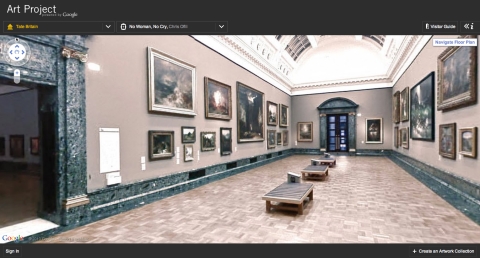
Today at 8 p.m. EST Google Art Project will launch a new series, Art Talks. Like Google’s other Hangouts on Air, Art Talks will convene some of the most influential people of our time.
Each month Art Talks will feature a conversation with curators, museum directors, historians, or educators from world-renowned cultural institutions, who “will reveal the hidden stories behind particular works, examine the curation process and provide insights into particular masterpieces or artists.”
For today’s talk Deborah Howes, director of digital learning at the Museum of Modern Art, will moderate a panel of artists and students for a discussion about how to teach art online. To post a question for the group, visit the Google event page.
The talk will be broadcast live at 8 p.m. EST. Afterwards it’ll be available on Google Art Project’s YouTube channel.
Later this month Caroline Campbell and Arnika Schmidt from the National Gallery will discuss depictions of the female nude. In April, a panel will examine the gigapexil project based on Bruegel’s “Tower of Babel.”
The question “what is art?” has not been answered so much as exponentially dismantled in the past 100 years, such that, at present, it’s more or less meaningless to assert that some higher aesthetic realm exists apart from the splash and topicality of street art, product design, or advertising. Museums find themselves not so much curators of high culture as interpreters of what’s happening now, including such “low” arts as, say, graffiti, hip hop, rock photography, and, most recently, video games.
Which brings us to the Museum of Modern Art’s video game exhibit opening this Friday. Does the idea make you gasp? Well, according to MoMA Senior Curator Paola Antonelli in the video above, you are “in a dramatic minority… out of space and out of time.” Is she for real? It really doesn’t matter, since the final word on what is or isn’t art rests with… well, no one, really. And that is, in my humble opinion, a salutary legacy of the modernist revolution in the arts. Maybe if everyone’s a critic these days, then everyone’s also an artist, but especially those designers and programmers who gave us such enduring classics as Pac-Man, Tetris, SimCity, and Myst, all of which have made the cut in MoMA’s exhibition.
This is not the first large-scale exhibition of video games in a major art museum. In March-September, 2012, the Smithsonian Museum of American Art staged The Art of the Video Game, which featured eighty games, selected with help from the public, and video interviews with twenty game developers. Curated by gamer and collector Chris Melissinos, the exhibition made an extensive case for video games as art. See the Smithsonian exhibition trailer below, and decide for yourself if video games belong in museums. You’re the critic, after all.
We're hoping to rely on loyal readers, rather than erratic ads. Please click the Donate button and support Open Culture. You can use Paypal, Venmo, Patreon, even Crypto! We thank you!
Open Culture scours the web for the best educational media. We find the free courses and audio books you need, the language lessons & educational videos you want, and plenty of enlightenment in between.