There’s nothing really wrong with Back to the Future. Critics loved Robert Zemeckis’ sci-fi comedy when it first came out in 1985. (Roger Ebert likened it to a great Frank Capra film.) And it still delights old and new viewers almost 30 years later. But, like every film, Back to the Future has its minor flaws. The web site/YouTube channelCinema Sins is “dedicated to pointing out all the sins [they] can find in movies, some big and some small. Some … downright microscopic.” And that’s what you get here. A breakdown of every little problem and inconsistency in Zemeckis’ film. Fortunately, the folks behind Cinema Sins don’t take themselves too seriously. Nor do they consider themselves beyond reproach. Heck, this summer they produced Everything Wrong With Cinema Sins In 3 Minutes Or Less. You can watch it here.
If you would like to sign up for Open Culture’s free email newsletter, please find it here. It’s a great way to see our new posts, all bundled in one email, each day.
If you would like to support the mission of Open Culture, consider making a donation to our site. It’s hard to rely 100% on ads, and your contributions will help us continue providing the best free cultural and educational materials to learners everywhere. You can contribute through PayPal, Patreon, and Venmo (@openculture). Thanks!
Looking like a haute couture treatment of “As the World Falls Down” from Labyrinth, by way of Peter Jackson’s Beautiful Creatures, the “Director’s Cut” of this Louis Vuitton ad above, titled “L’Invitation au Voyage,” is pretty stunning. Bowie lip syncs “I’d Rather be High,” a stand out from his latest, The Next Day, and looks nearly as magnetic as his Goblin King did almost thirty years ago. He’s definitely still got it on screen, making me pine for another Bowie-led feature-length fantasy (but not a Labyrinth remake).
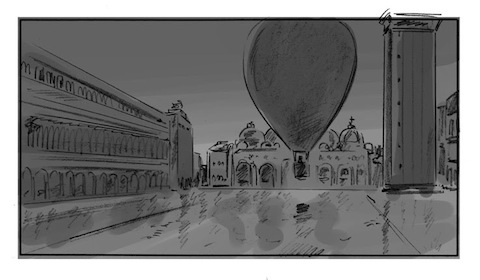
The making-of reel above might also be of interest, although at under two minutes, the techno montage doesn’t offer much insight into the elaborate design of the short. Of more interest for fans of fashion, design, and film may be this blog post (in Chinese), which features some gorgeous production stills and storyboards, like the one below. The short’s director, Romain Gavras, previously made the video for Kanye West and Jay Z’s “No Church in the Wild,” so he’s definitely got an eye for spectacle.
Their roof-mounted 15-lens Trekker cameras constantly blunder across less-than-dignified scenes whilst trawling the roads on behalf of Google Maps (a service that is forever linked in my mind to Lazy Sunday, the preposterous rap video starring comedians Andy Samberg and Chris Parnell.)
The cars themselves are totally goofy-looking. I would imagine that spotting one in real life is something akin to a Weinermobile sighting. No wonder the producers of Arrested Development arranged for George Michael Bluth, the hapless innocent played by Michael Cera, to drive one in the series’ fourth season.
I have a hunch that the Street View Trekker’s backpack model will ultimately prove less mockable than its four-wheeled counterpart. It can go where cars can’t, conferring an extreme sports vibe despite the big, ball-shaped camera apparatus sticking up. A limited pilot program has been recruiting volunteers to wear the backpack in such locales as Bulgaria, Indonesia, and South Africa. The Philippines is another destination where volunteers are sought, and all kidding aside, it would be riveting to see how this technology might document the devastation in Tacloban.
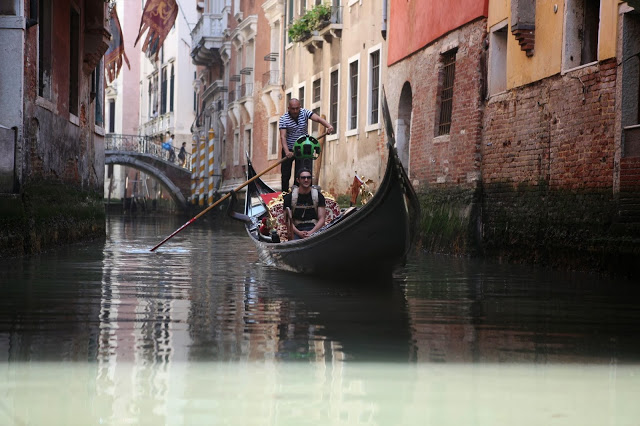
For now, the non-automotive Street View’s greatest triumph lies in recording the canals and cobbled walkways of Venice, Italy, a feat impossible to pull off in a car. To accomplish this, a team of backpackers logged over 375 miles on foot and by boat. Their efforts provide tourists with practical information in a format to which they’ve no doubt grown accustomed, as well as presenting armchair travelers with plenty of non-disappointing eye candy.
Cyber visitors can choose to traverse the Floating City much as actual visitors can — on foot, by vaporetta or by gondola. (I’d advise making a trip to the bathroom even if you’re not actually leaving home. At the very least turn the sound down — the paddling noises accompanying the last option could cause a Pavlovian bladder response.)
An émigré from Nazi Germany, Hans Bethe joined Cornell’s physics department back in 1935. There, he built a remarkable career for himself. A nuclear physicist, Bethe made key contributions to the Manhattan Project during World War II. After the war, he brought stellar young physicists like Richard Feynman from Los Alamos to Ithaca and turned Cornell’s physics department into a top-notch program. In 1967, he won the Nobel Prize for “his groundbreaking work on the theory of energy production in stars.”
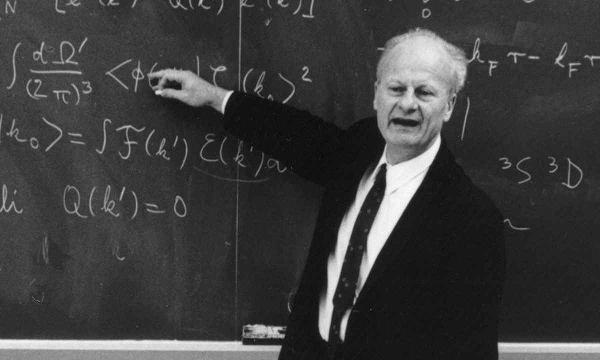
As a tribute to Bethe, Cornell now hosts a web site called Quantum Physics Made Relatively Simple, where you can watch three lectures presented by Bethe in 1999. They’re a little different from the usual lectures you encounter online. In these videos, Bethe is 93 years old, older than your average prof. And he presents the lectures not in a Cornell classroom, but at the Kendal of Ithaca retirement community, which gives them a certain charm. You can watch them here:
Lecture 1: Here Bethe “introduces quantum theory as ‘the most important discovery of the twentieth century’ and shows that quantum theory gave us ‘understanding and technology.’ He cites computers as a dramatic realization of applied quantum physics.”
Lecture 2: “By the 1920s, physicists were driving to synthesize early quantum ideas into a consistent theory. In Lecture 2, Professor Bethe relates the exciting theoretical and experimental breakthroughs that led to modern quantum mechanics.”
Lecture 3: In the last lecture, “Professor Bethe recalls work on the interpretation of the wave function, the Heisenberg Uncertainty Principle, and the Pauli Exclusion Principle. He shows how quantum theory forced discussion of issues such as determinism, physical observables, and action-at-a-distance.”
Tom Waits is a rare breed of performer, having attained vast commercial success without having had to pander to a mass audience. His gruff voice—the vocal equivalent of too many late nights, strong scotch, and a pack-an-hour habit—has become the hallmark of a sort of grimy, outsider cool favored by Jim Jarmusch and John Lurie. His career, which has spanned four decades and includes theatre, film, and the iconic interview that inspired the character of The Joker in The Dark Knight, is the envy of most musicians. It was only fitting, considering his prodigious output, that Waits would become the subject of a cover album. Unsurprisingly, it comes with a twist—it’s in Hebrew.
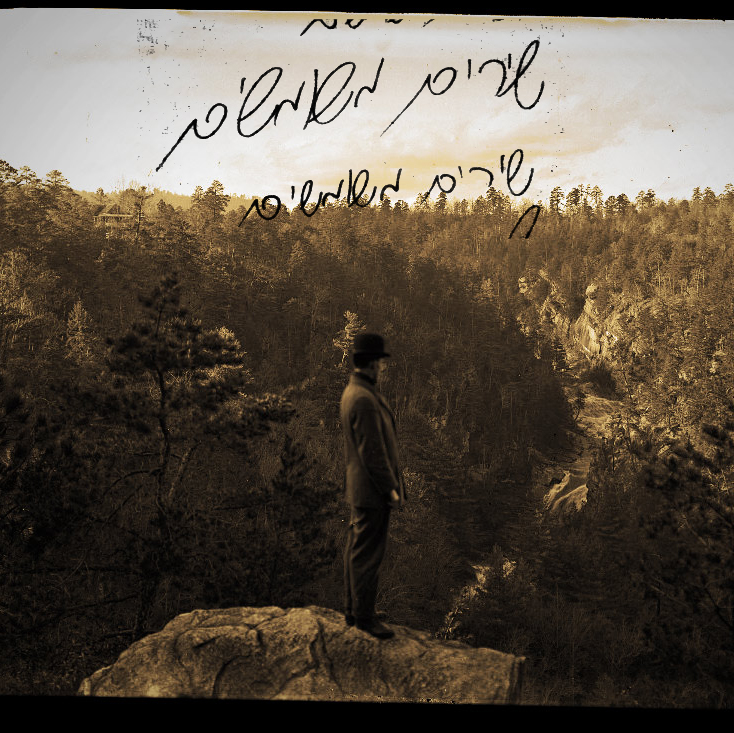
Heeb Magazine recently posted a link to “Shirim Meshumashim” (“Used Songs”), producer Guy Hajjaj’s four-year project where Israeli musicians recreate Tom Waits’ back catalog. The 22-song album draws widely from Waits’ career, including songs from classic albums such as Raindogs (1985) as well as the more recent Orphans: Brawlers, Bawlers & Bastards (2006)and Glitter and Doom Live (2009). While more zealous fans will undoubtedly claim that Waits’ original delivery can never be matched, those with an open mind will likely find a number of gems. Some of our favorites include “Clap Hands,” ideally suited to Hebrew’s harsh, gravelly sounds, and the lighter, yet unmistakably Waits-written, “Dirt in The Ground.”
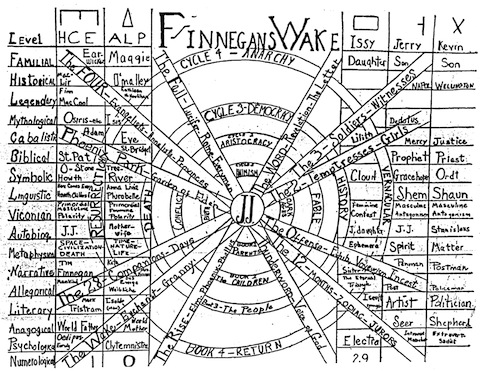
After the publication and eventual triumph of Ulysses, James Joyce spent the remainder of his life working secretively on a “Work in Progress” that he would publish in 1939 as Finnegans Wake, a novel that largely abandons the trappings of the novel and should better be called, as Anthony Burgess called it, a prose-poem—a beast that strikes the common reader as, in Burgess’ words, “too literary” and “horribly opaque.” My first encounter with this most intimidating book felt like something between hearing Italian comedian Adriano Celentano’s rapturously gibberish approximation of the sound of English in song and Michael Chabon’s detection of a “faintly Tolkienesque echo.” Like Chabon, I too could “hear the dreaming suspirations of the princess who lay sleeping in its keep.” Yet I was a bit too old for fantasy, I thought, and far too out of my depth in Joyce’s invented language, built, Burgess writes, “on the freshly uncovered roots of English.”
I’ve never lost my fear of the book, and never found it accommodating to any narrative sense. And it is fearful and unaccommodating if one approaches it like a conventional novel that will yield its secrets eventually and reward the diligent reader with some sort of singular payoff. Nevertheless, the sheer pleasure one can derive—conventional expectations duly set aside—from the almost tactile quality of Joyce’s prose, its earthy, ancient, elven sounds, seems more to the point of appreciating this odd, frustrating work. Perhaps, like any well-written poem, one simply needs to hear it read aloud. Joyce himself said so, and so you can. Ubuweb brings us the entirety of Patrick Healy’s reading of the text, recorded over a four-day period in 1992 at Dublin’s Bow Lane Recording Studios. (You can hear a small opening segment above.) Healy’s reading is not without its faults—he rushes and stumbles at times—but that seems a mean commentary on a recording of this length and difficulty. Listen to the first installment above and the rest here. You may just have an epiphany or two.
Wes Anderson, it seems, has entered his European period. His next feature film, The Grand Budapest Hotel, which comes out in March, takes place in its titular location. His new short film Castello Cavalcanti, too, takes place in its titular location, a hamlet tucked away somewhere undisclosed in Italy. Then again, hasn’t Anderson, aesthetically and referentially speaking, always enjoyed something of a European period? (Maybe we can call it European by way of his native Texas, which, for me, only adds to the visual interest.) This, combined with his apparent fascination with the objects and built environment of the early- to late-middle twentieth century, has won him a great many fans sympathetic to his sensibilities. (Along with, of course, a handful of detractors less sympathetic to them.) This brief but vibrant new piece should, for them, resonate on several levels at once.
Anderson transports us to Castello Cavalcanti in the suitably midcentury year of 1955. The quiet evening scene, exuding that richly Italian feeling falling somewhere between idyll and indolence, splinters apart when a race car crashes into the center of town. Out of the wreck emerges the unscathed but enraged driver: Jed Cavalcanti, played by none other than Jason Schwartzman, star of Anderson’s 1998 breakout Rushmore. Once his anger at his brother-in-law mechanic cools — evidently, the steering wheel got screwed on backward — the Italian-American Cavalcanti realizes he may have driven not only straight into his own ancestral village, but into the company of his ancestors themselves. These charming and vividly colorful seven Andersonian minutes come brought to you by Prada, who, apart from our hero’s racing suit, don’t seem to have left many overt stamps on the finished product. Prada’s prices may still keep me away from their door, but their taste in directors sure won’t.
Castello Cavalcantiwill be added to our collection of 600 Free Movies Online.
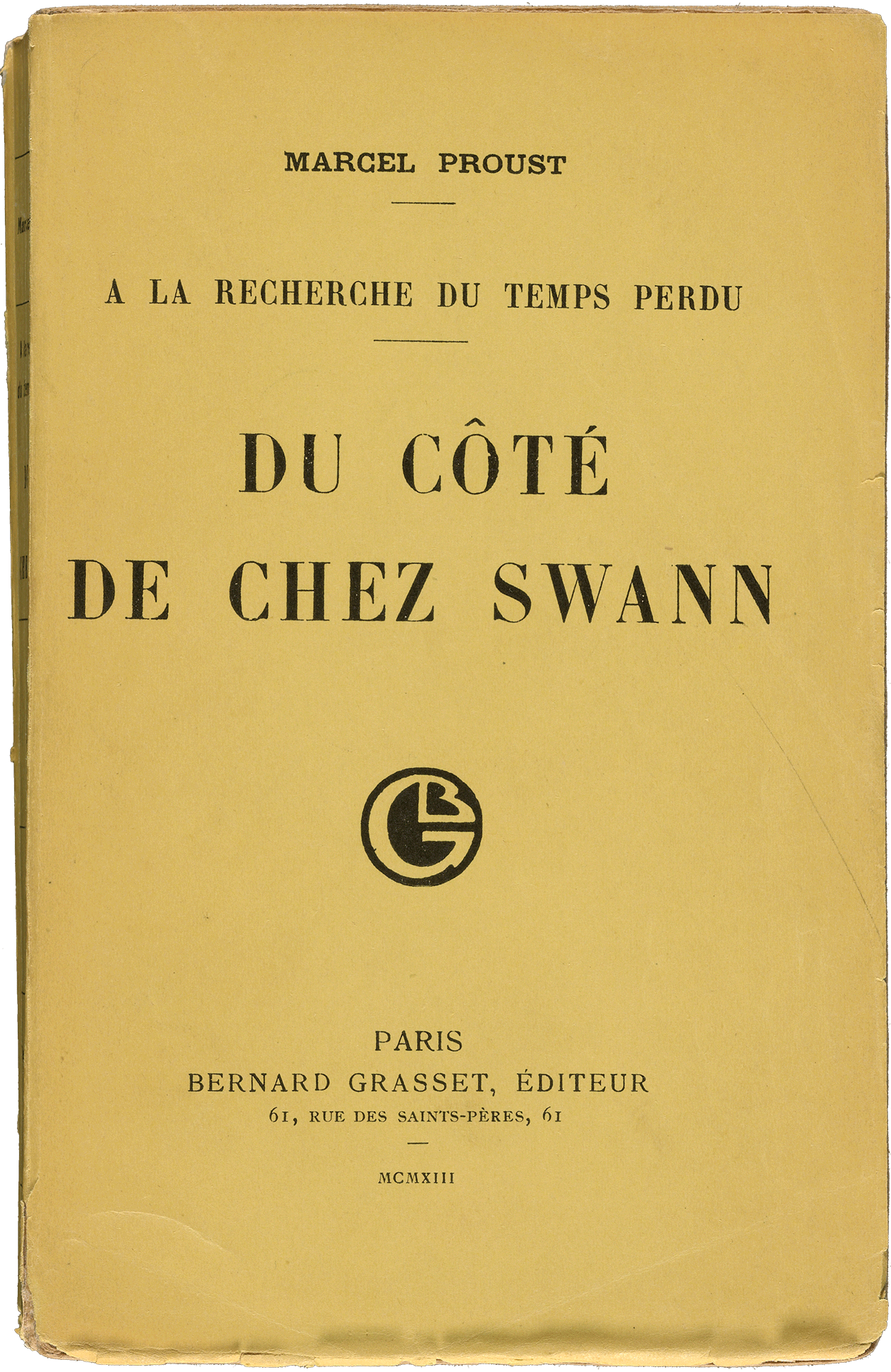
“We seem to be reaching a point in history where Ulysses (1922) is talked or written about more than read,” writes Wayne Wolfson at Outsideleft in an essay on James Joyce and Marcel Proust, whose Swann’s Way, the first in his seven-volume cycle Remembrance of Things Past (À la recherche du temps perdu), turns 100 today. This observation might have applied to Proust’s enormous modernist feat at all times in its history. Though Proust was fêted by high culture patrons and writers like Violet and Sydney Schiff, it’s hard to imagine these busy socialites secluding themselves for several months to catch up with a 4,000-page modernist masterwork. As French crime novelist Frédérique Molay glibly observes, “[Remembrance of Things Past] corresponds to a lot of lost time.”
Molay also points out that Proust’s friend and rival André Gide “didn’t like the manuscript, calling it ‘incomprehensible.’” Gide only saw volume one, Swann’s Way, though whether he actually read it or not is in some dispute. In any case, after Gide’s rejection, Proust’s publishing options narrowed to Bernard Grasset (Proust footed the bill for printing), with whom, notes The Independent, the author “engaged in a tortuous pas de deux… for most of 1913.” The back and forth included the “elaborate to-and-fro of his labyrinthine galley-proofs” (see an example above, and more here). And yet, The Independent goes on,
Swann’s Way at last appeared on 14 November in an edition of 1,750 copies (for which Proust paid more than 1,000 francs). A familiar kind of literary myth would suggest that, after a difficult birth, such a groundbreaking work must sink without trace. On the contrary.
Indeed. As a young grad student, I once walked in shame because—gasp—I had read no Proust. Not a word. I vaguely associated the name with French modernism, with a languorous, self-indulgent kind of writing that a reader like myself at the time, with a taste for the knotty, gnarled, and grotesque—for Faulkner and O’Connor, Hardy, Melville, and yes, Joyce—found disagreeable. I’d avoided Proust thus far, I reasoned, no need to rend my veil of ignorance now. Later, I defaulted to Molay’s glibness. Shrug, who has the time?
But today I feel I should revise that conclusion, at the very least because a bandwagon full of highly respected names has turned up to celebrate Proust’s achievement—or its nominal birthdate—including Ira Glass, pastry chef Dominique Ansel, who will bake madeleines (and who invented the Cronut), and novelist Rick Moody. These are but three of a cloud of “Proust fans of all kinds” participating in a “nomadic reading” of Swann’s Way in New York. It’s a showy affair, with readers gathering “over madeleines and champagne, in hotel rooms, gardens and nightclubs, from the Bronx to Brooklyn.”
By contrast, Antonin Baudry, one of the event’s organizers tells us, “In France, ordinary people are more likely just to read Proust at home.” (You can see clips of everyday French people reading Proust here, in fact.) Given the famously hypochondriac and reclusive author’s penchant, I may also spend the day at home, reading Proust, in bed, inspired also by Rick Moody’s observation: “As a young writer, I felt there were two kinds of people: Joyce people and Proust people.… For a long time, I would’ve asserted my allegiance to Joycean qualities. But in my galloping middle age, Proust calls to me more fervently.”
If you feel likewise inspired today, you can read all of Proust’s literary feast—or just sample it in bites. Find links to all seven volumes of Remembrance of Things Past below. They’re otherwise housed in our collection, 800 Free eBooks for iPad, Kindle & Other Devices.
We're hoping to rely on loyal readers, rather than erratic ads. Please click the Donate button and support Open Culture. You can use Paypal, Venmo, Patreon, even Crypto! We thank you!
Open Culture scours the web for the best educational media. We find the free courses and audio books you need, the language lessons & educational videos you want, and plenty of enlightenment in between.