BBC Radio Adaptation of Neil Gaiman’s Neverwhere Begins Saturday: A Preview

Amer­i­can radio dra­mas, once the pride of the medi­um, died out soon after the rise of tele­vi­sion. But U.S. lis­ten­ers in search of con­tin­ued dra­mat­ic inno­va­tion over the air­waves need only turn their ears toward the oth­er side of the Atlantic, where the BBC has kept the craft in stur­dy work­ing order. This Sat­ur­day, March 16, brings the debut of a much-antic­i­pat­ed BBC Radio 4 series adapt­ed from the work of a British sto­ry­teller with inter-gen­er­a­tional, inter­na­tion­al appeal, and a hybrid fan­tas­ti­cal-real­ist sen­si­bil­i­ty all his own. The writer? Neil Gaiman. The dra­ma? Nev­er­where. Astute fans will know that Gaiman craft­ed this “urban fan­ta­sy” series first as a tele­vi­sion series, and then as a nov­el. It went on to become a com­ic book, then a stage pro­duc­tion and now, adapt­ed by Dirk Mag­gs, a radio play. Has the man’s work tran­scend­ed all lim­its of form?

When Nev­er­where begins, non‑U.K. res­i­dents can lis­ten on the BBC’s site here. At the moment, it offers a slew of pre­view clips to give you a fla­vor of just how Gaiman’s mate­r­i­al sounds as inter­pret­ed by cast includ­ing James McAvoy, Natal­ie Dormer, Bene­dict Cum­ber­batch, and Christo­pher Lee. With just music, sound effects, and the voic­es of these for­mi­da­ble thes­pi­ans, the BBC’s experts will tell Gaiman’s sto­ry of two Lon­dons: “Lon­don Above,” the one we all know and some of us love, and “Lon­don Below,” the city’s under­ground par­al­lel inhab­it­ed by the grotesque, the flam­boy­ant, the anachro­nis­tic, or—depending on your feel­ings about Lon­don Above—the more grotesque, the more flam­boy­ant, and the more anachro­nis­tic. Hear what hap­pens between these two visions of Lon­don with Nev­er­where’s first, hour-long episode on Sat­ur­day and its sub­se­quent five half-hour episodes from Mon­day, March 18 onward. All episodes will stay avail­able on demand until March 29. You can read more details on the BBC Radio 4 Nev­er­where about page.

Relat­ed Con­tent:

Neil Gaiman’s Free Short Sto­ries

Neil Gaiman Launch­es New Crowd­sourced Sto­ry­telling Project (Spon­sored by the New Black­Ber­ry)

The BBC Presents a New Drama­ti­za­tion of Orwell’s 1984, with Christo­pher Eccle­ston as Win­ston Smith

Col­in Mar­shall hosts and pro­duces Note­book on Cities and Cul­ture and writes essays on lit­er­a­ture, film, cities, Asia, and aes­thet­ics. He’s at work on a book about Los Ange­les, A Los Ange­les Primer. Fol­low him on Twit­ter at @colinmarshall.

Creative Commons Announces “School of Open” with Courses to Focus on Digital Openness

Just in time to cel­e­brate Open Edu­ca­tion Week, here comes a new ini­tia­tive, the School of Open, a learn­ing envi­ron­ment focused on increas­ing our under­stand­ing of “open­ness” and the ben­e­fits it brings to cre­ativ­i­ty and edu­ca­tion in the dig­i­tal age.

Devel­oped by the col­lab­o­ra­tive edu­ca­tion plat­form Peer to Peer Uni­ver­si­ty (P2PU) with orga­ni­za­tion­al sup­port from Cre­ative Com­mons, the School of Open aims to spread under­stand­ing of the pow­er of this brave new world through free online class­es.

We hear about it all the time: Uni­ver­sal access to research, edu­ca­tion and culture—all good things, with­out a doubt—made pos­si­ble by things like open source soft­ware, open edu­ca­tion­al resources and the like.

But what are these var­i­ous com­mu­ni­ties and what do they mean? How can we all learn more and get involved?

School of Open has rolled the con­ver­sa­tion back to square one so that under­stand­ing the basics is easy. Through a list of new cours­es cre­at­ed by users and experts, peo­ple can learn more about what “open­ness” means and how to apply it. There are stand-alone cours­es on copy­right, writ­ing for Wikipedia, the col­lab­o­ra­tive envi­ron­ment of open sci­ence, and the process behind mak­ing open video.

These free cours­es start March 18 (sign up by click­ing the “start course” but­ton by Sun­day, March 17):

These free cours­es are open for you to take at any time:

The approach at P2PU encour­ages peo­ple to work togeth­er, assess one another’s work, and pro­vide con­struc­tive feed­back. It’s a great place to learn how to design your own course, because the design process is bro­ken down step-by-step, and course con­tent is vet­ted by users and P2PU staff. The tuto­r­i­al shows you how the process works.

P2PU is also a place to learn more about what is open con­tent and what is not. Par­tic­i­pants in the ongo­ing course Open Detec­tive learn to iden­ti­fy open source media and then demon­strate mas­tery by mak­ing some­thing of their own using only open con­tent. What if you’re real­ly, real­ly proud of the resource you cre­ate in Open Detec­tive? Take it to the next lev­el and get a Cre­ative Com­mons license to make your work avail­able with­out giv­ing up full copy­right. You guessed it, there’s a course for that too.

Open Edu­ca­tion Week is in full swing (through Mon­day the 18th). There’s a full sched­ule of webi­na­rs to check out, includ­ing dis­cus­sions about the impli­ca­tions of open access for polit­i­cal struc­tures like the World Bank, and the impact of open, glob­al teach­ing in Syr­ia.

Relat­ed Con­tent:

Total Noob to Learn­ing Online? P2PU’s Peer-to-Peer Cours­es Hold Your Hand

700 Free Online Cours­es

A Meta List of MOOCs

What Entered the Pub­lic Domain in 2013? Zip, Nada, Zilch!

Noam Chom­sky Spells Out the Pur­pose of Edu­ca­tion

Kate Rix writes about dig­i­tal media and edu­ca­tion. Vis­it her web­site at .

Clash of the Titans: Noam Chomsky & Michel Foucault Debate Human Nature & Power on Dutch TV, 1971

Today, we’re revis­it­ing the clash of two intel­lec­tu­al titans, Noam Chom­sky and Michel Fou­cault. In 1971, at the height of the Viet­nam War, the Amer­i­can lin­guist and the French theorist/historian of ideas appeared on Dutch TV to debate a fun­da­men­tal ques­tion: Is there such a thing as innate human nature? Or are we shaped by expe­ri­ences and the pow­er of cul­tur­al and social insti­tu­tions around us? The thinkers answered these ques­tions rather dif­fer­ent­ly, giv­ing view­ers a fair­ly suc­cinct intro­duc­tion to their basic the­o­ries of lan­guage, knowl­edge, pow­er and beyond.

42 years lat­er, you can watch the debate on YouTube in parts or in its entire­ty. Above you will find two excerpts that show you the high­lights, com­plete with sub­ti­tles. Below you can watch the entire debate online, from start to fin­ish. Sub­ti­tles should be pro­vid­ed, but if you have any prob­lems, you can read a full tran­script of the debate online (it’s entire­ly in Eng­lish), or pur­chase a copy in book for­mat.

Look­ing for free, pro­fes­­sion­al­­ly-read audio books from Audible.com? Here’s a great, no-strings-attached deal. If you start a 30 day free tri­al with Audible.com, you can down­load two free audio books of your choice. Get more details on the offer here.

If you would like to sign up for Open Culture’s free email newslet­ter, please find it here. It’s a great way to see our new posts, all bun­dled in one email, each day.

If you would like to sup­port the mis­sion of Open Cul­ture, con­sid­er mak­ing a dona­tion to our site. It’s hard to rely 100% on ads, and your con­tri­bu­tions will help us con­tin­ue pro­vid­ing the best free cul­tur­al and edu­ca­tion­al mate­ri­als to learn­ers every­where. You can con­tribute through Pay­Pal, Patre­on, and Ven­mo (@openculture). Thanks!

Relat­ed Con­tent:

Michel Fou­cault: Free Lec­tures on Truth, Dis­course & The Self (UC Berke­ley, 1980–1983)

Michel Fou­cault – Beyond Good and Evil: 1993 Doc­u­men­tary Explores the Theorist’s Con­tro­ver­sial Life and Phi­los­o­phy

An Ani­mat­ed Intro­duc­tion to Michel Fou­cault, “Philoso­pher of Pow­er”

Noam Chom­sky Spells Out the Pur­pose of Edu­ca­tion

Jacques Lacan Speaks; Zizek Pro­vides Free Cliffs Notes

Down­load 130 Free Phi­los­o­phy Cours­es: Tools for Think­ing About Life, Death & Every­thing Between

Read Chez Fou­cault, the 1978 Fanzine That Intro­duced Stu­dents to the Rad­i­cal French Philoso­pher

by | Permalink | Make a Comment ( 21 ) |

Donald Barthelme’s Syllabus Highlights 81 Books Essential for a Literary Education

barthelme_1a

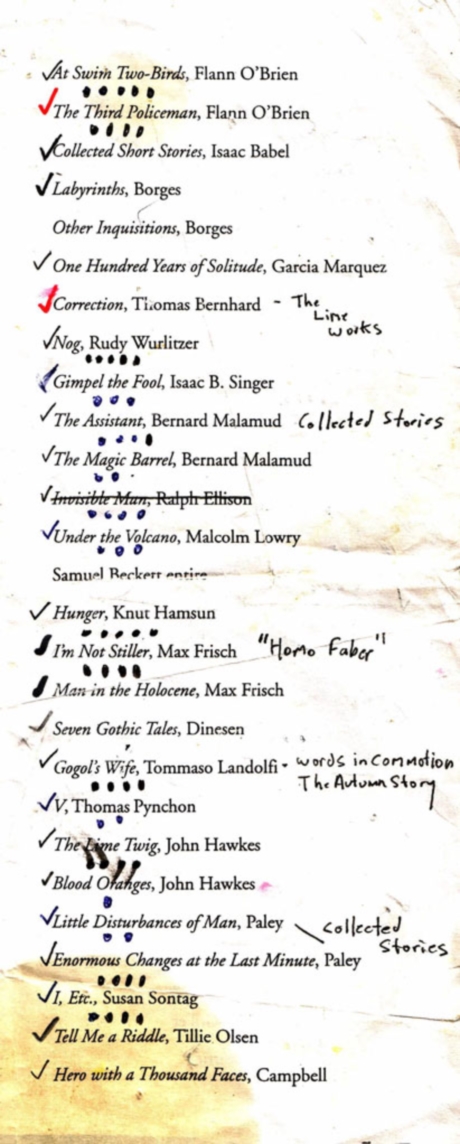
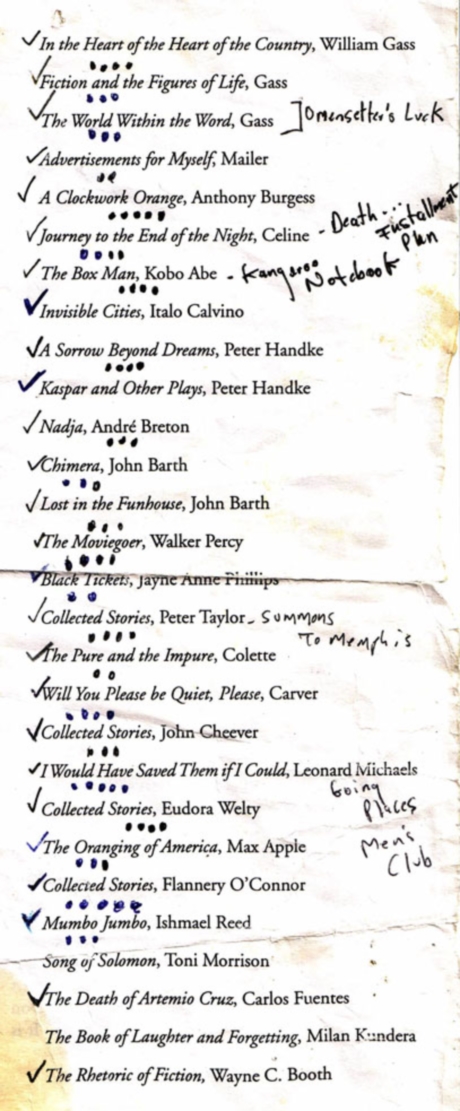
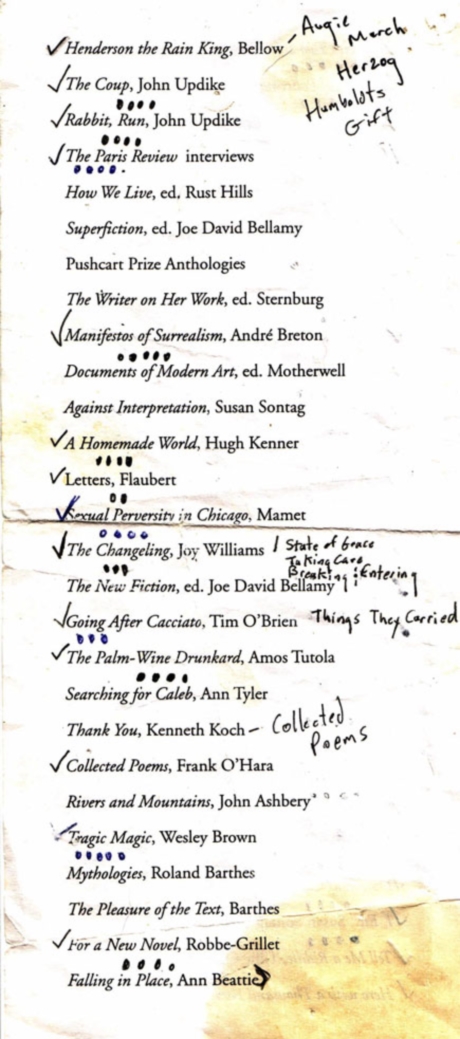
We’ve had a lot of fun—and some debate—lately with read­ing lists from peo­ple like Carl Sagan, Neil DeGrasse Tyson, and even Mar­i­lyn Mon­roe (via her library). And we’ve fea­tured under­grad­u­ate syl­labi from the teach­ing days of David Fos­ter Wal­lace and W.H. Auden. Now for some­thing more-or-less for­mal than those. This one comes via a 2003 piece by Kevin Mof­fett in McSweeney’s spin-off The Believ­er (10 years old this month—I know, right?). The list (first page above and full list below) has a some­what illus­tri­ous her­itage. Com­piled by post­mod­ernist writer Don­ald Barthelme for his stu­dents at the Uni­ver­si­ty of Hous­ton, it then made its way to Barthelme’s stu­dent, South­ern writer Pad­gett Pow­ell. The list then came to Mof­fett when he was a stu­dent of Powell’s at the Uni­ver­si­ty of Flori­da.

barthelme_2a

Con­sist­ing of 81 books, most­ly nov­els and short sto­ry col­lec­tions (and the work of Samuel Beckett—“entire”), and most­ly twen­ti­eth-cen­tu­ry mod­ernist fic­tion, the list came to Pow­ell with Barthelme’s instruc­tion to attack the books, “in no par­tic­u­lar order, just read them.”

This Mof­fett did, and his sto­ry of how he sought the books—in the used book­shops, ware­house sales, and libraries of north Florida—lends to his expe­ri­ence the air of a sub­ur­ban knight’s quest tale, with Mof­fett as under­dog hero. The list spans a range of dif­fi­cul­ty, from the aca­d­e­m­ic obscu­ran­tism of Roland Barthes to the gen­er­al acces­si­bil­i­ty of Updike (Barthelme mod­est­ly exempts him­self). But the text that turns Mof­fett from dif­fi­dent to avid read­er, Flan­nery O’Connor’s “A Late Encounter With the Ene­my,” also turns his “res­o­lu­tion into a vow.” It’s almost as though his engage­ment with Barthelme’s list ini­ti­ates him into a mys­ti­cal order of lan­guage.

barthelme_3a

The list itself, as you can see from the scans, shows the wear of sev­er­al pairs of hands—hands hold­ing late-night cof­fees in col­lege-town cafes and felt-tip pens with which to make tiny check­marks of accom­plish­ment. We do not know from Moffett’s piece whose hands did the cof­fee-spilling, check­mark­ing, and anno­tat­ing, whether Powell’s, Moffett’s, or some stu­dent or pri­vate read­er unmen­tioned. Some of the books left unchecked are those with which I have had read­er­ly epipha­nies: Borges’ Oth­er Inqui­si­tions, Barthes’ Mytholo­gies, Beck­ett (“entire”), Toni Morrison’s Song of Solomon. And what strikes me, as with all such lists, are the num­ber of books I haven’t read but have wished to, meant to, promised that I would. Per­haps it’s not too late to turn a res­o­lu­tion to a vow and hit the stacks.

Here is the com­plete list:

Relat­ed Con­tent:

Neil deGrasse Tyson Lists 8 (Free) Books Every Intel­li­gent Per­son Should Read

W.H. Auden’s 1941 Lit­er­a­ture Syl­labus Asks Stu­dents to Read 32 Great Works, Cov­er­ing 6000 Pages

Carl Sagan’s Under­grad Read­ing List: From Pla­to and Shake­speare, to Hux­ley and Gide

Josh Jones is a writer, edi­tor, and musi­cian based in Wash­ing­ton, DC. Fol­low him @jdmagness

Bob Dylan and Van Morrison Sing Together in Athens, on Historic Hill Overlooking the Acropolis

“For­eign Win­dow” and “One Irish Rover”:

On a sum­mer day in 1989, Van Mor­ri­son and Bob Dylan met up in Greece and brought their acoustic gui­tars to the place in Athens where the ancients believed the mus­es lived. Philopap­pos Hill, tra­di­tion­al­ly known as the Hill of the Mus­es, ris­es high above the Athens Basin and has a com­mand­ing view of the Acrop­o­lis. It was June 29. Dylan had just wrapped up a Euro­pean tour the night before at Panathi­naiko Sta­di­um, and Mor­ri­son was trav­el­ing with a BBC crew for an Are­na doc­u­men­tary that would be broad­cast in 1991 as One Irish Rover: Van Mor­ri­son in Per­for­mances. The two leg­endary singer-song­writ­ers played sev­er­al of Mor­rison’s songs: “For­eign Win­dow” and “One Irish Rover,” above, and “Crazy Love,” below. A fourth song, “And It Stoned Me,” was appar­ent­ly cut from the film.

“Crazy Love”:

If you would like to sign up for Open Culture’s free email newslet­ter, please find it here. It’s a great way to see our new posts, all bun­dled in one email, each day.

If you would like to sup­port the mis­sion of Open Cul­ture, con­sid­er mak­ing a dona­tion to our site. It’s hard to rely 100% on ads, and your con­tri­bu­tions will help us con­tin­ue pro­vid­ing the best free cul­tur­al and edu­ca­tion­al mate­ri­als to learn­ers every­where. You can con­tribute through Pay­Pal, Patre­on, and Ven­mo (@openculture). Thanks!

Relat­ed Con­tent:

The Won­drous Night When Glen Hansard Met Van Mor­ri­son

Bob Dylan and The Grate­ful Dead Rehearse Togeth­er in Sum­mer 1987. Lis­ten to 74 Tracks.

Two Leg­ends Togeth­er: A Young Bob Dylan Talks and Plays on The Studs Terkel Pro­gram, 1963

Rare Live Footage Documents The Clash From Their Raw Debut to the Career-Defining London Calling (1977–1980)

For all their left­ist polit­i­cal fer­vor, musi­cal rich­ness, and fierce­ly uncom­pro­mised deliv­ery, The Clash still suf­fered accu­sa­tions that they sold out when they signed what looked like a rel­a­tive­ly lucra­tive deal with CBS records in 1977. Those charges came from grass­roots fans and crit­ics like Mark Per­ry, who wrote in his sem­i­nal British punk fanzine Snif­fin’ Glue that “Punk died the day The Clash signed to CBS.” A a cou­ple years lat­er, they were grandiose­ly billed as “the only band that mat­ters,” a quote then CBS employ­ee and NYC-based gui­tarist Gary Lucas takes cred­it for.  While they would come to regret the CBS deal, even after their breakup in 1986, it’s also undoubt­ed­ly true that their uncom­fort­able tenure with the cor­po­rate giant helped their ear­ly, career-defin­ing work reach a much wider public—and, as one writer argues,  may even have bro­ken bar­ri­ers for the rise of inde­pen­dent punk labels.

But enough about commerce—I’ll let the music speak. In video above, the band per­forms at Sus­sex Uni­ver­si­ty Brighton on May 25, 1977. This show, part of the White Riot Tour, marks the begin­ning of their time with CBS, short­ly after the release of debut album, The Clash. In very washed-out, grainy black and white, watch them play “Cap­i­tal Radio,” “Pro­tex Blue,” “Cheat,” and “Remote Con­trol.” Joe Strum­mer begins the set with a nod to the band’s own sense of how much they “mat­tered,” mum­bling “Okay, ‘Cap­i­tal Radio’… with words that mean some­thing” before they tear into the track.

In the sec­ond part of this footage (above) the band bangs out “White Riot” and “Police and Thieves.” It’s hard­ly a qual­i­ty edit­ing job, here, and the audio is most­ly boomy reverb (despite the major label deal), but it’s still some pret­ty amaz­ing archival footage. One thing to note is that this 1977 film doc­u­ments the band after a cru­cial line­up change.  While drum­mer Ter­ry Chimes played on record­ed ver­sions of these songs (cred­it­ed as “Tory Crimes” on record), he left the band soon after, to be replaced by the excel­lent “Top­per” Head­on (Chimes returned in 1982 when Head­on was over­come by his hero­in addic­tion). Their head­lin­ing White Riot Tour includ­ed sup­port­ing bands The Jam, The Buz­zcocks, and The Slits.

If debut album The Clash was most­ly raw, grit­ty punk rock with sprin­klings of reg­gae, and the fol­low-up Give ‘Em Enough Rope a lit­tle too pol­ished for some fans (at CBS’s insis­tence), the dou­ble album Lon­don Call­ing sure­ly marks the band’s writ­ing and record­ing apex. It tops so many crit­ics’ “top” lists that I hard­ly need say more about it to intro­duce the high-qual­i­ty film above of a Feb­ru­ary 27, 1980 Paris show. The con­trast between the White Riot tour footage and this is stark: we get full-col­or, well-lit video and fair­ly decent live sound, and the band is much tighter, hav­ing worked a full three years at this point with drum­mer Head­on. The above set includes Lon­don Call­ing clas­sics like the title track, “Wrong ‘Em Boyo,” “Jim­my Jazz,” and “Train in Vain.” Part of what the con­trast between these two sets of footage sig­ni­fies is the increas­ing con­fi­dence and pol­ish of The Clash as they made their way from their first gig at the Black Swan open­ing for the Sex Pis­tols in ’76 to the world­wide punk phe­nom­e­non they became by 1980. If it’s true The Clash sold out, they most­ly did it with more style and integri­ty than pret­ty much any­one before or since.

Relat­ed Con­tent:

The Clash Live in Tokyo, 1982: Watch the Com­plete Con­cert

The Clash: West­way to the World

Mick Jones Plays Three Favorite Songs by The Clash at the Library

Josh Jones is a writer, edi­tor, and musi­cian based in Wash­ing­ton, DC. Fol­low him @jdmagness

Inside the Making of Dr. Strangelove: Documentary Reveals How a Cold War Story Became a Kubrick Classic

Stan­ley Kubrick direct­ed Dr. Strangelove: Or, How I Learned to Stop Wor­ry­ing and Love the Bomb, but view­ers only famil­iar with his more overt­ly lav­ish films—The Shin­ing, A Clock­work Orange, 2001: A Space Odyssey—might not real­ize it at first. (Unless, of course, they paid atten­tion to its dis­tinc­tive Pablo Fer­ro-designed open­ing cred­its.) Kubrick­’s fifth fea­ture, released in 1964 and set in that same era, did not require the direc­tor and his col­lab­o­ra­tors to build an entire space sta­tion, nor to write dia­logue in the spe­cial­ized slang of the hooli­gans of Lon­don’s apoc­a­lyp­tic future, nor to release crash­ing waves of blood from ele­va­tor doors. A few rough-and-ready fly­ing and shoot­ing sequences aside, the phys­i­cal pro­duc­tion of Dr. Strangelove required only the accou­trements of the Unit­ed States military—mostly real, some imag­ined.

Yet more than a few of Kubrick­’s fans now hold up Dr. Strangelove as the direc­tor’s most intri­cate work. By my own high­ly per­son­al mea­sure of the sheer fre­quen­cy with which I can watch the movie (I attend near­ly every the­atri­cal screen­ing, no mat­ter what), it cer­tain­ly ranks as his rich­est.

This owes in large part to Kubrick­’s sig­na­ture per­fec­tion­ism, which forged Dr. Strangelove as much as it did the films that fol­lowed. Watch Inside: Dr. Strangelove (part one, part two, part three, part four, part five), and you can learn just what went into film­ing this sto­ry of a crazed gen­er­al, a gung-ho bomber, a frus­trat­ed RAF cap­tain, a Ger­man nuclear sci­en­tist in mor­tal com­bat with his own right hand, and the loom­ing prospect of mutu­al­ly assured destruc­tion. Inter­views with cast mem­bers, crit­ics, edi­tors, pro­duc­ers and oth­ers asso­ci­at­ed with the pic­ture reveal how this Cold War worst-case-sce­nario devel­oped into some­thing so very… Kubrick­ian. And into a Kubrick­ian com­e­dy, at that.

Relat­ed Con­tent:

Rare 1960s Audio: Stan­ley Kubrick’s Big Inter­view with The New York­er

Stan­ley Kubrick’s Very First Films: Three Short Doc­u­men­taries

Peter Sell­ers Gives a Quick Demon­stra­tion of British Accents

Col­in Mar­shall hosts and pro­duces Note­book on Cities and Cul­ture and writes essays on lit­er­a­ture, film, cities, Asia, and aes­thet­ics. He’s at work on a book about Los Ange­les, A Los Ange­les Primer. Fol­low him on Twit­ter at @colinmarshall.

The Math in Good Will Hunting is Easy: How Do You Like Them Apples?

Per­haps you remem­ber the scene (above) in Gus Van San­t’s 1997 film, Good Will Hunt­ing. MIT pro­fes­sor Ger­ald Lam­beau, win­ner of the cov­et­ed Fields Medal, chal­lenges his grad­u­ate stu­dents to solve a math prob­lem that he, him­self, spent two years try­ing to crack. That set the bar pret­ty high. So, imag­ine every­one’s sur­prise when Will Hunt­ing, a jan­i­tor at MIT played by Matt Damon, wres­tles the prob­lem to the ground with­out break­ing a men­tal sweat.

?t=13s

Well, not quite every­one was sur­prised, espe­cial­ly not the math­e­mati­cians behind the Num­ber­phile video series. Right above James Grime, who resides at the Depart­ment of Math­e­mat­ics and The­o­ret­i­cal Physics at Cam­bridge Uni­ver­si­ty, breaks down the famous “Home­o­mor­phi­cal­ly Irre­ducible Trees of Degree Ten” prob­lem. And, it turns out, it’s a prob­lem mere mor­tals can solve fair­ly eas­i­ly at home.

Num­ber­phile also offers a quick bonus video that tries to answer anoth­er tough ques­tion: Who was the real Will Hunt­ing? Who was the char­ac­ter mod­eled after? There are a few prime can­di­dates.…

If you would like to sign up for Open Culture’s free email newslet­ter, please find it here. It’s a great way to see our new posts, all bun­dled in one email, each day.

If you would like to sup­port the mis­sion of Open Cul­ture, con­sid­er mak­ing a dona­tion to our site. It’s hard to rely 100% on ads, and your con­tri­bu­tions will help us con­tin­ue pro­vid­ing the best free cul­tur­al and edu­ca­tion­al mate­ri­als to learn­ers every­where. You can con­tribute through Pay­Pal, Patre­on, and Ven­mo (@openculture). Thanks!

Relat­ed Con­tent:

Math­e­mat­ics in Movies: Har­vard Prof Curates 150+ Scenes

Cal­cu­lus Life­saver: A Free Online Course from Prince­ton

Math: Free Cours­es

by | Permalink | Make a Comment ( 2 ) |

« Go BackMore in this category... »
Quantcast