A Song of Our Warming Planet: Cellist Turns 130 Years of Climate Change Data into Music

If you use data graph­ics and tech­ni­cal illus­tra­tions to explain cli­mate change to most Amer­i­cans, their eyes will glaze over. So Uni­ver­si­ty of Min­neso­ta under­grad Daniel Craw­ford is try­ing a dif­fer­ent approach. He’s using music to com­mu­ni­cate the lat­est in cli­mate sci­ence. Draw­ing on a method called “data soni­fi­ca­tion” that con­verts glob­al tem­per­a­ture records into a series of musi­cal notes, Craw­ford and his trusty cel­lo have cre­at­ed “A Song of Our Warm­ing Plan­et.” Here’s some of the tech­ni­cal back­sto­ry you need to know:

Craw­ford based his com­po­si­tion on sur­face tem­per­a­ture data from NASA’s God­dard Insti­tute of Space Stud­ies. The tem­per­a­ture data were mapped over a range of three octaves, with the cold­est year on record (–0.47 °C in 1909) set to the low­est note on the cel­lo (open C). Each ascend­ing halftone is equal to rough­ly 0.03°C of plan­e­tary warm­ing.

In Crawford’s com­po­si­tion, each note rep­re­sents a year, ordered from 1880 to 2012. The pitch reflects the aver­age tem­per­a­ture of the plan­et rel­a­tive to the 1951–80 base line. Low notes rep­re­sent rel­a­tive­ly cool years, while high notes sig­ni­fy rel­a­tive­ly warm ones.

Craw­ford has released the score and sound files under a Cre­ative Com­mons license.

Down­load the sheet music (PDF) | Down­load the audio file (MP3) | Play the audio file only | Code to embed the audio file

To delve deep­er into what’s hap­pen­ing to our cli­mate, we sug­gest you spend time with Glob­al Warm­ing: a free course from the Uni­ver­si­ty of Chica­go.

via i09

Fol­low us on Face­bookTwit­ter and Google Plus and share intel­li­gent media with your friends! They’ll thank you for it.


by | Permalink | Make a Comment ( 7 ) |

Learn 48 Languages for Free Online: A Big Update to Our Master List

SONY DSCRight in time for your trav­els, we’ve just com­plet­ed a big update to our rich col­lec­tion of Free For­eign Lan­guage Lessons. Fea­tur­ing free audio and video lessons, this handy resource will help you learn to speak Span­ish, French, Ger­man, Eng­lish, Chi­nese, Ara­bic, Ital­ian, and Russ­ian, plus 36 oth­er lan­guages. And it’s all for free, which is a lot less than what Roset­ta Stone and oth­er ven­dors will charge you. Not bad, espe­cial­ly con­sid­er­ing that some of the lessons come from ven­er­a­ble insti­tu­tions like Yale, Cam­bridge, Carnegie Mel­lon, Emory, the BBC, the US Peace Corps, the For­eign Ser­vice Insti­tute, and more.

The com­plete list of Free For­eign Lan­guage Lessons, includes the fol­low­ing lan­guages: Ara­bic, Bul­gar­i­an, Cam­bo­di­an, Cata­lan, Chi­nese (Man­darin & Can­tonese), Czech, Dan­ish, Dutch, Eng­lish, Finnish, French, Gael­ic, Ger­man, Greek, Hebrew, Hin­di, Hun­gar­i­an, Ice­landic, Indone­sian, Irish, Ital­ian, Japan­ese, Kore­an, Lao, Latin, Lithuan­ian, Lux­em­bour­gish, Maori, Nor­we­gian, Pol­ish, Por­tuguese, Roman­ian, Russ­ian, Ser­bo-Croa­t­ian, Sign Lan­guage, Span­ish, Swahili, Taga­log, Thai, Turk­ish, Ukrain­ian, Urdu, Viet­namese, Welsh and Yid­dish.

If we’re miss­ing any great resources, please tell us in the com­ments sec­tion below.

Relat­ed Con­tent:

Free Online Cours­es from Top Uni­ver­si­ties

Free Kids Edu­ca­tion­al Resources: Video Lessons, Apps, Books, Web­sites & More

Free MOOCs from Great Uni­ver­si­ties (Many Offer­ing Cer­tifi­cates)

Free Audio Books: Down­load Great Books for Free

Free eBooks: Down­load to Kin­dle, iPad/iPhone & Nook

by | Permalink | Make a Comment ( 20 ) |

David Bowie Narrates Sergei Prokofiev’s Children’s Symphony Peter and the Wolf

Some of the 20th century’s great­est actors have nar­rat­ed Sergei Prokofiev’s sym­phon­ic sto­ry Peter and the Wolf, includ­ing Peter Usti­nov, Alec Guin­ness, Ralph Richard­son, John Giel­gud, Basil Rath­bone, Edna Ever­age, and one of my favorites, Boris Karloff. In 1978, David Bowie joined this illus­tri­ous com­pa­ny with his record­ing of the clas­sic for RCA Vic­tor with the Philadel­phia Orches­tra. Find it above.

Bowie begins, as do all of the nar­ra­tors, with a brief sum­ma­ry of how this sym­pho­ny works, with dif­fer­ent instru­men­ta­tion rep­re­sent­ing the var­i­ous char­ac­ters (see here for full text of the sto­ry and descrip­tion of themes):

Each char­ac­ter in the tale is going to be rep­re­sent­ed by a dif­fer­ent instru­ment of the orches­tra. For instance, the bird will be played by the flute. (Like this.) Here’s the duck, played by the oboe. The cat by the clar­inet. The bas­soon will rep­re­sent grand­fa­ther. The wolf by the French horns. And Peter by the strings. The blast of the hunters’ shot­guns played by the ket­tle drums.

Bowie has said he that he made the record­ing as a present for his son, Dun­can, then 7. Prokofiev, com­mis­sioned by the Cen­tral Children’s The­atre in Moscow in 1936 to help cul­ti­vate the musi­cal tastes of young chil­dren, wrote the sym­pho­ny in four days. As Tim Smith points out in an essay for PBS, Peter and the Wolf has “helped intro­duce gen­er­a­tions of chil­dren to the instru­ments of the orches­tra and the con­cept of telling a sto­ry through music.” I know it will be a part of my daughter’s musi­cal edu­ca­tion. I’m pret­ty sure we’ll start with Bowie’s ver­sion.

Relat­ed Con­tent: 

David Bowie Releas­es Vin­tage Videos of His Great­est Hits from the 1970s and 1980s

The Sto­ry of Zig­gy Star­dust: How David Bowie Cre­at­ed the Char­ac­ter that Made Him Famous

Rare 1946 Film: The Great Russ­ian Com­pos­er Sergei Prokofiev Plays Piano, Dis­cuss­es His Music

Josh Jones is a writer and musi­cian based in Wash­ing­ton, DC. Fol­low him at @jdmagness

The Earliest Footage of Elvis Presley, Buddy Holly and Johnny Cash (1955)

Here are some rare home movies from the ear­li­est days of rock and roll. Although accounts dif­fer, this is appar­ent­ly the old­est footage of four leg­endary per­form­ers: Elvis Pres­ley, Bud­dy Hol­ly, John­ny Cash and Carl Perkins. The film was shot in 1955 with an 8mm cam­era in Hol­ly’s home­town of Lub­bock, Texas, by his friend Ben Hall, a local disc jock­ey and musi­cian who would lat­er write the song “Blue Days, Black Nights” from Hol­ly’s That’ll Be The Day album. The silent footage is wide­ly report­ed to have been tak­en at one of Pres­ley’s April 29, 1955 shows at the Cot­ton Club in Lub­bock. But that may not be entire­ly true, because Hol­ly, Cash and Perkins were not on the adver­tised bill for those shows.

Pres­ley per­formed in Lub­bock sev­er­al times that year. He first met Hol­ly at a show at the Fair Park Col­i­se­um on Feb­ru­ary 13, when Hol­ly and his friend Bob Mont­gomery appeared at the bot­tom of the bill as the coun­try duo Bud­dy & Bob. Hol­ly was 18 years old and still a senior in high school. The charis­mat­ic Pres­ley, though still unknown in most parts of the coun­try in 1955, was already treat­ed as a star in the South, where he was mobbed by fans.

Accord­ing to the Scot­ty Moore Web site, the footage of Pres­ley was tak­en on April 29 and the oth­ers were filmed lat­er in the year. Pres­ley is shown onstage and off with his orig­i­nal band, the Blue Moon Boys, with Scot­ty Moore on gui­tar and Bill Black on bass. Perkins appears in an orange jack­et, Cash is wear­ing a white string tie over a black shirt, and Hol­ly, who turned 19 around that time, is eas­i­ly rec­og­niz­able in his trade­mark eye­glass­es.

Relat­ed Con­tent:

Bud­dy Hol­ly at Age 12: His First Record­ing

Library Card Signed by 13-Year-Old Elvis Pres­ley, the Ear­li­est Known Sig­na­ture of the King

Jim­my Page, 13, Plays Gui­tar on BBC Tal­ent Show (1957)

Two Prison Con­certs That Defined an Out­law Singer: John­ny Cash at San Quentin and Fol­som (1968–69)

The Bea­t­les as Teens (1957)

Deconstructing The Master Track of The Beatles’ “Sgt. Pepper’s Lonely Hearts Club Band”

There are sev­er­al ver­sions of the sto­ry of how The Bea­t­les’ most high­ly-acclaimed album Sgt. Pep­per’s Lone­ly Hearts Club came to be. In one, John gives the full cred­it to Paul, who, inspired by “Amer­i­ca and the whole West Coast, long-named group thing”—of bands like Quick­sil­ver Mes­sen­ger Ser­vice and Big Broth­er and the Hold­ing Company—came up with the con­cept. Accord­ing to Lennon, Paul “was try­ing to put some dis­tance between the Bea­t­les and the pub­lic”:

And so there was this iden­ti­ty of Sgt. Pep­per…. Sgt. Pep­per is called the first con­cept album, but it doesn’t go any­where. All my con­tri­bu­tions to the album have absolute­ly noth­ing to do with the idea of Sgt. Pep­per and his band; but it works ‘cause we said it worked, and that’s how the album appeared. But it was not as put togeth­er as it sounds, except for Sgt. Pep­per intro­duc­ing Bil­ly Shears and the so-called reprise. Every oth­er song could have been on any oth­er album.

Lennon’s typ­i­cal mix of grandios­i­ty and self-dep­re­ca­tion prob­a­bly sells the album short in any fan’s esti­ma­tion (cer­tain­ly in mine), but I  believe that Paul cooked up the goofy per­sonas and march­ing-band look. It is, after all, as Lennon says, “his way of work­ing.” Paul him­self has said of Sgt. Pepper’s: “I thought it would be nice to lose our iden­ti­ties, to sub­merge our­selves in the per­sona of a fake group. We could make up all the cul­ture around it and col­lect all our heroes in one place.”

Despite the com­plex of per­son­al­i­ties (both real and imag­ined) in the writ­ing and record­ing of what many con­sid­er the band’s mas­ter­piece, the record­ing process was incred­i­bly sim­ple, at least by today’s stan­dards. Today’s dig­i­tal record­ing enables bands to record an unlim­it­ed num­ber of tracks—either live or, more often, in lay­ers upon lay­ers of overdubs—leaving mix­ing engi­neers with some­times hun­dreds of indi­vid­ual tracks to inte­grate into a coher­ent whole. In 1967, dur­ing the age of tape and the track­ing of Sgt. Pepper’s, engi­neers were lim­it­ed to four tracks at a time, which they could then “bounce,” or merge togeth­er, to free up room for addi­tion­al record­ing.

This is how the title song “Sgt. Pepper’s Lone­ly Heart’s Club Band” was made, and you can hear the four final mas­ter tracks “decon­struct­ed” above. First, in green, you’ll hear the orig­i­nal rhythm tracks, with drums, bass, and two gui­tars, all record­ed on two tracks. The red line rep­re­sents tracks 3 and 4—all of the vocals. The blue por­tion is the horns and lead gui­tar, and yel­low is the audi­ence sounds. You’ll hear each track indi­vid­u­al­ly, then hear them all come togeth­er, so to speak. The descrip­tion below of the record­ing process comes from that inerrant (so I’ve heard) source, The Bea­t­les Bible:

The song was record­ed over four days. On 1 Feb­ru­ary 1967 The Bea­t­les taped nine takes of the rhythm track, though only the first and last of these were com­plete. They record­ed drums, bass and two gui­tars — the lat­ter played by McCart­ney and Har­ri­son.

The next day McCart­ney record­ed his lead vocals, and he, Lennon and Har­ri­son taped their har­monies. The song was then left for over a month, until the French horns were over­dubbed on 3 March. McCart­ney also record­ed a lead gui­tar solo, leav­ing the song almost com­plete.

On 6 March they added the sounds of the imag­i­nary audi­ence and the noise of an orches­tra tun­ing up, a com­bi­na­tion of crowd noise from a 1961 record­ing of the com­e­dy show Beyond The Fringe and out-takes from the 10 Feb­ru­ary orches­tral over­dub ses­sion for A Day In The Life.

For the segue into With A Lit­tle Help From My Friends, mean­while, they insert­ed screams of Beat­le­ma­ni­acs from the record­ings of The Bea­t­les live at the Hol­ly­wood Bowl.

Relat­ed Con­tent:

Eric Clapton’s Iso­lat­ed Gui­tar Track From the Clas­sic Bea­t­les Song, ‘While My Gui­tar Gen­tly Weeps’ (1968)

The Bea­t­les: Unplugged Col­lects Acoustic Demos of White Album Songs (1968)

Hear the 1962 Bea­t­les Demo that Dec­ca Reject­ed: “Gui­tar Groups are on Their Way Out, Mr. Epstein”

Josh Jones is a writer and musi­cian based in Wash­ing­ton, DC. Fol­low him at @jdmagness

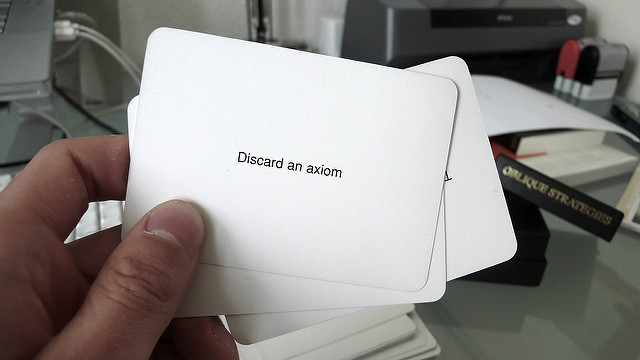
Jump Start Your Creative Process with Brian Eno’s “Oblique Strategies” Deck of Cards (1975)

Image by Bas­ti­aan Ter­horst, via Flickr Com­mons

The likes of U2, Cold­play, and David Bowie can afford to hire pro­duc­er, artist, and thinker Bri­an Eno to shake up their cre­ative process­es. You and I, alas, prob­a­bly can’t. We can, how­ev­er, afford to con­sult the Oblique Strate­gies, a deck of cards invent­ed by Eno and painter Peter Schmidt in 1975. Each card offers, in its own oblique fash­ion, a strat­e­gy you can fol­low when you find your­self at an impasse in your own work, be it music, paint­ing, or any form at all: “Hon­or thy error as a hid­den inten­tion.” “State the prob­lem in words as clear­ly as pos­si­ble.” “Remem­ber those qui­et evenings.” “Once the search is in progress, some­thing will be found.” “Work at a dif­fer­ent speed.” “Look close­ly at the most embar­rass­ing details and ampli­fy them.”

“The Oblique Strate­gies evolved from me being in a num­ber of work­ing sit­u­a­tions when pan­ic, par­tic­u­lar­ly in stu­dios, tend­ed to make me quick­ly for­get that there were oth­ers ways of work­ing,” said Eno in a 1980 radio inter­view, “and that there were tan­gen­tial ways of attack­ing prob­lems that were in many sens­es more inter­est­ing than the direct head-on approach.”

Should you feel the need for just such a break with the obvi­ous approach, you can track down one of the offi­cial phys­i­cal edi­tions of the Oblique Strate­gies deck. Or you can con­sult one of  its many vir­tu­al ver­sions avail­able on the inter­net. Eno talks about how the deck of cards came into being. Vin­tage sets can be found on Ama­zon here.

Relat­ed Con­tent:

Bri­an Eno on Cre­at­ing Music and Art As Imag­i­nary Land­scapes (1989)

Watch Bri­an Eno’s “Video Paint­ings,” Where 1980s TV Tech­nol­o­gy Meets Visu­al Art

Day of Light: A Crowd­sourced Film by Mul­ti­me­dia Genius Bri­an Eno

Col­in Mar­shall hosts and pro­duces Note­book on Cities and Cul­ture and writes essays on lit­er­a­ture, film, cities, Asia, and aes­thet­ics. He’s at work on a book about Los Ange­lesA Los Ange­les Primer. Fol­low him on Twit­ter at @colinmarshall.

Blondie Plays CBGB in the Mid-70s in Two Vintage Clips

In hon­or of Deb­bie Harry’s 68th birth­day today, we bring you some very ear­ly clips of Blondie at CBGB. Above, the band plays “A Girl Should Know Bet­ter” in 1975, an unre­leased track that’s got all the garage rock, girl-group sound the band rode in on before going new wave in the 80s. Gui­tarist Chris Stein looks and sounds like John­ny Thun­ders and Har­ry per­forms the almost-whole­some, semi-vacant sex­u­al­i­ty of her Play­boy bun­ny past. While this track didn’t make it onto their first album, 1976’s Blondie, it’s a fun lit­tle num­ber all the same.

Down below watch the band play “Rip Her to Shreds” in 1977, look­ing a lit­tle less trash-rock but still sound­ing hard­er than they would in lat­er, slick­er years. For more vin­tage Har­ry moments, pop on over to Dan­ger­ous Minds to see her arm wres­tle Andy Kauf­man, recount a run-in with Ted Bundy, and intro­duce Amer­i­cans to the pogo dance on Glenn O’Brien’s local New York show TV Par­ty.

Relat­ed Con­tent:

The Talk­ing Heads Play CBGB, the New York Club that Shaped Their Sound (1975)

Andy Warhol Dig­i­tal­ly Paints Deb­bie Har­ry with the Ami­ga 1000 Com­put­er (1985)

Josh Jones is a writer and musi­cian based in Wash­ing­ton, DC. Fol­low him at @jdmagness

New Yorker Cartoon Editor Bob Mankoff Reveals the Secret of a Successful New Yorker Cartoon

A friend of mine rails against the New York­er’s week­ly car­toon cap­tion con­test, insist­ing that while the read­er-sub­mit­ted entries are uni­ver­sal­ly bad, the win­ner is always the weak­est of the lot.

I dis­agree, agog at peo­ple’s clev­er­ness. Any line I come up with feels too obvi­ous or too obscure. Unlike my friend, I nev­er feel I could do bet­ter.

Car­toon edi­tor Bob Mankof­f’s recent TED Talk offers some key insights into what the mag­a­zine is look­ing for (incon­gruity, dis­po­si­tion­al humor, cog­ni­tive mash ups), as well as what it’s not inter­est­ed in (gross-out jokes, mild child-cen­tered can­ni­bal­ism) He also cites for­mer con­trib­u­tor and author of my father’s favorite New York­er car­toon, E.B. White on the futil­i­ty of ana­lyz­ing humor.

Fre­quent con­trib­u­tor Matthew Dif­fee’s short  satir­i­cal film Being Bob sug­gests Mankoff edi­to­r­i­al selec­tions owe much to gut response (and a jerk­ing knee). Such intu­ition is hard won. Mankoff glee­ful­ly alludes to the 2000 rejec­tion let­ters he him­self received between 1974 and 1977, fol­low­ing an uncer­e­mo­ni­ous dis­missal from psy­chol­o­gy school. Then, final­ly, he got his first accep­tance.

That accep­tance let­ter is some­thing to see.

Ayun Hal­l­i­day used Charles Bar­sotti’s New York­er car­toon of a danc­ing bird as her high­school year­book’s senior say­ing. Fol­low her @AyunHalliday

Relat­ed Con­tent:

The New Yorker’s Fic­tion Pod­cast: Where Great Writ­ers Read Sto­ries by Great Writ­ers

Improv with New York­er Car­toon­ists

Einstein’s Rel­a­tiv­i­ty: An Ani­mat­ed New York­er Car­toon

« Go BackMore in this category... »
Quantcast