The German artist Albrecht Dürer (1471–1528) was one of the greatest figures of the Northern Renaissance. As a draughtsman and painter, he rivaled his elder contemporary Leonardo Da Vinci, and his masterful woodcuts and engravings of mythical and allegorical scenes made him famous across Europe.
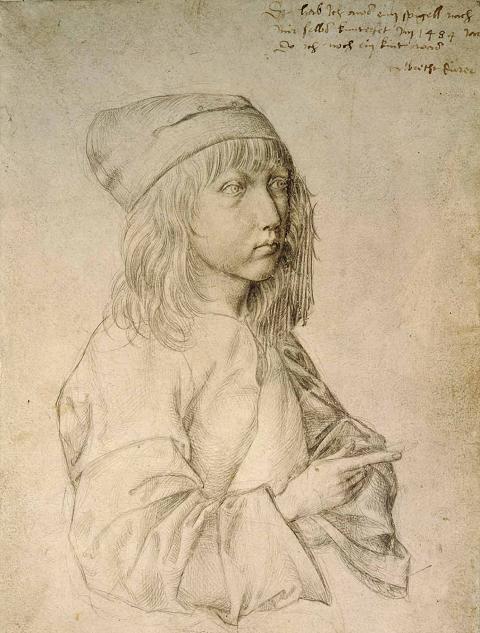
In the first half of his life, Dürer made a series of exquisite self-portraits. The earliest (above) was made in 1484, when the artist was a precocious boy of 13. It was drawn in silverpoint. Sometime later, he wrote in the upper right-hand corner: “This I have drawn from myself from the looking-glass, in the year 1484, when I was still a child — Albrecht Dürer.” The drawing, now in the collection of the Albertina museum in Vienna, was made at about the time Dürer became an apprentice goldsmith in his father’s jewelry shop in Nuremberg. Much to his father’s disappointment, he would leave the goldsmith shop about a year later to become an apprentice to the prominent Nuremberg artist and printmaker Michael Wolgemut. But the early experience of working with the tools in the goldsmith shop would prove invaluable to Dürer’s later work as an engraver.
Age 22:
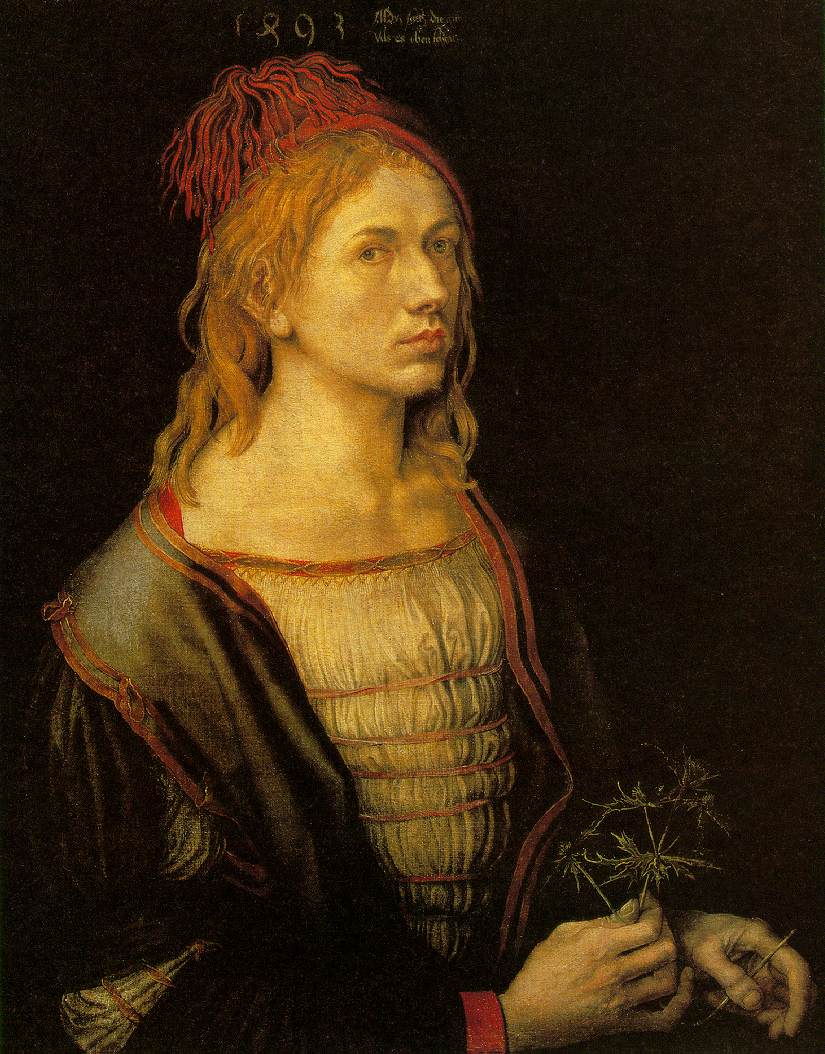
After Dürer finished his apprenticeship with Wolegmut at the age of 19, he followed the tradition of young artists and embarked on a guild tour of southern Germany to study the work of various artists and printmakers. He was probably in Strasbourg when he painted his “Portrait of the Artist holding a Thistle” (above) in 1493. He was 22 years old. The portrait was painted in oil on vellum, and was pasted on canvas several centuries later. Johann Wofgang von Goethe saw the painting in 1805 at a museum in Leipzig and was deeply impressed. In 1922 it was purchased by the Louvre.
“The face still has some of the childish features seen in his early drawing of a Self-Portrait,” says the Louvre Web site, “but the manly neck, the strong nose, and the vigorous hands are already those of an adult. Dürer, who was also an excellent engraver, composed his works in a very graphic fashion. The almost metallic fineness of detail, seen in the prickles of the thistle, also recalls his early training as a goldsmith.”
There are two competing theories about the meaning of the painting. Some scholars believe it was an engagement present for Agnes Frey, whom Dürer would marry the following year. “In fact,” says the Louvre, “the thistle held by the artist is called ‘Mannstreu’ in German, which also means ‘husband’s fidelity.’ This pledge of love would also explain the elegance of the costume. The main loophole in this hypothesis is that Dürer may still have been unaware of the marriage, which had been arranged by his father.” A rival theory is that the thistle represents the crown of thorns from Christ’s Passion. In any case, the artist’s inscription reads, “Things happen to me as it is written on high.”
Age 26:
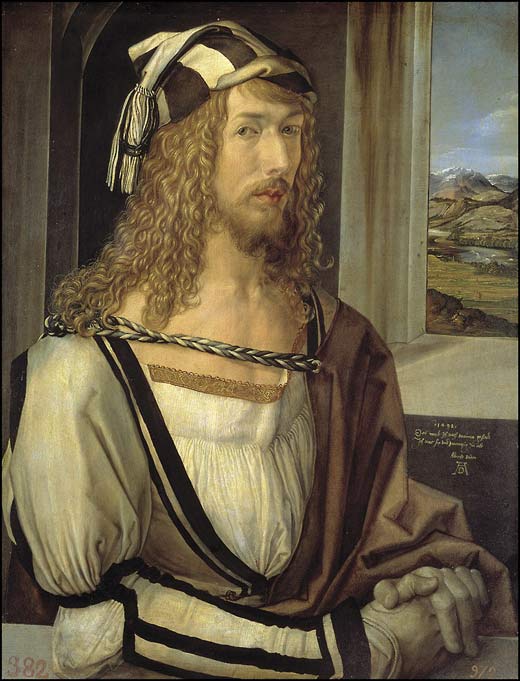
The second of Dürer’s three painted self-portraits was made in 1498, when he was 26 years old and entering his mature period as a master artist. Dürer had made his first of two visits to northern Italy a few years earlier to study Italian art and mathematics. While there, he was impressed and gratified by the elevated social status granted to great artists. In Germany he had been looked down upon as a lowly craftsman. “How I shall freeze after this sun!” Dürer wrote home to his friend Willibald Pirckheimer from Italy. “Here I am a gentleman, at home only a parasite.” Upon his return to Nuremberg, Dürer asserted his new sense of social position. In the portrait above he depicts himself as something of a dandy, with flamboyant dress and a haughty bearing. The painting was made in oil on a wood panel, and now resides in the Museo del Prado in Madrid.
Age 28:
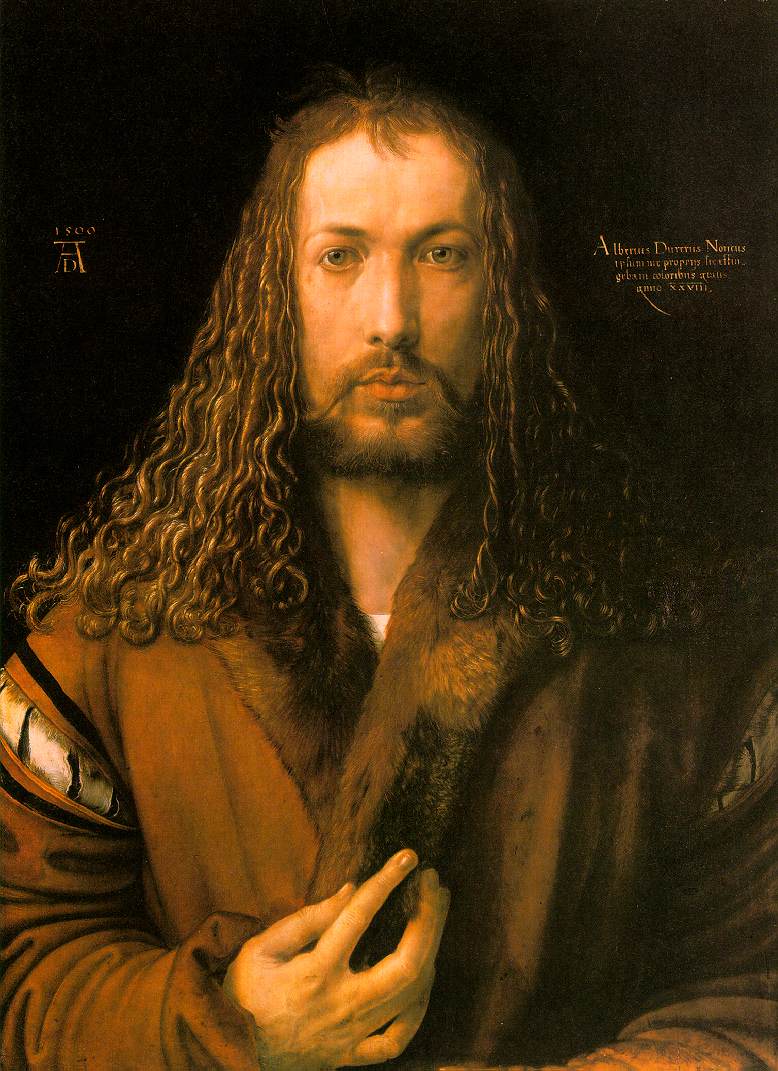
The Christ-like self-portrait above was painted in 1500, shortly before Dürer’s 29th birthday. The painting was made in oil on a wooden panel, and is now in the collection of the Alte Pinakothek in Munich. Unlike his earlier self-portraits, which were composed in the customary three-quarters view, Dürer’s self-portrait of 1500 depicts the artist faced squarely toward the viewer — a pose usually reserved at that time for images of Christ. His hand, touching the fur collar of his coat, brings to mind the gestures of blessing in religious icons. The highly symmetric composition draws attention to the eyes, which gaze directly at the viewer. The artist’s monogram, “AD,” and the Latin inscription — “I, Albrecht Dürer of Nuremberg, portrayed myself in everlasting colors aged twenty-eight years” — are placed at eye-level to strengthen the effect. The year “1500” is written directly above the monogram, giving the “AD” a second meaning as Anno Domini, which further reinforces the connection between Dürer and Christ. The art historian Joseph Koerner has suggested that the entire composition, from the triangular outline of the frontal likeness to the curve of Dürer’s fingers, echoes the overarching “A” and nestled “D” of the artist’s monogram. “Nothing we see in a Dürer is not Dürer’s,” writes Koerner, “monogram or not.”

I grew up listening to radio plays, keeping in high rotation vintage broadcasts of shows like Suspense, Amos ‘n Andy, and Dragnet. These stoked in me a fascination with the medium of radio, and they also taught me a thing or two about life in early 20th-century America — mostly lessons, by way of the commercials, about its various consumer products (usually soaps). With the modern internet, kids today can not only listen to their fill of old-time radio programs essentially without effort — no bootleg cassette tapes for them, like I had to use — but easily find newer, more innovative, and I daresay more interesting audio productions as well. Case in point: the Los Angeles Theatre Works’ Relativity Series, offering science-themed plays you can listen to free online, featuring performances by well-known actors like Alfred Molina, Jason Ritter, and Ed Asner.
But don’t mistake any of the Relativity Series’ 24 currently available productions as straightforwardly “educational.” Knowing that no listener, man, woman, or child, wants a simple physics or biology lesson tarted up with a thin scrim of drama, the producers have instead recorded new versions of full-fledged works for the stage that happen to have scientific themes or involve events and players from the history of science. How it delighted me to find, for instance, Tom Stoppard’s Arcadia in the Relativity Series. Stoppard, perhaps the most intellectually omnivorous writer alive, became a fascination of mine around the same time I delved into old-time radio, and Arcadia remains the finest play dealing with chaos theory to take place on an English country estate in two centuries at once. Other productions deal with the lives of scientists like Alan Turing and Richard Feynman as well as events like the Scopes Monkey Trial and the development of the atomic bomb. Above, you can listen to a unique performance where members of the Star Trek cast recreate Orson Welles’ dramatic 1938 “War of the Worlds” broadcast.
Today, as the U.S. celebrates the “nation’s birthday,” we also round the corner of the 150th anniversary of Gettysburg, the bloodiest and arguably most decisive battle of an internal struggle that never ceases to haunt the national psyche. With over 50,000 Union and Confederate soldiers killed, injured, gone missing, or captured during the days of July 1–3, 1863, historians continue to pore over the most minute details of the battle strategies of Generals Lee and Meade. Today’s digital imaging and satellite technology means that our views of the action are in many ways far superior to anything commanders on the field could have hoped for.
Since 2000, the National Park Service has used military engineering techniques to restore the historic battlefield to something resembling its 1863 state, and, in the past few years, cartographers and researchers Anne Kelly Knowles, Dan Miller, Alex Tait, and Allen Carroll have analyzed new and old maps of the Pennsylvania terrain in and around Gettysburg to get a renewed appreciation for what the generals could and could not see during the conflict. Confederate officers had their views obstructed not only by limited mapping technology and relative field positions, but also by their own communication failures. As Knowles points out at the Smithsonian’s website:
We know that Confederate general Robert E. Lee was virtually blind at Gettysburg, as his formerly brilliant cavalry leader J.E.B. Stuart failed to inform him of Federal positions, and Confederate scouts’ reconnaissance was poor. The Confederates’ field positions, generally on lower ground than Yankee positions, further put Lee at a disadvantage. A striking contrast in visual perception came when Union Gen. Gouvernour K. Warren spotted Confederate troops from Little Round Top and called in reinforcements just in time to save the Federal line.
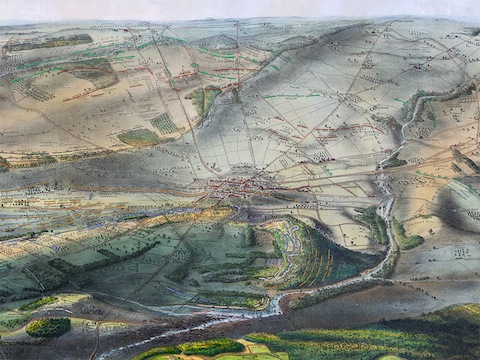
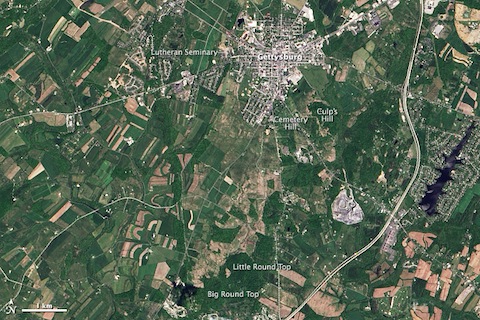
Using so-called GIS (Geographic Information Systems), Knowles and her team are able to show what was hidden from the solders’ views during such key moments as Pickett’s Charge. The team used several period maps, like the 1863 “isometrical drawing” at the top, in their reconstructions. They also used satellite images from NASA, including the May 2013 picture below from the Operational Land Imager (OLI). You can see Knowles and her team’s painstaking geographical and topographic reconstructions of the country’s costliest rift at the Smithsonian Magazine’s site.
In 1973, Dale Irby, a teacher at Prestonwood Elementary in Dallas, decided to wear a polyester shirt and coffee-colored sweater for school-picture day. Without realizing it, he wore the same outfit the following year. According to the Dallas News, Dale’s wife noticed the emerging trend and dared him to do it a third year. And then they figured, ‘Why stop?’ The tradition continued 40 years in total, until Dale and his outfit retired this year.
Douglas Engelbart, a technology pioneer best known for his invention of the computer mouse, died in Atherton, California on Wednesday. He was 88 years old. Engelbart began working at the Stanford Research Institute (SRI International) in 1957, and there, according to John Markoff’s obituary in The New York Times, he began trying to make the computer screen “a workstation that would organize all the information and communications for a given project.” It’s a concept we take for granted today. But it was considered far-fetched back then. A decade later, Engelbart brought us all into the world of interactive computing and graphic interfaces when, in 1968, he presented what’s now called “The Mother of All Demos.” You can watch it in its entirety above. Stanford’s MouseSite sets the stage for what you’re going to see:
On December 9, 1968, Douglas C. Engelbart and the group of 17 researchers working with him in the Augmentation Research Center at Stanford Research Institute in Menlo Park, CA, presented a 90-minute live public demonstration of the online system, NLS, they had been working on since 1962. The public presentation was a session of the Fall Joint Computer Conference held at the Convention Center in San Francisco, and it was attended by about 1,000 computer professionals. This was the public debut of the computer mouse. But the mouse was only one of many innovations demonstrated that day, including hypertext, object addressing and dynamic file linking, as well as shared-screen collaboration involving two persons at different sites communicating over a network with audio and video interface.
Let’s sneak in a quick birthday celebration before the 4th. Franz Kafka was born on this day (July 3), a good 130 years ago. To commemorate the occasion, we’re presenting Piotr Dumala’s 1992 short animated film called, quite simply, Franz Kafka. Dumala’s animation technique grew out of his training as a sculptor, when he started experimenting with scratching images into painted plaster. Later he developed a more full blown method known as “destructive animation,” which is on full display in the film. You can learn more about Dumala and his approach here. The 16-minute film is based on The Diaries of Franz Kafka, and now appears in our collection of 525 Free Movies Online. Also on our site, you can view Dumala’s adaptation of Dostoevsky’s Crime and Punishment.
Note: This film/post originally appeared on our site in 2010. Still enamored by Dumala’s work, we thought it was time to bring it back.
If you would like to sign up for Open Culture’s free email newsletter, please find it here. It’s a great way to see our new posts, all bundled in one email, each day.
If you would like to support the mission of Open Culture, consider making a donation to our site. It’s hard to rely 100% on ads, and your contributions will help us continue providing the best free cultural and educational materials to learners everywhere. You can contribute through PayPal, Patreon, and Venmo (@openculture). Thanks!
David Lynch has embraced visual art and the possibilities of the new music industry. With Pina, Wim Wenders made one of the most acclaimed works in the latest, superhero-filled wave of 3D movies. Jean-Luc Godard… well, I couldn’t quite tell you what he has got up to with his latest picture, but it sounds conceptually and technologically forward-looking indeed. Clearly, some of the creators best suited for the new cinematic reality in which we find ourselves also happen to have already logged decades and decades in the craft. Werner Herzog, director of Cave of Forgotten Dreams, another one of the few recent 3D movies you still hear people talking about, has executed his latest project not in the theater, but in a museum, and not as a traditional film, but as a five-channel video installation.
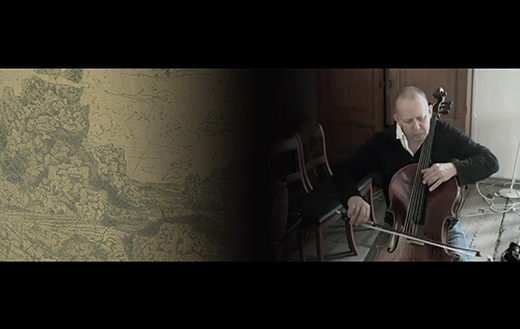
Hearsay of the Soul will run at the Getty Center, a particularly well-known museum overlooking Los Angeles — Herzog’s city of residence and my own — from July 23 to January 19. In it, Herzog combines landscape etchings by Dutch Golden Age master printmaker and Rembrandt-influencer Hercules Segers with music from two of Segers’ modern countrymen, cellist Ernst Reijseger and organist Harmen Fraanje. (Herzog aficionados will, in fact, recognize Reijseger’s work from the score of Cave of Forgotten Dreams.) “They are like flashlights held in our uncertain hands,” Herzzog says of Segers’ images, “a frightened light that opens breaches into the recesses of a place that seems somewhat known to us: our selves. We morph with these images. Hercules Segers’s images and my films do not speak to each other, but for a brief moment, I hope, they might dance with each other.” You can glimpse a few of the installation’s images and hear a few of its sounds just above.
We're hoping to rely on loyal readers, rather than erratic ads. Please click the Donate button and support Open Culture. You can use Paypal, Venmo, Patreon, even Crypto! We thank you!
Open Culture scours the web for the best educational media. We find the free courses and audio books you need, the language lessons & educational videos you want, and plenty of enlightenment in between.