In 1971, a year before Last Tango in Paris was released in the US, Bette Davis went on The Dick Cavett Show to dish on a career’s worth of onscreen kisses. Four decades on, when access to Netflix is all that’s required to enjoy a visual intimacy bordering on the gynecological with Halle Berry or Maria Bello, Davis still captivates. Watch the above excerpt and don’t feel ashamed if you spend the rest of the day trying to guess the identity of the actor who—in Cavett’s words—“was so repulsive that you just couldn’t stand to do it.”
Whoever he was, she cashed her paycheck and took one for the team, just as she did in 1930, when under contract to Universal, the self-described “Yankee-ist, modest virgin that ever walked the earth” was pressed into service as a “test girl.” This involved lying on a couch as a succession of 15 auditioning actors demonstrated their passionate kissing abilities.
That session was filmed, but evidence has yet to surface on the Internet. Fans will just have to content themselves with sneaking onto a three-acre private arboretum in Massachusetts for a glimpse of an Anna Colman Ladd fountain featuring four frolicsome nudes. Word has it a certain modest virgin Yankee served as the model for one of these figures while still in her teens. Or so a legendary actress revealed to Playboy at the age of 74.
Gregory Corso was kind of the Joey Bishop of the Beats—a member of the inner circle of Kerouac, Burroughs, and Ginsberg, but never quite achieving their degree of notoriety. Nevertheless, he outlived them all, and he was also arguably the biggest comedian in a group of inveterate pranksters (see him crack up an interviewer in this clip). A streetwise Greenwich Village kid, Corso learned his craft on the streets of Little Italy, and briefly in a psych ward and a prison cell, as much as in Harvard classes and the San Francisco poetry scene, where he relocated along with Allen Ginsberg in 1955, arriving just one day too late for Ginsberg’s historic Six Gallery reading of “Howl.”
Perhaps in order to make up for his absence then, Corso decided to make his presence decidedly known nearly twenty years later in a Ginsberg reading at New York’s 92nd St. Y in February of 1973. Ginsberg is captivating as always, reading in that almost hypnotic cadence, with elliptical conversational asides, that he and Kerouac both mastered. Listen to the whole reading above. You won’t be disappointed. But for a laugh, skip ahead to 5:50.
Corso interrupts the solemn proceedings with some wiseguy heckling, calling out Ginsberg’s “poesy bullshit.” Ginsberg takes it in stride, improvising and tossing back banter. Ginsberg’s father Louis is also onstage, and he takes up a muttering defense against Corso’s verbal siege as Ginsberg begins singing around 10:30.
Whether the whole thing was staged or a spontaneous outburst by Corso is anyone’s guess, but the two lifelong friends could put on quite a show when they wanted to, like this happening in 1981. Wherever Ginsberg and Corso lived and breathed poetry—as Michelle Dean writes at The Rumpus—heckling was “an integral part of poetry reading.”
Didn’t we used to hear all sorts of grumbling about the disappearance of the handwritten letter? What a relief those complaints seem now to have subsided, leaving us in peace to efficiently type to one another about how we find pieces of longhand correspondence fascinating purely as artifacts of our favorite historical figures. If you share that fascination, have a look at The Art of Handwriting, an exhibit from the Smithsonian’s Archives of American Art now on display through October 27 at Washington D.C.‘s Lawrence A. Fleischman gallery, which showcases not only the artistic aspects of handwriting, but the handwriting of actual artists. “An artist might put pen to paper just as he or she would apply a line to a drawing,” says the exhibition’s site. “For each artist, a leading authority interprets how the pressure of line and sense of rhythm speak to that artist’s signature style. And questions of biography arise: does the handwriting confirm assumptions about the artist, or does it suggest a new understanding?” Plus, we have here the ideal test of those handwriting analysis booths at county fairs — could they detect these artistic personalities?
Just above, we have a page of abstract expressionist painter Willem de Kooning’s missive in light-blue ink of March 28, 1966 to friend and fellow abstract expressionist Michael Loew. (They’ve even included the envelope.) At the top of the post, you’ll find a page another painter, the famously blossom-focused Georgia O’Keeffe, wrote to New Mexico modernist Cady Wells in 1939. The subject of the letter? “O’Keeffe worries that Wells doesn’t like a painting she has bought and suggests replacements; and describes an argument she had with a friend.” That description comes from the Smithsonian’s catalog, as does this one: “[Jackson] Pollock writes with descriptions of his new home in Springs, on Long Island, and discusses his work and that of other artists.” You can also view both pages of that evidently unscandalous piece of communication on the site. They’ve even got letters composed by hand in other languages, such as Marcel Duchamp writing to his sister Suzanne (below) on January 15, 1916. Don’t worry if you can’t read French, or if you think you can’t contextualize the personal content of any of the letters at all; focus on, as the Archives of American Art suggests, how “every message brims with the personality of the writer at the moment of interplay between hand, eye, mind, pen, and paper.” That, and the that hope schoolchildren won’t have to endure cursive lessons many generations longer.
In the Russian port city of Rostov-on-Don two men were having a beer this weekend and talking about the philosophy of Immanuel Kant (of course), when something went terribly wrong. An argument broke out, critical reason went out the window, and one man ended getting shot with rubber bullets. He’s in the hospital with non life-threatening injuries. The shooter now faces up to 10 years in jail, where he’ll have lots of time to ponder Kant’s theories.
If you would like to contemplate Kant in a more serene manner, we would invite you to check out his texts listed in our Free eBook collection:
One of the treasures of our time, biologist E.O. Wilson, the folksy and brilliant author of two Pulitzer Prize-winning books and the world’s leading authority on ants, is 84 years old and retired from his professorship at Harvard. But even in retirement he came up with one of the most innovative new scientific resources available today: the Encyclopedia of Life, a networked encyclopedia of all the world’s knowledge about life.
Six years ago Wilson announced his vision for such a project while accepting the 2007 TED Prize. He expressed a wish for a collaborative tool to create an infinitely expandable page for each species—all 1.9 million known so far—where scientists around the world can contribute text and images.
Wilson’s dream came true, not long after he announced it, and the EOL was so popular right away that it had to go off-line for a spell to expand its capacity to handle the traffic. The site was redesigned to be more accessible and to encourage contributions from users. It’s vision: to continue to dynamically catalog every living species, as research is completed, and to include the roughly 20,000 new species discovered every year.
Wilson’s vision is manifest in a fun and well-designed site useful for educators, academics, and any curious person with access to the Internet.
Search for a species or just browse. Each EOL taxonomy page features a detailed overview of the species, research, articles and media. Media can be filtered by images, video, and sound. There are 66 different pieces of media about Tasmanian Devils, for example. A group of Tassies, as they’re known, get pretty devilish over their dinner in this video, contributed by an Australian Ph.D. student.
As E.O. Wilson so eloquently puts it, the EOL has the potential to inspire others to search for life, to understand it, and, most importantly, to preserve it.
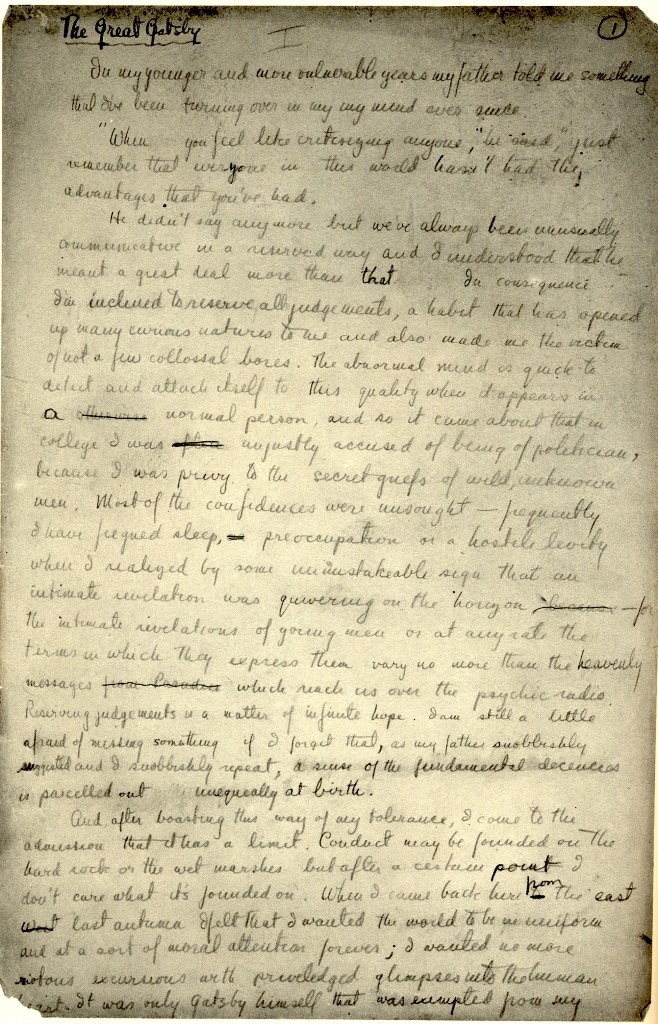
We rarely think about where F. Scott Fitzgerald’s hard-living, often tragic generation of American writers went to school. This year, however, Fitzgerald’s own almost-alma mater merits a note: the novelist began his studies at Princeton exactly one hundred years ago this fall, beginning classes on his birthday, September 24, 1913. To mark the occasion, that Ivy League institution has digitized their The Great Gatsby-writing alumnus’ manuscripts. Earlier this year, in fact, they completed the process on Fitzgerald’s manuscript, or manuscripts, of Gatsby itself. “We can see Fitzgerald at work on his third novel over a four-year period,” says the announcement from Princeton University Library’s Department of Rare Books and Special Collections (RBSC), which offers “Ur-Gatsby (2‑page fragment), the author’s abandoned effort, conceived in 1922 and written in 1923; The Great Gatsby autograph manuscript (302 pages), which he largely wrote in France and completed by September 1924;” and “corrected galleys of ‘Trimalchio,’ the novel’s working title when it was typeset by Charles Scribner’s Sons in 1924, only to be much reworked by the author early in 1925.”
You can find these online in the Princeton University Digital Library. There you can also, naturally, find papers associated with This Side of Paradise, the novel Fitzgerald began, under the working title The Romantic Egoist, while still at Princeton. The book, says the RBSC, “still stands as the most famous literary work about Princeton University. While Fitzgerald was not a good student and never graduated, dropping out in 1917 to join the U.S. Army during World War I, he began learning the craft of writing as an undergraduate and befriended other students who were aspiring authors, Edmund Wilson, Class of 1916, and John Peale Bishop, Class of 1917. Fitzgerald came to form a deep affection for Princeton that lasted until his untimely death in Hollywood.” They’ve digitized the corrected 1918 typescript of The Romantic Egoist, and the manuscript of This Side of Paradise. You can peruse all of these online in the PUDL’s Fitzgerald collection. Some regard Gatsby as a perfect novel; Edmund Wilson called Paradise “one of the most illiterate books of any merit every published.” (“Hastily written” and “somewhat disjointed,” says the RBSC itself.) But seeing how either became the Fitzgerald books we know today will prove instructive to readers and writers, academics and (like Fitzgerald, evidently) non-academics alike.
You can find Gatsby and This Side of Paradise in our collection of 500 Free eBooks.
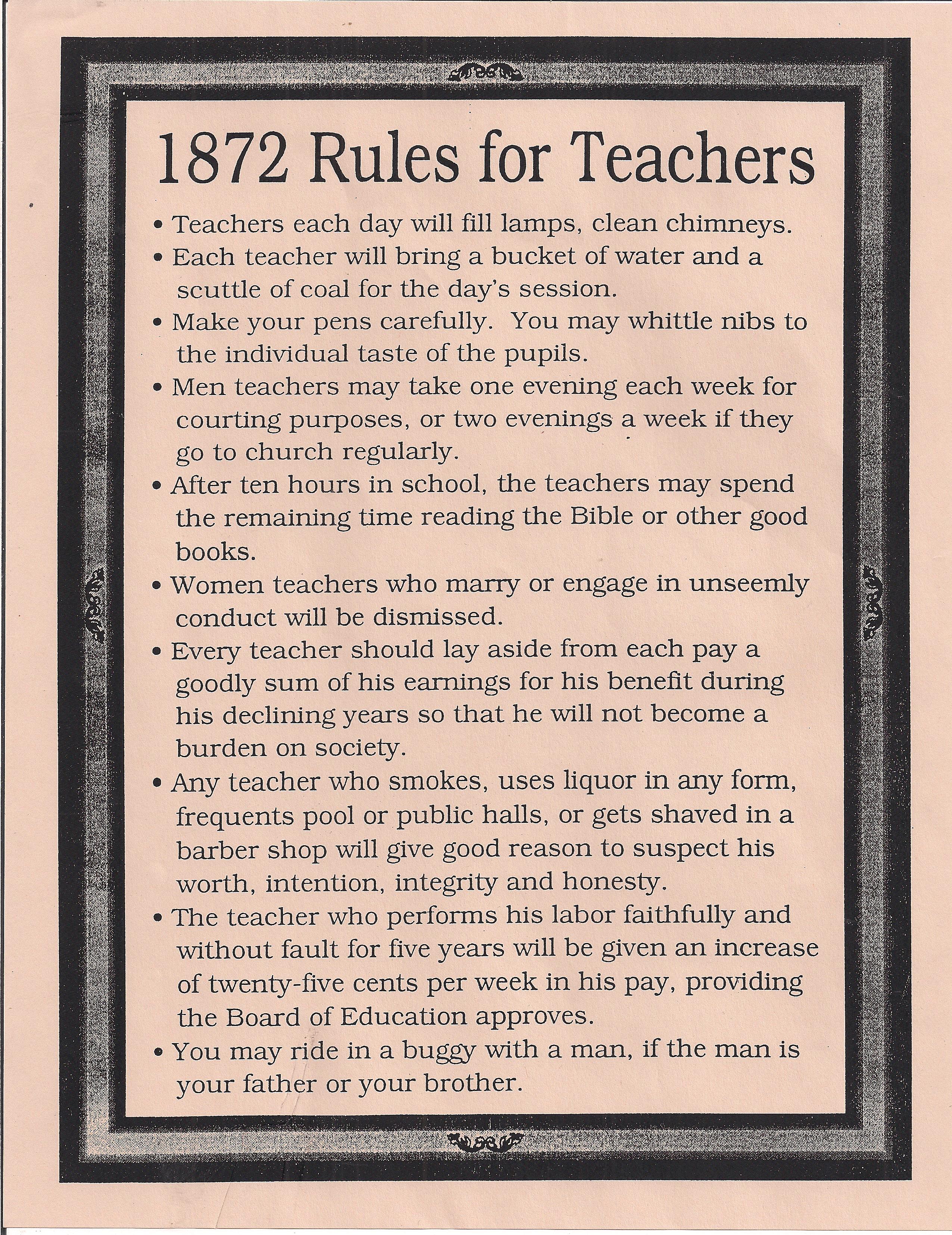
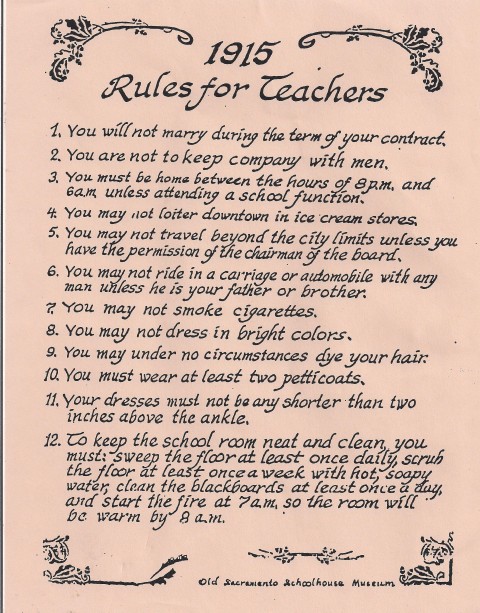
No one would call this the golden era of teaching, not with school budgets getting slashed, state governors routinely scoring political points at teachers’ expense, and the federal government forcing schools to teach to the test. But if today’s teachers are feeling beleaguered, they can always look back to a set of historical “documents” for a little comfort. For decades, museums and publishers have showcased two lists — one from 1872 (above) and another from 1915 (below) — that highlight the rigorous rules and austere moral codes under which teachers once taught. You couldn’t drink or smoke. In women’s cases, you couldn’t date, marry, or frequent ice cream parlors. And, for men, getting a shave in a barber shop was strictly verboten.
But are these documents real?
On its web site, the New Hampshire Historical Society writes that “the sources for these ‘rules’ are unknown; thus we cannot attest to their authenticity—only to their verisimilitude and charming quaintness.” “The rules from 1872 have been variously attributed to an 1872 posting in Monroe County, Iowa; to a one-room school in a small town in Maine; and to an unspecified Arizona schoolhouse. The 1915 rules are attributed to a Sacramento teachers’ contract and elsewhere to an unspecified 1915 magazine.” According to Snopes, the fact-checking web site, the 1872 list has been “displayed in numerous museums throughout North America,” over the past 50 years, “with each exhibitor claiming that it originated with their county or school district.” Heck, the lists even appeared in the venerated Washington Post not so long ago. Here are the rules:
Rules for Teachers — 1872
1. Teachers will fill the lamps and clean the chimney each day.
2. Each teacher will bring a bucket of water and a scuttle of coal for the day’s sessions.
3. Make your pens carefully. You may whittle nibs to the individual tastes of the pupils.
4. Men teachers may take one evening each week for courting purposes, or two evenings a week if they go to church regularly.
5. After ten hours in school, the teachers may spend the remaining time reading the Bible or other good books.
6. Women teachers who marry or engage in improper conduct will be dismissed.
7. Every teacher should lay aside from each day’s pay a goodly sum of his earnings. He should use his savings during his retirement years so that he will not become a burden on society.
8. Any teacher who smokes, uses liquor in any form, visits pool halls or public halls, or gets shaved in a barber shop, will give good reasons for people to suspect his worth, intentions, and honesty.
9. The teacher who performs his labor faithfully and without fault for five years will be given an increase of twenty-five cents per week in his pay.
Rules for Teachers — 1915
1. You will not marry during the term of your contract.
2. You are not to keep company with men.
3. You must be home between the hours of 8 PM and 6 AM unless attending a school function.
4. You may not loiter downtown in ice cream stores.
5. You may not travel beyond the city limits unless you have the permission of the chairman of the board.
6. You may not ride in a carriage or automobile with any man except your father or brother.
7. You may not smoke cigarettes.
8. You may not dress in bright colors.
9. You may under no circumstances dye your hair.
10. You must wear at least two petticoats.
11. Your dresses may not be any shorter than two inches above the ankles.
12. To keep the classroom neat and clean you must sweep the floor at least once a day, scrub the floor at least once a week with hot, soapy water, clean the blackboards at least once a day, and start the fire at 7 AM to have the school warm by 8 AM.
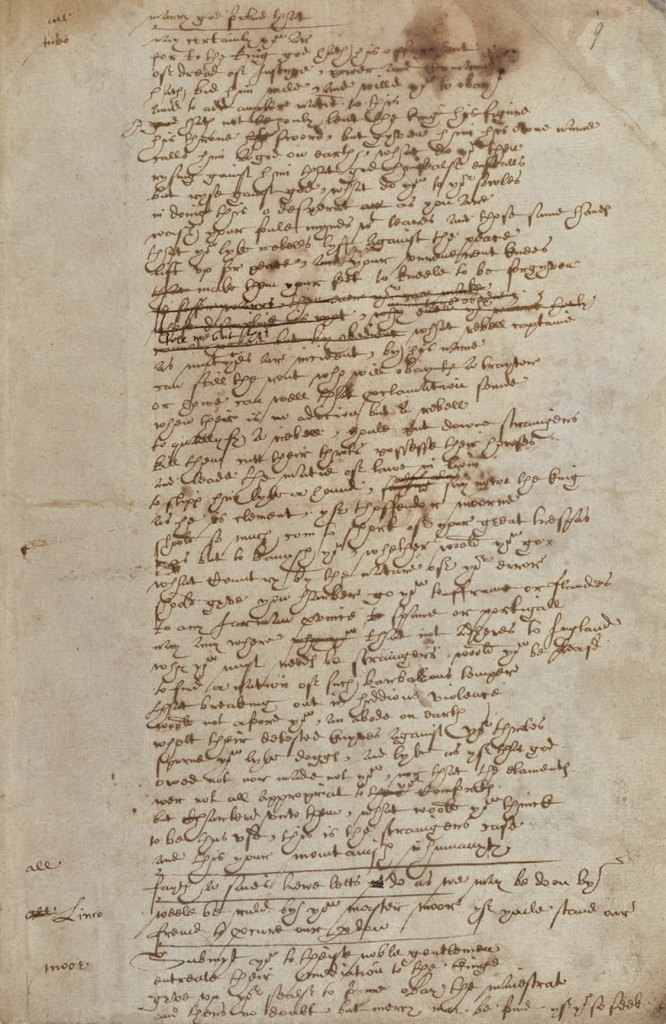
Last week, we posted on how scholars have tried to recover the original pronunciations of Shakespeare’s plays and poems when performed on the stage. Today, we bring you the bard’s original handwriting. Shakespeare’s handwriting has recently become the focus of a new article by Professor Douglas Bruster at UT Austin, who is using an analysis of the playwright’s quirky spellings and penmanship to solve a very old question of authorship. The page of handwriting you see above is a fragment of a lost play called Sir Thomas More and it goes by the name of “Hand D” (click the image above, and then the image that appears — for a much larger version).
Bruster’s short essay, published this month in the Oxford journal Notes & Queries, is far too inside baseball for anyone but hardcore textual scholars to make much sense of, but this New York Times article does a good job of distilling the finer points. Suffice it to say that thanks to Bruster’s painstaking analysis of Shakespeare’s distinctive handwriting, we can be fairly certain that a 1602 revision of Thomas Kyd’s enormously popular Renaissance play The Spanish Tragedy—in the words of Shakespeare scholar Eric Rasmussen—has the bard’s “fingerprints all over it.”
We're hoping to rely on loyal readers, rather than erratic ads. Please click the Donate button and support Open Culture. You can use Paypal, Venmo, Patreon, even Crypto! We thank you!
Open Culture scours the web for the best educational media. We find the free courses and audio books you need, the language lessons & educational videos you want, and plenty of enlightenment in between.