A little while back, we gave you The Sachal Studios Orchestra, based in Lahore, Pakistan, playing an innovative cover of “Take Five,” the jazz standard written by Paul Desmond and performed by The Dave Brubeck Quartet in 1959. While he was still alive, Brubeck called it the “most interesting” version of “Take Five” he had ever heard. Now, the Pakistani Orchestra is back with an interpretation of “Everybody Hurts,” the melancholic song from the 1992 REM album Automatic for the People. It will appear on the forthcoming album Jazz and All That, scheduled for release this summer.
For more great moments in musical fusion, don’t miss these performances:
Forget the airports, the ticket lines, and the crowds. Now you can step right into the Vatican’s most sacred spaces and inspect the wonders of Renaissance art and architecture with just a click of a mouse. The Vatican has posted a series of virtual tours created by students and faculty in the communication and computing science departments at Pennsylvania’s Villanova University. The four Papal Basilicas are included, along with the smaller Sistine and Pauline chapels. Here are six links to six amazing virtual tours:
Basilica of St. Peter: Designed by Michelangelo and others, St. Peter’s is the focal point of the Vatican, and perhaps the most famous example of Renaissance architecture. You can scroll up and down to inspect the walls and ceilings–including the famous dome–and zoom in for a close look at Michelangelo’s masterpiece the Pietà or Bernini’s ornate canopy, or baldachin, over the Papal Altar.
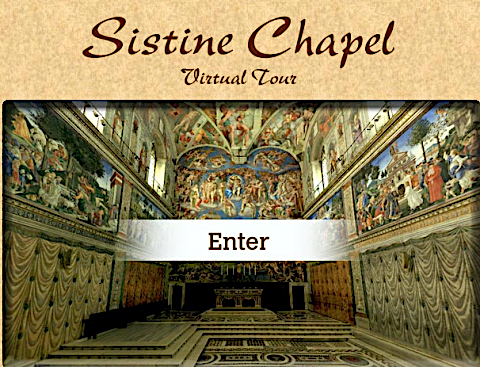
The Sistine Chapel: The most famous building in the Vatican, after St. Peter’s, is the Sistine Chapel, a part of the Pope’s official residence, the Apostolic Palace. Frescoes by Raphael, Bernini, Botticelli and others adorn the walls–and on the ceiling, one of the great masterpieces in the history of art: Michelangelo’s early 16th century depiction of scenes from the Book of Genesis, covering some 12,000 square feet. On a walking tour you would barely have enough time to recognize some of the major scenes. With this virtual tour you can spend all the time you want scanning around and zooming in to study the details.
Archbasilica of St. John Lateran: The Pope’s official ecclesiastical seat, St. John Lateran is the oldest Papal Basilica. But many of its most famous features are relatively recent. The basilica is perhaps best known for its neoclassical façade by Alessandro Galilei, completed in 1735.
Basilica of Paul Outside-the-Walls: Built outside the old city walls, this basilica contains the tomb of St. Paul. You can see the tomb and other features of the graceful church (which was rebuilt in the 19th century after a devastating fire) on the tour.
Basilica of St. Mary Major: This basilica is actually located outside the Vatican City compound, in Rome, but has extraterritorial status similar to that of a foreign embassy. Built in the fifth century, with some later additions, the basilica is a beautiful example of classical Roman architecture.
The Pauline Chapel: Another chapel in the Apostolic Palace, the Pauline Chapel is separated from the Sistine Chapel by the Sala Regia, or “Regal Room.” Although less well-known than the Sistine Chapel, the Pauline Chapel houses two great frescoes by Michelangelo: “The Conversion of Saul” and “The Crucifixion of St. Peter.”
If you would like to support the mission of Open Culture, consider making a donation to our site. It’s hard to rely 100% on ads, and your contributions will help us continue providing the best free cultural and educational materials to learners everywhere. You can contribute through PayPal, Patreon, and Venmo (@openculture). Thanks!
A long time ago, in a New York that seems a galaxy away, I found myself stumbling out into Times Square in the rain-drenched, pre-dawn hours from a friend’s recording studio, and stumbling into a discarded Ampeg Jet J12, a vintage guitar amp powered by tubes (or as the Brits say, valves). Someone had abandoned this beautiful relic on the curb. I dragged the filthy thing into a cab home to Brooklyn, cleaned it up as best I could, and went to sleep. The next day, I powered it up (it worked!), plugged in my guitar, and entered the world of vintage tube amps. I would never be the same again.
The guitar amplifier—perfected, some would say in the 1950s by Leo Fender—initially provided jazz guitarists a way to project over horn sections in the big-band era. They eventually became instruments in their own right with the rise of Dick Dale’s surf rock sound and the advent of electric blues and rock and roll. But, in the ’80s, vacuum tubes gave way to solid-state transistors, then digital, and tubes fell by the wayside. However, since grunge and the garage rock revival, tube amp tones have once again become the standard for most rock guitarists, even if they’re now often digital copies.
But some die-hards never gave up on tubes, and one of those, featured above, is Blackie Pagano, who has spent his days repairing and maintaining vintage vacuum tube guitar amps and “all manner of audio madness.” In the short doc above—part of a series of profiles of New Yorkers—Blackie shows us Django Reinhardt’s original amp and quotes Lux Interior, singer of psychobilly punk band The Cramps, who once said that tube amps “turn music into fire and then back into music.” In just under three minutes, the solitary, tattooed Pagano may convince you that vintage tube guitar amps are truly magical things, whether you find one on eBay, at Guitar Center, or on an NYC streetcorner at four in the morning.
Her appetite for digital dialogue with admirers and accusers alike calls to mind fellow shrinking violet Courtney Love. Her refusal to let anyone but Amanda Palmer speak for Amanda Fucking Palmer has given rise to an army of trolls, who gleefully find proof of monstrous ego in her most innocuous of moves. It’s the price of allowing the public complete access to “Do It With a Rockstar,” if you will.
As noted in her keynote speech (above) at the recent Muse and the Marketplace literary conference, “with the internet you do not get to choose.” This applies whether one is generating content or leaving nasty comments. Her remarks touch upon her most recent firestorm, a direct trail leading back to “A Poem for Dzhokar,” a hastily composed and posted attempt to put herself in the shoes of the suspected Boston Marathon bomber as he lay in a boat, awaiting capture.
Clearly, someone with her experience does not slap such a hot potato online innocent of the consequences. She got plenty of lumps, and whether or not the majority of them were deserved is a matter of personal opinion. More than 2300 people quickly logged on to voice these aforementioned opinions, some supportive, some taking the form of mocking haikus, which Palmer appreciated, especially since it was, at the time, National Poetry Month.
It seems to me that any time her ass is hanging out her giant heart’s not far behind. Listen to her speech, and see if you don’t find her attitude ultimately inspiring, especially for those artists interested in connecting with a larger audience. (The presentation’s so restrained, you can turn your back on the screen, turn your attention to some pedestrian task, and enjoy her thoughts podcast-style. )
In September 1975, Brian Eno released his album Another Green World. The following month, the BBC’s acclaimed documentary series Arena first aired, using Another Green World’s title track as its theme music. 35 years later, the show finally got around to documenting Eno himself. This 2010 episode, also called Another Green World, captures the “intellectual guru of the rock world” (as a Desert Island Discs DJ calls him) at work in his studio, in conversation with a variety of interlocutors—including journalist Malcolm Gladwell, record producer Steve Lillywhite, and evolutionary biologist Richard Dawkins—and cycling around the green hills that roll around his neighborhood. Bono from U2, several of whose records Eno produced, calls the man “a mind-expanding drug,” and listening to Eno expound here upon his various ideas about and experiences with art, music, technology, journaling, and his native England, I’d have to agree.
The faintly hypnotic tone and pace of the episode — a sensibility not far removed from Eno’s famous “ambient” records like Discreet Music and Music for Airports— might also have something to do with that. We learn about Eno’s school days, his love of singing, his descent from a long line of “postmen with passion,” his getting more girls than Bryan Ferry in their days with Roxy Music, his preference for inconsistent instruments, his history with Catholicism, his enthusiasm for Stafford Beer’s management book Brain of the Firm, his work with audiovisual installations, and his ever-present interest in how complexity arises from simplicity. But we also feel like we’ve seen something not just about Eno, but Eno-like, where form meets function as closely as in all of Arena’smost memorable episodes and all of Eno’s most memorable projects. Or maybe I just like the sound of the rain outside during the studio segments — a sound which had a lot to do with Eno’s development of ambient music in the first place.
Every American schoolchild — so it went in my generation, anyway, and in several before it — learns about Helen Keller, though generally we only learn that, despite having lost both her sight and her hearing to scarlet fever, she managed to become a respected public figure. This sort of notability-in-the-face-of-adversity story so captures the imagination, and I daresay the American imagination especially, that Keller wound up the subject of quite a few movies: not just documentaries, but feature films too, from 1919’s silent Deliverance to 1962’s The Miracle Worker to 1984’s The Miracle Continues. Yet it still takes seeing the actual Keller, whose name has over the past 45 years become a byword for deafblindness, to believe her.
Fortunately, clips like the one above allow us to do just that. Here, we see Keller communicating with Polly Thompson, her assistant and companion. Thompson could translate the touch-based language system she used with Keller, but in this film, we hear not just Thompson’s voice but Keller’s own. Her incomplete mastery of speech, alas, remained Keller’s lifelong regret. “It is not blindness or deafness that bring me my darkest hours,” she says, and Thompson repeats in her own theatrically clear, Scots-tinged elocution. “It is the acute disappointment in not being able to speak normally. Longingly I feel how much more good I could have done if I had acquired normal speech. But out of this sorrowful experience, I understand more fully all human tragedies, thwarted ambitions, and the infinite capacity of hope.”
Carl Sagan — he was an astronomer, astrophysicist, cosmologist and great popularizer of science. He was also, it turns out, a lifelong smoker of cannabis. In 1999, and just three years after Sagan’s death, Keay Davidson published Carl Sagan: A Life, a biography that made headlines for revealing how Sagan wrote an essay in 1969, using the pseudonym “Mr. X,” where he outlined the personal benefits of smoking marijuana. The essay eventually appeared in the 1971 book Reconsidering Marijuana. 35 years old at the time, Sagan explained how the drug heightened his sensory experience, gave him an appreciation for the spiritual realm (“a feeling of communion with my surroundings, both animate and inanimate”), enhanced his enjoyment of sex, and allowed him to achieve some “devastating” insights into scientific, creative and particularly social questions. The drug also gave him a newfound respect for art and music. He wrote:
The cannabis experience has greatly improved my appreciation for art, a subject which I had never much appreciated before. The understanding of the intent of the artist which I can achieve when high sometimes carries over to when I’m down. This is one of many human frontiers which cannabis has helped me traverse.… A very similar improvement in my appreciation of music has occurred with cannabis. For the first time I have been able to hear the separate parts of a three-part harmony and the richness of the counterpoint. I have since discovered that professional musicians can quite easily keep many separate parts going simultaneously in their heads, but this was the first time for me.
We're hoping to rely on loyal readers, rather than erratic ads. Please click the Donate button and support Open Culture. You can use Paypal, Venmo, Patreon, even Crypto! We thank you!
Open Culture scours the web for the best educational media. We find the free courses and audio books you need, the language lessons & educational videos you want, and plenty of enlightenment in between.