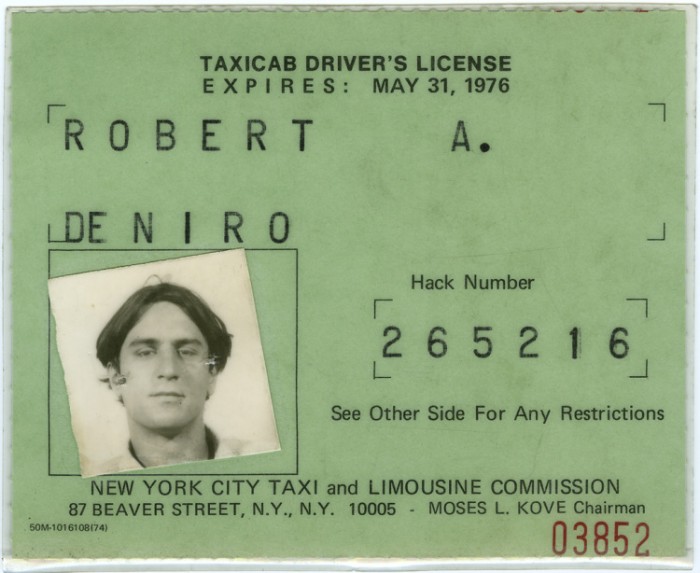
We all know that Robert De Niro has never cut corners when it comes to preparing for roles in films. Need him to gain 60 pounds to play the retired Jake LaMotta in Raging Bull? No problem. How about dropping down to a lean 4% body fat for Cape Fear? Consider it done. And while we’re at it, let’s pay a dentist $20k to grind the actor’s teeth down, you know, to achieve the menacing look of Max Cady. When it comes to Taxi Driver, the least a method actor can do is learn to drive a cab. Above, behold the hack license obtained by Bobby D. in 1976. As part of De Niro’s meticulous preparation for Taxi Driver, writes Andrew J. Rausch in The Films of Martin Scorsese and Robert De Niro, the actor spent some weekends as a cabbie. On one occasion, a passenger recognized him and asked him if he was Robert De Niro. The passenger, who also happened to be an actor, then quipped: “Well, that’s acting. One year the Oscar, the next you’re driving a cab!” (I’d really like to believe that story is true.) The license permanently resides at the Harry Ransom Center in Austin, Texas.
The best gospel recordings—by Aretha Franklin, The Staples Singers, The Carter Family, even Elvis—hum with a deep sincerity that can be truly moving, despite the unintentionally funny earnestness of ballads like “He Touched Me” (not to mention some of those album covers). You can add to the list of Southern gospel greats the name of Johnny Cash, who, like Elvis, got his start singing gospel and returned frequently to the hymns of his youth. Unlike the King, however, Cash also returned to the fold in the 1970s, partly influenced by his wife June Carter.
Cash would record a total of eight solo gospel albums with Columbia Records over his career, and a sort of old-time gospel greatest hits with The Million Dollar Quartet (Cash, Elvis, Jerry Lee Lewis, and Carl Perkins). He wrote a 1986 novelization of the life of the Apostle Paul called Man in White, and a song of the same name (below), and in 1990, the aging star recorded the entire New Testament, New King James Version. Hear the Gospel of Matthew above, and listen to it on Youtube. Running over 19 hours, the recording was repackaged in 2008 as a DVD called Chapter and Verse, with a slideshow and a CD of 14 of Cash’s gospel recordings.
Like his life and career, Cash’s religious journey was tumultuous, but once he’d kicked his addiction, he became something of a “staunch, conservative Bible thumper,” writing in the introduction to The Man in White, “Please understand that I believe the Bible, the whole Bible, to be the infallible, indisputable Word of God.” His theological views may have tempered over the years, but they remained staunchly Evangelical to the end of his life. That said, Cash “was a private man and preferred to keep his faith to himself,” once declaring, “If I’m with someone who doesn’t want to talk about it, I don’t talk about it. I don’t impose myself on anybody in any way, including religion.”
As in everything else Cash recorded, his conviction comes through in his reading above. While he didn’t preach, he did practice what he understood to be the values of his faith, standing up for the poor, imprisoned, and oppressed and against the power structures that constantly beat them down. Cash’s humility and commitment to principle have inspired millions of people who share his beliefs and millions who don’t. To learn more about this little-discussed side of the Man in Black, listen to the one-hour radio documentary below from Public Radio Exchange.
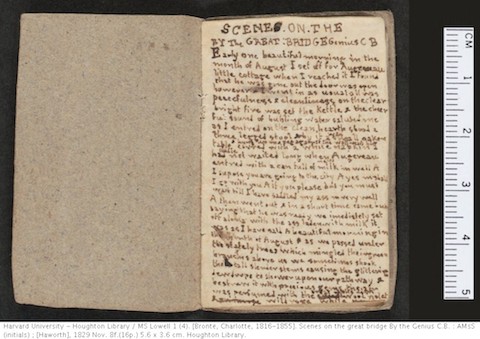
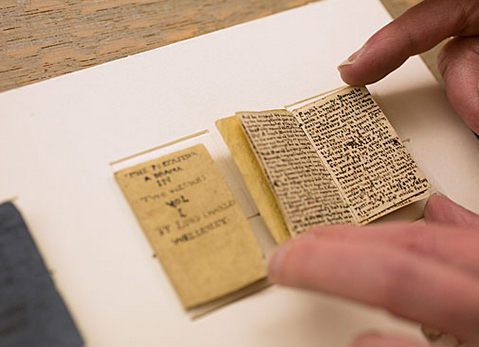
So you consider yourself a reader of the Brontës? Of course you’ve read Wuthering Heights, Jane Eyre, and The Tenant of Wildfell Hall. (Find these classics in our collection of Free eBooks and Free Audio Books.) You’ve probably even got on to the likes of The Green Dwarf and Agnes Grey. Surely you know details from the lives of Charlotte, Emily, and Anne. But have you read such lesser-known entries in the Brontë canon as Scenes on a Great Bridge, The Poetaster: A Drama in Two Volumes, or An Interesting Passage in the Lives of Some Eminent Personages of the Present Age? Do you know of Brontë brother Branwell, the ill-fated tutor, clerk, and artist, and have you seen his own literary output? Now you can, as Harvard University’s Houghton Library has put online nine very early works from Charlotte and Branwell Brontë — all of which measure less than one inch by two inches.
“In 1829 and 1830,” writes Harvard Library Communications’ Kate Kondayen, “Charlotte and Branwell cobbled pages together from printed waste and scrap paper, perhaps cut from margins of discarded pamphlets,” producing “tiny, hand-lettered, hand-bound books” in which “page after mini-page brims with poems, stories, songs, illustrations, maps, building plans, and dialogue. The books, lettered in minuscule, even script, tell of the ‘Glass Town Confederacy,’ a fictional world the siblings created for and around Branwell’s toy soldiers, which were both the protagonists of and audience for the little books.” A dedicated Brontë aficionado may settle for nothing less than seeing these in person, but a reader more interested in the avoidance of eyestrain will certainly prefer to read these digitally magnifiable editions on the web. The hat tip for these miniscule treasures of literary juvenalia goes to the Los Angeles Times’ Carolyn Kellogg, who provides a list of links to the individual works:
According to Harvard Medical School’s Admissions department, “to study medicine at Harvard is to prepare to play a leading role” in the “quest to improve the human condition.”
It might also prepare you to play a giant spleen, as Richard Ngo, Class of 2016, does in this video for the Harvard Medical School and Harvard School of Dental Medicine’s 107th Annual Second Year Show.
In this anatomical homage to “The Fox,” Norwegian comedy duo Ylvis’ deliberately bizarre hit, the Crimsonites demonstrate a pretty straightforward grasp of their studies:
Their parents, particularly the hard working immigrant ones, must have been so relieved to learn that music videos are a fallback should the doctor thing not work out.
Though why wouldn’t it? Secret male uterus? Vestigial fin? Possibly a backup tongue?
They may be guesses, but they’re educated guesses!
I’d say those kids stand a good chance of getting into Harvard.
(Don’t be embarrassed if you remain a bit shaky on what exactly the spleen’s there to do. This simple, non-musical primer on the “Queen of Clean,” compliments of I Heart Guts, should clear things up right away.
On Vimeo, James Cary describes his video creation:
A few years ago, knowing I absolutely adored the John Coltrane album, “A Love Supreme” my wife gave me this incredible book by Ashley Kahn : “A Love Surpreme/The Story of John Coltrane’s Signature Album.” Reading the book, I discovered something remarkable: the fourth movement, Psalm, was actually John Coltrane playing the ‘words’ of the poem that was included in the original liner notes. Apparently he put the handwritten poem on the music stand in front of him, and ‘played’ it, as if it were music. I immediately played the movement while reading the poem, and the hair stood up on the back of my neck. It was one of the most inspirational and spiritual moments of my life.
I’ve seen some nice versions of this posted on the net, but wanted to make one using his exact handwriting. I also wanted to keep it simple. The music and John’s poem are what’s important. I hope you enjoy this. I hope this inspires you, no matter what ‘God’ you may believe in.
Koko the Gorilla, who celebrates her 43rd birthday today, keeps pretty down-to-earth company for a celebrity. While others court the paparazzi with their public canoodling and high profile Twitter feuds, Koko’s most comfortable hanging with non-marquee-name kittens and palsPenny Patterson and Ron Cohn, the human doctors who’ve headed her caregiving team for the past 41 years.
Her privacy is closely guarded, but there have been a handful of times over the years when her name has been linked to other celebs…
Above, actor William Shatner recalls how, as a younger man, he called upon her in her quarters. He was nervous, approaching submissively, but determined not to retreat. “I love you, Koko,” he told her. “I love you.”
She responded by gripping a part of his anatomy that just happens to be one of the thousand or so words that comprise her American Sign Language vocabulary. One that takes two hands to sign…
Their time was fleeting, but as evidenced below, the connection was intense.
Comedian Robin Williams also claims to have shared “something extraordinary” with Koko. Their flirtation seems innocent enough, despite Williams’ NSFW description of their encounter, below. (He undercuts his credibility by referring to her as a “silverback”.)
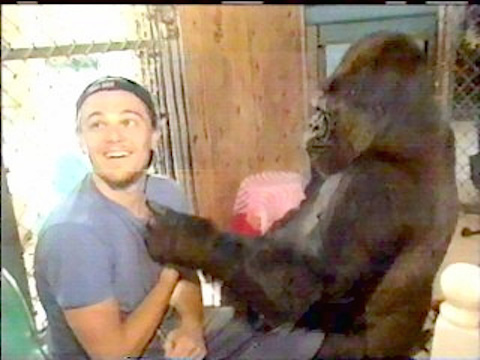
Leonardo DiCaprio is yet another famous admirer to be caught on camera with Koko. Is it any wonder that she embodies all of the qualities he claims to look for in a potential love interest: “humility, a sense of humor and not a lot of drama”? No word as to how the Titanic hunk measures up against the qualities Koko looks for in a mate, though footage of their one and only meeting has been known to get fans fantasizing in the comments section: “I wish I was that gorilla ;) lol I looooooooooooooooove u Leo”
From the lady’s perspective, Koko’s sweetest celebrity encounter was almost certainly with her favorite, the late children’s television host, Fred Rogers. She removed his shoes and socks, he studied her lips, love was a primary topic and yet their time together does not invite prurient speculation. I can’t think of another human male as deserving of her affection.
I don’t know about other disciplines, but academic writing in the humanities has become notorious for its jargon-laden wordiness, tangled constructions, and seemingly deliberate vagary and obscurity. A popular demonstration of this comes via the University of Chicago’s academic sentence generator, which allows one to plug in a number of stock phrases, verbs, and “-tion” words to produce corkers like “The reification of post-capitalist hegemony is always already participating in the engendering of print culture” or “The discourse of the gaze gestures toward the linguistic construction of the gendered body”—the point, of course, being that the language of academia has become so meaningless that randomly generated sentences closely resemble and make as much sense as those pulled from the average journal article (a point well made by the so-called “Sokal hoax”).
There are many theories as to why this is so. Some say it’s several generations of scholars poorly imitating famously difficult writers like Hegel and Heidegger, Lacan and Derrida; others blame a host of postmodern ‑isms, with their politicized language games and sectarian schisms. A recent discussion cited scholarly vanity as the cause of incomprehensible academic prose. A more practical explanation holds that the publish or perish grind forces scholars to turn out derivative work at an unreasonable pace simply to keep their jobs, hence stuffing journals with rehashed arguments and fancy-sounding puffery that signifies little. In the above video, Harvard cognitive scientist and linguist Steven Pinker offers his own theory, working with examples drawn from academic writing in psychology.
For Pinker, the tendency of academics to use “passives, abstractions, and ‘zombie nouns’” stems not primarily from “nefarious motives” or the desire to “sound sophisticated and recherché and try to bamboozle their readers with high-falutin’ verbiage.” He doesn’t deny that this takes place on occasion, but contra George Orwell’s claim in “Politics and the English Language” that bad writing generally hopes to disguise bad political and economic motives, Pinker defers to evolutionary biology, and refers to “mental habits” and the “mismatch between ordinary thinking and speaking and what we have to do as academics.” He goes on to explain, in some fairly academic terms, his theory of how our primate mind, which did not evolve to think thoughts about sociology or literary criticism, struggles to schematize “learned abstractions” that are not a part of everyday experience. It’s a plausible theory that doesn’t rule out other reasonable alternatives (like the perfectly straightforward claim that clear, concise writing poses a formidable challenge for academics as much as anyone else.)
Pinker’s talk was part of a larger Harvard conference called “Stylish Academic Writing” and sponsored by the Office of Faculty Development & Diversity. The full conference seems designed primarily as professional development for other academics, but layfolks may find much here of interest as well. See more talks from the conference, as well as a number of unrelated videos on good academic writing here. Or, for more amusement at the expense of clunky academic prose, see the results of the Philosophy and Literature bad writing contest, which ran from 1995–98 and turned up some almost shockingly unreadable sentences from a variety of scholarly texts.
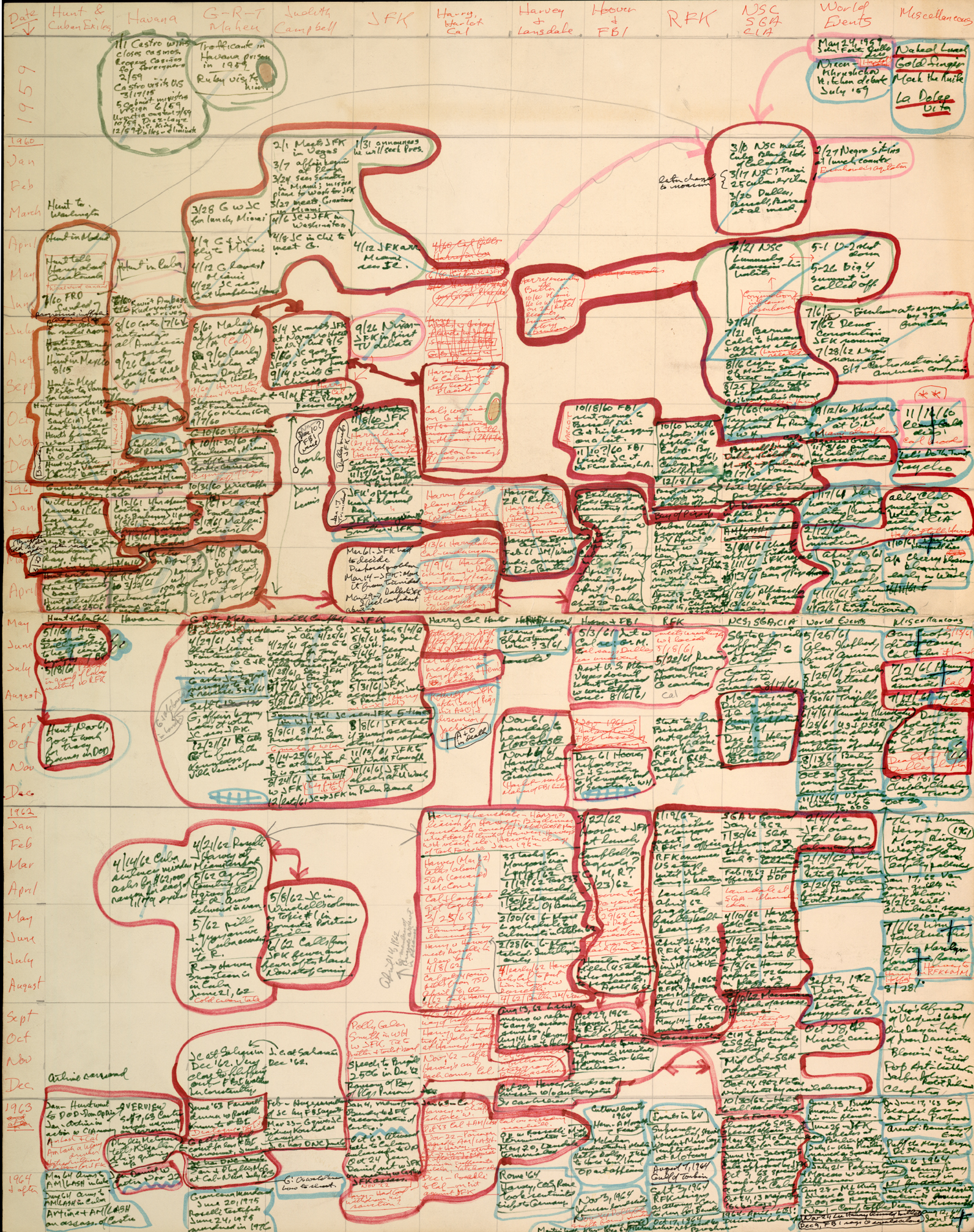
Norman Mailer wrote prolifically, but that didn’t mean cranking out insubstantial volumes. The books whose names we all remember always feel, when we take them down off the shelf, somewhat weightier than we remember: Advertisements for Myself at 532 pages, The Naked and the Dead at 731, The Executioner’s Song at 1072. But the ones with titles which don’t come to mind quite so readily can feel even more physically monumental, and deliberately crafted that way. “Mailer liked to think of his books as his children,” wrote Louis Menand in the author’s 2007 New Yorker obituary, “and, when asked which were his favorites, to name the least critically appreciated” — he answered, “Ancient Evenings and Harlot’s Ghost, great literary pyramids that no one visits any longer.” Ancient Evenings takes place in Egypt, among the actual pyramids, but if you want to visit the much more labyrinthine landmark of Harlot’s Ghost, you’d best take a map. Conveniently, Mailer drew one up himself, in the form of the outline above.
It would never before have seemed possible to me to reduce Mailer’s 1191-page novel of the CIA in the 1960s — a tale of the Mafia, the Cold War, the Cuban Revolution and Missile Crisis, the JFK assassination, and all those events’ attendant complications both real and imagined — to a single sheet, but here we have it. You can click on the image at the top of the post to enlarge it, and then click on the section you’d like to read in detail. Read Harlot’s Ghost with this outline handy, and perhaps you’ll find yourself not on the side of those (Menand included) who dismissed the book upon its publication in 1991, but of those who consider it Mailer’s masterpiece. Christopher Hitchens took the latter position in his own obituary for Mailer, calling the novel “a historic fictionalizing of the national-security state that came very near to realizing the Balzacian ambition that he had conceived for it. What a shame that it was so dismally received by the critics and that he never delivered the second volume of it that he had promised.” And imagine the size and complexity to which Mailer would have grown that book.
We're hoping to rely on loyal readers, rather than erratic ads. Please click the Donate button and support Open Culture. You can use Paypal, Venmo, Patreon, even Crypto! We thank you!
Open Culture scours the web for the best educational media. We find the free courses and audio books you need, the language lessons & educational videos you want, and plenty of enlightenment in between.