Interactive Map Lets You Take a Literary Journey Through the Historic Monuments of Rome

Arch­es on arch­es! as it were that Rome,

Col­lect­ing the chief tro­phies of her line,

Would build up all her tri­umphs in one dome,

Her Col­i­se­um stands; the moon­beams shine

As ’twere its nat­ur­al torch­es, for divine

Should be the light which streams here, to illume

This long-explored but still exhaust­less mine

Of con­tem­pla­tion; and the azure gloom

Of an Ital­ian night, where the deep skies assume

Hues which have words, and speak to ye of heav­en,

Floats o’er this vast and won­drous mon­u­ment,

And shad­ows forth its glo­ry.

—Lord Byron, Childe Harold’s Pil­grim­age (1818)

A mod­ern vis­i­tor to Rome, drawn to the Col­i­se­um on a moon­lit night, is unlike­ly to be so bewitched, sand­wiched between his or her fel­low tourists and an army of ven­dors aggres­sive­ly ped­dling light-up whirligigs, knock off design­er scarves, and acrylic columns etched with the Eter­nal City’s must-see attrac­tions.

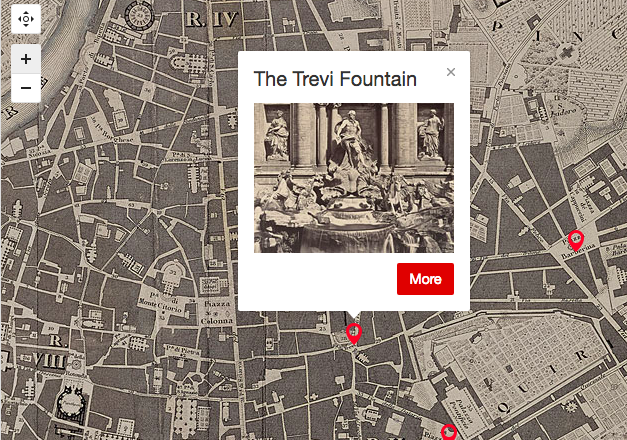
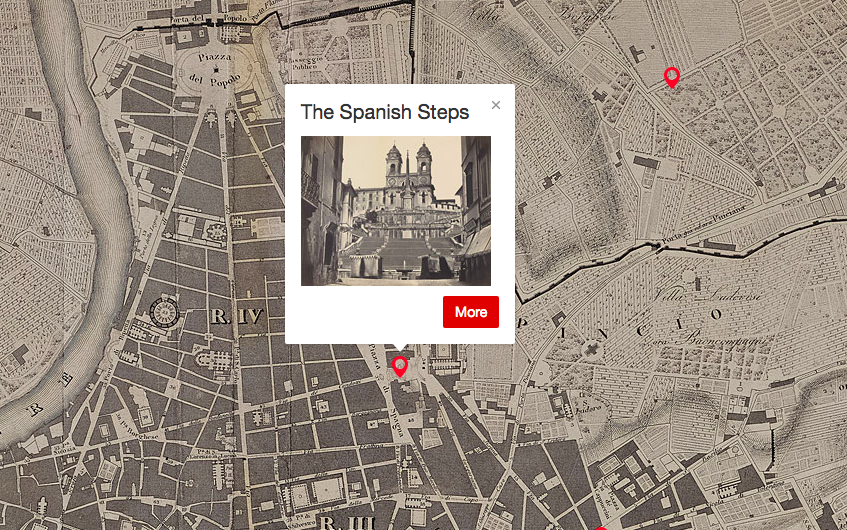
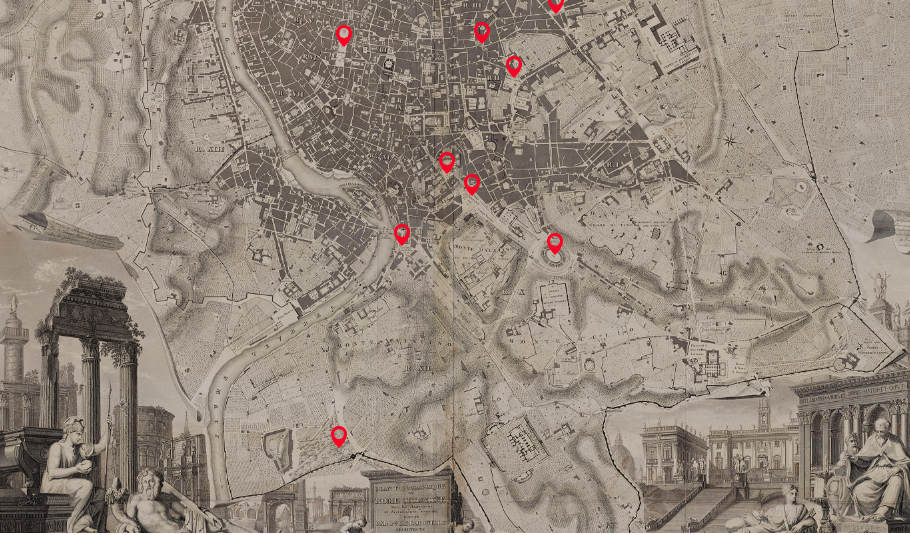
These days, your best bet for tour­ing Rome’s best known land­marks in peace may be an inter­ac­tive map, com­pli­ments of the Mor­gan Library and Muse­um. Based on Paul-Marie Letarouil­ly’s pic­turesque 1841 city plan, each dig­i­tal pin can be expand­ed to reveal descrip­tions by nine­teenth-cen­tu­ry authors and side-by-side, then-and-now com­par­isons of the fea­tured mon­u­ments.

The endur­ing pop­u­lar­i­ty of the film Three Coins in the Foun­tain, cou­pled with the inven­tion of the self­ie stick has turned the area around the Tre­vi Foun­tain into a pickpocket’s dream and a claustrophobe’s worst night­mare.

Not so in Nathaniel Hawthorne’s day, though unlike Lord Byron, he cul­ti­vat­ed a cool remove, at least at first:

They and the rest of the par­ty descend­ed some steps to the water’s brim, and, after a sip or two, stood gaz­ing at the absurd design of the foun­tain, where some sculp­tor of Bernini’s school had gone absolute­ly mad in mar­ble. It was a great palace-front, with nich­es and many bas-reliefs, out of which looked Agrippa’s leg­endary vir­gin, and sev­er­al of the alle­goric sis­ter­hood; while, at the base, appeared Nep­tune, with his floun­der­ing steeds and Tri­tons blow­ing their horns about him, and twen­ty oth­er arti­fi­cial fan­tasies, which the calm moon­light soothed into bet­ter taste than was native to them. And, after all, it was as mag­nif­i­cent a piece of work as ever human skill con­trived. At the foot of the pala­tial façade was strown, with care­ful art and ordered irreg­u­lar­i­ty, a broad and bro­ken heap of mas­sive rock, look­ing as if it might have lain there since the del­uge. Over a cen­tral precipice fell the water, in a semi­cir­cu­lar cas­cade; and from a hun­dred crevices, on all sides, snowy jets gushed up, and streams spout­ed out of the mouths and nos­trils of stone mon­sters, and fell in glis­ten­ing drops; while oth­er rivulets, that had run wild, came leap­ing from one rude step to anoth­er, over stones that were mossy, slimy, and green with sedge, because in a cen­tu­ry of their wild play, Nature had adopt­ed the Foun­tain of Tre­vi, with all its elab­o­rate devices, for her own.

The human stat­ues garbed as glad­i­a­tors and char­i­o­teers spend hours in the blaz­ing sun at the foot of the Span­ish Stepsthe heirs to the artists and mod­els who pop­u­lat­ed William Wet­more Sto­ry’s Roba di Roma:

All day long, these steps are flood­ed with sun­shine in which, stretched at length, or gath­ered in pic­turesque groups, mod­els of every age and both sex­es bask away the hours when they are free from employ­ment in the stu­dios. … Some­times a group of artists, pass­ing by, will pause and steadi­ly exam­ine one of these mod­els, turn him about, pose him, point out his defects and excel­lences, give him a baioc­co, and pass on. It is, in fact, a mod­els’ exchange.

The Medici Vil­la hous­es the Académie de France, and its gar­dens remain a pleas­ant respite, even in 2017. Vis­i­tors who aren’t whol­ly con­sumed with find­ing a wifi sig­nal may find them­selves fan­ta­siz­ing about a dif­fer­ent life, much as Hen­ry James did in his Ital­ian Hours:

Such a dim light as of a fabled, haunt­ed place, such a soft suf­fu­sion of ten­der grey-green tones, such a com­pa­ny of gnarled and twist­ed lit­tle minia­ture trunks—dwarfs play­ing with each oth­er at being giants—and such a show­er of gold­en sparkles drift­ing in from the vivid West! … I should name for my own first wish that one didn’t have to be a French­man to come and live and dream and work at the Académie de France. Can there be for a while a hap­pi­er des­tiny than that of a young artist con­scious of tal­ent and of no errand but to edu­cate, pol­ish and per­fect it, trans­plant­ed to these sacred shades?…What morn­ings and after­noons one might spend there, brush in hand, unpre­oc­cu­pied, untor­ment­ed, pen­sioned, satisfied—either per­suad­ing one’s self that one would be “doing some­thing” in con­se­quence or not car­ing if one shouldn’t be.

The inter­ac­tive map was cre­at­ed to accom­pa­ny the Morgan’s 2016 exhi­bi­tion City of the Soul: Rome and the Roman­tics. Oth­er pit­stops include St. Peter’s, the Roman Forum, and The Eques­tri­an Mon­u­ment of Mar­cus Aure­lius on the Capi­tol. Begin your explo­rations here.

Relat­ed Con­tent:

New Dig­i­tal Archive Puts Online 4,000 His­toric Images of Rome: The Eter­nal City from the 16th to 20th Cen­turies

Ancient Rome’s Sys­tem of Roads Visu­al­ized in the Style of Mod­ern Sub­way Maps

Rome Reborn: Take a Vir­tu­al Tour of Ancient Rome, Cir­ca 320 C.E.

Ayun Hal­l­i­day is an author, illus­tra­tor, the­ater mak­er and Chief Pri­ma­tol­o­gist of the East Vil­lage Inky zine.  Fol­low her @AyunHalliday.

Bryan Cranston Gives Advice to the Young: Find Yourself by Traveling and Getting Lost

I don’t know what time you’re read­ing this post but “What do you real­ly want to do in life?” is a ques­tion that can wake you up right fast, or make you want to pack it in and sleep on it.

It’s also a ques­tion asked maybe a bit too ear­ly of our young peo­ple, which starts with fan­ta­sy (“What do you want to be when you grow up?” “A space­man!”) and by our teens it turns into a more seri­ous, fate-decid­ing inquiry by peo­ple who may not be hap­py with their sta­tion in life.

Actor Bryan Cranston takes on this ques­tion in this Big Think video, and extolls the virtues of trav­el and wan­der­ing.

“Trav­el­ing forces you to be social,” Cranston says. “You have to get directions.You have to learn where things are. You’re attuned to your envi­ron­ment.”

Cranston thought he was going to be a police­man when he entered col­lege. Then he took an act­ing class. So, at 19, Cranston explored Amer­i­ca for two years by motor­cy­cle with his broth­er, in essence to find them­selves by get­ting lost. He says he’s passed on this direc­tion­less wan­der­ing to his now 24 year-old daugh­ter.

That idea of let­ting go and just wan­der­ing also dove­tails nice­ly into his oth­er advice about audi­tions. You don’t go there to get a job, you go to cre­ate a char­ac­ter and present it. The rest is out of your con­trol.

Now, Cranston says that the peri­od between high school/college and the “real world” is the best time to do it, but there’s real­ly no time like right now. To quote Niger­ian author Chi­ma­man­da Ngozi Adichie, “I think you trav­el to search and you come back home to find your­self there,” and the boats are always leav­ing. Just jump on.

Relat­ed Con­tent:

21 Artists Give “Advice to the Young:” Vital Lessons from Lau­rie Ander­son, David Byrne, Umber­to Eco, Pat­ti Smith & More

Ray Brad­bury Gives 12 Pieces of Writ­ing Advice to Young Authors (2001)

John Cleese’s Advice to Young Artists: “Steal Any­thing You Think Is Real­ly Good”

Walt Whit­man Gives Advice to Aspir­ing Young Writ­ers: “Don’t Write Poet­ry” & Oth­er Prac­ti­cal Tips (1888)

Ursu­la Le Guin Gives Insight­ful Writ­ing Advice in Her Free Online Work­shop

Aki­ra Kurosawa’s Advice to Aspir­ing Film­mak­ers: Write, Write, Write and Read

Ted Mills is a free­lance writer on the arts who cur­rent­ly hosts the artist inter­view-based FunkZone Pod­cast and is the pro­duc­er of KCR­W’s Curi­ous Coast. You can also fol­low him on Twit­ter at @tedmills, read his oth­er arts writ­ing at tedmills.com and/or watch his films here.

Yale Presents a Free Online Course on Miguel de Cervantes’ Masterpiece Don Quixote

Among the lit­er­ary works that emerged in the so-called Gold­en Age of Span­ish cul­ture in the 16th and 17th cen­turies, one shines so bright­ly that it seems to eclipse all oth­ers, and indeed is said to not only be the foun­da­tion of mod­ern Span­ish writ­ing, but of the mod­ern nov­el itself. Miguel de Cer­vantes’ Don Quixote syn­the­sized the Medieval and Renais­sance lit­er­a­ture that had come before it in a bril­liant­ly satir­i­cal work, writes pop­u­lar aca­d­e­m­ic Harold Bloom, with “cos­mo­log­i­cal scope and rever­ber­a­tion.” But in such high praise of a great work, we can lose sight of the work itself. Don Quixote is hard­ly an excep­tion.

“The notion of ‘lit­er­ary clas­sic,’” Simon Leys writes at the New York Review of Books, “has a solemn ring about it. But Don Quixote, which is the clas­sic par excel­lence, was writ­ten for a flat­ly prac­ti­cal pur­pose: to amuse the largest pos­si­ble num­ber of read­ers, in order to make a lot of mon­ey for the author (who need­ed it bad­ly).” To men­tion these inten­tions is not to dimin­ish the work, but per­haps even to bur­nish it fur­ther. To have cre­at­ed, as Yale’s Rober­to González Echevar­ría says in his intro­duc­to­ry lec­ture above, “one of the unques­tioned mas­ter­pieces of world lit­er­a­ture, let alone the West­ern Canon,” while seek­ing pri­mar­i­ly to enter­tain and make a buck says quite a lot about Cer­vantes’ con­sid­er­able tal­ents, and, per­haps, about his mod­ernism.

Rather than write for a feu­dal patron, monarch, or deity, he wrote for what he hoped would be a prof­itable mass-mar­ket. In so doing, says Pro­fes­sor González, quot­ing Gabriel Gar­cía Márquez, Cer­vantes wrote “a nov­el in which there is already every­thing that nov­el­ists would attempt to do in the future until today.” González’s course, “Cer­vantes’ Don Quixote,” is now avail­able online in a series of 24 lec­tures, avail­able on YouTube and iTunes. (Stream all 24 lec­tures below.) You can down­load all of the course mate­ri­als, includ­ing the syl­labus and overview of each class, here. There is a good deal of read­ing involved, and you’ll need to get your hands on a few extra books. In addi­tion to the weighty Quixote, “stu­dents are also expect­ed to read four of Cer­vantes’ Exem­plary Sto­ries, Cer­vantes’ Don Quixote: A Case­book, and J.H. Elliott’s Impe­r­i­al Spain.” It would seem well worth the effort.

Pro­fes­sor González goes on in his intro­duc­tion to dis­cuss the novel’s impor­tance to such fig­ures as Sig­mund Freud, Jorge Luis Borges, and British schol­ar Ian Watt, who called Don Quixote “one of four myths of mod­ern indi­vid­u­al­ism, the oth­ers being Faust, Don Juan, and Robin­son Cru­soe.” The novel’s his­tor­i­cal resume is tremen­dous­ly impres­sive, but the most impor­tant thing about it, says González, is that it has been read and enjoyed by mil­lions of peo­ple around the world for hun­dreds of years. Just why is that?

The pro­fes­sor quotes from his own intro­duc­tion to the Pen­guin Clas­sics edi­tion he asks stu­dents to read in pro­vid­ing his answer: “Miguel de Cer­vantes Saavedra’s mas­ter­piece has endured because it focus­es on literature’s fore­most appeal: to become anoth­er, to leave a typ­i­cal­ly embat­tled self for anoth­er clos­er to one’s desires and aspi­ra­tions. This is why Don Quixote has often been read as a children’s book, and con­tin­ues to be read by and to chil­dren.” Crit­ics might be prone to dis­miss such enjoy­able wish ful­fil­ment as triv­ial, but the cen­turies-long suc­cess of Don Quixote shows it may be the foun­da­tion of all mod­ern lit­er­ary writ­ing.

Don Quixote will be added to our col­lec­tion of Free Online Lit­er­a­ture cours­es, a sub­set of our larg­er col­lec­tion, 1,700 Free Online Cours­es from Top Uni­ver­si­ties.

Relat­ed Con­tent:

Gus­tave Doré’s Exquis­ite Engrav­ings of Cer­vantes’ Don Quixote

Sal­vador Dalí Sketch­es Five Span­ish Immor­tals: Cer­vantes, Don Quixote, El Cid, El Gre­co & Velázquez

Free Online Lit­er­a­ture Cours­es 

Josh Jones is a writer and musi­cian based in Durham, NC. Fol­low him at @jdmagness

The Internet Archive “Liberates” Books Published Between 1923 and 1941, and Will Put 10,000 Digitized Books Online

Here at Open Cul­ture, we can nev­er resist the chance to fea­ture books free to read and down­load online. Books can become free in a num­ber of dif­fer­ent ways, one of the most reli­able being rever­sion to the pub­lic domain after a cer­tain amount of time has passed since its pub­li­ca­tion — usu­al­ly a long time, with the result that the aver­age age of the books freely avail­able online skews quite old. Noth­ing wrong with old or even ancient read­ing mate­r­i­al, of course, but some­times one wish­es copy­right law did­n’t put quite such a delay on the process. The Inter­net Archive and its col­lab­o­ra­tors have recent­ly made progress in that depart­ment, find­ing a legal means of “lib­er­at­ing” books of a less dis­tant vin­tage than usu­al.

“The Inter­net Archive is now lever­ag­ing a lit­tle known, and per­haps nev­er used, pro­vi­sion of US copy­right law, Sec­tion 108h, which allows libraries to scan and make avail­able mate­ri­als pub­lished [from] 1923 to 1941 if they are not being active­ly sold,” writes the site’s founder Brew­ster Kahle.

Tulane Uni­ver­si­ty copy­right schol­ar Eliz­a­beth Townsend Gard and her stu­dents “helped bring the first scanned books of this era avail­able online in a col­lec­tion named for the author of the bill mak­ing this nec­es­sary: The Son­ny Bono Memo­r­i­al Col­lec­tion.” Yes, that Son­ny Sono, who after his music career (most mem­o­rably as half of Son­ny and Cher) served in the U.S. House of Rep­re­sen­ta­tives from 1994 until his death in 1998.

At the moment, the Son­ny Bono Memo­r­i­al Col­lec­tion offers such 94-to- 76-year-old pieces of read­ing mate­r­i­al as var­ied as André Mal­raux’s The Roy­al Way, Arnold Dres­den’s An Invi­ta­tion to Math­e­mat­ics, René Kraus’ Win­ston Churchill: A Biog­ra­phy, Colonel S.P. Meek’s Frog, the Horse that Knew No Mas­ter, and Don­ald Hen­der­son Clarke’s Impa­tient Vir­gin. Kahle assures us that “We will add anoth­er 10,000 books and oth­er works in the near future,” and reminds us that “if the Found­ing Fathers had their way, almost all works from the 20th cen­tu­ry would be pub­lic domain by now.” The inten­tions of the Found­ing Fathers may mat­ter to you or they may not, but if you’re an Open Cul­ture read­er, you can hard­ly quib­ble with the new avail­abil­i­ty of dozens of free books online — and the prospect of thou­sands more soon to come. Stay tuned and watch the col­lec­tion grow.

Relat­ed Con­tent:

800 Free eBooks for iPad, Kin­dle & Oth­er Devices

2,000+ Archi­tec­ture & Art Books You Can Read Free at the Inter­net Archive

Down­load 200+ Free Mod­ern Art Books from the Guggen­heim Muse­um

Free: You Can Now Read Clas­sic Books by MIT Press on Archive.org

British Library to Offer 65,000 Free eBooks

74 Free Banned Books (for Banned Books Week)

Based in Seoul, Col­in Mar­shall writes and broad­casts on cities and cul­ture. His projects include the book The State­less City: a Walk through 21st-Cen­tu­ry Los Ange­les and the video series The City in Cin­e­ma. Fol­low him on Twit­ter at @colinmarshall or on Face­book.

23-Year-Old Eric Clapton Demonstrates the Elements of His Guitar Sound (1968)


In the fall of 1968, Eric Clap­ton was 23 years old and at the height of his cre­ative pow­ers. His band, Cream, was on its farewell tour of Amer­i­ca when a film crew from the BBC caught up with the group and asked the young gui­tar vir­tu­oso to show how he cre­at­ed his dis­tinc­tive sound.

The result is a fas­ci­nat­ing four-minute tour of Clapton’s tech­nique. He begins by demon­strat­ing the wide range of tones he could achieve by vary­ing the set­tings on his psy­che­del­i­cal­ly paint­ed 1964 Gib­son SG Stan­dard gui­tar. His wah-wah ped­al (an ear­ly Vox mod­el) was crit­i­cal to the sound of so many Cream clas­sics, like “Tales of Brave Ulysses.” In the film, Clap­ton real­ly has to stomp on it to get it work­ing.

One of the most dif­fi­cult skills to mas­ter, Clap­ton says, is the vibra­to. In a 1970 inter­view with Gui­tar Play­er mag­a­zine he goes into more detail: “When I stretch strings,” he says, “I hook my thumb around the neck of the gui­tar. A lot of gui­tarists stretch strings with just their hand free. The only way I can do it is if I have my whole hand around the neck—actually grip­ping onto it with my thumb. That some­how gives me more of a rock­ing action with my hand and wrist.” If you watch the BBC clip close­ly you will see this in action.

The inter­view was con­duct­ed with Clap­ton seat­ed in front of his famous stack of Mar­shall ampli­fiers. In the Gui­tar Play­er inter­view, how­ev­er, he admits he rarely used both at the same time. “I always had two Mar­shalls set up to play through,” he says, “but I think it was just so I could have one as a spare. I usu­al­ly used only one 100-watt amp.”

Clapton’s demon­stra­tion (along with inter­views of bassist Jack Bruce and drum­mer Gin­ger Bak­er) was incor­po­rat­ed into Tony Palmer’s film of Cream’s Farewell Con­cert, which took place on Novem­ber 21, 1968 at the Roy­al Albert Hall in Lon­don.

If you would like to sign up for Open Culture’s free email newslet­ter, please find it here. It’s a great way to see our new posts, all bun­dled in one email, each day.

If you would like to sup­port the mis­sion of Open Cul­ture, con­sid­er mak­ing a dona­tion to our site. It’s hard to rely 100% on ads, and your con­tri­bu­tions will help us con­tin­ue pro­vid­ing the best free cul­tur­al and edu­ca­tion­al mate­ri­als to learn­ers every­where. You can con­tribute through Pay­Pal, Patre­on, and Ven­mo (@openculture). Thanks!

Relat­ed Con­tent:

Eric Clapton’s Iso­lat­ed Gui­tar Track From the Bea­t­les’ ‘While My Gui­tar Gen­tly Weeps’ (1968)

Eric Clap­ton Tries Out Gui­tars at Home and Talks About the Bea­t­les, Cream, and His Musi­cal Roots

Hear the Nev­er Released Ver­sion of The Stones’ “Brown Sug­ar,” With Eric Clap­ton on Slide Gui­tar

Journey to the Center of a Triangle: Watch the 1977 Digital Animation That Demystifies Geometry

In 1977, Bruce and Katharine Corn­well used a Tek­tron­ics 4051 Graph­ics Ter­mi­nal to cre­ate ani­mat­ed short films that demys­ti­fy geom­e­try. The films have now reemerged on the Inter­net Archive. Jour­ney to the Cen­ter of a Tri­an­gle appears above. You can also watch below Con­gru­ent Tri­an­gles, which fea­tures the mem­o­rable ‘Bach meets Third Stream Jazz’ musi­cal score. Enjoy them both. And find them in the Ani­ma­tion sec­tion of our col­lec­tion, 4,000+ Free Movies Online: Great Clas­sics, Indies, Noir, West­erns, Doc­u­men­taries & More

If you would like to sign up for Open Culture’s free email newslet­ter, please find it here. It’s a great way to see our new posts, all bun­dled in one email, each day.

If you would like to sup­port the mis­sion of Open Cul­ture, con­sid­er mak­ing a dona­tion to our site. It’s hard to rely 100% on ads, and your con­tri­bu­tions will help us con­tin­ue pro­vid­ing the best free cul­tur­al and edu­ca­tion­al mate­ri­als to learn­ers every­where. You can con­tribute through Pay­Pal, Patre­on, and Ven­mo (@openculture). Thanks!

Relat­ed Con­tent:

Watch “Geom­e­try of Cir­cles,” the Abstract Sesame Street Ani­ma­tion Scored by Philip Glass (1979)

The Com­plex Geom­e­try of Islam­ic Art & Design: A Short Intro­duc­tion

The Geom­e­try of Sound Visu­al­ized

Watch a 17th-Century Portrait Magically Get Restored to Its Brilliant Original Colors

Every week, five mil­lion peo­ple in the Unit­ed King­dom alone tune in to the BBC’s Fake or For­tune?, a tele­vi­sion show about the prove­nance and attri­bu­tion of notable works of art. That may well say some­thing about the British char­ac­ter, but it says even more about its host and co-cre­ator, art deal­er Philip Mould. Involved with antiques from a very ear­ly age, he dis­plays in Fake or For­tune? and his oth­er media projects a keen sense of not just how a piece of art appeals to us, but what hid­den poten­tial it car­ries with­in. Take, for instance, the grimy 17th-cen­tu­ry por­trait you can see par­tial­ly restored in the clip above, which he post­ed on Twit­ter this week.

At first glance, the paint­ing might not look that much worse for wear than any­thing else from the Jacobean era, but even the first few min­utes of work reveal the true bril­liance of the col­ors hid­den under­neath what turn out to be lay­ers of brown and yel­low. They’ve actu­al­ly built up in the name of preser­va­tion: over about 200 years, a few (or more than a few) coats of var­nish had been applied to the can­vas in order to pro­tect it, but that var­nish turns col­or over time. Luck­i­ly, with the right tools and the right tech­nique, it comes off.

“The paint­ing was orig­i­nal­ly in a pri­vate col­lec­tion in Eng­land,” Mould told the Tele­graph. “A mix­ture of gel and sol­vent was cre­at­ed, specif­i­cal­ly just to remove the var­nish and not to dam­age the under­ly­ing paint.” Cer­tain­ly the por­trait’s sub­ject would approve of her appear­ance’s return to its for­mer splen­dor, though lit­tle infor­ma­tion remains as to the iden­ti­ty of the lady her­self: “We don’t know the iden­ti­ty yet but cer­tain icono­graph­ic clues are start­ing to emerge,” said Mould. “All we know is she is 36 and it was paint­ed in 1617.”

And so we hap­pen upon anoth­er of the com­pelling aspects of art his­to­ry: its poten­tial to turn into a detec­tive sto­ry. But if you’d like to accom­pa­ny the nar­ra­tive expe­ri­ence with a lit­tle more tech­ni­cal knowl­edge, have a look at the short video above show­ing what it takes to revive a 400-year-old mas­ter­work. Peo­ple once com­mis­sioned por­traits so that pos­ter­i­ty could know their like­ness­es, but one won­ders if they under­stood just how far into pos­ter­i­ty their like­ness­es would make it — some of them, thanks to art restor­ers, look­ing fresh­er than they have for cen­turies.

Relat­ed Con­tent:

The Art of Restor­ing a 400-Year-Old Paint­ing: A Five-Minute Primer

The Art of Restor­ing Clas­sic Films: Cri­te­ri­on Shows You How It Refreshed Two Hitch­cock Movies

The Met Dig­i­tal­ly Restores the Col­ors of an Ancient Egypt­ian Tem­ple, Using Pro­jec­tion Map­ping Tech­nol­o­gy

Short Film Takes You Inside the Recov­ery of Andy Warhol’s Lost Com­put­er Art

Based in Seoul, Col­in Mar­shall writes and broad­casts on cities and cul­ture. His projects include the book The State­less City: a Walk through 21st-Cen­tu­ry Los Ange­les and the video series The City in Cin­e­ma. Fol­low him on Twit­ter at @colinmarshall or on Face­book.

A Digital Archive of the Earliest Illustrated Editions of Dante’s Divine Comedy (1487–1568)

Book his­to­ry buffs don’t need to be told, but the rest of us prob­a­bly do: incun­able—from a Latin word mean­ing “cra­dle,” “swad­dling clothes,” or “infancy”—refers to a book print­ed before 1501, dur­ing the very first half-cen­tu­ry of print­ing in Europe. An over­whelm­ing num­ber of the works print­ed dur­ing this peri­od were in Latin, the transcon­ti­nen­tal lan­guage of phi­los­o­phy, the­ol­o­gy, and ear­ly sci­ence. Yet one of the most revered works of the time, Dante’s Divine Com­e­dy—writ­ten in Italian—fully attained its sta­tus as a lit­er­ary clas­sic in the lat­ter half of the 15th cen­tu­ry.

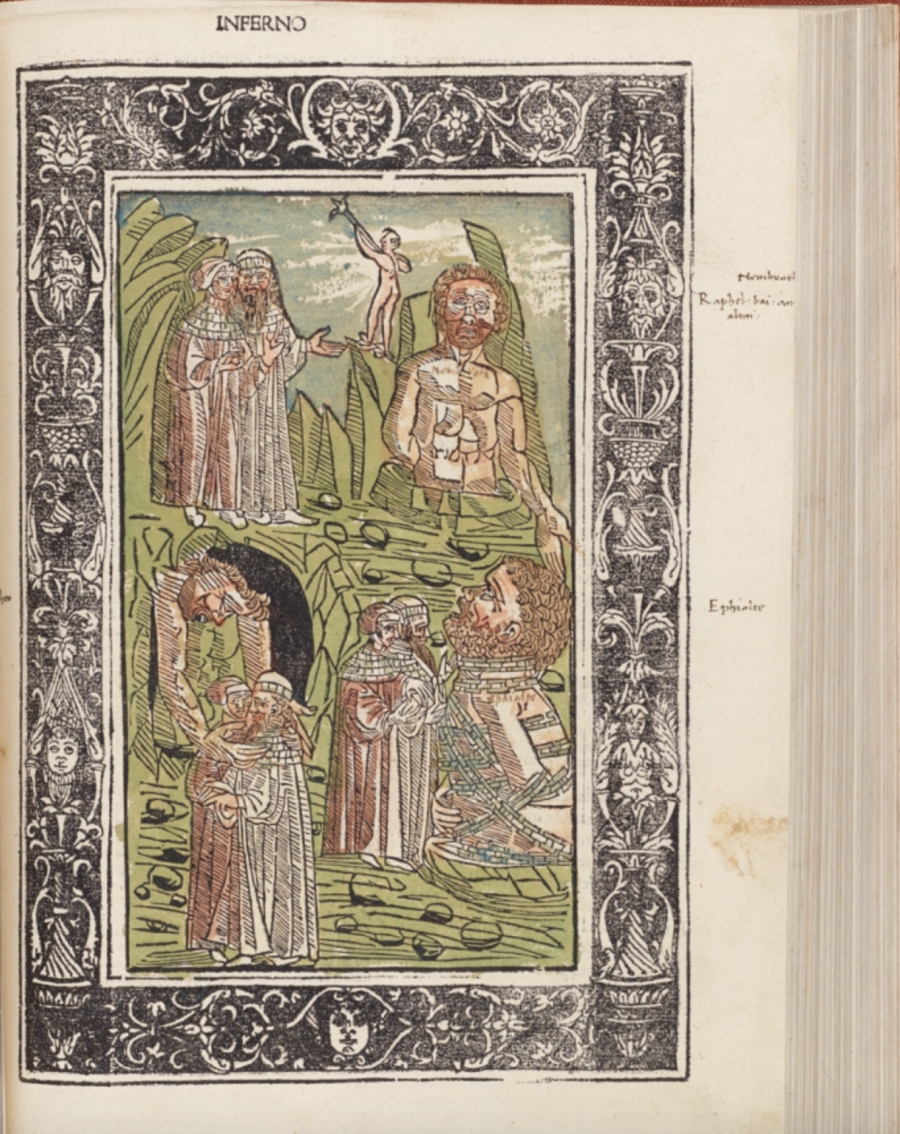
In addi­tion to numer­ous com­men­taries and biogra­phies of its author, over 10 edi­tions of the epic Medieval poem— the tale of Dante’s descent into hell and rise through pur­ga­to­ry and paradise—appeared in the peri­od of incunab­u­la, the first in 1472. The 1481 edi­tion con­tained art based on San­dro Botticelli’s unfin­ished series of Divine Com­e­dy illus­tra­tions. The first ful­ly-illus­trat­ed edi­tion appeared in 1491. None of these print­ings includ­ed the word Divine in the title, which did not come into use until 1555. The Com­me­dia, as it was orig­i­nal­ly called, con­tin­ued to gain in stature into the 16th cen­tu­ry, where it received lav­ish treat­ment in oth­er illus­trat­ed edi­tions.

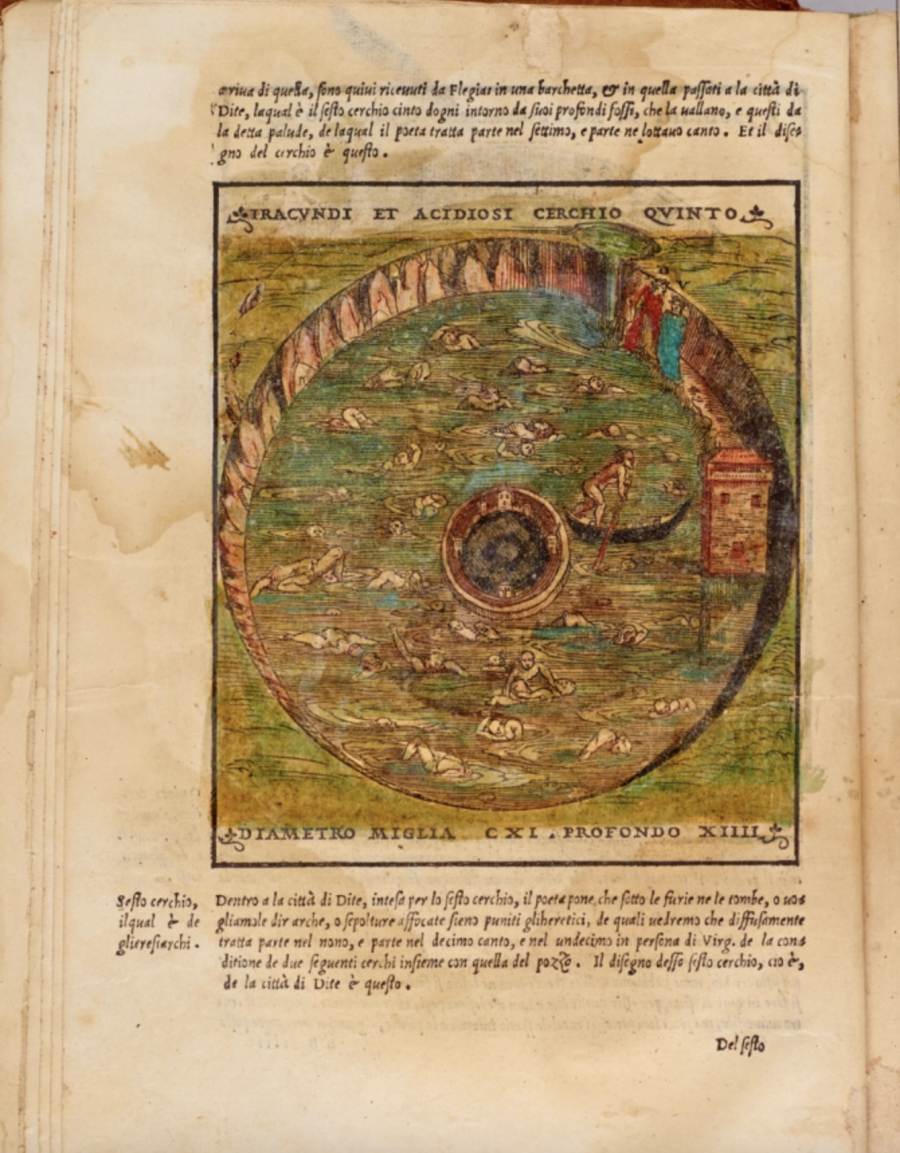
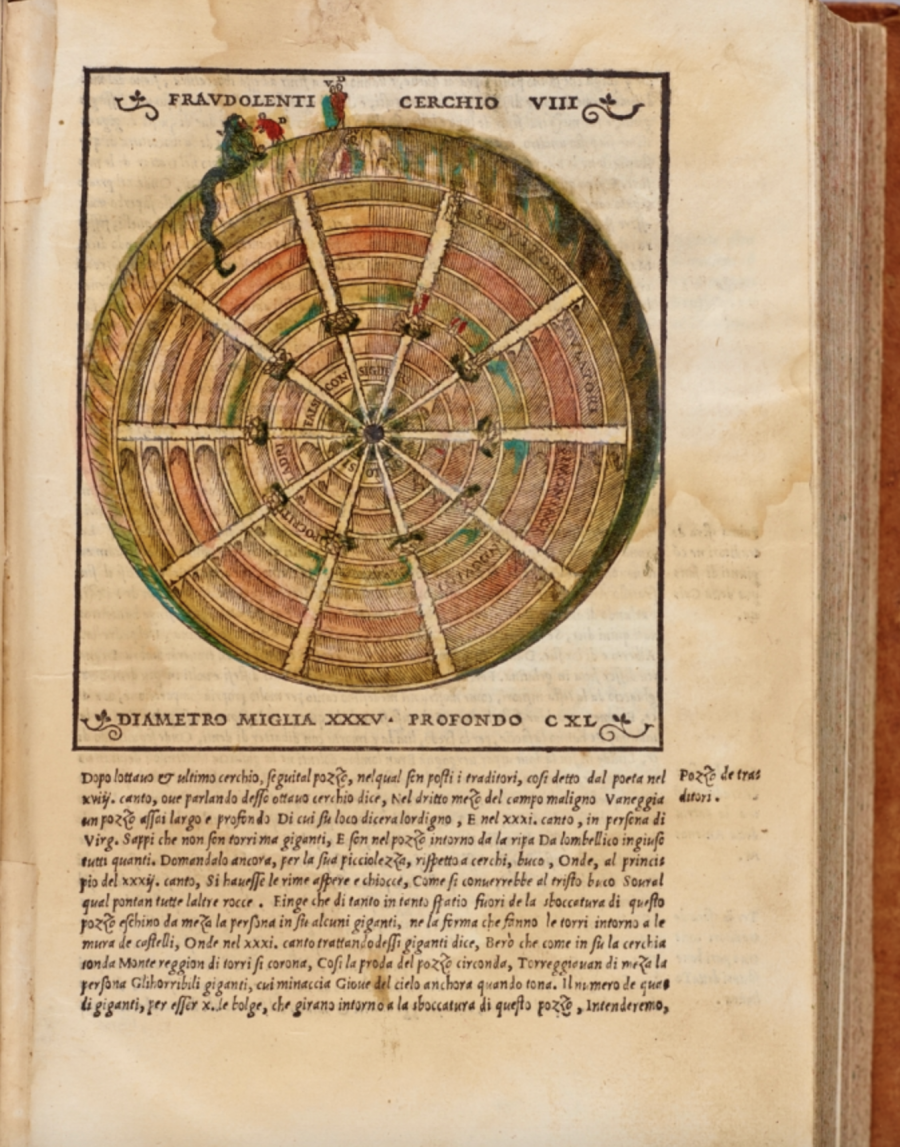
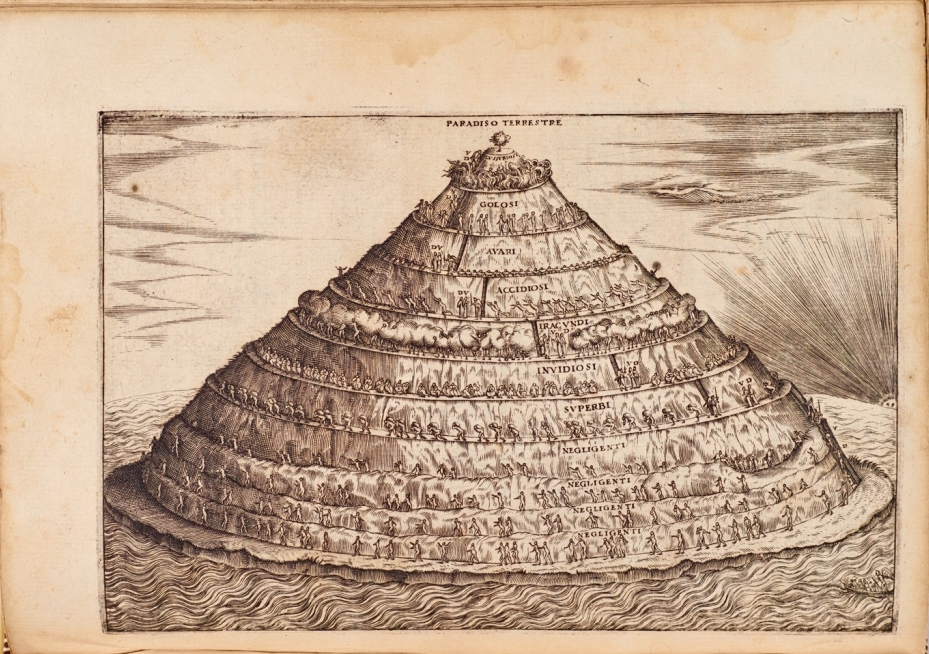
You can see Illus­tra­tions from three of the edi­tions from the first 100-plus years of print­ing here, and many more at Dig­i­tal Dante, a col­lab­o­ra­tive effort from Colum­bia University’s Library and Depart­ment of Ital­ian. These images, from Columbi­a’s Rare Book and Man­u­script Library, rep­re­sent a 1497 wood­cut edi­tion, at the top, with a num­ber of hand-col­ored pages; an edi­tion from 1544, above, with almost 90 cir­cu­lar and tra­di­tion­al­ly-com­posed scenes, all of them prob­a­bly hand-col­ored in the 19th cen­tu­ry; and a 1568 edi­tion with three engraved maps, one for each book, like the care­ful­ly-ren­dered visu­al­iza­tion of pur­ga­to­ry, below.

Of this last edi­tion, Jane Siegel, Librar­i­an for Rare Books, writes, “the rel­a­tive lack of illus­tra­tions are bal­anced by the fine­ness and detail made pos­si­ble by using expen­sive cop­per engrav­ings as a medi­um, and by the live­ly dec­o­rat­ed and his­to­ri­at­ed wood­cut ini­tials sprin­kled through­out the vol­ume at the head of each can­to.” Each of these his­tor­i­cal arti­facts shows us a lin­eage of crafts­man­ship in the infan­cy and ear­ly child­hood of print­ing, a time when lit­er­ary works of art could be turned dou­bly into mas­ter­pieces with illus­tra­tion and typog­ra­phy that com­ple­ment­ed the text. Luck­i­ly for lovers of Dante, fine­ly-illus­trat­ed edi­tions of the Divine Com­e­dy have nev­er gone away.

You can see more images by enter­ing the Dig­i­tal Dante col­lec­tion here.

Relat­ed Con­tent:

A Free Course on Dante’s Divine Com­e­dy from Yale Uni­ver­si­ty

Artists Illus­trate Dante’s Divine Com­e­dy Through the Ages: Doré, Blake, Bot­ti­cel­li, Mœbius & More

Botticelli’s 92 Sur­viv­ing Illus­tra­tions of Dante’s Divine Com­e­dy (1481)

Mœbius Illus­trates Dante’s Par­adiso

Josh Jones is a writer and musi­cian based in Durham, NC. Fol­low him at @jdmagness

« Go BackMore in this category... »
Quantcast