The old joke about supergroups being less than the sum of their parts often holds true in rock and pop. Too many cooks, and all that. But what happens when you bring together superstars from different genres? This was basically the idea of jazz fusion, and especially of Miles Davis, one of fusion’s principle pioneers in the late sixties and early seventies. It’s a genre of music people seem to either love or hate. Those who fall into the latter camp often cite the tendency of jazz-rock ensembles to overplay, to the detriment of both jazz and rock.
Following Davis’ innovations, virtuoso collaborators like John McLaughlin went on to form their own supergroups, while the star trumpeter checked out for a while. But “after five years of silence,” as People magazine wrote in 1981, his trumpet was “once again heard in the land.”
Davis assembled a few bands and charged ahead in an even more fusion‑y direction, despite some severe criticism from music writers, fans, and fellow performers. He covered Cyndi Lauper and Michael Jackson and collaborated with new wave bands and pop stars like Toto. He seemed determined to mix it up with as many major players as he could.
The results were sometimes less than the sum of their parts, though his experimentation crystalized in an excellent record in 1986, the Marcus Miller-produced jazz/funk/pop/R&B album Tutu. That same year, Davis and a loosely-assembled band took the stage at Giants Stadium for a short set at an Amnesty International benefit concert, where they were joined by jazz and rock guitarist Robben Ford and, on the last song, by special guest star Carlos Santana. Tutu, notes The Last Miles—website for George Cole’s book of the same name—“was still a few months away from its official release.”
The band jammed through two of the new album’s tunes, the title track and “Splatch.” Then, for the final song, “Burn”—“a rock-funk number that Miles first heard in 1980”—Santana took the stage. You can see video of them playing that song at the top of the post and hear the full audio of the short performance, less than 30 minutes, further up. The eight-piece band plays a typically busy fusion set, with solo after amazing solo over a full-on wall of electrified sound. I confess, I find this side of Miles a little assaultive next to the restraint of much earlier work, but that’s a matter of personal taste. It’s impossible to say a bad word about the quality of these performances.
How did these superstars end up working together, not only at this benefit but in other concerts and recordings? Find out in the interviews above from Santana and Ford, both of whom describe their experiences as major career highlights. The respect in both cases, a rarity with Miles Davis, was mutual.
You’ve heard the word “blockchain” many times now, but probably not quite as many as you’ve heard the word “bitcoin.” Yet you surely have a sense that the referents of those two words have a connection, and even if you haven’t yet been interested in either, you may well know that blockchain, a technology, makes Bitcoin, a currency, possible in the first place. Their sheer novelty has already given rise to a mini-industry of explainer videos, more of them dealing directly with bitcoin than blockchain, but in time the latter could potentially overtake the former in importance, to the degree that it becomes as vital to society as the protocols that undergird the internet itself.
Or at least you could come away convinced of that after watching the blockchain explainer videos featured here. The shortest of the three, the one by the Institute for the Future at the top of the post, attempts to break down, in just two minutes, the principles behind this technology, still in its infancy, in which so many see such revolutionary potential.
“Blockchains store information across a network of personal computers, making them not just decentralized but distributed,” says the video’s narrator. “This means no central company or person owns the system, yet everyone can use it and help run it.” And according to blockchain’s boosters, that very decentralization and distribution makes it that much more trustable and less hackable.
In the Wired video just above, blockchain researcher Bettina Warburg explains her subject in five different ways to people at five different stages of life, from a five-year-old girl to a fully grown academic. Actually, that last interlocutor, an NYU historian named Finn Brunton, does much of the explaining himself, and right at the beginning of his segment (at 9:48) rolls out one of the clearer and more intriguing rundown of the nature of blockchain currently floating around on the internet:
A technical definition of blockchain is that it is a persistent, transparent, public, append-only ledger. So it is a system that you can add data to, and not change previous data within. It does this through a mechanism for creating consensus between scattered, or distributed, parties that do not need to trust each other. They just need to trust the mechanism by which their consensus is arrived at. In the case of blockchain, it relies on some form of challenge such that no one actor on the network is able to solve this challenge more consistently than anyone else on the network. It randomizes the process, and in theory ensures that no one can force the blockchain to accept a particular entry onto the ledger that others disagree with.
Brunton also emphasizes that “almost every aspect of it that is connected with the concept of money” — including but not limited to Bitcoin — “is wildly over-hyped.” Those who can look past the Gold Rush-style ballyhooing of those early applications of blockchain can better grasp what role the technology, which essentially enables the building of systems to securely exchange information over the internet that no one person or company owns, might one day play in many parts of our lives, from finance to energy to health care. “Credit scores that aren’t controlled by a handful of high-risk, data-breach-prone companies,” promises Carissa Carter of Stanford’s d.school, “credible news systems that resist censorship; efficient power grids that could lower your power bills.”
Before it can bring those wonders, Bitcoin must first overcome formidable technical limitations: as Computerworld’s Lucas Mearian writes, for instance,” the Bitcoin blockchain harnesses anywhere between 10 and 100 times as much computing power compared to all of Google’s serving farms put together.” But then, few of the first developers of the technologies that drive the internet could have imagined all we do with them across the world today, and those who did must have had a solid understanding of its most basic elements. How do you know when you’ve attained that understanding? “If you can’t explain it simply, you don’t understand it well enough,” as Albert Einstein once said, and as Citi Innovation Lab CTO Shai Rubin quotes him as saying at the beginning of his own blockchain explainer, performed in less than fifteen minutes using no pieces of technology more revolutionary than a whiteboard and marker.
Based in Seoul, Colin Marshall writes and broadcasts on cities and culture. His projects include the book The Stateless City: a Walk through 21st-Century Los Angeles and the video series The City in Cinema. Follow him on Twitter at @colinmarshall or on Facebook.
In the spring of 1934, a young man who wanted to be a writer hitchhiked to Florida to meet his idol, Ernest Hemingway.
Arnold Samuelson was an adventurous 22-year-old. He had been born in a sod house in North Dakota to Norwegian immigrant parents. He completed his coursework in journalism at the University of Minnesota, but refused to pay the $5 fee for a diploma. After college he wanted to see the country, so he packed his violin in a knapsack and thumbed rides out to California. He sold a few stories about his travels to the Sunday MinneapolisTribune.
In April of ’34 Samuelson was back in Minnesota when he read a story by Hemingway in Cosmopolitan, called “One Trip Across.” The short story would later become part of Hemingway’s fourth novel, To Have and Have Not. Samuelson was so impressed with the story that he decided to travel 2,000 miles to meet Hemingway and ask him for advice. “It seemed a damn fool thing to do,” Samuelson would later write, “but a twenty-two-year-old tramp during the Great Depression didn’t have to have much reason for what he did.”
And so, at the time of year when most hobos were traveling north, Samuelson headed south. He hitched his way to Florida and then hopped a freight train from the mainland to Key West. Riding on top of a boxcar, Samuelson could not see the railroad tracks underneath him–only miles and miles of water as the train left the mainland. “It was headed south over the long bridges between the keys and finally right out over the ocean,” writes Samuelson. “It couldn’t happen now–the tracks have been torn out–but it happened then, almost as in a dream.”
When Samuelson arrived in Key West he discovered that times were especially hard there. Most of the cigar factories had shut down and the fishing was poor. That night he went to sleep on the turtling dock, using his knapsack as a pillow. The ocean breeze kept the mosquitos away. A few hours later a cop woke him up and invited him to sleep in the bull pen of the city jail. “I was under arrest every night and released every morning to see if I could find my way out of town,” writes Samuelson. After his first night in the mosquito-infested jail, he went looking for the town’s most famous resident.
When I knocked on the front door of Ernest Hemingway’s house in Key West, he came out and stood squarely in front of me, squinty with annoyance, waiting for me to speak. I had nothing to say. I couldn’t recall a word of my prepared speech. He was a big man, tall, narrow-hipped, wide-shouldered, and he stood with his feet spread apart, his arms hanging at his sides. He was crouched forward slightly with his weight on his toes, in the instinctive poise of a fighter ready to hit.
“What do you want?” said Hemingway. After an awkward moment, Samuelson explained that he had bummed his way from Minneapolis just to see him. “I read your story ‘One Trip Across’ in Cosmopolitan. I liked it so much I came down to have a talk with you.” Hemingway seemed to relax. “Why the hell didn’t you say you just wanted to chew the fat? I thought you wanted to visit.” Hemingway told Samuelson he was busy, but invited him to come back at one-thirty the next afternoon.
After another night in jail, Samuelson returned to the house and found Hemingway sitting in the shade on the north porch, wearing khaki pants and bedroom slippers. He had a glass of whiskey and a copy of the New York Times. The two men began talking. Sitting there on the porch, Samuelson could sense that Hemingway was keeping him at a safe distance: “You were at his home but not in it. Almost like talking to a man out on a street.” They began by talking about the Cosmopolitan story, and Samuelson mentioned his failed attempts at writing fiction. Hemingway offered some advice.
“The most important thing I’ve learned about writing is never write too much at a time,” Hemingway said, tapping my arm with his finger. “Never pump yourself dry. Leave a little for the next day. The main thing is to know when to stop. Don’t wait till you’ve written yourself out. When you’re still going good and you come to an interesting place and you know what’s going to happen next, that’s the time to stop. Then leave it alone and don’t think about it; let your subconscious mind do the work. The next morning, when you’ve had a good sleep and you’re feeling fresh, rewrite what you wrote the day before. When you come to the interesting place and you know what is going to happen next, go on from there and stop at another high point of interest. That way, when you get through, your stuff is full of interesting places and when you write a novel you never get stuck and you make it interesting as you go along.”
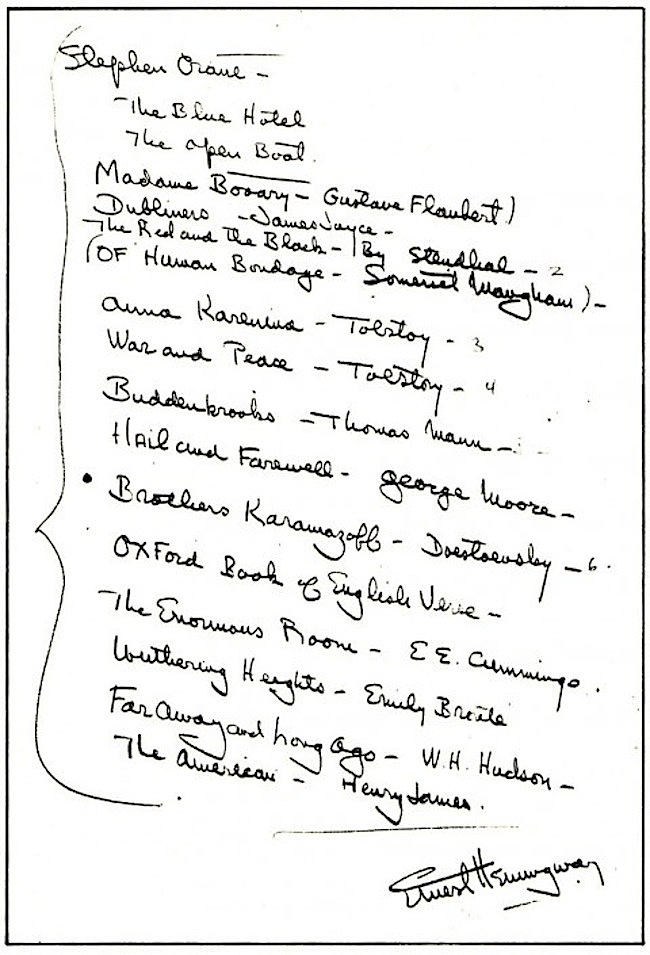
Hemingway advised Samuelson to avoid contemporary writers and compete only with the dead ones whose works have stood the test of time. “When you pass them up you know you’re going good.” He asked Samuelson what writers he liked. Samuelson said he enjoyed Robert Louis Stevenson’s Kidnapped and Henry David Thoreau’s Walden. “Ever read War and Peace?” Hemingway asked. Samuelson said he had not. “That’s a damned good book. You ought to read it. We’ll go up to my workshop and I’ll make out a list you ought to read.”
His workshop was over the garage in back of the house. I followed him up an outside stairway into his workshop, a square room with a tile floor and shuttered windows on three sides and long shelves of books below the windows to the floor. In one corner was a big antique flat-topped desk and an antique chair with a high back. E.H. took the chair in the corner and we sat facing each other across the desk. He found a pen and began writing on a piece of paper and during the silence I was very ill at ease. I realized I was taking up his time, and I wished I could entertain him with my hobo experiences but thought they would be too dull and kept my mouth shut. I was there to take everything he would give and had nothing to return.
Hemingway wrote down a list of two short stories and 14 books and handed it to Samuelson. Most of the texts you can find in our collection, 800 Free eBooks for iPad, Kindle & Other Devices. If the texts don’t appear in our eBook collection itself, you’ll find a link to the text directly below.
Hemingway reached over to his shelf and picked up a collection of stories by Stephen Crane and gave it to Samuelson. He also handed him a copy of his own novel, A Farewell to Arms. “I wish you’d send it back when you get through with it,” Hemingway said of his own book. “It’s the only one I have of that edition.” Samuelson gratefully accepted the books and took them back to the jail that evening to read. “I did not feel like staying there another night,” he writes, “and the next afternoon I finished reading A Farewell to Arms, intending to catch the first freight out to Miami. At one o’clock, I brought the books back to Hemingway’s house.” When he got there he was astonished by what Hemingway said.
“There is something I want to talk to you about. Let’s sit down,” he said thoughtfully. “After you left yesterday, I was thinking I’ll need somebody to sleep on board my boat. What are you planning on now?”
“I haven’t any plans.”
“I’ve got a boat being shipped from New York. I’ll have to go up to Miami Tuesday and run her down and then I’ll have to have someone on board. There wouldn’t be much work. If you want the job, you could keep her cleaned up in the mornings and still have time for your writing.”
“That would be swell,” replied Samuelson. And so began a year-long adventure as Hemingway’s assistant. For a dollar a day, Samuelson slept aboard the 38-foot cabin cruiser Pilar and kept it in good condition. Whenever Hemingway went fishing or took the boat to Cuba, Samuelson went along. He wrote about his experiences–including those quoted and paraphrased here–in a remarkable memoir, With Hemingway: A Year in Key West and Cuba. During the course of that year, Samuelson and Hemingway talked at length about writing. Hemingway published an account of their discussions in a 1934 Esquire article called “Monologue to the Maestro: A High Seas Letter.” (Click here to open it as a PDF.) Hemingway’s article with his advice to Samuelson was one source for our February 19 post, “Seven Tips From Ernest Hemingway on How to Write Fiction.”
When the work arrangement had been settled, Hemingway drove the young man back to the jail to pick up his knapsack and violin. Samuelson remembered his feeling of triumph at returning with the famous author to get his things. “The cops at the jail seemed to think nothing of it that I should move from their mosquito chamber to the home of Ernest Hemingway. They saw his Model A roadster outside waiting for me. They saw me come out of it. They saw Ernest at the wheel waiting and they never said a word.”
Note: An earlier version of this post originally appeared on our site in May, 2013.
Homer’s Iliad staged as a one-woman show? IN A BAR! It’s an outrage. A desecration of a founding work of Western Civilization™. A sure sign of cultural decline.
But wait…. What if McGill University classics professor Lynn Kozak’s performance returns the epic Greek poem to its origins, as a dramatic oral presentation for small audiences who were, quite possibly, inebriated, or at least a little tipsy? Kozak’s Previously on… The Iliad, described as “Happy Hour Homer,” presents its intimate audience with “a new, partially improvised English translation of a bit of The Iliad, all the way through the epic.”
The performances take place every Monday at 6 at Montreal’s Bar des Pins. Like the story itself, Kozak begins in medias res—in the middle, that is, of a chattering crowd of students, who quiet down right away and give the story their full attention.
Ancient Greek poetry was performed, not studied in scholarly editions in academic departments. It was sung, with musical accompaniment, and probably adapted, improvised, and embellished by ancient bards to suit their audiences. Granted, Kozak doesn’t sing (though some performances involve music); she recites in a manner both casual and dramatically gripping. She reminds us that the stories we find in the text are distant kin to the bloody serialized TV soap operas that occupy so much of our day-to-day conversation, at home, on social media, and at happy hour.
The liberties Kozak takes recreate the poem in the present as a living work. This is classics education at its most engaging and accessible. Like any poetic performer, Kozak knows her audience. The Iliad is a lot like Game of Thrones, “because of the number of characters that you have to keep up with,” Kozak tells the CBC’s As It Happens, “and also because of the fact that there’s not always clean-cut kind of villains or who you’re supposed to be rooting for in any major scene—especially in battle scenes.”
The performance of the “anger of Achilles” (top, with beer pong) conveys the moral complexity of the Greek hero. “He must be brutal and ready to risk brutality,” as UNC professor of philosophy CDC Reeve writes. “At the same time, he must be gentle to his friends and allies, and able to join with them in group activities both military and peaceful.” Is Achilles a tool of the gods or a man driven to extremes by rage? Homer suggests both, but the action is set in motion by divine agency. “Apollo was pissed at King Agamemnon,” Kozak paraphrases, then summarizes the nature of the insult and checks in with the young listeners: “everyone still with me?”
The story of The Iliad, many scholars believe, existed as an oral performance for perhaps 1,000 years before it was committed to writing by the scribe or scribes identified as Homer. But the poem “isn’t really a theatre piece,” says Kozak, despite its musical nature. “It’s really a story. It’s really a one-person show. And for me it’s just important to be in a place that’s casual and where I’m with the audience.” It’s doubtful that the poem was performed in its entirely in one sitting, though the notion of “serialization” as we know it from 19th century novels and modern-day television shows was not part of the culture of antiquity.
“We’re not really sure how The Iliad was broken up originally,” Kozak admits. Adapting the poem to contemporary audience sensibilities has meant “thinking about where or if episodes exist in the epic,” in the way of Game of Thrones. Each performance is styled differently, with Kozak holding court as various characters. “Sometimes there are cliffhangers. Sometimes they have resolutions. It’s been an interesting mix so far.” That “so far” extends on YouTube from Week 1 (Book 1, lines 1–487) to Week 14 (Book 11, line 461 to Book 12, line 205). Check back each week for new “episodes” to come online, and watch Weeks One through Four above and the other ten at the Previously on… The Iliad YouTube channel.
Among my works, the one I like best is the Home that I have had built in Milan for accommodating old singers not favored by fortune, or who, when they were young did not possess the virtue of saving. Poor and dear companions of my life!
—Giuseppe Verdi
Is there a remedy for the isolation of old age?
What about the jolly fraternity and competitiveness of an art college dorm, as envisioned by opera composer Giuseppe Verdi?
Shortly before his death, the composer donated all royalties from his operas to the construction and administration of a luxurious retreat for retired musicians, designed by his librettist’s brother, architect Camillo Boito.
Completed in 1899, Casa Verdi still serves elderly musicians today–up to 60 at a time. Residents of Casa Verdi include alumnae of the Metropolitan Opera and the Royal Opera House. Guests have worked alongside such notables as Chet Baker and Maria Callas.
Competition for residential slots is stiff. To qualify, one must have been a professional musician or music teacher. Those selected enjoy room, board, and medical treatment in addition to, writes The New York Times, “access to concerts, music rooms, 15 pianos, a large organ, harps, drum sets and the company of their peers.” Musical programming is as constant as the fine view of Verdi’s grave.
Dining tables are named in honor of Verdi’s works. Those inclined to worship do so in a chapel named for Santa Cecilia, the patron saint of musicians.
Practice rooms are alive with the sound of music and criticism. As Casa Verdi’s music therapist told the Financial Times, “They are very competitive: they are all prima donnas.”
When memory fails, residents can tune in to such documentaries as actor Dustin Hoffman’s Tosca’s Kiss, below
Get a peek inside Verdi’s retirement home for artists, compliments of Urban Sketchers here.
Something highly unusual happened during the New York Philharmonic’s concert of April 6, 1962. After the intermission, just before starting the second half with the First Piano Concerto of Johannes Brahms featuring Glenn Gould, conductor Leonard Bernstein stepped onto the podium and said a few words to prepare the audience for what would come next:
You are about to hear a rather, shall we say, unorthodox performance of the Brahms D Minor Concerto, a performance distinctly different from any I’ve ever heard, or even dreamt of for that matter, in its remarkably broad tempi and its frequent departures from Brahms’ dynamic indications. I cannot say I am in total agreement with Mr. Gould’s conception and this raises the interesting question: “What am I doing conducting it?” I’m conducting it because Mr. Gould is so valid and serious an artist that I must take seriously anything he conceives in good faith and his conception is interesting enough so that I feel you should hear it, too.
You can hear Bernstein’s remarks in full in the concert recording just above. “Why do I not make a minor scandal,” he asks rhetorically, “get a substitute soloist, or let an assistant conduct?” Because he was “glad to have the chance for a new look at this much-played work,” because “there are moments in Mr. Gould’s performance that emerge with astonishing freshness and conviction,” and because “we can all learn something from this extraordinary artist, who is a thinking performer.”
Just as Bernstein didn’t agree with the famously (and sometimes infamously) individualistic Gould’s much-slowed-down interpretation of Brahms (though the decades of Brahms scholarship since have given it more support), many critics didn’t agree with Bernstein’s decision to introduce it that way. “I think that even though the conductor made this big disclaimer, he should not be allowed to wiggle off the hook that easy,” wrote the New York Times’ Harold C. Schonberg, who approved of neither the presentative choices of the conductor nor the artistic choices of the pianist. “I mean, who engaged the Gould boy in the first place? Who is the musical director? Somebody has to be responsible.”
“At the time I felt that saying something like this before a performance was not the right thing to do,” says famed conductor Seiji Ozawa in Absolutely on Music, his book of conversations with novelist Haruki Murakami. He happened to be there at Carnegie Hall on April 6, 1962, in his capacity as Bernstein’s assistant conductor: “When Lenny said in his speech that he could have let an assistant conduct it — that’s me!” Listening to the recording again, Ozawa describes Gould (who would retire from live performance two years thereafter) as having “an absolutely solid grasp of the flow of the music,” and adds that “Lenny’s got it absolutely right, too. He’s putting his heart and soul into it.” Ozawa still disapproves of Bernstein’s introductory remarks, but acknowledges the special quality of the man who introduced him to America: “From Lenny, people were willing to accept it.”
Based in Seoul, Colin Marshall writes and broadcasts on cities and culture. His projects include the book The Stateless City: a Walk through 21st-Century Los Angeles and the video series The City in Cinema. Follow him on Twitter at @colinmarshall or on Facebook.
Who invented ambient music? Many fans of the genre might say Brian Eno, though Brian Eno himself makes no such claim. Still, the records he labeled with the word “ambient” in the 1970s and 80s did much to popularize not just the term, but a certain conception of the form itself. “For me, the central idea was about music as a place you go to,” he said in an interview about his recent ambient album Reflection. “Not a narrative, not a sequence that has some sort of teleological direction to it — verse, chorus, this, that, and the other. It’s really based on abstract expressionism: Instead of the picture being a structured perspective, where your eye is expected to go in certain directions, it’s a field, and you wander sonically over the field.”
Did the 19th and early 20th-century French composer Erik Satie have the same idea? The Guardian’s Nick Shave calls Satie (whom you’ll at the very least know for Gymnopédie No.1) “the maverick who invented ‘furniture music,’ sounds that were designed to be heard but not listened to.”
F.D. Leone of Musica Kaleidoskopea describes Satie’s musique d’ameublement as “music which had no set form and sections could be re-arranged as a performer or conductor wished, much like furniture in a room, and to act as part of the ambiance or furnishings.” And Satie started on it in back in 1917, composing for the delivery system of not records, and certainly not (as Eno has used in recent years) generative smartphone apps, but live performance.
Though Satie would continue writing furniture music until just a couple of years before his death in 1925, much of it was never performed during his lifetime. Its revival came a few decades later, thanks to the arrival into the music world of a young composer intent on taking his art to places it had seldom gone before: John Cage. “He’s indispensable,” Cage once said of the still oft-derided Satie. Shave also describes Eno’s 1978 album Ambient 1: Music for Airports a direct answer to Satie’s call for “music that would be a part of the surrounding noises.” You can hear all of Satie’s furniture music (selections of which appear embedded here) performed by the Ars Nova Ensembleat Ubuweb. “It seems to have swollen to accommodate some quite unexpected bedfellows,” Eno has written of the genre of ambient music today. But would would Satie hear it all as just an expansion of furniture music?
Based in Seoul, Colin Marshall writes and broadcasts on cities and culture. His projects include the book The Stateless City: a Walk through 21st-Century Los Angeles and the video series The City in Cinema. Follow him on Twitter at @colinmarshall or on Facebook.
Five years ago, Choir!Choir!Choir!, a large amateur choir from Toronto, got a rare chance to perform with Patti Smith, joining her onstage to sing her 1978 hit “Because the Night.” Still inspired by that experience, the group recently revisited the song during one of their weekly sessions. “The feeling in the room was electric, everyone was leaning in hard, and the end result is so powerful,” Choir!Choir!Choir! writes on their YouTube channel. You can watch the end result above.
If you would like to sign up for Open Culture’s free email newsletter, please find it here. It’s a great way to see our new posts, all bundled in one email, each day.
If you would like to support the mission of Open Culture, consider making a donation to our site. It’s hard to rely 100% on ads, and your contributions will help us continue providing the best free cultural and educational materials to learners everywhere. You can contribute through PayPal, Patreon, and Venmo (@openculture). Thanks!
We're hoping to rely on loyal readers, rather than erratic ads. Please click the Donate button and support Open Culture. You can use Paypal, Venmo, Patreon, even Crypto! We thank you!
Open Culture scours the web for the best educational media. We find the free courses and audio books you need, the language lessons & educational videos you want, and plenty of enlightenment in between.