What’s your relationship to music? Do you just embrace the pure sound, or do you care about who made that sound? One way of seeing where you fall on this issue is whether you care more for singles or to whole albums or careers by artists.
Ken Stringfellow, who co-fronts The Posies and was a member of R.E.M. and Big Star, joins Mark Linsenmayer, Erica Spyres, and Brian Hirt to talk about what actually grabs us about music, whether being a musician yourself is a key factor in whether you pay attention to the context of a song, how music gets to your ears, singers vs. songwriters, what we think about the notion of “genius,” and how this artist vs. song conflict relates to how we take in other media (e.g. favorite film directors).
The ideas for this discussion mostly came from reflecting on our own experiences and habits, but we did some warm-up research into:
“In the West,” the I Ching, or the Book of Changes, “is mainly known as a divination manual,” writes philosopher and novelist Will Buckingham, “part of the wild carnival of spurious notions that is New Age spirituality.” But just as one can use the Tarot as a means of reading the present, rather than predicting future events, so too can the I Ching serve to remind us, again and again, of a principle we are too apt to forget: the critical importance of non-action, or what is called wu wei in Chinese philosophy.
Non-action is not passivity, though it has been mischaracterized as such by cultures that overvalue aggression and self-assertion. It is a way of exercising power by attuning to the rhythms of its mysterious source. In the religious and philosophical tradition that became known as Taoism, non-action achieves its most canonical expression in the Tao Te Ching, the classic text attributed to sixth century B.C.E. thinker Laozi, who may or may not have been a real historical figure.
The Tao Te Ching describes non-action as a paradox in which dualistic tensions like passivity and aggression resolve.
That which offers no resistance, Overcomes the hardest substances. That which offers no resistance Can enter where there is no space. Few in the world can comprehend The teaching without words, or Understand the value of non-action.
Wu wei is sometimes translated as “effortless action” or the “action of non-action,” phrases that highlight its dynamic quality. Arthur Waley used the phrase “actionless activity” in his English version of the Tao Te Ching. In the short video introduction above, “philosophical entertainer” Einzelgänger explains “the practical sense” of wu wei in terms of that which athletes call “the zone,” a state of “action without striving” in which bodies “move through space effortlessly.” But non-action is also an inner quality, characterized by its depth and stillness as much as its strength.
Among the many symbols of wu wei is the action of water against stone—a graceful organic movement that “overcomes the hardest substances” and “can enter where there is no space.” The image illustrates what Einzelgänger explains in contemporary terms as a “philosophy of flow.” We cannot grasp the Tao—the hidden creative energy that animates the universe—with discursive formulas and definitions. But we can meet it through “stillness of mind, curbing the senses, being humble, and the cessation of striving, in order to open ourselves up to the workings of the universe.”
The state of “flow,” or total absorption in the present, has been popularized by psychologists in recent years, who describe it as the secret to achieving creative fulfillment. Non-action has its analogues in Stoicism’s amor fati, Zen’s “backward step,” and Henri Bergson’s élan vital. In the Tao te Ching, the Way appears as both a metaphysical, if enigmatic, philosophy and a practical approach to life that transcends our individual goals. It is an improvisatory practice which, like rivers carving out their beds, requires time and persistence to master.
In a story told by Taoist philosopher Zhuangzi, a renowned butcher is asked to explain his seemingly effortless skill at carving up an ox. He replies it is the product of years of training, during which he renounced the struggle to achieve, and came to rely on intuition rather than perception or brute force. Embracing non-action reveals to us the paths down which our talents naturally take us when we stop fighting with life. And it can show us how to handle what seem like insoluble problems by moving through, over, and around them rather than crashing into them head on.
Clutch imaginary pearls, rest the back of your hand on your forehead, look wan and stricken, begin to wilt, and most people will recognize the symptoms of your sarcasm, aimed at some pejoratively feminized qualities we’ve seen characters embody in movies. The “literary swoon” as Iaian Bamforth writes at the British Journal of General Practice, dates back much further than film, to the early years of the modern novel itself, and it was once a male domain.
“Somewhere around the time of the French Revolution (or perhaps a little before it) feelings were let loose on the world.” Rationalism went out vogue and passion was in—lots of it, though not all at once. It took some decades before the discovery of emotion reached the climax of Romanticism and denouement of Victorian sentimentality:
Back in 1761, readers had swooned when they encountered the ‘true voice of feeling’ in Jean-Jacques Rousseau’s novel La Nouvelle Héloïse; by the end of the decade, all of Europe was being sentimental in the manner made fashionable a few years later by Laurence Sterne in his A Sentimental Journey. Then there was Goethe’s novella, The Sorrows of Young Werther (1774), which made its author a celebrity.
It’s impossible to overstate how popular Goethe’s book became among the aristocratic young men of Europe. Napoleon “reputedly carried a copy of the novel with him on his military campaign.” Its swooning hero, whom we might be tempted to diagnose with any number of personality and mood disorders, develops a disturbing and debilitating obsession with an engaged woman and finally commits suicide. The novel supposedly inspired many copycats and “the media’s first moral panic.”
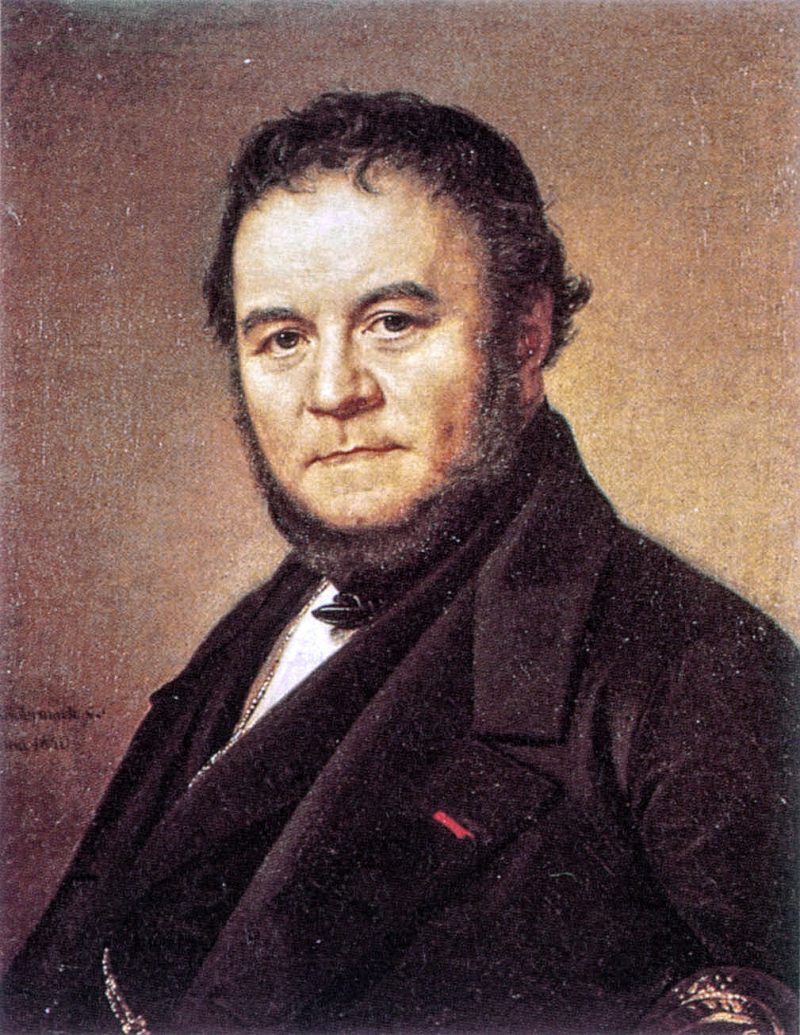
If we can feel such exaltation, disquiet, and fear when in the grip of romantic passion, or when faced with nature’s implacable behemoths, as in Kant’s Sublime, so too may we be overcome by art. Napoleonic novelist Stendhal suggested as much in a dramatic account of such an experience. Stendhal, the pen name of Marie-Henri Beyle, was no inexperienced dreamer. He had traveled and fought extensively with the Grand Army (including that fateful march through Russia, and back) and had held several government offices abroad. His realist fiction didn’t always comport with the more lyrical tenor of the times.
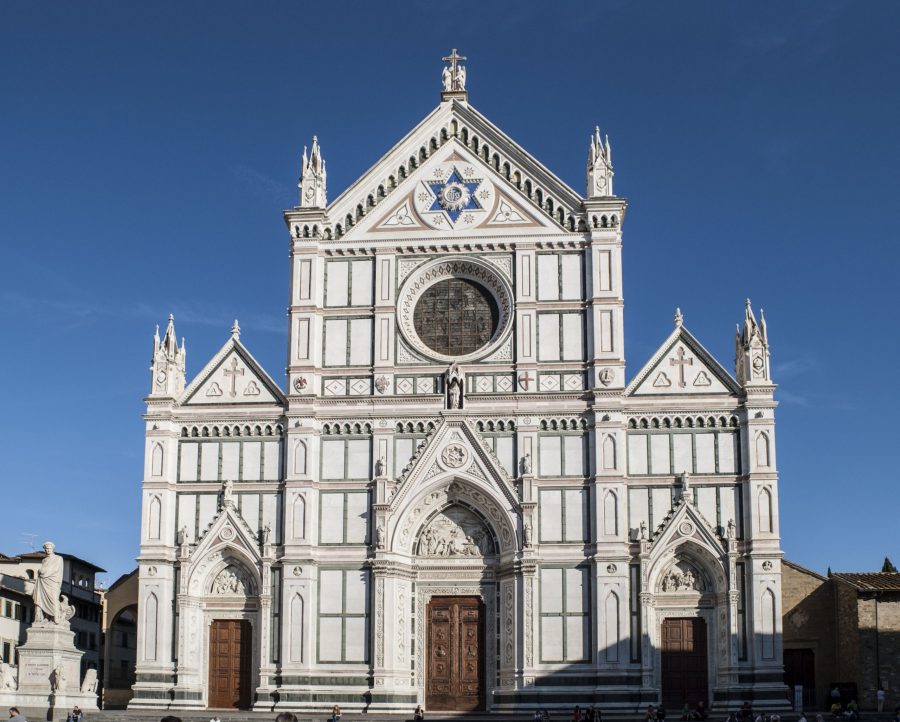
Photo of the Basilica of Santa Croce by Diana Ringo, via Wikimedia Commons
But he was also of the generation of young men who read Werther while touring Europe, contemplating the varieties of emotion. He had held a similarly unrequited obsession for an unavailable woman, and once wrote that “in Italy… people are still driven to despair by love.” During a visit to the Basilica of Santa Croce in 1817, he “found a monk to let him into the chapel,” writes Bamforth, “where he could sit on a genuflecting stool, tilt his head back and take in the prospect of Volterrano’s fresco of the Sibyls without interruption.” As Stendhal described the scene:
I was already in a kind of ecstasy by the idea of being in Florence, and the proximity of the great men whose tombs I had just seen. Absorbed in contemplating sublime beauty, I saw it close-up—I touched it, so to speak. I had reached that point of emotion where the heavenly sensations of the fine arts meet passionate feeling. As I emerged from Santa Croce, I had palpitations (what they call an attack of the nerves in Berlin); the life went out of me, and I walked in fear of falling.
With the recording of this experience, Stendhal “brought the literary swoon into tourism,” Bamforth remarks. Such passages became far more commonplace in travelogues, not least those involving the city of Florence. So many cases similar to Stendhal’s have been reported in the city that the condition acquired the name Stendhal syndrome in the late seventies from Dr. Graziella Magherini, chief of psychiatry at the Santa Maria Nuova Hospital. It presents as an acute state of exhilarated anxiety that causes people to feel faint, or to collapse, in the presence of art.
Magherini and her assistants compiled studies of 107 different cases in 1989. Since then, Santa Maria Nuova has continued to treat tourists for the syndrome with some regularity. “Dr. Magherini insists,” writes The New York Times, that “certain men and women are susceptible to swooning in the presence of great art, especially when far from home.” Stendhal didn’t invent the phenomenon, of course. And it need not be solely caused by sufferers’ love of the 15th century.
The stresses of travel can sometimes be enough to make anyone faint, though further research may rule out other factors. The effect, however, does not seem to occur with nearly as much frequency in other major cities with other major cultural treasures. “It is surely the sheer concentration of great art in Florence that causes such issues,” claims Jonathan Jones at The Guardian. Trying to take it all in while navigating unfamiliar streets and crowds.… “More cynically, some might say the long queues do add a layer of stress on the heart.”
There’s also no discounting the effect of expectation. “It is among religious travelers that Stendhal’s syndrome seems to have found its most florid expression,” notes Bamforth. Stendhal admitted that his “ecstasy” began with an awareness of his “proximity of the great men whose tombs I had just seen.” Without his prior education, the effect might have disappeared entirely. The story of the Renaissance, in his time and ours, has impressed upon us such a reverence for its artists, statesmen, and engineers, that sensitive visitors may feel they can hardly stand in the actual presence of Florence’s abundant treasures.
Perhaps Stendhal syndrome should be regarded as akin to a spiritual experience. A study of religious travelers to Jerusalem found that “otherwise normal patients tended to have ‘an idealistic subconscious image of Jerusalem’” before they succumbed to Stendhal syndrome. Carl Jung described his own such feelings about Pompeii and Rome, which he could never bring himself to visit because he lived in such awe of its historical aura. Those primed to have symptoms tend also to have a sentimental nature, a word that once meant great depth of feeling rather than a callow or mawkish nature.
We might all expect great art to overwhelm us, but Stendhal syndrome is rare and rarified. The experience of many more travelers accords with Mark Twain’s 1869 The Innocents Abroad, or The New Pilgrim’s Progress, a fictionalized memoir “lampooning the grandiose travel accounts of his contemporaries,” notes Bamforth. It became “one of the best-selling travel books ever” and gave its author’s name to what one researcher calls Mark Twain Malaise, “a cynical mood which overcomes travelers and leaves them totally unimpressed with anything UNESCO has on its universal heritage list.” Sentimentalists might wish these weary tourists would stay home and let them swoon in peace.
Though born in the late 19th century and partially shaped by a few sojourns to Europe, Edward Hopper was an artist fundamentally of early 20th-century America. He took life in that time and place as his subject, but he also once said that “an artist paints to reveal himself through what he sees in his subject,” meaning that he in some sense embodied early 20th-century America. Royal Academy of the Arts Artistic Director Tim Marlow quotes that line in the 60-second introduction to Hopper above, then points to a common thread in the painter’s “enigmatic works”: a “profound contemplation of the world around us” that turns each of his paintings into one captured “moment of stillness in a frantic world.”
Much of Hopper’s work came out of the Great Depression, “a period of great uncertainty and anxiety, but also a time of deep national self-imagination about the very idea of American-ness.” To look at the figures who inhabit Hopper’s thoroughly American settings — a gas station, a hotel room, inside a train car, an all-night diner — self-reflection would seem to be their main pastime.
“A woman sits alone drinking a cup of coffee,” says the School of Life’s head of Art and Architecture Hanna Roxburgh of Hopper’s 1927 Automat in the video above. “She seems slightly self-conscious and a little afraid. Perhaps she’s not used to sitting alone in a public space. Something seems to have gone wrong. The view is invited to invent stories for her of betrayal or loss.”
Loneliness, isolation, even despair: these words tend to come up in discussion of the moods of Hopper’s characters, as well as of his paintings themselves. In the in-depth exploration above, Colin Wingfield focuses on a single emotion expressed in Hopper’s work: alienation. A product of the “machine age” in late 19th- and early 20th century America, Hopper expressed an uneasy view of the ways in which accelerating industrialization and automation were altering the lives lived around him into unrecognizability. This view would turn out to have an enormous cultural resonance, as detailed in Edward Hopper and the Blank Canvas, the hourlong documentary below.
Touching on the Hopper influences seen in the work of directors like Alfred Hitchcock and Terrence Malick as well as television shows like Mad Men and The Simpsons, Edward Hopper and the Blank Canvas also brings in cultural figures like the German filmmaker Wim Wenders, an avowed Hopper enthusiast with much to say about the painter’s vision in America. More creators from the world of cinema appear in the video below to offer their personal perspectives on Hopper’s considerable influence on their art form — an art form that had considerable influence on Hopper, an avid moviegoer since he first watched a motion picture in Paris in 1909.
No single painting of Hopper’s has had as much influence on film as 1942’s Nighthawks, by far the painter’s best-known work. How exactly he achieved his own cinematic effects in a still image, such as the “storyboarding” technique with which he developed its composition, is a subject we’ve featured before here on Open Culture. In the video essay “Nighthawks: Look Through the Window,” Evan Puschak — better known as the Nerdwriter — seeks out the sources of the painting’s enduring power, from its “clean, smooth, and almost too real” aesthetic to its rigorous composition to its host of visual elements meant to both compel and unsettle the viewer.
Hopper explains his way of working in his own words in the short video from the Walker Art Center below. “It’s a long process of gestation in the mind and a rising emotion,” he says, followed by “drawings, quite often many drawings”: “various small sketches, sketches of the thing that i wish to do, also sketches of details in the picture.” As for the themes of “loneliness, isolation, modern man and his man-made environment” so often ascribed to the final products, “those are the words of critics. It may be true and it may not be true. It’s how the viewer looks at the pictures, what he sees in them.”
Based in Seoul, Colin Marshall writes and broadcasts on cities, language, and culture. His projects include the book The Stateless City: a Walk through 21st-Century Los Angeles and the video series The City in Cinema. Follow him on Twitter at @colinmarshall or on Facebook.
Two psych rock superstars at the height of their fame, both notorious for epic drug and alcohol consumption, and neither particularly suited to the other’s sensibility, Jim Morrison and Jimmy Hendrix might have been an oddly consonant musical pairing, or not. Morrison, the egomaniac, looked inward, mining his dark fantasies for material. Hendrix, the introvert, ventured into the reaches of outer space in his expansive imagination.
What might come of a musical meeting? We know only what transpired one night at Manhattan’s Scene Club in 1968, and let’s just say it didn’t go particularly well. It seems unfair to lob criticism at a bootlegged, one-off, improvised performance. But that hasn’t stopped critics from doing so. The recording has appeared under several names, including Sky High, Bleeding Heart, Morrison/Hendrix/Winter (under the assumption Johnny Winter played on it), and as the very resonantly titled Woke up this morning and found myself dead.
Eventually, some anonymous distributer settled on Morrison’s Lament, “an apt title,” Ron Kretsch writes at Dangerous Minds, “if by ‘lament’ one means ‘drunken, formless discharge of inane profanities.” Morrison, it seems, invited himself onstage, and Hendrix, who made the tape himself, seems not to mind the intrusion. At one point, you can hear him tell the Doors’ singer to “use the recording mic.” Some bootlegs credit Morrison for the harmonica playing, while others credit Lester Chambers.
Hendrix starts with his go-to blues jam, “Red House.” He’s backed—depending on which liner notes you read—by either Band of Gypsys’ drummer Buddy Miles or McCoy’s drummer Randy Zehringer. Rick Derringer may have played rhythm guitar. Johnny Winter reportedly denied having been there, but the Scene Club was owned by his manager, Steve Paul. “Jimi was a frequent visitor here,” writes Hendrix biographer Tony Brown in the notes for a 1980 copy of the session. “He loved he atmosphere and also loved to jam and as he always had a tape machine on hand, that night was captured forever.”
That’s a very mixed blessing. “Some of the tracks kinda kick ass,” writes Kretsch, including the effortlessly brilliant “Red House” Hendrix and band play in the first six minutes or so at the top. Then Morrison steps onstage and begins to howl—sounding like a random inebriated audience member who’s lost all inhibition, instead of the eerily cool singer of “Riders on the Storm.” Maybe there’s good reason to hear Morrison bellowing “save me, woman!” as a serious cry for help.
But there’s little reason to take this performance seriously. If that still leaves you wondering—what might have resulted from a sober, well-rehearsed session between these two?—you’ll have to make-do with the mashup above, which convincingly combines Morrison’s “Riders on the Storm” vocals with Hendrix’s “Hey Joe” playing. Listen at least until the solo at around 1:20 to hear Ray Manzarek’s organ trickle in. Now that would have been a great collaboration. If you every come across any bootlegged Manzarek and Hendrix jams, send them our way.…
Andrew Wyeth died a decade ago, but his status as a beloved American painter was assured long before. He painted his best-known work Christina’s World in 1948, a time in American painting when images of immediately recognizable fields, farmhouses, and middle-aged women were not, to put it mildly, in vogue. But Christina’s World has survived right alongside, say, Jackson Pollock’s drip paintings from the very same year. How it has done so — and what way of seeing enabled Wyeth to paint it with such confidence in the first place — constitutes the subject of this new video essay by Evan Puschak, better known as the Nerdwriter (whose investigations into Picasso, Rembrandt, Van Gogh, Hopper and others we’ve previously featured here on Open Culture).
“Being realistic and dramatic, Christina’s World more easily fits the shape of our memories, our dreams, our fears and cravings,” says Pucshak. “In other words, it resembles a story.” Not only does the painting’s combination of the familiar and the unknown fire up our imagination, getting us to generate narratives to apply to it, it also guides our vision, taking us on a journey from woman to house to barn and back again. But for all its appearance of pastoral reverie, it also has a certain darkness about it, hinted at by the colors, which are muted, reflecting the particular austerity of New England landscapes, a common image in early American art and thought,” as well as the body of Christina herself, lifted from the earth only by “thin and contorted arms.”
The real Christina, as is now common art-historical knowledge, suffered from a disease of the nervous system that robbed her of her ability to walk; her preference of crawling rather than using a wheelchair meant that she navigated her world in a much different manner than most of us do. But even as Wyeth shows us one variety of little-acknowledged human limitation, he also shows us another variety of little-acknowledged human ability. Puschak suggests that Wyeth was “looking for a secret in nature,” and in the search became the transcendentalist writer Ralph Waldo Emerson’s “transparent eye-ball,” which contains nothing yet sees everything.
“He sees in the nature around him, even in the barren landscapes of new England, something profoundly real,” says Puschak. “As an artist, he helps us to see it too.” He also reminds us 21st century urbanites, who dwell as much in the digital realm as the physical one, of the “piece of us in the land, in the trees, in the sky, and a sense of wholeness waits for us when we can remember not to forget it.” The idea may sound as unfashionable as realism looked in Wyeth’s day, but to the artist’s own mind, he was never a realist at all. “My people, my objects breathe in a different way,” he once said. “There’s another core — an excitement that’s definitely abstract. My God, when you really begin to peer into something, a simple object, and realize the profound meaning of that thing — if you have an emotion about it, there’s no end.”
Based in Seoul, Colin Marshall writes and broadcasts on cities, language, and culture. His projects include the book The Stateless City: a Walk through 21st-Century Los Angeles and the video series The City in Cinema. Follow him on Twitter at @colinmarshall or on Facebook.
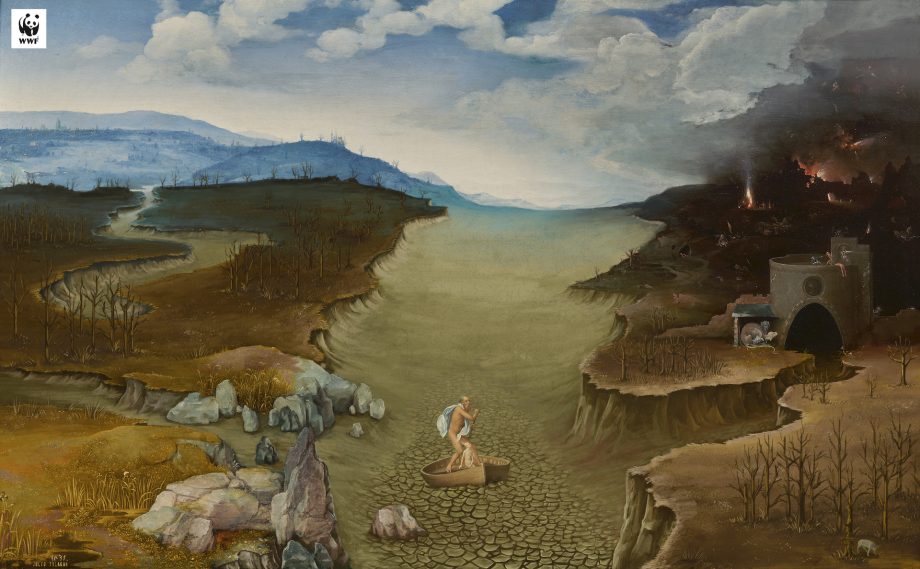
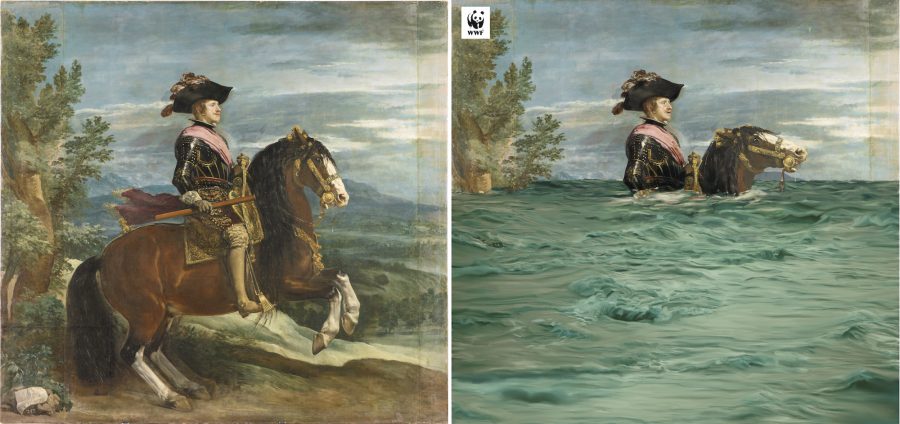
A catastrophic series of chain reactions, including but not limited to:
–Sea level rise
–Change in land and ocean ecosystems
–Increased intensity and frequency of weather extremes
–Temperature extremes on land
–Drought due to precipitation deficits
–Species loss and extinction
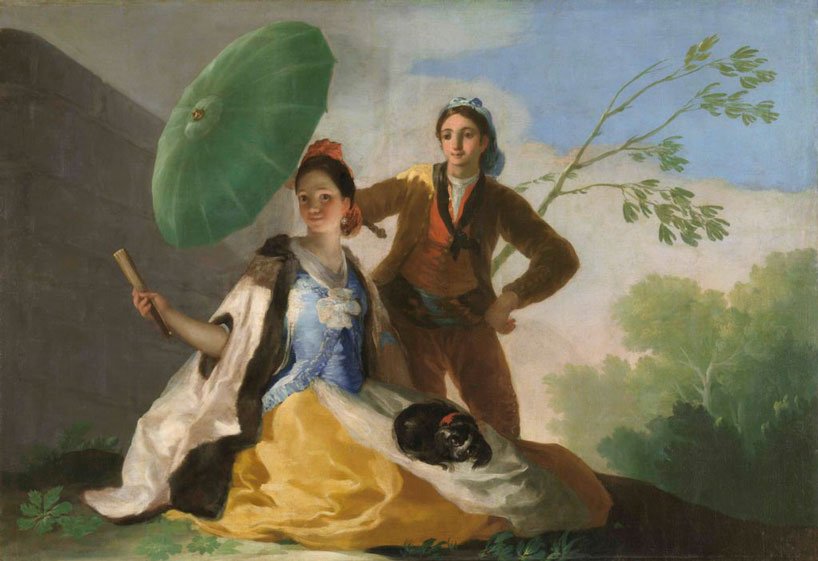
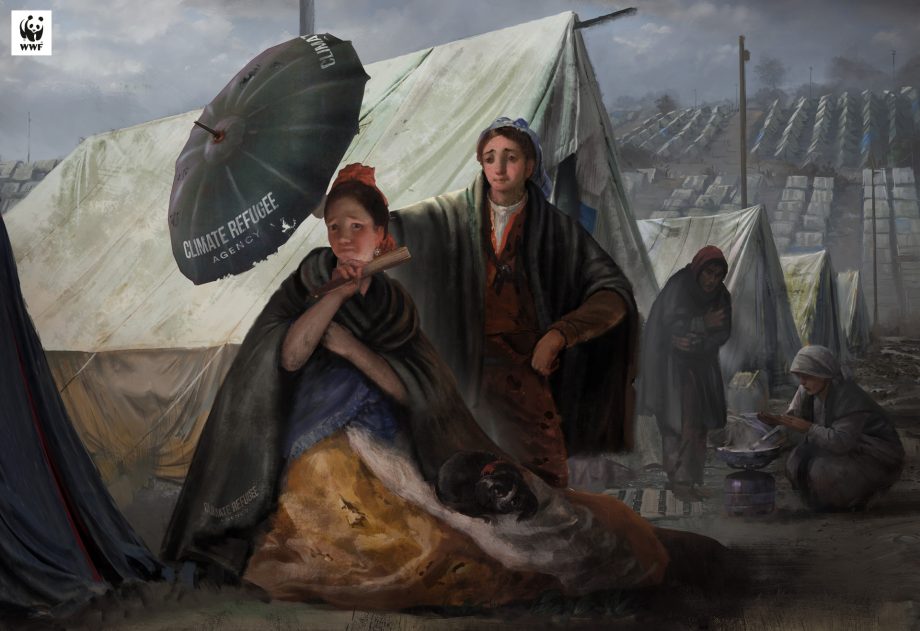
The Parasol that supplies the title for Francisco de Goya’s El Quitasol of 1777 becomes a tattered umbrella barely sheltering miserable, crowded refugees in the sodden, makeshift camp of Pedro Veloso’s reimagining.
And the Niños en la Playa captured relaxing on the beach in 1909 by Joaquín Sorolla now compete for space with dead fish, as observed by artist Conspiracy 110 years further along.
None of the original works are currently on display.
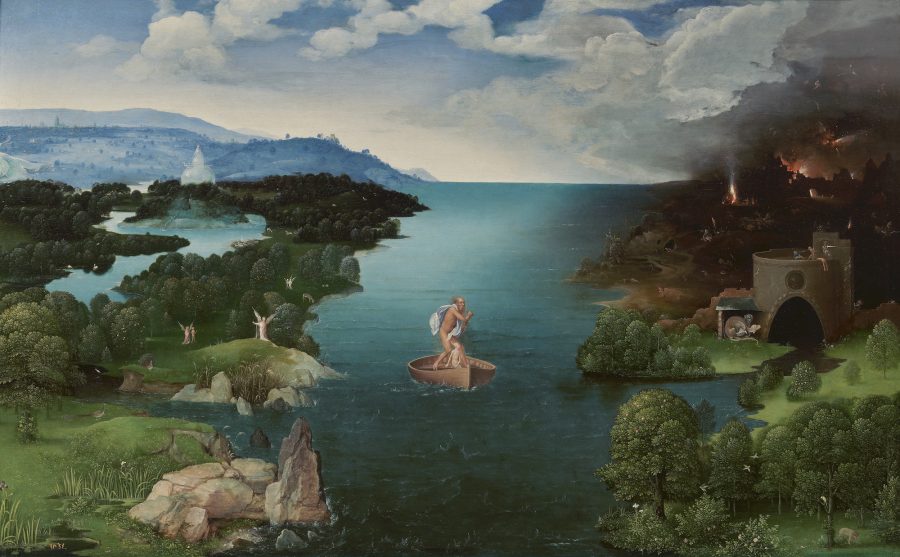
It would be a public service if they were, alongside their drastically retouched twins and perhaps Hieronymus Bosch’s The Garden of Earthly Delights, to further unnerve viewers about the sort of hell we’ll soon be facing if we, too, don’t make some major alterations.
For now the works in the +1.5ºC Lo Cambia Todo (+1.5ºC Changes Everything) project are making an impact on giant billboards in Madrid, as well as online.
The Dust to Digital Facebook page sets the scene: “Christone ‘Kingfish’ Ingram, play[s] an amazing and touching version of “Amazing Grace” at the funeral of his mother, Princess Pride, today. She was a great supporter of her son, and would have turned 50 tomorrow.” Amazing and touching indeed. Make sure you play it all of the way through. And when you start the video, manually move up the volume icon at the bottom right of the video.
We're hoping to rely on loyal readers, rather than erratic ads. Please click the Donate button and support Open Culture. You can use Paypal, Venmo, Patreon, even Crypto! We thank you!
Open Culture scours the web for the best educational media. We find the free courses and audio books you need, the language lessons & educational videos you want, and plenty of enlightenment in between.





_-_Facade.jpg)