Boing Boing writes: “Back in April, Andrew Albanese from Publishers Weeklywrote a column deploring the abysmal formatting in the DoJ’s release of the Mueller Report, and publicly requesting that the Digital Public Library of America produce well-formatted ebook editions, which they have now done!”
The Digital Public Library of America adds:
The Report On The Investigation Into Russian Interference In The 2016 Presidential Election, or the Mueller Report, is now freely available in ebook format to read on your phone or tablet from DPLA’s website and the Open Bookshelf collection. The Mueller report was released to the public by the Department of Justice as a PDF last month, initially in a format that was not text-searchable. By making the report available as an ebook in our Open Bookshelf collection, anyone can download and read it for free, all in the SimplyE app — no library card or sign in required.
One of the primary objectives of DPLA’s ebooks work is to make the best openly-licensed e‑content available to libraries and their patrons. For libraries offering New York Public Library’s SimplyE app, the Mueller Report can be easily integrated into the ebook offerings made available to their patrons. SimplyE and Open Bookshelf are freely available to anyone with an iOS or Android device.
Read the Mueller Report today
Download on the web: Visit https://muellerreport.dp.la, download it in one click, and read it with your computer’s e‑reader like iBooks.
Read in SimplyE on your phone or tablet:
Download the SimplyE app to your iOS or Android device.
Use the library selector icon in the upper left corner, select Manage Accounts, then Add Library, and select Digital Public Library of America.
Find the Mueller Report in the top row.
To learn more about Open Bookshelf and other DPLA ebooks offerings, visit https://ebooks.dp.la. DPLA’s Ebook work and the production of the Mueller Report ebook is supported by the Alfred P. Sloan Foundation.
If you would like to sign up for Open Culture’s free email newsletter, please find it here. It’s a great way to see our new posts, all bundled in one email, each day.
If you would like to support the mission of Open Culture, consider making a donation to our site. It’s hard to rely 100% on ads, and your contributions will help us continue providing the best free cultural and educational materials to learners everywhere. You can contribute through PayPal, Patreon, and Venmo (@openculture). Thanks!
There are purists out there who think computers ruined electronic music, made it cold and alien, removed the human element: the warm, warbling sounds of analog oscillators, the unpredictability of analog drum machines, synthesizers that go out of tune and have minds of their own. Musicians played those instruments, plugged and patched them together, tried their best to control them. They did not program them.
Then came digital samplers, MIDI, DAWs (digital audio workstations), pitch correction, time correction… every note, every arpeggio, every drum fill could be mapped in advance, executed perfectly, endlessly editable forever, and entirely played by machines.
All of this may have been true for a short period of time, when producers became so enamored of digital technology that it became a substitute for the old ways. But analog has come back in force, with both technologies now existing harmoniously in most electronic music, often within the same piece of gear.
Digital electronic music has virtues all its own, and the dizzying range of effects achievable with virtual components, when used judiciously, can lead to sublime results. But when it comes to another argument about the impact of computers on music made by humans, this conclusion isn’t so easy to draw. Rock and roll has always been powered by human error—indeed would never have existed without it. How can it be improved by digital tools designed to correct errors?
The ubiquitous sound of distortion, for example, first came from amplifiers and mixing boards pushed beyond their fragile limits. The best songs seem to all have mistakes built into their appeal. The opening bass notes of The Breeder’s “Cannonball,” mistakenly played in the wrong key, for example… a zealous contemporary producer would not be able to resist running them through pitch correction software.
John Bonham’s thundering drums, a force of nature caught on tape, feel “impatient, sterile and uninspired” when sliced up and snapped to a grid in Pro Tools, as producer and YouTuber Rick Beato has done (above) to prove his theory that computers ruined rock music. You could just write this off as an old man ranting about new sounds, but hear him out. Few people on the internet know more about recorded music or have more passion for sharing that knowledge.
In the video at the top, Beato makes his case for organic rock and roll: “human beings playing music that is not metronomic, or ‘quantized’”—the term for when computers splice and stretch acoustic sounds so that they align mathematically. Quantizing, Beato says, “is when you determine which rhythmic fluctuations in a particular instrument’s performance are imprecise or expressive, you cut them, and you snap them to the nearest grid point.” Overuse of the technology, which has become the norm, removes the “groove” or “feel” of the playing, the very imperfections that make it interesting and moving.
Beato’s thorough demonstration of how digital tools turn recorded music into modular furniture show us how the production process has become a mental exercise, a design challenge, rather than the palpable, spontaneous output of living, breathing human bodies. The “present state of affairs,” as Nick Messitte puts it, is “keyboards triggering samples quantized to within an inch of their humanity by producers in the pre-production stages.” Anyone resisting this status quo becomes an acoustic musician by default, argues Messitte, standing on one side of the “acoustic versus synthetic” divide.
Whether the two modes of music can be harmoniously reconciled is up for debate, but at present, I’m inclined to agree with Beato: digital recording, processing, and editing technologies, for all their incredible convenience and unlimited capability, too easily turn rhythms made with the elastic timing of human hearts and hands into machinery. The effect is fatiguing and dull, and on the whole, rock records that lean on these techniques can’t stand up to those made in previous decades or by the few holdouts who refuse to join the arms race for synthetic pop perfection.
Johannes Kepler determined just how the planets of our solar system make their way around the sun. He published his innovative work on the subject from 1609 to 1619, and in the final year of that decade he also came up with a theory that each planet sings a song, and each in a different voice at that. Mars is a tenor, Mercury is a soprano, and Earth, as the BBC show QI (or Quite Interesting) recently tweeted, “is an alto that sings two notes Mi and Fa, which Kepler read as ‘Miseriam & Famem’, ‘misery and famine’ ” — two phenomena not unknown on Earth in Kepler’s time, even though the scientific revolution had already started to change the way people lived.
Not all of the best minds of the scientific revolution thought purely in terms of calculation. The blog ThatsMaths describes Kepler’s mission as explaining the solar system “in terms of divine harmony,” finding “a system of the world that was mathematically correct and harmonically pleasing.” Truly divine harmony could presumably find its expression in music, an idea that led Kepler to explain “planetary motions in terms of harmonic relationships, a scheme that he called the ‘song of the Earth.’ ”
According to this scheme, “each planet emits a tone that varies in pitch as its distance from the Sun varies from perihelion to aphelion and back” — that is, from the nearest they get to the sun to the farthest they get from the sun and back — “producing a continuous glissando of intermediate tones, a ‘whistling produced by friction with the heavenly light.’ ”
Kepler named the combined result “the music of the spheres,” but what does it sound like? Switzerland-based cornettist Bruce Dickey wants to give us a sense of it with Nature’s Whispering Secret, “a project for a CD recording exploring the ideas about music and cosmology of Johannes Kepler.” Demanding the musicianship of not just Dickey but composer Calliope Tsoupaki, singer Hana Blažíková, and a group of singers and instrumentalists from across Europe and America as well, all “among the most distinguished musicians performing 16th-century polyphonic music today.” The Indiegogo campaign for this ambitious tribute to Kepler’s ideas at the intersection of science and aesthetics, which involves an album as well as a series of live performances into the year 2020, is on its very last day, so if you’d like to hear the music of the spheres for yourself, consider making a contribution.
Based in Seoul, Colin Marshall writes and broadcasts on cities, language, and culture. His projects include the book The Stateless City: a Walk through 21st-Century Los Angeles and the video series The City in Cinema. Follow him on Twitter at @colinmarshall, on Facebook, or on Instagram.
“For sixty years, conventional wisdom has told us that women generally did not perform rock and roll during the 1950s,” writes Leah Branstetter, Ph.D. candidate in musicology at Case Western Reserve University. Like so many cultural forms into which we are initiated, through education, personal interest, and general osmosis, this popular form of Western music—now a genre with seventy years under its belt—has functioned as an almost ideal example of the great man theory of history.
It can seem like settled fact that Chuck Berry, Elvis Presley, Jerry Lee Lewis, Little Richard, Buddy Holly, and their celebrated male contemporaries invented the music; and that women played passive roles as fans, studio audience members, groupies, personifications of cars and guitars.…
The reality is, however, that hundreds—or maybe thousands—of women and girls performed and recorded rock and roll in its early years. And many more participated in other ways: writing songs, owning or working for record labels, working as session or touring musicians,designing stage wear, dancing, or managing talent…. [W]omen’s careers didn’t always resemble those of their more famous male counterparts. Some female performers were well known and performed nationally as stars, while others had more influence regionally or only in one tiny club. Some made the pop charts, but even more had impact through live performance. Some women exhibited the kind of wild onstage behavior that had come to be expected from figures Jerry Lee Lewis or Little Richard—but that wasn’t the only way to be rebellious, and others found their own methods of being revolutionary.
Branstetter’s project, a digital dissertation, covers dozens of musicians from the period, just a fraction of the names she has uncovered in her research. Some of the women profiled were never particularly well-known. Many more were accomplished stars before the 60’s girl group phenomenon, and continued performing into the 21st century.
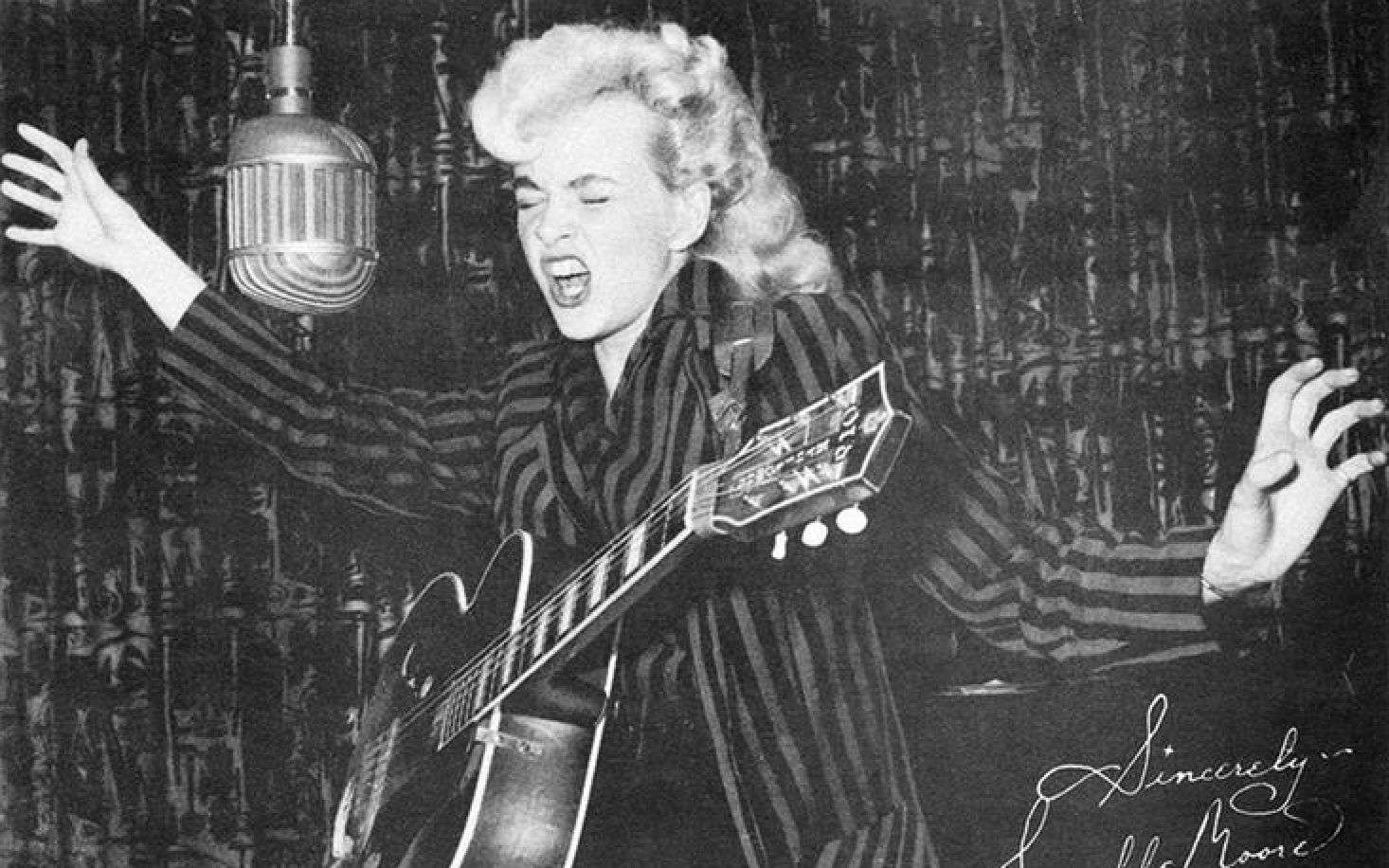
Meet rockers like Sparkle Moore (see up top), born in Omaha, Nebraska and inspired by Bill Haley in the mid-fifties to play rockabilly in her hometown. She went on to tour the country, putting out record after record. “By 1957,” writes Branstetter, “she had about forty songwriting credits to her name.” Teen magazine Dig wrote that Moore had “an amazing resemblance to the late James Dean… Presley’s style and Dean’s looks.” She is still a “favorite with rockabilly fans,” notes her biography. Moore “has been inducted into the Iowa Rock and Roll Hall of Fame and also made a new album in 2010 entitled Spark-a-Billy.”
Meet Lillie Bryant, one half of duo Billie & Lillie, whose breezier R&B sounds and more wholesome image resonated with early rock and roll fans, promoters, and stars. Bryant began performing in New York City clubs as a teenager. Then producers Bob Crewe and Frank Slay turned her and singer Billie Ford into a duo who went on to star in legendary DJ Alan Freed’s stage shows, “including a six-week tour with Chuck Berry and Frankie Lymon” and an appearance on American Bandstand. Bryant still performs in her hometown of Newburgh, New York.
Meet The Chantels. “Formed in the Bronx, New York in the early 1950s,” they were “among the first African-American female vocal groups to gain national attention.” They also toured with Alan Freed and appeared on American Bandstand and The Dick Clark Show. In 1961, their hit “Look in My Eyes” went to number 14 on the pop charts and 6 on the R&B charts. (Thirty years later, it appeared on the Goodfellas soundtrack.)
Most people who grew up on the music of the 50s and 60s have likely heard of many of these women rockers, or have at least heard their music if they didn’t know the names and faces. But Branstetter’s project does more than tell the stories of individuals—in biographies, interviews (with, for one, Jerry Lee Lewis’s sister, singer and piano player Linda Gail Lewis), blog posts, playlists (hear one below), song analyses, and essays.
She also substantiates her larger claim that women’s “contributions shaped the culture and sound of rock and roll,” in numerous well-documented ways. This despite the fact that women in early rock were told versions of the same thing Joan Jett heard 20 years later—“girls don’t play rock and roll.” They sometimes heard it from other women in the music business. Pop singer Connie Frances, for example, offered her opinion in a 1958 issue of Billboard: “A girl can’t sing rock and roll. It’s basically too savage for a girl singer to handle.”
Attitudes like these persisted so long, and became so unconscious, that one of the largest guitar makers in the world, Fender, and several other musical instrument makers, may have lost millions in sales before they finally realized that women make up half of new guitar players. Women in Rock and Roll’s First Wave will inspire and enlighten many of those young musicians who didn’t grow up knowing anything about Sparkle Moore or The Chantels, but should have. Unless rock historians willingly ignore the work of scholars like Branstetter, subsequent accounts should reflect a more expansive, inclusive, view of the territory. Starthere.
What is a Muppet? Homer Simpson once offered this explanation: “It’s not quite a mop and it’s not quite a puppet, but man…” — before cracking up with amusement. “So to answer your question, I don’t know.” That episode of The Simpsons aired in the mid-1990s, a somewhat fallow period for Jim Henson’s puppet-like (though less so mop-like) creations, but the decades between now and then have shown them to be at least as culturally influential as Matt Groening’s family of Springfieldians. What gives the Muppets, who made their television debut in 1955 and have now survived their creator by nearly thirty years, their power to endure?
Insight into that question is on offer right now in a new six-part documentary series on Jim Henson’s life and work. It comes as a part of Defunctland, “a YouTube series discussing the history of extinct theme parks and themed entertainment experiences” that has recently expanded its cultural purview.
The first episode of Defunctland’s Jim Henson explores “the history of Jim’s beginnings and his first television show, Sam and Friends”; the second “the origins of Sesame Street, the Muppetland specials, and the failed Muppet pilots”; and the third the proper beginnings of The Muppet Show, whose creators didn’t know they were “about to make the most popular show in the world.” After you’ve caught up with the first three episodes of Jim Henson, the next three episodes will appear on the series’ Youtube playlist.
As you’ll know if you’ve seen the surreal early films, experimental animations, and violent coffee commercials made by Jim Henson previously featured here on Open Culture, the man behind the Muppets hardly sought to produce entertainment for children alone: one of the pilots of The Muppet Show, in fact, was titled “Sex and Violence.” Defunctland’s documentary series gets into that and all the other aspects of Henson’s life and work, two concepts hardly separable for such a famously dedicated creator. There’s much more to Henson’s legacy than a childhood full of Sesame Street — now in its 50th year on the air — would suggest. As for how rigorous a definition of “Muppet” the series will leave us with, we’ll have to wait until it concludes to find out.
Based in Seoul, Colin Marshall writes and broadcasts on cities, language, and culture. His projects include the book The Stateless City: a Walk through 21st-Century Los Angeles and the video series The City in Cinema. Follow him on Twitter at @colinmarshall, on Facebook, or on Instagram.
On the week where Alabama Public Television banned an episode of the kids’ cartoon Arthur for showing a gay wedding (just after banning abortion the week before), let’s go back to a time when the entire country needed a little bit of an education on homosexuality and used The Simpsons and a guest appearance by director John Waters to make the point.
“Homer’s Phobia” premiered on February 16, 1997 in the show’s eighth season. Written by Ron Hauge, the episode casts Waters as John, the owner of Springfield’s antique and memorabilia store “Cockamamie’s”, who befriends the family. Bart and Lisa love the retro and campy objects on sale, Marge loves John’s compliments, but Homer freaks out when he realizes (and it takes some time) that John is gay. Panicking that Bart might become gay from John’s influence, he forces Bart to take a tour of the manliest thing he can think of, a steel mill, only to find that it doubles as a gay disco after work (“We work hard and we play hard,” says the foreman).
Homer doubles down, believing that hunting and killing a deer will make Bart a man. John saves the day of course, Homer learns a little lesson on acceptance, and only at the end does Bart understand what the whole panic has been about.
As comedy with a message, the episode still holds up. Homer’s cluelessness (when Marge says “He prefers the company of men,” Homer responds, “Who doesn’t?”) and his homophobia (referring to the word “queer” he says “I resent you people using that word. That’s our word for making fun of you! We need it!”) is both dopey and pointed, but never vicious. Also delightful is John’s visit to the Simpsons’ home, where he has a vintage collector’s swoon over the kitsch of the entire interior decoration, which as viewers we’ve never really considered. There’s plenty of visual gags, like a pink flamingo in John’s shop and the amazing Sha-Boom-Ka-Boom googie-architecture cafe.
According to Matt Baume’s recent video essay, this episode did more for awareness and exposing intolerance than any live action show at the time. John Waters, despite his filthy filmography, is fun, collected, and cool. He is neither a punchline nor a tragic figure. At this time in America, homosexuality was still a crime in many states. A head censor at Fox objected to nearly every line in the show (although not always from the right–there was also concern that gay people might be offended). Time solved the problem, however. By the time it came back from the animators that one censor had lost his job.
A few months later Ellen Degeneres came out on Oprah and the culture started to shift even a little more. But as this week proved, this episode’s insights still ring true today.
Ted Mills is a freelance writer on the arts who currently hosts the artist interview-based FunkZone Podcast and is the producer of KCRW’s Curious Coast. You can also follow him on Twitter at @tedmills, read his other arts writing at tedmills.com and/or watch his films here.
Juxtapoz writes: “Never invited to be the part of Venice Biennale, Banksy once again invited himself to showcase his work. Using a typical pop-up stand that usually sells tacky paintings and souvenirs, he assembled a selection of 9 works that collectively built an image of a massive cruise ship blocking the city.”
If you would like to sign up for Open Culture’s free email newsletter, please find it here. It’s a great way to see our new posts, all bundled in one email, each day.
If you would like to support the mission of Open Culture, consider making a donation to our site. It’s hard to rely 100% on ads, and your contributions will help us continue providing the best free cultural and educational materials to learners everywhere. You can contribute through PayPal, Patreon, and Venmo (@openculture). Thanks!
Fleetwood Mac lost one lead singer and guitarist after another in the 70s, first to a mental health crisis, then a religious cult, then dramatic firings and relational breakdowns. They were in a bit of a shambles when new prospect Lindsay Buckingham arrived, bringing with him even more drama, as well as an unknown singer, Stevie Nicks. One year later, their breakup coincided with the dissolution of John and Christine McVie’s marriage, and drummer and namesake Mick Fleetwood’s divorce, during the recording of the massive-selling Rumors album in 1976.
Somehow, the band kept on, making greater leaps forward with Tusk, surviving into the 90s intact and mounting several reunion tours afterward. How? Many a book and documentary have tackled the subject. But maybe the main reason is plain.
Despite enduring circumstances that would tear most bands apart, despite the cynical lures and traps of wealth and fame, Fleetwood Mac’s professional longevity came from the fact that they were musicians who loved playing together, who knew how good they were at what they did, and knew they were better when they did it together.
Not only did the new five-piece put aside huge personal conflicts and an already legendary history to make some of the greatest pop music ever written, both collaborating and letting individual songwriters take the lead, but they had the smarts to recognize the enormous talent they had in Nicks, who first joined the band at Buckingham’s insistence then quickly became its star frontwoman. Her magnetism was undeniable, her songwriting bewitching, her stage presence transformative.
Fans seeing Nicks onstage with the band after the release of 1975’s Fleetwood Machave “no idea who Stevie Nicks is,” writes Rob Sheffield at Rolling Stone. They have “heard ‘Rhiannon’ on the radio,” have maybe bought the record, but “they’ve never seen her rock.” Then they did—explaining the origins of “Rhiannon” on The Old Grey Whistle Test (top) before launching into the “song about a Welsh witch,” and going full-on new-age diva with super-feathered hair on The Midnight Special (above).
“She’s the new girl in a long-running band,” writes Sheffield, “but she’s here to blow all that history away. She keeps pushing the song harder, faster, as if she’s impatient to prove the new Mac is a real savage-like rock monster, now that she’s fully arrived.” Buckingham was the right guitarist at the right time in the band’s evolution, stepping into several huge pairs of shoes to help them recreate their sound. But Stevie Nicks provided the voice and electrifyingly weird energy they needed to become their best new selves.
Big, dramatic TV appearances were one thing, but the band’s transition from British blues rockers to pop radio superstars wasn’t a total eclipse of their past. While they may have been promoted as a Stevie Nicks-centric entity, Christine McVie still played a major singer/songwriter role, as did Buckingham. In one of their first live concerts with the two new members, at the Capitol Theatre in New Jersey, above, McVie opens the set with “Get Like You Used to Be” and “Spare Me a Little of Your Love.”
Buckingham shows off his impeccable blues and country chops, and Nicks sits in on backing vocals, then takes the lead three songs in on “Rhiannon.” Other new songs in the short setlist include “World Turning,” sung by McVie and Buckingham, and the Buckingham-led “Blue Letter” and “I’m So Afraid.” (They reach as far back in the back catalog as Peter Green’s “Green Manalishi.”) It’s clear at this point that the band doesn’t quite know what to do with Stevie Nicks. But once they debuted on television, she knew exactly how to sell herself to audiences.
FYI: If you happen to be an Audible member, you can download Rob Sheffield’s audiobook, The Wild Heart of Stevie Nicks, as a free additional book this month. (It’s part of their Audible Originals program.) If you’re not an Audible member, you can always sign up for a free 30-day trial here.
We're hoping to rely on loyal readers, rather than erratic ads. Please click the Donate button and support Open Culture. You can use Paypal, Venmo, Patreon, even Crypto! We thank you!
Open Culture scours the web for the best educational media. We find the free courses and audio books you need, the language lessons & educational videos you want, and plenty of enlightenment in between.