Coursera Makes Courses & Certificates Free During Coronavirus Quarantine: Take Courses in Psychology, Music, Wellness, Professional Development & More Online

Over the past decade or two, developments in the technology of the World Wide Web have made learning at home possible in a way it wasn’t before. Over the past month or two, learning at home has gone from option to necessity, prevented as many of us are from going out to a classroom by the coronavirus pandemic. If you’ve taken courses on the internet before — and especially if you’ve picked them from our selection of 1,500 you can take for free — you’ve no doubt heard of Coursera, one of the major online learning platforms. Now through May 31st, a period during which the number of potential students will surely remain high, Coursera has made more of its classes free for the taking.

“To help our community during this critical time, we’re launching new, free resources, as well as surfacing interesting course collections, community discussions, and expert interviews,” says the official Coursera blog. “While many courses on Coursera are already available for free without a certificate, this promotion enables you to not only access lectures and quizzes, but also to earn a free certificate for courses that offer them.” The blog highlights these collections of courses, describing them as follows:

The post also includes the following instructions for how to redeem a free course:

  1. First, click the link to visit a promotion page.
  2. From the promotion page, click to visit a specific course and wait for the page to fully load. Once loaded, you will see a promotion banner at the top of the page. If you don’t see the banner, please refresh the page.
  3. Next, click the “Enroll for free” button.
  4. Select “Purchase Course.” Note that with the promotion applied, there will be a message in parentheses that says “Your promotion will automatically be applied at checkout.”
  5. At checkout, your purchase total will read “$0.”
  6. Complete check out and start learning!

Among Coursera’s current free offerings you’ll find a host of courses including “Getting Started with Music Theory” from Michigan State University, “Social Psychology” from Wesleyan University, and “Cloud Computing Basics” from LearnQuest. You’re as likely to come across subject areas into which you’ve long been meaning to get deeper as practical education pertinent to the times we now live in. Take “Sit Less, Get Active” from the University of Edinburgh, or “Science Matters: Let’s Talk About COVID-19” from Imperial College London, a virus-related course of the kind we’ve previously featured here on Open Culture. The University of California, San Diego’s “Converting Challenges into Opportunities” is also not without its relevance, to the future as well as the present. After all, the coronavirus will hardly be the last challenge in which we’ll need to find our own opportunities.

Related Content:

1,500 Free Online Courses from Top Universities

Watch “Coronavirus Outbreak: What You Need to Know,” and the 24-Lecture Course “An Introduction to Infectious Diseases,” Both Free from The Great Courses

Free Courses on the Coronavirus: What You Need to Know About the Emerging Pandemic

Dyson Creates 44 Free Engineering & Science Challenges for Kids Quarantined During COVID-19

Use Your Time in Isolation to Learn Everything You’ve Always Wanted To: Free Online Courses, Audio Books, eBooks, Movies, Coloring Books & More

Based in Seoul, Colin Marshall writes and broadcasts on cities, language, and culture. His projects include the book The Stateless City: a Walk through 21st-Century Los Angeles and the video series The City in Cinema. Follow him on Twitter at @colinmarshall, on Facebook, or on Instagram.

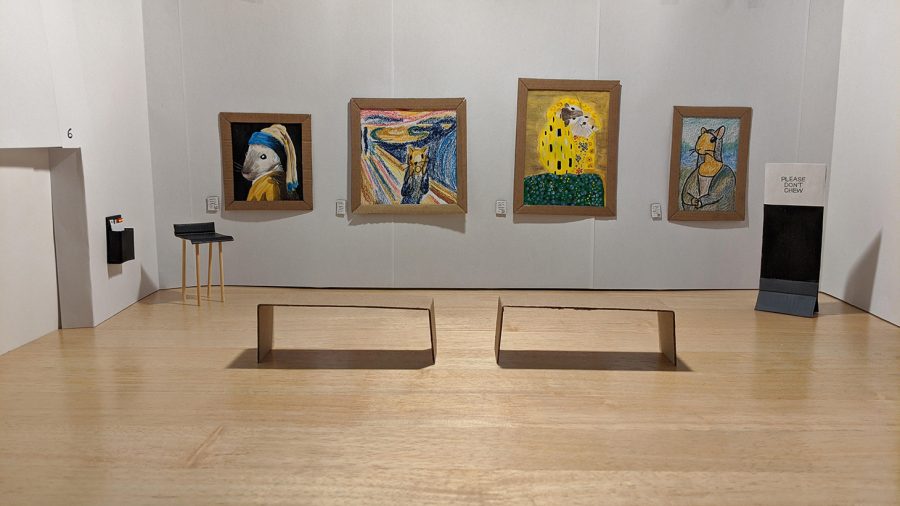
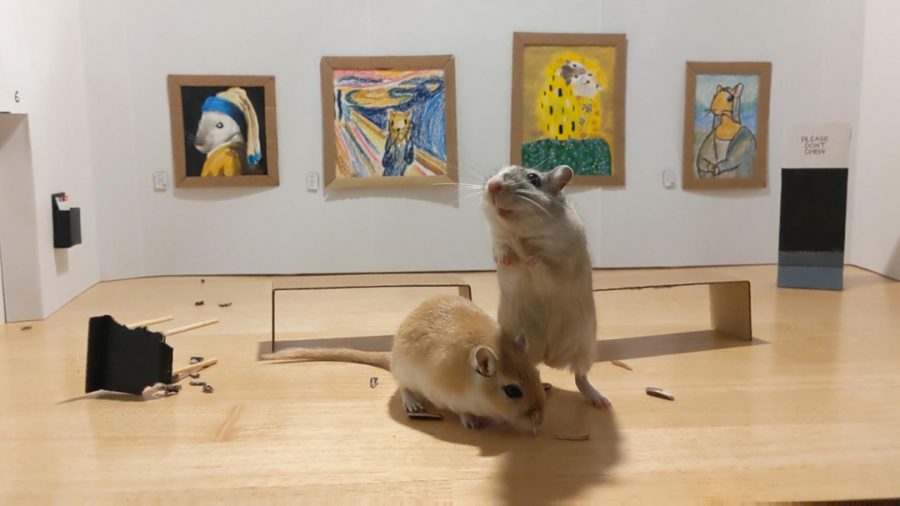
An Art Gallery for Gerbils: Two Quarantined Londoners Create a Mini Museum Complete with Gerbil-Themed Art

London-based couple Filippo and Marianna‘s self-isolation project calls to mind artist (and museum curator) Bill Scanga’s At the Met, exhibited nearly 20 years ago as part of the group show Almost Warm and Fuzzy: Childhood and Contemporary Art at P.S.1 Contemporary Art Center (now known as MoMA PS1).

Scanga’s installation involved hanging mini-replicas of works from the Metropolitan Museum’s American collection on extremely long wires that traveled from under-ceiling picture rail to the baseboard, where a collection of art-loving taxidermied mice waited expectantly. One rested on a familiar-looking, black vinyl upholstered bench, a tiny blue shopping bag from the Met’s gift store parked near its dainty, shoeless feet.

Filippo and Marianna’s art-loving rodents are gerbils, and unlike Scanga’s artfully stuffed models, theirs—9-month-old brothers Pandoro and Tiramisù—are very much alive, as Tiramisù proved when he gnawed the unseen gallery assistant’s painstakingly assembled cardboard stool to bits under the watchful eye of the tiny Girl with a Pearl Earring facsimile Marianna crafted for his cultural enrichment.


A video the couple published on Reddit, above, shows the furry museum goers scampering under the benches to the tune of “The Blue Danube” and placing their paws on the artwork, including an expert, gerbil-themed forgery of Gustav Klimt’s gold-flecked Symbolist masterpiece, The Kiss.

Not to be vulgar, but if this museum has a restroom, Pandoro and Tiramisù seem to have given it a miss, an impropriety surpassing any waged by the titular characters of Beatrix Potter’s Tale of Two Bad Mice.

Filippo and Marianna accepted the destruction of their exquisitely staged set with a cheer that suggests they’re not shut up for the duration with a small child… just gerbils, who can be deposited back into their Habitrail when the fun’s over.

The attention to detail—the gallery tags! The laminated cards in multiple languages in a wall-mounted holder!—captured the imagination of Reddit. Users jumped Marianna’s original post—(Quarantine, day 14. Me and my boyfriend spent the whole day setting up an art gallery for our gerbil)—with suggestions of other famous works to recreate in miniature and add to the collection. Rest assured no groan-worthy, pun-based, gerbil-centric title was left unexpressed.

With cultural institutions temporarily shuttered for the good of public health, many viewers also shared their yearning to get back inside favorite museums. (Marianna reports that Filippo is a museum worker.)

For now, we must be patient, and live vicariously through gerbils ’til the long wait is over.


Via Hyperallergic

Related Content: 

Two Cats Keep Trying to Get Into a Japanese Art Museum … and Keep Getting Turned Away: Meet the Thwarted Felines, Ken-chan and Go-chan

Take a Virtual Tour of 30 World-Class Museums & Safely Visit 2 Million Works of Fine Art

14 Paris Museums Put 300,000 Works of Art Online: Download Classics by Monet, Cézanne & More

Ayun Halliday is an author, illustrator, theater maker and Chief Primatologist of the East Village Inky zine.  Like Choir! Choir! Choir!, she has been crowdsourcing art in isolation, most recently a hastily assembled tribute to the classic 60s social line dance, The Madison. Follow her @AyunHalliday.

Musicians Around the World Play “Lean on Me,” the Uplifting Song by Bill Withers (RIP)

A few weeks back (but what seems like a different world now) we told you about the Playing for Change project, which features covers of well loved pop songs played by a group of international musicians…the gimmick being that each musician is recorded in their own country and only come together in the mix.

Suddenly, it seems that Playing for Change was ahead of the curve, because this is the way the entire world is living right now. People are making art in quarantine, joining together only through the magic of 21st century technology.


But in honor of the passing of Bill Withers, who left us last week at 81 (not, we should mention, because of COVID-19), here’s Playing for Change with their version of “Lean on Me.” Withers’ message of love and community is exactly what we need right now.

In a 2015 Rolling Stone profile Questlove called him “the last African-American Everyman…Jordan’s vertical jump has to be higher than everyone. Michael Jackson has to defy gravity. On the other side of the coin, we’re often viewed as primitive animals. We rarely land in the middle. Bill Withers is the closest thing black people have to a Bruce Springsteen.”

That article adds that Withers was so long out of the spotlight that many already thought he was dead. And now he’s passed during a grim time, it seemed like there was one full day to mourn him before the next round of mortal coil shufflings. (We’re here to celebrate him for a little bit longer).

This cover features Renard Poché (New Orleans) on guitar, Roberto Luvi (Livorno, Italy) on slide, Grandpa Eliot (New Orleans), Clarence Bekker (Amsterdam), Saritah (Melbourne, Australia), and Titi Tsira (Gugulethu, South Africa) on vocals, aided by Keiko Komaki (Kagoshima, Japan) on keyboards, Toby Williams (Chicago) on drums, One eat One (Livorno, Italy) on electronics, Mariachi group Las Rosas Angelinas (Los Angeles) on strings, Alanna Vicente (Los Angeles) on trombone, and the children of Tintale Village in Nepal on harmonium.

The track was originally commissioned by the Bill & Melinda Gates Foundation for The Art of Saving a Life, which aims to tell the story of vaccines and their importance to children over the world. (I would hope that we understand the urgency of vaccines right about now.)

Bill Withers was an accidental hitmaker, a natural tunesmith, who didn’t enter the business until his 30s and then dropped out of it less than ten years later. No comeback tour, no duets with an up-and-coming star. (Though Questlove was determined to produce one final album). What he has left is timeless, and his music is still there to get us through these troubling times.

Related Content:

Remembering American Songwriting Legend John Prine (RIP): “A True Folk Singer in the Best Folk Tradition”

Deconstructing Stevie Wonder’s Ode to Jazz and His Hero Duke Ellington: A Great Breakdown of “Sir Duke”

Musicians Around the World Play The Band’s Classic Song, “The Weight,” with Help from Robbie Robertson and Ringo Starr

Ted Mills is a freelance writer on the arts who currently hosts the Notes from the Shed podcast and is the producer of KCRW’s Curious Coast. You can also follow him on Twitter at @tedmills, and/or watch his films here.

365 Free Movies Streaming on YouTube

The wail resounds in every corner of the house, you cannot stop it—the books have all been read, the new releases streamed, every video game played to the end multiple times. I’m bored… You gave up quarantine homeschool weeks ago. Just who did you think you were? Here’s an idea, parent at your wit’s end: sit the kids in front of Lone Wolf McQuade or Over the Top.

Tell them how everything used to look like that when you were young. No second or third screen to turn to when you lost interest. You’d catch a free movie on a Sunday afternoon—streaming in real time, as it were—on one of four or five channels. No pause, rewind, or save for later. (Play it up—maybe you didn’t live this, they don’t know that.)


Oh, and there were commercials every ten minutes or so—lots and lots and lots of ads. This is a lesson in media history—you’re an educator! They’ll readily admit how much better they have it as they watch Chuck Norris and Stallone rack up the kills on YouTube, free to stream (and pause, rewind, and save for later), with many fewer ad interruptions than in your day, and with 363 other films to watch and more to come.

But say you find this content objectionable, or… well, bad. You could certainly do much worse, believe me, as you’ll see in a cursory look at the many feature entertainments available to stream free with ads on YouTube. But, in all seriousness, you care about your children’s education, and with some careful digging, you’ll find quite a lot to give them a real cultural lesson, and to enlighten the grown-ups, too.

Learn, for example, about the Wrecking Crew, in a documentary of the same name, the famous cohort of studio musicians who played on hundreds of the best pop, rock, soul, etc. records in the 60s. As the Funk Brothers were to Motown, Booker T. & the MGs to Stax, so were the Wrecking Crew to the West Coast Sound (and the sound of Elvis, The Beach Boys, Frank Sinatra, Nat King Cole, the Mamas and the Papas, Sonny & Cher, Simon & Garfunkel, and so on).

And as the Wrecking Crew were to the West Coast so was Muscle Shoals to the deep South. The tiny Alabama town and its FAME Studios featured some of the greatest R&B, soul, and country rhythm players in the world, major contributors to records by Dylan, the Stones, Lynyrd Skynyrd, Aretha Franklin, Wilson Pickett, and so many more. There’s a film about them too. (We can’t embed the full movies here, but you’ll find them in the links below.)

There are many other quality educational entertainments about pop music history, like the Dave Grohl-directed Sound City. You’ll also find documentaries like Super Size Me, Capitalism: A Love Story, and Freakonomics. (An economics course!) Many other platforms have introduced free streaming movies with ads. In YouTube’s case, as AdAge notes, the move to streaming free films comes as a way to recoup advertisers who increasingly found their ads running “inside offensive videos, some with terrorist propaganda and hate speech.”

The company is cleaning up its image, and in the process becoming something like the TV channels of old, only with all the digital ease that makes streaming so convenient. “They are now a TV network,” says an executive for one video ad technology platform, moving away from low-quality, user-generated content and toward high dollar series and the goldmine of old movies. Advertising is everything, so, there’s another lesson for you—even in the new media business, history repeats.

See a list of recommended films available to stream free on YouTube, with ads, below. Enter the general collection here. And feel free to explore our collection, 1,150 Free Movies Online: Great Classics, Indies, Noir, Westerns, etc..

Super Size Me

The Wrecking Crew

Capitalism: A Love Story

Freddie Mercury: The King of Queen

Muscle Shoals

Freakonomics

Bob Marley: The Roots of Man

Sound City

George Harrison: All Things Pass

All Things Pass (Documentary on Tower Records)

The Bird Cage

Related Content:

Watch 99 Movies Free Online Courtesy of YouTube & MGM: Rocky, The Terminator, Four Weddings and a Funeral & More

60 Free Film Noir Movies 

Download 6600 Free Films from The Prelinger Archives and Use Them However You Like

Josh Jones is a writer and musician based in Durham, NC. Follow him at @jdmagness

How Can Boccaccio’s 14th Century Decameron Help Us Live Through COVID-19?

I remember reading selections of Giovanni Boccaccio’s Decameron in my early high school years—and I remember reading them as light, bawdy tales about aristocrats in gardens. We were briefly introduced to the frame narrative, set amidst the 1348 outbreak of plague in Florence, which killed off half the city’s population. But the Black Death seemed almost mythological in scope—a phantom on the periphery. As Albert Camus writes in The Plague, a book also appearing on bestseller and recommended reading lists everywhere: “a dead man has no substance unless one has actually seen him dead, a hundred million corpses broadcast through history are no more than a puff of smoke.”

I don’t recall reading how Florentines “dropped dead in open streets, both by day and by night, whilst a great many others, though dying in their own houses, drew their neighbors’ attention to the fact more by the smell of their rotting corpses.” The picture Boccaccio paints is so incredibly bleak, one is amazed we’ve come to “see the Decameron as a collection of entertaining stories to keep next to your bed,” as Andre Spicer writes at New Statesman. “This scourge had implanted so great a terror in the hearts of men and women that brothers abandoned brothers,” Boccaccio writes, “uncles their nephews, sisters their brothers… fathers and mothers refused to nurse and assist their children.”


This is unimaginable, or so we thought, having never lived through any kind of plague ourselves. Made up of tales swapped by ten friends who escape Florence for a country villa to wait out the epidemic, telling 100 stories between them to pass the time in quarantine, the Decameron, if it has left schools since my time, will surely return with significant emphasis on what was previously given as background. Of course, Italians are revisiting with much renewed interest these tales “of life lessons and folly, of tragedy and happiness, of virtue and vice,” as the blog Tuscan Trends notes.

Read by actors from the Oranona Theatre, with musical accompaniment, a live production of the stories has been going on for a decade. But only now does it constitute a trend, offered as “entertainment for Italians who are confined to their homes escaping a plague seven centuries after Boccaccio wrote his masterpiece of early Italian prose.” (Hear these performances in Italian at the Oranona Facebook page here.) What does this story cycle communicate across 700 years?

“Over the centuries, during other outbreaks of epidemic illness,” says Professor Martin Marafioti in the video above, “the work has become relevant, over and over and over again.” The book offers what Marafioti calls “narrative prophylaxis,” a medicine prescribed by Italian theologian Nicolas of Burgo, another of the many literary voices in Italy’s “canon of contagion.” In a plague advice book, Burgo warns against “fear, anger, sadness, excessive anguish, heavy thoughts and similar things. And equally one should take care to be joyful, to be happy, to listen to lullabies, stories and melodies.”

This advice may be well and good for those who can decamp to well-provisioned houses for two weeks (or months). As Massimo Riva, chair of Brown University’s Italian Studies Department, says in a recent interview, in answer to a question about Boccaccio’s relevance:

I would point to the ethical dilemma the ten young protagonists face in their decision to (temporarily) abandon the city. This decision can be interpreted in two different and somewhat opposite ways: as an escape from the common destiny of those who can afford a luxurious shelter (similar to the doomsday bunkers that very rich people build for themselves today); and as the utopian desire to rebuild together a better, more ethical and harmoniously natural way of life, out of the ruins of the old world.

These two options need not be mutually exclusive, but they might very well rebuild the old exclusions in the new world. More positively, Spicer writes, in some TED-like language that might seem anachronistic in discussions of a 14th century text: Boccaccio “understood the importance of what we now call ‘wellbeing’”; he had “faith in the curative power of stories,” a fact “supported by dozens of studies”; and he “understood the crucial role of what we now call social networks in public health crises.”

I don’t remember any of that in the Boccaccio I read in high school. But I’m starting to see some of it now as I revisit these 700-year-old stories, dipping in and out as time allows and finding in them what Spicer calls the critical “importance of connection when we are socially isolated,” whether in comfortable vacation homes, cramped city apartments, or even more confining circumstances. We need stories to help us figure who we are when everything comes apart. And we need people who will listen to us tell ours. Read and download the full text of the Decameron here.

via New Statesman

Related Content:

Download Classic Works of Plague Fiction: From Daniel Defoe & Mary Shelley, to Edgar Allan Poe

Pandemic Literature: A Meta-List of the Books You Should Read in Coronavirus Quarantine

Why You Should Read The Plague, the Albert Camus Novel the Coronavirus Has Made a Bestseller Again

Josh Jones is a writer and musician based in Durham, NC. Follow him at @jdmagness

A Free Shakespeare Coloring Book: While Away the Hours Coloring in Illustrations of 35 Classic Plays

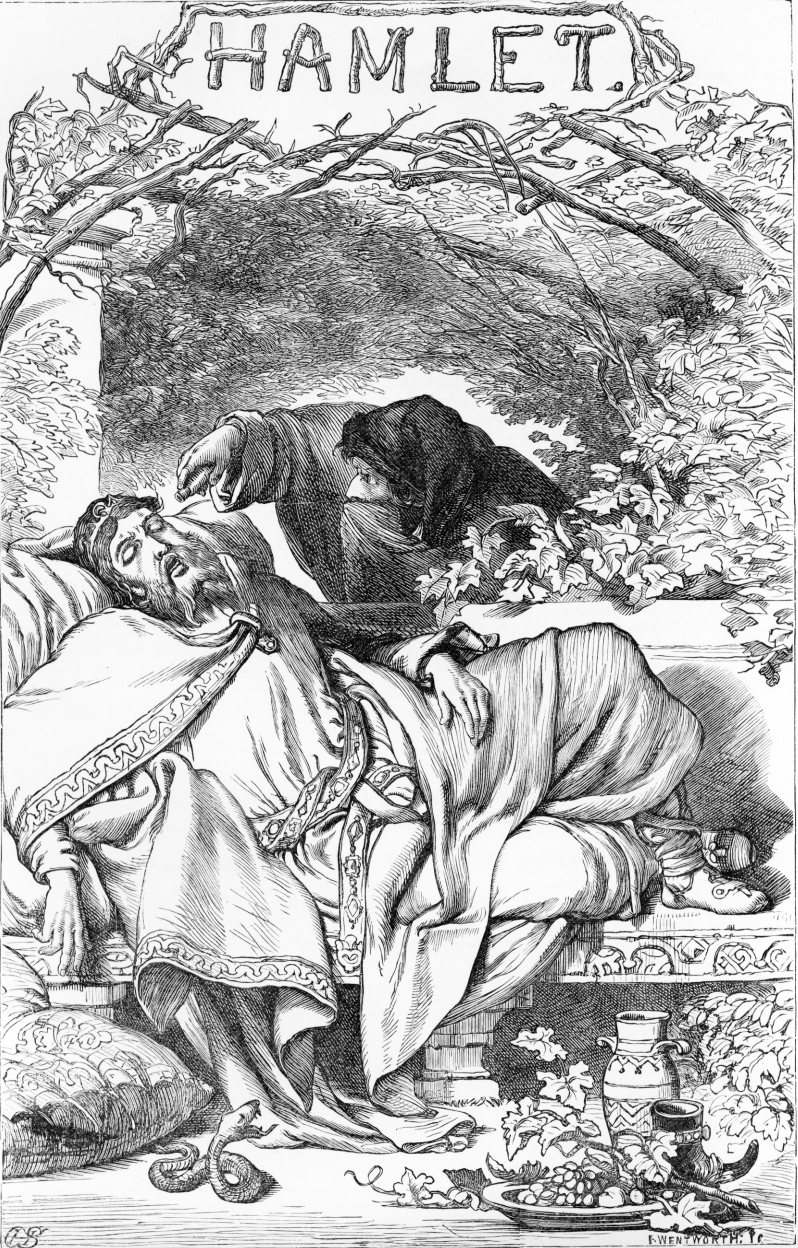
From the people who brought you the Victorian Illustrated Shakespeare Archive comes an Illustrated Shakespeare Coloring Book–a coloring book featuring illustrations of 35 different Shakespeare plays. (All illustrations come from a nineteenth edition of The Plays of William Shakespeare.) The coloring book’s creator, Michael Goodman, tell us: “It’s obviously free to use and I hope in these days of home schooling parents might find it a simple way to engage their kids with Shakespeare.” Access the coloring book here.

You can find more free coloring books in the Relateds below.

Would you like to support the mission of Open Culture? Please consider making a donation to our site. It’s hard to rely 100% on ads, and your contributions will help us continue providing the best free cultural and educational materials to learners everywhere.

Also consider following Open Culture on Facebook and Twitter and sharing intelligent media with your friends. Or sign up for our daily email and get a daily dose of Open Culture in your inbox. 

Related Content:

Download Free Coloring Books from 113 Museums

Free Coloring Books from World-Class Libraries & Museums: The New York Public Library, Bodleian, Smithsonian & More

The Dune Coloring & Activity Books: When David Lynch’s 1984 Film Created Countless Hours of Peculiar Fun for Kids

Free Coloring Books from World-Class Libraries & Museums: Download & Color Hundreds of Free Images

Download 150 Free Coloring Books from Great Libraries, Museums & Cultural Institutions: The British Library, Smithsonian, Carnegie Hall & More

While Away the Hours with a Free H.P. Lovecraft Call of Cthulhu Coloring Book

Remembering American Songwriting Legend John Prine (RIP): “A True Folk Singer in the Best Folk Tradition”

“A friend called our new world ‘a ghost ship,’” wrote Nick Cave in a recent installment of his Red Hand Files blog. “She has recently lost someone dear to her and recognizes acutely the premonitory feeling of a world about to be shattered.” The experience has become distressingly common. We have all begun to lose people dear, if not near, to us—artists taken by the disease before their time like Bill Withers, whose “Lean on Me” is now more poignant than ever. Whatever else we’re faced with as the global epidemic progresses, we are entering a period of deep mourning that Cave encourages his fans to treat with serious respect.

To the list of those we mourn, we now must add legendary singer and songwriter John Prine, who died from COVID-19 complications yesterday. Prine was an artist who didn’t so much achieve fame as an almost indispensable presence in American culture that runs much deeper and will last longer. He wrote songs so good, Kris Kristofferson once joked “we’ll have to break his thumbs.” (Kristofferson discovered him playing in the Chicago folk scene in 1971. Their meeting was, said Prine in 2019, “a Cinderella story.”) Prine could count himself among Bob Dylan’s favorite songwriters, and was sometimes called “the next Dylan.” (In his Twitter tribute, Bruce Springsteen writes, “John and I were ‘New Dylans’ together in the early 70s.)

Prine wrote with more folksy good humor than Dylan, however, a much cheerier theological bent, and with more concern for telling stories with straightforward emotional impact, without veering into sentimentality. But like Dylan, every songwriter in folk, bluegrass, and country has paid homage to him as a muse and covered his songs. Bonnie Raitt made his “Angel in Montgomery” famous and called him “a true folk singer in the best folk tradition, cutting right to the heart of things, as pure and simple as rain.”

As has many great folk singers, Prine paid ample tribute to his forebears: A.P. Carter, Hank Williams, “Cowboy” Jack Clement, Tex Ritter…. building a bridge between them and contemporary songwriters like the Avett Brothers, Bon Iver, Justin Townes Earle, and Jason Isbell, who have all covered Prine songs. (See him with Sturgill Simpson at the top.) He was indie before indie—breaking from the major labels in 1981 and establishing his own label, Oh Boy Records. And he was genuinely “Americana” in that he wrote of rural working-class issues in a working-class voice, inspired to pen his first major song “Paradise” by the destruction strip mining wrought upon his father’s Kentucky hometown.

“Paradise” plays out like a John Sayles film, with local Green River references and images of shooting pistols at snakes and pop bottles at “the abandoned old prison down by Airdrie Hill.” The song’s third verse depicts the mindless violence of strip mining: “they tortured the timber and stripped all the land,” he sings, “then they wrote it all down as the progress of man.” It was the first song he recorded for his self-titled 1971 debut and established a long tradition of protest music both wistful and witty, like the perennially relevant “Your Flag Decal Won’t Get You Into Heaven Anymore,” which tells flag-waving chauvinists, “They’re already overcrowded from your dirty little war.” He tells the story of writing the song all the way back in 1968 in the live performance from 2010’s In Person & On Stage below.

Prine also wrote from the perspective of a veteran (he served in the army in the 60s), whose country had let him down in the Vietnam debacle and subsequent bloody misadventures. In “The Great Compromise,” he used the allegory of a jilted lover to express great disillusionment.

Many times I’d fought to protect her
But this time she was goin’ too far
Now some folks they call me a coward
Cause I left her at the drive-in that night
But I’d druther have names thrown at me
Than to fight for a thing that ain’t right

I used to sleep at the foot of Old Glory
And awake in the dawn’s early light
But much to my surprise
When I opened my eyes
I was a victim of the great compromise

The song’s title and refrain reference the 1787 Constitutional Convention, suggesting that part of his awakening to the country’s flaws includes a recognition that they had been built in from the start. “Sam Stone,” his portrait of a Vietnam vet dying slow from heroin addiction, a song once covered by Johnny Cash, perfects the directness and simple lyricism of country ballads to devastating effect: “There’s a hole in daddy’s arm where all the money goes/Jesus Christ died for nothin I suppose.”

Songs like “Sam Smith” and “Paradise” grab hold with images and observations that crystalize the kind of down-and-out American suffering that features all the time in bestselling nonfiction books and longform articles, but never gets addressed in any meaningful way. But Prine could also lighten up—a lot—with comic-romantic gems like “In Spite of Ourselves,” written for a film in which he starred as Billy Bob Thornton’s brother. He recorded the song as a duet with Iris DeMent, the title track for an album of covers with other famous women country singers like Emmylou Harris, Lucinda Williams, and Patty Loveless.

Full of profane, downhome humor (“he’s got more balls than a big brass monkey”), the tune is representative of one of Prine’s many songwriting personae in a career impossible to sum up in a neat and tidy way. Suffice it to say that Prine’s death from COVID-19 at age 73—after his many decades celebrating and lamenting the struggles of ordinary people and lambasting the greed and belligerence of the U.S. government and corporations—underlines the plain truths of his songs with tragic irony. Prine survived cancer surgery in 1998 and the removal of a lung in 2013, yet he continued to perform into his final years, releasing a follow-up to In Spite of Ourselves in 2016 and his final album, The Tree of Forgiveness, in 2018, a “trunkful of supremely generous American music,” wrote Ian Crouch in a New Yorker review. See his NPR Tiny Desk performance from 2018 below.

Another writer who had seen and documented what Prine had over the years might have grown bitter. But we can mourn his death knowing that he seems to have had little unfinished business with his god or his fellow human beings. “When I get to heaven,” he speak-sings in the intro to one of his final recordings, “I’m gonna shake God’s hand/Thank him for more blessings than one man can stand/Then I’m gonna get a guitar/And start a rock ‘n’ roll band/Check into a swell hotel/Ain’t the afterlife grand?” We can hope, at least, if we’re so inclined, that it’s at least a kinder place than the world Prine left behind. And we can be grateful he left a legacy of timeless music that always seems to speak to the sadness, disappointment, anger, and raw, in-spite-of-it-all tragicomedy of the American predicament.

Related Content:

Bill Murray Explains How He Was Saved by John Prine      

Tom Petty Takes You Inside His Songwriting Craft

Bob Dylan Releases a Cryptic 17-Minute Song about the JFK Assassination: Hear a “Murder Most Foul”

Josh Jones is a writer and musician based in Durham, NC. Follow him at @jdmagness
One of the Earliest Known Uses of the “F-word” Discovered: It Appears in a 1568 Anthology Compiled During a Plague

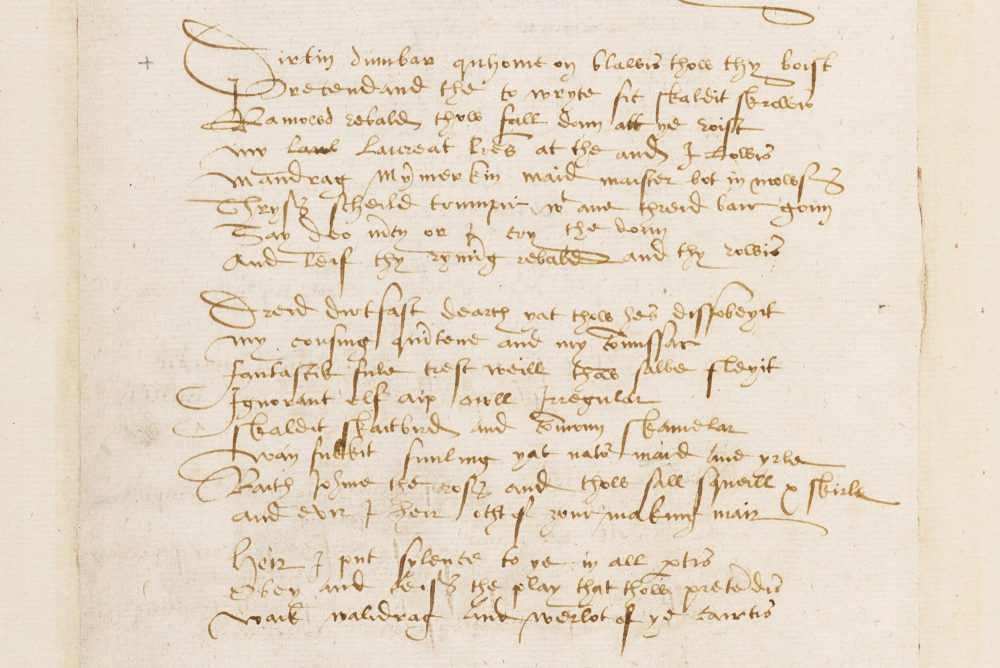
“Wan fukkit funling”: as an insult, these words would today land a minor blow at most. Not so in Scotland of the early 16th century, in which William Dunbar and Walter Kennedy, two of the land’s well-known poets, faced off before the court of King James IV in a contest of rhyme. The event is memorialized in the poem “The Flyting of Dunbar and Kennedie,” one of 400 anthologized in what’s known as the Bannatyne Manuscript. Compiled in 1568 by an Edinburgh merchant named George Bannatyne, stuck at home while a plague swept his city — a condition many can relate to these days — it now enjoys pride of place at the National Library of Scotland as a cultural treasure, not least because it contains what may be the oldest recorded use of the F-word.

The Bannatyne Manuscript and “wan fukkit funling” (whose appearance you can see in the image at the top of the post, in the sixth line from the bottom) play an important part in the new BBC Scotland documentary Scotland – Contains Strong Language. The hour-long program, writes The Scotsman‘s Brian Ferguson, “sees actress, singer and theatre-maker Cora Bissett trace the nation’s long love affair with swearing and insults, despite the long-standing efforts of religious leaders to condemn it as a sin.” Ferguson quotes Bissett describing the importance of this particular “flyting” (“the 16th century equivalent of a rap battle”) as follows: “When Kennedy addresses Dunbar, there is the earliest surviving record of the word ‘f***’ in the world.”

“In the poem, Dunbar makes fun of Kennedy’s Highland dialect, for instance, as well as his personal appearance, and he suggests his opponent enjoys sexual intercourse with horses,” writes Ars Technica’s Jennifer Ouellette. “Kennedy retaliates with attacks on Dunbar’s diminutive stature and lack of bowel control, suggesting his rival gets his inspiration from drinking ‘frogspawn’ from the waters of a rural pond.” All highly amusing, to be sure, but given how few of us English-speakers will immediately recognize in “wan fukkit funling” the curse with which we’ve grown so intimately familiar, does this really count as an example of usage in English?

‘To me, that looks more like Scots than Middle English,” writes Boing Boing’s Thom Dunn, “although both languages were derived from Olde English.” (He also reminds us not to confuse Scots with the separate language of Scottish Gaelic.) Medieval historian Kristin Uscinski writes in to Ars Technica to point out a certain “Roger F$#%-by-the-Navel who appears in some court records from 1310-11” — previously featured, of course, here on Open Culture. Historians and linguists will surely continue doing their own kind of battle to determine what counts as the first true F-word, making more discoveries about the English language’s heritage of swearing along the way. One thing is certain: if any nation has made a rich use of that heritage, it’s Scotland.

via BoingBoing

Related Content:

The Earliest Known Appearance of the F-Word, in a Bizarre Court Record Entry from 1310

The Very First Written Use of the F Word in English (1528)

Steven Pinker Explains the Neuroscience of Swearing (NSFW)

Stephen Fry, Language Enthusiast, Defends The “Unnecessary” Art Of Swearing

Read A Classical Dictionary of the Vulgar Tongue, a Hilarious & Informative Collection of Early Modern English Slang (1785)

A Lecture About the History of the Scots Language … in Scots: How Much Can You Comprehend?

Based in Seoul, Colin Marshall writes and broadcasts on cities, language, and culture. His projects include the book The Stateless City: a Walk through 21st-Century Los Angeles and the video series The City in Cinema. Follow him on Twitter at @colinmarshall, on Facebook, or on Instagram.

« Go BackMore in this category... »
Quantcast
Open Culture was founded by Dan Colman.