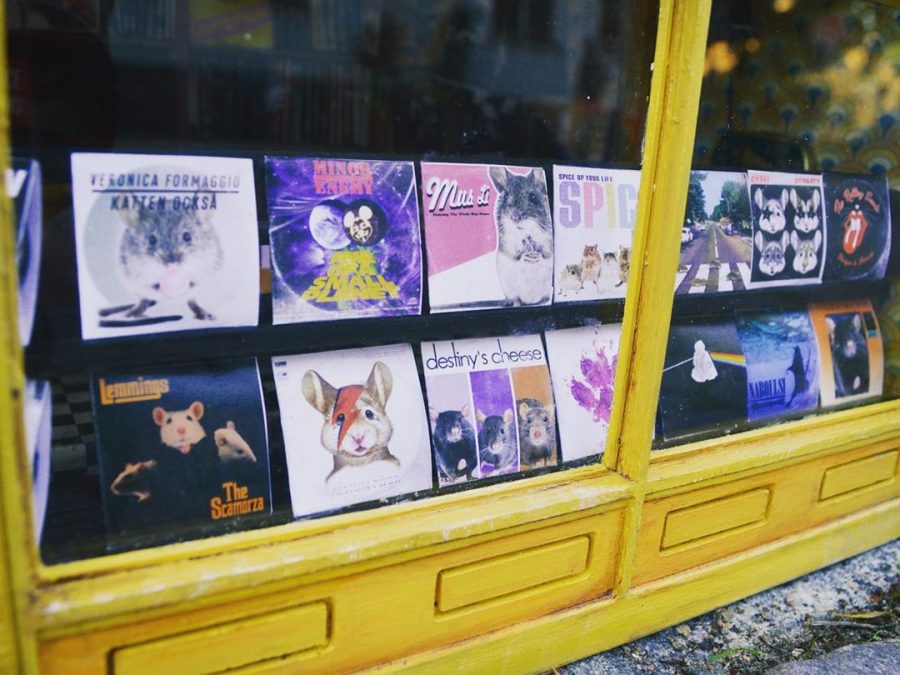
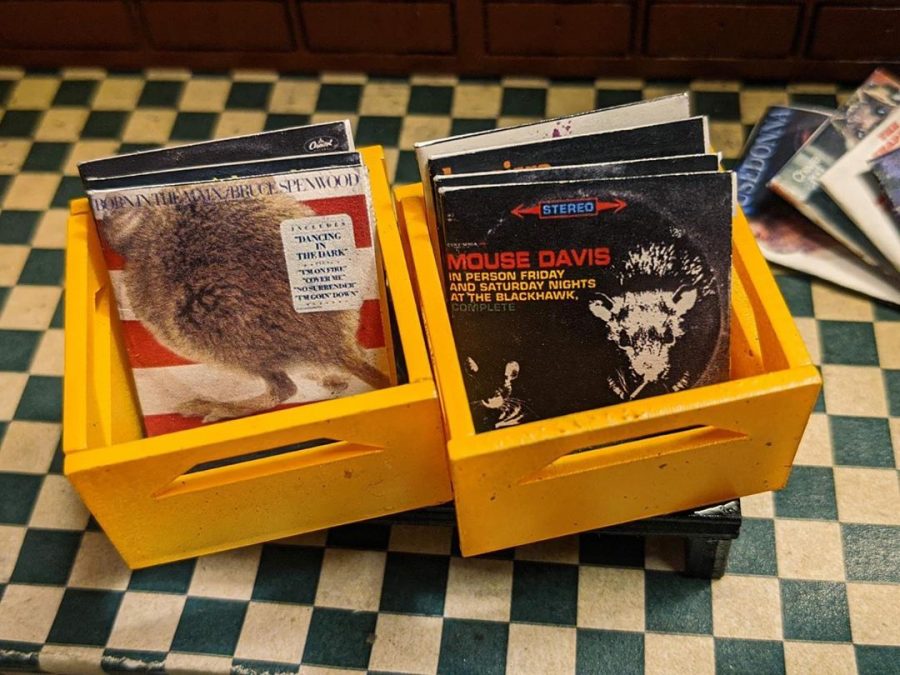
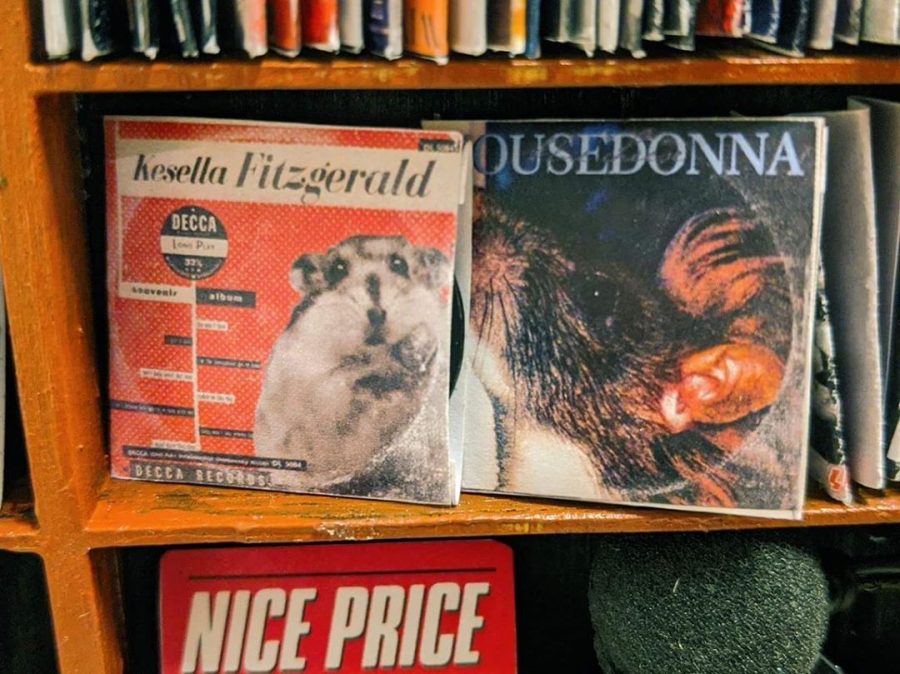
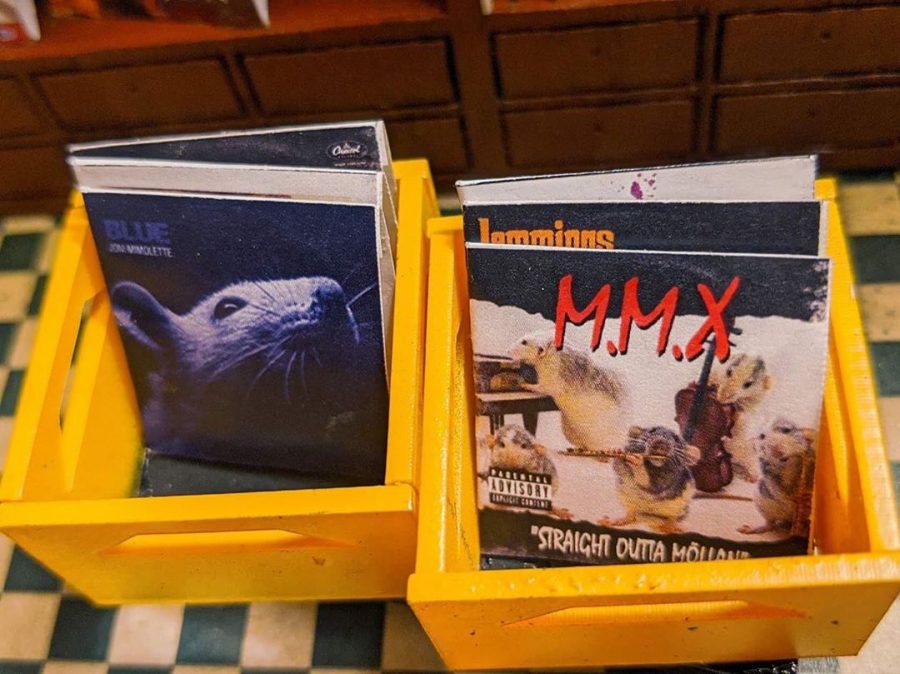
We live in [insert adjective, expletive, emoji, tweet, Tik Tok video here] times, I don’t have to tell you. We could all do with a little distraction from current events. I’m talking, obviously, about mice.
Not everyone loves the little home invaders. Some people loathe them. But who could fail to be charmed by the creations of the AnonyMouse collective, a group of artists who have recreated “miniature restaurants, record shops, and apothecaries squeeze[d] into ground-level windows on the street next to their human-sized equivalents”?
These installations have appeared “in cities across Sweden, France, and the Isle of Man,” writes Grace Ebert at Colossal, and they are profoundly adorable. The artists suggest “that the mice have a symbiotic relationship with the pedestrians on the street” by repurposing human items like a champagne topper or matchbox as mouse-sized furniture.
“Twenty-five installments currently exist across Europe…largely inspired by Astrid Lindgren’s and Beatrix Potter’s whimsical tales and movies from Don Bluth and Disney.” Unlike previous, similar projects by the artists Bill Scanga and, more recently, Filippo and Marianna, the miniatures do not feature any actual rodents, alive or otherwise, other than those who chance to wander in off the street. Instead, they adapt human cultural products for an imagined parallel mouse world.
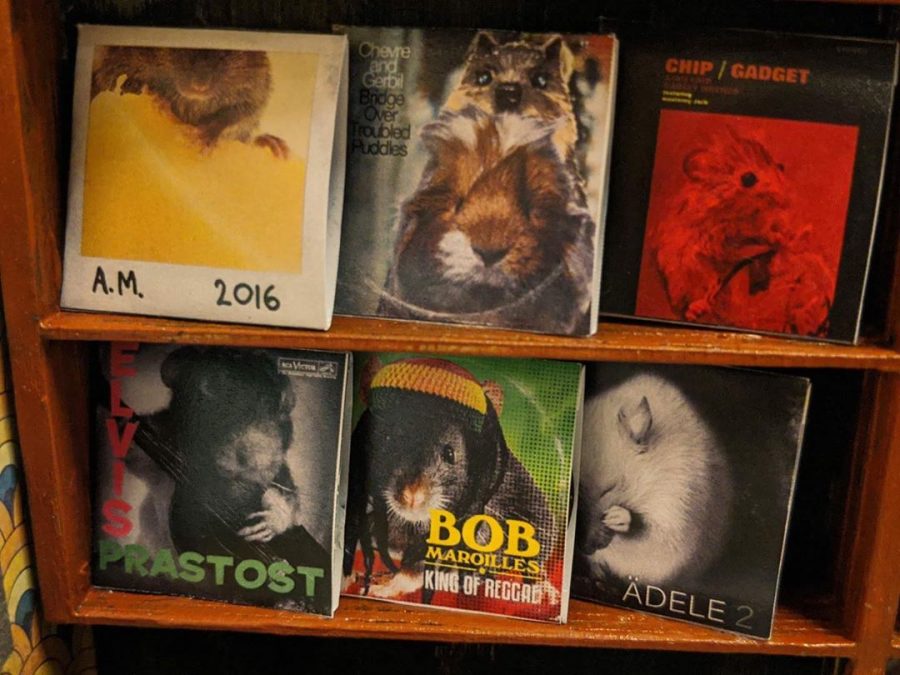
AnonyMouse’s latest installation, Ricotta Records in Lund, Sweden, “features tiny vinyl,” for example, “from the likes of Destiny’s Cheese, Bruce Spenwood, Kesella Fitzgerald, Dolly Parsley, and Winnimere Houston,” reports the Vinyl Factory. “In addition to its record selection, the shop also has a selection of miniature posters and instruments.”
See several images of the inventive interior above and below, and more—including band posters for Rats Against the Machine and Modest Mouse, the only band whose name remains unchanged—at the Vinyl Factory and the Anonymouse Instagram page. Should you be so moved as to participate in the growing AnonyMouse fan community, they have started a contest for the best Ricotta Records suggestions. The winner will receive a framed, mouse-sized poster.
You don’t have to love mice to get in on the action. Current frontrunners, NME notes, include “Amy Winemouse” and “Tailor Swiss”….
Yet popular canons of sci-fi, even “seemingly progressive books for their time,” Liz Lutgendorff writes, still contain a “pervasive sexism.” Campbell was hardly the only offender, but the charge certainly sticks to him. “The first science fiction anthologies were published during a backlash against first-wave feminism,” Wired explains. In response to growing women’s activism, “male editors such as John W. Campbell and Groff Conklin specifically excluded women from” the pages of Astounding Science Fiction’s popular anthology series and Conklin’s many best-ofs.
Prior to these powerful editors, “women writers were relatively common throughout the pulp era, and the proportion of women readers was even higher.” Lisa Yaszek, Professor of Science Fiction Studies at Georgia Tech, found that “at least 15 percent of the science fiction community were women—producers—and reading polls suggest that 40 to 50 percent of the readers were women.” These figures surprised even her. Many of the writers whom Campbell excluded were hugely popular during 1920s, influencing their contemporaries and inspiring readers.
One such writer, Clare Winger Harris, published her first short story “The Runaway World,” in the July 1926 issue of Weird Tales (after writing an earlier historical novel in 1923). That same year, she won third place in a story contest run by legendary Amazing Stories editor Hugo Gernsback, from whom the Hugo Awards take their name. She would go on to publish ten more stories in popular science fiction pulps, most of them for Gernsback. Then she disappeared from writing in 1930, ostensibly to raise her three sons.
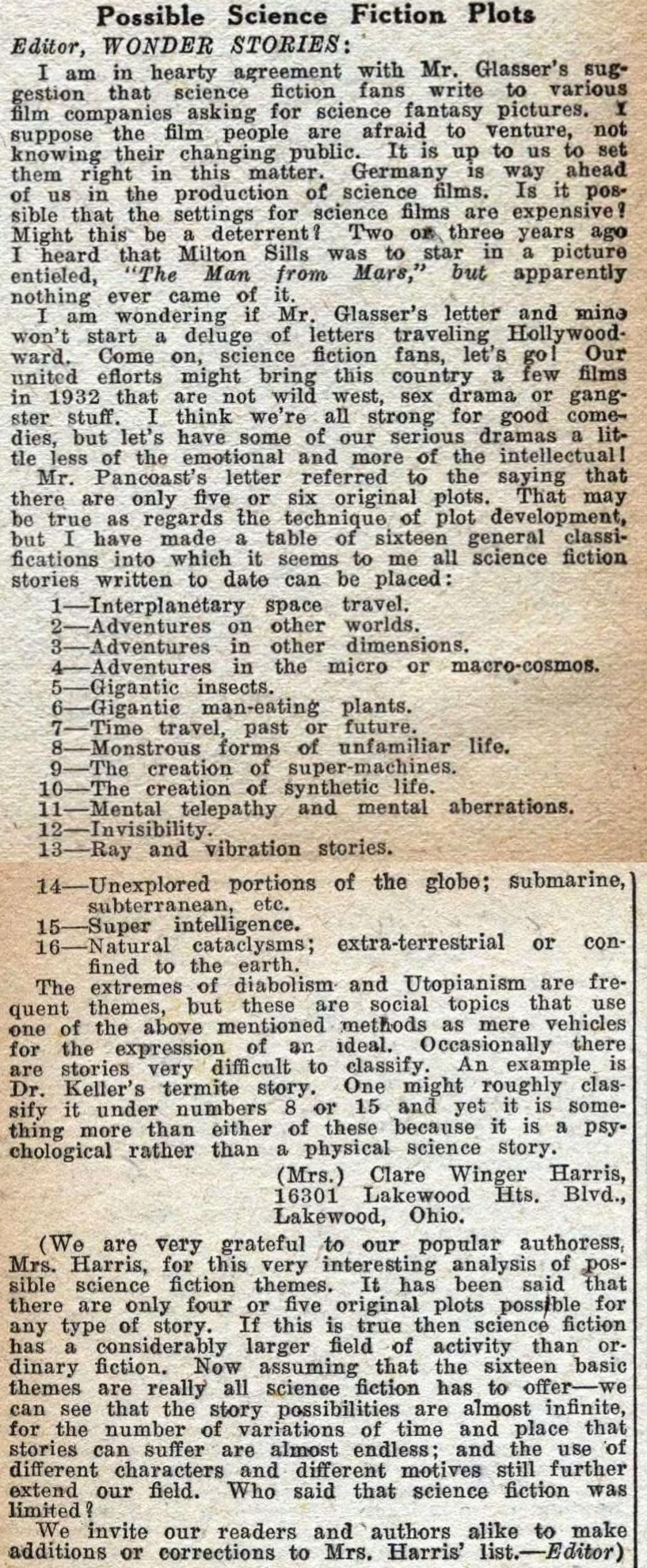
But she had more to say. In the August 1931 edition of Gernsback’s Wonder Stories, a letter from Harris appears in which she rallies the community to insist that Hollywood make sci-fi films. “Come on, science fiction fans, let’s go!” she writes, “Our united efforts might bring this country a few films in 1932 that are not wild west, sex drama or gangster stuff. I think we’re all strong for good comedies, but let’s have of our serious dramas a little less of the emotional and more of the intellectual.”
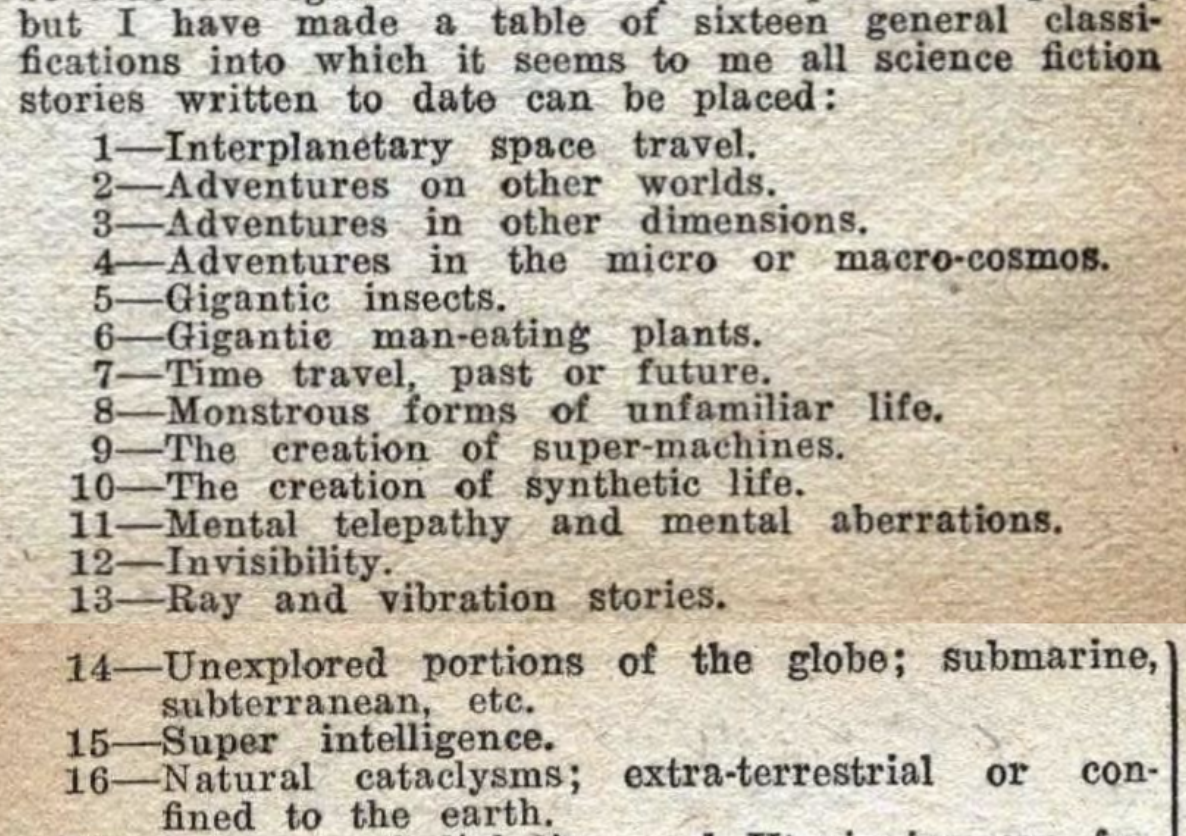
Harris goes on, in response to another reader letter, to correct the notion that “there are only five or six original plots.” (This number has varied over the ages from seven to thirty-seven). “That may be true as regards the technique of plot development,” writes Harris, “but I have made a table of sixteen general classifications into which it seems to me all science fiction stories written to date can be placed.” See it above.
Sci-fi author Doris V. Sutherland points to the redundancies and dated quaintness of much of the list. Giant insects have fallen out of fashion. “A number of the categories speak of the technological level of the day. The inclusion of ‘ray and vibration stores’ harks back to an era when the unseen effects of various electro-magnetic waves had only recently been grasped by researchers.” Moreover, the atomic age was yet to dawn. After it, “the idea of a man-made apocalypse would become rather more topical.”
The status of Harris’s letter as a “time capsule” that summarizes the “dominant themes in SF” at the time documents her keen appreciation for, as well as innovation on, those themes. She was valued for this talent by many in the field, Gernsback included. Upon learning she had won third prize in the 1926 Amazing Stories contest, he “gave praise,” Brad Ricca writes at LitHub, “couched in the cultural moment”—as well as indicative of his own biases.
That the third prize winner should prove to be a woman was one of the surprises of the contest, for, as a rule, women do not make good scientification writers, because their education and general tendencies on scientific matters are usually limited. But the exception, as usual, proves the rule, the exception in this case being extraordinarily impressive.
These insulting beliefs did not prevent Gernsback from continuing to publish Harris’s work, nor any of women whose writing he approved. (He also helped make Campbell’s career.) Some have found it remarkable that Harris published under her own name rather than a male pseudonym, but Yaszek argues this was fairly common at the time. In fact, several male authors published under female pseudonyms. (Gernsback himself once adopted the moniker “Grace G. Hucksnob.”)
As women writers were edged out of science fiction during Campbell’s reign in the 1930’s, Harris retreated. Her only published literary productions were the 1931 letter and a short story that again proves her status as a pioneer. Her last story original story “appeared in 1933 in the fifth and last issue of a stapled, mimeographed pamphlet called Science Fiction that had a print run of maybe—maybe—50 issues,” Ricca writes. The story had been solicited by the tiny magazine’s editors, Jerry Siegel and Joe Shuster, major Harris fans who would, of course, “go on to create Superman, the most recognized science fiction character on the planet.”
Learn more about Harris’s fascinating life—including her father’s brief stint as a Gernsback-influenced sci-fi novelist and her status as an early American convert to Buddhism before her death in 1968—at Ricca’s excellent LitHub investigation. See her full letter above.
For decades we’ve been hearing about the problem of Postmodernism. I suppose I get, in a vague sort of way, what people mean by this: moral relativism, mistrust of objectivity and scientific, religious, and other authorities, “incredulity toward metanarratives,” as Jean-Francois Lyotard defined the term in The Postmodern Condition in 1979.
Don’t we find much of this radical skepticism in the work of David Hume? The Cynics? Or Nietzsche (a Postmodern ancestor, but also claimed by Pragmatist and Existentialist thinkers)? A problem with blanket critiques of Postmodernism is that the word has never represented a cohesive school of thought (nor, for that matter, has Existentialism).
The term derives from an architectural movement of the 1960s that is, itself, impossible to clearly define since it intentionally grafts together approaches and traditions in experiments that celebrate kitschy excesses of style and that defy narrative coherence. Postmodern architecture gave us modern malls and multiplexes, aiding and abetting late capitalist sprawl. (But this is another story….)
Lyotard certainly fit the stereotype of the Postmodernist philosopher, with his lifetime of socialist activism and theoretical hybrids of Marx and Freud. He gets little credit, though he put the term in circulation in philosophy. Instead, Michel Foucault is often cited as a significant influence, though he rejected the categorization and thought of himself as a modernist.
Many a survey of Postmodern thought, such as this YouTube video series by Then & Now, begins with Foucault. The series covers other thinkers we don’t always see put in this box, like sociologist Pierre Bourdieu and 19th century Russian novelist Fyodor Dostoevsky. Nietzsche appears, of course, in two parts, as well as Eve Sedgwick, Jacques Derrida and Gilles Deleuze and Felix Guattari.
But in many ways, Foucault may be the best place to begin. As professor of philosophy Scott Moore writes:
If postmodernism is understood as a rejection of… an Enlightenment point of view… one that is characterized by a detached, autonomous, objective rationality… then Foucault is surely a postmodernist. Turning Bacon on his head, Foucault affirmed that it is not the case that knowledge is power, but power is knowledge. Meaning, those people who have power (social, political, etc.) always decide what will or will not be counted as “knowledge.”
Unlike, however, many later cultural theorists who inherited the cumbersome label, Foucault looked not to the present or the future in his work, but to the past, re-interpreting primary sources from ancient Rome to the post-WWI global economic order, through several different disciplinary lenses.
Then & Now creator Lewis Waller takes a postmodern approach to this series himself. In the video “Detachment, Objectivity, Imagination: A Critique,” he makes a case that Romantic historians like Michelet, Thierry, and Carlyle had a “better understanding of the reality of the historian’s craft than the scientifically minded did.” It’s a contrarian argument that begins with Sir Walter Scott and that may unsettle your preconceptions of what the catch-all term Postmodernism might include.
See more videos from the series above and watch all of them on YouTube. You may or may not feel like you have a better sense of what Postmodernism means in general. If we take it as shorthand for the loss of unchallenged heteropatriarchal power, then it is, I suppose, a problem for many people. If we take it to mean a mode of thought that “problematizes” seemingly simple concepts we mistake for the very structure of reality, then it “is also an attitude,” writes Moore, “and it has been most artfully practiced by Socrates, St. Augustine, Kierkegaard, Wittgenstein, and a host of others.”
Maybe Postmodernism has appeared in every period of philosophical and literary history. Only it hasn’t always been so… well… so overwhelmingly French, which could have had more than a little to do with its negative reputation in Anglophone countries. Put your metanarratives aside and learn more here.
From New York City designer Lydia Cambron comes 2020: An Isolation Odyssey, a short film that reenacts the finale of Stanley Kubrick’s iconic film, 2001: A Space Odyssey. But with a COVID-19 twist. “Restaged in the context of home quarantine,” Cambron writes, “the journey through time adapts to the mundane dramas of self-isolation–poking fun at the navel-gazing saga of life alone and indoors.” If you’ve been a good citizen since March, you will surely get the joke.
If Richard Feynman had only ever published his work in theoretical physics, his name would still be known far and wide. As it is, Feynman remains famous more than thirty years after his death in large part for the way he engaged with the public. From his popular textbook The Feynman Lectures on Physics (which you can read free online here) to his bestselling conversational essay collections like Surely You’re Joking, Mr. Feynman to the classes he taught at Cornell (now available online) to his demonstration of what went wrong with the Space Shuttle Challenger, he kept in conversation all his life with humanity outside the realm of professional science. This explains, in part, why Feynman became what Bill Gates calls, in the video above, “the best teacher I never had.”
Gates points to Feynman’s lecture series “The Character of Physical Law,” previously featured here on Open Culture, as “a great example of how he could explain things in a fun and interesting way to everyone. And he was very funny.”
That sense of humor complemented a sense of rigor: “Dr. Feynman used a tough process on himself, where if he didn’t really understand something, he would push himself,” asking questions like “Do I understand this boundary case?” and “Do I understand why we don’t do it this other way?” Such an effort to find the gaps in and failures of one’s own understanding may sound familiar, fundamental as it is to Feynman’s “notebook” technique of learning that we’ve posted about morethanonce before.
You only know how well you understand something when you explain it to someone else; many of us realize this, but Feynman lived it. The depth of his own understanding allowed him never to be boring: “Feynman made science so fascinating,” Gates says, “He reminded us how much fun it is,” and in so doing emphasized that “everybody can have a pretty full understanding. He’s such a joyful example of how we’d all like to learn and think about things.” Though the term “science communicator” wasn’t in wide use during Feynman’s lifetime, he played the role to near-perfection. And in the kind of materials highlighted here, he continues to convey not just knowledge but, as he liked to put it, the pleasure of finding things out.
Based in Seoul, Colin Marshall writes and broadcasts on cities, language, and culture. His projects include the book The Stateless City: a Walk through 21st-Century Los Angeles and the video series The City in Cinema. Follow him on Twitter at @colinmarshall, on Facebook, or on Instagram.
Celebrities (those who are not professional celebrity chefs, that is) release cookbooks at an alarming rate. Do we imagine most of their recipes were actually curated by the person on the cover? Do we suppose that person has spent the countless hours in the kitchen required to become an authority on what the rest of us should eat? As in all things, it depends.
Stanley Tucci seems to have more than proven his mettle, releasing two well-loved cookbooks and earning praise from Mario Batali. But I’d also take a chance on Snoop Dogg’s From Crook to Cook, which includes 50 of his own recipes, such as “baked mac and cheese and fried Bologna sandwiches with chips.” How could you go wrong?
Many a celebrity cookbook aims for the fine-dining approach famous people are used to getting from personal chefs. But Snoop joins a long tradition of artists whose signature dishes are everyday comfort foods and holiday favorites. Whatever else he and Leo Tolstoy might find to talk about, for example (use your imagination), they would surely swap mac and cheese recipes.
Tolstoy’s recipe for mac and cheese is made on the stovetop, not baked, but it sounds delicious all the same, with its layers of Parmesan cheese. Far more complex meals, fit for Russian aristocrats, appear in The Cookbook, a collection of Tolstoy family recipes, though we can hardly imagine the Tolstoy family did much of the cooking themselves.
Not so with Miles Davis, who also uses Parmesan in a dish not usually known to feature the Italian cheese. His chili—or rather “Miles’s South Side Chicago Chili Mack”—sounds incredibly rich in a recipe published in 2007. “I could cook most of the French dishes,” Miles wrote in his autobiography, “and all the black American dishes.” His skills in the kitchen were well attested, though his personal recipe book has been lost.
Other celebrities like Marilyn Monroe also go with comforting old favorites. What appears in her recipe for turkey and stuffing (besides walnuts and no garlic… feel free to make substitutions…)? That’s right, Parmesan cheese. If there’s a pattern in this repetition, maybe it’s that the rest of us home cooks should do more with Parmesan cheese.
If you’re wondering what kind of cheese Ernest Hemingway puts on his favorite burger, the answer is none. Another celebrity cook who surely did a good bit of his own cooking, Hemingway asks a lot of those willing to take a chance on his burger recipe, which commingles India relish, capers, Beau Monde seasoning, Mei Yen Powder with garlic, green onions, egg, and red or white wine.
Despite such unusual toppings, a burger is still a burger—for millions of people the most comforting food they can imagine. Cracking open Salvador Dali’s 1973 cookbook reveals few dishes that are familiar, or actually edible or even legal. Dali formed ambitions to become a chef, he claimed, at the age of 6. Maybe that’s also when he came up with “Toffee with Pine Cones,” “Veal Cutlets Stuffed with Snails,” and “Thousand Year Old Eggs.”
None of these recipes have in mind the needs of the carb-conscious, or of vegetarians and vegans. But some creative reimagining could make them suitable for several kinds of modern diets. (In Hemingway’s case, a simple swap for any burger alternative might do the trick.) When it comes to cocktail recipes, alternatives are trickier.
If you don’t drink alcohol or eat meat, you’ll have little to gain from Leonard Cohen’s recipe for The Red Needle, which involves two ounces of tequila and should be served with Montreal smoked meat sandwiches. Likewise, I doubt there’s any vegan, low-sugar, non-alcoholic way to make Eudora Welty’s “Mother’s Eggnog” (which she also attributed to Charles Dickens).
Maybe celebrity cookbooks these days don’t contribute so much to the epidemic of heart disease and hypertension. But there’s something to be said for the authenticity of recipes from famous people of the past. They reflect dishes and drinks made with deep affection—for butter, cheese, carbs, salt, fat, and booze.
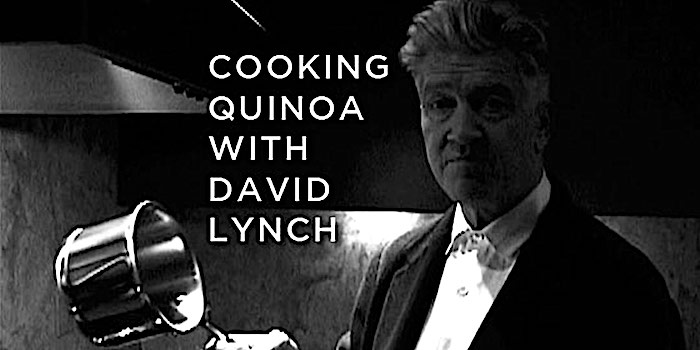
If it’s healthier fare you’re looking for, why not take a chance on Allen Ginsberg’s cold summer borscht? Or David Lynch’s easy quinoa recipe? Aleister Crowley’s recipe for a rice meant to be eaten with curry sounds delightful, though one can’t help but wonder at another lost recipe the infamous occultist once made for his fellow mountaineers on an expedition—a rice so spicy, he claimed, it made them “dash out of the tent after one mouthful and wallow in the snow, snapping at it like mad dogs.”
See many more recipes from famous artists at the links below.
Gimme Mick, gimme Mick Baby’s hair, bulgin’ eyes, lips so thick Are you woman, are you man I’m your biggest funked-up fan So rock me and roll meeee… ‘Til I’m sick
—(the fictional) Candy Slice, Saturday Night Live
You, Mick Jagger, are English and go out with a model and get an incredible amount of publicity
You, Mick Jagger, don’t keep regular hours
You, Mick Jagger, have the greatest rock ‘n roll band in the history of rock ‘n roll, and you don’t even play an instrument yourself
It’s a bit sobering, watching the late Gilda Radner, expertly preening and prancing as the then-36-year-old, yet-to-be-knighted Mick in “Rock Against Yeast,” the star studded Saturday Night Live Sketch from 1979, above.
Readers over the age of 36 who want to get seriously bummed out, poll your under-35 friends to see who’s heard of the versatile Gilda, an original Not-Ready-for-Prime-Time Player and one of America’s most complicated sweethearts.
Fortunately, she’s not entirely forgotten:
I can personally attest, and I feel comfortable speaking for Amy Poehler, Maya Rudolph and Rachel Dratch when I say that seeing Gilda as a kid…[she was] so authentically herself and so regular in so many ways. She was not a piece of casting, she was who she was on TV. We all saw that and said, ‘I want to do that, and it’s possible because I see her doing that. It was an early example for me of how important representation is, for everyone from every walk of life. Gilda was our equivalent of Michelle Obama. —Tina Fey
Gilda’s not alone in having left us at a young age. Some of her “Rock Against Yeast” castmates and the celebrities they spoofed made similarly shocking early exits:
Smith, who over the years has proved herself to be a very good egg, admitted to NPR that while her band found Gilda’s characterization “hilarious,” she took a while to warm up to it:
When I was younger, I—it sort of bothered me because, you know, she makes a big thing about, you know, I think it’s like the white powder and the vast amounts of cocaine in the recording studio. I had never even had cocaine. It wasn’t how—it’s not how I work. But I thought it was actually hilarious besides that. She was a great artist.
It was—actually, it was a privilege to be played—it was a privilege to have Gilda Radner project what she thought I might be like. And the funniest part was since there was a big controversy over the armpit hair on the cover of “Easter,” she brushed the hair under her arms, and I think she had like a foot of hair coming from her armpit, and we were all laughing so hard.
She was a great artist, and cocaine or not, I salute her. And I feel very lucky to have been, you know, portrayed by Gilda.
Read a full transcript of “Rock Against Yeast” here, while heaving a sigh of relief that that singer Dolly Parton (Jane Curtin) continues to walk so vigorously amongst us.
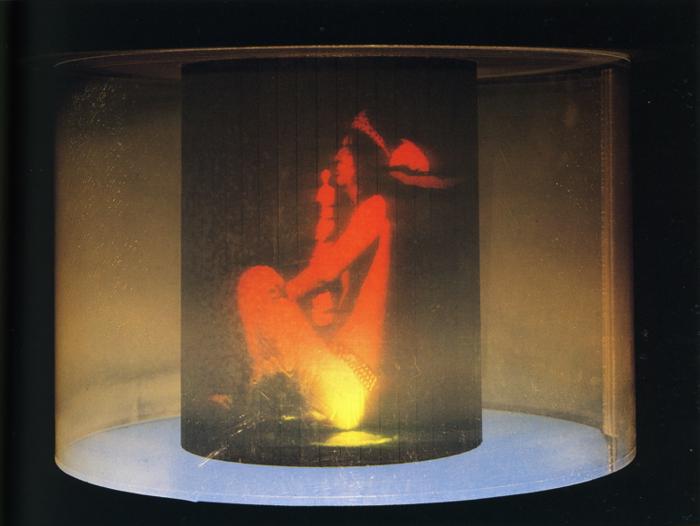
Kings of camp Alice Cooper and Salvador Dalí made a natural pair when they met in New York City in April of 1973. “A mind-melding of sorts took place,” writes Super Rad Now. “Over the course of about two weeks” Cooper and Dalí “ate together, drank together, and basked in the glow of each other’s exceptional uniqueness.” Then Dalí decided to turn Cooper into a hologram, the First Cylindric Chromo-Hologram Portrait of Alice Cooper’s Brain.
How did this come about? It was only a matter of time before Dalí sought out the “godfather of shock rock.” The Surrealist prankster “knew how to promote himself and others,” notes historian and writer Sophia Deboick in a fantastic understatement. Dalí had been shocking audiences decades before Vincent Furnier, lead singer of the band Alice Cooper—who took the name for himself in 1975—was born, making transgressive films like Un Chien Andalou and getting tossed out of the Surrealists for possible fascist sympathies and unabashedly commercial aspirations.
Dalí used his connections to the world of pop music to meet “figures such as Brian Jones, Bryan Ferry and David Bowie” in the late 60s and early 70s. He came calling at Cooper’s door after the 1972 “rapier-waving performance of ‘School’s Out’ on Top of the Pops [drew] the opprobrium of Mary Whitehouse… and a truck carrying a billboard image of Alice wearing only a snake… mysteriously ‘broke down’ on Oxford Circus the same summer, causing chaos.”
Cooper’s schtick was catnip to Dalí, but as usual, the artist had something more sophisticated in mind when he staged what looked like a typically bizarre publicity stunt. Cooper was invited to Dalí’s studio to pose with “an ant-covered plaster brain topped with a chocolate éclair.” This Dalí placed behind Cooper’s head on a red velvet cushion as Alice “sat on a rotating turntable wearing over a million dollars-worth of diamonds from the famous Harry Winston jewelers on Fifth Avenue (Cooper remembers it in the short video clip at the top as 4 million dollars worth), holding a fragmented Venus de Milo as a microphone.”
For Cooper and the band, the collaboration helped bring their own particular artistic vision to fruition, lending them the imprimatur of the most popular shock artist of the century. “Five of the original band members were art majors,” he later recalled, “and we worshipped Dalí: we thought of ourselves as surrealists.” (He also named one of his boa constrictors Dalí.)
For Dalí, the resulting holographic image fulfilled a longstanding exploration of new ideas and a new medium—as well as a deliberate movement away from his devotion to Freudian psychoanalysis.
Throughout the 1970s Dalí worked with optical illusions and stereoscopic images… but his interest in working in the third and fourth dimensions dated back further. His 1958 Anti-Matter Manifesto proclaimed his intent to abandon his exploration of the interior world for a focus on “the exterior world and that of physics [which] has transcended the one of psychology,” saying he had swapped Freud for Heisenberg. The tesseract cross of his Crucifixion (Corpus Hypercubus) (1954) was inspired by the diverse influences of mathematical theory, cubism, and works of Philip II’s architect Juan de Herrera and Catalan mystic Ramon Llull. The Alice hologram may have taken an emerging popular icon as its subject, but the medium was one which fulfilled Dalí’s artistic ambitions at the end of his career to embrace science and break out of the two dimensional.
The attention may have gone to Cooper’s head. He attended the unveiling of the hologram without his band members, then went on to record 1975’s Welcome to My Nightmare without them and promoted “an ABC television special starring Vincent Price” that same year, again with a new band. His star fell over the decade, but his essential place in rock and roll history had already been fully secured.
Alice Cooper’s (the band) gender-bending had influenced David Bowie and the New York Dolls. The Sex Pistol’s John Lydon breathlessly proclaimed them his favorite and sang (“or at least mimed to”) their “I’m Eighteen” at his audition. “The direct line between Alice Cooper and every possible genre of metal is obvious,” Deboick writes.
Like the Surrealist master, Cooper became something of a parody of his earlier incarnation in later years, and in sobriety, the preacher’s son from Detroit reappeared as a “golf-playing born-again Christian.” But however else he is remembered, the man born Vincent Furnier will also always be the only rock star to have his ant-covered brain turned into a hologram by Salvador Dalí, who knew a kindred spirit when he saw one. See a video of the hologram, which resides in Spain, just above.
We're hoping to rely on loyal readers, rather than erratic ads. Please click the Donate button and support Open Culture. You can use Paypal, Venmo, Patreon, even Crypto! We thank you!
Open Culture scours the web for the best educational media. We find the free courses and audio books you need, the language lessons & educational videos you want, and plenty of enlightenment in between.