We’ve previously written about one of Leonard Bernstein’s major works, The Unanswered Question, the staggering six-part lecture that the multi-disciplinary artist gave as part of his duties as Harvard’s Charles Eliot Norton Professor. Over 11 hours, Bernstein attempts to explain the whither and the whence of music history, notably at a time when Classical music had come to a sort of crisis point of atonality and anti-music, but was still pre-Merzbow.
But, as Bernstein said “…the best way to ‘know’ a thing is in the context of another discipline,” and these six lectures bring in all sorts of contexts, especially Chomsky’s linguistic theory, phonology, semantics, and more. And he does it all with frequent trips to the piano to make a point, or bringing in a whole orchestra—which Bernstein kept in his back pocket for times just like this.
Joking aside, this is still a major scholarly work that has plenty inside to debate. That’s pertinent a half a century after the fact, especially when so much music feels like it has stopped advancing, just recycling.
The above clip is just one of the gems to be found among the lectures, something that one viewer found so stunning they recorded it off the television screen and posted to YouTube.
In the clip, Bernstein uses the melody of “Fair Harvard,” also known as “Believe Me, If All Those Endearing Young Charms” by Thomas Moore—recognizable to the young’uns as the fiddle intro to “Come On, Eileen”—as a starting point. He assumes a prehistoric hominid humming the tune, then the younger and/or female members of the tribe singing along an octave apart.
From this moment of musical and human evolution, Bernstein brings in the fifth interval—only a few million years later—and then the fourth. Then polyphony is born out of that and…well, we don’t want to spoil everything. Soon Bernstein brings us up to the circle of fifths, compressing them into the 12 tones of the scale, and then 12 keys.
Bernstein can hear the potential for chaos, however, in the possibilities of “chromatic goulash,” and so ends with Bach, the master of “tonal control” who balanced the chromatic (which uses notes outside a key’s scale) with the diatonic (which doesn’t). (It all comes back to Bach, doesn’t it?)
Ted Mills is a freelance writer on the arts who currently hosts the FunkZone Podcast. You can also follow him on Twitter at @tedmills, read his other arts writing at tedmills.com and/or watch his films here.
If you’re under 60, you probably heard the line “I read the news today, oh boy” before encountering the song it opens. Even after you discovered the work of the Beatles, it may have taken you some time to understand what, exactly, it was that John Lennon read in the news. The “lucky man who made the grade” and “blew his mind out in a car” turn out to have been inspired by the young Guinness heir Tara Browne, who’d fatally wiped out in his Lotus Elan. The figure of 4,000 holes in the roads of Blackburn came from another page of the same edition of the Daily Mail. These are just two of the memorable images in “A Day in the Life,” which sonically reconstructs the fabric of the nineteen-sixties as the Beatles knew it.
And if any single factor shaped its development, that factor was LSD. “A song about perception — a subject central both to late-period Beatles and the counterculture at large — ‘A Day in the Life’ concerned ‘reality’ only to the extent that this had been revealed by LSD to be largely in the eye of the beholder,” he writes. Lennon may have proven to be the group’s most dedicated enthusiast of that shortcut to enlightenment. It’s worth noting, as Puschak does, that it was Browne who first “turned on” Paul McCartney.
Though primarily John’s work, “A Day in the Life” wouldn’t be what it is without Paul’s double-time bridge, whose jauntily narrative ordinariness makes the verses all the more transcendent. The need for some kind of transition between these disparate John and Paul parts led to George Martin’s commissioning a 40-piece orchestra instructed to play from the lowest notes up to the highest, a collective glissando quadruple-recorded and mixed to sound like the end of the world. In theory, perhaps, all this — to say nothing of Lennon’s references to the Albert Hall, the House of Lords, and his own role in Richard Lester’s How I Won the War — shouldn’t work together. But the result, as MacDonald puts it, remains one of “the most penetrating and innovative artistic reflections of its era,” as experienced by the young men standing at its very center.
Based in Seoul, Colin Marshall writes and broadcasts on cities, language, and culture. His projects include the Substack newsletterBooks on Cities and the book The Stateless City: a Walk through 21st-Century Los Angeles. Follow him on the social network formerly known as Twitter at @colinmarshall.
At the age of twelve, he followed his own line of reasoning to find a proof of the Pythagorean Theorem. At thirteen he read Kant, just for the fun of it. And before he was fifteen he had taught himself differential and integral calculus.
But while the young Einstein was engrossed in intellectual pursuits, he didn’t much care for school. He hated rote learning and despised authoritarian schoolmasters. His sense of intellectual superiority was resented by his teachers.
At the Gymnasium a teacher once said to him that he, the teacher, would be much happier if the boy were not in his class. Einstein replied that he had done nothing wrong. The teacher answered, “Yes, that is true. But you sit there in the back row and smile, and that violates the feeling of respect that a teacher needs from his class.”
The same teacher famously said that Einstein “would never get anywhere in life.”
What bothered Einstein most about the Luitpold was its oppressive atmosphere. His sister Maja would later write:
“The military tone of the school, the systematic training in the worship of authority that was supposed to accustom pupils at an early age to military discipline, was also particularly unpleasant for the boy. He contemplated with dread that not-too-distant moment when he will have to don a soldier’s uniform in order to fulfill his military obligations.”
When he was sixteen, Einstein’s parents moved to Italy to pursue a business venture. They told him to stay behind and finish school. But Einstein was desperate to join them in Italy before his seventeenth birthday. “According to the German citizenship laws,” Maja explained, “a male citizen must not emigrate after his completed sixteenth year; otherwise, if he fails to report for military service, he is declared a deserter.”
So Einstein found a way to get a doctor’s permission to withdraw from the school on the pretext of “mental exhaustion,” and fled to Italy without a diploma. Years later, in 1944, during the final days of World War II, the Luitpold Gymnasium was obliterated by Allied bombing. So we don’t have a record of Einstein’s grades there. But there is a record of a principal at the school looking up Einstein’s grades in 1929 to fact check a press report that Einstein had been a very bad student. Walter Sullivan writes about it in a 1984 piece in The New York Times:
With 1 as the highest grade and 6 the lowest, the principal reported, Einstein’s marks in Greek, Latin and mathematics oscillated between 1 and 2 until, toward the end, he invariably scored 1 in math.
After he dropped out, Einstein’s family enlisted a well-connected friend to persuade the Swiss Federal Institute of Technology, or ETH, to let him take the entrance exam, even though he was only sixteen years old and had not graduated from high school. He scored brilliantly in physics and math, but poorly in other areas. The director of the ETH suggested he finish preparatory school in the town of Aarau, in the Swiss canton of Aargau. A diploma from the cantonal school would guarantee Einstein admission to the ETH.
At Aarau, Einstein was pleasantly surprised to find a liberal atmosphere in which independent thought was encouraged. “When compared to six years’ schooling at a German authoritarian gymnasium,” he later said, “it made me clearly realize how much superior an education based on free action and personal responsibility is to one relying on outward authority.”
In Einstein’s first semester at Aarau, the school still used the old method of scoring from 1 to 6, with 1 as the highest grade. In the second semester the system was reversed, with 6 becoming the highest grade. Barry R. Parker talks about Einstein’s first-semester grades in his book, Einstein: The Passions of a Scientist:
His grades over the first few months were: German, 2–3; French, 3–4; history, 1–2; mathematics, 1; physics, 1–2; natural history, 2–3; chemistry, 2–3; drawing, 2–3; and violin, 1. (The range is 1 to 6, with 1 being the highest.) Although none of the grades, with the exception of French, were considered poor, some of them were only average.
The school headmaster, Jost Winteler, who had welcomed Einstein into his home as a boarder and had become something of a surrogate father to him during his time at Aarau, was concerned that a young man as obviously brilliant as Albert was receiving average grades in so many courses. At Christmas in 1895, he mailed a report card to Einstein’s parents. Hermann Einstein replied with warm thanks, but said he was not too worried. As Parker writes, Einstein’s father said he was used to seeing a few “not-so-good grades along with very good ones.”
In the next semester Einstein’s grades improved, but were still mixed. As Toby Hendy of the YouTube channel Tibees shows in the video above, Einstein’s final grades were excellent in math and physics, but closer to average in other areas.
Einstein’s uneven academic performance continued at the ETH, as Hendy shows. By the third year his relationship with the head of the physics department, Heinrich Weber, began to deteriorate. Weber was offended by the young man’s arrogance. “You’re a clever boy, Einstein,” said Weber. “An extremely clever boy. But you have one great fault. You’ll never allow yourself to be told anything.” Einstein was particularly frustrated that Weber refused to teach the groundbreaking electromagnetic theory of James Clerk Maxwell. He began spending less time in the classroom and more time reading up on current physics at home and in the cafes of Zurich.
Einstein increasingly focused his attention on physics, and neglected mathematics. He came to regret this. “It was not clear to me as a student,” he later said, “that a more profound knowledge of the basic principles of physics was tied up with the most intricate mathematical methods.”
Einstein’s classmate Marcel Grossmann helped him by sharing his notes from the math lectures Einstein had skipped. When Einstein graduated, his conflict with Weber cost him the teaching job he had expected to receive. Grossmann eventually came to Einstein’s rescue again, urging his father to help him secure a well-paid job as a clerk in the Swiss patent office. Many years later, when Grossmann died, Einstein wrote a letter to his widow that conveyed not only his sadness at an old friend’s death, but also his bittersweet memories of life as a college student:
“Our days together come back to me. He a model student; I untidy and a daydreamer. He on excellent terms with the teachers and grasping everything easily; I aloof and discontented, not very popular. But we were good friends and our conversations over iced coffee at the Metropol every few weeks belong among my nicest memories.”
Note: An earlier version of this post appeared on our site in 2020.
World War II officially ended on September 2, 1945. It followed, by less than three weeks, an equally momentous event, at least in the eyes of cinephiles: the birth of Wim Wenders. Though soon to turn 80 years old, Wenders has remained both productive and capable of drawing great critical acclaim. Witness, for example, his Tokyo-set 2023 film Perfect Days, which made it to the running for both the Palme d’Or and a Best International Feature Film Academy Award. Back on V‑J Day, it surely would’ve been difficult to imagine a Japanese-German co-production seriously competing for the most prestigious prizes in cinema — even one directed by a known Americaphile.
Wenders has long worked at revealing intersections of history and culture. Seen today, Wings of Desireseems for all the world to express the spirit about to be liberated by the fall of the Soviet Union, but by Wenders’ own admission, nobody working on the movie would have credited the idea of the Berlin Wall coming down any time in the foreseeable future.
In his new short film “The Keys to Freedom,” he commemorates the 80th anniversary of the Second World War’s conclusion by paying a visit to a school in Reims. Commandeered for the secret all-night meeting in which German generals signed the documents confirming their country’s total surrender to the Allies, it hosted the end of what Wenders called “the darkest period in the history of Europe.”
Closing up the temporary headquarters, Allied commander-in-chief Dwight D. Eisenhower returned its keys to the mayor of Reims, saying, “These are the keys to the freedom of the world.” As much as these words move Wenders, he also fears that, even as the Russia-Ukraine war roils on, younger generations of Europeans no longer grasp their meaning. Born into societies protected by the United States, they naturally take peace for granted. “We have to be aware of the fact that Uncle Sam isn’t doing our job for very much longer, and we might have to defend this freedom ourselves,” Wenders explains in a New York Times interview. The end of World War II marked the beginning of the so-called “American century.” If that century is well and truly drawing to its close, who better to observe it than Wenders?
Based in Seoul, Colin Marshall writes and broadcasts on cities, language, and culture. His projects include the Substack newsletterBooks on Cities and the book The Stateless City: a Walk through 21st-Century Los Angeles. Follow him on the social network formerly known as Twitter at @colinmarshall.
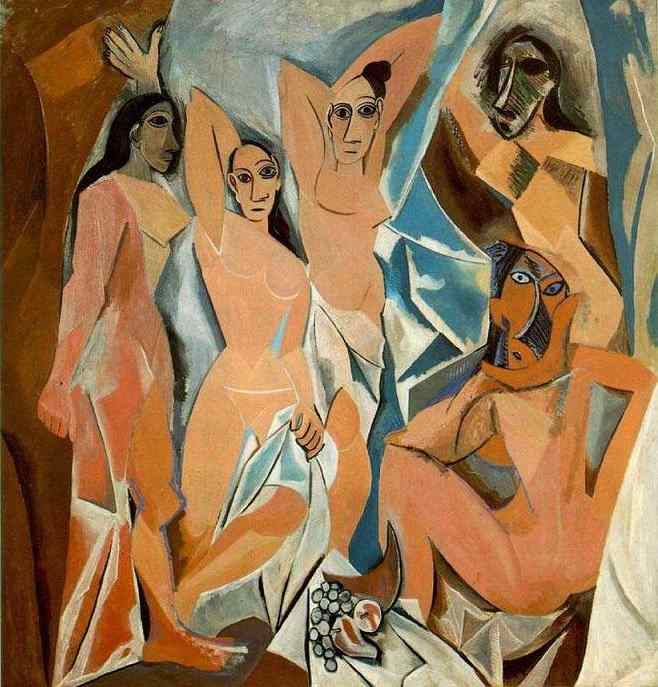
It’s hard to imagine from this historical distance how upsetting Pablo Picasso’s 1907 modernist painting Les Demoiselles d’Avignonwas to Parisian society at its debut. On its 100th anniversary, Guardian critic Jonathan Jones described it as “the rift, the break that divides past and future.” The painting caused an uproar, even among the artist’s peers. It was a moment of culture shock, notes PBS. Its five nude figures, broken into proto-cubist planes and angles with faces painted like African masks, met “with almost unanimous shock, distaste, and outrage.”
Henri Matisse, himself often credited with ushering in modernist painting with his flattened fields of color, “is angered by the work, which he considers a hoax, an attempt to paint the fourth dimension.” Much of the outrage was purported to come from middle-class moral qualms about the painting’s subject, “the sexual freedom depicted in a brothel.”
This is a little hard to believe. Nude women in brothels, “odalisques,” had long been a favorite subject of some of the most revered European painters. But where the women in these paintings always appear passive, if not submissive, Picasso’s nudes pose suggestively and meet the viewer’s gaze, actively unashamed.
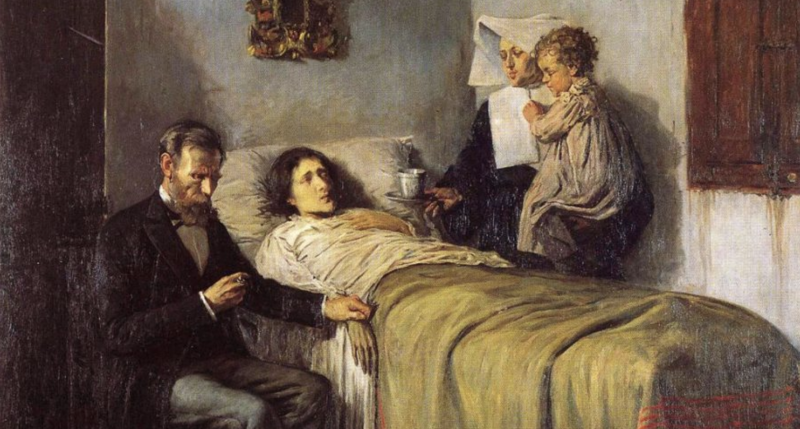
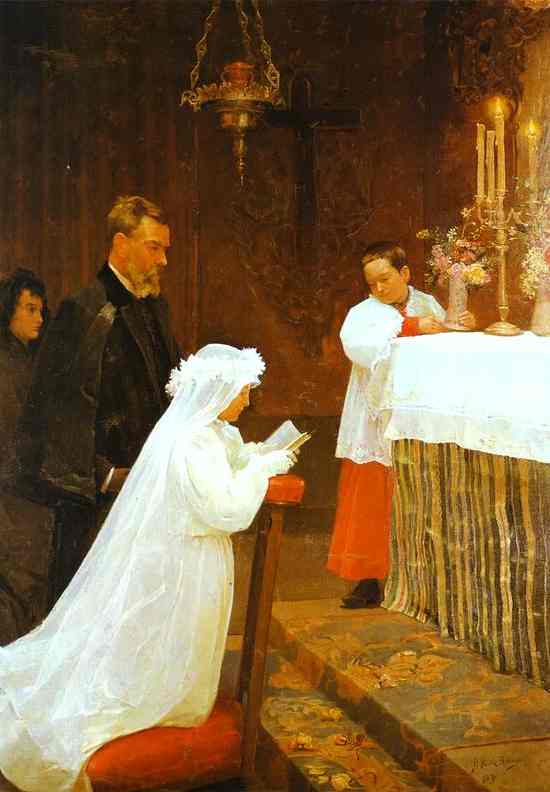
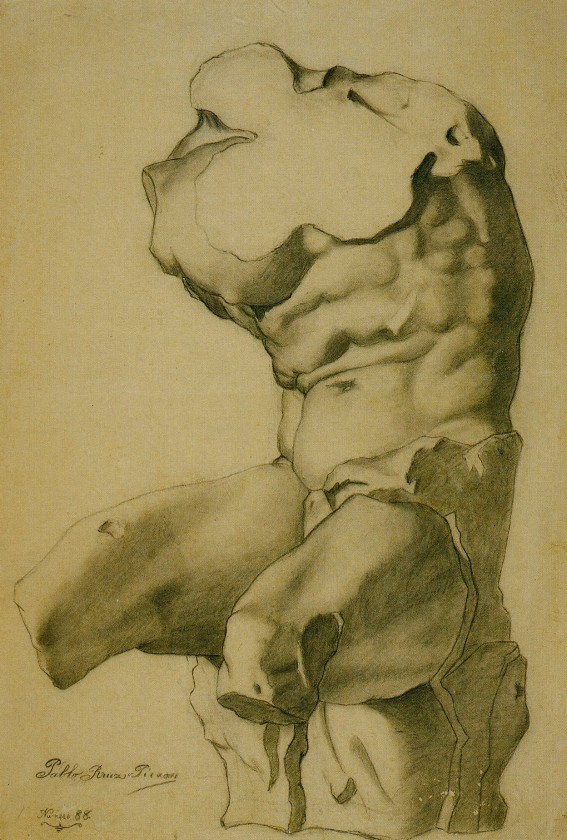
What likely most disturbed those first viewers was the perceived violence done to tradition. While we cannot recover the tender sensibilities of early 20th-century Parisian critics, we can, I think, experience a similar kind of shock by looking at work Picasso had done ten years earlier, such as the 1896 First Communion, further up, and 1897 study Science and Charity at the top, conservative genre paintings in an academic style, beautifully rendered with exquisite skill by a then 15-year-old artist. See an earlier drawing, Study for a Torso, above, completed in 1892 when Picasso was only 11.
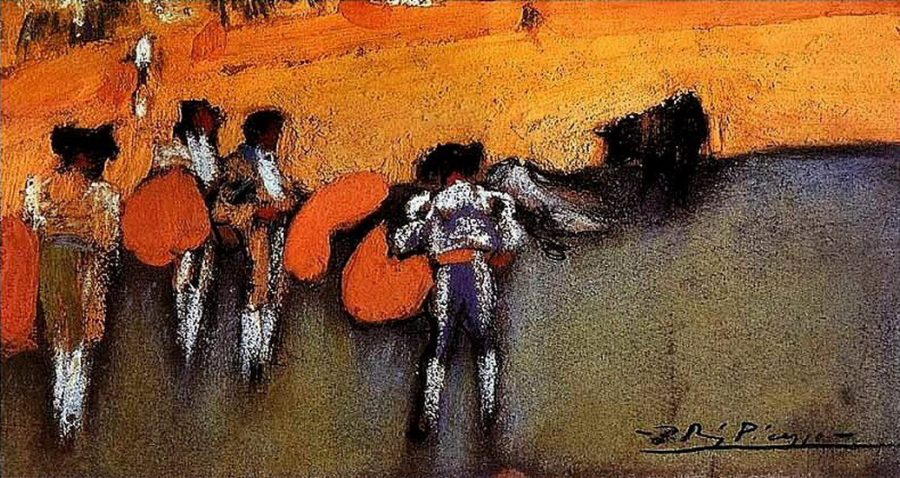
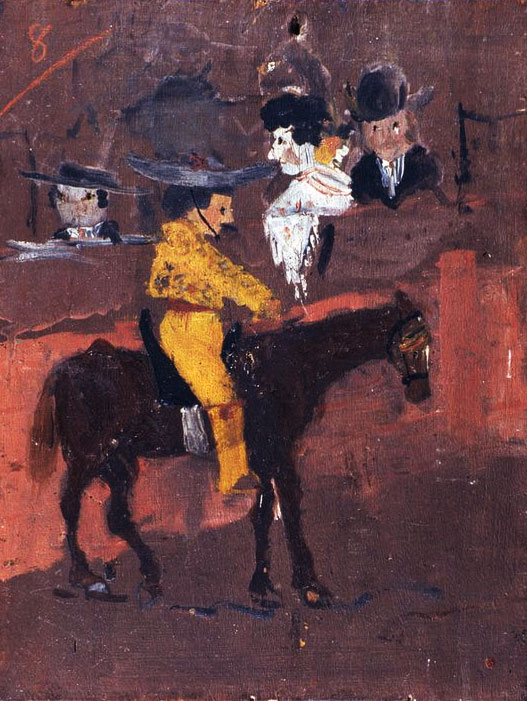
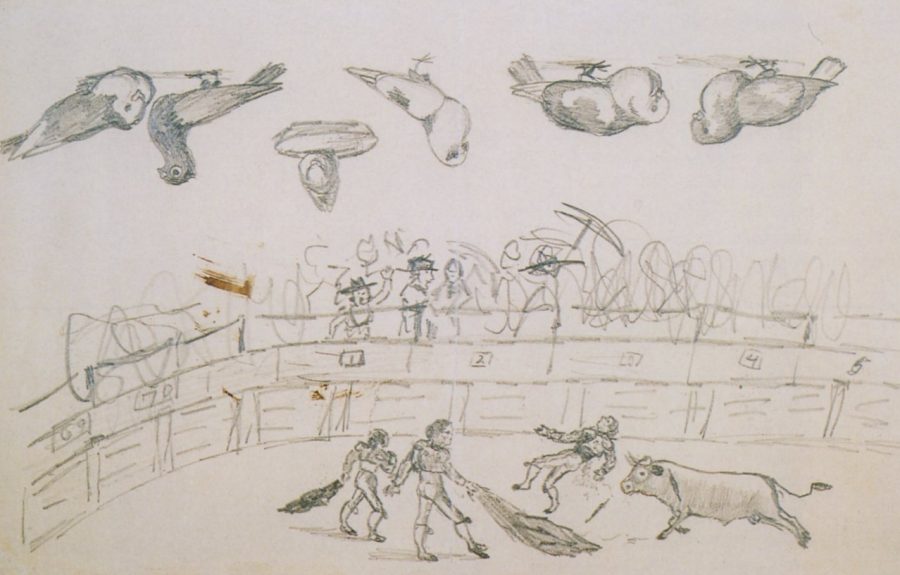
Given his incredible precocity, it may seem hardly any wonder that Picasso innovated scandalously new means of using line, color, and composition. He was a prodigious master of technique at an age when many artists are still years away from formal study. Where else could his restless talent go? He painted a favorite subject in 1900, in the loose, impressionist Bullfight, above, a return of sorts to his first oil painting, Picador, below, made when he was 8. Further down, see a drawing from the following year in his early development, “Bullfight and Pigeons.”
This piece, with its realistic-looking birds carefully drawn upside-down atop a loose sketch of a bullfight, appeared in a 2006 show at the Phillips Collection in Washington, DC featuring childhood artworks from Picasso and Paul Klee. Contrary, perhaps, to our expectations, curator Jonathan Fineberg remarks of this drawing that “9‑year-old Picasso’s confident, playful scribble” gives us more indication of his talent than the finely-drawn birds.
“It’s not just that Picasso could render well, because you could teach anybody to do that,” Fineberg says. Maybe not anybody, but the point stands—technique can be taught, creative vision cannot. “It’s not about skill. It’s about unique qualities of seeing. That’s what makes Picasso a better artist than Andrew Wyeth. Art is about a novel way of looking at the world.” You may prefer Wyeth, or think the downward comparison unfair, but there’s no denying Picasso had a very “novel way of seeing,” from his earliest sketches to his most revolutionary modernist masterpieces. See several more highly accomplished early works from Picasso here.
Note: An earlier version of this post appeared on our site in 2018.
In South Korea, where I live, there may be no brand as respected as Habodeu. Children dream of it; adults seemingly do anything to play up their own connections to it, however tenuous those connections may be. But what is Habodeu? An electronics company? A line of clothing? Some kind of luxury car? Not at all: it is, in fact, the Korean pronunciation of Harvard, the American university. Practically everyone around the world is aware of Harvard’s prestige, but relatively few know that you can take many of its courses online without paying tuition, or even applying. In fact, you can find a list of more than 130 such courses right here, all available to take right now.
If you would like to sign up for Open Culture’s free email newsletter, please find it here. It’s a great way to see our new posts, all bundled in one email, each day.
If you would like to support the mission of Open Culture, consider making a donation to our site. It’s hard to rely 100% on ads, and your contributions will help us continue providing the best free cultural and educational materials to learners everywhere. You can contribute through PayPal, Patreon, and Venmo (@openculture). Thanks!
Based in Seoul, Colin Marshall writes and broadcasts on cities, language, and culture. His projects include the Substack newsletterBooks on Cities and the book The Stateless City: a Walk through 21st-Century Los Angeles. Follow him on the social network formerly known as Twitter at @colinmarshall.
Though its answer has grown more complicated in recent years, the question of whether computers will ever truly think has been around for quite some time. Richard Feynman was being asked about it 40 years ago, as evidenced by the lecture clip above. As his fans would expect, he approaches the matter of artificial intelligence with his characteristic incisiveness and humor — as well as his tendency to re-frame the conversation in his own terms. If the question is whether machines will ever think like human beings, he says no; if the question is whether machines will ever be more intelligent than human beings, well, that depends on how you define intelligence.
Even today, it remains quite a tall order for any machine to meet our constant demands, as Feynman articulates, for better-than-human mastery of every conceivable task. And even when their skills do beat mankind’s — as in, say, the field of arithmetic, which computers dominate by their very nature — they don’t use their calculating apparatus in the same way as human beings use their brains.
Perhaps, in theory, you could design a computer to add, subtract, multiply, and divide in approximately the same slow, error-prone fashion we tend to do, but why would you want to? Better to concentrate on what humans can do better than machines, such as the kind of pattern recognition required to recognize a single human face in different photographs. Or that was, at any rate, something humans could do better than machines.
The tables have turned, thanks to the machine learning technologies that have lately emerged; we’re surely not far from the ability to pull up a portrait, and along with it every other picture of the same person ever uploaded to the internet. The question of whether computers can discover new ideas and relationships by themselves sends Feynman into a disquisition on the very nature of computers, how they do what they do, and how their high-powered inhuman ways, when applied to reality-based problems, can lead to solutions as bizarre as they are effective. “I think that we are getting close to intelligent machines,” he says, “but they’re showing the necessary weaknesses of intelligence.” Arthur C. Clarke said that any sufficiently advanced technology is indistinguishable from magic, and perhaps any sufficiently smart machine looks a bit stupid.
Based in Seoul, Colin Marshall writes and broadcasts on cities, language, and culture. His projects include the Substack newsletterBooks on Cities and the book The Stateless City: a Walk through 21st-Century Los Angeles. Follow him on the social network formerly known as Twitter at @colinmarshall.
Is perpetual motion possible? In theory… I have no idea…. In practice, so far at least, the answer has been a perpetual no. As Nicholas Barrial writes at Makery, “in order to succeed,” a perpetual motion machine “should be free of friction, run in a vacuum chamber and be totally silent” since “sound equates to energy loss.” Trying to satisfy these conditions in a noisy, entropic physical world may seem like a fool’s errand, akin to turning base metals to gold. Yet the hundreds of scientists and engineers who have tried have been anything but fools.
The long list of contenders includes famed 12th-century Indian mathematician Bhāskara II, also-famed 17th-century Irish scientist Robert Boyle, and a certain Italian artist and inventor who needs no introduction. It will come as no surprise to learn that Leonardo da Vinci turned his hand to solving the puzzle of perpetual motion. But it seems, in doing so, he “may have been a dirty, rotten hypocrite,” Ross Pomery jokes at Real Clear Science. Surveying the many failed attempts to make a machine that ran forever, he publicly exclaimed, “Oh, ye seekers after perpetual motion, how many vain chimeras have you pursued? Go and take your place with the alchemists.”
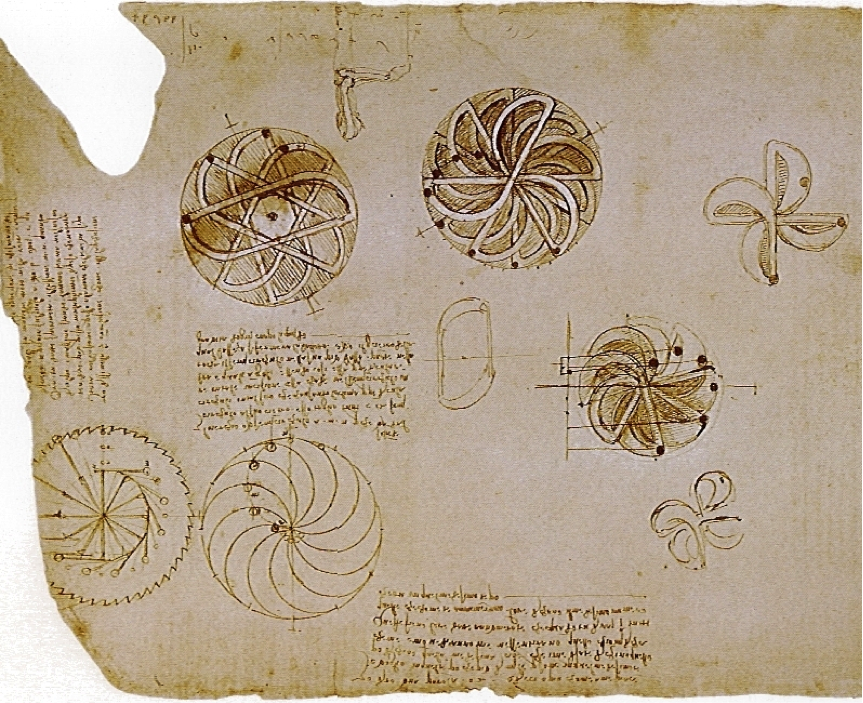
In private, however, as Michio Kaku writes in Physics of the Impossible, Leonardo “made ingenious sketches in his notebooks of self-propelling perpetual motion machines, including a centrifugal pump and a chimney jack used to turn a roasting skewer over a fire.” He also drew up plans for a wheel that would theoretically run forever. (Leonardo claimed he tried only to prove it couldn’t be done.) Inspired by a device invented by a contemporary Italian polymath named Mariano di Jacopo, known as Taccola (“the jackdaw”), the artist-engineer refined this previous attempt in his own elegant design.
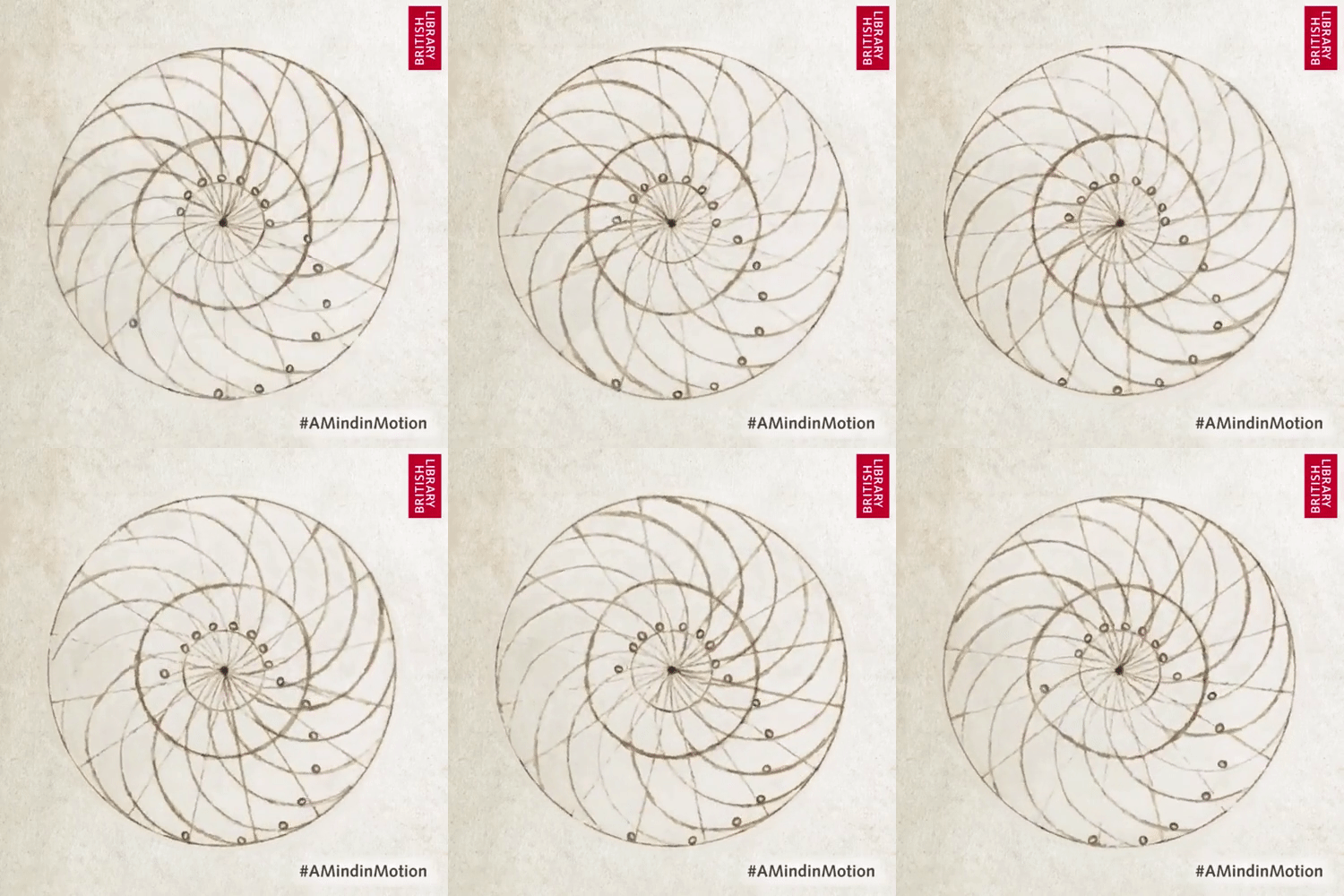
Leonardo drew several variants of the wheel in his notebooks. Despite the fact that the wheel didn’t work—and that he apparently never thought it would—the design has become, Barrial notes, “THE most popular perpetual motion machine on DIY and 3D printing sites.” (One maker charmingly comments, in frustration, “Perpetual motion doesn’t seem to work, what am I doing wrong?”) The gif at the top, from the British Library, animates one of Leonardo’s many versions of unbalanced wheels. This detailed study can be found in folio 44v of the Codex Arundel, one of several collections of Leonardo’s notebooks that have been digitized and previously made available online.
In his book The Innovators Behind Leonardo, Plinio Innocenzi describes these devices, consisting of “12 half-moon-shaped adjacent channels which allow the free movement of 12 small balls as a function of the wheel’s rotation…. At one point during the rotation, an imbalance will be created whereby more balls will find themselves on one side than the other,” creating a force that continues to propel the wheel forward indefinitely. “Leonardo reprimanded that despite the fact that everything might seem to work, ‘you will find the impossibility of motion above believed.’”
Leonardo also sketched and described a perpetual motion device using fluid mechanics, inventing the “self-filling flask” over two-hundred years before Robert Boyle tried to make perpetual motion with this method. This design also didn’t work. In reality, there are too many physical forces working against the dream of perpetual motion. Few of the attempts, however, have appeared in as elegant a form as Leonardo’s.
Note: An earlier version of this post appeared on our site in 2019.
We're hoping to rely on loyal readers, rather than erratic ads. Please click the Donate button and support Open Culture. You can use Paypal, Venmo, Patreon, even Crypto! We thank you!
Open Culture scours the web for the best educational media. We find the free courses and audio books you need, the language lessons & educational videos you want, and plenty of enlightenment in between.