It took 90 years to complete. But, in 2011, scholars at the University of Chicago finally published a 21-volume dictionary of Akkadian, the language used in ancient Mesopotamia. Unspoken for 2,000 years, Akkadian was preserved on clay tablets and in stone inscriptions until scholars deciphered it during the last two centuries.
It was long ago that polytheism, as the story comes down to us, gave way to monotheism. Humanity used to have many gods, and now almost every religious believer acknowledges just one — though which god, exactly, does vary. Some popular theories of “big history” hold that, as the scale of a society grows larger, the number of deities proposed by its faiths gets smaller. In that scheme, it makes sense that the growing Roman Empire would eventually adopt Christianity, and also that the gods it first inherited from the city-states of ancient Greece would be so numerous. Through our modern eyes, the various immortals invoked so readily by the Greeks look less like holy figures than a cast of characters in a long-running television drama.
Or maybe it would have to be a soap opera, given that most of them belong to one big, often troubled clan. Hence the structure of UsefulCharts’ Greek Mythology Family Tree, explained in the video above. Also available for purchase in poster form, it clearly diagrams the relationships between everyone in the Greek pantheon, from the highest “primordial gods” like Eros Elder and Gaia down to the children of Zeus and Poseidon.
However powerful they could be — and some were powerful indeed — none of these gods acted like the infallible, omniscient entities of the major religions we know today. They could act capriciously, vengefully and even nonsensically, a reflection of the often capricious‑, vengeful‑, and nonsensical-seeming nature of life in the ancient world.
For the Greeks themselves, these mythical gods and monsters offered not just an explanatory mechanism, but also a form of entertainment, given that nothing could go on in their elevated world without high drama. For us, they remain present in legends from which we still draw inspiration for our own larger-than-life stories of heroism and villainy, but also in our very language. Consider the ways in which we continue to evoke the likes of the time-ruling Chronos, the love-bringing Cupid, the androgynous Hermaphroditus, or the multi-headed Hydra in everyday speech. Though we may no longer need them to organize our societies, some of them have kept playing roles in the age of monotheism — which, whatever its other advantages, doesn’t require us to consult diagrams to know who’s who.
Based in Seoul, Colin Marshall writes and broadcasts on cities, language, and culture. He’s the author of the newsletterBooks on Cities as well as the books 한국 요약 금지 (No Summarizing Korea) and Korean Newtro.Follow him on the social network formerly known as Twitter at @colinmarshall.
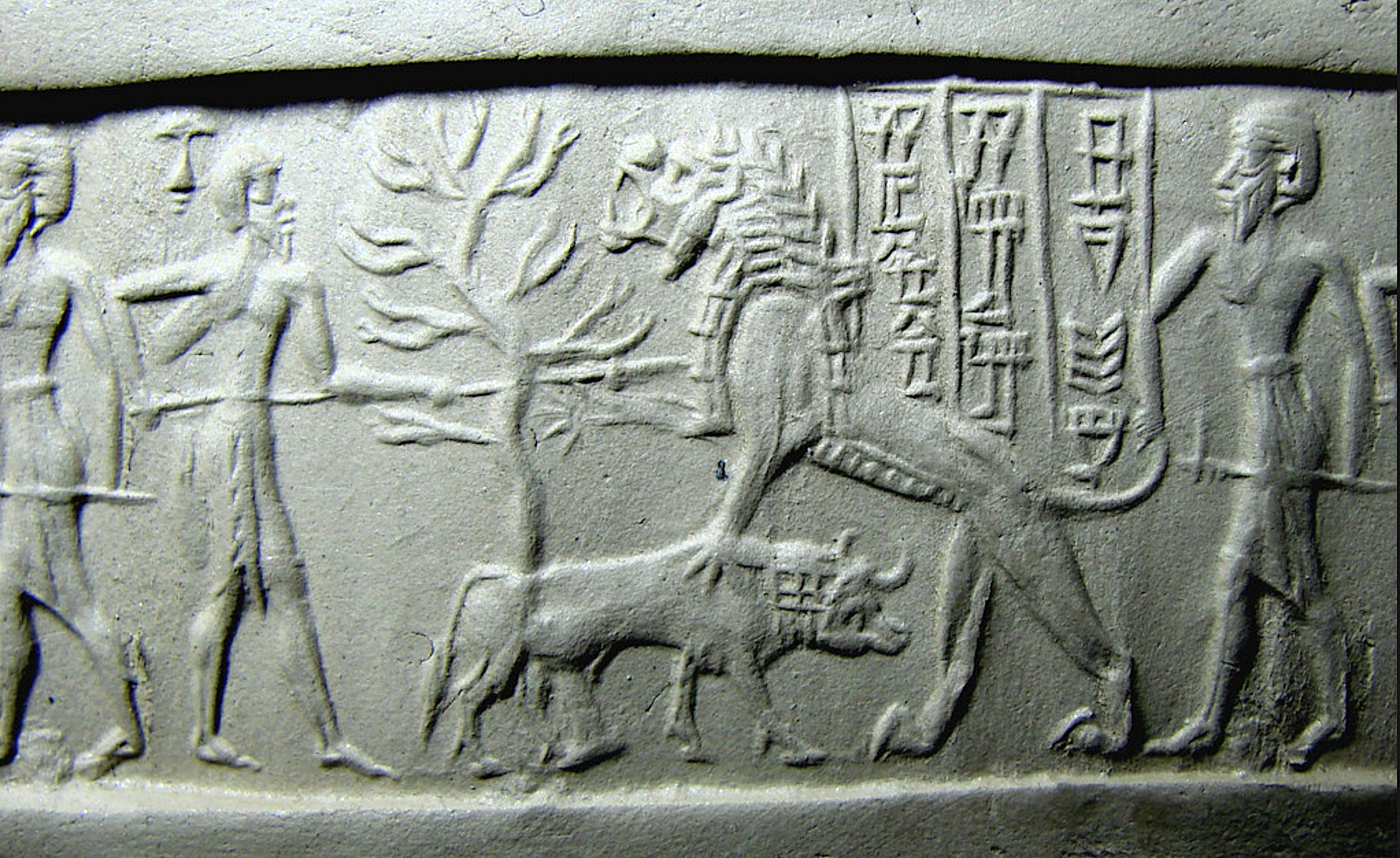
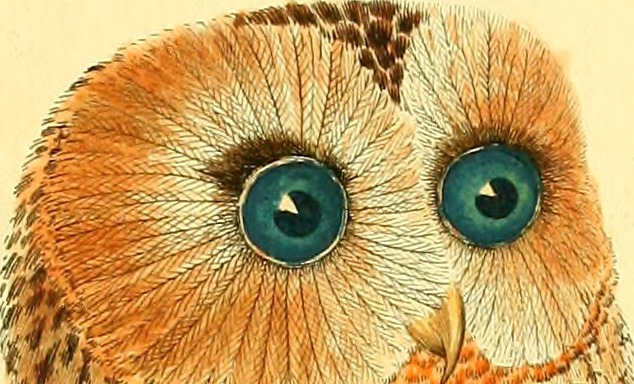
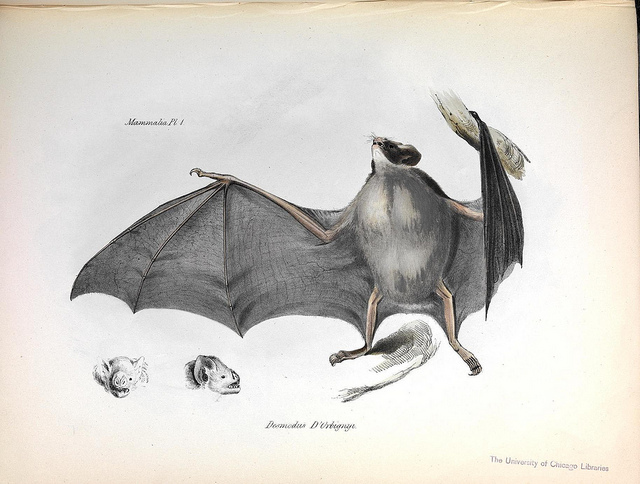
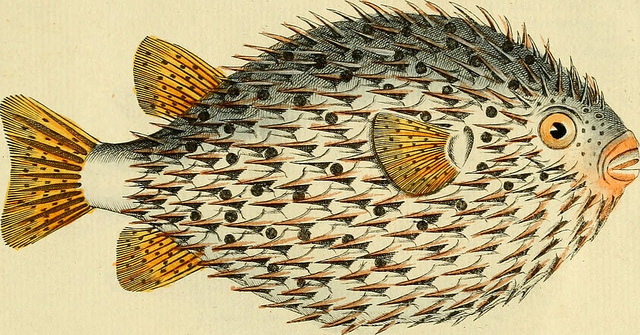
Are we truly in the midst of a human-caused sixth mass extinction, an era of “biological annihilation”? Many scientists and popular science writers say yes, using terms like “Holocene” or “Anthropocene” to describe what follows the Ordovician, Devonian, Permian, Triassic, and Cretaceous periods. Peter Brannen, the author of extinction history The Ends of the Earth has found at least one scientist who thinks the concept is “junk.” But Brannen quotes some alarming statistics. Chilling, even. “Until very recently,” he writes, “all vertebrate life on the planet was wildlife. But astoundingly, today wildlife accounts for only 3 percent of Earth’s land animals; human beings, our livestock, and our pets take up the remaining 97 percent of the biomass… almost half of the Earth’s land has been converted into farmland.”
This state of affairs does not bode well for the millions of remaining species getting edged out of their environments by agribusiness and climate change. We learn from extinctions past that the planet rebounds after unimaginable catastrophe. Life really does go on, though it may take millions of years to recover. But the current forms of life may disappear before their time. If we want to understand what is at stake besides our own fragile fossil-fuel-based civilizations, we need to connect to life emotionally as well as intellectually. Short of globe-hopping physical immersion in the Earth’s biodiversity, we could hardly do better than immersing ourselves in the tradition of naturalist writing, art, and photography that brings the world to us.
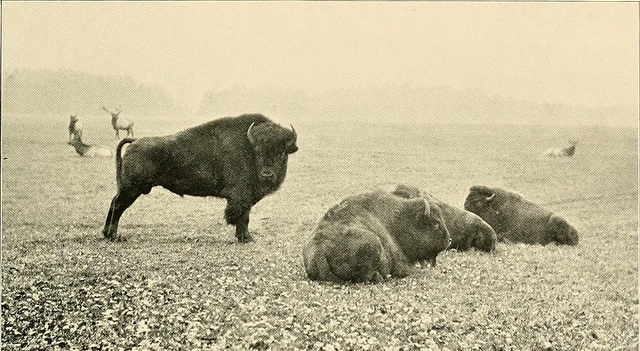
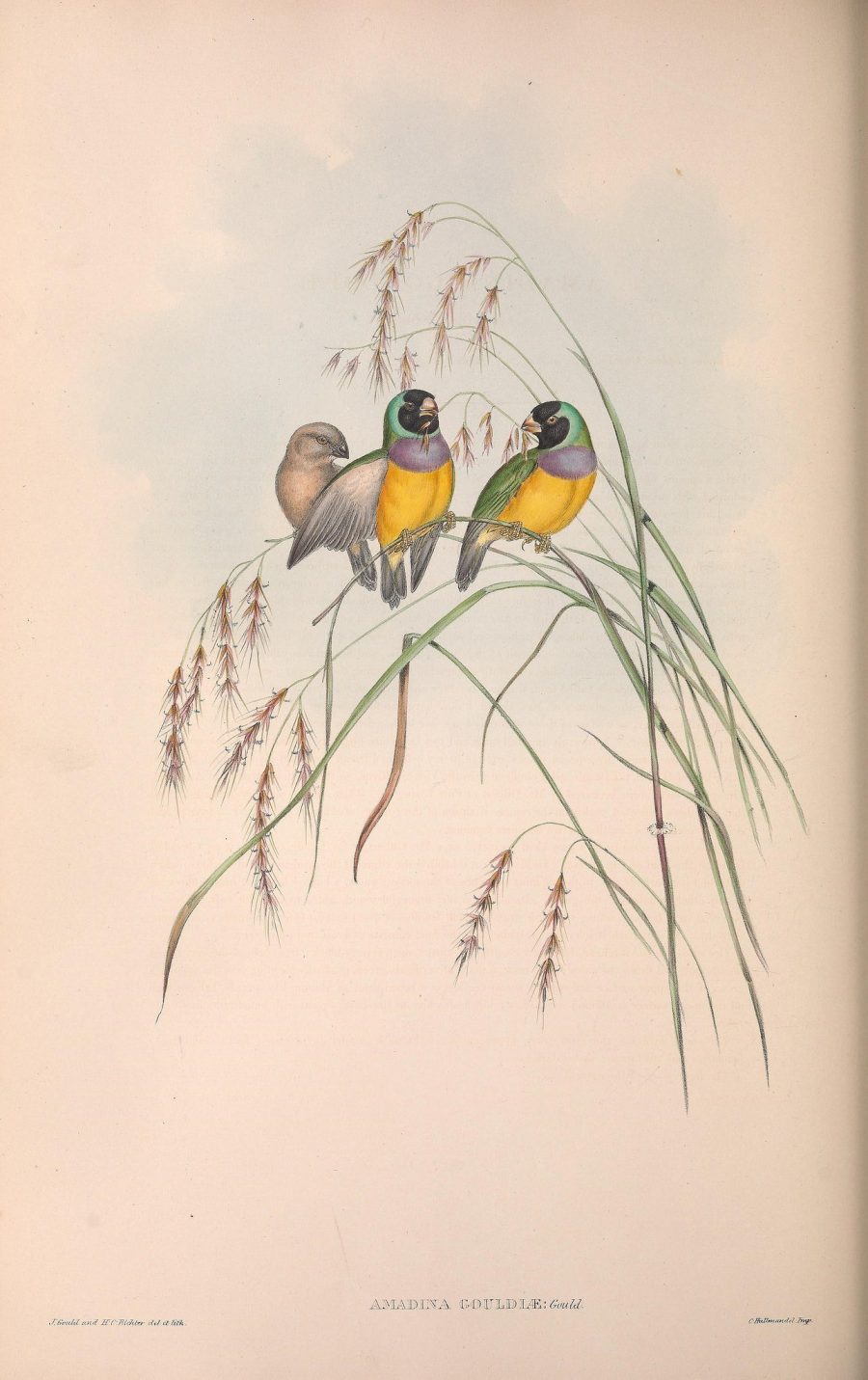
This image archive offers expansive views of humanity’s encounter with the natural world, not only through statistics and academic jargon, but through the artistic recording of wonder, scientific curiosity, and deep appreciation. Enter the archive here.
Note: An earlier version of this post appeared on our site in 2017.
Each culture has its own sayings about the uniqueness and transience of the present moment. In recent years, the English-speakers have often found themselves reminded, through the expression “YOLO,” that they only live once. (The question of whether that should really be “YLOO,” or “You Live Only Once,” we put aside for the time being.) In Japan, unsurprisingly, one sometimes hears a much more venerable equivalent: “ichi-go ichi‑e,” which some readers acquainted with the Japanese language should be assured has nothing to do with strawberries, ichigo. Rather, the saying’s underlying Chinese characters (一期一会) can be translated as “one time, one meeting.”
The Buddhistically inflected “ichi-go ichi‑e” is just one in the vast library of yojijukugo, highly condensed aphoristic expressions written with just four characters. (Other countries with Chinese-influenced languages have their versions, including sajaseongeo in Korea and chéngyǔ in China itself.) It descends, as the story goes, from a slightly longer saying favored by the sixteenth-century tea master Sen no Rikyū, “ichi-go ni ichi-do” (一期に一度).
One must pay respects to the host of a tea ceremony because the meeting would only ever occur once — which, of course, it would, even if the ceremony was a regularly scheduled event. For we never, to borrow an ancient Greek take on this whole subject, step into the same river twice; no two events, separated in time, can ever truly be identical.
One implication, as noted in the explanatory videos above from the BBC and Einzelgänger, is that we should savor whatever moment we happen to find ourselves in, however imperfect, because we won’t get a second chance to do so. And if it offers little or nothing to enjoy, we can find solace in the fact that its particular displeasure, too, can never revisit us. With the past gone and the future never guaranteed, the present moment, in any case, is the only time that actually exists for us, so we’d better make ourselves comfortable within it. Though these ideas have perhaps found their most elegant and memorable expression in Japan, they’re hardly considered exclusive cultural property there. The Japanese title of Forrest Gump, after all, was Foresuto Ganpu: Ichi-go Ichi‑e.
Based in Seoul, Colin Marshall writes and broadcasts on cities, language, and culture. He’s the author of the newsletterBooks on Cities as well as the books 한국 요약 금지 (No Summarizing Korea) and Korean Newtro.Follow him on the social network formerly known as Twitter at @colinmarshall.
Having not revisited The Hobbit in some time, I’ve felt the familiar pull—shared by many readers—to return to Tolkien’s fairy-tale novel itself. It was my first exposure to Tolkien, and the perfect book for a young reader ready to dive into moral complexity and a fully-realized fictional world.
And what better guide could there be through The Hobbitthan Tolkien himself, reading (above) from the 1937 work? In this 1952 recording in two parts (part 2 is below), the venerable fantasist and scholar reads from his own work for the first time on tape.
Tolkien begins with a passage that first describes the creature Gollum; listening to this description again, I am struck by how much differently I imagined him when I first read the book. The Gollum of The Hobbit seems somehow hoarier and more monstrous than many later visual interpretations. This is a minor point and not a criticism, but perhaps a comment on how necessary it is to return to the source of a mythic world as rich as Tolkien’s, even, or especially, when it’s been so well-realized in other media. No one, after all, knows Middle Earth better than its creator.
These readings were part of a much longer recording session, during which Tolkien also read (and sang!) extensively from The Lord of the Rings. A YouTube user has collected, in several parts, a radio broadcast of that full session, and it’s certainly worth your time to listen to it all the way through. It’s also worth knowing the neat context of the recording. Here’s the text that accompanies the video on YouTube:
When Tolkien visited a friend in August of 1952 to retrieve a manuscript of The Lord of the Rings, he was shown a “tape recorder”. Having never seen one before, he asked how it worked and was then delighted to have his voice recorded and hear himself played back for the first time. His friend then asked him to read from The Hobbit, and Tolkien did so in this one incredible take.
Note: An earlier version of this post appeared on our site in 2012.
In 1991, the French husband-and-wife volcanologist-filmmaker team Maurice and Katia Krafft were killed by the flow of ash from the eruption of Mount Unzen in Nagasaki. Inexplicably, Werner Herzog didn’t get around to making a film about them for more than 30 years. These would seem to be ideal subjects for the documentary half of his career, a large portion of which he’s spent on portraits of eccentric, romantic, often foolhardy, and more than occasionally ill-fated individuals who pit themselves, or in any case find themselves pitted, against the raw elements of nature. Their couplehood makes the Kraffts a slight exception in that lineup, but it also makes them even less resistible to a more conventional documentarian — not that a documentarian could get much less conventional than Herzog.
Hence, perhaps, the appearance of two entirely separate documentaries on the Kraffts in the same year, 2022: Herzog’s The Fire Within, and Sara Dosa’s Fire of Love. The Like Stories of Old video above performs a direct comparison of the two films, both of which make heavy use of the volcano footage shot by the Kraffts themselves.
Herzog assembles it into wordless, operatically scored, and sometimes quite long sequences, intensifying their quality of the sublime, which we feel in that aesthetic zone where awe of beauty and fear of existential annihilation overlap completely. These do nothing to advance a narrative, but everything to put forth what Herzog has often referred to in interviews as a sense of “ecstatic truth,” a distillation of reality that cannot be captured by any conventional documentary means.
The video’s host Tom van der Linden describes Fire of Love as “much more fast-paced. Images come and go so quickly that they don’t really have a chance to reveal that strange, secret beauty, to take the spotlight with their own mysterious stardom. Instead, they feel subservient to whatever predetermined emotion the narrative wants you to experience,” as if the director is giving you orders: “Be in awe. Feel the romance. And now the comedy.” That hardly suggests incompetence on the part of Dosa and her collaborators, or any deficiency in her highly acclaimed film. But it does give us a sense of what becomes wearying about the techniques of mainstream cinema in general, fictional, or nonfictional. The truth is that Werner Herzog may be uniquely well placed to appreciate not just the fearsomely enrapturing object of the Kraffts’ obsession, but also the driving passion, and flashes of ridiculousness, in the Kraffts themselves — who were, after all, fellow soldiers of cinema.
Based in Seoul, Colin Marshall writes and broadcasts on cities, language, and culture. He’s the author of the newsletterBooks on Cities as well as the books 한국 요약 금지 (No Summarizing Korea) and Korean Newtro.Follow him on the social network formerly known as Twitter at @colinmarshall.
It is a method of pressurized coffee brewing that ensures speedy delivery, and it has birthed a whole culture.
Americans may be accustomed to camping out in cafes with their laptops for hours, but Italian coffee bars are fast-paced environments where customers buzz in for a quick pick-me-up, then head right back out, no seat required.
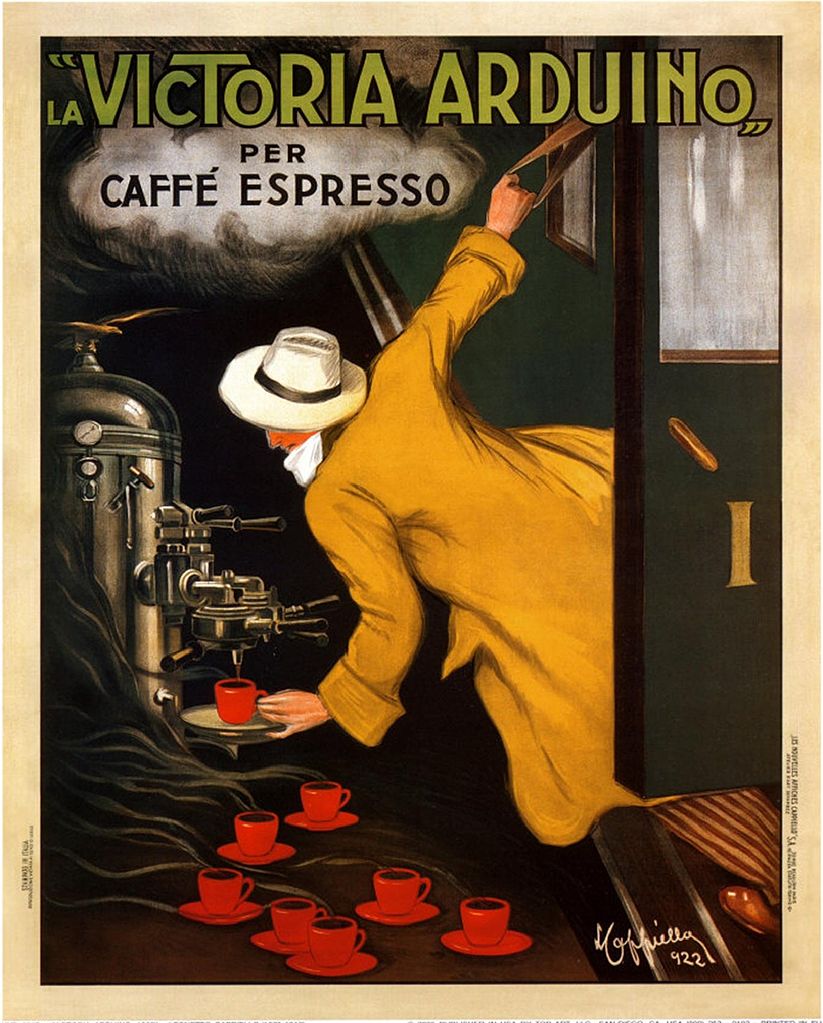
It’s the sort of efficiency the Father of the Modern Advertising Poster, Leonetto Cappiello, alluded to in his famous 1922 image for the Victoria Arduino machine (below).
Let 21st-century coffee aficionados cultivate their Zen-like patience with slow pourovers. A hundred years ago, the goal was a quality product that the successful businessperson could enjoy without breaking stride.
As coffee expert James Hoffmann, author of The World Atlas of Coffee points out in the above video, the Steam Age was on the way out, but Cappiello’s image is “absolutely leveraging the idea that steam equals speed.”
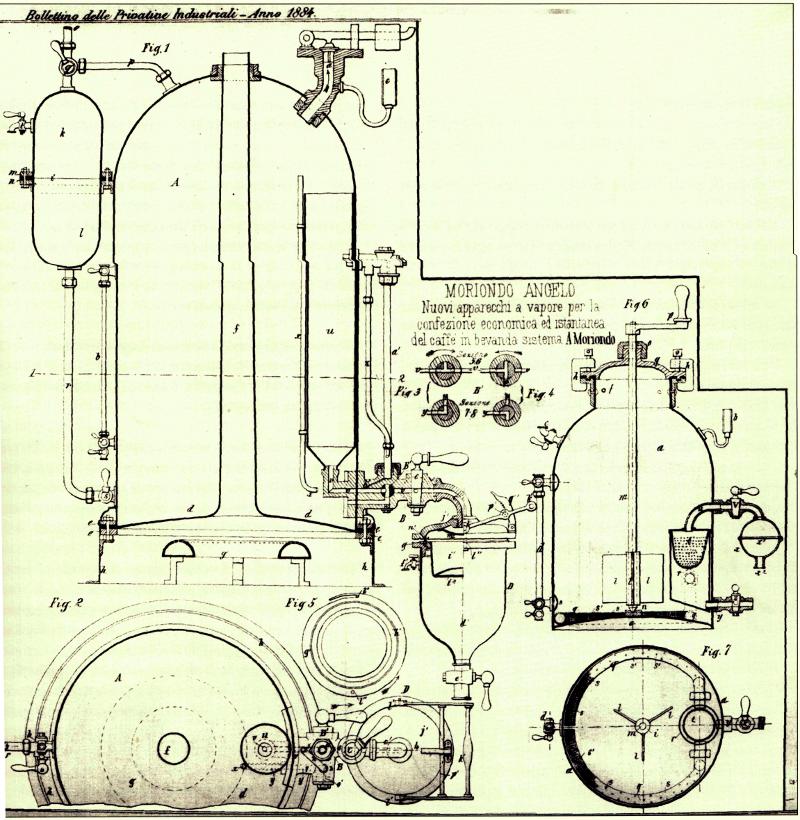
That had been the goal since 1884, when inventor Angelo Moriondo patented the first espresso machine (see below).
The bulk brewer caused a stir at the Turin General Exposition. Speed wise, it was a great improvement over the old method, in which individual cups were brewed in the Turkish style, requiring five minutes per order.
This “new steam machinery for the economic and instantaneous confection of coffee beverage” featured a gas or wood burner at the bottom of an upright boiler, and two sight glasses that the operator could monitor to get a feel for when to open the various taps, to yield a large quantity of filtered coffee. It was fast, but demanded some skill on the part of its human operator.
As Jimmy Stamp explains in a Smithsonian article on the history of the espresso machine, there were also a few bugs to work out.
Early machines’ hand-operated pressure valves posed a risk to workers, and the coffee itself had a burnt taste.
Milanese café owner Achille Gaggia cracked the code after WWII, with a small, steamless lever-driven machine that upped the pressure to produce the concentrated brew that iswhat we now think of as espresso.
Stamp describes how Gaggia’s machine also standardized the size of the espresso, giving rise to some now-familiar coffeehouse vocabulary:
The cylinder on lever groups could only hold an ounce of water, limiting the volume that could be used to prepare an espresso. With the lever machines also came some new jargon: baristas operating Gaggia’s spring-loaded levers coined the term “pulling a shot” of espresso. But perhaps most importantly, with the invention of the high-pressure lever machine came the discovery of crema – the foam floating over the coffee liquid that is the defining characteristic of a quality espresso. A historical anecdote claims that early consumers were dubious of this “scum” floating over their coffee until Gaggia began referring to it as “caffe creme,“ suggesting that the coffee was of such quality that it produced its own creme.
Note: An earlier version of this post appeared on our site in 2021.
Though it isn’t the kind of thing one hears discussed every day, serious Disney fans do tend to know that Goofy’s original name was Dippy Dawg. But how many of the non-obsessive know that Mickey’s faithful pet Pluto was first called Rover? (We pass over in dignified silence the quasi-philosophical question of why the former dog is humanoid and the latter isn’t.) It is Rover, as distinct from Pluto, who passes into the public domain this new year, one of a cast of now-liberated characters including Blondie and Dagwood as well as Betty Boop — who, upon making her debut in Fleischer Studios’ Dizzy Dishes of 1930, has a somewhat canoid appearance herself. You can see them all in the video above from Duke University’s Center for the Study of the Public Domain, with much more information available in their blog post marking this year’s “Public Domain Day.”
The year 1930, write the Center’s Jennifer Jenkins and James Boyle, was one “of detectives, jazz, speakeasies, and iconic characters stepping onto the cultural stage — many of whom have been locked behind copyright for nearly a century.”
Novels that come available this year include William Faulkner’s As I Lay Dying, Dashiell Hammett’s The Maltese Falcon, and Agatha Christie’s The Murder at the Vicarage; among the films are Lewis Milestone’s Best Picture-winning All Quiet on the Western Front, Victor Heerman’s Marx Brothers picture Animal Crackers, and Luis Buñuel and Salvador Dalí’s L’Âge d’Or. In music, compositions like “I Got Rhythm” and “Embraceable You” by the Gershwin Brothers as well as recordings like “Nobody Knows the Trouble I’ve Seen” by Marian Anderson and “Sweet Georgia Brown” by Ben Bernie and His Hotel Roosevelt Orchestra have also, at long last, gone public.
Reflection on some of these works themselves suggests something about the importance of the public domain. With the title of Cakes and Ale, another book in this year’s crop, Somerset Maugham makes reference to “a classic public domain work, in this case Shakespeare’s Twelfth Night”; so, for that matter, does Faulkner, given that the line “as I lay dying” comes from the Odyssey. “To tell new stories, we draw from older ones,” write Jenkins and Boyle. “One work of art inspires another — that is how the public domain feeds creativity.” Today, we’re free to take explicit inspiration for our own work from Nancy Drew, “Just a Gigolo,” Blondie, Mondrian’s Composition with Red, Blue, and Yellow, Hitchcock’s Murder!, and much else besides. And by all means use Rover, but if you also want to bring in Dippy Dawg, you’re going to have to wait until 2028.
Based in Seoul, Colin Marshall writes and broadcasts on cities, language, and culture. His projects include the Substack newsletterBooks on Cities and the book The Stateless City: a Walk through 21st-Century Los Angeles. Follow him on the social network formerly known as Twitter at @colinmarshall.
We're hoping to rely on loyal readers, rather than erratic ads. Please click the Donate button and support Open Culture. You can use Paypal, Venmo, Patreon, even Crypto! We thank you!
Open Culture scours the web for the best educational media. We find the free courses and audio books you need, the language lessons & educational videos you want, and plenty of enlightenment in between.