The idea of a youngster vacillating between whether to become a magician or join the Central Intelligence Agency may sound implausible, but those two working environments have deeper commonalities than it would seem. So, in any case, believes John McLaughlin, whose more than 30 years at the CIA included periods as its deputy director and acting director. He also describes himself as a lifelong amateur magician, an avocation that owes much to his boyhood discovery of Quicker Than the Eye, a magic manual from 1932 by one John Mulholland. Around the same time the young McLaughlin came across that book in the library, Mulholland was writing the more specialized guidebooks Some Operational Applications of the Art of Deception and Recognition Signals — though nobody without a serious security clearance would have known it.
In 1953, Mulholland left his position as editor of the magicians’ trade magazine The Sphinx, ostensibly for health reasons, but actually to go to work for the CIA. Formed just six years before, the organization was still determining what its mission of preventing surprise foreign attacks against the U.S. and countering the global advance of communism would entail on the ground. To anyone who’s made enough of a habit of novels and films dealing with Cold War espionage, it may come as no surprise that the arts of disguise, misdirection, and sleight of hand practiced by master magicians would look useful indeed to the CIA. “Just as a magician’s methods must elude detection in front of a closely attentive audience,” writes McLaughlin, “so an intelligence officer doing espionage work must elude close surveillance and pass messages and materiel without detection.”
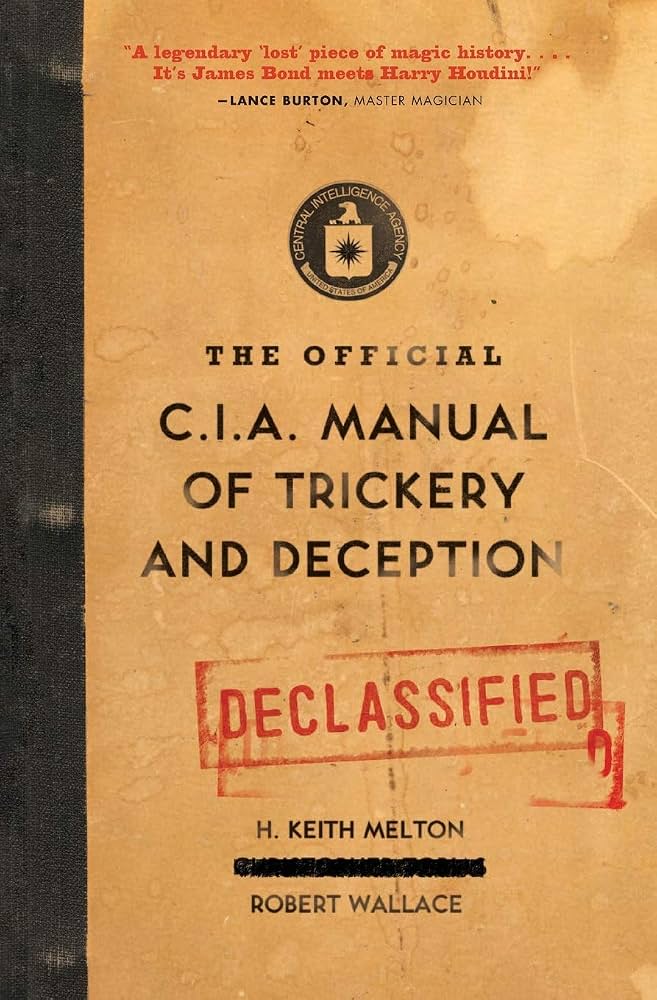
Additionally, “analysts must be as familiar as magicians with methods of deception, because analysts are almost always working with incomplete information and in circumstances where an adversary is seeking to mislead them — or in the magician’s term, misdirect them.” The Company’s specialists in counterintelligence described their subfield as a “wilderness of mirrors,” an expression professional illusionists must find especially evocative. Commissioned in the time of the CIA’s human-experimentation program MKULTRA, previously featured here on Open Culture, Mulholland’s manuals were long assumed officially destroyed along with many other of its documents in 1973. After they unexpectedly resurfaced during declassification in the two-thousands, they were published in The Official CIA Manual of Trickery and Deception by Agency historians H. Keith Melton and Robert Wallace. You can find a copy over at the Internet Archive.
At that time, the Boston Globe published illustrated explanations of some of Mulholland’s techniques, such as transporting spies using a mechanism similar to the one that conceals an apparently sawed-in-half stagehand, or surreptitiously dropping into a drink a pill affixed to the back of a book of matches. Amid “the superpower struggle for power and influence around the world,” writes Tom Scocca, “both the ideas and techniques of secret war pervaded the culture — the corrosive belief in hidden conspiracy and the nifty thrill of spycraft itself, the codes and disguises and miniature cameras.” Today, “Mulholland’s account of real-world stagecraft amounts to an etiquette manual for a lost moment of history. The matchbook trick depends on people smoking and drinking. There is a survey of the many pockets found in every man’s suit, and which ones are most natural for casually slipping objects into.” However much of the romance has drained out of espionage — as it has from so much else since the mid-twentieth century — the best magicians know that old tricks can always be re-enchanted for a new world. You can read The Official CIA Manual of Trickery and Deception here.
Related content:
The CIA’s Former Chief of Disguise Show How Spies Use Costumes in Undercover Operations
Inside MKUltra, the CIA’s Secret Program That Used LSD to Achieve Mind Control (1953–1973)
Based in Seoul, Colin Marshall writes and broadcasts on cities, language, and culture. He’s the author of the newsletter Books on Cities as well as the books 한국 요약 금지 (No Summarizing Korea) and Korean Newtro. Follow him on the social network formerly known as Twitter at @colinmarshall.




Leave a Reply