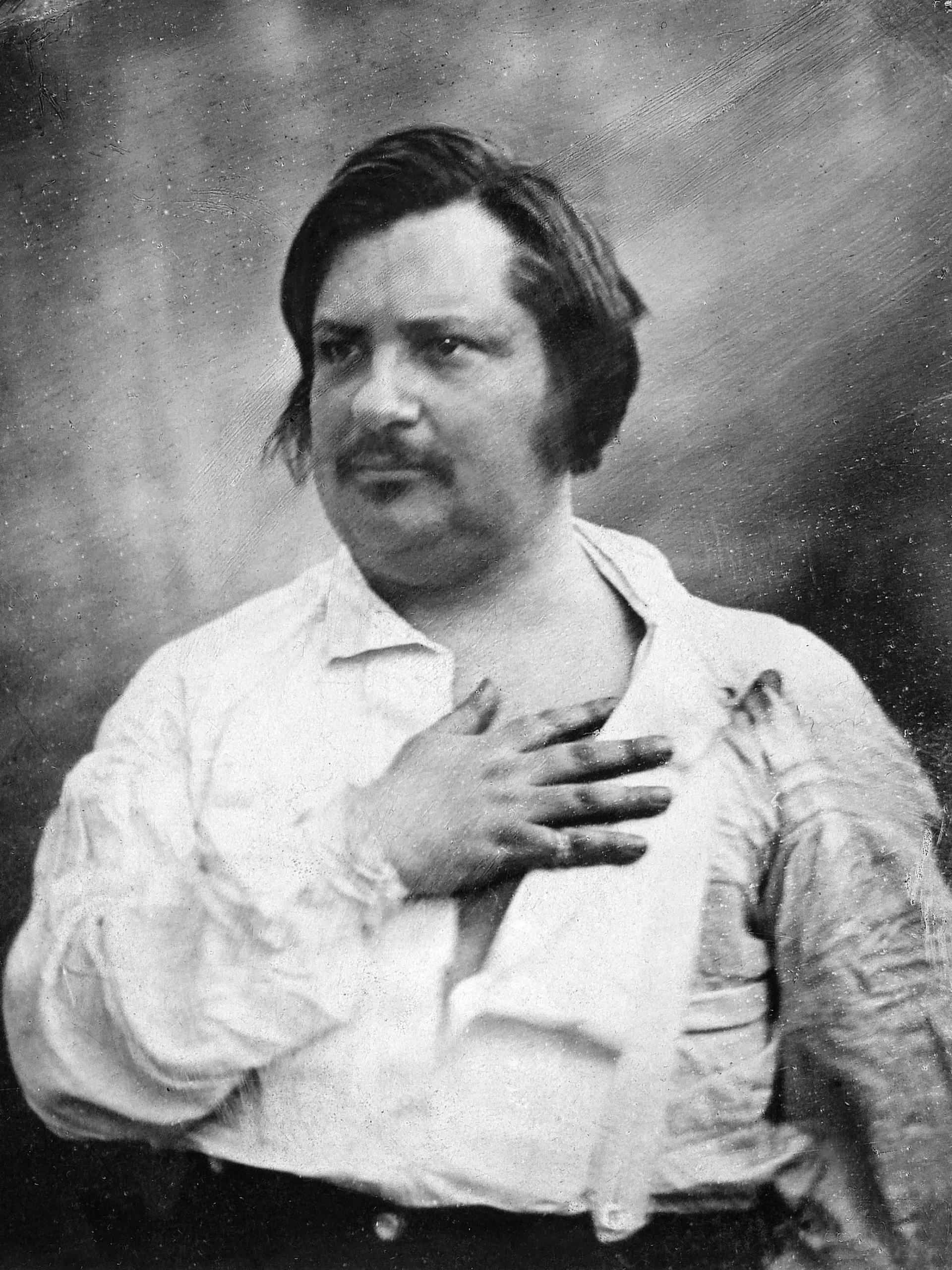
Even now, in this age when the very reading of literature is endangered — or so the articles tell us — Honoré de Balzac (1799–1850) retains a notable ability to pick up new admirers. But even though he may have a decent readership by the standards of French novelists who died in the middle of the nineteenth century, one does wonder whether he still inspires the kind of devotion embodied by William Hobart Royce. A Brooklyn bookseller’s assistant first introduced to Les Cent Contes drolatiques as an impressionable (and duly scandalized) teenager on a trip to England, Royce became not just the early twentieth century’s foremost American expert on Balzac, but also a kind of clone of the man himself, right down to his appearance.
“In their long association, Royce has contracted several habits from Balzac,” writes the New Yorker’s Alva Johnston in a 1933 profile. “When working late at night or early in the morning, he combats fatigue, as Balzac did, by taking snuff, smoking Latakia tobacco, and drinking enormous quantities of coffee. These are not mere whims or idol-worshipping ceremonies on the part of Royce; they are practices which he adopted from Balzac after testing them and convincing himself that they were sound.”
Balzac himself explains the importance of these substances to the writing life — nothing less, to his mind, than life itself — in “Traité des excitants modernes,” or “Treatise on Modern Stimulants,” an essay he appended to Physiologie du goût, the celebrated text by the lawyer-politician-gourmand Jean Anthelme Brillat-Savarin.
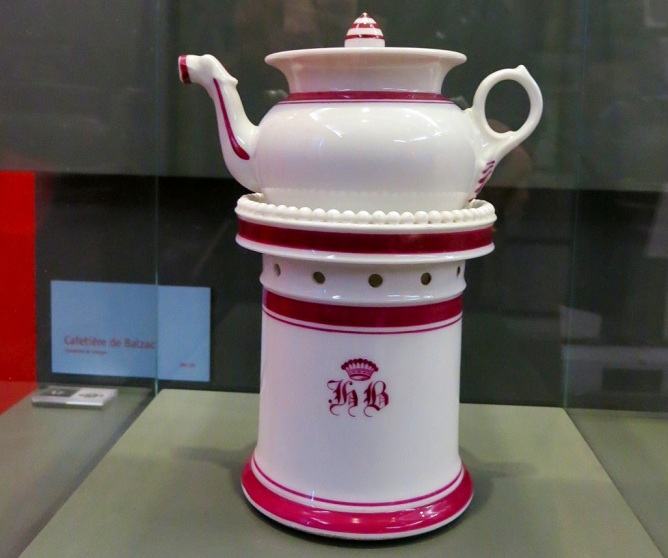
Known for drinking his own custom blend of beans from Martinique, coffee from Bourbon (now known as Réunion Island), and Mokha from the pot pictured above, Balzac also recommends to his fellow “men of excessive vigor” a “horrible, rather brutal method” involving “finely pulverized, dense coffee” prepared with as little water as possible and consumed on an empty stomach. In response, he promises in this partial English translation of the essay, “ideas quick march into motion like battalions of a grand army to its legendary fighting ground, and the battle rages. Memories charge in, bright flags on high; the cavalry of metaphor deploys with a magnificent gallop; the artillery of logic rushes up with clattering wagons and cartridges; on imagination’s orders, sharpshooters sight and fire; forms and shapes and characters rear up.”
In the case of Balzac, who created thousands of characters and deployed them across his body of work, that charge could have been a fearsome sight indeed. Yet he proved equal to it night after writing night, sitting down to his desk some time between midnight and 2:00 a.m., then producing manuscript pages with his quill at a typewriter’s pace until morning. After a nap, more work followed until 4:00 or so in the afternoon; soon thereafter would come an early-evening dinner, and thus the cycle would repeat. A commonly cited figure holds that Balzac drank as many as 50 cups of coffee per day, which even the most proudly caffeine-hooked laptop jockey today would struggle to touch. Nor would it be advisable to try, given that Balzac’s formidable coffee habit may have contributed to his death at age 51 — but then, it certainly played a part in the productivity that ensured his immortalité.
Related content:
Paul Giamatti Plays Honoré de Balzac, Hopped Up on 50 Coffees Per Day
Is Coffee Good for You?: A Coffee Connoisseur Reviews the Scientific Research
Philosophers Drinking Coffee: The Excessive Habits of Kant, Voltaire & Kierkegaard
The Case for Writing in Coffee Shops: Why Malcolm Gladwell Does It, and You Should Too
How Coffee Affects Your Brain: A Very Quick Primer
Based in Seoul, Colin Marshall writes and broadcasts on cities, language, and culture. He’s the author of the newsletter Books on Cities as well as the books 한국 요약 금지 (No Summarizing Korea) and Korean Newtro. Follow him on the social network formerly known as Twitter at @colinmarshall.


Leave a Reply