Ray Ellis had a six-decade career as a producer, arranger, and jazz composer. And while he’s best known for arranging music for Billie Holiday’s Lady in Satin(1958), he also enjoyed a long career orchestrating music for television. Working under a pseudonym “Yvette Blais” (his wife’s name), Ellis composed background music for the cartoon studio Filmation between 1968 and 1982. And, during the late 60s, he notably created the background and incidental music for the original Spider-Man cartoons.
Above, hear Ray Ellis’ Spider-Mansoundtrack. The show’s talking parts and sound effects have been removed as much as possible, then “pieced back together into complete form,” by a YouTuber who uses the moniker “11db11.” All of the music from Season 1 is included, plus many recordings from Seasons 2 and 3. It’s worth noting that the 52 episodes from the original 1967 Spider-Man TV series have been completely restored. You can purchase them on DVD online.
Note: An earlier version of this post appeared on our site in 2017.
Scholars disagree on when, exactly, Rome fell. But if you watch the new video from City 3D Timelapse above, you’ll understand the lack of debate on the question of whether it fell. Around the turn of the sixth century AD, buildings start vanishing at a rate that soon turns alarming; long before the end of the first millennium, it’s clear that Rome has been plunged into very hard times indeed. In the video’s accelerated visual history, that much-scrutinized 500-year span passes in a little more than five seconds. Just one minute later, it has spread not just beyond the old city limits, but beyond the very frame of the aerial view, becoming the vast urbanized region we know today.
Legend has it that Rome was founded in 753 BC, when Romulus killed his twin brother Remus. As reflected by the video, archaeological evidence suggests that the area was settled earlier, though the traditional date of Rome’s founding roughly coincides with the emergence of what we know as the Roman Kingdom.
There follow the Roman Republic, the Roman Empire, the medieval era — when the once-formidable Eternal City was left practically for dead — the Renaissance, the Roman Baroque period, the industrial era, and finally, our time of globalization. For reference, the classical archaeologist Giovanni Piranesi went to Rome and drew his influential etchings of its ruins around the 1:55 mark of this three-minute video.
Not that the Rome captured in Piranesi’s Vedute bears much resemblance to the Rome of the twenty-first century, for better or for worse. You can still see the Colosseum by moonlight, but the ambience won’t be the same: the overgrowth has long since been scraped off, and the cargo shorts are out in force year-round. Regardless, no city is best appreciated through its landmarks alone, not even the modern Rome so long both celebrated and dismissed as an open-air museum. Watching it rise, fall, and rise again from above within the length of a Eurovision song reminds us that it wasn’t built, or rebuilt, in a day — and that, in the face of often-formidable difficulties, it even now manages to put up something new once in a while.
Based in Seoul, Colin Marshall writes and broadcasts on cities, language, and culture. He’s the author of the newsletterBooks on Cities as well as the books 한국 요약 금지 (No Summarizing Korea) and Korean Newtro.Follow him on the social network formerly known as Twitter at @colinmarshall.
Sir Christopher Lee and Edgar Allan Poe went way back. Or at least they went as far back as 1969, the year of The OblongBox, a loose and lurid film adaptation of the eponymous story starring Lee and the also Poe-associated Vincent Price. Lee plays the doctor to whom a gang of grave-robbers delivers Price’s character, an Englishman disfigured in a voodoo ceremony who fakes his own death in order to escape the captivity of his brother. Whatever its entertainment value, the picture doesn’t rank especially high in the canon of Poe adaptations. Nor, for that matter, does the original story rank alongside works like “The Pit and the Pendulum,”“The Fall of the House of Usher,”“The Cask of Amontillado,” or “The Black Cat.”
You can hear Lee himself read all those macabre, imaginative stories and others besides in the YouTube playlist above. Some of the recordings come from Christopher Lee Reads Edgar Allan Poe Tales of Horror, the 1979 budget-label cassette previously featured here on Open Culture. Others include Lee’s performances of “The Masque of the Red Death,”“The Tell-Tale Heart,”“Hop-Frog,” and “The Murders in the Rue Morgue,” which is commonly credited with launching the entire genre of detective fiction.
Though now most widely remembered as a horror actor, the prolific Lee proved commanding in a variety of genres: in the final decade of his life, he appeared in numerous crime pictures, adaptations of The Golden Compass and Charlie and the Chocolate Factory, and several Star Wars and Lord of the Rings movies.
Not that he’d left Poe behind. Among the last credits Lee racked up in his lifetime is Extraordinary Tales, from 2013, a five-story anthology film in which he narrates “The Fall of the House of Usher.” Though British, his distinctive manner and slightly mid-Atlantic accent were as versatile on the screen as they were in readings of Poe, whose writing dates from a time when more than a few Americans still considered literature itself an import from across the pond. This Halloween, if you don’t have the hours free for a complete listen-through of the playlist do consider at least putting on “The Raven.” It remains a matter of debate among Poe enthusiasts to what extent Lee’s delivery of “nevermore” really captures the spirit of the poem, but it would be hard to imagine a more appropriate figure to preside over All Hallows’ Eve.
Based in Seoul, Colin Marshall writes and broadcasts on cities, language, and culture. He’s the author of the newsletterBooks on Cities as well as the books 한국 요약 금지 (No Summarizing Korea) and Korean Newtro.Follow him on the social network formerly known as Twitter at @colinmarshall.
Animator Josh Rudder of NativLang did a fair amount of digging in service of finding out What Latin Sounded Like, above.
(And he seems to have done so without the help of Derek Jarman’s NSFW Sebastiane, the only feature film to be filmed entirely in sermo vulgaris or vulgar Latin.)
Instead, he draws from ancient rhetorician Quintilian and Virgil’s poetic meter. Scroll backward through the Romance languages, and you’ll see Germanic tribes trading with and fighting ancient Roman troops.
The result is not so much a reconstructive pronunciation guide as a linguistic detective story.
Note: An earlier version of this post appeared on our site in 2016.
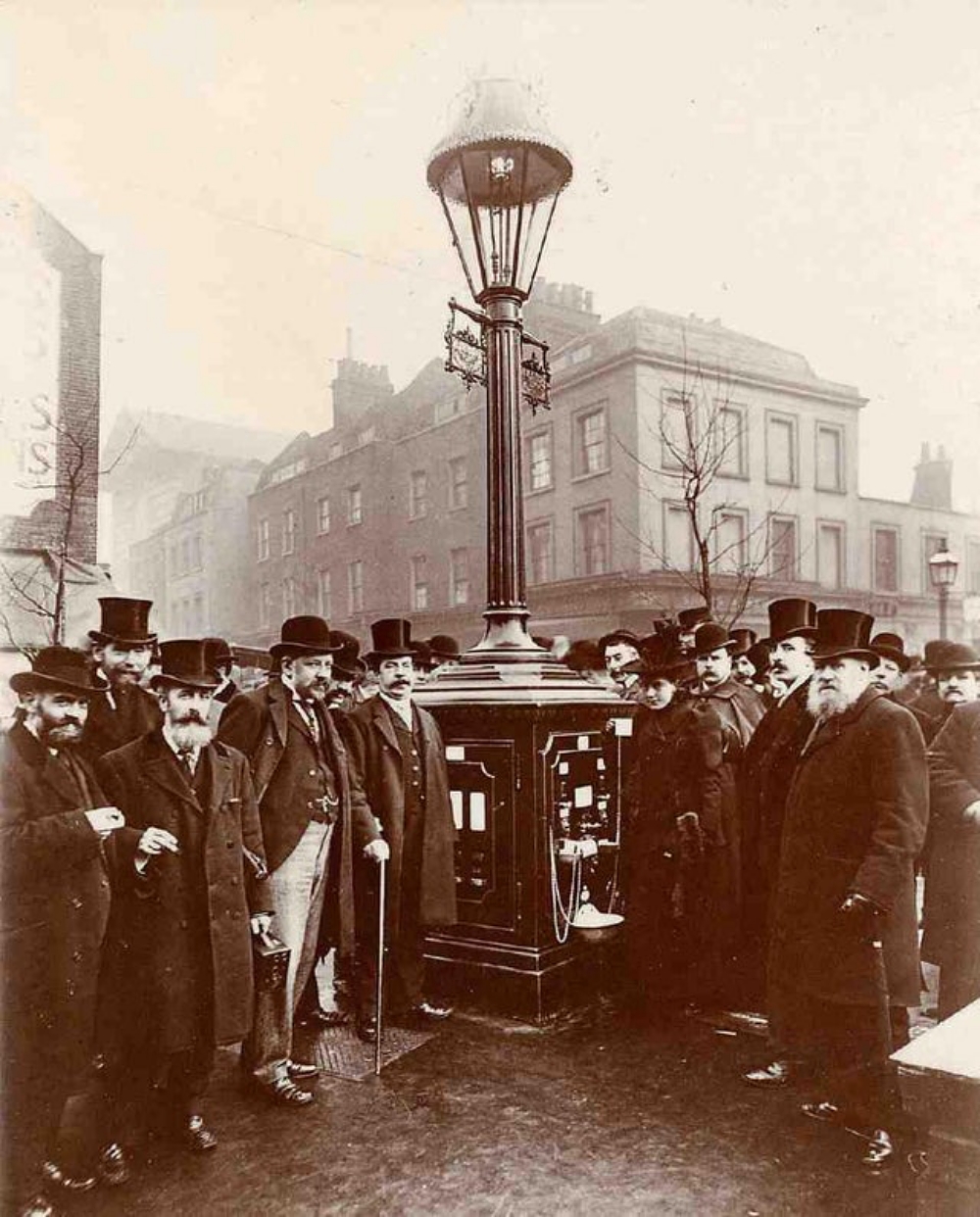
Any reader of Victorian literature will wonder how much a ha’penny was actually worth in those days. For a little more than a year at the very end of that period, it could buy you a cup of coffee, cocoa, milk, tea, or “fluid beef” — which would pour out of a lamppost on the corner. The Pluto Lamp, as it was branded, made its debut at the Victorian Era Exhibition, which was held in 1897 to celebrate the Queen’s Diamond Jubilee. Amid such attractions as a 360-degree panorama of ancient Rome, Pepper’s ghost illusions, and over 1,200 works of art by the likes of J. M. W. Turner, John Constable, and 180 specially selected female artists, a beverage-dispensing streetlight might seem mundane. Yet apart from being a technological marvel in its own way, it also presaged the technology-saturated streets one day to come.
Not long after the Victorian Era Exhibition, Pluto Lamps appeared in several London locations, including Exmouth Street in Clerkenwell, Leicester Square, and Rosebery Avenue. In addition to the illumination of their surroundings, and the drinks warmed by the excess heat thus generated, they in some cases offered postcards and four-to-the-penny cigarettes for sale as well.
However much attention the Pluto Lamps attracted as a novelty, this was still the infancy of the modern vending machine, whose deficiencies had yet to be fully worked out. It proved impossible, at the time, to defeat the enterprising scoundrels who used round pieces of tin in place of genuine currency, and in any case, maintenance costs seem to have proven unexpectedly high. (To say nothing of the prospect of drinking out of an enamel cup on a chain, shared with the entire public, which surely put off even some Victorians.)
All of the Pluto Lamps were decommissioned before the end of the nineteenth century, but they’d done their bit to expand public ideas of what was possible in the urban public realm. “For over a century, lamp posts would again do little more than shine light on to the city streets below,” writes Lukas Neckermann in Smart Cities, Smart Mobility. “But by the early twenty-first century, the spirit of the Pluto Lamps returned. City infrastructure and street furniture would once again become multi-purpose, multi-use, entrepreneurial, and connected.” And indeed, though talk of “smart cities” may now sound as dated and unappealing as that of fluid beef, lampposts have more recently been given such side jobs as vehicle charging, environmental protection, and even crime prevention. That last brings back to mind the Clerkenwell Pluto Lamp, equipped as it was with a telegraph recorder connected straight to Scotland Yard: a device that, had it lasted longer, might have inspired many a Victorian novelist.
Based in Seoul, Colin Marshall writes and broadcasts on cities, language, and culture. He’s the author of the newsletterBooks on Cities as well as the books 한국 요약 금지 (No Summarizing Korea) and Korean Newtro.Follow him on the social network formerly known as Twitter at @colinmarshall.
Two of the books that most shaped American culture both happened to bear the nickname “The Big Book.” While the second of these, the A.A. Manual, published in 1939, changed the country with 12-Step recovery groups, the first of these, the Sears Catalog, transformed America with mass consumption, offering customers in every part of the country access to modern conveniences and retail goods of all kinds at unheard of prices. Beginning in 1908, Sears started selling entire houses, in approximately 25-ton kits transported by railroad, consisting of 30,000 pre-cut parts, plumbing and electrical fixtures, and up to 750 pounds of nails.
“In an era before commercial aviation and long-haul trucking,” Curbed marvels, “Sears, Roebuck & Co. set up an operation that would package and ship more than 400 different types of homes and buildings to anybody who had the cash and access to a catalog.”
They started small, and just as they didn’t come up with the concept of the mail order catalog, Sears didn’t invent the kit house, though they suggest as much in their telling of the story. Instead they may have taken the idea from another company called Aladdin. Aladdin houses have been forgotten, however, and even Sears’ main competitor, Montgomery Ward, didn’t catch up until 1921 and only lasted ten years in the kit house business.
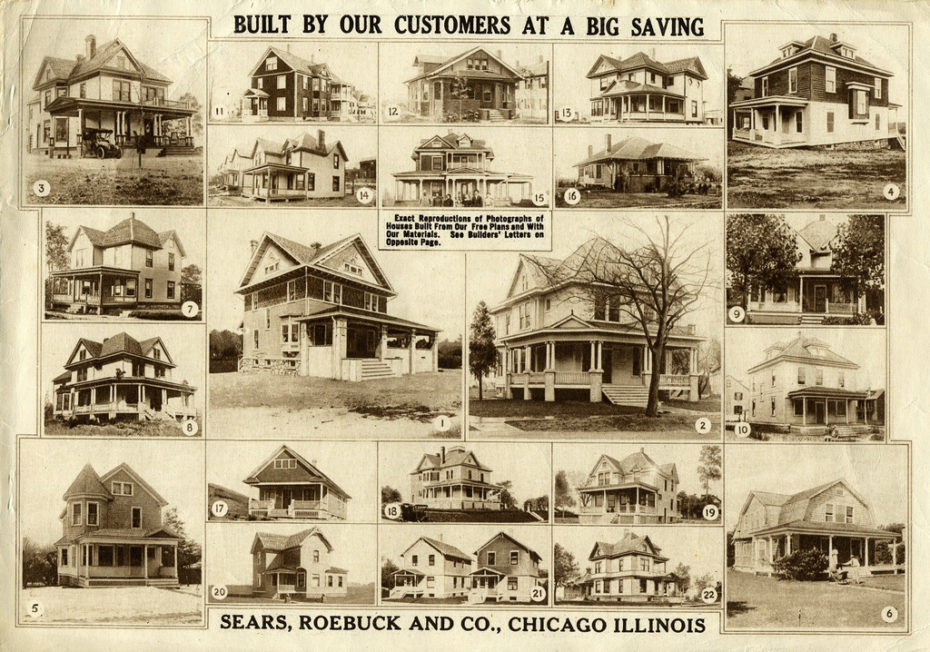
Sears houses, on the other hand, are celebrated and sought out as models of the early 20th century American home, and for good reason. Between 1908 and 1939, Sears sold 70–75,000 houses in 447 different styles all over the country. “From Craftsman to Cape Cods, they offered a custom home at budgets and sizes that could accommodate any size family,” writes Popular Mechanics.
These Sears homes weren’t cheap low-end houses. Many of them were built using the finest quality building materials available during that time. It’s not uncommon to find Sears homes today with oak floors, cypress siding, and cedar shingles.
What’s even more extraordinary is that 50% of these were built by the homeowners themselves, usually, as in a barn-raising, with the generous help of family, friends, and neighbors. The other half sold were built professionally. “Often,” writes Messy Nessy, “local builders and carpentry companies purchased homes from Sears to build as model homes and market their services to potential customers.”
These houses could have a significant effect on the character of a neighborhood. Not only could potential buyers see firsthand, and participate in, the construction. They could also order the same or a similar model, customize it, and even—as the company tells us in its own short history of the “Sears Modern Home”—design their own homes and “submit the blueprints to Sears, which would then ship off the appropriate precut and fitted materials.”
Sears sounds modest about its impact. The company writes it was not “an innovative home designer” but instead “a very able follower of popular home designs but with the added advantage of modifying houses and hardware according to buyer tastes.” Yet Sears houses aren’t beloved for their forward-looking designs, but for their sturdiness and variety, as well as for their impact on “the emotional lives of rural folk,” as Messy Nessy puts it.
“The Sears mail-order catalogues were sitting on kitchen countertops inside millions of American homes, allowing potential homeowners to both visualize their new home and purchase it as easily as they might have bought a new toaster.” Building a house required a little more investment than plugging in a toaster, and required a 75-page instruction book, but that’s another part of why Sears house hunters are such a dedicated bunch, awestruck at each still-standing model they’re able to photograph and match up with its catalog illustrations and floor plans.
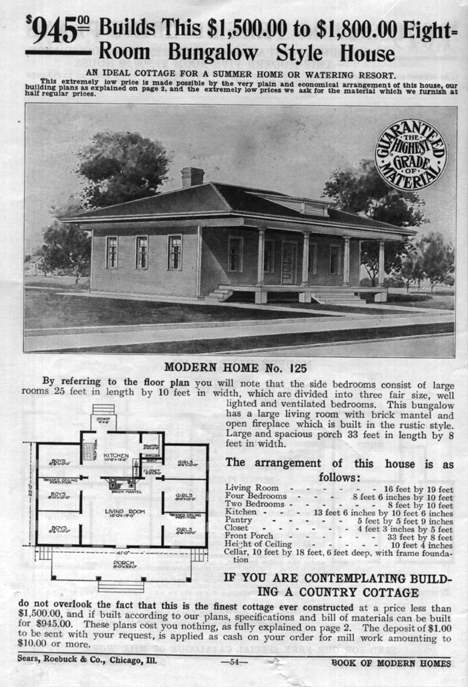
In its first year of production, 1908, Sears sold only one model, number 125, an Eight-Room Bungalow Style House for $945, advertised as “the finest cottage ever constructed at a price less than $1500.” In 1918, the company moved from a numbering system to named models, most of which sound like the names of cozy small towns and bedroom communities: Adeline, Belmont, Maplewood, Avalon, Kilbourne, Del Ray, Stone Ridge…. (See a full list of these models at The Arts & Crafts Society website.)
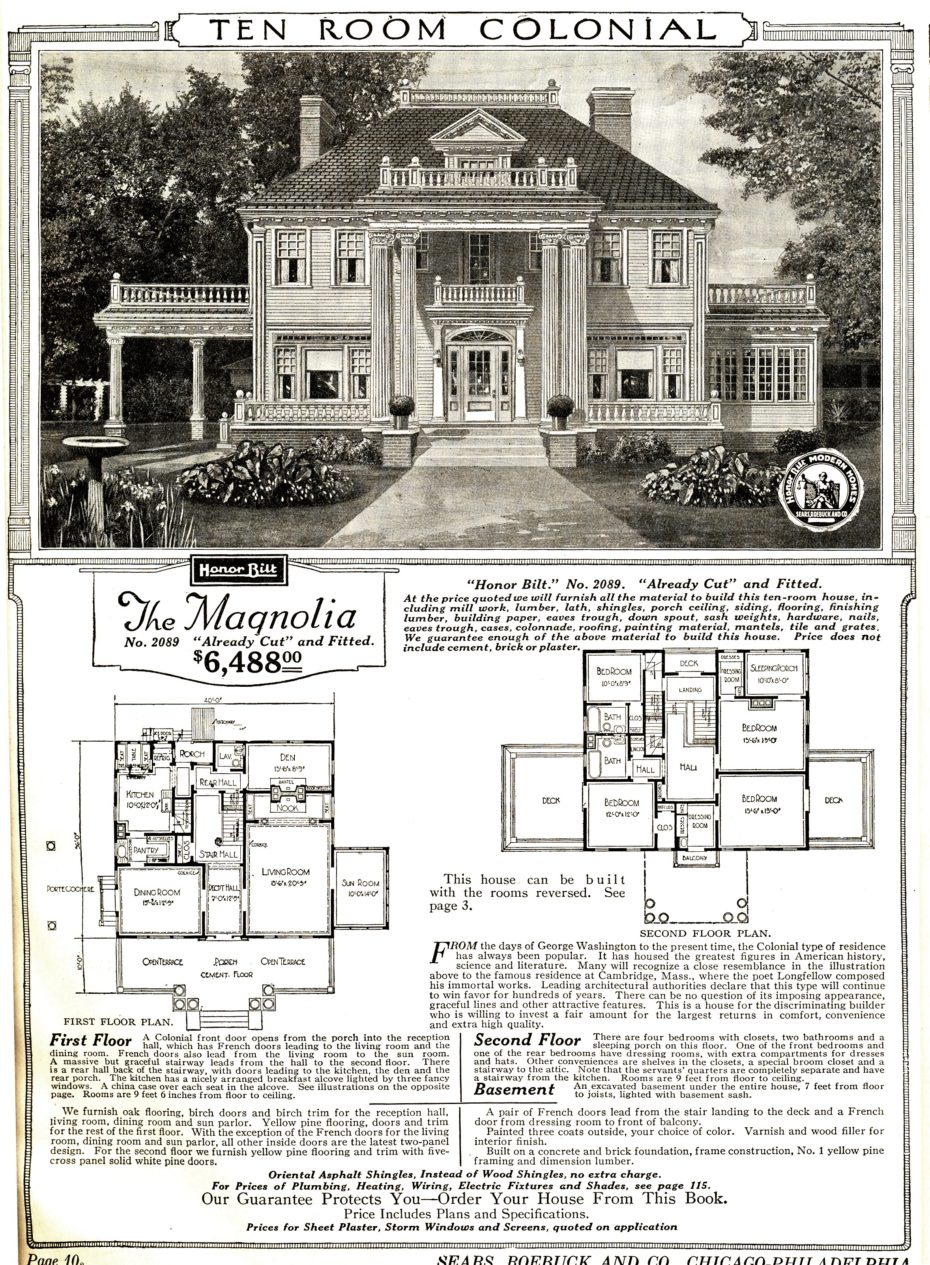
In the years Sears sold houses, between 54 and 44 percent of Americans lived in rural areas, and these constituted Sears’ most loyal customers, given that the catalog allowed them to purchase things they could buy nowhere else, including ten room colonial mansions like The Magnolia, available from 1913 to 1922 for $6,488, or roughly $88,000—a steal if you can put in the work. This was the largest and most expensive model the company offered, “a three-story, eight room neo-Georgian with a two-story columned portico, porte-cochere, and sleeping porches.” (Mint juleps and servants’ quarters not included.)
Sears eventually offered three build qualities, Honor Bilt, Standard Built, and Simplex Sectional. At the lowest end of the price and build spectrum, the company notes, “Simplex houses were frequently only a couple of rooms and were ideal for summer cottages.” Many of its low-end and early models did not include bathrooms, and the company sold outhouses separately. But due to innovative construction methods, even the least expensive houses held up well.
Because the company lost most of the records after its kit house business folded, it can be difficult to identify a Sears house. And because even the “youngest of Sears homes,” Popular Mechanics points out, is now going on nine decades old, they all require a significant amount of care.” The blog Kit House Hunters has found over 18,000 Sears houses still standing across the country, most of them in the Northeast and Midwest, where they sold best. (One community in Elgin, IL has over 200 verified Sears homes.)
In the video at the top, you can see a few of those well-built Sears houses still lived in today. The short How to Architect video above points out that “Sears had a massive impact on the business of home-building, and… the business of pre-fabrication, is alive and well today.” For a look at the variety and intricacy of the Sears Modern Home designs, see this Flickr gallery with over 80 images of catalog pages, illustrated homes, and floor plans. And if you think you might be living in one of these houses, many of which have been granted historic status, find out with this handy 9‑step guide for identifying a Sears Kit Home.
Note: An earlier version of this post appeared on our site in 2018.
Cast your mind, if you will, back to the year 2020. It now feels like a different time, what with the spreading COVID-19 pandemic and the heated sociopolitical battles being waged online, and indeed in the (socially distanced) streets. That spring, we featured here on Open Culture an amusing retro-technological diversion called Hyperland. First broadcast on BBC2, the program stars The Hitchhiker’s Guide to the Galaxy author Douglas Adams as himself and Doctor Who’s Tom Baker as his agent. “You want fifteen percent?” the former asks the latter when they first meet in a vast wasteland of flickering television sets. Not at all: “I’m here to do your every slightest bidding,” Baker explains, “to fetch and carry for you, to work tirelessly and selflessly on your behalf, always ready, always willing, no job too small or too menial.”
Today, we can hardly share in Adams’ bewilderment, familiar as we are with the notion of what Baker calls a “software agent,” an “artificial and completely customizable personality” with “instant access to every piece of information stored digitally anywhere in the world: any picture or film, any sound, any book, any statistic, any fact, any connection between anything you care to think of.” We must remind ourselves that Hyperland was produced in 1990, when these lines would have struck all but the most computer-savvy and forward-looking viewers as sheer science fiction. Even three decades thereafter, they still sounded more or less like an elevated version of ordinary late-twentieth-century techno-optimism. Here in 2026, Baker’s services are close to being considered a basic necessity, at least in Silicon Valley and its global provinces.
Not so very long ago, Hyperland looked startlingly prescient about the rise of the World Wide Web, which would soon let its users seek out their own desired pieces of information and media, actively moving through links between them, in a manner unlike the passive viewing experience of television (with which it would, as no one then knew, one day converge). This was an unfamiliar idea to most people in 1990; hence the variety of clear and entertaining ways in which the program breaks down its technological basis, pulling up clips from its onscreen “database” like an interview with Ted Nelson, who coined the term hypertext. Like multimedia, that word may carry a whiff of antiquity today, but it was once on the lips of practically every technologist in popular culture — in a manner reminiscent of the lexicon that has sprung from new developments in artificial intelligence over the past few years.
At times, Baker’s character now looks almost realistic, as when Adams asks him to knock off the obsequiousness, or when he pulls up Kurt Vonnegut’s theory of story form before Adams fully gets the question out. Yet Hyperland devotes little time to AI per se. The program appeared in the wake of the eighties’ AI boom, when “expert systems” promised to solve problems in industry, medicine, and other sectors, but many of the field’s larger ambitions went unrealized. There followed a long “AI winter” in research and development, in whose climate Baker-as-“agent” would have been a means of humanizing an abstract-seeming concept of organizing and navigating information. Not that all his enthusiastically proffered services draw unqualified enthusiasm from Adams, who possessed a rare combination of Californian technophilia and British skepticism. His fascination with humanity’s digital future is ours — and so is his wariness.
Based in Seoul, Colin Marshall writes and broadcasts on cities, language, and culture. He’s the author of the newsletterBooks on Cities as well as the books 한국 요약 금지 (No Summarizing Korea) and Korean Newtro.Follow him on the social network formerly known as Twitter at @colinmarshall.
Smack in the middle of Pink Floyd’s classic Dark Side of the Moon sits a song many listeners may hear as an extended bridge between the two true centerpieces, “Time” and “Money.” But I’ve always thought of “The Great Gig in the Sky” as the album’s true center, a swirling, swinging, soulful prog-rock masterpiece, carried to stratospheric heights by British singer Clare Torry. The song’s wordless gospel vocal makes it an ecstatic, even hopeful, tent pole supporting DarkSide’s brilliantly cynical songs about the banality and injustice of modern life.
“The Great Gig in the Sky,” that is to say, provides much-needed emotional release in an album that can sound, writes Alexis Petridis, “like one long sigh.” Yet if you know the story of Dark Side of the Moon and of Clare Torry’s defining contribution, you’ll know that her incredible soaring vocal was sheer happenstance, an improvisation by a young singer brought in at the last minute by producer Alan Parsons—and one who wasn’t a particular fan of the band. (“If it had been The Kinks,” she remembered, “I’d have been over the moon.”)
Torry reluctantly stepped into the studio and asked the band, “Well, what do you want?” Basically, she says, “they had no idea.” An isolated track from Alan Parsons’ 1973 mix (above) strips the song down to piano, drums, slide guitar, and Torry’s voice. Early live versions of the song in 1972 had featured Bible readings and recorded speeches by conservative writer Malcolm Muggeridge; in the final version, these gave way to snippets of the band’s crew and friends answering questions about death.
When Torry went into the vocal booth and put on the headphones, she would have heard an even more stripped-down mix. Given no other instruction than “we don’t want any words,” she decided, “I have to pretend to be an instrument.”
Torry’s vocal is so distinctive that she eventually won a settlement in 2005 for a co-songwriting credit with Wright—an outcome some songwriting experts agree was fully justified since she essentially created a new melody for the song. In the interview above, hear Torry describe how she “had a little go” and, after some guidance from David Gilmour and a can of Heineken, casually knocked out one of the most thrilling vocal performances in rock history.
Note: An earlier version of this post appeared on our site in 2017.
We're hoping to rely on loyal readers, rather than erratic ads. Please click the Donate button and support Open Culture. You can use Paypal, Venmo, Patreon, even Crypto! We thank you!
Open Culture scours the web for the best educational media. We find the free courses and audio books you need, the language lessons & educational videos you want, and plenty of enlightenment in between.