Will You Really Achieve Happiness If You Finally Win the Rat Race? Don’t Answer the Question Until You’ve Watched Steve Cutts’ New Animation

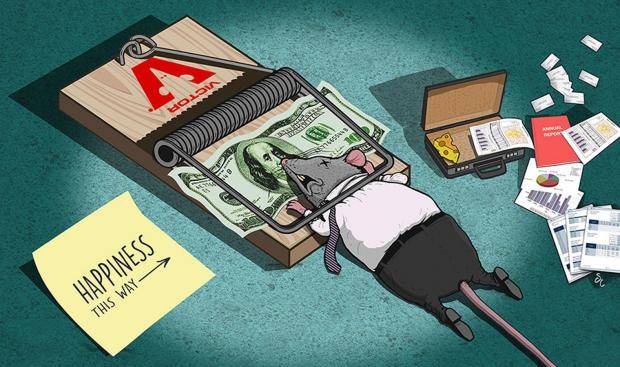
Illus­tra­tor Steve Cutts sets his lat­est ani­ma­tion, “Hap­pi­ness,” in a teem­ing urban envi­ron­ment, with hun­dreds of near iden­ti­cal car­toon rats stand­ing in for human drudges in an unful­fill­ing, and not unfa­mil­iar race.

Packed sub­way cars, a bom­bard­ment of adver­tis­ing, soul-dead­en­ing office jobs, and Black Fri­day sales are just a few of the indig­ni­ties Cutts’ rodents are sub­ject­ed to, to the tune of Bizet’s “L’amour est un oiseau rebelle.”

Ram­pant over-consumption—a major pre­oc­cu­pa­tion for this artist—offers illu­so­ry relief, and a great deal of fun for view­ers with the time to hit pause, to bet­ter savor the grim details.

The max­i­mal­ist frames read like a grat­i­fy­ing per­ver­sion of Richard Scarry’s relent­less­ly sun­ny Busy­town. As with Cutts’ 80s-throw­back Simpson’s couch gag: pop-cul­ture ref­er­ences and visu­al input whip by at sub­lim­i­nal warp speed. 

They may also serve as an anti­dote to the sort of mes­sag­ing we’re con­stant­ly on the receiv­ing end of, whether we live in city, coun­try or some­where in-between. Check out the scene as Cutts pans up from the sub­way plat­form, 52 sec­onds in:

The panty-clad female mod­el for Blah cologne’s fash­ion­ably black and white ad is ema­ci­at­ed near­ly to the point of death.

“You’re bet­ter than laces” flat­ters the lat­est (lace­less) shoe from a swoosh-bedecked footwear man­u­fac­tur­er, while a radi­a­tor-col­ored bev­er­age floats above the mot­to “Just drink it, morons.”

Krispo Flakes fight depres­sion with “the bits oth­er cere­als don’t want.”

Heav­en help us all, there’s even a poster for TRUMP The Musi­cal.

This freeze-frame scruti­ny could make an excel­lent activ­i­ty for any class where mid­dle and high school­ers are encour­aged to think crit­i­cal­ly about their role as con­sumers.

As Cutts, a one-time employ­ee of the dig­i­tal mar­ket­ing agency, Iso­bar, who con­tributed to cam­paigns for such glob­al giants as Coca-Cola, Google, Reebok, and Toy­ota, told Reverb Press in 2015:

These are things that affect us all on a fun­da­men­tal lev­el so nat­u­ral­ly they’re a main focus for a lot of my work. Human­i­ty has the pow­er to be great in so many ways and yet at the same time we are fun­da­men­tal­ly flawed. I think it’s the con­flict between these two that fas­ci­nates me the most. As a race of beings we’ve made incred­i­ble achieve­ments in such a short space, but at the same time we seem so over­whelm­ing­ly intent on destroy­ing our­selves and every­thing around us. It would be very inter­est­ing to see where we’ll be in a hun­dred years. The term insan­i­ty is intrigu­ing – it’s almost like we’re encour­aged to act in a way that seems gen­uine­ly insane when you look at it objec­tive­ly, but it’s often accept­ed as nor­mal right now. I think we will have to evolve beyond our cur­rent think­ing and way of doing things if we want to sur­vive.

See more of Cutts’ ani­mat­ed work here. And while he doesn’t go out of his way to hype his online store, a gallery qual­i­ty print of The Rat Trap would make a fan­tas­tic gift from your cubi­cle mate’s Secret San­ta. (HURRY! TIME IS RUNNING OUT!!!)

Relat­ed Con­tent:

The Employ­ment: A Prize-Win­ning Ani­ma­tion About Why We’re So Dis­en­chant­ed with Work Today

Bertrand Rus­sell & Buck­min­ster Fuller on Why We Should Work Less, and Live & Learn More

Charles Bukows­ki Rails Against 9‑to‑5 Jobs in a Bru­tal­ly Hon­est Let­ter (1986)

Ayun Hal­l­i­day is an author, illus­tra­tor, the­ater mak­er and Chief Pri­ma­tol­o­gist of the East Vil­lage Inky zine.  Fol­low her @AyunHalliday.

500,000 Years of Humans Degrading Nature Captured in a Biting Three Minute Animation by Steve Cutts

Eng­lish ani­ma­tor Steve Cutts has a knack for sat­i­riz­ing the excess­es of mod­ern soci­ety. Just watch his 2012 short ani­ma­tion “Man,” and you’ll see what I mean. In three short min­utes, Cutts cov­ers a lot of ground, doc­u­ment­ing the rise of human civ­i­liza­tion and its ever-esca­lat­ing assault on nature and our nat­ur­al resources. It’s fun­ny. It’s bit­ing. And it may give you pause as we gear up for Christ­mas, the apoth­e­o­sis of Amer­i­can mate­ri­al­ism.

If you would like to sup­port the mis­sion of Open Cul­ture, con­sid­er mak­ing a dona­tion to our site. It’s hard to rely 100% on ads, and your con­tri­bu­tions will help us con­tin­ue pro­vid­ing the best free cul­tur­al and edu­ca­tion­al mate­ri­als to learn­ers every­where. You can con­tribute through Pay­Pal, Patre­on, and Ven­mo (@openculture). Thanks!

Relat­ed Con­tent:

The Employ­ment: A Prize-Win­ning Ani­ma­tion About Why We’re So Dis­en­chant­ed with Work Today

Watch Glass Walls, Paul McCartney’s Case for Going Veg­e­tar­i­an

How Leo Tol­stoy Became a Veg­e­tar­i­an and Jump­start­ed the Veg­e­tar­i­an & Human­i­tar­i­an Move­ments in the 19th Cen­tu­ry

Depression & Melancholy: Animated Videos Explain the Crucial Difference Between Everyday Sadness and Clinical Depression

“Depres­sion,” the TED-Ed video above informs us, “is the lead­ing cause of dis­abil­i­ty in the world.” This may be a hard fact to swal­low, the prod­uct, we might think, of phar­ma­ceu­ti­cal adver­tis­ing. We all feel down from time to time, we think. “Then cir­cum­stances change, and those sad feel­ings dis­ap­pear.” Isn’t it like this for every­one? It is not. “Clin­i­cal depres­sion is dif­fer­ent. It’s a med­ical dis­or­der, and it won’t go away just because you want it to.”

Depres­sion can linger for up to two weeks, and become so debil­i­tat­ing that suf­fer­ers can­not work or play. It inter­feres with impor­tant rela­tion­ships and “can have a lot of dif­fer­ent symp­toms: a low mood, loss of inter­est in things you’d nor­mal­ly enjoy, changes in appetite, feel­ing worth­less or exces­sive­ly guilty,” rest­less­ness and insom­nia, or extreme lethar­gy, poor con­cen­tra­tion, and pos­si­ble thoughts of sui­cide. But sure­ly we can hear a paid pro­mo­tion­al voice when the nar­ra­tor states, “If you have at least 5 of those symp­toms, accord­ing to psy­chi­atric guide­lines, you qual­i­fy for a diag­no­sis of depres­sion.”

What we don’t typ­i­cal­ly hear about in phar­ma­ceu­ti­cal ads are the mea­sur­able phys­i­o­log­i­cal changes depres­sion writes in the brain, includ­ing decreased brain mat­ter in the frontal lobe and atro­phy of the hip­pocam­pus. These effects are mea­sur­able in humans and rats, in study after study after study. But while most of us know the names of a neu­ro­trans­mit­ter or two these days, not even neu­ro­sci­en­tists ful­ly under­stand the biol­o­gy of depres­sion. They do know that some com­bi­na­tion of med­ica­tion, ther­a­py, and, in extreme cas­es elec­tro­con­vul­sive treat­ment, can allow peo­ple to more ful­ly expe­ri­ence life.

Peo­ple in treat­ment will still feel “down” on occa­sion, just like every­one does. But depres­sion, the explain­er wants us to under­stand, should nev­er be com­pared to ordi­nary sad­ness. Its effects on behav­ior and brain health are too wide-rang­ing, per­va­sive, per­sis­tent, and detri­men­tal. These effects can be invis­i­ble, which adds to an unfor­tu­nate social stig­ma that dis­suades peo­ple from seek­ing treat­ment. The more we talk about depres­sion open­ly, rather than treat­ing as it as a shame­ful secret, the more like­ly peo­ple at risk will be to seek help.

Just as depres­sion can­not be alle­vi­at­ed by triv­i­al­iz­ing or ignor­ing it, the con­di­tion does not respond to being roman­ti­cized. While, indeed, many a famous painter, poet, actor, etc. has suf­fered from clin­i­cal depression—and made it a part of their art—their exam­ples should not sug­gest to us that artists shouldn’t get treat­ment. Sad­ness is nev­er triv­ial.

Unlike phys­i­cal pain, it is dif­fi­cult, for exam­ple, to pin­point the direct caus­es of sad­ness. As the short video above demon­strates, the assump­tion that sad­ness is caused by exter­nal events arose rel­a­tive­ly recent­ly. The humoral sys­tem of the ancient Greeks treat­ed all sad­ness as a bio­log­i­cal phe­nom­e­non. Greek physi­cians believed it was an expres­sion of black bile, or “melaina kole,” from which we derive the word “melan­choly.” It seems we’ve come full cir­cle, in a way. Ancient humoral the­o­rists rec­om­mend­ed nutri­tion, med­ical treat­ment, and phys­i­cal exer­cise as treat­ments for melan­cho­lia, just as doc­tors do today for depres­sion.

But melan­choly is a much broad­er term, not a sci­en­tif­ic des­ig­na­tion; it is a col­lec­tion of ideas about sad­ness that span thou­sands of years. Near­ly all of those ideas include some sense that sad­ness is an essen­tial expe­ri­ence. “If you’ve nev­er felt melan­choly,” the nar­ra­tor says, “you’ve missed out on part of what it means to be human.” Thinkers have described melan­cho­lia as a pre­cur­sor to, or inevitable result of, acquir­ing wis­dom. One key exam­ple, Robert Burton’s 1621 text The Anato­my of Melan­choly, “the apogee of Renais­sance schol­ar­ship,” set the tone for dis­cus­sions of melan­choly for the next few cen­turies.

The scientific/philosophical/literary text argues, “he that increaseth wis­dom, increaseth sor­row,” a sen­ti­ment the Roman­tic poets turned on its head. Before them came John Mil­ton, whose 1645 poem Il Penseroso address­es melan­choly as “thou God­des, sage and holy… Sober, sted­fast, and demure.” The deity Melan­choly over­sees the con­tem­pla­tive life and reveals essen­tial truths through “Gor­geous Tragedy.”

One of the poem’s lofti­est themes showed the way for­ward for the Roman­tics: “The poet who seeks to attain the high­est lev­el of cre­ative expres­sion must embrace the divine,” write Mil­ton schol­ars Kather­ine Lynch and Thomas H. Lux­on, “which can only be accom­plished by fol­low­ing the path set out in Il Penseroso.” The divine, in this case, takes the form of sad­ness per­son­i­fied. Yet this poem can­not be read in iso­la­tion: its com­pan­ion, L’Allegro, prais­es Mirth, and of sad­ness says, “Hence loathed Melan­choly / Of Cer­berus, and black­est mid­night born, in Sty­gian Cave for­lorn / ‘Mongst hor­rid shapes, and shrieks, and sights unholy.”

Rather than con­tra­dict each oth­er, these two char­ac­ter­i­za­tions speak to the ambiva­lent atti­tudes, and vast­ly dif­fer­ent expe­ri­ences, humans have about sad­ness. Fleet­ing bouts of melan­choly can be sweet, touch­ing, and beau­ti­ful, inspir­ing art, music, and poet­ry. Sad­ness can force us to reck­on with life’s unpleas­ant­ness rather than deny or avoid it. On the oth­er hand, in its most extreme, chron­i­cal­ly intractable forms, such as what we now call clin­i­cal depres­sion, sad­ness can destroy our capac­i­ty to act, to appre­ci­ate beau­ty and learn impor­tant lessons, mark­ing the crit­i­cal dif­fer­ence between a uni­ver­sal exis­ten­tial con­di­tion and a, thank­ful­ly, treat­able phys­i­cal dis­ease.

Relat­ed Con­tent:

Stanford’s Robert Sapol­sky Demys­ti­fies Depres­sion, Which, Like Dia­betes, Is Root­ed in Biol­o­gy

How Bak­ing, Cook­ing & Oth­er Dai­ly Activ­i­ties Help Pro­mote Hap­pi­ness and Alle­vi­ate Depres­sion and Anx­i­ety

A Uni­fied The­o­ry of Men­tal Ill­ness: How Every­thing from Addic­tion to Depres­sion Can Be Explained by the Con­cept of “Cap­ture”

Stephen Fry on Cop­ing with Depres­sion: It’s Rain­ing, But the Sun Will Come Out Again

Josh Jones is a writer and musi­cian based in Durham, NC. Fol­low him at @jdmagness

The Proof That Mel Blanc–the Voice Behind Bugs Bunny, Daffy Duck & Porky Pig–Was a Genius

Bugs Bun­ny is a tal­ent­ed mim­ic.

His effort­less imper­son­ations of the celebri­ties of his day are not always politic (see Al Jol­son) but  there’s no deny­ing that his impres­sions of Lib­er­ace, Edgar G. Robin­son, Bing Cros­by, and Hol­ly­wood Bowl con­duc­tor Leopold Stokows­ki intro­duced these per­son­ages to sub­se­quent gen­er­a­tions.

Clear­ly he was not work­ing alone. In the 1981 inter­view with David Let­ter­man below, Mel Blanc, who voiced Bugs, Daffy Duck, Porky Pig, Foghorn Leghorn and many oth­er ani­mat­ed favorites demon­strat­ed his ver­sa­til­i­ty.

Blanc shaped the char­ac­ters from the get go, invent­ing voic­es for char­ac­ter sketch­es and sto­ry­boards, though it was clear to him that tough nut Bugs should have an equal­ly tough  accent — either Brook­lyn or the Bronx. (Rather than split hairs, he invent­ed a hybrid.)


Hank Azaria, who is as cen­tral to The Simp­sons’ mythol­o­gy as Blanc is to Warn­er Broth­ers, mar­vels (up top) at Blanc’s abil­i­ty to mim­ic one char­ac­ter imi­tat­ing anoth­er, as Bugs and Daffy Duck do above.

Region­al­ism steered many of Blanc’s most mem­o­rable cre­ations, from Foghorn Leghon’s Texas drawl to French lover­boy, Pepe Le Pew.

Nice Mau­rice Cheva­lier, Bugs…

Relat­ed Con­tent:

The Strange Day When Bugs Bun­ny Saved the Life of Mel Blanc

A Look Inside Mel Blanc’s Throat as He Per­forms the Voic­es of Bugs Bun­ny and Oth­er Car­toon Leg­ends

Kill the Wab­bit!: How the 1957 Bugs Bun­ny Car­toon, “What’s Opera, Doc?,” Inspired Today’s Opera Singers to First Get Into Opera

Ayun Hal­l­i­day is an author, illus­tra­tor, the­ater mak­er and Chief Pri­ma­tol­o­gist of the East Vil­lage Inky zine.  Fol­low her @AyunHalliday.

Hear a Complete Reading of the Newly-Discovered Kurt Vonnegut Story, “The Drone King”

Twen­ty some years before a young engi­neer named Ray Tom­lin­son invent­ed email, writer Kurt Von­negut invent­ed bee-mail in “The Drone King,” a sto­ry that didn’t see the light of day until his friend and fel­low author Dan Wake­field unearthed it while going through old papers for a new Von­negut col­lec­tion.

The col­lec­tion’s co-edi­tor, Von­negut schol­ar Jerome Klinkowitz, esti­mates that it was writ­ten in the ear­ly 50s, like­ly before the pub­li­ca­tion of his first nov­el, Play­er Piano, in 1952.

This ear­ly work, recent­ly pub­lished in The Atlantic as well as Wake­field and Klinkow­itz’s col­lec­tion, shows an author whose gal­lows humor is already firm­ly in place.

Sev­er­al of his favorite themes crop up, too: the enthu­si­asm of the mis­guid­ed entre­pre­neur, the bat­tle of the sex­es, and tech­nol­o­gy tak­en to absurd extremes (i.e. bees deliv­er­ing scraps of mes­sages in soda straws tied to their tho­rax­es).

If we’re not mis­tak­en Indi­anapo­lis, Vonnegut’s boy­hood home, now host to his Memo­r­i­al Library, puts in an unbilled appear­ance, as well. The story’s Mil­len­ni­um Club bears an uncan­ny resem­blance to that city’s Ath­let­ic Club, now defunct.

The self-pity­ing male hap­less­ness Von­negut spoofs so ably feels just as skew­er-able in the post-Wein­stein era, though the dod­der­ing black waiter’s dialect is rather queasy-mak­ing, espe­cial­ly in the mouth of the white nar­ra­tor read­ing the sto­ry, above.

You can buy “The Drone King” as part of Kurt Von­negut Com­plete Sto­ries col­lec­tion or read it free online here. The Atlantic was also good enough to cre­ate an audio ver­sion. It’s excerpt­ed up top. And it appears in its entire­ty right above.

“The Drone King” will be added to our Free Audio Books and Free eBooks col­lec­tions.

Relat­ed Con­tent:

Kurt Vonnegut’s 8 Tips on How to Write a Good Short Sto­ry

Hear Kurt Vonnegut’s Nov­el, Cat’s Cra­dle, Get Turned into Avant-Garde Music (Fea­tur­ing Kurt Him­self)

Kurt Von­negut Pon­ders Why “Poor Amer­i­cans Are Taught to Hate Them­selves” in a Time­ly Pas­sage from Slaugh­ter­house-Five

Ayun Hal­l­i­day is an author, illus­tra­tor, the­ater mak­er and Chief Pri­ma­tol­o­gist of the East Vil­lage Inky zine.  Fol­low her @AyunHalliday.

Watch Classical Music Get Perfectly Visualized as an Emotional Roller Coaster Ride

When the Zurich Cham­ber Orches­tra aka the Zürcher Kam­merorch­ester want­ed to pro­mote its new sea­son in 2012 it com­mis­sioned stu­dio Vir­tu­al Repub­lic to think about lis­ten­ing to a sym­pho­ny as a ride, or more exact­ly an emo­tion­al roller­coast­er. And it returned with this brief inter­pre­ta­tion of the first vio­lin score for the fourth move­ment of Fer­di­nand Ries’ Sec­ond Sym­pho­ny.

It might not be as easy to fol­low as the Music Ani­ma­tion Machine we post­ed about last week, but the build­ing crescen­do of the violin’s line makes for a love­ly ascent, but once over the peak, the furi­ous drop is all ver­tig­i­nous runs until its sud­den stop.

Or as Vir­tu­al Repub­lic described their own work:

The notes and bars were exact­ly syn­chro­nized with the pro­gres­sion in the ani­ma­tion so that the typ­i­cal move­ments of a roller­coast­er ride match the dra­mat­ic com­po­si­tion of the music.

The pro­duc­tion company’s Vimeo page shows a lot of domes­tic prod­uct com­mer­cial CGI work, from dish­wash­ers to paint, so the chance to jump on some­thing a bit more artis­tic must have been a relief.

Watch a Mak­ing-of video below…

Relat­ed Con­tent:

Watch Clas­si­cal Music Come to Life in Art­ful­ly Ani­mat­ed Scores: Stravin­sky, Debussy, Bach, Beethoven, Mozart & More

Watch “Geom­e­try of Cir­cles,” the Abstract Sesame Street Ani­ma­tion Scored by Philip Glass (1979)

Philo­graph­ics Presents a Visu­al Dic­tio­nary of Phi­los­o­phy: 95 Philo­soph­i­cal Con­cepts as Graph­ic Designs

Watch “Alike,” a Poignant Short Animated Film About the Enduring Conflict Between Creativity and Conformity

From Barcelona comes “Alike,” a short ani­mat­ed film by Daniel Martínez Lara and Rafa Cano Mén­dez. Made with Blender, an open-source 3D ren­der­ing pro­gram, “Alike” has won a heap of awards and clocked an impres­sive 10 mil­lion views on Youtube and Vimeo. A labor of love made over four years, the film revolves around this ques­tion: “In a busy life, Copi is a father who tries to teach the right way to his son, Paste. But … What is the cor­rect path?” To find the answer, they have to let a dra­ma play out. Which will pre­vail? Cre­ativ­i­ty? Or con­for­mi­ty? It’s an inter­nal con­flict we’re all famil­iar with. 

Watch the film when you’re not in a rush, when you have sev­en unbur­dened min­utes to take it in. “Alike” will be added to our list of Free Ani­ma­tions, a sub­set of our col­lec­tion, 4,000+ Free Movies Online: Great Clas­sics, Indies, Noir, West­erns, Doc­u­men­taries & More.

If you would like to sup­port the mis­sion of Open Cul­ture, con­sid­er mak­ing a dona­tion to our site. It’s hard to rely 100% on ads, and your con­tri­bu­tions will help us con­tin­ue pro­vid­ing the best free cul­tur­al and edu­ca­tion­al mate­ri­als to learn­ers every­where. You can con­tribute through Pay­Pal, Patre­on, and Ven­mo (@openculture). Thanks!

via Design Taxi

Relat­ed Con­tent:

The Employ­ment: A Prize-Win­ning Ani­ma­tion About Why We’re So Dis­en­chant­ed with Work Today

Bertrand Rus­sell & Buck­min­ster Fuller on Why We Should Work Less, and Live & Learn More

Charles Bukows­ki Rails Against 9‑to‑5 Jobs in a Bru­tal­ly Hon­est Let­ter (1986)

William Faulkn­er Resigns From His Post Office Job With a Spec­tac­u­lar Let­ter (1924)

A Touching Animated Documentary About the Rise, Fall & Second Coming of the 60s Psych-Folk Musician Richard Atkins

One won­ders what might have become of Richard Atkins’ musi­cal career had he come of age in this mil­len­ni­um, when young­sters suf­fer­ing from acute stage fright reg­u­lar­ly attract sta­di­um-sized fol­low­ings on Youtube.

This was most def­i­nite­ly not the case in 1968, when Atkins, aged 19, took the stage in a small Hol­ly­wood club filled with music indus­try brass, there specif­i­cal­ly to see him.

Unfor­tu­nate­ly, tal­ent could only take him so far. Hav­ing learned to play gui­tar only a cou­ple of years ear­li­er in the wake of a dis­fig­ur­ing motor­cy­cle acci­dent, he and part­ner Richard Man­ning had record­ed an album, Richard Twice, for Mer­cury Records. The pres­ence on that record of sev­er­al mem­bers of the Wreck­ing Crew, an infor­mal, but leg­endary group of LA ses­sion musi­cians, con­ferred extra pop pedi­gree. The Acid Archives lat­er called it “a vir­tu­al­ly per­fect pop album, the kind of thing that would have ruled the charts if the wind had been blow­ing the right way that month.”

Alas, one tiny tech­ni­cal dif­fi­cul­ty at the start of the gig caused Man­ning to flee, leav­ing the freaked out and fright­en­ing­ly ill equipped Atkins to deal with the yawn­ing chasm that had opened between him and the audi­ence. The only fix that occurred to him was a Bugs Bun­ny-inspired soft shoe, a move that appar­ent­ly went over big with his Mom, pri­or to the acci­dent, when he had two legs and could bal­ance with­out a crutch.

As recount­ed in Matthew Salton’s ani­mat­ed doc­u­men­tary, above, this soul crush­ing moment is not with­out humor. Atkins, affa­bly nar­rat­ing his own sto­ry, has had 50 years to mull that night over, and real­izes that blown oppor­tu­ni­ties are prob­a­bly more uni­ver­sal than suc­cess­ful­ly snagged brass rings (Amer­i­can Idol, any­one?)

Over the ensu­ing years, Atkins found ful­fill­ment as a wood­work­er and fam­i­ly man, but music remained a painful what-if, addressed large­ly through avoid­ance.

Salton’s exu­ber­ant­ly scratchy ani­ma­tion comes as Atkins is tak­ing steps to con­quer his stage fright, per­form­ing out at small cafes, fes­ti­vals, and potluck sup­pers near his Pacif­ic North­west home.

He’s been post­ing old songs, gen­tly remind­ing lis­ten­ers, “before I’m judged too harsh­ly, remem­ber that I was 18 and liv­ing in North Hol­ly­wood, prob­a­bly rag­ing hor­mones and in the music busi­ness to boot!”

He’s also writ­ing and shar­ing new songs, includ­ing the touch­ing “Life Is A Roller­coast­er,” above.

Per­form­ing on Face­book Live in con­junc­tion with Salton’s New York Times Op-Doc essay, he tears up when the inter­view­er informs him that his daugh­ter has just post­ed an encour­ag­ing com­ment, and eager­ly con­firms his avail­abil­i­ty when anoth­er com­menter asks if he’d be up for a gig.

It’s only too late when you’re in the grave.

Trav­el back in time with a cou­ple more psych-folk cuts from Richard Twice, above, or buy the album in dig­i­tal form on Ama­zon.

Relat­ed Con­tent:

Eve­lyn Glen­nie (a Musi­cian Who Hap­pens to Be Deaf) Shows How We Can Lis­ten to Music with Our Entire Bod­ies

Syd Barrett’s “Effer­vesc­ing Ele­phant” Comes to Life in a New Retro-Style Ani­ma­tion

A His­to­ry of Alter­na­tive Music Bril­liant­ly Mapped Out on a Tran­sis­tor Radio Cir­cuit Dia­gram: 300 Punk, Alt & Indie Artists

Ayun Hal­l­i­day is an author, illus­tra­tor, the­ater mak­er and Chief Pri­ma­tol­o­gist of the East Vil­lage Inky zine.  Fol­low her @AyunHalliday.

« Go BackMore in this category... »
Quantcast