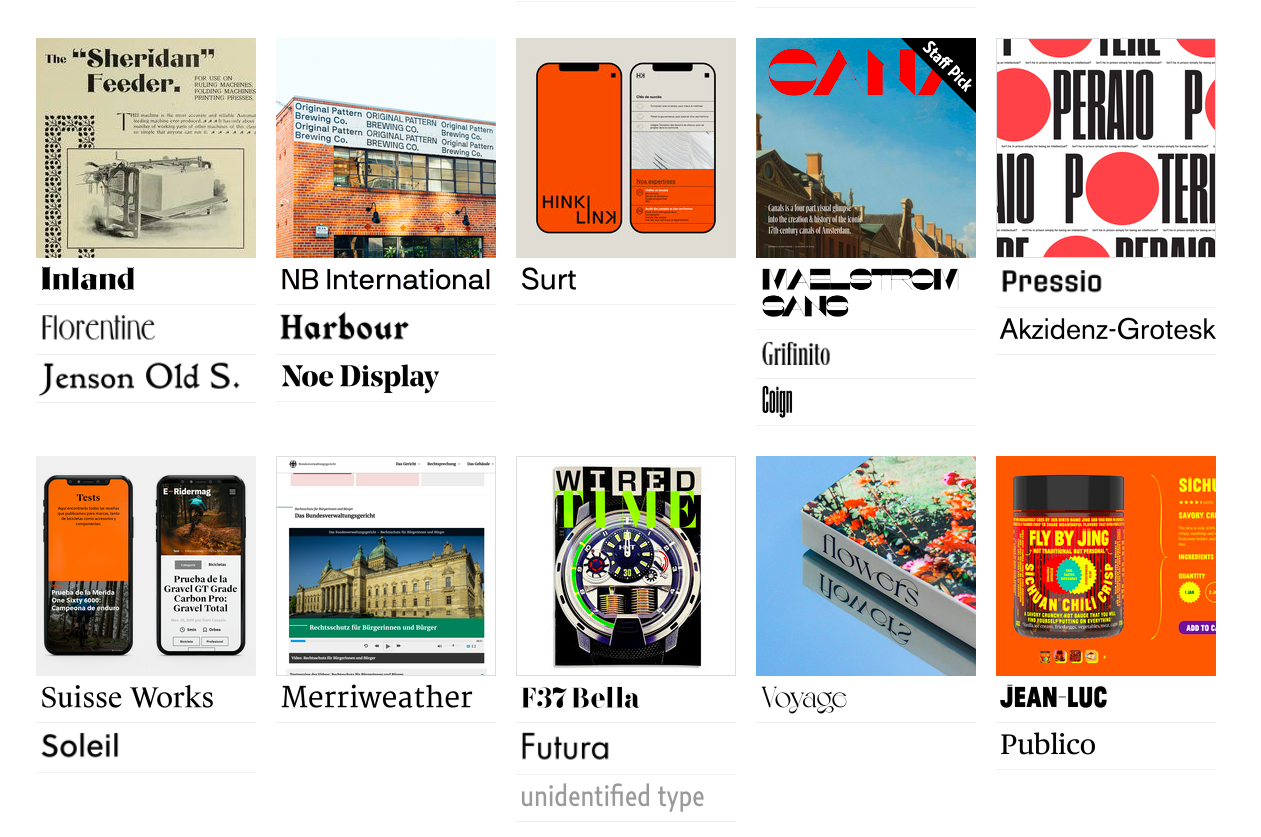
Fonts in Use: Enter a Giant Archive of Typography, Featuring 12,618 Typefaces

Type selec­tion is an inten­sive process that requires inti­mate knowl­edge of a brand’s val­ues, audi­ence, com­pe­ti­tion, voice, and goals.

Fonts in Use, FAQ

Fonts in Use is a typog­ra­phy nerd’s dream come true.

The 10-year-old inde­pen­dent archive of typog­ra­phy has col­lect­ed over 17,000 designs, each using at least one of over 12,000 type­face fam­i­lies from more than 3,500 type com­pa­nies. Each font is con­tex­tu­al­ized with images depict­ing them in the wild, on every­thing from wine labels and store­fronts to book cov­ers, record albums, movie posters and of course, adver­tis­ing of all shapes and sizes.

Fonts can cre­ate unlike­ly bed­fel­lows.

The Ramones’ icon­ic seal achieved its pres­i­den­tial look thanks to ITC Tiffany.

Oth­er mem­o­rable appear­ances include the first edi­tion cov­er of Ita­lo Calvino’s exper­i­men­tal nov­el If On a Winter’s Night a Trav­el­er and the titles for Ham­mer Film’s 1980 anthol­o­gy TV series, Ham­mer House of Hor­ror.

Fonts in Use’s man­ag­ing edi­tor, Flo­ri­an Hard­wig, describes ITC Tiffany as “Ed Ben­guiat’s 1974 revis­i­ta­tion and inter­pre­ta­tion of 19th-cen­tu­ry faces like West Old Style or Old Style Title,” not­ing such “Vic­to­ri­an details” as “large angled ser­ifs and sharply ter­mi­nat­ed diag­o­nals.”

The prin­ci­pal cast of Law & Order under­went sev­er­al changes over the show’s 20-year run, but Friz Quadra­ta remained a con­stant, sup­ply­ing titles and such nec­es­sary details as loca­tion, time, and date.

Friz Quadra­ta should be equal­ly famil­iar to Dun­geons & Drag­ons play­ers of a cer­tain age and fans of Gar­den Wafers, the pack­aged cook­ies from Hong Kong that are a sta­ple of state­side Asian mar­kets.

Artist Bar­bara Kruger’s dis­tinc­tive text-based work places overt com­men­tary in white ital­i­cized Futu­ra on red bands on top of black and white images.

Futu­ra was also the face of a tourist map to Berlin dur­ing the 1936 sum­mer Olympics and author David Rees’ tongue-in-cheek guide How to Sharp­en Pen­cils: A Prac­ti­cal & The­o­ret­i­cal Trea­tise on the Arti­sanal Craft of Pen­cil Sharp­en­ing for Writ­ers, Artists, Con­trac­tors, Flange Turn­ers, Angle­smiths, & Civ­il Ser­vants.

Com­ic Sans may not get much love out in the real world, but it’s well rep­re­sent­ed in the archive’s user sub­mis­sions.

You’ll find grow­ing num­bers of fonts in Cyril­lic, as well as fonts famil­iar to read­ers of Chi­neseJapan­eseKore­anAra­bicGreek and Hebrew

New­bie Net­flix Sans keeps com­pa­ny with 19th-cen­tu­ry sans Bureau Grot, a favorite of Vice Pres­i­dent-Elect Kamala Har­ris

Fat AlbertTin­toret­toBen­guiat CaslonScor­pio, Hoopla and Saphir are your tick­et back to a far groovi­er peri­od in the his­to­ry of graph­ic art.

Spend an hour or two rum­mag­ing through the col­lec­tion and we guar­an­tee you’ll feel an urgent need to upload typo­graph­ic exam­ples pulled from your shelves and cab­i­nets.

Fonts in Use wel­comes such sub­mis­sions, as long as type is clear­ly vis­i­ble in your uploaded image and isor wasin use (as opposed to an exam­ple of let­ter­ing for lettering’s sake). They will also con­sid­er cus­tom type­faces which are his­tor­i­cal­ly sig­nif­i­cant or oth­er­wise out­stand­ing, and those that are avail­able to the gen­er­al pub­lic. Please include a short descrip­tion in your com­men­tary, and when­ev­er pos­si­ble, cred­it any design­ers, pho­tog­ra­phers, or sources of your image.

Typog­ra­phy nerds are stand­ing by to help.

Begin your explo­rations of Fonts in Use here. If you’re feel­ing over­whelmed, the Staff Picks are a great place to start.

via MetaFil­ter

Relat­ed Con­tent:

The His­to­ry of Typog­ra­phy Told in Five Ani­mat­ed Min­utes

Why This Font Is Every­where: How Coop­er Black Became Pop Culture’s Favorite Font

Down­load Hel­l­veti­ca, a Font that Makes the Ele­gant Spac­ing of Hel­veti­ca Look as Ugly as Pos­si­ble

Ayun Hal­l­i­day is an author, illus­tra­tor, the­ater mak­er and Chief Pri­ma­tol­o­gist of the East Vil­lage Inky zine. She most recent­ly appeared as a French Cana­di­an bear who trav­els to New York City in search of food and mean­ing in Greg Kotis’ short film, L’Ourse.  Fol­low her @AyunHalliday.

The Internet Archive is Saving Classic Flash Animations & Games from Extinction: Explore Them Online

Flash is final­ly dead, and the world… does not mourn. Because the announce­ment of its end actu­al­ly came three years ago, “like a guil­lo­tine in a crowd­ed town square,” writes Rhett Jones at Giz­mo­do. It was a slow exe­cu­tion, but it was just. So use­ful in Web 1.0 days for mak­ing ani­ma­tions, games, and seri­ous pre­sen­ta­tions, Flash had become a vul­ner­a­bil­i­ty, a viral car­ri­er that couldn’t be patched fast enough to keep the hack­ers out. “Adobe’s Flash died many deaths, but we can tru­ly throw some dirt on its grave and say our final good­byes because it’s get­ting the preser­va­tion treat­ment.” Like the ani­mat­ed GIF, Flash ani­ma­tions have their own online library.

All those love­ly Flash memes—the danc­ing bad­gers and the snake, peanut but­ter and jel­ly time—will be saved for per­plexed future gen­er­a­tions, who will use them to deci­pher the runes of ear­ly 2000’s inter­net-speak. How­ev­er sil­ly they may seem now, there’s no deny­ing that these arti­facts were once cen­tral con­stituents of pop cul­ture.

Flash was much more than a dis­trac­tion or frus­trat­ing brows­er crash­er. It pro­vid­ed a “gate­way,” Jason Scott writes at the Inter­net Archive blog, “for many young cre­ators to fash­ion near-pro­fes­sion­al-lev­el games and ani­ma­tion, giv­ing them the first steps to a lat­er career.” (Even if it was a career mak­ing “advergames.”)

A sin­gle per­son work­ing in their home could hack togeth­er a con­vinc­ing pro­gram, upload it to a huge clear­ing­house like New­grounds, and get feed­back on their work. Some cre­ators even made entire series of games, each improv­ing on the last, until they became full pro­fes­sion­al releas­es on con­soles and PCs.

Always true to its pur­pose, the Inter­net Archive has devised a way to store and play Flash ani­ma­tions using emu­la­tors cre­at­ed by Ruf­fle and the Blue­Max­i­ma Flash­point Project, who have already archived tens of thou­sands of Flash games. All those adorable Home­s­tar Run­ner car­toons? Saved from extinc­tion, which would have been their fate, since “with­out a Flash play­er, flash ani­ma­tions don’t work.” This may seem obvi­ous, but it bears some expla­na­tion. Where image, sound, and video files can be con­vert­ed to oth­er for­mats to make them acces­si­ble to mod­ern play­ers, Flash ani­ma­tions can only exist in a world with Flash. They are like Edison’s wax cylin­ders, with­out the charm­ing three-dimen­sions.

Scott goes into more depth on the rise and fall of Flash, a his­to­ry that begins in 1993 with Flash’s pre­de­ces­sor, SmartS­ketch, which became Future­Wave, which became Flash when it was pur­chased by Macro­me­dia, then by Adobe. By 2005, it start­ed to become unsta­ble, and could­n’t evolve along with new pro­to­cols. HTML5 arrived in 2014 to issue the “final death-blow,” kind of.… Will Flash be missed? It’s doubt­ful. But “like any con­tain­er, Flash itself is not as much of a loss as all the art and cre­ativ­i­ty it held.” The Archive cur­rent­ly hosts over 1,500 Flash ani­ma­tions from those turn-of-the-mil­len­ni­um inter­net days, and there are many more to come. Enter the Archive’s Flash col­lec­tion here.

Relat­ed Con­tent: 

The U.S. Nation­al Archives Launch­es an Ani­mat­ed GIF Archive: See Whit­man, Twain, Hem­ing­way & Oth­ers in Motion

36,000 Flash Games Have Been Archived and Saved Before Flash Goes Extinct: Play Them Offline

What the Entire Inter­net Looked Like in 1973: An Old Map Gets Found in a Pile of Research Papers

Josh Jones is a writer and musi­cian based in Durham, NC. Fol­low him at @jdmagness

The Dorothea Lange Digital Archive: Explore 600+ Photographs by the Influential Photographer (Plus Negatives, Contact Sheets & More)

Short­ly before her death in 1965, one of the New Deal’s most famous pho­tog­ra­phers, Dorothea Lange, spoke at UC Berke­ley. “Some­one showed me pho­tos of migrant farm­work­ers they had just tak­en,” she said. “They look just like what I made in the ‘30s.” We can see the same con­di­tions Lange doc­u­ment­ed almost 60 years lat­er, from the pover­ty of the Depres­sion to the intern­ment and demo­niza­tion of immi­grants. Only the cloth­ing and the archi­tec­ture has changed. “Her work could not be more rel­e­vant to what’s hap­pen­ing today,” says Lange biog­ra­ph­er Lin­da Gor­don.

As an Amer­i­can, it can feel as if the coun­try is stuck in arrest­ed devel­op­ment, unable to imag­ine a future that isn’t a retread of the past. Yet activists, his­to­ri­ans, and ther­a­pists seem to agree: in order to move for­ward, we have to go back—to an hon­est account­ing of how Amer­i­cans have suf­fered and suf­fered unequal­ly from eco­nom­ic hard­ship and oppres­sion. These were Lange’s great themes: pover­ty and inequal­i­ty, and she “believed in the pow­er of pho­tog­ra­phy to make change,” says Erin O’Toole, asso­ciate cura­tor of pho­tog­ra­phy at the San Fran­cis­co Muse­um of Mod­ern Art

Among famous Bay Area col­leagues like Ansel Adams and Edward West­on, Lange is unique in that “her archive and all that mate­r­i­al,” says O’Toole, “stayed in the Bay Area,” held in the pos­ses­sion of the Oak­land Muse­um of Cal­i­for­nia. Now, more than 600 high-res­o­lu­tion scans are avail­able online at the OMCA’s new Dorothea Lange Dig­i­tal Archive, which also “con­tains con­tact sheets, film neg­a­tives and links relat­ed to mate­ri­als as addi­tion­al resources for the many cura­tors, schol­ars and gen­er­al audi­ences access­ing Lange’s body of work,” Emi­ly Mendel writes at The Oak­land­side

The dig­i­tal archive will like­ly expand in com­ing years as the dig­i­ti­za­tion process—funded by a grant from the Hen­ry Luce Foun­da­tion—con­tin­ues. The phys­i­cal archive is vast, includ­ing some “40,000 neg­a­tives and 6,000 prints, plus oth­er mem­o­ra­bil­ia.” These were inac­ces­si­ble to any­one who couldn’t make the “huge trek to OMCA,” Lange’s god­daugh­ter Eliz­a­beth Partridge—author of Dorothea Lange: Grab a Hunk of Light­ning (2013)—remarks. The project is “the most impor­tant thing,” says Par­tridge, “that has hap­pened to her work since it was giv­en to the muse­um decades ago” by her sec­ond hus­band Paul Tay­lor. 

The online archive-slash-exhib­it divides Lange’s work in four sec­tions: “The Depres­sion,” “World War II at Home,” “Post-War Projects,” and “Ear­ly Work/Personal Work.” The first of these con­tains some of her most famous pho­tographs, includ­ing ver­sions and adap­ta­tions of Migrant Moth­er, the posed por­trait of Flo­rence Thomp­son that “became a famous sym­bol of white moth­er­hood” (though Thomp­son was Native Amer­i­can) and “moved many Amer­i­cans to sup­port relief efforts.” We can see how the icon­ic pho­to was tak­en up and used by the Cuban jour­nal Bohemia, the Black Pan­ther Par­ty news­pa­per, and The Nation, who imag­ined Thomp­son in 2005 as a Wal­mart employ­ee.

In the sec­ond cat­e­go­ry are Lange’s pho­tographs of Japan­ese intern­ment camps, unseen until rel­a­tive­ly recent­ly. “When she final­ly gave these pho­tos to the Army who hired her,” Gor­don notes, “they fired her and impound­ed the pho­tos.” Lange’s skilled por­trai­ture, her uncan­ny abil­i­ty to human­ize and uni­ver­sal­ize her sub­jects, could not suit the pur­pos­es of the U.S. mil­i­tary. “She used pho­tog­ra­phy,” O’Toole says, “as a tool to uncov­er injus­tices, dis­crim­i­na­tion, to call atten­tion to pover­ty, the destruc­tion of the envi­ron­ment, immi­gra­tion…. The protests that are hap­pen­ing today would be some­thing she’d be pho­tograph­ing in the streets.”

Maybe in a dig­i­tal age, when we are over­whelmed by visu­al stim­uli, pho­tog­ra­phy has lost much of the influ­ence it once had. But Lange’s images still inspire equal amounts of com­pas­sion and curios­i­ty. As Amer­i­cans con­tend with the very same issues, we could do with a lot more of both. Enter the Dorothea Lange Dig­i­tal Archive here

via Austin Kleon

Relat­ed Con­tent: 

How Dorothea Lange Shot, Migrant Moth­er, Per­haps the Most Icon­ic Pho­to in Amer­i­can His­to­ry

478 Dorothea Lange Pho­tographs Poignant­ly Doc­u­ment the Intern­ment of the Japan­ese Dur­ing WWII

Yale Presents an Archive of 170,000 Pho­tographs Doc­u­ment­ing the Great Depres­sion

Josh Jones is a writer and musi­cian based in Durham, NC. Fol­low him at @jdmagness

Explore a Digital Archive of Student Notebooks from Around the World (1773-Present)

To bring back mem­o­ries of your school­days, there’s noth­ing quite like the sight of your old exer­cise books. This holds true whether you went to school in Ghana in the 2010sItaly in the 90s, France in the 80sChi­na in the 70sJapan in the 60s, or India in the 50s. All of these exam­ples and many more have come avail­able to view at the Exer­cise Book Archive, an “ever-grow­ing, par­tic­i­pa­to­ry archive of old exer­cise books that allows every­one to dis­cov­er the his­to­ry, edu­ca­tion, and dai­ly life of chil­dren and youth of the past.” All of the entries include the rel­e­vant book’s front cov­er — already a Prous­t­ian view­ing expe­ri­ence for any who had them grow­ing up — and some fea­ture scans of the inte­ri­or pages, stu­dent writ­ing and all.

One girl’s note­book describes the bomb­ing of her small town in 1940s Switzer­land,” writes Col­lec­tors Week­ly’s Hunter Oat­man-Stan­ford. “Anoth­er boy’s jour­nal chron­i­cles dai­ly life in rur­al Penn­syl­va­nia dur­ing the 1890s; the diary of a Chi­nese teenag­er recounts his expe­ri­ences in prison dur­ing the 1980s.” The arti­cle quotes Thomas Pololi, co-founder of the orga­ni­za­tion behind the Exer­cise Book Archive, on the his­tor­i­cal val­ue of books con­tain­ing “com­po­si­tions about war, pro­pa­gan­da, or polit­i­cal events that we now rec­og­nize as ter­ri­ble.

But in the nar­ra­tion of chil­dren, there is often enthu­si­asm about the swasti­ka in Ger­many, or the Duce in Italy (dic­ta­tor Ben­i­to Mus­soli­ni), or for Mao in Chi­na.” (Thanks to the work of vol­un­teers, these and oth­er exer­cise-book writ­ings have been tran­scribed and trans­lat­ed into Eng­lish.)

These young stu­dents “tend­ed to see the pos­i­tive side of trau­mat­ic things, per­haps because their main goal is to grow up, and they need­ed to do it the world they lived in.” Their exer­cise books thus offer reflec­tions of their soci­eties, in not just con­tent but design as well: “In Spain or in Chi­na,” for exam­ple, “you see beau­ti­ful illus­tra­tions of pro­pa­gan­da themes. They are often aes­thet­i­cal­ly appeal­ing because they were meant to per­suade chil­dren to do or think some­thing.” Edu­ca­tion­al trends also come through: “Before, there were main­ly exer­cis­es of cal­lig­ra­phy with dic­tat­ed sen­tences about how you have to behave in your life, with phras­es like ‘Emu­la­tion sel­dom fails,’ ” which to Pololi’s mind “implies that if you are your­self, you risk fail­ing. That’s the oppo­site of what we teach chil­dren nowa­days.”

Some­how the most mun­dane of these stu­dent com­po­si­tions can also be among the most inter­est­ing. Take the jour­nal of a group of Finnish girl scouts from the ear­ly 1950s. “The train to Lep­pä­vaara arrived quick­ly,” writes the author of one entry from April 1950. “At the sta­tion it start­ed to rain. We walked to the youth house, where we sang ‘Exalt the joy’ etc. Then we went to the sauna where we had to be. We sang and prayed. We then ate some sand­wich­es.” Could she have pos­si­bly imag­ined peo­ple all around the world read­ing of this girl-scout day trip with great inter­est sev­en­ty years lat­er? And what would the young man doing his pen­man­ship near­ly a quar­ter-mil­len­ni­um ago in Shrop­shire think if he know how eager we were to look at his exer­cise book? Bet­ter us than his school­mas­ter, no doubt. Enter the Exer­cise Book Archive here.

via Col­lec­tors Week­ly

Relat­ed Con­tent:

An Ancient Egypt­ian Home­work Assign­ment from 1800 Years Ago: Some Things Are Tru­ly Time­less

Muse­um Dis­cov­ers Math Note­book of an 18th-Cen­tu­ry Eng­lish Farm Boy, Adorned with Doo­dles of Chick­ens Wear­ing Pants

Down­load 20 Pop­u­lar High School Books Avail­able as Free eBooks & Audio Books

200 Free Kids Edu­ca­tion­al Resources: Video Lessons, Apps, Books, Web­sites & More

Based in Seoul, Col­in Mar­shall writes and broad­casts on cities, lan­guage, and cul­ture. His projects include the Sub­stack newslet­ter Books on Cities, the book The State­less City: a Walk through 21st-Cen­tu­ry Los Ange­les and the video series The City in Cin­e­ma. Fol­low him on Twit­ter at @colinmarshall, on Face­book, or on Insta­gram.

The Internet Archive Will Digitize & Preserve Millions of Academic Articles with Its New Database, “Internet Archive Scholar”

Open access pub­lish­ing has, indeed, made aca­d­e­m­ic research more acces­si­ble, but in “the move from phys­i­cal aca­d­e­m­ic jour­nals to dig­i­tal­ly-acces­si­ble papers,” Saman­tha Cole writes at Vice, it has also become “more pre­car­i­ous to pre­serve…. If an insti­tu­tion stops pay­ing for web host­ing or changes servers, the research with­in could dis­ap­pear.” At least a cou­ple hun­dred open access jour­nals van­ished in this way between 2000 and 2019, a new study pub­lished on arx­iv found. Anoth­er 900 jour­nals are in dan­ger of meet­ing the same fate.

The jour­nals in per­il include schol­ar­ship in the human­i­ties and sci­ences, though many pub­li­ca­tions may only be of inter­est to his­to­ri­ans, giv­en the speed at which sci­en­tif­ic research tends to move. In any case, “there shouldn’t real­ly be any decay or loss in sci­en­tif­ic pub­li­ca­tions, par­tic­u­lar­ly those that have been open on the web,” says study co-author Mikael Laasko, infor­ma­tion sci­en­tist at the Han­ken School of Eco­nom­ics in Helsin­ki. Yet, in dig­i­tal pub­lish­ing, there are no print­ed copies in uni­ver­si­ty libraries, cat­a­logued and main­tained by librar­i­ans.

To fill the need, the Inter­net Archive has cre­at­ed its own schol­ar­ly search plat­form, a “full­text search index” that includes “over 25 mil­lion research arti­cles and oth­er schol­ar­ly doc­u­ments” pre­served on its servers. These col­lec­tions span dig­i­tized and orig­i­nal dig­i­tal arti­cles pub­lished from the 18th cen­tu­ry to “the lat­est Open Access con­fer­ence pro­ceed­ings and pre-prints crawled from the World Wide Web.” Con­tent in this search index comes in one of three forms:

  • pub­lic web con­tent in the Way­back Machine web archives (web.archive.org), either iden­ti­fied from his­toric col­lect­ing, crawled specif­i­cal­ly to ensure long-term access to schol­ar­ly mate­ri­als, or crawled at the direc­tion of Archive-It part­ners
  • dig­i­tized print mate­r­i­al from paper and micro­form col­lec­tions pur­chased and scanned by Inter­net Archive or its part­ners
  • gen­er­al mate­ri­als on the archive.org col­lec­tions, includ­ing con­tent from part­ner orga­ni­za­tions, uploads from the gen­er­al pub­lic, and mir­rors of oth­er projects

The project is still in “alpha” and “has sev­er­al bugs,” the site cau­tions, but it could, when it’s ful­ly up and run­ning, become part of a much-need­ed rev­o­lu­tion in aca­d­e­m­ic research—that is if the major aca­d­e­m­ic pub­lish­ers don’t find some legal pre­text to shut it down.

Aca­d­e­m­ic pub­lish­ing boasts one of the most rapa­cious legal busi­ness mod­els on the glob­al mar­ket, and one of the most exploita­tive: a dou­ble stan­dard in which schol­ars freely pub­lish and review research for the pub­lic ben­e­fit (osten­si­bly) and very often on the pub­lic dime; while pri­vate inter­me­di­aries rake in astro­nom­i­cal sums for them­selves with pay­walls. The open access mod­el has changed things, but the only way to tru­ly serve the “best inter­ests of researchers and the pub­lic,” neu­ro­sci­en­tist Shaun Khoo argues, is through pub­lic infra­struc­ture and ful­ly non-prof­it pub­li­ca­tion.

Maybe Inter­net Archive Schol­ar can go some way toward bridg­ing the gap, as a pub­licly acces­si­ble, non-prof­it search engine, dig­i­tal cat­a­logue, and library for research that is worth pre­serv­ing, read­ing, and build­ing upon even if it does­n’t gen­er­ate share­hold­er rev­enue. For a deep­er dive into how the Archive built its for­mi­da­ble, still devel­op­ing, new data­base, see the video pre­sen­ta­tion above from Jef­fer­son Bai­ley, Direc­tor of Web Archiv­ing & Data Ser­vices. And have a look at Inter­net Archive Schol­ar here. It cur­rent­ly lacks advanced search func­tions, but plug in any search term and pre­pare to be amazed by the incred­i­ble vol­ume of archived full text arti­cles you turn up.

Relat­ed Con­tent:

The Inter­net Archive Makes 2,500 More Clas­sic MS-DOS Video Games Free to Play Online: Alone in the Dark, Doom, Microsoft Adven­ture, and Oth­ers

Libraries & Archivists Are Dig­i­tiz­ing 480,000 Books Pub­lished in 20th Cen­tu­ry That Are Secret­ly in the Pub­lic Domain

The Boston Pub­lic Library Will Dig­i­tize & Put Online 200,000+ Vin­tage Records

Josh Jones is a writer and musi­cian based in Durham, NC. Fol­low him at @jdmagness

500+ Beautiful Manuscripts from the Islamic World Now Digitized & Free to Download

Math­e­mat­ics, astron­o­my, his­to­ry, law, lit­er­a­ture, archi­tec­ture: in these fields and oth­ers, the Mus­lim world came up with major inno­va­tions before any oth­er civ­i­liza­tion did. This Islam­ic cul­tur­al and intel­lec­tu­al flow­er­ing last­ed from the 11th through the 19th cen­tu­ry, and many of the texts the peri­od left as its lega­cy have gone most­ly unre­searched. So say the cre­ators of Man­u­scripts of the Mus­lim World, a project of Colum­bia Uni­ver­si­ty, the Free Library of Philadel­phia, the Uni­ver­si­ty of Penn­syl­va­nia, Bryn Mawr Col­lege, and Haver­ford Col­lege aimed at cre­at­ing an online archive of “more than 500 man­u­scripts and 827 paint­ings from the Islam­i­cate world broad­ly con­strued.”

As UPenn Libraries Senior Cura­tor of Spe­cial Col­lec­tions Mitch Fraas tells Hyper­al­ler­gic’s Sarah Rose Sharp, “The aim of this project was to find and dig­i­tize all the Islam­i­cate man­u­scripts in Philadel­phia col­lec­tions and along the way we part­nered with Colum­bia on a grant to take a mul­ti-city approach.”

To the sources of its man­u­scripts it also takes a mul­ti-cul­ture approach, includ­ing “texts relat­ed to Chris­tian­i­ty (Cop­tic and Syr­i­ac mss. galore), Hin­duism (epics trans­lat­ed into Per­sian in Mughal India), sci­ence, tech­nol­o­gy, music, etc. but which were pro­duced in the his­toric Mus­lim world.” There are also texts, he adds, “in Per­sian, Ara­bic, and Turk­ish of course but also in Cop­tic, Tamazight, Aves­tan, etc.”

If you can read those lan­guages, Man­u­scripts of the Mus­lim World obvi­ous­ly amounts to a gold mine. (You may also find some­thing of inter­est in the dig­i­tal archives of 700 years of Per­sian man­u­scripts and 10,000 books in Ara­bic we’ve pre­vi­ous­ly fea­tured here on Open Cul­ture.) But even if you don’t, you’ll find in the col­lec­tion mar­vels of book design that will appeal to any­one with an appre­ci­a­tion of the lush aes­thet­ics, both abstract and fig­u­ra­tive, of these places and these times. Some of them aren’t even as old as they may seem: take the man­u­script at the top of the post, “over­paint­ed in the 20th cen­tu­ry to mim­ic Mughal style.” Or the one below that, whose colophon “says the copy was com­plet­ed in 1121 A.H. (1709 or 1710 CE),” which “does not make sense giv­en the author like­ly lived in the 19th cen­tu­ry.”

The oth­er pages here come from a set of “illus­tra­tions from Qur’ānic sto­ries” (this one depict­ing “Abra­ham sac­ri­fic­ing his son”) and a “Per­sian cal­lig­ra­phy and illus­tra­tion album.” You’ll find much more in Man­u­scripts of the Mus­lim World, host­ed on OPENN, the Uni­ver­si­ty of Penn­syl­va­ni­a’s online repos­i­to­ry of “high-res­o­lu­tion archival images of man­u­scripts” accom­pa­nied by “machine-read­able TEI P5 descrip­tions and tech­ni­cal meta­da­ta,” all released into the pub­lic domain or under Cre­ative Com­mons licens­es. Though each man­u­scrip­t’s entry comes with basic notes, the col­lec­tion is, in the main, not yet a thor­ough­ly stud­ied one. If you have an inter­est in the Islam­ic world at its peak of cul­tur­al and intel­lec­tu­al influ­ence so far, you may just find your next big research sub­ject here — or at the very least, mate­r­i­al for a few hours’ admi­ra­tion. Enter the col­lec­tion.

via Hyper­al­ler­gic

Relat­ed Con­tent:

The Com­plex Geom­e­try of Islam­ic Art & Design: A Short Intro­duc­tion

How Ara­bic Trans­la­tors Helped Pre­serve Greek Phi­los­o­phy … and the Clas­si­cal Tra­di­tion

Learn Islam­ic & Indi­an Phi­los­o­phy with 107 Episodes of the His­to­ry of Phi­los­o­phy With­out Any Gaps Pod­cast

700 Years of Per­sian Man­u­scripts Now Dig­i­tized and Avail­able Online

Down­load 10,000+ Books in Ara­bic, All Com­plete­ly Free, Dig­i­tized and Put Online

Based in Seoul, Col­in Mar­shall writes and broad­casts on cities, lan­guage, and cul­ture. His projects include the book The State­less City: a Walk through 21st-Cen­tu­ry Los Ange­les and the video series The City in Cin­e­ma. Fol­low him on Twit­ter at @colinmarshall, on Face­book, or on Insta­gram.

Take a Virtual Tour of 30 World-Class Museums & Safely Visit 2 Million Works of Fine Art

Rosetta Stone

Since the first stir­rings of the inter­net, artists and cura­tors have puz­zled over what the flu­id­i­ty of online space would do to the expe­ri­ence of view­ing works of art. At a con­fer­ence on the sub­ject in 2001, Susan Haz­an of the Israel Muse­um won­dered whether there is “space for enchant­ment in a tech­no­log­i­cal world?” She referred to Wal­ter Benjamin’s rumi­na­tions on the “poten­tial­ly lib­er­at­ing phe­nom­e­non” of tech­no­log­i­cal­ly repro­duced art, yet also not­ed that “what was for­feit­ed in this process were the ‘aura’ and the author­i­ty of the object con­tain­ing with­in it the val­ues of cul­tur­al her­itage and tra­di­tion.” Eval­u­at­ing a num­ber of online gal­leries of the time, Haz­an found that “the speed with which we are able to access remote muse­ums and pull them up side by side on the screen is alarm­ing­ly imme­di­ate.” Per­haps the “accel­er­at­ed mobil­i­ty” of the inter­net, she wor­ried, “caus­es objects to become dis­pos­able and to decline in sig­nif­i­cance.”

VG-Self-Portrait-1887

Fif­teen years after her essay, the num­ber of muse­ums that have made their col­lec­tions avail­able online whole, or in part, has grown expo­nen­tial­ly and shows no signs of slow­ing. We may not need to fear los­ing muse­ums and libraries—important spaces that Michel Fou­cault called “het­ero­topias,” where lin­ear, mun­dane time is inter­rupt­ed. These spaces will like­ly always exist.

Yet increas­ing­ly we need nev­er vis­it them in per­son to view most of their con­tents. Stu­dents and aca­d­e­mics can con­duct near­ly all of their research through the inter­net, nev­er hav­ing to trav­el to the Bodleian, the Bei­necke, or the British Library. And lovers of art must no longer shell out for plane tick­ets and hotels to see the pre­cious con­tents of the Get­ty, the Guggen­heim, or the Rijksmu­se­um. And who would dare do that dur­ing our cur­rent pan­dem­ic?

For all that may be lost, online gal­leries have long been “mak­ing works of art wide­ly avail­able, intro­duc­ing new forms of per­cep­tion in film and pho­tog­ra­phy and allow­ing art to move from pri­vate to pub­lic, from the elite to the mass­es.”

Kandinsky-Composition-II

Even more so than when Haz­an wrote those words, the online world offers pos­si­bil­i­ties for “the emer­gence of new cul­tur­al phe­nom­e­na, the vir­tu­al aura.” Over the years we have fea­tured dozens of data­bas­es, archives, and online gal­leries through which you might vir­tu­al­ly expe­ri­ence art the world over, an expe­ri­ence once sole­ly reserved for only the very wealthy. And as artists and cura­tors adapt to a dig­i­tal envi­ron­ment, they find new ways to make vir­tu­al gal­leries enchant­i­ng. The vast col­lec­tions in the vir­tu­al gal­leries list­ed below await your vis­it, with 2,000,000+ paint­ings, sculp­tures, pho­tographs, books, and more. See the Roset­ta Stone at the British Muse­um (top), cour­tesy of the Google Cul­tur­al Insti­tute. See Van Gogh’s many self-por­traits and vivid, swirling land­scapes at The Van Gogh Muse­um. Vis­it the Asian art col­lec­tion at the Smith­so­ni­an’s Freer and Sack­ler Gal­leries. Or see Vass­i­ly Kandin­sky’s daz­zling abstract com­po­si­tions at the Guggen­heim.

And below the list of gal­leries, find links to online col­lec­tions of sev­er­al hun­dred art books to read online or down­load. Con­tin­ue to watch this space: We’ll add to both of these lists as more and more col­lec­tions come online.

Art Images from Muse­ums & Libraries

Art Books

Note: This post orig­i­nal­ly appeared on our site in May 2016. It has since been updat­ed to include more art from dif­fer­ent muse­ums.

Relat­ed Con­tents:

Down­load 448 Free Art Books from The Met­ro­pol­i­tan Muse­um of Art

The Met­ro­pol­i­tan Muse­um of Art Puts 400,000 High-Res Images Online & Makes Them Free to Use

Free: The Met­ro­pol­i­tan Muse­um of Art and the Guggen­heim Offer 474 Free Art Books Online

Josh Jones is a writer and musi­cian based in Durham, NC. Fol­low him at @jdmagness

by | Permalink | Make a Comment ( 2 ) |

Watch More Than 400 Classic Korean Films Free Online Thanks to the Korean Film Archive

Even if you don’t know much about Korea, or indeed about film, it’s safe to say that you know at least one Kore­an film: Bong Joon-ho’s Par­a­site, which has cir­cled the world gath­er­ing acclaim and awards since its release last spring. First it won the Palme d’Or at the Cannes Film Fes­ti­val, becom­ing the first Kore­an pro­duc­tion to do so; more recent­ly, it made film his­to­ry even more dra­mat­i­cal­ly at the Acad­e­my Awards. There it won Oscars not just for Best Inter­na­tion­al Fea­ture Film, Best Orig­i­nal Screen­play, and Best Direc­tor, but also Best Pic­ture, becom­ing the first non-Eng­lish-lan­guage film to do so. For many view­ers, Par­a­site and its direc­tor seem to have come out of nowhere, but lovers of Kore­an cin­e­ma know full well that they come out of a rich tra­di­tion — and a robust indus­try.

Maybe you thrilled to Bong’s sus­pense­ful, fun­ny, and vio­lent tale of class war­fare as much as the Acad­e­my did. Maybe you’ve even seen the work of Bong’s con­tem­po­raries: Park Chan-wook, he of the con­tro­ver­sial hit Old­boy; the even more trans­gres­sive Kim Ki-duk; the pro­lif­ic Hong Sang­soo, with his Woody Allen-meets-Éric Rohmer sen­si­bil­i­ty.

But do you know their son­saeng­n­imthe gen­er­a­tions of Kore­an film­mak­ers who went before them? Now you can, no mat­ter where in the world you are, on the Kore­an Film Archive’s Youtube chan­nel. There, at no charge, you can expe­ri­ence decades of Kore­an cin­e­ma and hun­dreds of works of Kore­an cin­e­mat­ic art, includ­ing but not lim­it­ed to those of mid-20th-cen­tu­ry mas­ters like Kim Ki-young, Im Kwon-taek, and my per­son­al favorite Kim Soo-yong, direc­tor of haunt­ing, even brazen pic­tures of the 1960s and 70s like Mist and Night Jour­ney.

I actu­al­ly met the then-octo­ge­nar­i­an Kim Soo-yong a few years ago, when he called me over to his table out of curios­i­ty about what a for­eign­er was doing at a screen­ing of Mist. It hap­pened at the Kore­an Film Archive’s cin­e­math­eque (known as Cin­e­math­eque KOFA) here in Seoul, where I’ve lived for the past few years. Dur­ing that time I’ve also been writ­ing a Korea Blog for the Los Ange­les Review of Books, which occa­sion­al­ly fea­tures essays on the clas­sic Kore­an films made avail­able online by the Kore­an Film Archive. I began the series with Night Jour­ney, and more recent­ly have writ­ten up pic­tures like the 1960s neo­re­al­ist cry of agony Aim­less Bul­let, the 1970s col­lege-under-dic­ta­tor­ship com­e­dy The March of Fools, the 1980s West­ern­iza­tion com­e­dy Chil-su and Man-su, the 1990s food-sex-hor­ror satir­i­cal mix­ture 301, 302, and oth­ers.

If you need more sug­ges­tions as to where to start with the KOFA’s more than 400 free films online, pay a vis­it to the Kore­an Movie Data­base (KMDb), where KOFA reg­u­lar­ly post selec­tions from their cat­a­log. This mon­th’s picks are “spy thriller films from the 1950s to 1970s infused with the anti-com­mu­nist ide­ol­o­gy dur­ing the time.” Pre­vi­ous months have round­ed up “melo­dra­mas that are filled with women’s desire and crav­ing for love,” films about “indi­vid­ual or fam­i­ly tragedies lead­ing to his­tor­i­cal tragedies,” and “heart-warm­ing clas­si­cal movies all the fam­i­ly mem­bers can enjoy togeth­er.” You can watch all these films either on the KMDb (which requires free reg­is­tra­tion) or on KOFA’s ever-grow­ing Youtube chan­nel. Either way, as we say here in Korea, 재미있게 보세요.

Relat­ed Con­tent:

The Secret of the “Per­fect Mon­tage” at the Heart of Par­a­site, the Kore­an Film Now Sweep­ing World Cin­e­ma

Mar­tin Scors­ese Intro­duces Film­mak­er Hong Sang­soo, “The Woody Allen of Korea”

The Five Best North Kore­an Movies: Watch Them Free Online

Based in Seoul, Col­in Mar­shall writes and broad­casts on cities, lan­guage, and cul­ture. His projects include the book The State­less City: a Walk through 21st-Cen­tu­ry Los Ange­les and the video series The City in Cin­e­ma. Fol­low him on Twit­ter at @colinmarshall or on Face­book.

« Go BackMore in this category... »
Quantcast