In the early morning of March 18, 1990, two thieves entered the Isabella Stewart Gardner Museum in Boston and stole 13 pieces of precious art, including paintings by Vermeer and Rembrandt. To this day, those paintings, valued at $500 million dollars, have never been recovered.
The story of the bold heist and the various attempts to recover the paintings–they get told in a 10-part series of podcasts called Last Seen. Created by WBUR and The Boston Globe, the true-crime podcast “takes us inside the ongoing effort to bring back the jewels of the Gardner collection.” You can listen to the engrossing episodes online, or via iTunes, Stitcher and Spotify. Or simply stream the episodes below. And if you know anything that cracks the case, there’s a $5 million dollar reward.
If you would like to support the mission of Open Culture, consider making a donation to our site. It’s hard to rely 100% on ads, and your contributions will help us continue providing the best free cultural and educational materials to learners everywhere. You can contribute through PayPal, Patreon, and Venmo (@openculture). Thanks!
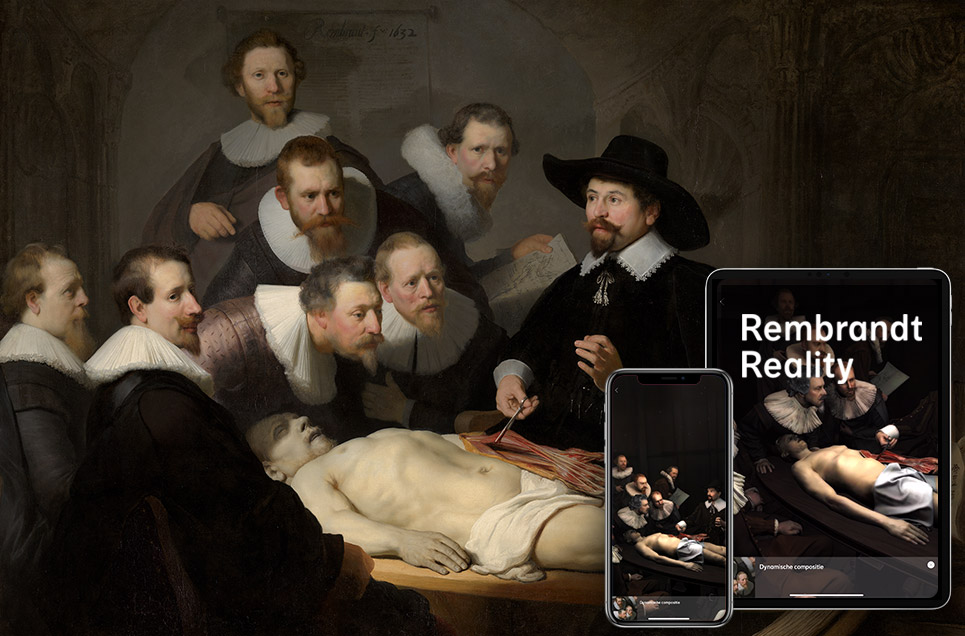
More than 350 years after he painted them, the paintings of Rembrandt van Rijn still look real enough to step right into. Now, thanks to a new augmented reality app from the Mauritshuis museum, you can do just that through the screen of your phone, starting with Rembrandt’s famed early canvas The Anatomy Lesson of Dr. Nicolaes Tulp. “The augmented reality experience, a first for a museum, allows the user to experience the anatomical theatre of 1632 digitally,” says the Mauritshuis’ press release, “and to observe Dr. Tulp and his fellow physicians, as well as the subject of their examination, the corpse of Aris Kindt.”
“I entered it and was surrounded by its enveloping darkness, its piecemeal illuminations,” writes Hyperallergic’s Seph Rodney on his augmented-reality experience of The Anatomy Lesson. “I walked in front of and sometimes faced each of the characters arrayed around a central figure, a corpse, with its left arm missing its skin below the elbow. One man, rather overdressed in a black doublet with a white shirt collar and white sleeves accenting his head and hands uses a pair of forceps to hold the corpse’s exposed arm muscles and tendons stretched away from the bones beneath.”
As Rodney approaches the figure, “a small text box pops out telling me precisely this: that he is gazing at the book to make sense of what the body beneath him is saying in all its vascular and muscular complexity.”
Sans text boxes, the scene will sound familiar to Rembrandt enthusiasts, but not even the most enthusiastic of them will have seen it in quite this way before. To build an augmented-reality version of the scene Rembrandt painted 387 years ago, “lookalikes of the main figures in the painting dressed up in seventeenth-century outfits and were then scanned with a 3D scanner made up of 600 reflex cameras. The original theatre in the Waag where Dr. Tulp gave his anatomy lesson in 1632 was then captured with the 3D scanner. These scans were then combined, after which 3D modelers gave the figures and the space the correct colors, textures and light.”
You can get a glimpse of the process in the short video at the top of the post, then download the Rembrandt Reality app in either its Google or Apple version and step into The Anatomy Lesson yourself. It may feel somewhat odd at first to simply stroll around the scene of an ongoing dissection of a human body, but in a way, the Mauritshuis’ digital opening of this immortal lesson to the world re-emphasizes the true nature of the original scene. When a physician of Tulp’s stature dissected a corpse, people from all around — medical professionals and otherwise — would come to watch the spectacle that could last for days. But could even Tulp, then Amsterdam’s city anatomist and later the city’s mayor, have imagined that this particular spectacle would last 387 years and counting?
Based in Seoul, Colin Marshall writes and broadcasts on cities, language, and culture. His projects include the book The Stateless City: a Walk through 21st-Century Los Angeles and the video series The City in Cinema. Follow him on Twitter at @colinmarshall or on Facebook.
What does it accomplish to talk about climate change? Even those who talk about climate change professionally might find it hard to say. If you really want to make a point about rising sea levels — not to mention all the other changes predicted to afflict a warming Earth — you might do better to show, not tell. That reasoning seems to have motivated art projects like the giant hands reaching out from the waters of Venice previously featured here on Open Culture, and it looks even clearer in the more recent case of Lines (57° 59 ́N, 7° 16 ́W), an installation now on display on a Scottish island.
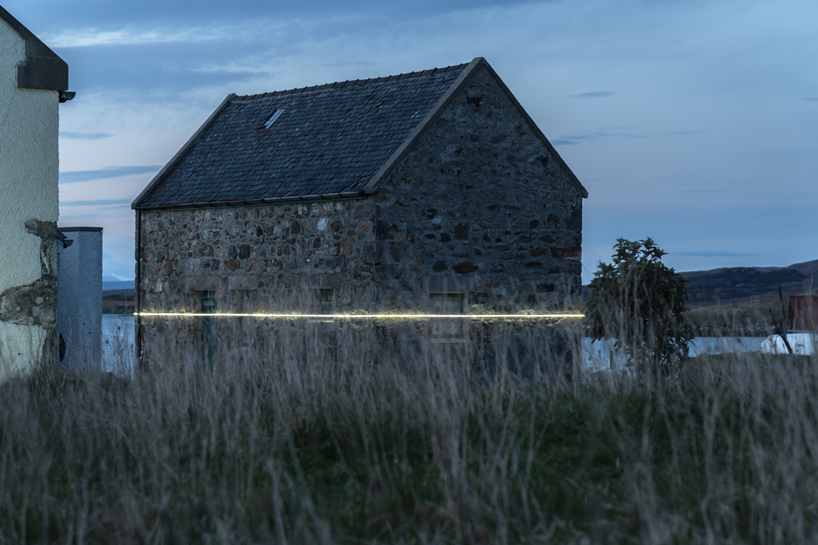
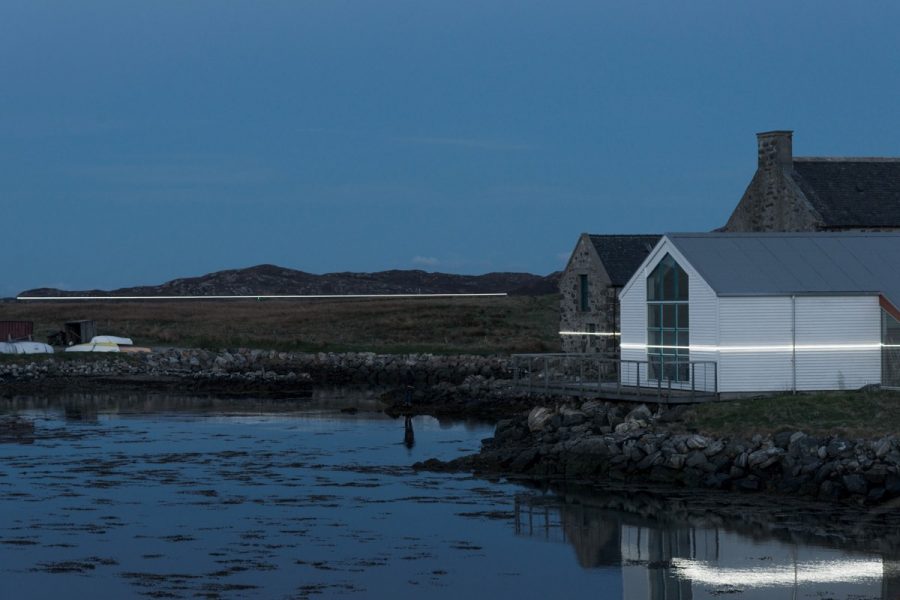
“At high tide, three synchronized lines of light activate in the Outer Hebrides off the west coast of Scotland,” writes Designboom’s Zach Andrews, and in the dark, “wrap around two structures and along the base of a mountain landscape.
Everything below these lines of light will one day be underwater.” Created by Finnish artists Pekka Niittyvirta and Timo Aho for Taigh Chearsabhagh Museum & Arts Centre, Lines (57° 59 ́N, 7° 16 ́W) offers a stark reminder of the future humanity faces if climate change goes on as projected.
But why put up an installation of such apparent urgency in such a thinly populated, out-of-the-way place? “Low lying archipelagos like this one are especially vulnerable to the catastrophic effects of climate change,” Andrews writes, adding that the Taigh Chearsabhagh Museum & Arts Centre itself “cannot even afford to develop on its existing site anymore due to the predicted rise of storm surge sea.” But though the effects of rising sea levels may be felt first on islands like these, few predictions have those effects stopping there; worst-case scenarios won’t spare our major metropolises, and certainly not the coastal ones.
You can get a sense of what Lines (57° 59 ́N, 7° 16 ́W) looks like in action from the photographs on Niittyvirta’s site a well as the time-lapse video at the top, which shows the lines of light activating when their sensors detect high tide, then only those lines of light remaining by the time the sun has gone completely down. To experience the full impact of the installation, however, requires seeing it in person in the context for which it was created. So if you’ve been putting off that trip to the Outer Hebrides, now might be the time to finally take it — not just because of Niittyvirta and Aho’s work, but because in a few years, it may not be quite the same place.
Based in Seoul, Colin Marshall writes and broadcasts on cities, language, and culture. His projects include the book The Stateless City: a Walk through 21st-Century Los Angeles and the video series The City in Cinema. Follow him on Twitter at @colinmarshall or on Facebook.
Bookcases are a great ice breaker for those who love to read.
What relief those shelves offer ill-at ease partygoers… even when you don’t know a soul in the room, there’s always a chance you’ll bond with a fellow guest over one of your hosts’ titles.
Occupy yourself with a good browse whilst waiting for someone to take the bait.
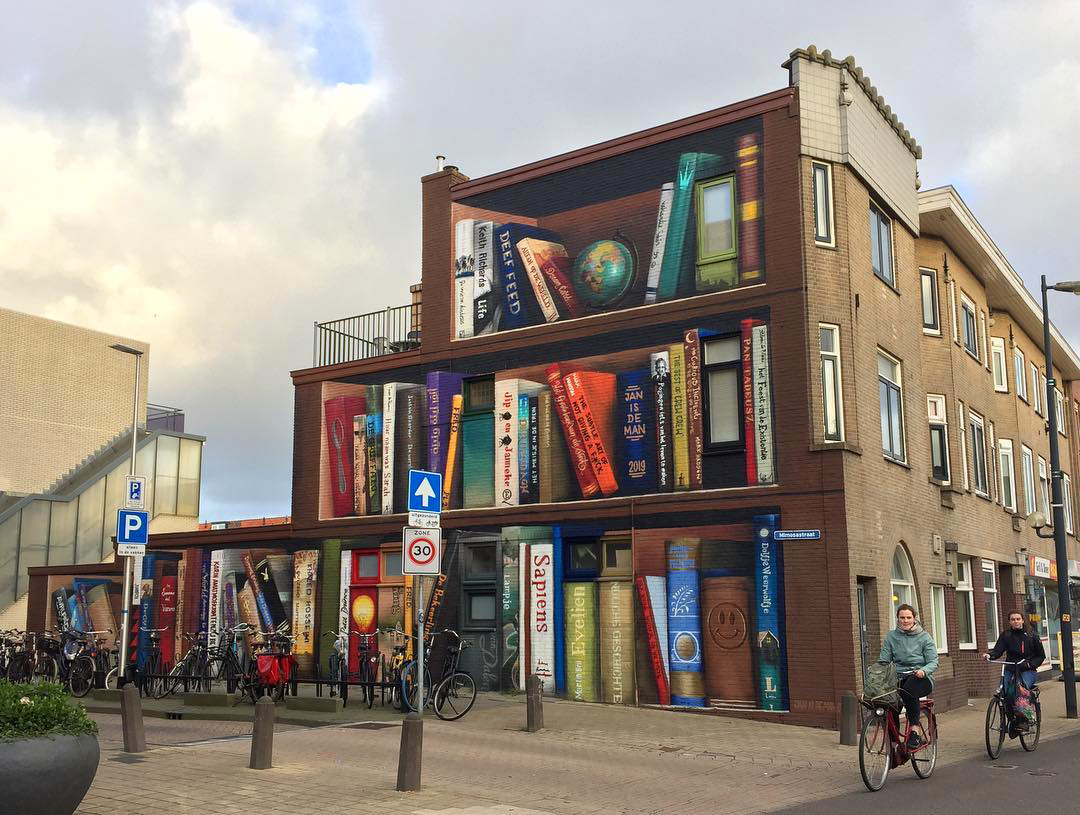
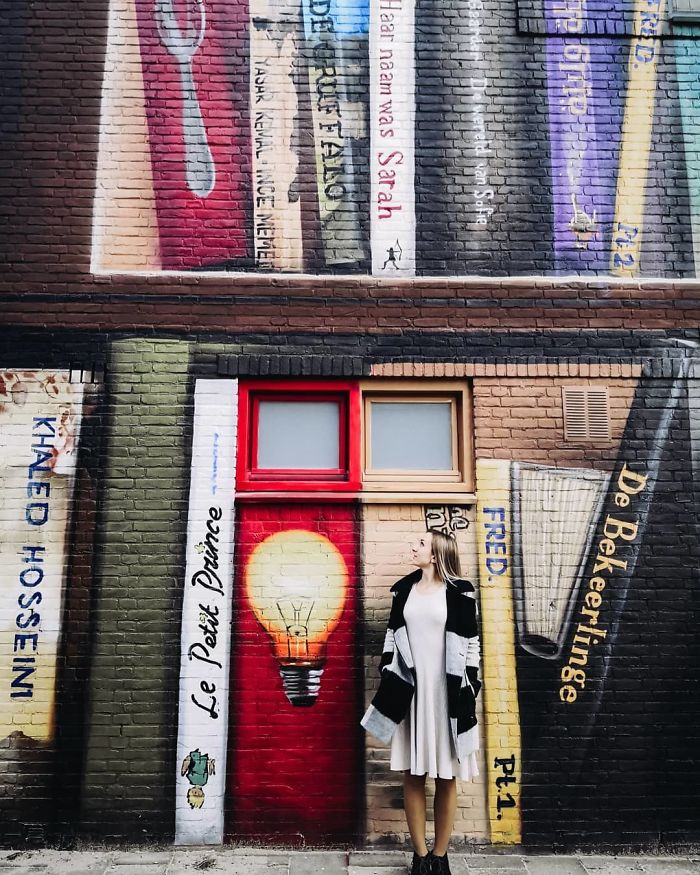
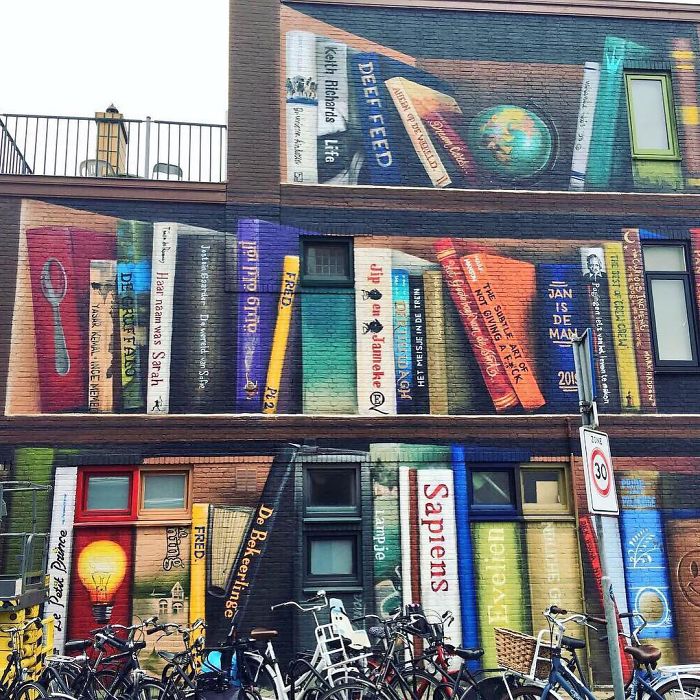
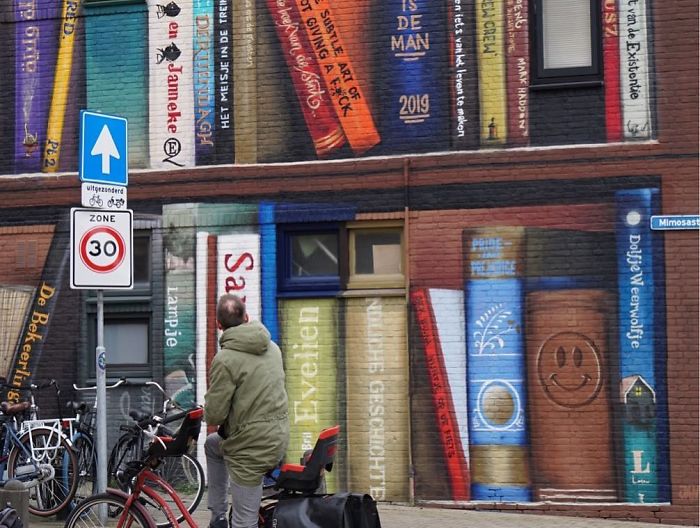
Now, with the aid of Dutch street artists Jan Is De Man and Deef Feed, some residents of Utrecht have turned their bookcases into street art, sparking conversation in their culturally diverse neighborhood.
De Man, whose close friends occupy the ground floor of a building on the corner of Mimosastraat and Amsterdam, had initially planned to render a giant smiley face on an exterior wall as a public morale booster, but the shape of the three-story structure suggested something a bit more literary.
The trompe-l’oeil Boekenkast (or bookcase) took a week to create, and features titles in eight different languages.
Look closely and you’ll notice both artists’ names (and a smiley face) lurking among the spines.
Design mags may make an impression by ordering books according to size and color, but this communal 2‑D boekenkast looks to belong to an avid and omnivorous reader.
And a classy-looking hardbound Playboy collection that may or may not exist in real life.
(Readers, can you spot the other fakes?)
Boekenkast is the latest of a number of global bookshelf murals tempting literary pilgrims to take a selfie on the way to the local indie bookshop.
Hundreds of gothic cathedrals dotted all over Europe have faced decimation and destruction, whether through sackings, revolutions, natural decay, or bombing raids. But since World War II, at least, the most extraordinary examples that remain have seen restoration and constant upkeep, and none of them is as well-known and as culturally and architecturally significant as Paris’s Notre Dame. One cannot imagine the city without it, which made the scenes of Parisians watching the cathedral burn yesterday as poignant as the scenes of the fire itself.
The flames claimed the rib-vaulted roof and the “spine-tingling, soul-lifting spire,” writes The Washington Post, who quote cathedral spokeman Andre Finot’s assessment of the damage as “colossal.” The exterior stone towers, famed stained-glass windows, and iconic arches and flying buttresses withstood the disaster, but the wooden interior, “a marvel,” writes the Post, “that has inspired awe and wonder for the millions who have visited over the centuries—has been gutted.” Nothing of the frame, says Finot, “will remain.”
The sad irony is that the fire reportedly resulted from an accident during the medieval church’s renovation, one of many such projects that have preserved this almost 900-year-old architecture. The French government has vowed to rebuild. Will it matter to posterity that a significant portion of the Cathedral dates from hundreds of years after its original construction? Will Notre Dame lose its ancient aura, and what does this mean for Parisians and the world?
It’s too soon to answer questions like these and too soon to ask them. Now is a time to reckon with cultural and historical loss, and to appreciate the importance of what was saved. At the top of the post, you can watch a virtual time-lapse recreation of the construction of Notre Dame, begun in 1160 and mostly completed one hundred years later, though building continued into the 14th century—a jaw-dropping time scale in an era when towering new buildings go up in a matter of weeks.
After taking more than the human lifespan to complete, until yesterday the cathedral stood the test of time, as the brief France in Focus tour of its eight centuries of art and architectural history above explains. “The most visited monument in the French Capital” may be a relic of a very different, pre-modern, pre-revolutionary, France. But its imposing central setting in the city, and in modern works from Victor Hugo’s Hunchback of Notre Dame to Walt Disney’s Hunchback of Notre Dame—not to mention the tourists, religious pilgrims, scholars, and art students who pour into Paris to see it—mark Notre Dame as a very contemporary landmark. Learn more about how it became so above.
Comic-book stories of a boy reporter and his dog (later accompanied by a foulmouthed sea captain) featuring rocketships and submarines, booby-traps and buried treasure, gangsters and abominable snowmen, smugglers and super-weapons, all told with bright colors, clear lines, and practically no girls in sight: no wonder The Adventures of Tintin at first looks tailor-made for rambunctious youngsters. But now, eighty years after Tintin’s debut in the children’s supplement of a Belgian Catholic newspaper, his ever-growing fan base surely includes more grown-ups than it does kids, and grown-ups prepared to regard his adventures as serious works of modern art at that.
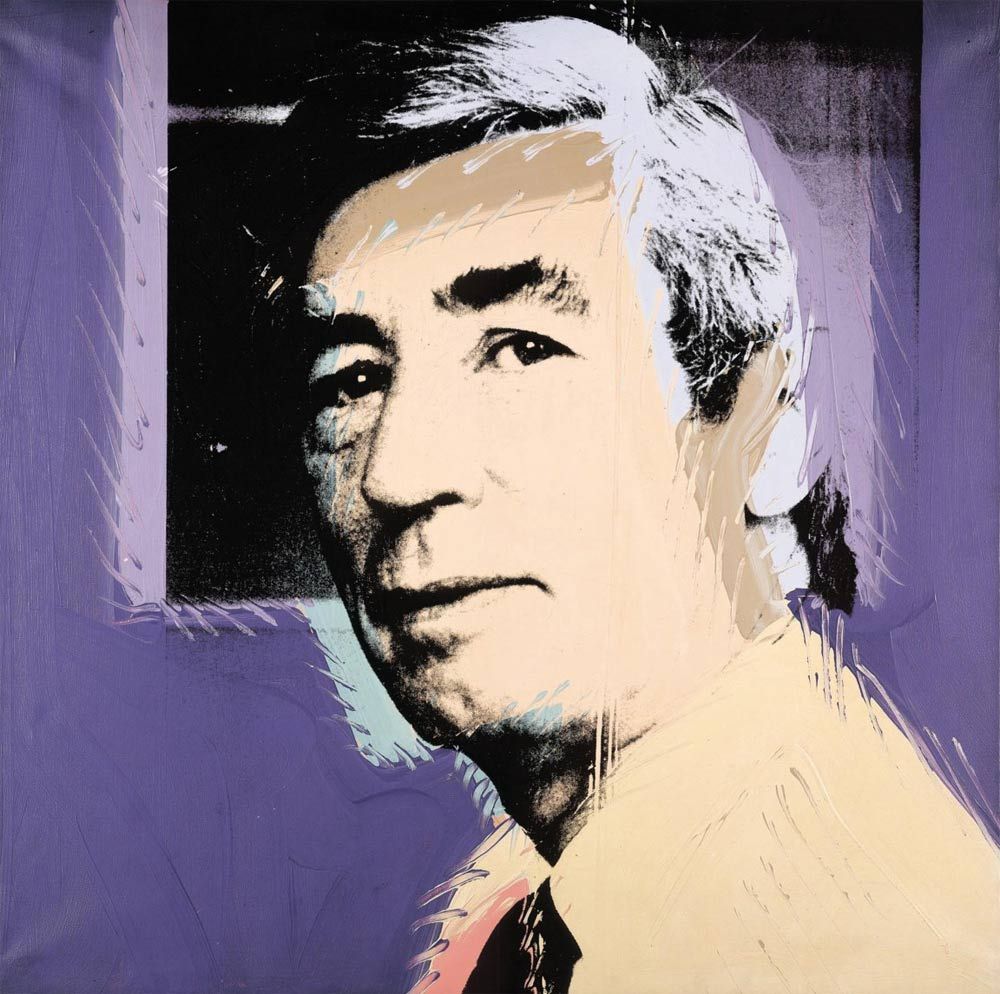
The field of Tintin enthusiasts (in their most dedicated form, “Tintinologists”) includes some of the best-known modern artists in history. Roy Lichtenstein, he of the zoomed-in comic-book aesthetic, once made Tintin his subject, and Tintin’s creator Hergé, who cultivated a love for modern art from the 1960s onward, hung a suite of Lichtenstein prints in his office. As Andy Warhol once put it, “Hergé has influenced my work in the same way as Walt Disney. For me, Hergé was more than a comic strip artist.” And for Hergé, Warhol seems to have been more than a fashionable American painter: in 1979, Hergé commissioned Warhol to paint his portrait, and Warhol came up with a series of four images in a style reminiscent of the one he’d used to paint Jackie Onassis and Marilyn Monroe.
Hergé and Warhol had first met in 1972, when Hergé paid a visit to Warhol’s “Factory” in New York — the kind of setting in which one imagines the straight-laced, sixtysomething Belgian setting foot only with difficulty. But the two had more in common as artists than it may seem: both got their start in commercial illustration, and both soon found their careers defined by particular works that exploded into cultural phenomena. (Warhol may also have felt an affinity with Tintin in their shared recognizability by hairstyle alone.) The Independent’s John Lichfield writes that Hergé, who had by that point learned to paint a few modern abstract pieces of his own, “asked Warhol, modestly, whether the father of Tintin should also consider himself a ‘Pop Artist.’ Warhol, although a great fan of Hergé, simply stared back at him and did not reply.”
Warhol may not have known what to say forty years ago, but in that time Hergé has unquestionably ascended into the institutional pantheon of Western art: Lichfield’s article is a review of a 2006 Hergé retrospective at the Pompidou Centre, and the years since have seen the opening of the Musée Hergé south of Brussels as well as increasingly elaborate exhibitions on Tintin and his creator all around the world. (I myself attended such an exhibition in Seoul, where I live, just last month.) The French artist Jean-Pierre Raynaud expresses a now-common kind of sentiment when he credits Hergé with “a precision of the kind I love in Mondrian” and “the artistic economy that you find in Matisse.” Warhol, who probably wouldn’t have phrased his appreciation in quite that way, makes a more tonally characteristic response in the clip above when Hergé tells him about Tintin’s latter-day switch from his signature plus fours to jeans: “Oh, great!”
Based in Seoul, Colin Marshall writes and broadcasts on cities, language, and culture. His projects include the book The Stateless City: a Walk through 21st-Century Los Angeles and the video series The City in Cinema. Follow him on Twitter at @colinmarshall or on Facebook.
When I look at maps from centuries ago, I wonder how they could have been of any use. Not only were they filled with mythological monsters and mythological places, but the perspectives mostly served an aesthetic design rather than a practical one. Of course, accuracy was hard to come by without the many mapping tools we take for granted—some of them just in their infancy during the Renaissance, and many more that would have seemed like outlandish magic to nearly everyone in 15th century Europe.
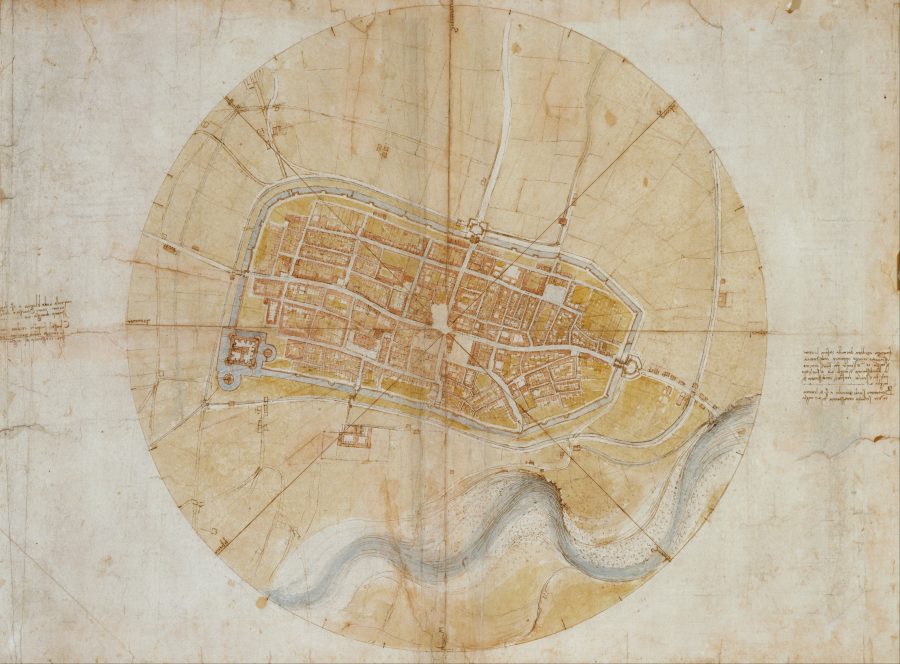
Everyone, it sometimes seems, but Leonardo da Vinci, who anticipated and sometimes steered the direction of futuristic public works technology. None of his flying machines worked, and he could hardly have seen images taken from outer space. But he clearly saw the problem with contemporary maps. The necessity of fixing them led to a 1502 aerial image of Imola, Italy, drawn almost as accurately as if he had been peering at the city through a Google satellite camera.
“Leonardo,” says the narrator of the Vox video above, “needed to show Imola as an ichnographic map,” a term coined by ancient Roman engineer Vitruvius to describe ground plan-style cartography. No streets or buildings are obscured, as they are in the maps drawn from the oblique perspective of a hilltop or mountain. Leonardo undertook the project while employed as Cesare Borgia’s military engineer. “He was charged with helping Borgia become more aware of the town’s layout.” For this visual aid turned cartographic marvel, he drew from the same source that inspired the elegant Vitruvian Man.
While the visionary Roman builder could imagine a god’s eye view, it took someone with Leonardo’s extraordinary perspicacity and skill to actually draw one, in a startlingly accurate way. Did he do it with grit and moxie? Did he astral project thousands of miles above the city? Was he in contact with ancient aliens? No, he used geometry, and a compass, the same means and instruments that allowed ancient scientists like Eratosthenes to calculate the circumference of the earth, to within 200 miles, over 2000 years ago.
Leonardo probably also used an instrument called a bussola, a device that measures degrees inside a circle—like the one that surrounds his city map. Painstakingly recording the angles of each turn and intersection in the town and measuring their distance from each other would have given him the data he needed to recreate the city as seen from above, using the bussola to maintain proper scale. Other methods would have been involved, all of them commonly available to surveyors, builders, city planners, and cartographers at the time. Leonardo trusted the math, even though he could never verify it, but like the best mapmakers, he also wanted to make something beautiful.
It may be difficult for historians to determine which inaccuracies are due to miscalculation and which to deliberate distortion for some artistic purpose. But license or mistakes aside, Leonardo’s map remains an astonishing feat, marking a seismic shift from the geography of “myth and perception” to one of “information, drawn plainly.” There’s no telling if the archetypal Renaissance man would have liked where this path led, but if he lived in the 21st century, he’d already have his mind trained on ideas that anticipate technology hundreds of years in our future.
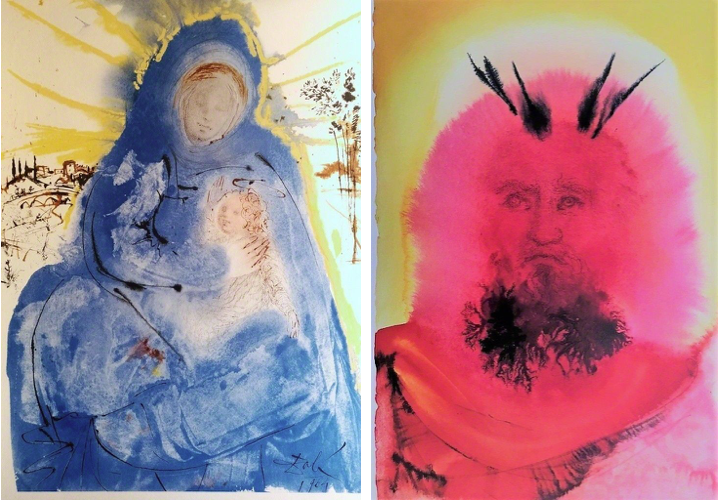
Some might have taken offense when Salvador Dalí began illustrating the Bible in 1963. The notorious Surrealist “went to jail for his artworks as a young man,” writes Jackson Arn writes at Artsy, but he “lived long enough to lend his legendary panache to Hollywood movies and Alka-Seltzer commercials.” Along the way, he gained a reputation for having a rather vicious character. George Orwell, reviewing Dalí’s autobiography, described him as “disgusting” for his fanatical harassment and abuse of other people. But, Orwell went on, “Dalí is a draughtsman of very exceptional gifts. He is also, to judge by the minuteness and the sureness of his drawings, a very hard worker…. He has fifty times more talent than most of the people who would denounce his morals and jeer at his paintings.”
Dalí hardly needed the defense of his morals or his paintings, nor might he have wanted it. That was the wrong sort of attention. But maybe he himself was surprised by a later career turn as an illustrator of respectable “Great Books”—including not only Judeo-Christian scripture, but also Don Quixote, Macbeth, The Divine Comedy, Alice in Wonderland, and much more.
The artist who seemed to have nothing but contempt for traditional canons approached these projects with the skill and professionalism Orwell couldn’t help but admire, as well as subtleties and understated tonal shifts we might not have associated with his work.
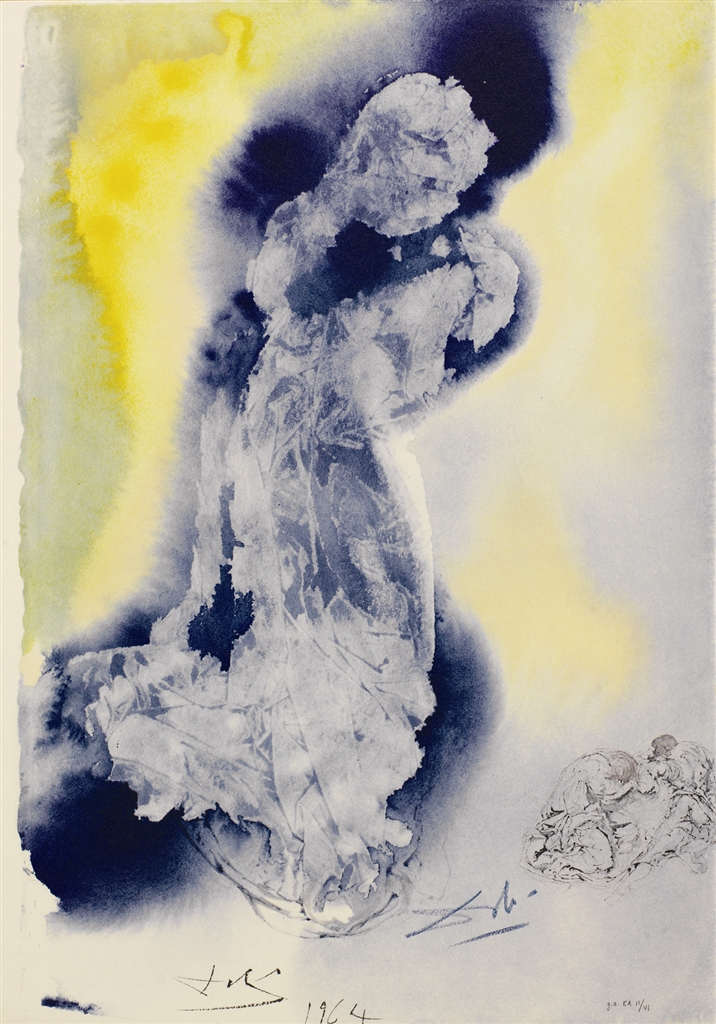
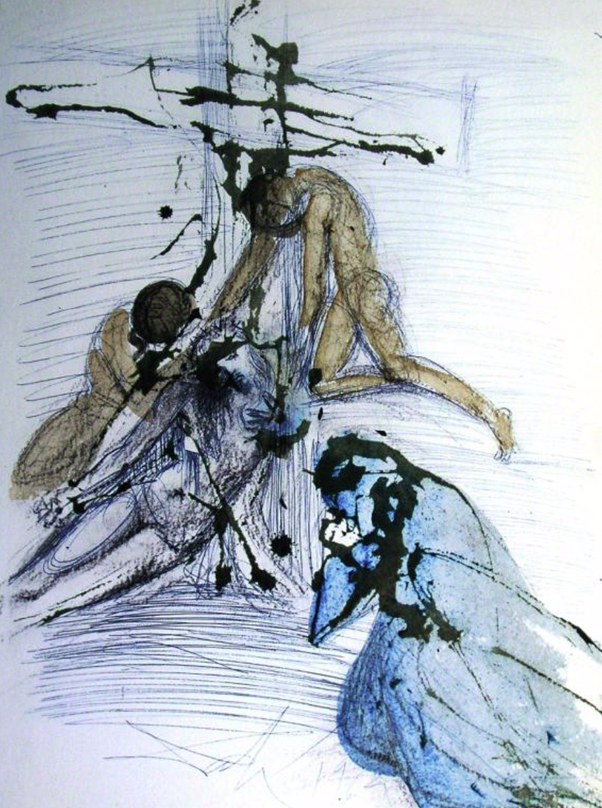
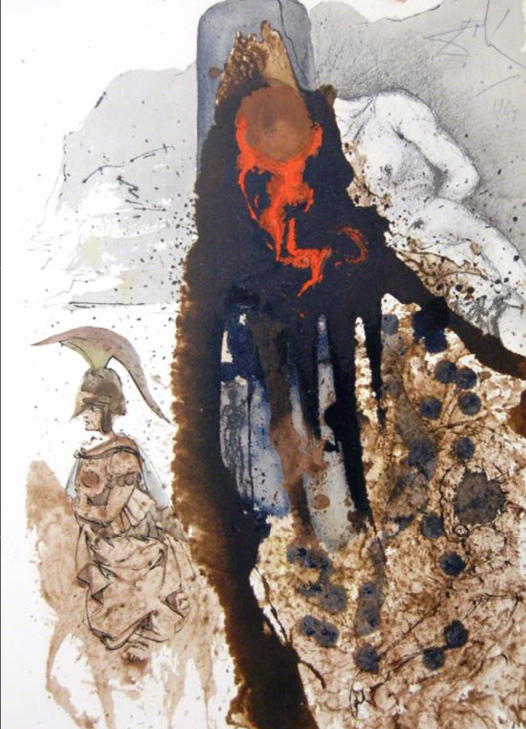
These are not his first religious subjects; he had always referenced big scenes and broad themes in Catholicism. But the illustrations represent a deeper engagement with the primary text—105 paintings in all, each based on select passages from the Latin Vulgate Bible. Published by Rizzoli in 1969, Biblia Sacra (The Sacred Bible) was commissioned by Dalí’s friend, Dr. Guiseppe Albareto, a devout Catholic whose intention “for this massive undertaking,” writes the Lockport St. Gallery, “was to bring the artist back to his religious roots.” Whatever effect that might have had, Dalí approaches the project with the same diligence evident in his other illustrations—he takes artistic risks while making a sincere effort to stay close to the spirit of the text. If he did this work for the money, he earned it.
Dalí’s illustrations “aren’t some kind of subversive prank,” writes Arn. “The luminous watercolors he produced for the Bible are, in the main, earnest renderings of their sacred subjects.” Perhaps the book illustrations have attracted so little attention from art historians because they lack the sensationalism and outrage Dalí aggressively cultivated in his public persona. Maybe these paintings, as German gallerist Holger Kempkens puts it, show “something of a spiritual side of Dalí.” Or maybe they just add to a bigger picture that shows what he could do with narratives not of his own making, but which he clearly respected and found challenging and stimulating. These qualities apply to many parts of the Bible as well as to great literary epics, including those based on the Bible, like John Milton’s Paradise Lost, which Dalí illustrated in a series of surprisingly spare, elegant etchings.
We're hoping to rely on loyal readers, rather than erratic ads. Please click the Donate button and support Open Culture. You can use Paypal, Venmo, Patreon, even Crypto! We thank you!
Open Culture scours the web for the best educational media. We find the free courses and audio books you need, the language lessons & educational videos you want, and plenty of enlightenment in between.