Did you know T.S. Eliot’s portentous and heavily allusive 1922 masterpiece “The Waste Land” was originally titled “He Do the Police in Different Voices,” a quote from Charles Dickens’ Our Mutual Friend? Filled with references to Dante’s Divine Comedy, Joseph Conrad’s Heart of Darkness, and James Frazier’s The Golden Bough, this most famous of high modernist poems—scourge of millions of college freshman each year—was a very different animal before notorious modernist impresario Ezra Pound got his hands on it. Pound’s heavy reworking is responsible for the poem you hear above, read by Eliot himself. The first image in the video shows Pound’s marginal annotations.
In the video above listen to Eliot read his second-most famous work, “The Love Song of J. Alfred Prufrock,” with the text of the poem choreographed by Wordookie, an open-source version of Wordle. “Prufrock,” first published in 1915, is as dense with literary allusions as “The Waste Land” (and thus as painful for the average undergraduate). And if Eliot’s reedy alto doesn’t deliver “Prufrock“ ‘s gravitas for you, listen to Anthony Hopkins read it here.
If you would like to support the mission of Open Culture, consider making a donation to our site. It’s hard to rely 100% on ads, and your contributions will help us continue providing the best free cultural and educational materials to learners everywhere. You can contribute through PayPal, Patreon, and Venmo (@openculture). Thanks!
Before Banned Books Week comes to a close, we bring you Allen Ginsberg’s 1955 poem, Howl. The controversial poem became his best known work, and it now occupies a central place in the Beat literary canon, standing right alongside Jack Kerouac’s On the Road and William S. Burroughs’s Naked Lunch. Ginsberg first read the poem aloud on October 7, 1955, to a crowd of about 150 at San Francisco’s Six Gallery. (James Franco reenacted that moment in the 2010 film simply called Howl.)
Things got dicey when City Lights published the poem in 1956, and especially when they tried to import 520 printed copies from London in ’57. US customs officials seized the copies, and California prosecutors tried City Lights founder Lawrence Ferlinghetti and his partner, Shigeyosi Murao, on obscenity charges that same year. Nine literary experts testified to the redeeming social value of Howl, and, after a lengthy trial, the judge ruled that the poem was of “redeeming social importance.”
Above, we give you Ginsberg reading Howl in 1959. It’s also listed in the Poetry section of our Free Audio Books collection. An online version of the text appears here.
If you would like to support the mission of Open Culture, consider making a donation to our site. It’s hard to rely 100% on ads, and your contributions will help us continue providing the best free cultural and educational materials to learners everywhere. You can contribute through PayPal, Patreon, and Venmo (@openculture). Thanks!
A number of sites offer free Mp3s of public domain books—Librivox and Podiobooks, for instance. What sets apart Lit2Go, the University of South Florida’s extensive collection of free audio books (Web — iTunes), are the materials to help K‑12 teachers present literature in the classroom.
From fairy tales to The Iliad (Web — iTunes), Lit2Go organizes more than 200 titles by author and genre (adventure, gothic, history, science fiction) with clear genre descriptions and plot summaries for young readers. The look and feel of the site’s beta version is user-friendly and library-like, with typewriter fonts and illustrations making it a pleasure to browse. There are a few small kinks to be worked out however, so teachers interested in downloading supplemental materials should opt for the original site.
Lit2Go marries the old school library form (each novel’s year of publication and original publisher is included) with the capacity of the web (a link takes readers directly to the iTunes store, where Lit2Go has its own section of free downloads).
Many titles include support material to kick off classroom discussion or to coach students through developing their own character diagrams. One of the site’s real assets is the way it curates titles into collections, including African-American Literature, American Founders and the intriguing Happiness Collection where readers find Robert Louis Stevenson’s poem “The Swing” and Shakespeare’s heart-stopping scene in which Friar Laurence marries Romeo to Juliet (Web — iTunes).
Another curatorial bonus: Materials are also organized by grade level, using the Flesch-Kincaid Grade Level index. Teachers and students can also download each title’s full text as a PDF, to read along to the audio.
Meanwhile, your can find hundreds of downloadable works of literature in our own meta collection of Free Audio Books.
Kate Rix writes about k‑12 instruction and higher ed.
Back in 1997, Hal Willner recorded,Closed On Account of Rabies, an audio compilation featuring well-known artists reading macabre stories by Edgar Allan Poe. 15 years later, the album has gone out of circulation. A handful of “out-of-print” CDs can be bought on Amazon. But they’ll run you anywhere from $30 for a used copy, to $250 for a mint copy in its original packaging. That puts the audio collection out of reach for most.
Once again Open Culture comes in handy. Above, we’re featuring a YouTube clip with Christopher Walken reading Poe’s classic poem, “The Raven.” Below, we have assembled a few more highlights from Closed On Account of Rabies — readings by Iggy Pop, Marianne Faithfull and Jeff Buckley. And if you want to get resourceful, you can always rummage through YouTube for more tracks listed out here. Meanwhile, the major works of Edgar Allan Poe can be found in our collections of Free Audio Books and Free eBooks.
This is a novel that needs no introduction, but we will give it a short one anyway. Published in serial format between 1918 and 1920, James Joyce’s Ulysses was initially reviled by many and banned in the US and UK until the 1930s. Today, it’s widely considered a classic in modernist literature, and The Modern Library went so far as to call it the most important English-language novel published during the 20th century. Although chronicling one ordinary day in the life of Leopold Bloom in 1904 Dublin, Ulysses is no small work. It sprawls over 750 pages, using over 250,000 words, and takes hours to read aloud. That you will find out when you hear the free audio book made available by Archive.org. What makes the audio special is that it features a full-cast, dramatic performance of Ulysses. You can stream the audio right below, or (or via this Archive.org file) download a big zip file right here. You can also download ebook versions of Ulysses in the following formats: iPad/iPhone – Kindle + Other Formats – Hypertext.
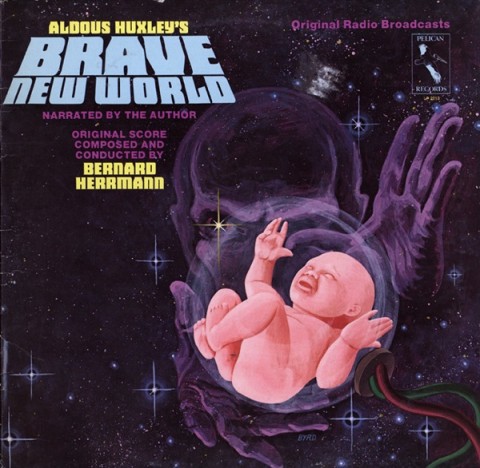
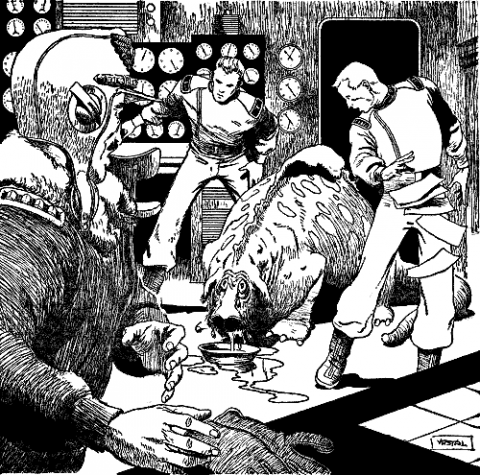
Today we’re bringing you a roundup of some of the great Science Fiction, Fantasy and Dystopian classics available on the web. And what better way to get started than with Aldous Huxley reading a dramatized recording of his 1932 novel, Brave New World. The reading aired on the CBS Radio Workshop in 1956. You can listen to Part 1 here and Part 2 here.
(FYI: You can download Huxley’s original work — as opposed to the dramatized version — in audio by signing up for a Free Trial with Audible.com, and that applies to other books mentioned here as well.)
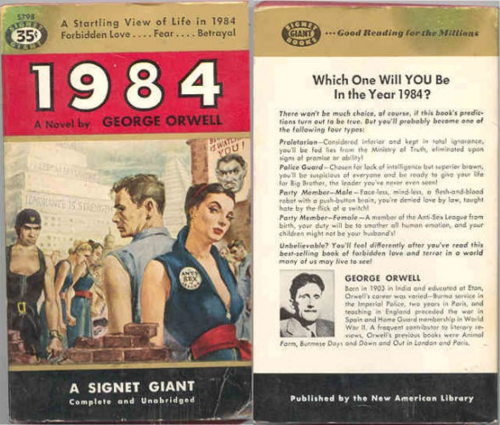
Little known fact. Aldous Huxley once gave George Orwell French lessons at Eton. And, 17 years after the release of Brave New World, Huxley’s pupil published 1984. The seminal dystopian work may be one of the most influential novels of the 20th century, and it’s almost certainly the most important political novel from that period. You can find it available on the web in three formats: Free eText — Free Audio Book – Free Movie.
In 1910, J. Searle Dawley wrote and directed Frankenstein. It took him three days to shoot the 12-minute film (when most films were actually shot in just one day). It marked the first time that Mary Shelley’s classic monster tale (text — audio) was ever adapted to film. And, somewhat notably, Thomas Edison had a hand (albeit it an indirect one) in making the film. The first Frankenstein film was shot at Edison Studios, the production company owned by the famous inventor.
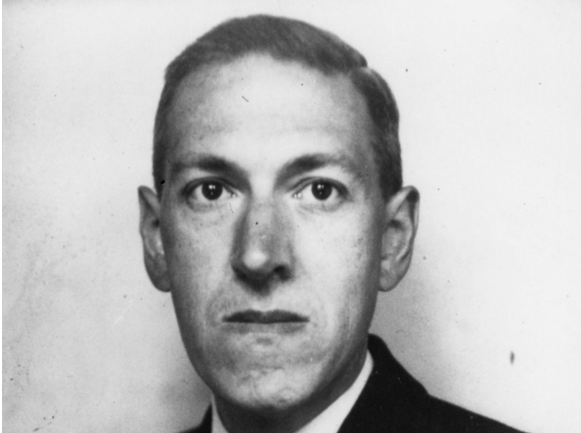
Stephen King and Joyce Carol Oates — they both pay homage to H.P. Lovecraft and his great tales. And you can too by spending time with his collected works, available in etext formats here and audio formats here (Free Mp3 Zip File – Free Stream).
Philip K. Dick published 44 novels and 121 stories during his short lifetime, solidifying his position as one of America’s top sci-fi writers. If you’re not intimately familiar with his novels, then you almost certainly know major films based on Dick’s work – Blade Runner, Total Recall, A Scanner Darkly and Minority Report. To get you acquainted with PKD’s writing, we have culled together 14 short stories for your enjoyment.
Back in the late 1930s, Orson Welles launched The Mercury Theatre on the Air, a radio program dedicated to bringing dramatic, theatrical productions to the American airwaves. The show had a fairly short run, lasting from 1938 to 1941. But it made its mark. During these few years, The Mercury Theatre aired The War of the Worlds, an episode narrated by Welles that led many Americans to believe their country was under Martian attack. The legendary production, perhaps the most famous ever aired on American radio, was based on H.G. Wells’ early sci-fi novel, and you can listen to the broadcast right here.
Between 1951 and 1953, Isaac Asimov published three books that formed the now famous Foundation Trilogy. Many considered it a masterwork in science fiction, and that view became official doctrine in 1966 when the trilogy received a special Hugo Award for Best All-Time Series, notably beating out Tolkien’s The Lord of the Rings. Eventually, the BBC decided to adapt Asimov’s trilogy to the radio, dramatizing the series in eight one-hour episodes that aired between May and June 1973. Thanks to The Internet Archive you can download the full program as a zip file, or stream it online:
Part 1 |MP3| Part 2 |MP3| Part 3 |MP3| Part 4 |MP3| Part 5 |MP3| Part 6 |MP3| Part 7 |MP3| Part 8 |MP3|
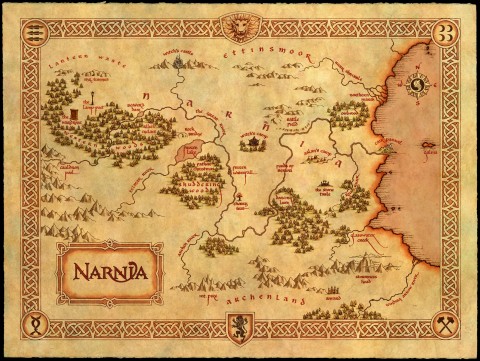
Before the days of Harry Potter, generations of young readers let their imaginations take flight with The Chronicles of Narnia, a series of seven fantasy novels written by C. S. Lewis. Like his friend J.R.R. Tolkien, Lewis served on the English faculty at Oxford University and took part in the Inklings, an Oxford literary group dedicated to fiction and fantasy. Published between 1950 and 1956, The Chronicles of Narnia has sold over 100 million copies in 47 languages, delighting younger and older readers worldwide.
Now, with the apparent blessing of the C.S. Lewis estate, the seven volume series is available in a free audio format. There are 101 audio recordings in total, each averaging 30 minutes and read by Chrissi Hart. Download the complete audio via the web or RSS Feed.
Neil Gaiman has emerged as one of today’s best fantasy writers. He has made comics respectable and published novels, including one that will be adapted by HBO. A great deal of his output, though, has been in the form of short stories, some available on the web in text format, others in audio.
The Truth Is a Cave in the Black Mountains – Read Online
Between 1982 and 2000, Rudy Rucker wrote a series of four sci-fi novels that formed The Ware Tetralogy. The first two books in the series – Software and Wetware – won the Philip K. Dick Award for best novel. And William Gibson has called Rucker “a natural-born American street surrealist” or, more simply, one sui generis dude. And now the even better part: Rucker (who happens to be the great-great-great-grandson of Hegel) has released The Ware Tetralogy under a Creative Commons license, and you can download the full text for free in PDF and RTF formats. In total, the collection runs 800+ pages.
“Everybody knows that Einstein did something astonishing,” writes Bertrand Russell in the opening passage of ABC of Relativity, “but very few people know exactly what it was. It is generally recognized that he revolutionized our conception of the physical world, but the new conceptions are wrapped up in mathematical technicalities. It is true that there are innumerable popular accounts of the theory of relativity, but they generally cease to be intelligible just at the point where they begin to say something important.”
Eighty-seven years after it was written, ABC of Relativity still stands as one of the most intelligible introductions to Albert Einstein’s theories. Russell wrote the book in 1925 as a companion to his earlier volume, ABC of Atoms. The project of writing books for a general readership was born of necessity. Russell had no academic appointment, and needed the money. But as Peter Clark explains in his introduction to the Routledge fifth edition to ABC of Relativity, the early 1920s were also a time when Russell was becoming increasingly preoccupied with social and political issues. He believed that many of the social ills of the period, including the rise of nationalism, were consequences of a widespread and entrenched irrationality, born of ignorance and a lack of education. Writes Clark:
It was certainly a heroic period in Russell’s life, when he earnestly believed that the sort of blind unthinking prejudice–which he conceived to be fundamentally responsible for the horrors of the First World War–could be transcended by the dissemination of knowledge and the exercise in critical reasoning power by all classes of society. His huge output in this period was designed to bring within, as far as possible, everyone’s grasp the freedom of thought and action which knowledge and learning brings. That spirit of enlightenment certainly pervades the ABC of Relativity.
Thanks to UbuWeb, you can listen to an abridged audio version of ABC of Relativity online. The book is read by English actor Derek Jacobi (who also starred in the film we featured last week on Alan Turing: Breaking the Code). Jacobi reads one of the later editions of ABC of Relativity. In 1959, and again in 1969, Russell consented to revisions by physicist Felix Pirani. Chapter 11 was rewritten by Pirani to incorporate the expansion of the universe, which wasn’t announced by Edwin Hubble until four years after the first edition of Russell’s book. The one troubling thing about the text, as it now stands, is that Pirani didn’t limit himself to the revisions made under Russell’s supervision. He made more changes in 1985, fifteen years after Russell’s death.
Stellar courses focusing on Einstein’s physics can also be found in our big collection of Free Courses Online. Just scroll down to the Physics section.
Today is the 200th birthday of Charles Dickens. He was born in Portsmouth, England on February 7, 1812, the second of eight children. When he was 12 years old his father was sent to debtors’ prison, along with most of his family, and Charles went to live with a friend of the family, an impoverished old lady. He was forced to quit school and work in a blacking factory, where he pasted labels on jars of shoe polish.
Dickens never forgot those early traumas. He incorporated his experiences and observations of social injustice into his works, including David Copperfield, Oliver Twist and A Christmas Carol. (Find free novels below.) He was the most popular writer of Victorian England, a virtual rock star in the days before recorded music and movies. His stories, published serially in magazines, were eagerly awaited by the public. Most have remained in print ever since.
The Dickens bicentenary is being celebrated with special events around the world, including a wreath-laying ceremony this morning at Poets’ Corner in Westminster Abbey, where actor and filmmaker Ralph Fiennes, author Claire Tomalin, and two of Dickens’s descendants are scheduled to give readings. For a listing of events today and throughout the year, go to Dickens2012.org. Also take a look at the short retrospective of Dickens-inspired movies (above) from the British Film Institute.
To help celebrate, we have gathered together some of the best Dickens material from across the Web:
Oliver Twist: Another classic by David Lean, this 1948 film stars John Howard Davies as Oliver and Alec Guinness as Fagin. In 1999 it was ranked 46th on the BFI’s list of the top 100 British films of all time.
A Tale of Two Cities: The 1958 film by Ralph Thomas, starring Dirk Bogarde as Sydney Carton and Dorothy Tutin as Lucie Manette. The film was shot in France’s Loire Valley, with several thousand U.S. soldiers, posted in nearby Orleans, cast as extras.
A Christmas Carol: George C. Scott gives an excellent performance as Ebenezer Scrooge in this critically acclaimed 1984 film directed by Clive Donner. It premiered in America on CBS television, and was released theatrically in Great Britain.
David Copperfield: A 2000 U.S.-Irish television adaptation starring Hugh Dancy as David Copperfield, Michael Richards as Wilkins Micawber and Sally Field as Betsey Trotwood.
The Pickwick Papers: A 1952 film, adapted and directed by Noel Langley and starring James Hayter as Samuel Pickwick.
We're hoping to rely on loyal readers, rather than erratic ads. Please click the Donate button and support Open Culture. You can use Paypal, Venmo, Patreon, even Crypto! We thank you!
Open Culture scours the web for the best educational media. We find the free courses and audio books you need, the language lessons & educational videos you want, and plenty of enlightenment in between.