Whether in the tanks into which we gaze at the aquarium or the CGI-intensive wildlife-based gagfests at which we gaze in the theater, most of us in the 21st century have seen more than a few funny fish. Eighteenth-century Europeans couldn’t have said the same. The great majority passed their entire lives without so much as a glance at the form of even one live exotic creature of the deep, and most of those who have a sense of what such a sight looked like probably got it from an illustration. But even so, some of the illustrated fish of the day must have proven unforgettable, especially the ones in Louis Renard’s Poissons, Ecrevisses et Crabes.
First published in 1719 with a second edition, seen here, in 1754, Renard’s book, whose full title translates to Fishes, Crayfishes, and Crabs, of Diverse Colors and Extraordinary Form, that Are Found Around the Islands of the Moluccas and on the Coasts of the Southern Lands, showed its readers, in full color for the very first time, creatures the likes of which they’d never have had occasion even to imagine. The book’s 460 hand-colored copper engravings depict, according to the Glasgow University Library, “415 fishes, 41 crustaceans, two stick insects, a dugong and a mermaid.”
The specimens in the first part of the book tend toward the realistic, while those of the second “verge on the surreal,” many of which “bear no similarity to any living creatures,” some of which bear “small human faces, suns, moons and stars” on their flanks and carapaces, most possessed of colors “applied in a rather arbitrary fashion,” though brilliantly so. In the short accompanying texts, “several of the fish” — presumably not the mermaid — “are assessed in terms of their edibility and are accompanied by brief recipes.”
Renard himself, who lived from 1678 to 1746, seems to have had a career as colorful as the fish in his book. “As well as spending some seventeen years as a publisher and bookdealer,” he also “sold medicines, brokered English bonds and, more intriguingly, acted as a spy for the British Crown, being employed by Queen Anne, George I and George II.” Far from keeping that part of his life a secret, “Renard used his status as an ‘agent’ to help advertise his books. This particular work is actually dedicated to George I while the title-page describes the publisher as ‘Louis Renard, Agent de Sa Majesté Britannique.’ ”
You can behold more of Poissons, Ecrevisses et Crabesat the Public Domain Review. “If the illustrations are breathtaking to us now, with all the hours of David Attenborough documentaries under our belts,” they write, “one can only imagine the impact this would have had on a European audience of the eighteenth century, to which the exotic ocean life of the East would have been virtually unknown.”
Though received as a respectable scientific work in its day — and even, as the Glasgow University Library puts it, “a product of the Enlightenment” — the book now stands as an enchanting tribute to the combination of a little knowledge and a lot of human imagination.
Based in Seoul, Colin Marshall writes and broadcasts on cities and culture. His projects include the book The Stateless City: a Walk through 21st-Century Los Angeles and the video series The City in Cinema. Follow him on Twitter at @colinmarshall or on Facebook.
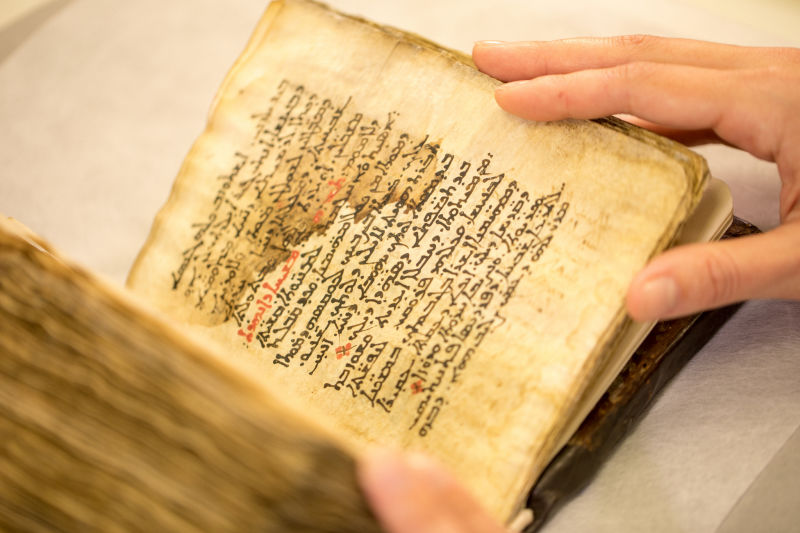
Are we truly in the midst of a human-caused sixth mass extinction, an era of “biological annihilation”? Many scientists and popular science writers say yes, using terms like “Holocene” or “Anthropocene” to describe what follows the Ordovician, Devonian, Permian, Triassic, and Cretaceous periods. Peter Brannen, author of extinction history The Ends of the Earth has found at least one scientist who thinks the concept is “junk.” But Brannen quotes some alarming statistics. Chilling, even. “Until very recently,” he writes, “all vertebrate life on the planet was wildlife. But astoundingly, today wildlife accounts for only 3 percent of earth’s land animals; human beings, our livestock, and our pets take up the remaining 97 percent of the biomass… almost half of the earth’s land has been converted into farmland.”
This state of affairs does not bode well for the millions of remaining species getting edged out of their environments by agribusiness and climate change. We learn from extinctions past that the planet rebounds after unimaginable catastrophe. Life really does go on, though it may take millions of years to recover. But the current forms of life may disappear before their time. If we want to understand what is at stake besides our own fragile fossil-fuel based civilizations, we need to connect to life emotionally as well as intellectually. Short of globe-hopping physical immersion in the earth’s biodiversity, we could hardly do better than immersing ourselves in the tradition of naturalist writing, art, and photography that brings the world to us.
The Biodiversity Heritage Library (BHL), an “open access digital library for biodiversity literature and archives,” has for many years been making it easy for people to connect to nature through nature writing and illustration. In 2012, they announced the “success story” of their Flickr streams, both containing thousands of illustrations and photographs uploaded by the BHL staff and readers from their huge collections of books.
The first stream, currently at 122,281 images, has been carefully curated, and includes searchable galleries and albums divided by book title or subject, such as “Exotic botany illustrated,” “The Birds of Australia v.1,” and “Bats!” The second stream, consisting of over 2 million images, is a massive grab-bag of photos, illlustrations from nature, advertisements, and imaginative renderings.
Though far less useful for the scholar—or the very purposeful user—this second photostream offers more potential for chance discovery, through the aimless wandering that often leads to serendipitously sublime experiences. The formal BHL stream does not disappoint, though it may offer fewer surprises. Both of these image archives offer expansive views of humanity’s encounter with the natural world, not only through statistics and academic jargon, but through the artistic recording of wonder, scientific curiosity, and deep appreciation.
MVRDV, a Dutch architecture and urban design firm, teamed up with Chinese architects to create the Tianjin Binhai Library, a massive cultural center featuring “a luminous spherical auditorium around which floor-to-ceiling bookcases cascade.” Located not far from Beijing, the library was built quickly by any standards. It took only three years to move from “the first sketch to the [grand] opening” on October 1. Elaborating on the library, which can house 1.2 million books, MVRDV notes:
The building’s mass extrudes upwards from the site and is ‘punctured’ by a spherical auditorium in the centre. Bookshelves are arrayed on either side of the sphere and act as everything from stairs to seating, even continuing along the ceiling to create an illuminated topography. These contours also continue along the two full glass facades that connect the library to the park outside and the public corridor inside, serving as louvres to protect the interior against excessive sunlight whilst also creating a bright and evenly lit interior.
The video above gives you a visual introduction to the building. And, on the MRDV website, you can view a gallery of photos that let you see the library’s shapely design.
If you would like to sign up for Open Culture’s free email newsletter, please find it here. It’s a great way to see our new posts, all bundled in one email, each day.
If you would like to support the mission of Open Culture, consider making a donation to our site. It’s hard to rely 100% on ads, and your contributions will help us continue providing the best free cultural and educational materials to learners everywhere. You can contribute through PayPal, Patreon, and Venmo (@openculture). Thanks!
Here at Open Culture, we can never resist the chance to feature books free to read and download online. Books can become free in a number of different ways, one of the most reliable being reversion to the public domain after a certain amount of time has passed since its publication — usually a long time, with the result that the average age of the books freely available online skews quite old. Nothing wrong with old or even ancient reading material, of course, but sometimes one wishes copyright law didn’t put quite such a delay on the process. The Internet Archive and its collaborators have recently made progress in that department, finding a legal means of “liberating” books of a less distant vintage than usual.
“The Internet Archive is now leveraging a little known, and perhaps never used, provision of US copyright law, Section 108h, which allows libraries to scan and make available materials published [from] 1923 to 1941 if they are not being actively sold,” writes the site’s founder Brewster Kahle.
At the moment, the Sonny Bono Memorial Collection offers such 94-to- 76-year-old pieces of reading material as varied as André Malraux’s The Royal Way, Arnold Dresden’s An Invitation to Mathematics, René Kraus’ Winston Churchill: A Biography, Colonel S.P. Meek’s Frog, the Horse that Knew No Master, and Donald Henderson Clarke’s Impatient Virgin. Kahle assures us that “We will add another 10,000 books and other works in the near future,” and reminds us that “if the Founding Fathers had their way, almost all works from the 20th century would be public domain by now.” The intentions of the Founding Fathers may matter to you or they may not, but if you’re an Open Culture reader, you can hardly quibble with the new availability of dozens of free books online — and the prospect of thousands more soon to come. Stay tuned and watch the collection grow.
Based in Seoul, Colin Marshall writes and broadcasts on cities and culture. His projects include the book The Stateless City: a Walk through 21st-Century Los Angeles and the video series The City in Cinema. Follow him on Twitter at @colinmarshall or on Facebook.
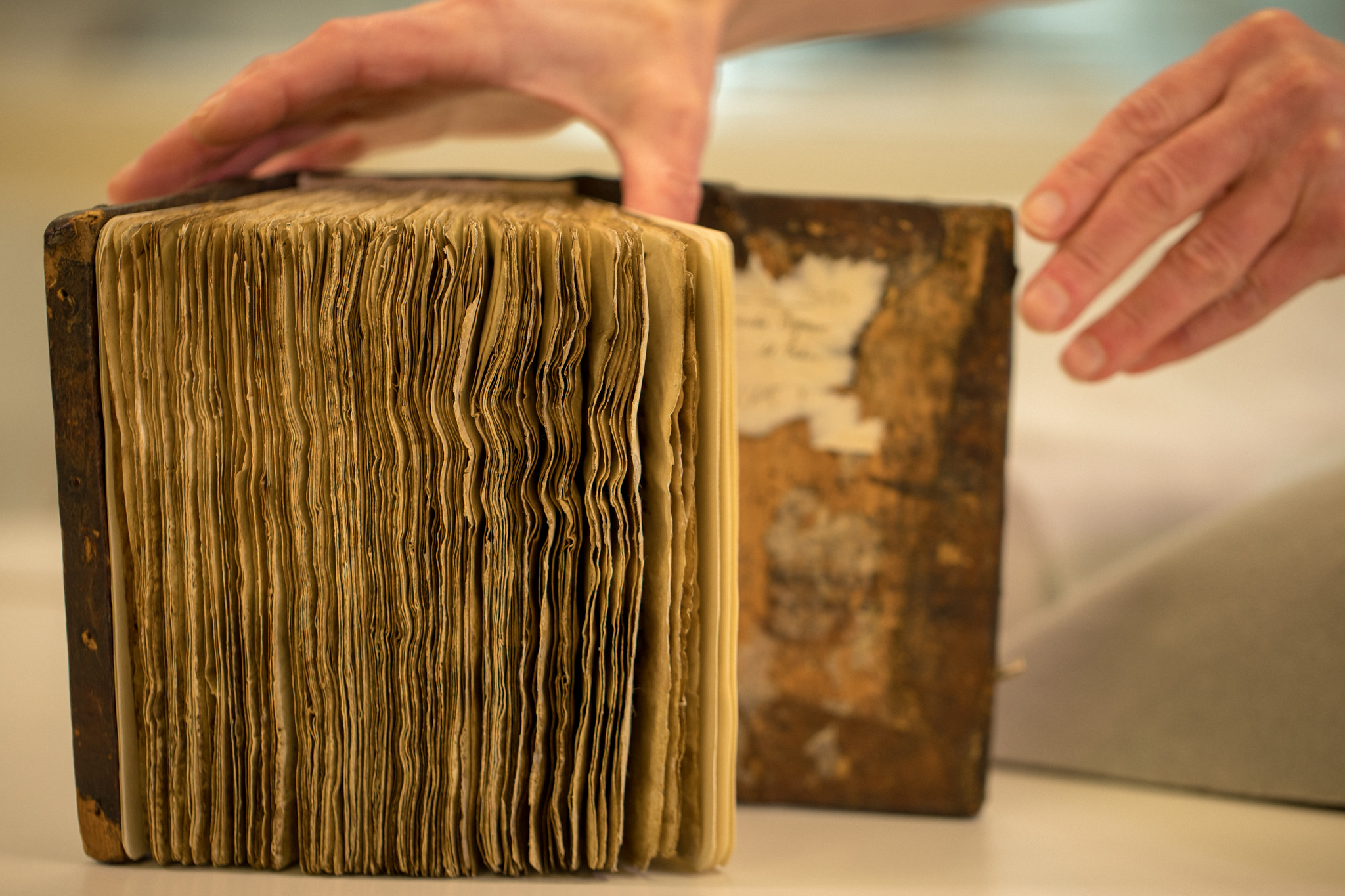
Book history buffs don’t need to be told, but the rest of us probably do: incunable—from a Latin word meaning “cradle,” “swaddling clothes,” or “infancy”—refers to a book printed before 1501, during the very first half-century of printing in Europe. An overwhelming number of the works printed during this period were in Latin, the transcontinental language of philosophy, theology, and early science. Yet one of the most revered works of the time, Dante’s Divine Comedy—written in Italian—fully attained its status as a literary classic in the latter half of the 15th century.
In addition to numerous commentaries and biographies of its author, over 10 editions of the epic Medieval poem— the tale of Dante’s descent into hell and rise through purgatory and paradise—appeared in the period of incunabula, the first in 1472. The 1481 edition contained art based on Sandro Botticelli’s unfinished series of Divine Comedy illustrations. The first fully-illustrated edition appeared in 1491. None of these printings included the word Divine in the title, which did not come into use until 1555. The Commedia, as it was originally called, continued to gain in stature into the 16th century, where it received lavish treatment in other illustrated editions.
You can see Illustrations from three of the editions from the first 100-plus years of printing here, and many more at Digital Dante, a collaborative effort from Columbia University’s Library and Department of Italian. These images, from Columbia’s Rare Book and Manuscript Library, represent a 1497 woodcut edition, at the top, with a number of hand-colored pages; an edition from 1544, above, with almost 90 circular and traditionally-composed scenes, all of them probably hand-colored in the 19th century; and a 1568 edition with three engraved maps, one for each book, like the carefully-rendered visualization of purgatory, below.
Of this last edition, Jane Siegel, Librarian for Rare Books, writes, “the relative lack of illustrations are balanced by the fineness and detail made possible by using expensive copper engravings as a medium, and by the lively decorated and historiated woodcut initials sprinkled throughout the volume at the head of each canto.” Each of these historical artifacts shows us a lineage of craftsmanship in the infancy and early childhood of printing, a time when literary works of art could be turned doubly into masterpieces with illustration and typography that complemented the text. Luckily for lovers of Dante, finely-illustrated editions of the Divine Comedy have never gone away.
The list of English translators of Homer’s Odyssey includes an illustrious bunch of names every student of literature knows: Thomas Hobbes, Alexander Pope, William Cowper, Samuel Butler, T.E. Lawrence, Robert Fitzgerald, Robert Fagles…. Should you look further into the history of Homeric translation, you might notice one thing immediately. All of Homer’s translators, to a man, have been men. None have, presumably, approached the text from a woman’s point of view.
But what would that entail? Perhaps a certain critical distance, suspicion even—an unwillingness to readily identify with or admire the hero or credit the tales of his exploits at their supposed value. As Margaret Atwood writes in the introduction to The Penelopiad—her reimagining of the tale from Penelope’s perspective—“The story as told in The Odyssey doesn’t hold water: there are too many inconsistencies.”
Atwood is not a translator. Prolific poet and scholar Anne Carson, on the other hand, has published acclaimed translations of Sappho, Euripides, and Aeschylus. Of the art, she writes, “Silence is as important as words in the practice and study of translation.” Though Carson calls the observation “cliché,” the experience of another rare female classics translator in a field overcrowded with men bears out the importance of silence in a personal way.
Classicist Emily Wilson has made the first translation of The Odyssey by a woman. Her version, writes Wyatt Mason at The New York Times, approaches the text afresh, apart from the chattering conversations between hundreds of years of previous attempts. “Wilson has made small but, it turns out, radical changes to the way many key scenes of the epic are presented,” notes Mason. This translation is a corrective, she believes, of a text that “has through translation accumulated distortions that affect the way even scholars who read Greek discuss the original.”
Confronting silence is a theme of Wilson’s interview with Mason about her new translation. From a family of accomplished scholars, most notably her father, novelist and critic A.N. Wilson, she remembers her childhood as “a lot of silence… As a kid I was just aware of unhappiness, and aware of these things that weren’t ever being articulated.” She gravitated toward classics because of shyness and fear of mispronouncing living languages. “You don’t have to have beautiful Latin pronunciation,” she says. “It took away a whole level of shame.”
Greek tragedy appealed to Wilson because of its tumultuous irruption into the silence and shame of repressed emotion: “I had a childhood where it was very hard to name feelings, and just the fact that tragedy as a genre is very good at naming feelings. It’s all going to be talked out. I love that about it.” Her attention to emotional nuance as much as to action, concept, and image in part inspires her careful, independent approach to the language of the text. As a salient example, Wilson discusses the word polytropos, used as the first description we get of the poem’s hero.
The prefix poly… means “many” or “multiple.” Tropos means “turn.” “Many” or “multiple” could suggest that he’s much turned, as if he is the one who has been put in the situation of having been to Troy, and back, and all around, gods and goddesses and monsters turning him off the straight course that, ideally, he’d like to be on. Or, it could be that he’s this untrustworthy kind of guy who is always going to get out of any situation by turning it to his advantage. It could be that he’s the turner.
Mason surveys the many renderings of the word by some of Wilson’s “60 some predecessors.” Though these translations display “quite a range,” they also tend toward similarly flattering interpretations of Odysseus as “the turner.” He’s “prudent,” “for wisdom’s various arts renown’d,” “for shrewdness famed/And genius versatile,” “crafty,” “much-versed,” “deep,” “sagacious,” “ingenious,” “so wary and wise,” “clever,” and—in Stanley Lombardo’s translation—“cunning.”
Tell me about a complicated man.
Muse, tell me how he wandered and was lost
when he had wrecked the holy town of Troy,
and where he went, and who he met, the pain
he suffered in the storms at sea, and how
he worked to save his life and bring his men
back home. He failed to keep them safe; poor fools,
they ate the Sun God’s cattle, and the god
kept them from home. Now goddess, child of Zeus,
tell the old story for our modern times.
Find the beginning.
The silence in Wilson’s approach here is of the “metaphysical” variety—as Carson puts it—where “intentions are harder to define.” It is a refusal to make hasty appraisals or assume singular design or agency. “What gets us to ‘complicated,’” she says, “is both that I think it has some hint of the original ambivalence and ambiguity… and hints at ‘There might be a problem with him.’” We will learn about his turning and his being turned, and we must make up our own minds about what sort of person he is. The word also resonates strongly with contemporary usage. “I wanted it to feel like an idiomatic thing,” says Wilson, “that you might say about somebody: that he is complicated.” It is, she admits, “a flag. It says, ‘Guess what?—this is different.’ ”
Complicated: from a certain point of view, we might say this about everybody, which adds a modern layer of anxious, and very human, universalism to the description of the poem’s hero, so often cast as a heroic trickster archetype. Wilson expects pushback for her refusal to adhere to what she calls the “boys’ club” of classical translation shibboleths, many passed down from Matthew Arnold’s criteria in his 1860 lectures “On Translating Homer.” These criteria, she says, are about “noblesse oblige… you’re going to be the kind of gentlemen who’s going to have gone to Rugby and that will be the kind of language that we speak… It’s describing a boys’ club.”
Her observations turn the gaze back upon the lineage of male translators, examining how gender, as well as class and nationality, features in the way they used language. “I do think that gender matters,” she says, “and I’m not going to not say it’s something I’m grappling with.” But gender is only one part of the complicated identity of any translator. Wilson describes her approach as “trying to take this task and this process of responding to this text and creating this text extremely seriously, with whatever I have, linguistically, sonically, emotionally.” You may appreciate the results yourself—either enjoying them afresh or comparing them to previous translations you’ve loved, liked, or loathed—by purchasing a copy Wilson’s Odyssey starting today.
The concept beyond “Library Extension” is simple. As you browse books and e‑books websites like Amazon, Barnes and Noble and Goodreads, the Library Extension will check the online catalog of your local library and see whether the book you’re interested in happens to be available at your local library. The browser extension currently works on Chrome. Firefox is coming soon. And the browser extension currently has access to data from 4000 local libraries and library systems.
Above you can watch a short video that shows the browser extension in action. You can download it here. Below find a list of websites that Library Extension interacts with:
* Amazon (amazon.com, amazon.co.uk, amazon.ca, amazon.de)
* AR BookFinder (arbookfind.com)
* Barnes and Noble (barnesandnoble.com)
* BookDepository (bookdepository.com)
* Chapters/Indigo (chapters.indigo.ca)
* Good Reads (goodreads.com)
* Google Books (books.google.com, books.google.co.uk)
* LibraryThing (librarything.com)
If you would like to sign up for Open Culture’s free email newsletter, please find it here. It’s a great way to see our new posts, all bundled in one email, each day.
If you would like to support the mission of Open Culture, consider making a donation to our site. It’s hard to rely 100% on ads, and your contributions will help us continue providing the best free cultural and educational materials to learners everywhere. You can contribute through PayPal, Patreon, and Venmo (@openculture). Thanks!
Popular food culture is dominated by status symbols of restaurant-inspired consumer kitchenware and appliances, thanks in large part to reality televisions shows about cooking competitions which can make the preparation of haute cuisine seem more accessible to the average home chef than it may actually be.
Many would argue, however, that we’ve come a long way since the 70s, when the mass-market products that held sway over best-selling cooking guides went by names like Hamburger Helper, Cool Whip, and Jello. Back then, willful anachronism Salvador Dali stepped into this commercial landscape with his 1973 cookbook Les Diners de Gala, offering aristocratic, extravagant recipes—next to even more extravagant art—with exotic ingredients often impossible to find at the local supermarket both then and now.
Dali made it plain that his object was to bring back pure pleasure to dining, the adventurous opulence he and his wife, Gala, so appreciated in their own outsized social lives. A few years later, Dali did the same thing with the fine-dining beverage of choice, publishing The Wines of Gala, an “eccentric guide to wine grapes and their origin,” writes This is Colossal. The book’s “groupings are appropriate imaginative classifications.”
The Wines of Gala splits into two parts: “Ten Divine Dali Wines” and “Ten Gala Wines.” The latter includes categories like “Wines of Frivolity,” “Wines of Joy,” “Wines of Sensuality,” “Wines of Purpose,” and “Wines of Aestheticism.” Among the Divine Dali Wines, we find “The Wine of King Minos,” “Lacrima Christi,” “Chateauneuf-du-Pape,” and “Sherry.” In an appendix, Dali surveys “Vineyards of the World,” generally, and “Vineyards of France,” specifically, and offers “Advice to the Wine-Loving Gourmet.”
While some of Dali’s wine advice may go over our heads, maybe the real reason we’re drawn to his cookbook and wine guide is the artwork they contain within their pages, likely also the principle reason arts publisher Taschen has reissued both of these publications. The Wines of Gala is due out on November 21, but you can pre-order a hard copy now (or find used copies of the original 1970s edition here). In it you’ll find much bewitching original art to complement the passionate descriptions of wine.
The “rich and extravagant wine bible features 140 illustrations by Dali,” notes Rebecca Fulleylove. “Many of the artworks featured are appropriated pieces, including… a work from Dali’s late Nuclear Mystic phase, The Sacrament of the Last Supper.” Even to this solemn affair, Dali brings “his ability to seek out pleasure and beauty in everything.”
We're hoping to rely on loyal readers, rather than erratic ads. Please click the Donate button and support Open Culture. You can use Paypal, Venmo, Patreon, even Crypto! We thank you!
Open Culture scours the web for the best educational media. We find the free courses and audio books you need, the language lessons & educational videos you want, and plenty of enlightenment in between.