If you’ve never seen Gentlemen Broncos, the little-seen third feature by the Napoleon Dynamite-making husband-and-wife team Jared and Jerusha Hess, I highly recommend it. You must, though, enjoy the peculiar Hess sense of humor, a blend of the almost objectively detached and the heartily sophomoric fixed upon the preoccupations of deeply unfashionable sections of working-class America. In Gentlemen Broncosit makes itself felt immediately, even before the film’s story of a young aspiring science fiction writer in small-town Utah begins, with a tour de force opening credits sequence made up of homages to the pulpiest sci-fi book covers of, if not recent decades, then at least semi-recent decades.
The style of these cover images, though risible, no doubt look rich with associations to anyone who’s spent even small part of their lives reading mass-market sci-fi novels. To see more than a few higher examples, watch “The Art of Sci-Fi Book Covers,” the Nerdwriter video essay above that digs into the history of that enormously inventive yet seldom seriously considered artistic subfield.
Its begins with the world’s first science-fiction magazine Amazing Stories (an online archive of which we’ve previously featured here on Open Culture) and its pieces of fantastical, eye-catching cover art by Austria-Hungary-born illustrator Frank R. Paul. In the mid-1920s, says the Nerdwriter, “these covers were probably among the strangest art that the average American ever got to see.”
It would get stranger. The Nerdwriter follows the development of sci-fi cover art from the heyday of the Paul-illustrated Amazing Stories to the introduction of mass-market paperback books in the late 1930s to Penguin’s experimentation with existing works of modern art in the 1960s to the commissioning of new, even more bizarre and evocative works by all manner of publishers (some of them sci-fi specialists) thereafter. “You can walk into any used book store anywhere and get five of these old pulp books for a dollar each,” the Nerdwriter reminds us. “And then the art is with you; it’s in your home. As you read the stories, it’s on your bedside table. It’s art you hold with your hands. It’s not precious: it’s bent, folded, and creased. And above all, it’s weird.”
Based in Seoul, Colin Marshall writes and broadcasts on cities and culture. His projects include the book The Stateless City: a Walk through 21st-Century Los Angeles and the video series The City in Cinema. Follow him on Twitter at @colinmarshall or on Facebook.
There are too many things people don’t know about Zora Neale Hurston, renowned primarily for her novel Their Eyes Were Watching God. That’s not to slight the novel or its significant influence on later writers like Toni Morrison and Maya Angelou, but to say that Hurston’s scholarly work deserves equal attention. A student of famed anthropologist Franz Boas while at Barnard College, Hurston became “the first African American to chronicle folklore and voodoo,” notes the Association for Feminist Anthropology. Before turning to fiction, she traveled the Caribbean and the American South, collecting stories, histories, and songs and publishing them in the collections Mules and Men and Tell My Horse.
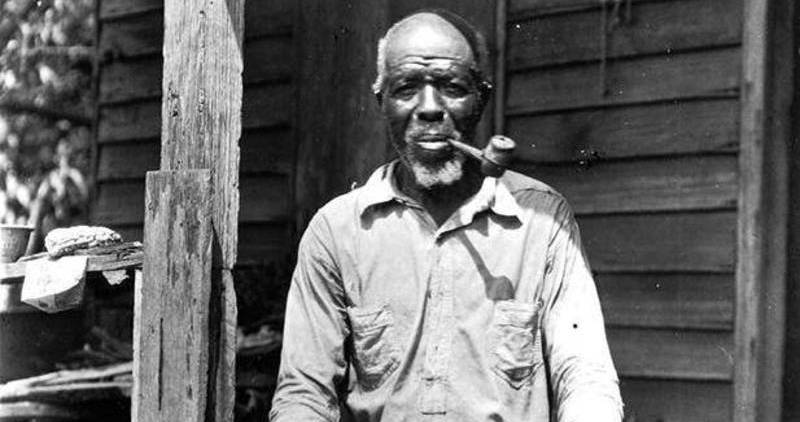
Hurston’s work in ethnography informed her fiction and opened up the field to other African American scholars. It also produced one of the most important works of American nonfiction in the 20th century, a book that, until now, sat in manuscript form at Howard University’s library, where only academics could access it. Barracoon: The Story of the Last “Black Cargo”tells the story of Cudjo Lewis (1840–1935), the last known survivor of the Atlantic slave trade, in his own words. Hurston met Lewis—born Oluale Kossola in what is today the country of Benin—in 1927. She conducted three months of interviews and published a study, “Cudjo’s Own Story of the Last African Slaver,” that same year.
But when she tried to publish the interviews as a book in 1931, she was told she had to change Lewis’ language. “For at least two publishing houses,” writes Meagan Flynn, “Lewis’s heavily accented dialect was seen as too difficult to read.” Hurston refused. Now, the book has finally been published by HarperCollins, with Lewis’s speech intact as Hurston recorded it. HarperCollins editor Deborah Plant tells NPR, “We’re talking about a language that he had to fashion for himself in order to negotiate this new terrain he found himself in.”
As published excerpts of the book show, his speech is not hard to understand. He describes the kind of bewilderment all enslaved Africans must have felt after arriving on alien shores and forced to toil day in and day out under threat of whipping or worse: “We doan know why we be bring ’way from our country to work lak dis,” he says, “Everybody lookee at us strange. We want to talk wid de udder colored folkses but dey doan know whut we say.”
Lewis tells the story of his capture by the King of Dahomey, whose warriors raided his village of Takkoi and sold the captives to American Captain William Foster, operating an illegal operation (the slave trade had been outlawed for almost 60 years). Forced aboard the ship Clotilda with over 100 other African men and women, Lewis was transported to Mobile, Alabama and sold to a businessman named Timothy Meaher. “Cudjo and his fellow captives were forced to work on Meaher’s mill and shipyard,” Gabe Paoletti writes at All That’s Interesting. “As a slave, he started to go by the name ‘Cudjo,’ a day-named given to boys born on a Monday, as Meaher could not pronounce the name ‘Kossola.’”
Deborah Plant sees the rejection of Hurston’s book in the 30s as akin to Lewis’s loss of his name, country, and culture. “Embedded in his language is everything of his history,” she says. “To deny him his language is to deny his history, to deny his experience, which is ultimately to deny him period, to deny what happened to him.”
87 years after the book’s writing, Lewis’s story offers a timely reminder of the history of slavery. The book arrives just after the discovery of what historians and archaeologists believe to be the wreck of the Clotilda, a vessel owned and operated, says AL.com reporter Ben Raines in the video above, by two already wealthy men who smuggled slaves to prove that they could get away with it, then burned the evidence, the ship, to escape detection.
When police arrived at Meaher’s property to charge him with illegally smuggling enslaved people, he “had hidden away the captives,” writes Paoletti, “and had erased all trace of them having been there.” Thanks to Hurston, we have an invaluable firsthand account of what it was like for one West African man who not only endured war and capture at the hands of a rival tribe, but also sale at a slave market, the middle passage across the Atlantic, and forced labor in the deep South—and who lived through the Civil War, Emancipation, Reconstruction and well into the early 20th Century.
But we aren’t talking Disney here, but hard-boiled pulp fiction, a genre I think Chesterton would have liked. Chesterton’s work “was entirely popular in nature,” notes Graydanus. He was “a great defender of popular and even ‘vulgar’ culture.” Take his essay “A Defense of Penny Dreadfuls,” which begins:
One of the strangest examples of the degree to which ordinary life is undervalued is the example of popular literature, the vast mass of which we contentedly describe as vulgar. The boy’s novelette may be ignorant in a literary sense, which is only like saying that modern novel is ignorant in the chemical sense, or the economic sense, or the astronomical sense; but it is not vulgar intrinsically–it is the actual centre of a million flaming imaginations.
Sentiments like these inspired admirers of Chesterton like Marshall McLuhan and Jorge Luis Borges to take seriously the mass entertainments of their respective cultures.
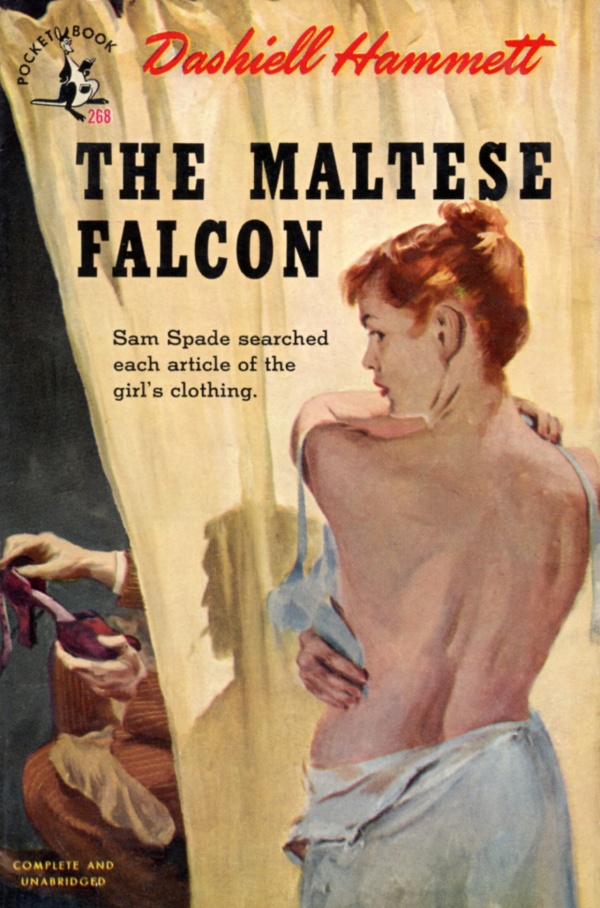
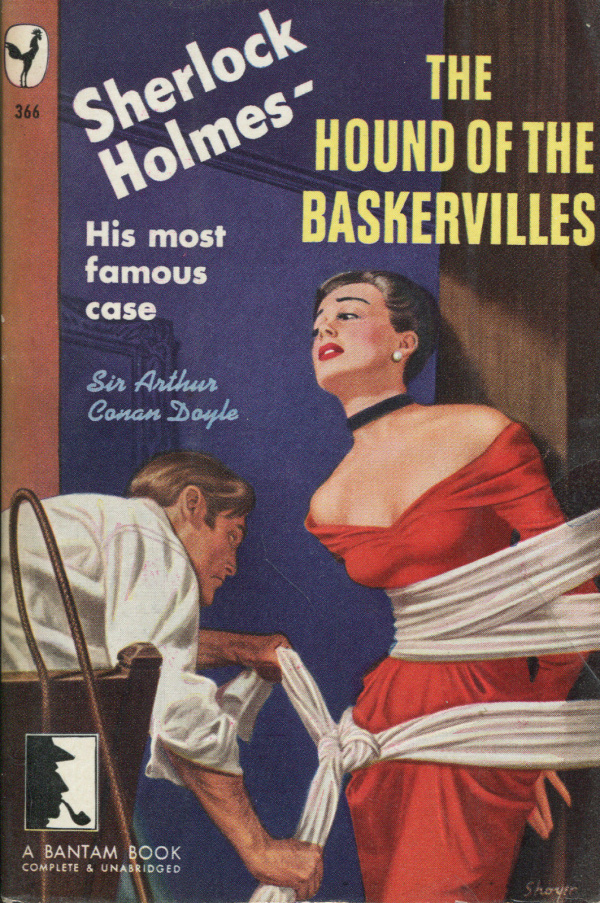
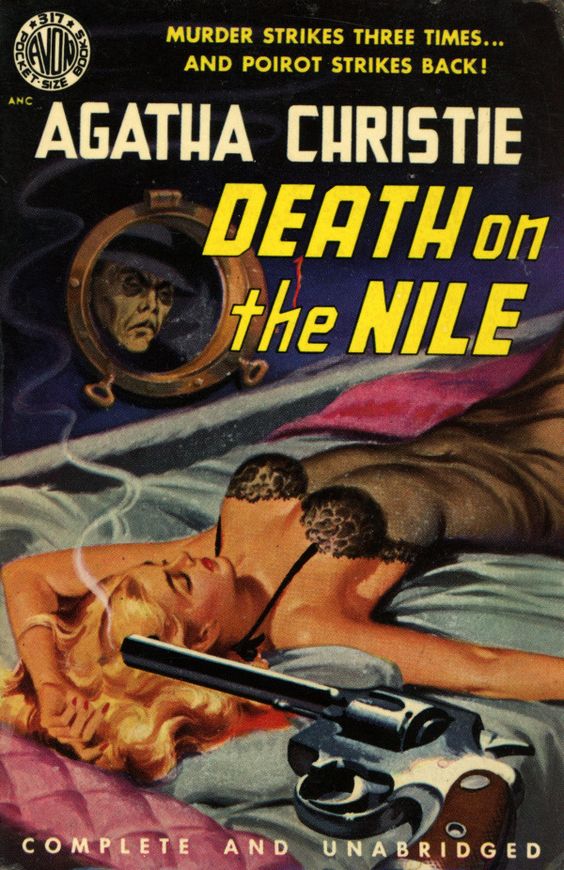
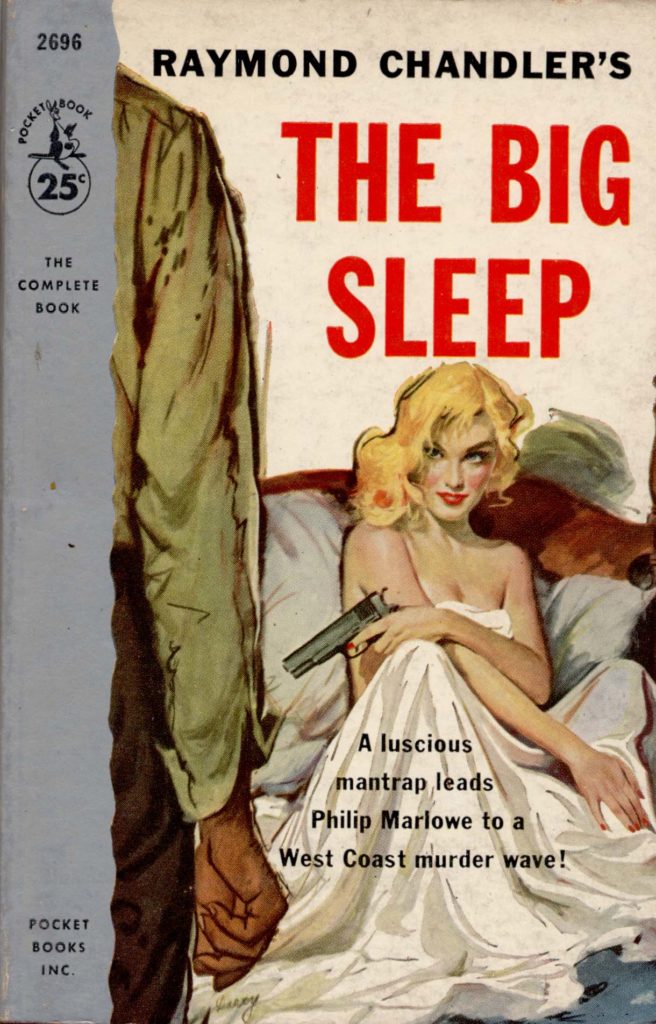
We might apply a Chestertonian appreciation to the book covers here, illustrating detective fiction by such notables as Dashiell Hammett, Arthur Conan Doyle, Agatha Christie, and Raymond Chandler.
Despite the cultural cachet these names bear, they are also writers whose work thrived in the “pulps,” a term denoting, Rebecca Romney writes at Crime Reads, “a wide category that bounds across genres.” Famed detective writers were as likely to be printed in “pulp fiction” magazines and cheap paperback editions as were acclaimed authors like Jules Verne, H.G. Wells, and Edgar Allan Poe. In addition to a number of genre conventions, the “common traits” of pulp fiction “are cheapness, portability, and popularity.”
Detective fiction, whether “literary” or wildly sensational, has always been a popular entertainment, close kin to the “Penny Dreadful,” those cheaply-produced 19th century British novels of adventure and sensation. “Twentieth-century detective novels are intimately tied to the history of the pulps,” writes Romney, which “rely on the erotic for their appeal.” Pulp publications sensationalize in images what may be far more chaste in the text. These “ridiculously sexified” book covers do not bother with coy symbolism or minimalist allusion. They take aim directly at the libido, or, to take Chesterton’s phrase, “the actual centre of a million flaming imaginations.”
The cover of The Maltese Falcon at the top goes out of its way to illustrate “the only sexually scandalous scene of the book, as if it were the single most crucial moment of the entire story.” The cover is pure objectification, and on such grounds we might reasonably object. To do so is to critique an entire mid-twentieth century aesthetic of “exploitation,” a campy style that gleefully titillated audiences who gleefully desired titillation.
The covers date from the mid-thirties to early fifties. All of the typical visual pulp themes are here, which are also typical of detective fiction and noir: the femme fatale (called “a luscious mantrap” on the cover of Raymond Chandler’s The Big Sleep below), in various seductive states of undress; the unsubtle hints of violence and sadomasochism. Such themes in the novels can be overt, implicit, or fully submerged. The focus of these covers turns the tropes into cheap come-ons. In this, perhaps, they do their authors an injustice, but their naked intention is solely to make the sale. What readers do with the books afterward is their own affair.
“These absurd covers,” Romney writes, “speak to the detective novel’s unavoidably shared heritage with other sensational pulp genres, much like the ever-present creepy uncle at Thanksgiving.” As much as quality detective fiction, sci-fi, fantasy, and horror might receive critical praise as high art, they will always be inextricably related to the “vulgar” pleasures of the pulps. To speak of such entertainments as the domain of the lowbrow, the magnanimous Chesterton might say, is only to “mean humanity minus ourselves.” Still, I wonder what Chesterton would have said had his collected Father Brown stories appeared in a pulp version with a nonsensically sexy cover?
Visit Crime Reads to see these covers compared with those of more subtle, and arguably more tasteful, editions.
In the spring of 1934, a young man who wanted to be a writer hitchhiked to Florida to meet his idol, Ernest Hemingway.
Arnold Samuelson was an adventurous 22-year-old. He had been born in a sod house in North Dakota to Norwegian immigrant parents. He completed his coursework in journalism at the University of Minnesota, but refused to pay the $5 fee for a diploma. After college he wanted to see the country, so he packed his violin in a knapsack and thumbed rides out to California. He sold a few stories about his travels to the Sunday MinneapolisTribune.
In April of ’34 Samuelson was back in Minnesota when he read a story by Hemingway in Cosmopolitan, called “One Trip Across.” The short story would later become part of Hemingway’s fourth novel, To Have and Have Not. Samuelson was so impressed with the story that he decided to travel 2,000 miles to meet Hemingway and ask him for advice. “It seemed a damn fool thing to do,” Samuelson would later write, “but a twenty-two-year-old tramp during the Great Depression didn’t have to have much reason for what he did.”
And so, at the time of year when most hobos were traveling north, Samuelson headed south. He hitched his way to Florida and then hopped a freight train from the mainland to Key West. Riding on top of a boxcar, Samuelson could not see the railroad tracks underneath him–only miles and miles of water as the train left the mainland. “It was headed south over the long bridges between the keys and finally right out over the ocean,” writes Samuelson. “It couldn’t happen now–the tracks have been torn out–but it happened then, almost as in a dream.”
When Samuelson arrived in Key West he discovered that times were especially hard there. Most of the cigar factories had shut down and the fishing was poor. That night he went to sleep on the turtling dock, using his knapsack as a pillow. The ocean breeze kept the mosquitos away. A few hours later a cop woke him up and invited him to sleep in the bull pen of the city jail. “I was under arrest every night and released every morning to see if I could find my way out of town,” writes Samuelson. After his first night in the mosquito-infested jail, he went looking for the town’s most famous resident.
When I knocked on the front door of Ernest Hemingway’s house in Key West, he came out and stood squarely in front of me, squinty with annoyance, waiting for me to speak. I had nothing to say. I couldn’t recall a word of my prepared speech. He was a big man, tall, narrow-hipped, wide-shouldered, and he stood with his feet spread apart, his arms hanging at his sides. He was crouched forward slightly with his weight on his toes, in the instinctive poise of a fighter ready to hit.
“What do you want?” said Hemingway. After an awkward moment, Samuelson explained that he had bummed his way from Minneapolis just to see him. “I read your story ‘One Trip Across’ in Cosmopolitan. I liked it so much I came down to have a talk with you.” Hemingway seemed to relax. “Why the hell didn’t you say you just wanted to chew the fat? I thought you wanted to visit.” Hemingway told Samuelson he was busy, but invited him to come back at one-thirty the next afternoon.
After another night in jail, Samuelson returned to the house and found Hemingway sitting in the shade on the north porch, wearing khaki pants and bedroom slippers. He had a glass of whiskey and a copy of the New York Times. The two men began talking. Sitting there on the porch, Samuelson could sense that Hemingway was keeping him at a safe distance: “You were at his home but not in it. Almost like talking to a man out on a street.” They began by talking about the Cosmopolitan story, and Samuelson mentioned his failed attempts at writing fiction. Hemingway offered some advice.
“The most important thing I’ve learned about writing is never write too much at a time,” Hemingway said, tapping my arm with his finger. “Never pump yourself dry. Leave a little for the next day. The main thing is to know when to stop. Don’t wait till you’ve written yourself out. When you’re still going good and you come to an interesting place and you know what’s going to happen next, that’s the time to stop. Then leave it alone and don’t think about it; let your subconscious mind do the work. The next morning, when you’ve had a good sleep and you’re feeling fresh, rewrite what you wrote the day before. When you come to the interesting place and you know what is going to happen next, go on from there and stop at another high point of interest. That way, when you get through, your stuff is full of interesting places and when you write a novel you never get stuck and you make it interesting as you go along.”
Hemingway advised Samuelson to avoid contemporary writers and compete only with the dead ones whose works have stood the test of time. “When you pass them up you know you’re going good.” He asked Samuelson what writers he liked. Samuelson said he enjoyed Robert Louis Stevenson’s Kidnapped and Henry David Thoreau’s Walden. “Ever read War and Peace?” Hemingway asked. Samuelson said he had not. “That’s a damned good book. You ought to read it. We’ll go up to my workshop and I’ll make out a list you ought to read.”
His workshop was over the garage in back of the house. I followed him up an outside stairway into his workshop, a square room with a tile floor and shuttered windows on three sides and long shelves of books below the windows to the floor. In one corner was a big antique flat-topped desk and an antique chair with a high back. E.H. took the chair in the corner and we sat facing each other across the desk. He found a pen and began writing on a piece of paper and during the silence I was very ill at ease. I realized I was taking up his time, and I wished I could entertain him with my hobo experiences but thought they would be too dull and kept my mouth shut. I was there to take everything he would give and had nothing to return.
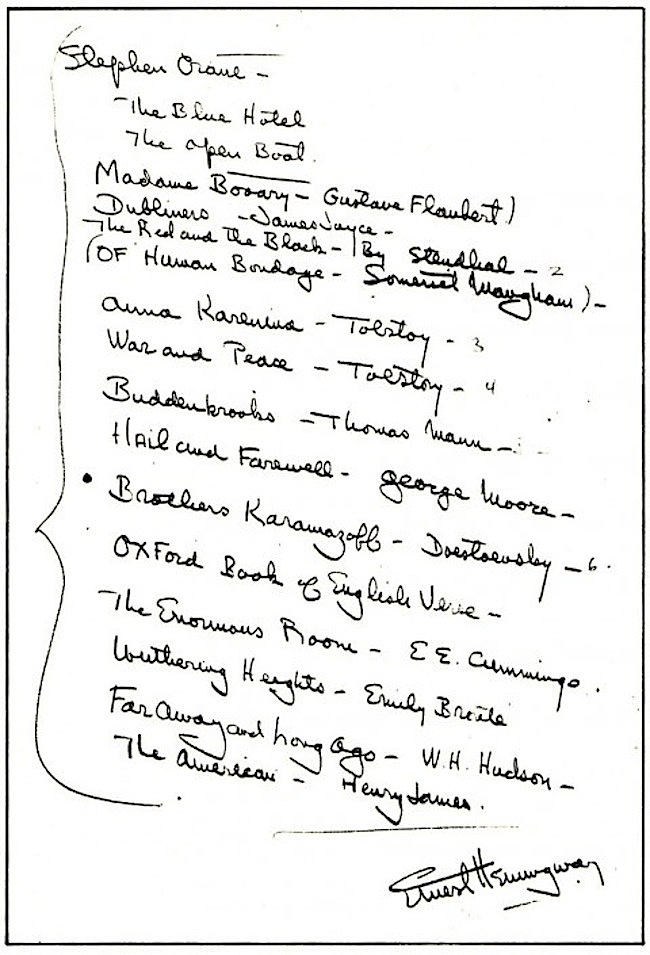
Hemingway wrote down a list of two short stories and 14 books and handed it to Samuelson. Most of the texts you can find in our collection, 800 Free eBooks for iPad, Kindle & Other Devices. If the texts don’t appear in our eBook collection itself, you’ll find a link to the text directly below.
Hemingway reached over to his shelf and picked up a collection of stories by Stephen Crane and gave it to Samuelson. He also handed him a copy of his own novel, A Farewell to Arms. “I wish you’d send it back when you get through with it,” Hemingway said of his own book. “It’s the only one I have of that edition.” Samuelson gratefully accepted the books and took them back to the jail that evening to read. “I did not feel like staying there another night,” he writes, “and the next afternoon I finished reading A Farewell to Arms, intending to catch the first freight out to Miami. At one o’clock, I brought the books back to Hemingway’s house.” When he got there he was astonished by what Hemingway said.
“There is something I want to talk to you about. Let’s sit down,” he said thoughtfully. “After you left yesterday, I was thinking I’ll need somebody to sleep on board my boat. What are you planning on now?”
“I haven’t any plans.”
“I’ve got a boat being shipped from New York. I’ll have to go up to Miami Tuesday and run her down and then I’ll have to have someone on board. There wouldn’t be much work. If you want the job, you could keep her cleaned up in the mornings and still have time for your writing.”
“That would be swell,” replied Samuelson. And so began a year-long adventure as Hemingway’s assistant. For a dollar a day, Samuelson slept aboard the 38-foot cabin cruiser Pilar and kept it in good condition. Whenever Hemingway went fishing or took the boat to Cuba, Samuelson went along. He wrote about his experiences–including those quoted and paraphrased here–in a remarkable memoir, With Hemingway: A Year in Key West and Cuba. During the course of that year, Samuelson and Hemingway talked at length about writing. Hemingway published an account of their discussions in a 1934 Esquire article called “Monologue to the Maestro: A High Seas Letter.” (Click here to open it as a PDF.) Hemingway’s article with his advice to Samuelson was one source for our February 19 post, “Seven Tips From Ernest Hemingway on How to Write Fiction.”
When the work arrangement had been settled, Hemingway drove the young man back to the jail to pick up his knapsack and violin. Samuelson remembered his feeling of triumph at returning with the famous author to get his things. “The cops at the jail seemed to think nothing of it that I should move from their mosquito chamber to the home of Ernest Hemingway. They saw his Model A roadster outside waiting for me. They saw me come out of it. They saw Ernest at the wheel waiting and they never said a word.”
Note: An earlier version of this post originally appeared on our site in May, 2013.
There may be no sweeter sound to the ears of Open Culture writers than the words “public domain”—you might even go so far as to call it our “cellar door.” The phrase may not be as musical, but the fact that many of the world’s cultural treasures cannot be copyrighted in perpetuity means that we can continue to do what we love: curating the best of those treasures for readers as they appear online. Public domain means companies can sell those works without incurring any costs, but it also means that anyone can give them away for free. “Anyone can re-publish” public domain works, notes Lifehacker, “or chop them up and use them in other projects.” And thereby emerges the remixing and repurposing of old artifacts into new ones, which will themselves enter the public domain of future generations.
Some of those future works of art may even become the next Great American Novel, if such a thing still exists as anything more than a hackneyed cliché. Of course, no one seriously goes around saying they’re writing the “Great American Novel,” unless they’re Philip Roth in the 70s or William Carlos Williams (top right) in the 20s, who both somehow pulled off using the phrase as a title (though Roth’s book doesn’t quite live up to it.) Where Roth casually used the concept in a light novel about baseball, Williams’ The Great American Novel approached it with deep concern for the survival of the form itself. His modernist text “engages the techniques of what we would now call metafiction,” writes literary scholar April Boone, “to parody worn out formulas and content and, ironically, to create a new type of novel that anticipates postmodern fiction.”
We will all, as of January 1, 2019, have free, unfettered access to Williams’ metafictional shake-up of the formulaic status quo, when “hundreds of thousands of… books, musical scores, and films first published in the United States during 1923” enter the public domain, as Glenn Fleishman writes at The Atlantic. Because of the complicated history of U.S. copyright law—especially the 1998 “Sonny Bono Act” that successfully extended a copyright law from 50 to 70 years (for the sake, it’s said, of Mickey Mouse)—it has been twenty years since such a massive trove of material has become available all at once. But now, and “for several decades from 2019 onward,” Fleishman points out, “each New Year’s Day will unleash a full year’s worth of works published 95 years earlier.”
In other words, it’ll be Christmas all over again in January every year, and while you can browse the publication dates of your favorite works yourself to see what’s coming available in coming years, you’ll find at The Atlantic a short list of literary works included in next-year’s mass-release, including books by Aldous Huxley, Winston Churchill, Carl Sandburg, Edith Wharton, and P.G. Wodehouse. Lifehacker has several more extensive lists, which we excerpt below:
Cecil B. DeMille’s (first, less famous, silent version of) The Ten Commandments
Harold Lloyd’s Safety Last!, including that scene where he dangles off a clock tower, and his Why Worry?
A long line-up of feature-length silent films, including Buster Keaton’s Our Hospitalityand Charlie Chaplin’s The Pilgrim
Short films by Chaplin, Keaton, Laurel and Hardy, and Our Gang (later Little Rascals)
Cartoons including Felix the Cat(the character first appeared in a 1919 cartoon)
Marlene Dietrich’s film debut, a bit part in the German silent comedy The Little Napoleon; also the debuts of Douglas Fairbanks Jr. and Fay Wray
Whose Body?, the first Lord Peter Wimsey novel by Dorothy L. Sayers
Two of Agatha Christie’s Hercule Poirot novels, The Murder of Roger Ackroyd and The Murder on the Links
The Prisoner, volume 5 of Marcel Proust’s In Search of Lost Time (note that English translations have their own copyrights)
The Complete Works of Anthony Trollope
George Bernard Shaw’s play Saint Joan
Short stories by Christie, Virginia Woolf, H.P. Lovecraft, Katherine Mansfield, and Ernest Hemingway
Poetry by Edna St. Vincent Millay, E.E. Cummings, William Carlos Williams, Rainer Maria Rilke, Wallace Stevens, Robert Frost, Sukumar Ray, and Pablo Neruda
Works by Jane Austen, D.H. Lawrence, Edith Wharton, Jorge Luis Borges, Mikhail Bulgakov, Jean Cocteau, Italo Svevo, Aldous Huxley, Winston Churchill, G.K. Chesterton, Maria Montessori, Lu Xun, Joseph Conrad, Zane Grey, H.G. Wells, and Edgar Rice Burroughs
Marcel Duchamp’s The Bride Stripped Bare By Her Bachelors, Even (The Large Glass)
Yokoyama Taikan’s Metempsychosis
Work by M. C. Escher, Pablo Picasso, Wassily Kandinsky, Max Ernst, and Man Ray
Again, these are only partial lists of highlights, and such highlights…. Speaking for myself, I cannot wait for free access to the very best (and even worst, and weirdest, and who-knows-what-else) of 1923. And of 1924 in 2020, and 1925 and 2021, and so on and so on….
Faced with the question, “who are the most important philosophers of the 20th century?,” I might find myself compelled to ask in turn, “in respect to what?” Ethics? Political philosophy? Philosophy of language, mind, science, religion, race, gender, sexuality? Phenomenology, Feminism, Critical theory? The domains of philosophy have so multiplied (and some might say siloed), that a number of prominent authors, including eminent philosophy professor Robert Solomon, have written vehement critiques against its entrenchment in academia, with all of the attendant pressures and rewards. Should every philosopher of the past have had to run the gauntlet of doctoral study, teaching, tenure, academic politics and continuous publication, we might never have heard from some of history’s most luminous and original thinkers.
Solomon maintains that “nothing has been more harmful to philosophy than its ‘professionalization,’ which on the one hand has increased the abilities and techniques of its practitioners immensely, but on the other has rendered it an increasingly impersonal and technical discipline, cut off from and forbidding to everyone else.” He championed “the passionate life” (say, of Nietzsche or Camus), over “the dispassionate life of pure reason…. Let me be outrageous and insist that philosophy matters. It is not a self-contained system of problems and puzzles, a self-generating profession of conjectures and refutations.” I am sympathetic to his arguments even as I might object to his wholesale rejection of all academic thought as “sophisticated irrelevancy.” (Solomon himself enjoyed a long career at UCLA and the University of Texas, Austin.)
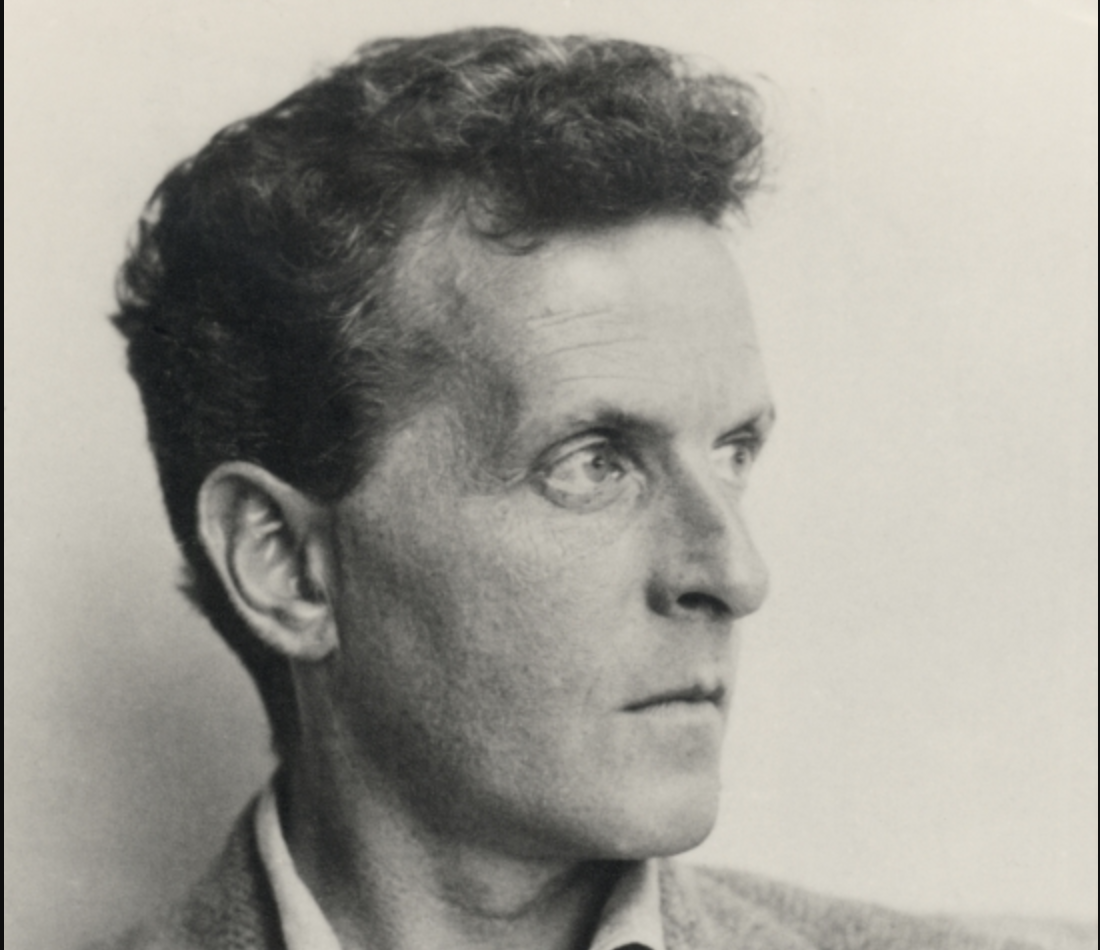
But if forced to choose the most important philosophers of the late 20th century, I might gravitate toward some of the most passionate thinkers, both inside and outside academia, who grappled with problems of everyday personal, social, and political life and did not shy away from involving themselves in the struggles of ordinary people. This need not entail a lack of rigor. One of the most passionate of 20th century thinkers, Ludwig Wittgenstein, who worked well outside the university system, also happens to be one of the most difficult and seemingly abstruse. Nonetheless, his thought has radical implications for ordinary life and practice. Perhaps non-specialists will tend, in general, to accept arguments for philosophy’s everyday relevance, accessibility, and “passion.” But what say the specialists?
One philosophy professor, Chen Bo of Peking University, conducted a survey along with Susan Haack of the University of Miami, at the behest of a Chinese publisher seeking important philosophical works for translation. As Leiter Reports reader Tracy Ho notes, the two professors emailed sixteen philosophers in the U.S., England, Australia, Germany, Finland, and Brazil, asking specifically for “ten of the most important and influential philosophical books after 1950.” “They received recommendations,” writes Ho, “from twelve philosophers, including: Susan Haack, Donald M. Borchert (Ohio U.), Donald Davidson, Jurgen Habermas, Ruth Barcan Marcus, Thomas Nagel, John Searle, Peter F. Strawson, Hilary Putnam, and G.H. von Wright.” (Ho was unable to identify two other names, typed in Chinese.)
The results, ranked in order of votes, are as follows:
As an addendum, Ho adds that “most of the works on the list are analytic philosophy,” therefore Prof. Chen asked Habermas to recommend some additional European thinkers, and received the following: “Axel Honneth, Kampf um Anerkennung (1992), Rainer Forst, Kontexte der Cerechtigkeit (1994) and Herbert Schnadelbach, Kommentor zu Hegels Rechtephilosophie (2001).”
The list is also overwhelmingly male and pretty exclusively white, pointing to another problem with institutionalization that Solomon does not acknowledge: it not only excludes non-specialists but can also exclude those who don’t belong to the dominant group (and so, perhaps, excludes the everyday concerns of most of the world’s population). But there you have it, a list of the most important, post-1950 works in philosophy according to some of the most eminent living philosophers. What titles, readers, might get your vote, or what might you add to such a list, whether you are a specialist or an ordinary, “passionate” lover of philosophical thought?
Magic is real—hear me out. No, you can’t solve life’s problems with a wand and made-up Latin. But there are academic departments of magic, only they go by different names now. A few hundred years ago the difference between chemistry and alchemy was nil. Witchcraft involved as much botany as spellwork. A lot of fun bits of magic got weeded out when gentlemen in powdered wigs purged weird sisters and gnostic heretics from the field. Did the old spells work? Maybe, maybe not. Science has become pretty reliable, I guess. Standardized classification systems and measurements are okay, but yawn… don’t we long for some witching and wizarding? A well-placed hex might work wonders.
Say no more, we’ve got you covered: you, yes you, can learn charms and potions, demonology and other assorted dark arts. How? For a onetime fee of absolutely nothing, you can enter magical books from the Early Modern Period.
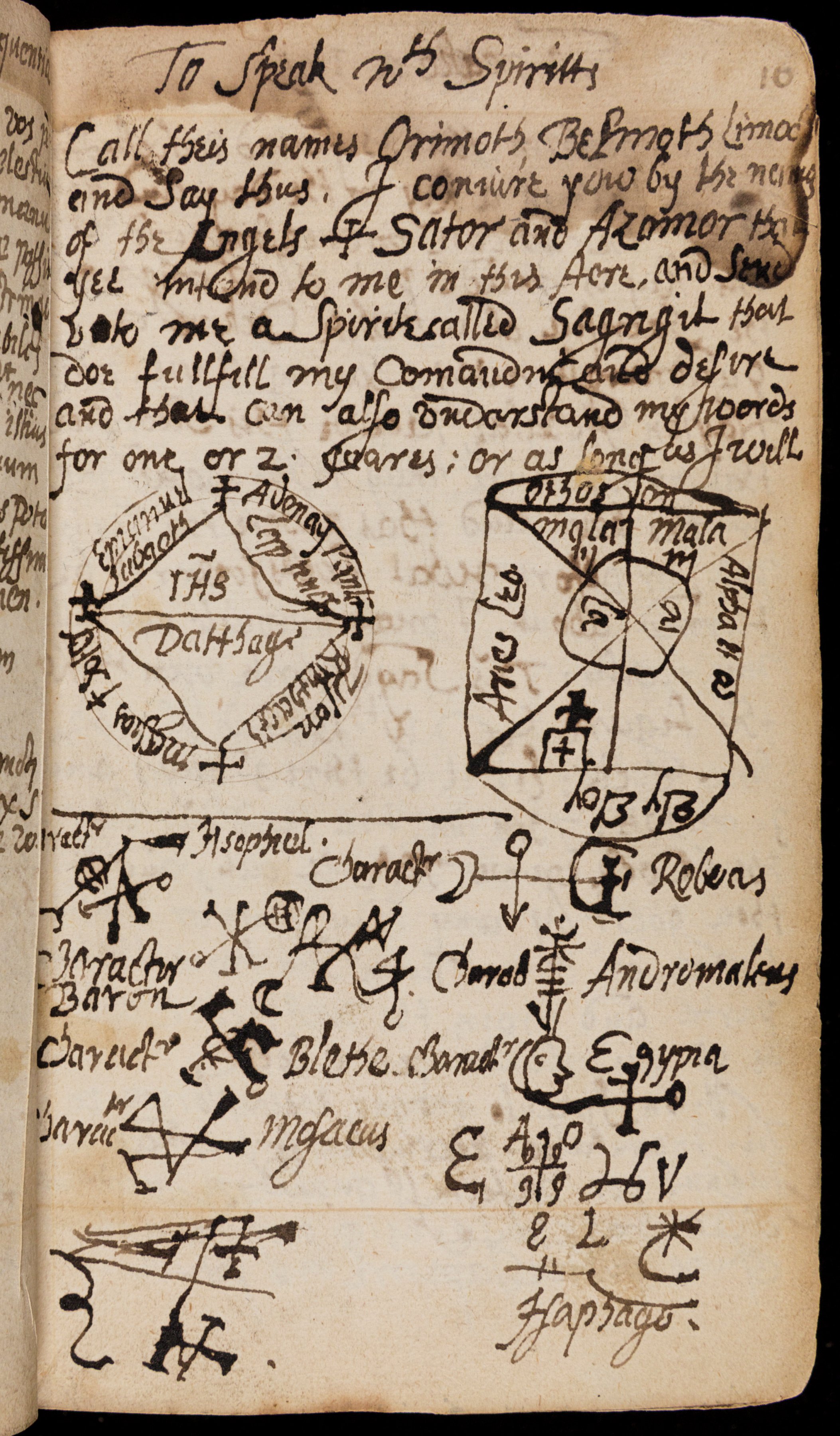
The library’s Transcribing Faith initiative gives users a chance to connect with texts like The Book of Magical Charms(above), by transcribing and/or translating the contents therein. Like software engineer Joseph Peterson—founder of the Esoteric Archives, which contains a large collection of John Dee’s work—you can volunteer to help the Newberry’s project “Religious Change, 1450–1700.” The Newberry aims to educate the general public on a period of immense upheaval. “The Reformation and the Scientific Revolution are very big, capital letter concepts,” project coordinator Christopher Fletcher tells Smithsonian.com, “we lose sight of the fact that these were real events that happened to real people.”
By aiming to return these texts to “real people” on the internet, the Newberry hopes to demystify, so to speak, key moments in European history. “You don’t need a Ph.D. to transcribe,” Fletcher points out. Atlas Obscura describes the process as “much like updating a Wikipedia page,” only “anyone can start transcribing and translating and they don’t need to sign up to do so.” Check out some transcriptions of The Book of Magical Charms—written by various anonymous authors in the seventeenth century—here. The book, writes the Newberry, describes “everything from speaking with spirits to cheating at dice to curing a toothache.”
Need to call up a spirit for some dirty work? Just follow the instructions below:
Call their names Orimoth, Belmoth Limoc and Say thus. I conjure you by the neims of the Angels + Sator and Azamor that yee intend to me in this Aore, and Send unto me a Spirite called Sagrigid that doe fullfill my comandng and desire and that can also undarstand my words for one or 2 yuares; or as long as I will.
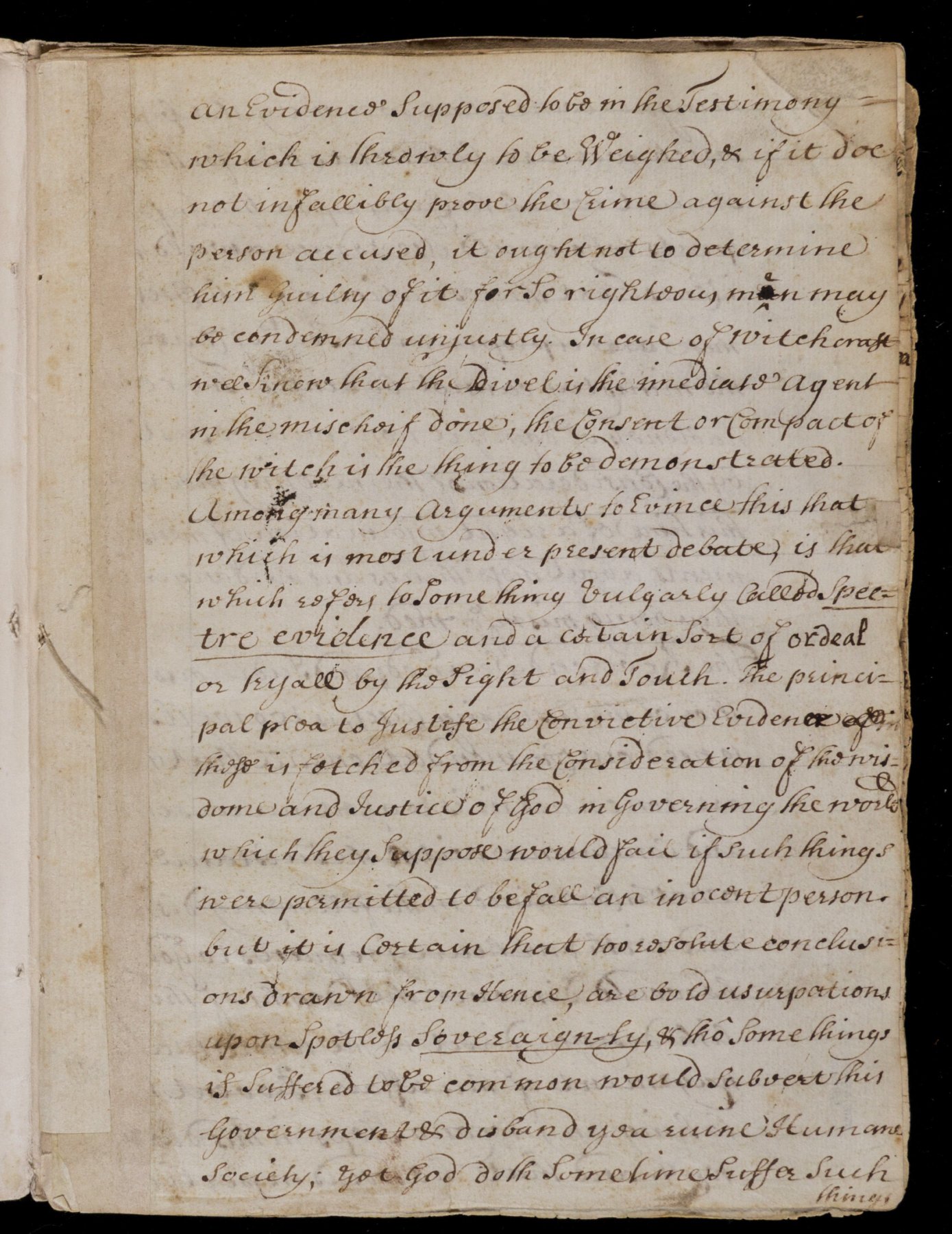
Seems simple enough, but of course this business did not sit well with some powerful people, including one Increase Mather, father of Cotton, president of Harvard, best known from his work on the Salem Witch Trials. Increase defended the prosecutions in a manuscript titled Cases of Conscience Concerning Evil Spirits, a page from which you can see further up. The text reads, in part:
an Evidence Supposed to be in the Testimony which is throwly to be Weighed, & if it doe not infallibly prove the Crime against the person accused, it ought not to determine him Guilty of it for So righteous may be condemned unjustly.
Mather did not consider these to be show trials or “witchhunts” but rather the fair and judicious application of due process, for whatever that’s worth. Elsewhere in the text he famously wrote, “It were better that Ten Suspected Witches should escape, than that one Innocent Person should be Condemned.” Cold comfort to those condemned as guilty for likely practicing some mix of religion and early science.
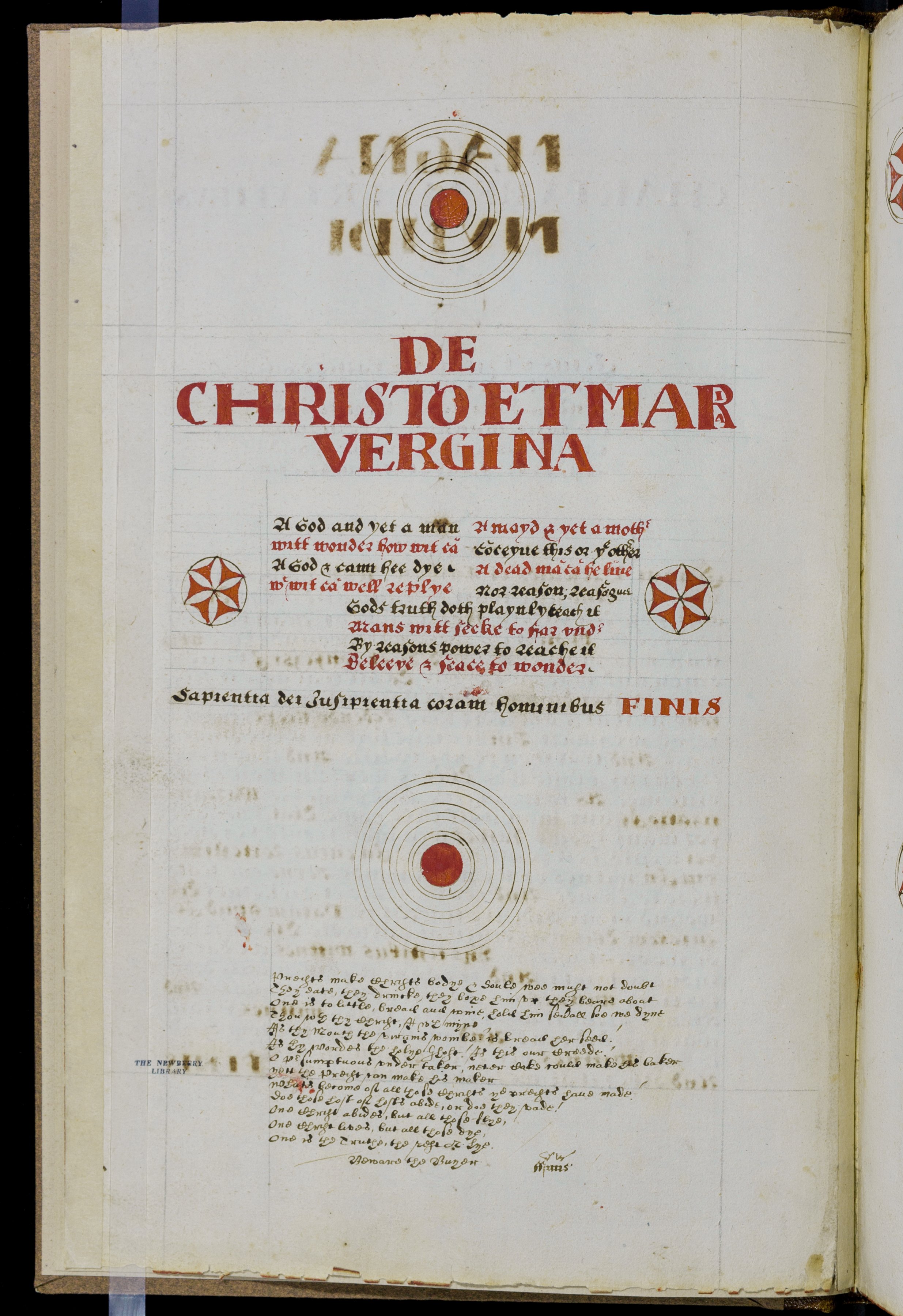
These texts are written in English and concern themselves with magical and spiritual matters expressly. Other manuscripts in the project’s archive roam more broadly across topics and languages, and “shed light on the entwined practices of religion and reading.” One “commonplace book,” for example (above), from sometime between 1590 and 1620, contains sermons by John Donne as well as “religious, political, and practical texts, including a Middle English lyric,” all carefully written out by an English scribe named Henry Feilde in order to practice his calligraphy.
Another such text, largely in Latin, “may have been started as early as the 16th century, but continued to be used and added to well into the 19th century. Its compilers expressed interest in a wide range of topics, from religious and moral questions to the liberal arts to strange events.” Books like these “reflected the reading habits of early modern people, who tended not to read books from beginning to end, but instead to dip in and out of them,” extracting bits and bobs of wisdom, quotations, recipes, prayers, and even the odd spell or two.
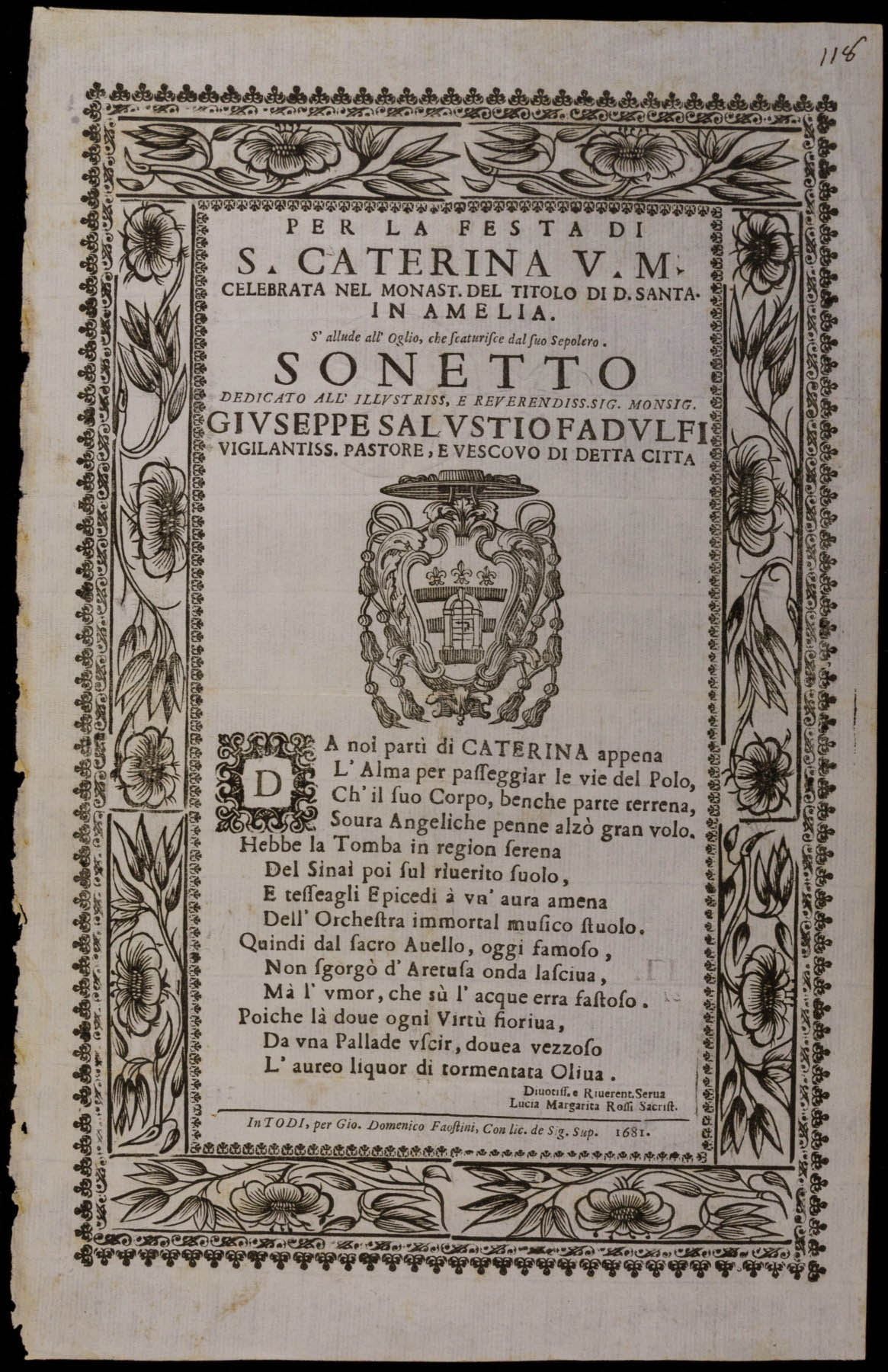
The final work in need of transcription/translation is also the only printed text, or texts, rather, a collection of Italian religious broadsides, advertising “public celebrations and commemorations of Catholic feast days and other religious occasions.” Hardly summoning spirits, though some may beg to differ. If you’re so inclined to take part in opening the secrets of these rare books for lay readers everywhere, visit Transcribing Faith here and get to work.
If you’ve ever had to name your ten favorite of anything, you know how much trickier such a list is to compose than it sounds. Not because you don’t know of ten books, movies, albums, or what have you, of course, but because you don’t know if the favorites that come to mind today would also come to mind tomorrow. Stephen King, a man apparently often asked for top-however-many lists (see the related posts below for more examples), acknowledges this truth in his approach to the task, as when he drew up this top-ten-favorite-books list for Goodreads:
“Any list like this is slightly ridiculous,” King admits. “On another day, ten different titles might come to mind, like The Exorcist, or All the Pretty Horses in place of Blood Meridian. On another day I’d be sure to include Light in Augustor Scott Smith’s superb A Simple Plan. The Sea, the Sea, by Iris Murdoch. But what the hell, I stand by these. Although Anthony Powell’s novels should probably be here, especially the sublimely titled Casanova’s Chinese Restaurant and Books Do Furnish a Room. And Paul Scott’s Raj Quartet. And at least six novels by Patricia Highsmith. What about Patrick O’Brian? See how hard this is to let go?”
Thus King, as prolific in his appreciation of novels as he is in his writing of novels, expands his number of selections from ten to at least 28. You can actually compare this list to one he made on another day by having a look at another “all-time favorite book list” of his we featured a few years ago. The common titles between them include Lord of the Flies, Blood Meridian, and 1984. (Light in August and the Raj Quartet also made it onto the list proper.) We might draw from King’s lists the lesson that we shouldn’t sweat tasks like this too much: the important thing isn’t to nail down an unchanging personal canon, but to spread the love across the aesthetic and intellectual spectrum (how many of us would think to name the likes of Roth, Tolkien, Orwell, and Porter all in one place?) and, even more important than that, to simply keep reading.
Based in Seoul, Colin Marshall writes and broadcasts on cities and culture. His projects include the book The Stateless City: a Walk through 21st-Century Los Angeles and the video series The City in Cinema. Follow him on Twitter at @colinmarshall or on Facebook.
We're hoping to rely on loyal readers, rather than erratic ads. Please click the Donate button and support Open Culture. You can use Paypal, Venmo, Patreon, even Crypto! We thank you!
Open Culture scours the web for the best educational media. We find the free courses and audio books you need, the language lessons & educational videos you want, and plenty of enlightenment in between.