Given the image of Communist Russia we’ve mostly inherited from Cold War Hollywood propaganda and cherry-picked TV documentaries, we tend to think of Communist art as sterile, brutalist, devoid of expressive emotion and experiment. But this has never been entirely so. While Party-approved social realism dominated in certain decades, experimental Russian animation, film, design, and literature flourished, even under extremely harsh conditions one wouldn’t wish on any artist.
In the early days of the Revolution, one of the most influential forms of expression, Russian Futurism, brought its avant-gardism to the masses, and praised the Revolution while formally challenging every received idea or doctrine. Beginning in the early 20th century and working until the Soviet Union was formed and Trotsky banished, Futurist poets and artists like Vladimir Mayakovsky, Kazimir Malevich, Nalia Goncharova, and Velimir Khlebnikov contributed to a style called “Zaum,” a word, as we noted in a previous post, that can mean “transreason” or “beyond sense.” (A very unscientific, bourgeois approach, it would later be alleged by the Central Committee.)
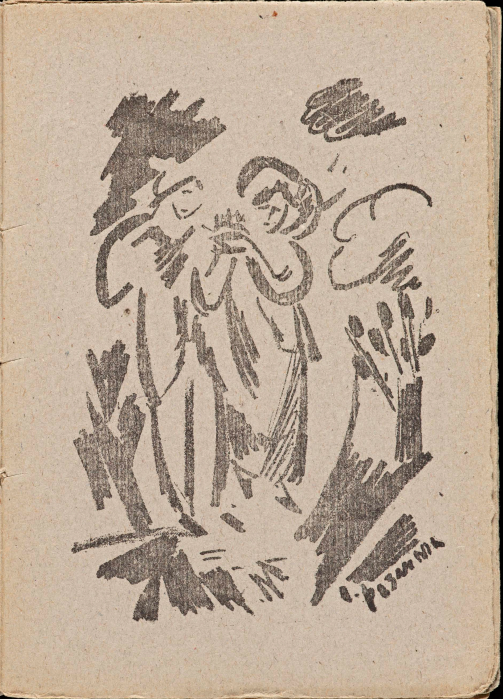
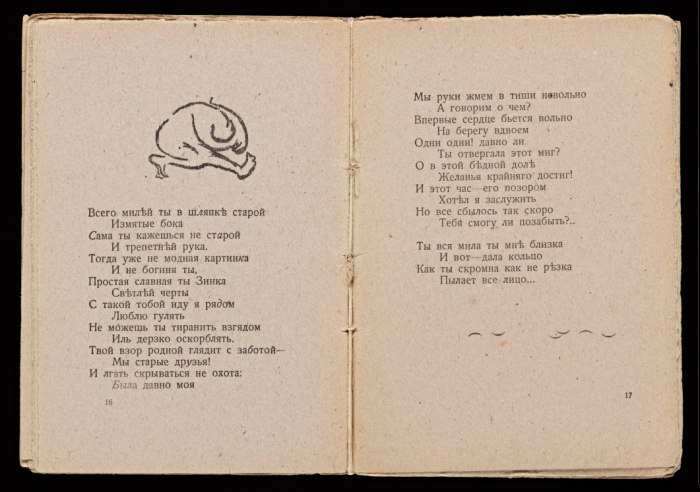
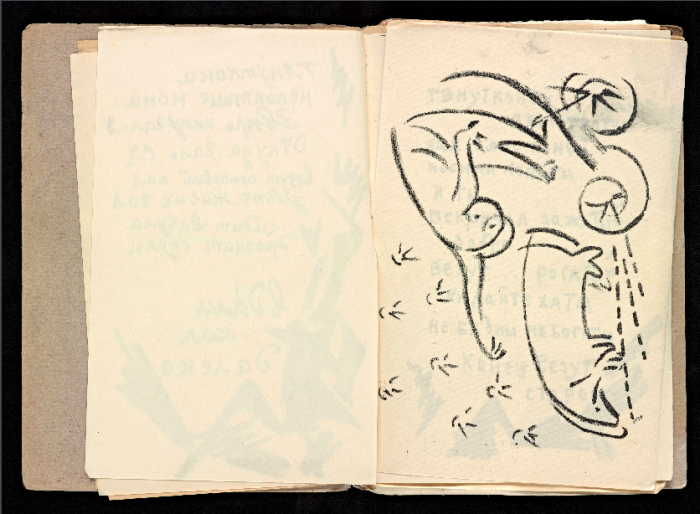
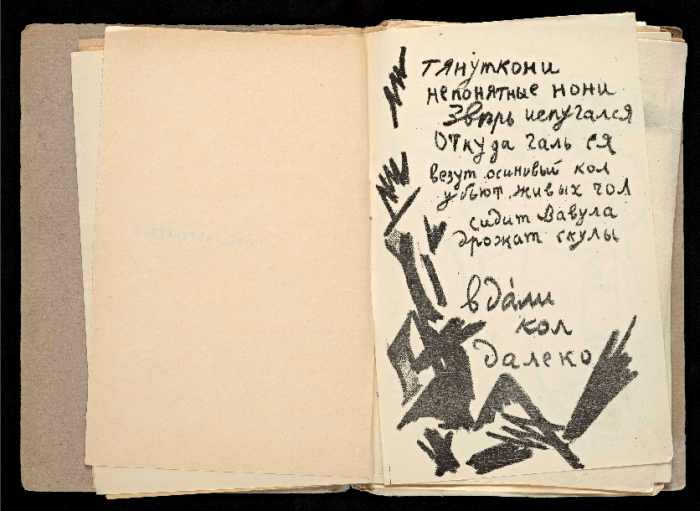
This archive contains about four dozen books by artist/poets like Khlebnikov whose 1914 Old-Fashioned Love; Forestly Boom, you can see pages from at the top of the post. Further up and just above, we see excerpts from Alexei Kruchenykh’s 1913 Vzorval’ (Explodity), a mostly hand-lettered publication with whimsical, dynamic drawings alternating with and surrounding the text. You’ll find over four dozen of these books at the Getty Research Institute. As you browse or search their catalogue, then click on an entry, you’ll want to click on the “View Online” button to see scanned images.
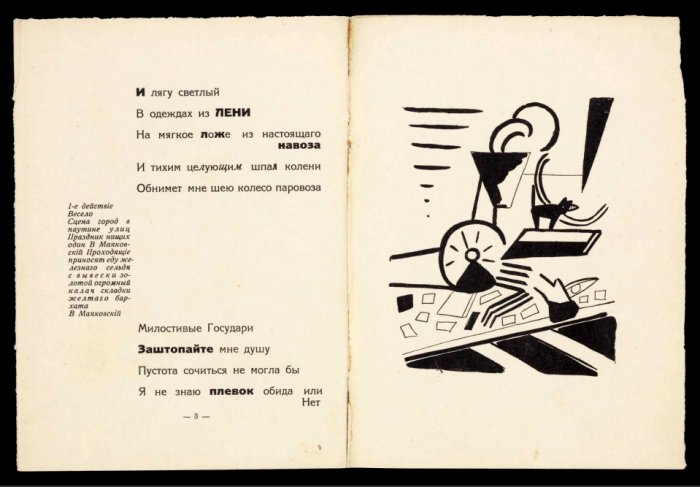
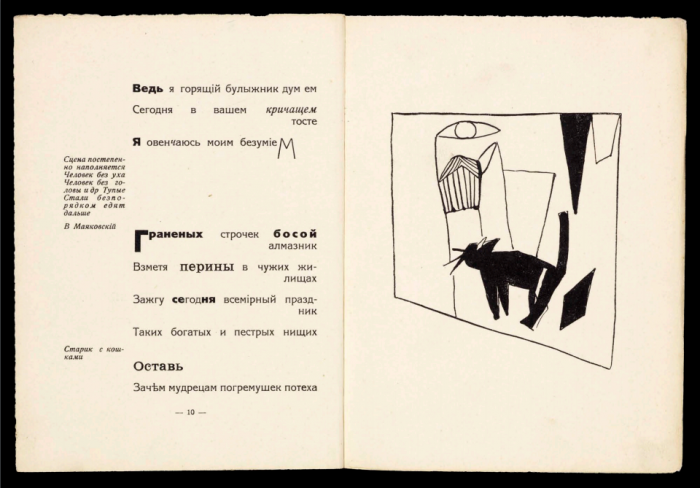
Each of these books—like Vladimir Mayakovsky’s 1913 play, Vladimir Mayakovsky: A Tragedy, above and below—makes a forceful visual impression even if we cannot understand the text. But in many ways, this is beside the point. Zaum poetry was meant to be heard as sound, not sense, and looked at as a physical artifact. Perloff’s book, writes the Getty, “uncovers a wide-ranging legacy in the midcentury global movement of sound and concrete poetry (the Brazilian Noigandres group, Ian Hamilton Finlay, and Henri Chopin), contemporary Western conceptual art, and the artist’s book.” In many ways, these artists represent a parallel tradition in modernism to the one we generally learn of in Western Europe and the U.S., and one just as rich and fascinating.
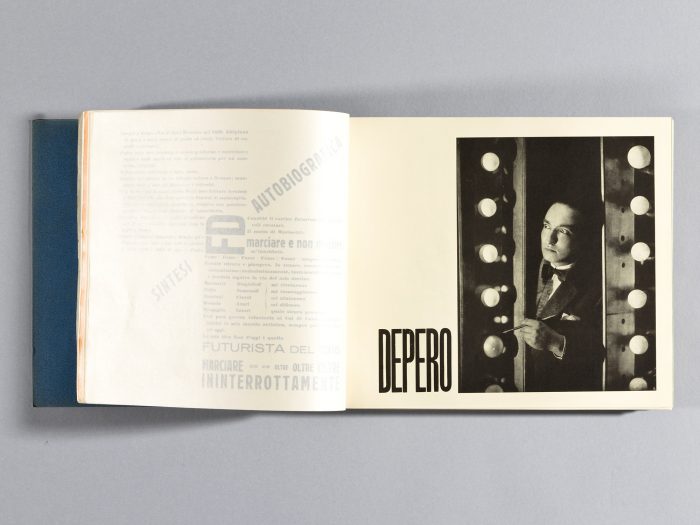
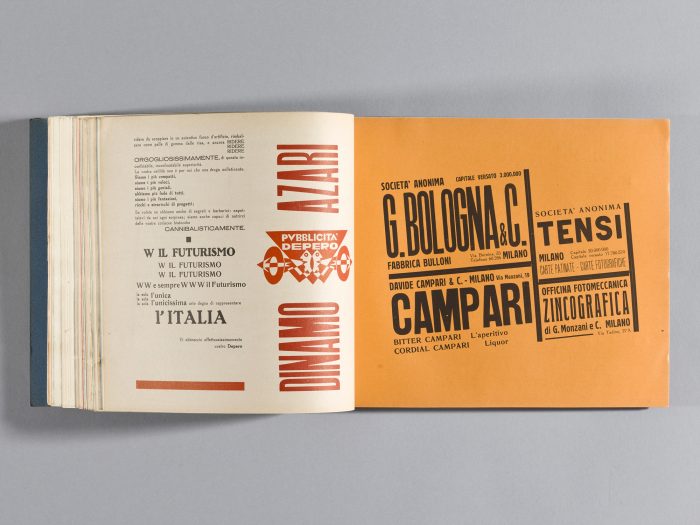
You can try to dismantle your e‑reader, but you can’t unscrew an eBook. Despite having cast his artistic mind, as did his fellow 20th-century Italian Futurists, forcefully into the world to come, could Fortunato Depero have imagined that such a question would arise in the 21st? The Trentino-born painter, writer, sculptor, and graphic designer, led a highly creative life, producing no work more enduring than the instantly recognizable Campari Soda bottle. But just last year, a group of enthusiasts successfully raised more than $250,000 on Kickstarter to bring back into print Depero’s second-best-known creation: Depero Futurista, also known as “The Bolted Book.”
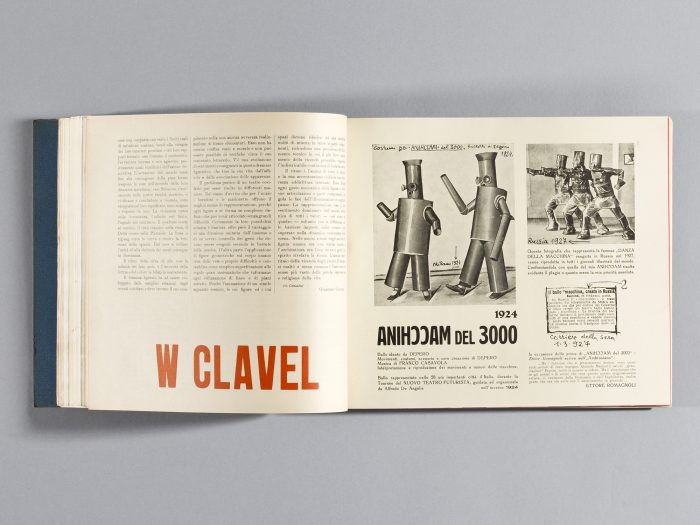
Designed by Depero as “a kind of portable museum or calling card, a portfolio of his career to date — including paintings, sculptures, textile and architectural designs, theater and advertising work, wordplays, manifestoes, and reviews he received in many different languages,” Depero Futurista, as described by the reprint project’s web site, also shows off his “skills as a designer and typographical wizard.”
These impress as much in 2017 as they must have at the time of the book’s first publication ninety years ago in Milan, and the binding method remains as distinctive: “Comprising 240 pages, the book is secured by two large industrial aluminum bolts that when removed allow for the pages to be removed, rearranged, or exhibited individually.”
You may never have heard of Depero, but today’s most respected designers certainly have, and some of them appear in the project’s Kickstarter promo video giving testimonials not just to the importance of Depero’s aesthetic achievements in general but The Bolted Book in particular. It offers a “bridge between the past and the future” in design, an innovative, ironic, and playful use of the “machine aesthetic,” and evidence that “Depero, despite his idiosyncrasies, was one of the most creative of the Futurists.” (It also, of course, holds the title of the first-ever book “bolted by two giant clasps.”) But perhaps the most compelling comes from Stefan Sagmeister: “This book contains the favorite packaging of my favorite drink, Campari Soda. For this alone, it should be contributed at properly — Kickstarted.”
Successfully Kickstarted, the new and 100 percent faithful reprint of Depero Futurista (whose few surviving originals sit mostly in institutional collections) should arrive in July of this year. Even if you can’t get your hands on a real, bolted copy just yet, you can view each and every one of its pageson the reprint project’s site. All the brilliance on display does make one regret that the Futurist movement ended with the tarnish of Fascism. But now that references to the latter seems to have re-entered the public conversation, maybe the time has come to bring back the vigorous, forward-looking artistic inventiveness of the former as a kind of countervailing inspiration.
When Umberto Eco died last year at the age of 84, he left behind a sizable body of work and a vast collection of books. He wrote such hefty and much-read novels as The Name of the Rose and Foucault’s Pendulum as well as stories for children, pieces of literary criticism, academic texts on semiotics, studies of everything from medieval aesthetics to modern media, and much else besides, but as we recently noted, he also advised against becoming too prolific. Not for him the life of “those novelists who publish a book every year,” thus missing out on the “pleasure of spending six, seven, eight years to tell a story.”
Still, the man wrote a lot. He also read a lot, as a glance at a chapter or two from any one of his own novels will attest. An avowed fan of James Joyce and Jorge Luis Borges, Eco wove into his work countless threads pulled from the literary and intellectual history of a host of different places, cultures, and languages — evidence of a well-stocked mind indeed, but a well-stocked mind requires a well-stocked library, or libraries.
We can only imagine how many such citadels of knowledge Eco visited in his travels all over the world, but we don’t have to imagine the one he built himself, since we can see it in the video above. Though not infinite like the library of all possible books imagined by Borges, Eco’s private home library looks, from certain angles, nearly as big. The camera follows Eco as he passes shelf after packed shelf, some lining the walls and others standing free, eventually finding his way to one volume in particular — despite the fact that he apparently shelved very few of his books with their spines facing outward.
According to Nassim Nicholas Taleb, quoted by Maria Popova at Brain Pickings, Eco’s library contained 30,000 books and tended to separate visitors into two categories: ‘those who react with ‘Wow! Signore professore dottore Eco, what a library you have! How many of these books have you read?’ and the others — a very small minority — who get the point that a private library is not an ego-boosting appendage but a research tool. Read books are far less valuable than unread ones.” By that measure, Eco might have amassed an even more valuable library than his fans would assume.
“In another time I guess I would have been content with filming girls and cats,” said Chris Marker. “But you don’t choose your time.” Though the inimitable filmmaker, writer, and media artist couldn’t choose his time, he did enjoy a decently sized slice of it, passing away in 2012 on his 91st birthday. His six-decade career’s best-known achievements include the innovative science-fiction short La Jetéeand the semi-fictional travelogue essay-film masterpiece Sans Soleil, but Marker’s vast body of work, most all of it deeply concerned with the combination of words and images, covers a much wider territory — aesthetic territory, of course, but given Marker’s peripatetic tendencies, also physical territory, scattered all across the globe.
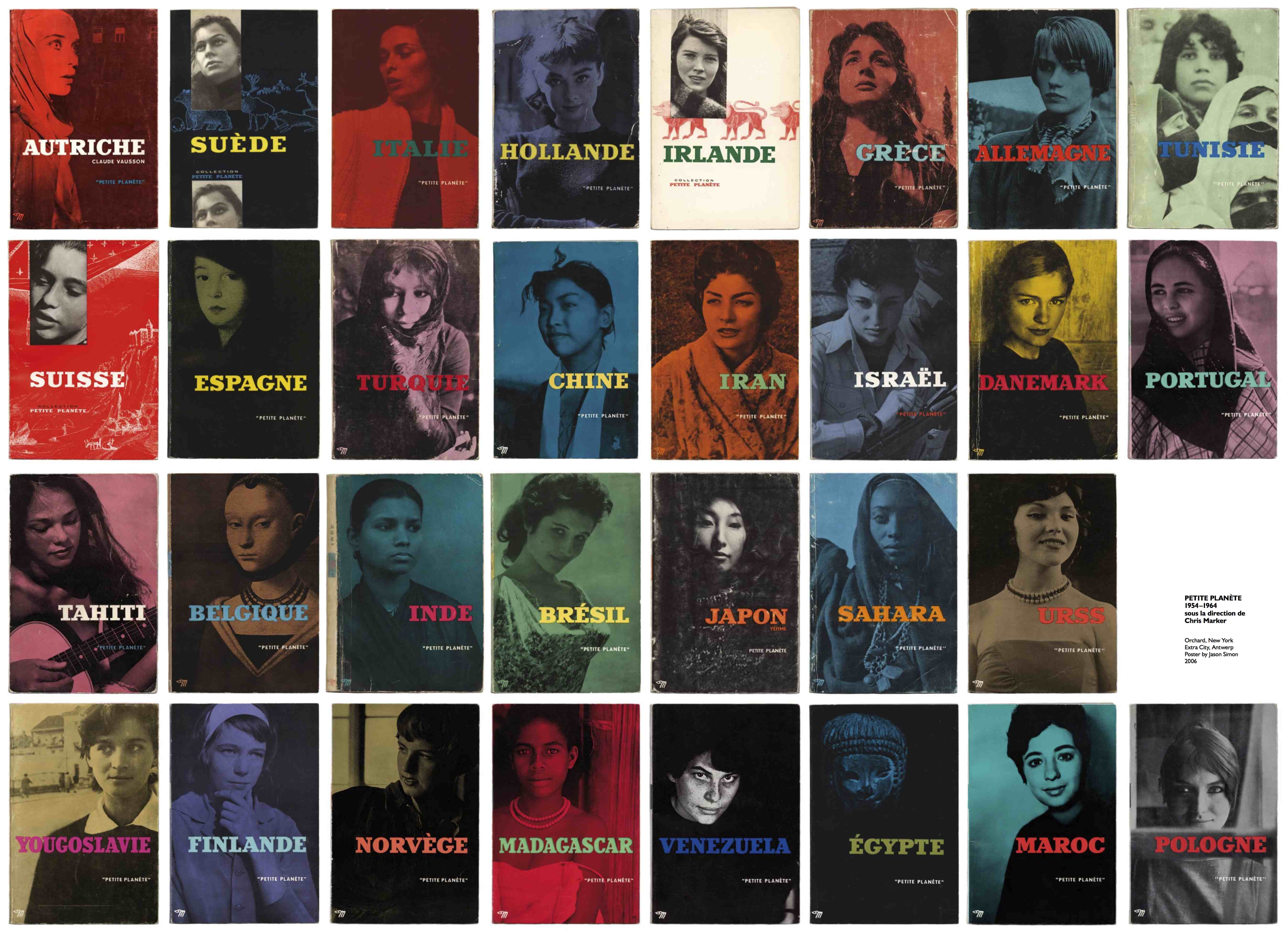
Perhaps that sensibility landed Marker, 33 years old and with his most famous work ahead of him, a job as an editor at Paris’ Editions de Seuil, where he conceived and designed a series of travel guides called Petite Planète. He considered each volume “not a guidebook, not a history book, not a propaganda brochure, not a traveller’s impressions, but instead equivalent to the conversation we would like to have with someone intelligent and well versed in the country that interests us.” Launched “nearly a decade after World War II,” writes Isabel Stevens at Aperture,” the first time when “foreign locales seemed tantalizingly within reach, Éditions du Seuil introduced the books rather charmingly as ‘the world for everyone.’ ”
“Apart from the ambition to provide something different from run-of-the-mill guidebooks, histories, or travelers’ tales,” writes Catherine Lupton in Chris Marker: Memories of the Future, “the most innovative aspect of the Petite Planète guides was their lavish use of illustrations, which were displayed not merely as support to the text but in dynamic layouts that established an unprecedented visual and cognitive relay between text and images.” Though Marker contributed some of his own photographs (as did his French New Wave colleague Agnès Varda), his chief creative contribution came in blending these and a variety of “engravings, miniatures, popular graphic illustrations, picture postcards, maps, cartoons, postage stamps, posters, and advertisements” into “a heady and heterogenous mix of high cultural and mass-market scenes,” all arranged with the words in “a manner that engages knowingly and playfully with the parameters of the book.”
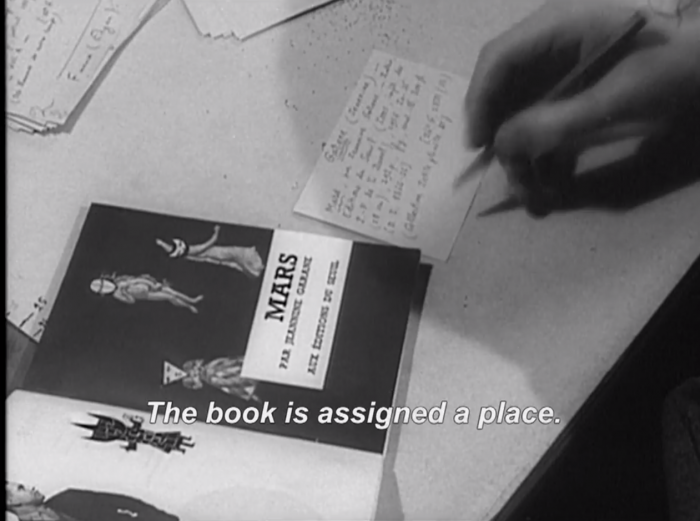
True Marker exegetes will find plenty of connections between Petite Planète and the rest of his oeuvre. Though no cats ever made the covers, plenty of girls did — or rather, plenty of women did, since a local female face fronted every title he oversaw. One of those faces, gazing statue-like from one volume on Japan, will look awfully familiar to anyone who’s seen Le mystère Koumiko, Marker’s documentary on a young lady he met in the street while in Tokyo for the 1964 Olympics. And in Toute la mémoire du monde, Alain Resnais’ short on France’s Bibliothèque Nationale made in collaboration with a certain “Chris and Magic Marker,” we witness the cataloging and shelving of a Petite Planète never written — and one that actually departs from the planet at that.
Around the same time, Marker published Coréennes, a highly Markeresque visual travelogue of war-torn North Korea. I recently wrote about its Korean edition for the Los Angeles Review of Books, though the long-out-of-print English version remains hard to come by. The same goes for the Marker-designed Petite Planète books, translations of which London’s Vista Books put out in the 1950s and 60s, and about which Adam Davis at Division Leap has begun a series of posts with a look at Germany. You can examine more of the originals at Let’s Get Lost, Index Grafix, SÜRKRÜT, and this slide showfrom The Ressiabator. Our hyperconnected era, at a distance of sixty years, places us well to understand the meaning of Marker’s statement on his travel-guide project: “We see the world escape us at the same time as we become more aware of our links with it.”
The meaning of the word “library” has never been more ambiguous. When we can virtually carry library-sized collections of images, music, literature and reference data in our pockets, what are physical libraries but museums of a sort? Of course, from the point of view of librarians especially, this isn’t true in the least. Libraries are fortresses of free speech, public education, and “information literacy” at the community level. Rather than obsolete or secondary, they may be more necessary than ever.
On a larger view both of these things are true. For millions of people, physical libraries have become secondary and will remain so, but they also remain community resources of paramount importance. As Ted Mills posted here in the summer of 2015, Talking Heads frontman, “polymath and all-around swell person David Byrne” affirmed that latter status of the physical library when he leant out 250 books on music from his personal library to themselves be leant out at a library hosted by the 22nd annual Meltdown Festival and London’s Poetry Library.
“I love a library,” wrote Byre in his own Guardian essay announcing the project.
I grew up in suburban Baltimore and the suburbs were not a particularly cosmopolitan place. We were desperate to know what was going on in the cool places, and, given some suggestions and direction, the library was one place where that wider exciting world became available. In my little town, the library also had vinyl that one could check out and I discovered avant-garde composers such as Xenakis and Messiaen, folk music from various parts of the world and even some pop records that weren’t getting much radio play in Baltimore. It was truly a formative place.
Having grown up in the DC suburbs in the years before the internet, I can relate, and would add the importance of local music stores and affordable all-age venues. But Byrne has never stayed tied to the media of his youth. During his several decades as a cultural critic and arts educator, he has made ecumenical use of mundane new technologies to interrogate the status of other older forms. One recent project, for example, consisted of a 96-page book and 20-minute DVD about his experiments in PowerPoint art. One of the questions raised by the project, writes Veronique Vienne, is whether the book is “an antiquated cultural artifact” in an age of hypervisualization.
Clearly for Byrne himself, the answer is no, and that answer is closely connected to the question of commodification verses open access, whether through libraries or free online archives. “The idea of reading books for free,” he writes, “didn’t kill the publishing business, on the contrary, it created nations of literate and passionate readers. Shared interests and the impulse to create.” Byrne’s library reflects a lifetime of shared interests and creative inspiration. He himself has spent his life writing about music in spite of the clever maxim that such a venture is like “dancing about architecture.” It is, he writes, “stimulating and inspiring nonetheless.”
1. 40 Watts from Nowhere: A Journey into Pirate Radioby Sue Carpenter
2. A divina comedia dos Mutantes by Carlos Calado
3. A Photographic Record: 1969–1980 by Mick Rock
4. A Thelonious Monk: Study Albumby Lionel Grigson
5. A Whole Room for Music: A Short Guide to the Balfour Building Music Makers’ Gallery by Helene La Rue
6.Acoustic Territories: Sound Culture and Everyday Life by Brandon Labelle
7. Acoustics for Radio and Television Studios by Christopher Gilford
8. Africa Dances by Geoffrey Gorer
9. African Music: A People’s Art by Francis Bebey
10. African Rhythm and African Sensibility by John Miller Chernoff
11. Afro-American Folk Songs by H.E. Krehbiel
12.AfroPop! An Illustrated Guide to Contemporary African Music by Sean Barlow & Banning Eyre
13. All You Need to Know About the Music Business by Donald S. Passman
14. Aloud: Voices from the Nuyorican Poets Cafè by Miguel Algarin & Bob Holman
15. An Illustrated Treasury of Songs by National Gallery of Art
16. And They All Sang: Adventures of an Eclectic Disc Jockey by Studs Terkel
17. Arranged Marriageby Wallace Berman & Robert Watts
18. Audio Culture: Readings in Modern Music by Cristoph Cox & Daniel Warner
19. Austin City Limits: 35 Years in Photographs by Scott Newton & Terry Lickona
20. Bachata: A Social History of a Dominican Popular Music by Deborah Pacini Hernandez
21. Bandalism: The Rock Group Survival Guideby Julian Ridgway
22. Beats of the Heart: Popular Music of the World by Jeremy Marre & Hannah Charlton
23. Best Music Writing 2001by Nick Hornby & Ben Schafer
24. Best Music Writing 2002 by Jonathan Lethem & Paul Bresnick
25. Best Music Writing 2003 by Matt Groening & Paul Bresnick
26. Best Music Writing 2006 by Mary Gaitskill & Daphne Carr
27. Best Music Writing 2007by Robert Christgau & Daphne Carr
28. Bicycle Diaries by David Byrne
29. Black Music of Two Worlds by John Storm Roberts
30. Black Rhythms of Peru: Reviving African Musical Heritage in the Black Pacific by Heidi Carolyn Feidman
31. Blues Guitar: The Men Who Made the Music by Jas Obrecht
32. Bossa Nova: The Story of the Brazilian Music that Seduced the Worldby Ruy Castro
33. Botsford Collection of Folk Songs Volume 1by Florence Hudson Botsford
34. Botsford Collection of Folk Songs Volume 2 by Florence Hudson Botsford
35. Bound for Gloryby Woody Guthrie
36. Bourbon Street Black: The New Orleans Black Jazzman by Jack V Buerkle & Danny Barker
37. Brazilian Popular Music and Citizenship by Idelber Avelar & Christopher Dunn
38. Brutality Garden: Tropicalla and the Emergence of a Brazilian Countercultureby Christopher Dunn
39. Bug Music: How Insects Gave Us Rhythm and Noise by David Rothenberg
40. But Beautiful: A Book About Jazzby Geoff Dyer
41. Cancioneiro Vinicius De Moraes by Orfeu
42. Capturing Sound: How Technology Has Changed Music by Mark Katz
43. Catch a Fire: The Life of Bob Marley by Timothy White
44. Chambers by Alvin Lucier & Douglas Simon
45. Chinaberry Sidewalks: A Memoir by Rodney Crowell
46. Chris Stein/Negative: Me, Blondie and the Advent of Punk by Deborah Harry, Glenn O’Brien & Shepard Fairey
47. Clandestino: In Search of Manu Chao by Peter Culshaw
48. Clothes Music Boys by Viv Albertine
49. Cocinando! Fifty Years of Latin Cover Art by Pablo Yglesias
50. Conjunto by John Dyer
51. Conversations with Glenn Gould by Jonathan Cott
52. Conversing with Cage by Richard Kostelanetz
53. Copyrights & Copywrongs: The Rise of Intellectual Property and How it Threatens Creativity by Siva Vaidhyanathan
54. Dancing in Your Head: Jazz, Blues, Rock and Beyond by Gene Santoro
55. Desert Plants: Conversations with Twenty-Three American Musicians by Walter Zimmerman
56. Diccionario de Jazz Latino by Nat Chediak
57. Diccionario del Rock Latino by Nat Chediak
58. Driving Through Cuba: Rare Encounters in the Land of Sugar Cane and Revolution by Carlo Gebler
59. Drumming at the Edge of Magic: A Journey into the Spirit of Percussionby Mickey Hart & Jay Stevens
60. Essays on Music by Theodor W. Adorno
61. Experimental Music: Cage and Beyond by Michael Nyman
62. Fair Use: The Story of the Letter U and the Numeral 2 by Negativland
63. Fela Fela: This Bitch of a Life by Carlos Moore
64. Fetish & Fame: The 1997 MTV Video Music Awards by David Felton
65. Finishing the Hat: Collected Lyrics (1954–1981) with Attendant Comments, Principles, Heresies, Grudges, Whines and Anecdotes by Stephen Sondheim
66. Folk and Traditional Music of the Western Continents by Bruno Nettl
67. Folk Song Style and Culture by Alan Lomax
68. Folk: The Essential Album Guide by Neal Walers & Brian Mansfield
69. Formalized Music: Thought and Mathematics in Composition by Iannis Xenakis
70. Fotografie in Musica by Guido Harari
71. Genesis of a Music by Harry Partch
72. Give my Regards to Eighth Street: Collected Writings of Morton Feldman by B.H. Friedman
73. Gravikords, Whirlies, & Pyrophones: Experimental Musical Instruments by Bart Hopkin
74. Guia Esencial De La Salsa by Jose Manuel Gomez
75. Guitar Zero: The New Musician and the Science of Learning by Gary Marcus
77. Hearing Cultures: Essays on Sound, Listening, and Modernity by Veit Erlmann
78. Here Come the Regulars: How to Run a Record Label on a Shoestring Budget by Ian Anderson
79. He Stopped Loving Her Today: George Jones, Billy Sherrill and the Pretty-Much Totally True Story of the Making of the Greatest Country Record of All Time by Jack Isenhour
80. Hip Hop: The Illustrated History of Break Dancing, Rap Music and Graffiti by Steven Hager
81. Hit Men by Frederic Dannen
82. Hitsville: The 100 Greatest Rock ‘n’ Roll Magazines 1954–1968 by Alan Betrock
83. Homo Aestheticus: Where Art Comes From and Why by Ellen Dissanayake
84. Hot Stuff: Disco and the Remaking of American Culture by Alice Echols
85. How Music Works: The Science and Psychology of Beautiful Sounds, from Beethoven to the Beatles and Beyond by John Powell
86. Hungry for Heaven: Rock and Roll and the Search for Redemption by Steve Turner
87. I Have Seen the End of the World and it Looks Like This by Bob Schneider
88. I’ll Take You There Mavis Staples: The Staple Songers, and the March Up Freedom’s Highway by Greg Kot
89. In Pursuit of Silence: Listening for Meaning in a World of Noise by George Prochnik
90. Indian Music by B. Chaitanya Deva
91. It Ain’t Easy: Long John Baldry and the Birth of the British Blues by Paul Myers
92. Japanese Music and Musical Instruments by William P. Malm
93. Javanese Gamelan by Jennifer Lindsay
94. Jazz by William Claxton
95. Knitting Music by Michael Dorf
96. La Traviata: In Full Score by Giuseppe Verdi
97. Laurie Anderson by John Howell
98. Leon Geico: Cronica de un Sueno by Oscar Finkelstein
99. Lexicon of Musical Invective by Nicolas Slonimsky
101. Light Strings: Impressions of the Guitar by Ralph Gibson & Andy Summers
102. Listen Again: A Momentary History of Pop Music by Eric Weisbard
103. Listening Through the Noise: the Aesthetics of Experimental Electronic Music by Joanna Demers
104. Listen to This by Alex Ross
105. Look, I Made a Hat: Collected Lyrics (1981–2011) with Attendant Comments, Amplifications, Dogmas, Harangues, Digressions, Anecdotes and Miscellany by Stephen Sondheim
106. Love Goes to Buildings on Fire: Music Made New in New York City in the ’70s by Will Hermes
107. Love in Vain: The Life and Legend of Robert Johnson by Allen Greenberg
108. Love Saves the Day: A History of American Dance Music Culture by Tim Lawrence
109. Low by Hugo Wilcken
110. Lucking Out: My Life Getting Down and Semi-dirty in Seventies New York by James Wolcott
111. Macumba: The Teachings of Maria-Jose, Mother of the Gods by Serge Bramly
112. Mango Mambo by Adal
113. Masters of Contemporary Brazilian Song: MPB 1965–1985 by Charles Perrone
114. Max’s Kansas City: Art, Glamour, Rock and Roll by Steven Kasher
115. Me, the Mob, and the Music: One Helluva Ride with Tommy James and the Shondells by Tommy James
116. Miles: The Autobiography by Miles Davis with Quincy Troupe
117. Mingering Mike: The Amazing Career of an imaginary Soul Superstar by Dori Hadar
118. Mister Jelly Roll: The Fortunes of Jelly Roll Morton, New Orleans Creole and “Inventor of Jazz” by Alan Lomax
119. Mix Tape: The Art of Cassette Culture by Thurston Moore
120. Music by Paul Bowles
121. Music and Communication by Terence McLaughlin
122. Music and Globalization: Critical Encounters by Bob W. White
123. Music and the Brain: Studies in the Neurology of Music by MacDonald Critchley & R. A. Henson
124. Music and the Mind by Anthony Storr
125. Music and Trance: A Theory of the Relations between Music and Possession by Gilbert Rouget
126. Music Cultures of the Pacific, The Near East, and Asia by William P. Malm
128. Music in Cuba by Alejo Carpentier
129. Music, Language and the Brain by Aniruddh D. Patel
130. Musica Cubana Del Areyto a la Nueva Trova by Dr. Cristobal Diaz Ayala
131. Musical Instruments of the World: An Illustrated Encyclopedia with More than 4,000 Original Drawings by Ruth Midgely
132. Musicophilia: Tales of Music and the Brain by Oliver Sacks
133. My Music by Susan D Crafts, Daniel Cavicchi & Charles Keil
134. New York Noise: Art and Music from the New York Underground 1978–88 by Stuart Baker
135. Noise: A Human History of Sound & Listening by David Hendy
136. Noise: The Political Economy of Music by Jacques Attali
137. Notations by John Cage
138. Ocean of Sound: Aether Talk, Ambient Sound and Imaginary Worlds by David Toop
139. On Sonic Art by Trevor Wishart
140. Opera 101: A Complete Guide to Learning and Loving the Opera by Fred Plotkin
141. Patronizing The Arts by Marjorie Garber
142. Perfecting Sound Forever: An Aural History of Recorded Music by Greg Milner
143. Pet Shop Boys: Literally by Chris Heath
144. Popular Musics of the Non-Western World: An Introductory Survey by Peter Manuel
145. The Power of Music: Pioneering Discoveries in the Science of Song by Elena Mannes
146. Presenting Celia Cruz by Alexis Rodriguez-Duarte
147. Psychotic Reactions and Carburetor Dung by Lester Bangs
148. Queens of Havana: The Amazing Adventures of the Legendary Anacaona, Cuba’s First All-Girl Dance Band by Alicia Castro
149. Recordando a Tito Puente: El Rey del Timbal by Steven Loza
150. Reflections on Macedonian Music: Past and Future by Dimitrije Buzarovski
151. Remembering the Future by Luciano Berio
152. Repeated Takes: A Short History of Recording Music and Its Effect on Music by Michael Chanan
153. Revolution in the Head: The Beatles Records and the Sixties by Ian Macdonald
154. Rhythm & Blues in New Orleans by John Broven
155. Rock ‘n’ Roll is Here to Pay: The History of Politics in the Music Industry by Steve Shapple & Reebee Garofalo
156. Rock Archives by Michael Ochs
157. Rock Images: 1970–1990 by Claude Gassian
158. Rock Lives: Profiles and Interviews by Timothy White
159. Salsa Guidebook for Piano & Ensemble by Rebeca Mauleon
160. Salsa: The Rhythm of Latin Music by Gerard Sheller
161. Salsiology: Afro-Cuban Music and the Evolution of Salsa in New York City by Vernon W. Boggs
162. Samba by Alma Guillermoprieto
163. Sonic Transports: New Frontiers in Our Music by Cole Gagne
164. Sonic Warfare: Sound, Affect, and the Ecology of Fear by Steve Goodman
165. Souled American: How Black Music Transformed White Culture by Kevin Phinney
166. Sounding New Media: Immersion and Embodiment in the Arts and Culture by Frances Dyson
167. Soundings by Neuberger Museum
168. South to Louisiana: The Music of the Cajun Bayous by John Broven
169. Spaces Speak, Are You Listening: Experiencing Aural Architecture by Barry Blesser & Linda-Ruth Salter
170. Spirit Rising: My Life, My Music by Angelique Kidjo
171. Starmaking Machinery: The Odyssey of an Album by Geoffrey Stokes
172. Stockhausen: Conversations with the Composer by Jonathan Cott
173. Stolen Moments: Conversations with Contemporary Musicians by Tom Schnabel
174. Stomping the Blues by Albert Murray
175. Tango: The Art History of Love by Robert Farris Thompson
176. Text-Sound Texts by Richard Kostelanetz
177. The ABCs of Rock by Melissa Duke Mooney
178. The Agony of Modern Music by Henry Pleasants
179. The Anthropology of Music by Alan P. Merriam
180. The Art of Asking: How I Learned to Stop Worrying and Let People Help by Amanda Palmer
181. The Beatles: Recording Sessions by Mark Lewisohn
182. The Book of Drugs: A Memoir by Mike Dougherty
183. The Brazilian Sounds: Samba, Bossa Nova, and the Popular Music of Brazil by Chris McGowan & Ricardo Pessanha
184. The Faber Book of Pop by Hanif Kureishi & Jon Savage
185. The Great Animal Orchestra: Finding the Origins of Music in the World’s Wild Places by Bernie Krause
186. The Human Voice by Jean Cocteau
187. The Kachamba Brothers’ Band: A Study of Neo-Traditional Music in Malawi by Gerhard Kubik
188. The Last Holiday: A Memoir by Gil Scott-Heron
189. The Latin Tinge: The Impact of Latin American Music on the United States by John Storm Roberts
190. The Life and Times of Little Richard: The Quasar of Rock by Charles White
191. The Merge Records Companion: A Visual Discography of the First Twenty Years by Merge Records
192. The Music Instinct by Philip Ball
193. The Music of Brazil by David P. Appleby
194. The Mystery of Samba: Popular Music and the National Identity in Brazil by Hermano Vianna
195. The New Woman Poems: A Tribute to Mercedes Sosa by Nestor Rodriguez Lacoren
196. The Performer Prepares by Robert Caldwell
197. The Rational and Social Foundations of Music by Max Weber
198. The Record: Contemporary Art and Vinyl by Trevor Schoonmake
199. The Recording Angel: Music, Records and Culture from Aristotle to Zappa by Evan Eisenberg
200. The Rest is Noise: Listening to the Twentieth Century by Alex Ross
201. The Rolling Stone Interviews: The 1980s by Various
202. The Shape of Things to Come: Prophecy and the American Voice by Greil Marcus
203. The Sound Book: The Science of the Sonic Wonders of the World by Trevor Cox
204. The Sun and the Drum: African Roots in Jamaican Folk Tradition by Leonard Barrett
205. The Thinking Ear by R. Murray Schafer
206. The Traditional Music of Japan by Kishibe Shigeo
207. The Triumph of Music: The Rise of Composers, Musicians and Their Art by Tim Blanning
208. The Veil of Silence by Djura
209. The Wilco Book by Dan Nadel
210. This Business of Music: The Definitive Guide to the Music Industry by M. William Krasilovsky & Sidney Shemel
211. This is Your Brain on Music: The Science of Human Obsession by Daniel J. Levitin
212. Through Music to Self by Peter Michael Hamel
213. West African Rhythms for Drumset by Royal Hartigan
214. What Good are the Arts? by John Carey
215. White Bicycles: Making Music in the 1960’s by Joe Boyd
216. Who Shot Rock & Roll: A Photographic History 1955–Present by Gail Buckland
218. Whose Music? A Sociology of Musical Languages by John Shepard, Phil Virden, Graham Vulliamy, Trevor Wishart
219. Why is This Country Dancing: A One-Man Samba to the Beat of Brazil by John Krich
220. Woody Guthrie: A Life by Joe Klein
221. The Rough Guide to World Music: Latin and North America, Caribbean, India, Asia, and Pacific: An A‑Z of the Music, Musicians and Discs by Simon Broughton & Mark Ellingham
222. The Rough Guide to World Music: Salsa to Soukous, Cajun to Calypso by Simon Broughton, Mark Ellingham, David Muddyman & Richard Trillo
223. World: The Essential Album Guide by Adam McGovern
224. Yakety Yak: The Midnight Confessions and Revelations of Thirty-Seven Rock Stars and Legends by Scott Cohen
To properly honor your cultural role models, don’t try to do what they did, or even to think what they thought, but to think how they thought. This goes at least double for John Cage, the experimental composer whose innovative works can be, and often are, re-staged (go on, have four minutes and 33 seconds of silence to yourself), but it takes a different kind of effort altogether to cultivate the kind of mind that would come up with them in the first place. As a means of activating your own inner Cageness, you could do much worse than read through his personal library, a list of whose books you’ll find at johncage.org.
The volumes number 1126 in total, and if you load the library’s main page, it will present you with a list of ten randomly selected books. (You can get a list of all of them by selecting the “See Entire Library” option on the left sidebar.)
Hitting refresh a few times will give you a sense of the breadth of Cage’s reading: Emma Goldman on anarchism, Chinese poetry gathered by Kenneth Rexroth, M. Conrad Hyers’ Zen and the Comic Spirit (two of Cage’s driving forces if ever I’ve heard them), How to Play Backgammon, essays on Ulysses (an interest shared with Marilyn Monroe), and even essays on John Cage. Here we’ve assembled a list of ten books from Cage’s library of particular interest to the Open Culture reader:
To those who know anything of Cage’s life and interests, his shelves on healthy eating—on which Dining Naturally in Japan: A Restaurant Guide to Wholesome Foodalso appears, as, naturally given the era and Cage’s acquired northern-Californianness, The Tassajara Bread Book—and especially the eating of mushrooms, come as no surprise, nor might his inclination toward philosophy. But we should note what looks like a particular fascination with the work of Ludwig Wittgenstein, evidenced by 22 of the books in his library: his best-known works like the Tractatus Logico-Philosophicus, but also his letters, lectures, and notebooks, as well as biographies, commentaries, and Wittgenstein and Buddhism, which Cage must have considered an exciting find indeed.
In one of his most quotable quotes, Cage describes college as “two hundred people reading the same book. An obvious mistake. Two hundred people can read two hundred books.” And indeed, 1126 people can read 1126 books—or many more people can each read a different subset of those books. While you could methodically read your way through Cage’s entire library, and would surely learn a great deal in the process, wouldn’t making use of the unthinking guidance of the ten-random-books function, surrendering the direction of this informal education to the kind of chance that places Paul Bowles next to the common fungi of North American and Charles Ives next to Italian futurism, be a much more Cagean way of going about it?
The writer David Auerbach once posted a fascinating inquest on left-brained literature, an examination of what he calls “a parallel track of literature that is popular specifically among engineers,” excluding genre fiction (science- or otherwise), with an eye toward “which novels of some notoriety and good PR happen to attract members of the engineering professions.” Favored author names turn out to include Richard Powers, Umberto Eco, Haruki Murakami, William Gibson, Italo Calvino, and Jorge Luis Borges.
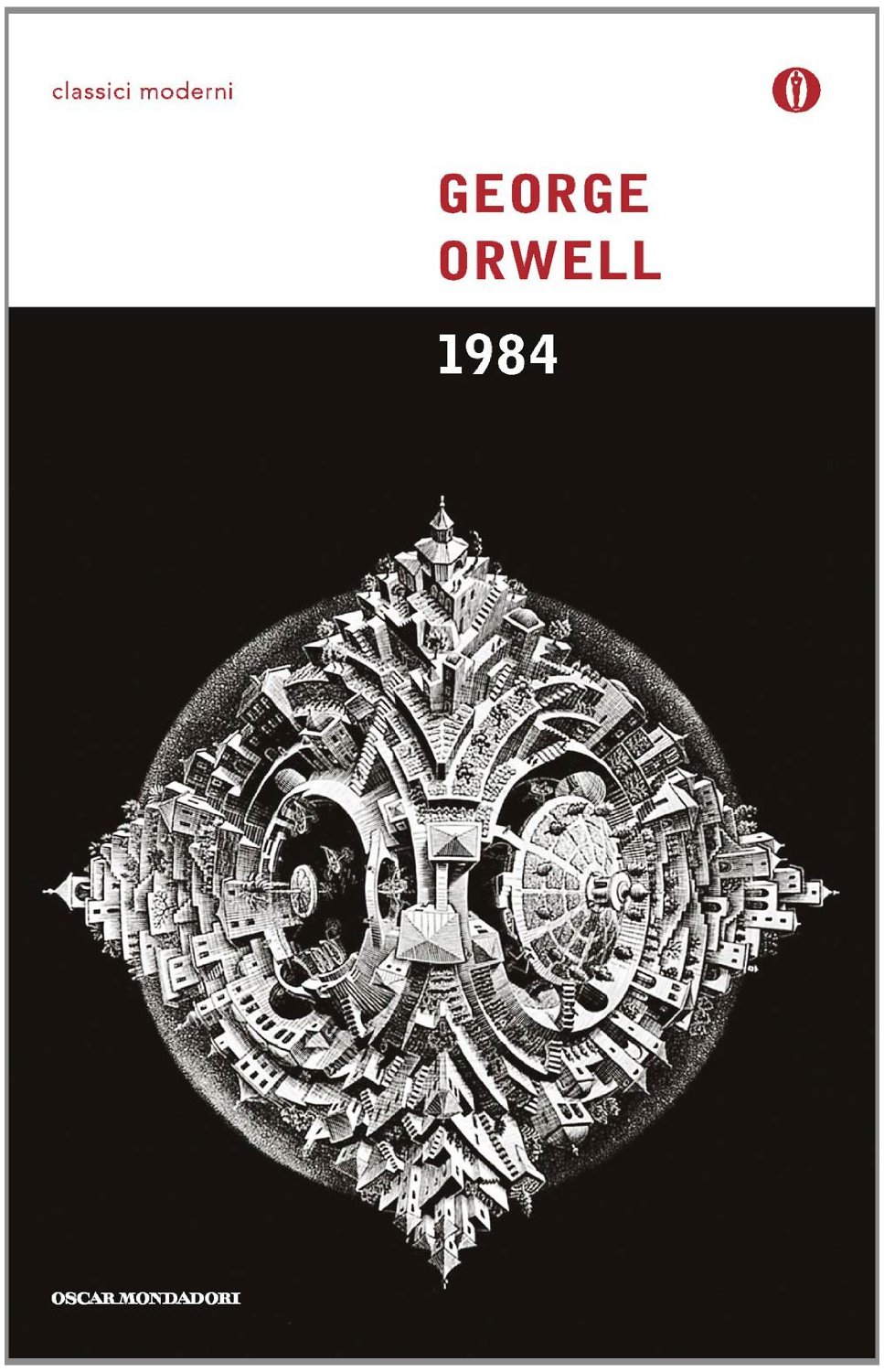
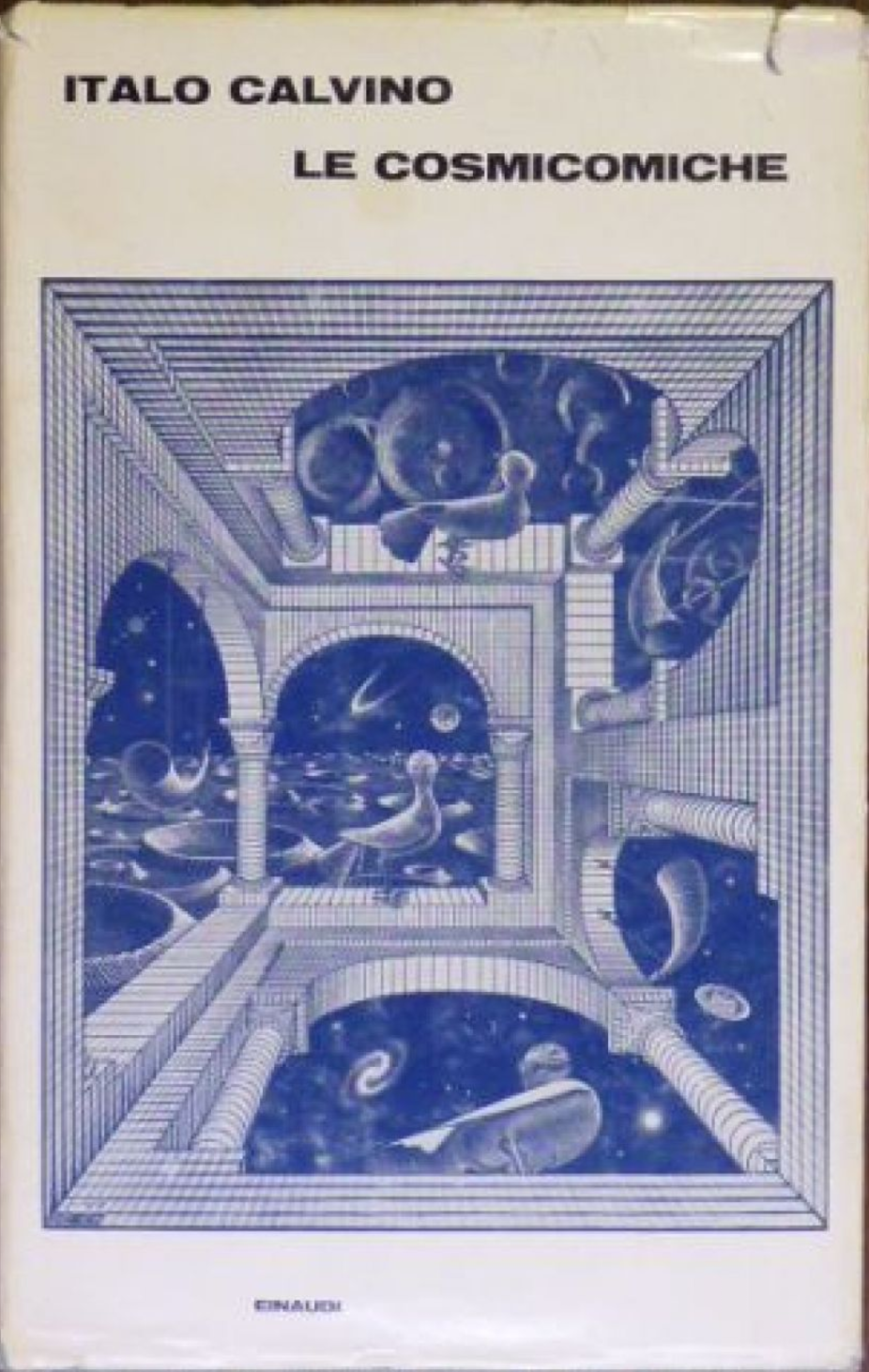
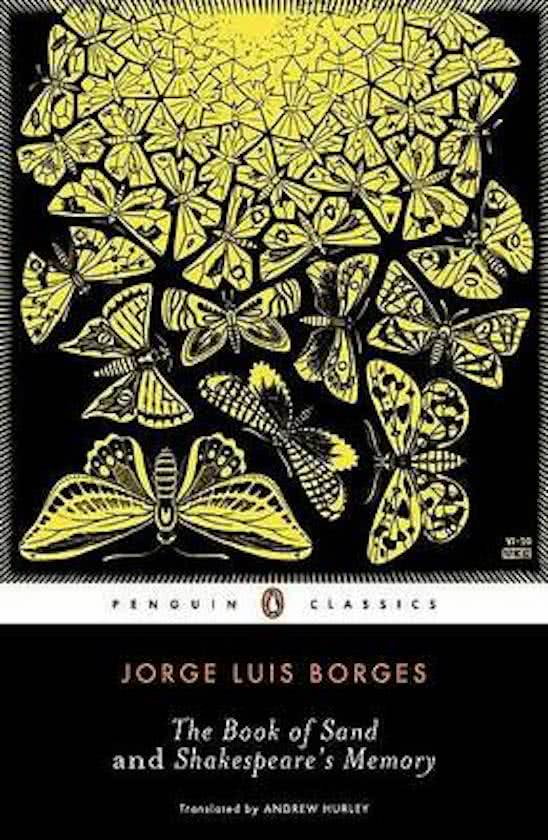
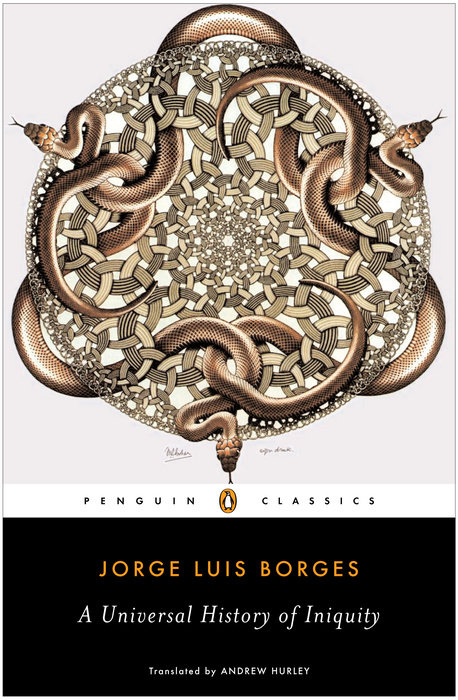
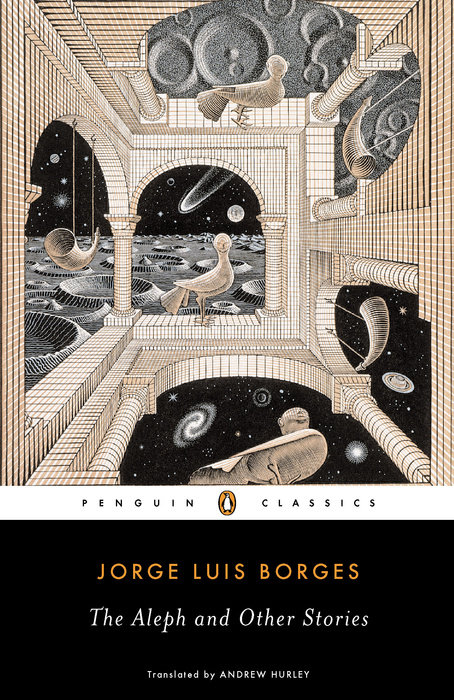
More of these literarily inclined left-brainers exist than one might imagine. From the publisher’s point of view, what cover art could best attract them? Books targeted toward that demographic could do far worse than to use the work of M.C. Escher, who spent his career with one foot in art and the other in mathematics.
In the hitherto unseen (and even unimagined) worlds pictured in his woodcuts, lithographs, and mezzotints, he made use of mathematical concepts from tessellation to reflection to infinity in ways at once impossible and somehow plausible, all of them still intellectually and aesthetically compelling today.
The non-novelist Douglas Hofstadter appears in Auerbach’s inquest since his best-known work, Gödel, Escher, Bach: an Eternal Golden Braid, “which partly uses fictional forms, is too great not to list.” Not only does Escher’s name appear in Hofstadter’s book title, his art informs its central concepts. “Hofstadter wove a network of connections linking the mathematics of Gödel, the art of Escher, and the music of Bach,” writes Allene M. Parker in the paper “Drawing Borges: a Two-Part Invention on the Labyrinths of Jorge Luis Borges and M.C. Escher.” In Gödel, Escher, Bach he describes their common denominator as a “strange loop,” a phenomenon that “occurs whenever, by movement upwards (or downwards) through the levels of some hierarchical system, we unexpectedly find ourselves right back where we started.”
Parker identifies 1948’s “Drawing Hands” as a “particularly striking and familiar example” of a strange loop in Escher’s work. We can interpret that image by recognizing that “it is Escher, the artist, who is drawing both hands and who stands outside this particular puzzle.” Or we can “adopt a Zen-inspired solution and let mystery be mystery by choosing to embrace a unity which contains oppositions,” such as one described by the opening of Borges’ poem “Labyrinths”:
There’ll never be a door. You’re inside
and the keep encompasses the world
and has neither obverse nor reverse
nor circling in secret center.
The Escher-Borges connections go deeper beyond, and as you can see in John Coulthart’s original post, the selection of Escher-covered books extends farther.
Aside from countless nonfiction publications, the Dutch mathematical master’s work has graced science-fiction and fantasy magazines, one edition of Flatland, a collection of “Forteana, weird fiction, occultism and historical speculation,” Clive Barker’s The Damnation Game, and George Orwell’s 1984, a novel more widely read than ever by the left- and right-brained alike. But no matter which hemisphere we favor, Escher — like Orwell, Borges, and Calvino — shows us how to see reality in more interesting ways.
We're hoping to rely on loyal readers, rather than erratic ads. Please click the Donate button and support Open Culture. You can use Paypal, Venmo, Patreon, even Crypto! We thank you!
Open Culture scours the web for the best educational media. We find the free courses and audio books you need, the language lessons & educational videos you want, and plenty of enlightenment in between.





 by Lionel Grigson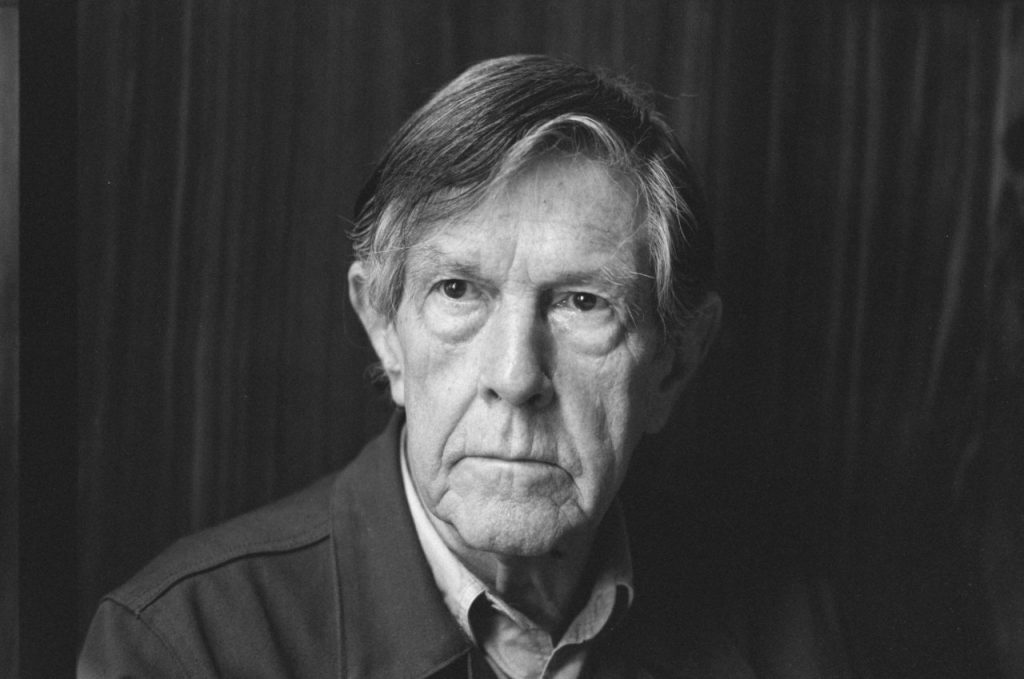





.jpg)