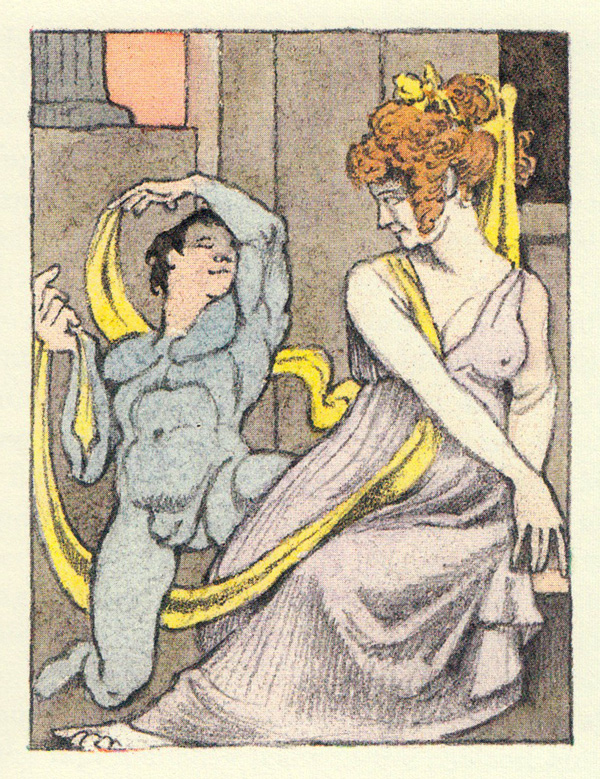
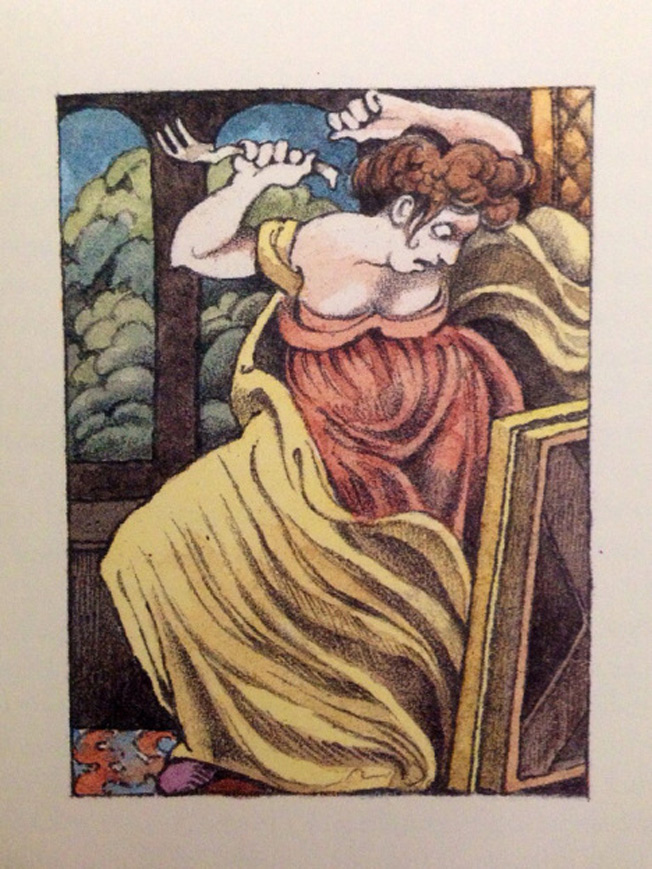
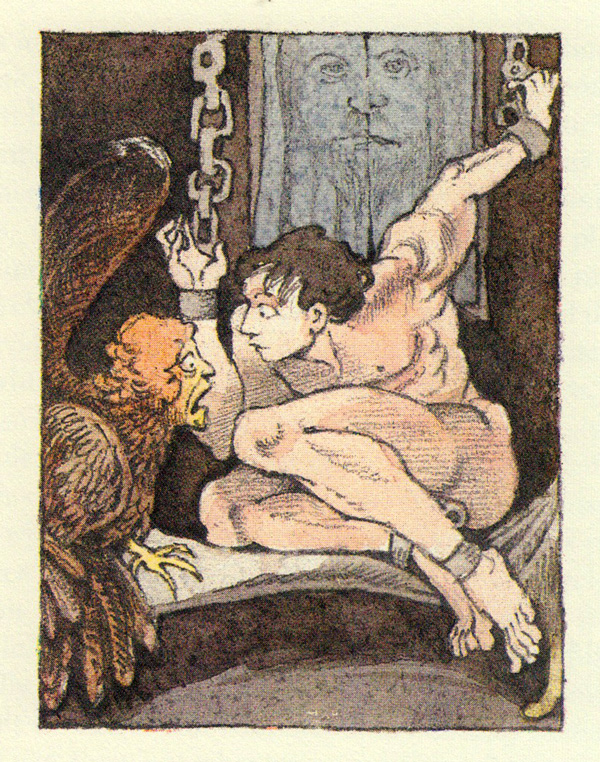
You could pay $118 on Amazon for the Metropolitan Museum of Art’s catalog The Art of Illumination: The Limbourg Brothers and the Belles Heures of Jean de France, Duc de Berry. Or you could pay $0 to download it at MetPublications, the site offering “five decades of Met Museum publications on art history available to read, download, and/or search for free.”
Since I haven’t yet turned to art collection — I suppose you need money for that — these books don’t necessarily make me covet the vast sweep of artworks they depict and contextualize. But they do make me wish for something even less probable: a time machine so I could go back and see all these exhibits firsthand.
Image by Università Reggio Calabria, released under a C BY-SA 3.0 license.
In general, the how-to book—whether on beekeeping, piano-playing, or wilderness survival—is a dubious object, always running the risk of boring readers into despairing apathy or hopelessly perplexing them with complexity. Instructional books abound, but few succeed in their mission of imparting theoretical wisdom or keen, practical skill. The best few I’ve encountered in my various roles have mostly done the former. In my days as an educator, I found abstract, discursive books like Robert Scholes’ Textual Power or poet and teacher Marie Ponsot’s lyrical Beat Not the Poor Desk infinitely more salutary than more down-to-earth books on the art of teaching. As a sometime writer of fiction, I’ve found Milan Kundera’s idiosyncratic The Art of the Novel—a book that might have been titled The Art of Kundera—a great deal more inspiring than any number of other well-meaning MFA-lite publications. And as a self-taught audio engineer, I’ve found a book called Zen and the Art of Mixing—a classic of the genre, even shorter on technical specifications than its namesake is on motorcycle maintenance—better than any other dense, diagram-filled manual.
How I wish, then, that as a onetime (longtime) grad student, I had had access to the English translation, just published this month, of Umberto Eco’s How to Write a Thesis, a guide to the production of scholarly work worth the name by the highly celebrated Italian novelist and intellectual. Written originally in Italian in 1977, before Eco’s name was well-known for such works of fiction as The Name of the Rose and Foucault’s Pendulum, How to Write Thesis is appropriately described by MIT Press as reading: “like a novel”: “opinionated… frequently irreverent, sometimes polemical, and often hilarious.”
For example, in the second part of his introduction, after a rather dry definition of the academic “thesis,” Eco dissuades a certain type of possible reader from his book, those students “who are forced to write a thesis so that they may graduate quickly and obtain the career advancement that originally motivated their university enrollment.” These students, he writes, some of whom “may be as old as 40” (gasp), “will ask for instructions on how to write a thesis in a month.” To them, he recommends two pieces of advice, in full knowledge that both are clearly “illegal”:
(a) Invest a reasonable amount of money in having a thesis written by a second party. (b) Copy a thesis that was written a few years prior for another institution. (It is better not to copy a book currently in print, even if it was written in a foreign language. If the professor is even minimally informed on the topic, he will be aware of the book’s existence.
Eco goes on to say that “even plagiarizing a thesis requires an intelligent research effort,” a caveat, I suppose, for those too thoughtless or lazy even to put the required effort into academic dishonesty.
Instead, he writes for “students who want to do rigorous work” and “want to write a thesis that will provide a certain intellectual satisfaction.” Eco doesn’t allow for the fact that these groups may not be mutually exclusive, but no matter. His style is loose and conversational, and the unseriousness of his dogmatic assertions belies the liberating tenor of his advice. For all of the fun Eco has discussing the whys and wherefores of academic writing, he also dispenses a wealth of practical hows, making his book a rarity among the small pool of readable How-tos. For example, Eco offers us “Four Obvious Rules for Choosing a Thesis Topic,” the very bedrock of a doctoral (or masters) project, on which said project truly stands or falls:
1. The topic should reflect your previous studies and experience. It should be related to your completed courses; your other research; and your political, cultural, or religious experience.
2. The necessary sources should be materially accessible. You should be near enough to the sources for convenient access, and you should have the permission you need to access them.
3. The necessary sources should be manageable. In other words, you should have the ability, experience, and background knowledge needed to understand the sources.
4. You should have some experience with the methodological framework that you will use in the thesis. For example, if your thesis topic requires you to analyze a Bach violin sonata, you should be versed in music theory and analysis.
Having suffered the throes of proposing, then actually writing, an academic thesis, I can say without reservation that, unlike Eco’s encouragement to plagiarism, these four rules are not only helpful, but necessary, and not nearly as obvious as they appear. Eco goes on in the following chapter, “Choosing the Topic,” to present many examples, general and specific, of how this is so.
Much of the remainder of Eco’s book—though written in as lively a style and shot through with witticisms and profundity—is gravely outdated in its minute descriptions of research methods and formatting and style guides. This is pre-internet, and technology has—sadly in many cases—made redundant much of the footwork he discusses. That said, his startling takes on such topics as “Must You Read Books?,” “Academic Humility,” “The Audience,” and “How to Write” again offer indispensable ways of thinking about scholarly work that one generally arrives at only, if at all, at the completion of a long, painful, and mostly bewildering course of writing and research.
FYI: You can download Eco’s book, How to Write a Thesis, as a free audiobook if you want to try out Audible.com’s no-risk, 30-day free trial program. Find details here.
Samuel Beckett, Pic, 1″ by Roger Pic. Via Wikimedia Commons
Clad in a black turtleneck and with a shock of white hair, Samuel Beckett was a gaunt, gloomy high priest of modernism. After the 1955 premiere of Samuel Beckett’s play Waiting for Godot (watch him stage a performance here), Kenneth Tynan quipped, ”It has no plot, no climax, no denouement; no beginning, no middle and no end.” From there, Beckett’s work only got more austere, bleak and despairing. His 1969 play Breath, for instance, runs just a minute long and features just the sound of breathing.
An intensely private man, he managed to mesmerize the public even as he turned away from the limelight. When he won the Nobel Prize in 1969, his wife Suzanne, fearing the onslaught of fame that the award would bring, decried it as a “catastrophe.”
A recently published collection of his letters from 1941–1956, the period leading up to his international success with his play Waiting for Godot, casts some light on at least one corner of the man’s private life – what books were piling up on his bed stand. Below is an annotated list of what he was reading during that time. Not surprisingly, he really dug Albert Camus’s The Stranger. “Try and read it,” he writes. “I think it is important.” He dismisses Agatha Christie’s Crooked Houseas “very tired Christie” but praises Around the World in 80 Days, “It is lively stuff.” But the book he reserves the most praise for is J.D. Salinger’s Catcher in the Rye. “I liked it very much indeed, more than anything for a long time.”
You can see the full list below. It was originally published online by Cambridge University Press in 2011. Books with an asterisk next to the title can be found in our collection of 700 Free eBooks.
Andromaque* by Jean Racine: “I read Andromaque again with greater admiration than ever and I think more understanding, at least more understanding of the chances of the theatre today.”
Lautreamont and Sade by Maurice Blanchot: “Some excellent ideas, or rather starting-points for ideas, and a fair bit of verbiage, to be read quickly, not as a translator does. What emerges from it though is a truly gigantic Sade, jealous of Satan and of his eternal torments, and confronting nature more than with humankind.”
Jonathan Crow is a Los Angeles-based writer and filmmaker whose work has appeared in Yahoo!, The Hollywood Reporter, and other publications. You can follow him at @jonccrow. And check out his blog Veeptopus, featuring lots of pictures of badgers and even more pictures of vice presidents with octopuses on their heads. The Veeptopus store is here.
In high school, the language I most fell in love with happened to be a dead one: Latin. Sure, it’s spoken at the Vatican, and when I first began to study the tongue of Virgil and Catullus, friends joked that I could only use it if I moved to Rome. Tempting, but church Latin barely resembles the classical written language, a highly formal grammar full of symmetries and puzzles. You don’t speak classical Latin; you solve it, labor over it, and gloat, to no one in particular, when you’ve rendered it somewhat intelligible. Given that the study of an ancient language is rarely a conversational art, it can sometimes feel a little alienating.
And so you might imagine how pleased I was to discover what looked like classical Latin in the real world: the text known to designers around the globe as “Lorem Ipsum,” also called “filler text” and (erroneously) “Greek copy.”
The idea, Priceonomics informs us, is to force people to look at the layout and font, not read the words. Also, “nobody would mistake it for their native language,” therefore Lorem Ipsum is “less likely than other filler text to be mistaken for final copy and published by accident.” If you’ve done any web design, you’ve probably seen it, looking something like this:
Lorem ipsum dolor sit amet, consectetur adipiscing elit, sed do eiusmod tempor incididunt ut labore et dolore magna aliqua. Ut enim ad minim veniam, quis nostrud exercitation ullamco laboris nisi ut aliquip ex ea commodo consequat. Duis aute irure dolor in reprehenderit in voluptate velit esse cillum dolore eu fugiat nulla pariatur. Excepteur sint occaecat cupidatat non proident, sunt in culpa qui officia deserunt mollit anim id est laborum.
When I first encountered this text, I did what any Latin geek will—set about trying to translate it. But it wasn’t long before I realized that Lorem Ipsum is mostly gibberish, a garbling of Latin that makes no real sense. The first word, “Lorem,” isn’t even a word; instead it’s a piece of the word “dolorem,” meaning pain, suffering, or sorrow. So where did this mash-up of Latin-like syntax come from, and how did it get so scrambled? First, the source of Lorem Ipsum—tracked down by Hampden-Sydney Director of Publications Richard McClintock—is Roman lawyer, statesman, and philosopher Cicero, from an essay called “On the Extremes of Good and Evil,” or De Finibus Bonorum et Malorum.
Why Cicero? Put most simply, writes Priceonomics, “for a long time, Cicero was everywhere.” His fame as the most skilled of Roman rhetoricians meant that his writing became the benchmark for prose in Latin, the standard European language of the middle ages. The passage that generated Lorem Ipsum translates in part to a sentiment Latinists will well understand:
Nor is there anyone who loves or pursues or desires to obtain pain of itself, because it is pain, but occasionally circumstances occur in which toil and pain can procure him some great pleasure.
Dolorem Ipsum, “pain in and of itself,” sums up the tortuous feeling of trying to render some of Cicero’s complex, verbose sentences into English. Doing so with tolerable proficiency is, for some of us, “great pleasure” indeed.
But how did Cicero, that master stylist, come to be so badly manhandled as to be nearly unrecognizable? Lorem Ipsum has a history that long predates online content management. It has been used as filler text since the sixteenth century when—as McClintock theorized—“some typesetter had to make a type specimen book, to demo different fonts” and decided that “the text should be insensible, so as not to distract from the page’s graphical features.” It appears that this enterprising craftsman snatched up a page of Cicero he had lying around and turned it into nonsense. The text, says McClintock, “has survived not only four centuries of letter-by-letter resetting but even the leap into electronic typesetting, essentially unchanged.”
The story of Lorem Ipsum is a fascinating one—if you’re into that kind of thing—but its longevity raises a further question: should we still be using it at all, this mangling of a dead language, in a medium as vital and dynamic as web publishing, where “content” refers to hundreds of design elements besides font. Is Lorem Ipsum a quaint piece of nostalgia that’s outlived its usefulness? In answer, you may wish to read Karen McGrane’s spirited defense of the practice. Or, if you feel it’s time to let the garbled Latin go the way of manual typesetting machines, consider perhaps as an alternative “Nietzsche Ipsum,” which generates random paragraphs of mostly verb-less, incoherent Nietzsche-like text, in English. Hey, at least it looks like a real language.
Public domain image originally taken by George Charles Beresford.
When Open Culture recently published Jorge Luis Borges’ self-compiled list of 74 ‘great works of literature’, commissioned by Argentine publisher Hyspamerica, I, along with many others, saw one glaring issue in the otherwise fantastically diverse list: it included no works by female writers.
Whether intentional or not, the fact that women are excluded from Borges’ noteworthies (and in 1985, no less) means that a vast number of historically and culturally significant books and writings have been overlooked. While this ought not to discredit the works listed in any way, after witnessing the immense popularity of Borges’ list I certainly felt that for his selection to be relevant today it needed to be accompanied by a list of works which had been overlooked due to the gender of their respective authors.
I decided to put a suggestion to a group of international women writers, artists and curators, and we compiled our own list of 74 ‘great works of literature’ — one just as varied, loose and substantial as that of Borges, but made up solely of writers identifying as women or non-gender-binary. Over two days we amassed many suggestions, which I’ve now curated to form the list below. It’s not intended to invalidate the original, but rather to serve as an accompaniment to highlight and encourage a dialogue on gender imbalances in creative and intellectual realms, as well as to provide a balance by actively ‘equalising’ that of Jorge Luis Borges.
Agatha Christie — The Mousetrap
Albertine Sarrazin — L’Astragale
Alice Walker — The Color Purple
Anaïs Nin — Little Birds
Angela Carter — Nights at the Circus
Angela Davis — Are Prisons Obselete?
Anita Desai — Clear Light of Day
Anne Carson — Autobiography of Red
Anne Frank — The Diary of a Young Girl
Anne Sexton — Live or Die
Arundhati Roy — The God of Small Things
Banana Yoshimoto — Kitchen
bell hooks — Ain’t I a Woman?
Beryl Bainbridge — Master Georgie
Beryl Markham — West with the Night
Buchi Emecheta — The Joys of Motherhood
Carson McCullers — The Heart is a Lonely Hunter
Charlotte Bronte — Jane Eyre
Charlotte Roche — Feuchtgebiete
Chris Kraus — I Love Dick
Colette — Chéri
Daphne du Maurier — Rebecca
Doris Lessing — The Golden Notebook
Edith Wharton — Age of Innocence
Eileen Myles — Inferno
Elfriede Jelinek — Women as Lovers
Emily Bronte — Wuthering Heights
Flannery O’Connor — Complete Stories
Françoise Sagan — Bonjour Tristesse
George Eliot — Silas Marner
Gertrude Stein — The Making of Americans
Gwendolyn Brooks — To Disembark
Hannah Arendt — The Human Condition
Harper Lee — To Kill a Mockingbird
Hillary Mantel — Wolf Hall
Iris Murdoch — The Sea, The Sea
James Tiptree Jr. — Her Smoke Rose Up Forever
Jean Rhys — Wide Sargasso Sea
Jhumpa Lahiri — Interpreter of Maladies
Joan Didion — Slouching Towards Bethlehem
Joyce Carol Oats — A Bloodsmoore Romance
Jung Chang — Wild Swans
Kate Zambreno — Heroines
Kathy Acker — Blood and Guts in High School
Leonora Carrington — The Hearing Trumpet
Leslie Feinberg — Stone Butch Blues
Lorrie Moore — Who Will Run the Frog Hospital?
Louise Erdrich — The Beet Queen
Margaret Atwood — The Handmaid’s Tale
Marguerite Duras — Le ravissement de Lol V. Stein
Mary Shelley — Frankenstein
Mary Wollstonecraft — A Vindication of the Rights of Women
“Jorge Luis Borges 1951, by Grete Stern” by Grete Stern (1904–1999). Licensed under Public Domain via Wikimedia Commons.
Jorge Luis Borges’ terse, mind-expanding stories reshaped modern fiction. He was one of the first authors to mix high culture with low, merging such popular genres as science fiction and the detective story with heady philosophical discourses on authorship, reality and existence. His story “The Garden of the Forking Paths,” which describes a novel that is also a labyrinth, presaged the hypertextuality of the internet age. His tone of ironic detachment influenced generations of Latin American authors. The BBC argued that Borges was the most important writer of the 20th century.
Of course, Borges wasn’t just an author. When not writing fiction, Borges worked as a literary critic, occasional film critic, a librarian, and, for a spell, as the director of the Biblioteca Nacional in Buenos Aires. His tastes were famously eclectic. He did not think of much of canonical writers like Goethe, Jane Austen, James Joyce and Gabriel Garcia Marquez. He favored the 19th storytellers like Edgar Allan Poe and Rudyard Kipling.
In 1985, Argentine publisher Hyspamerica asked Borges to create A Personal Library — which involved curating 100 great works of literature and writing introductions for each volume. Though he only got through 74 books before he died of liver cancer in 1988, Borges’s selections are fascinating and deeply idiosyncratic. He listed adventure tales by Robert Louis Stevenson and H.G. Wells alongside exotic holy books, 8th century Japanese poetry and the musing of Kierkegaard. You can see the full list below. A number of the selected works can be found in our Free eBooks and Free Audio Books collections.
1. Stories by Julio Cortázar (not sure if this refers to Hopscotch, Blow-Up and Other Stories, or neither)
2. & 3. The Apocryphal Gospels
4. Amerika and The Complete Stories by Franz Kafka
5. The Blue Cross: A Father Brown Mystery by G.K. Chesterton
6. & 7. The Moonstone by Wilkie Collins
8. The Intelligence of Flowers by Maurice Maeterlinck
9. The Desert of the Tartars by Dino Buzzati
10. Peer Gynt and Hedda Gabler by Henrik Ibsen
11. The Mandarin: And Other Stories by Eça de Queirós
12. The Jesuit Empire by Leopoldo Lugones
13. The Counterfeiters by André Gide
14. The Time Machine and The Invisible Man by H.G. Wells
15. The Greek Myths by Robert Graves
16. & 17. Demons by Fyodor Dostoyevsky
18. Mathematics and the Imagination by Edward Kasner
19. The Great God Brown and Other Plays, Strange Interlude, and Mourning Becomes Electra by Eugene O’Neill
20. Tales of Ise by Ariwara no Narihara
21. Benito Cereno, Billy Budd, and Bartleby, the Scrivener by Herman Melville
22. The Tragic Everyday, The Blind Pilot, and Words and Blood by Giovanni Papini
23. The Three Impostors
24. Songs of Songs tr. by Fray Luis de León
25. An Explanation of the Book of Job tr. by Fray Luis de León
26. The End of the Tether and Heart of Darkness by Joseph Conrad
27. The Decline and Fall of the Roman Empire by Edward Gibbon
28. Essays & Dialogues by Oscar Wilde
29. Barbarian in Asia by Henri Michaux
30. The Glass Bead Game by Hermann Hesse
31. Buried Alive by Arnold Bennett
32. On the Nature of Animals by Claudius Elianus
33. The Theory of the Leisure Class by Thorstein Veblen
34. The Temptation of St. Antony by Gustave Flaubert
35. Travels by Marco Polo
36. Imaginary lives by Marcel Schwob
37. Caesar and Cleopatra, Major Barbara, and Candide by George Bernard Shaw
38. Macus Brutus and The Hour of All by Francisco de Quevedo
39. The Red Redmaynes by Eden Phillpotts
40. Fear and Trembling by Søren Kierkegaard
41. The Golem by Gustav Meyrink
42. The Lesson of the Master, The Figure in the Carpet, and The Private Life by Henry James
43. & 44. The Nine Books of the History of Herodotus by Herdotus
45. Pedro Páramo by Juan Rulfo
46. Tales by Rudyard Kipling
47. Vathek by William Beckford
48. Moll Flanders by Daniel Defoe
49. The Professional Secret & Other Texts by Jean Cocteau
50. The Last Days of Emmanuel Kant and Other Stories by Thomas de Quincey
51. Prologue to the Work of Silverio Lanza by Ramon Gomez de la Serna
52. The Thousand and One Nights
53. New Arabian Nights and Markheim by Robert Louis Stevenson
54. Salvation of the Jews, The Blood of the Poor, and In the Darkness by Léon Bloy
55. The Bhagavad Gita and The Epic of Gilgamesh
56. Fantastic Stories by Juan José Arreola
57. Lady into Fox, A Man in the Zoo, and The Sailor’s Return by David Garnett
58. Gulliver’s Travels by Jonathan Swift
59. Literary Criticism by Paul Groussac
60. The Idols by Manuel Mujica Láinez
61. The Book of Good Love by Juan Ruiz
62. Complete Poetry by William Blake
63. Above the Dark Circus by Hugh Walpole
64. Poetical Works by Ezequiel Martinez Estrada
65. Tales by Edgar Allan Poe
66. The Aeneid by Virgil
67. Stories by Voltaire
68. An Experiment with Time by J.W. Dunne
69. An Essay on Orlando Furioso by Atilio Momigliano
70. & 71. The Varieties of Religious Experience and The Study of Human Nature by William James
72. Egil’s Saga by Snorri Sturluson
73. The Book of the Dead
74. & 75. The Problem of Time by J. Alexander Gunn
Jonathan Crow is a Los Angeles-based writer and filmmaker whose work has appeared in Yahoo!, The Hollywood Reporter, and other publications. You can follow him at @jonccrow. And check out his blog Veeptopus, featuring lots of pictures of badgers and even more pictures of vice presidents with octopuses on their heads. The Veeptopus store is here.
He has a wild look in his eyes, but a beautiful idea in his mind. Meet Raul Lemesoff, an eccentric character from Buenos Aires, who takes old cars and turns them into “militaristic bibliothecas” that drive the streets of Argentina, giving free books to those who want them. This is an ongoing project for Lemesoff, but the weaponized 1979 Ford Falcon you see above was specially created to celebrate World Book Day on March 5th. You can thank 7UP for commissioning that project.
Follow us on Facebook, Twitter and Google Plus and share intelligent media with your friends. And if you see any great items we should feature on our site, send them our way. We’d love to get your ideas.
New York-based artist Brian Dettmer cuts into old books with X‑ACTO knives and turns them into remixed works of art. Speaking at TED Youth last November, he told the audience, “I think of my work as sort of a remix .… because I’m working with somebody else’s material in the same way that a D.J. might be working with somebody else’s music.” “I carve into the surface of the book,and I’m not moving or adding anything.I’m just carving around whatever I find interesting.So everything you see within the finished pieceis exactly where it was in the book before I began.”
Dettmer puts on display his pretty fantastic creations, all while explaining how he sees the book — as a body, a technology, a tool, a machine, a landscape, a case study in archaeology. The talk runs six minutes and delivers more than the average TED Talk does in 17.
We're hoping to rely on loyal readers, rather than erratic ads. Please click the Donate button and support Open Culture. You can use Paypal, Venmo, Patreon, even Crypto! We thank you!
Open Culture scours the web for the best educational media. We find the free courses and audio books you need, the language lessons & educational videos you want, and plenty of enlightenment in between.