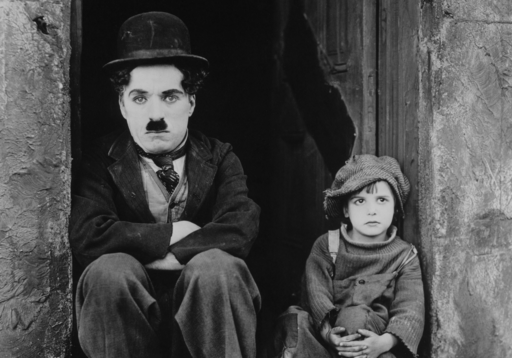
Question: Where Can You Watch 65 Charlie Chaplin Films Free Online?

free chaplin films

Answer: Why, in our col­lec­tion 65 Char­lie Chap­lin Films Free Online. Just did­n’t want you to for­get :)


If you would like to sign up for Open Culture’s free email newslet­ter, please find it here. It’s a great way to see our new posts, all bun­dled in one email, each day.

If you would like to sup­port the mis­sion of Open Cul­ture, con­sid­er mak­ing a dona­tion to our site. It’s hard to rely 100% on ads, and your con­tri­bu­tions will help us con­tin­ue pro­vid­ing the best free cul­tur­al and edu­ca­tion­al mate­ri­als to learn­ers every­where. You can con­tribute through Pay­Pal, Patre­on, and Ven­mo (@openculture). Thanks!

Monty Python’s John Cleese Worries That Political Correctness Will Lead Us into a Humorless World, Reminiscent of Orwell’s 1984

As with all of our polit­i­cal debates, those over “polit­i­cal cor­rect­ness” have become even more polar­ized, vit­ri­olic, and out­sized than when I was in col­lege at the height of the first cul­ture wars, when it often seemed to me like just new eti­quette for increas­ing­ly plu­ral­ist cam­pus­es and work­places. Now, peo­ple use the phrase to refer to any call for basic human decen­cy and intel­lec­tu­al honesty—and use it to dis­miss such calls out of hand. On the oth­er hand, many efforts at curb­ing or crit­i­ciz­ing cer­tain kinds of speech can seem gen­uine­ly, unnec­es­sar­i­ly, repres­sive. Whether it’s an illib­er­al col­lege group pres­sur­ing their uni­ver­si­ty to dis­in­vite enter­tain­ers or shut down debates, or fanat­i­cal gun­men threat­en­ing, and tak­ing, the lives of jour­nal­ists or blog­gers, the stakes over what can and can’t be said have grown expo­nen­tial­ly.

Have we reached a cri­sis of “Orwellian” pro­por­tions in the U.S.? I’d hes­i­tate to say so, giv­en the overuse and abuse of Orwell’s name and ideas as a catch-all for soci­etal dys­func­tion. We have ral­lies in which tens of thou­sands gath­er to cheer for the demo­niza­tion and slan­der of entire peo­ple groups. It hard­ly seems to me that anyone’s los­ing their free­dom of speech any time soon. But John Cleese in the Big Think video above makes an argu­ment about a par­tic­u­lar kind of polit­i­cal cor­rect­ness that he defines as “the idea that you have to be pro­tect­ed from any kind of uncom­fort­able emo­tion.” Describ­ing this kind of speech polic­ing as patho­log­i­cal, Cleese refers to a the­o­ry of a psy­chi­a­trist friend, Robin Skin­ner, that peo­ple who can’t con­trol their own emo­tions “have to start to con­trol oth­er people’s behav­ior.”

Cleese does­n’t blan­ket­ly impugn the motives of all activists for polit­i­cal­ly cor­rect speech. He notes a sim­i­lar tra­jec­to­ry as I have when it comes to col­lege cam­pus­es. “Polit­i­cal cor­rect­ness,” he says, “has been tak­en from being a good idea, which is ‘let’s not be mean, and par­tic­u­lar­ly to peo­ple who are not able to look after them­selves very well,’ to the point where any kind of crit­i­cism of any indi­vid­ual or group can be labeled cru­el.” Per­haps he’s right. (And Cleese is by no means the first com­ic to say so—and to swear off col­lege cam­pus­es.) In any case, his obser­va­tions about the nec­es­sary rela­tion­ship of com­e­dy to crit­i­cism or offense are dead on, as well as his con­clu­sion that once the humor’s gone, so “goes a sense of pro­por­tion, and… you’re liv­ing in 1984.” I can’t think of a book, or a soci­ety, with less humor in it.

One point of inter­est: Polit­i­cal Cor­rect­ness means a great many things to a great many peo­ple. For some it is about agency and self-deter­mi­na­tion, and right­ing his­tor­i­cal wrongs so as not to per­pet­u­ate them in the present. For oth­ers, it tends more toward a patron­iz­ing activist cru­sade on behalf, as Cleese says in his def­i­n­i­tion of the term, of “peo­ple who are not able to look after them­selves.” While he calls a lit­tle of this lat­ter atti­tude a good thing, George Car­lin saw it as con­de­scend­ing and disin­gen­u­ous. By no means a respecter of any par­ty ide­ol­o­gy, Car­lin described even seem­ing­ly innocu­ous forms of polit­i­cal­ly cor­rect lan­guage as fas­cism mas­querad­ing as man­ners.

In my expe­ri­ence, few peo­ple can make argu­ments against polit­i­cal­ly cor­rect lan­guage with­out occa­sion­al­ly falling into the trap of prov­ing its point. But Car­lin and Cleese make thought­ful cas­es, espe­cial­ly when they use humor—as Car­lin did over an entire career of rail­ing against the speech police. In his bit above on the increas­ing insis­tence on ungain­ly euphemisms and puffed-up jar­gon, he demon­strates what Cleese calls the effec­tive anti­dote to a polit­i­cal move­ment run riot: a sense of proportion—as well as a sense of com­pas­sion.

Relat­ed Con­tent:

Slavoj Žižek Calls Polit­i­cal Cor­rect­ness a Form of “Mod­ern Total­i­tar­i­an­ism”

John Cleese on How “Stu­pid Peo­ple Have No Idea How Stu­pid They Are” (a.k.a. the Dun­ning-Kruger Effect)

What “Orwellian” Real­ly Means: An Ani­mat­ed Les­son About the Use & Abuse of the Term

Josh Jones is a writer and musi­cian based in Durham, NC. Fol­low him at @jdmagness

Recalling Albert Camus’ Fashion Advice, Noam Chomsky Pans Glenn Greenwald’s Shiny, Purple Tie

chomsky fashion advice

70 years ago this month, Albert Camus made his first and only trip to the Unit­ed States, briefly vis­it­ing Philadel­phia and Boston, but most­ly stay­ing in New York, the city that cap­ti­vat­ed him most. As Jen­nifer Schuessler writes in The New York Times, Camus did­n’t quite know what to make of the city’s “swarm­ing lights” and “fran­tic streets.” But he had to appre­ci­ate the warmth with which he was greet­ed. Dur­ing his 1946 stay, Camus cel­e­brat­ed the Eng­lish pub­li­ca­tion of The Stranger on the rooftop of the Hotel Astor. He sat down for an inter­view with The New York­er and gave a mem­o­rable speech at Colum­bia Uni­ver­si­ty. He also became a fash­ion crit­ic for a brief moment, offer­ing this thought on Amer­i­can neck­ties: “You have to see it to believe it. So much bad taste hard­ly seems imag­in­able.”

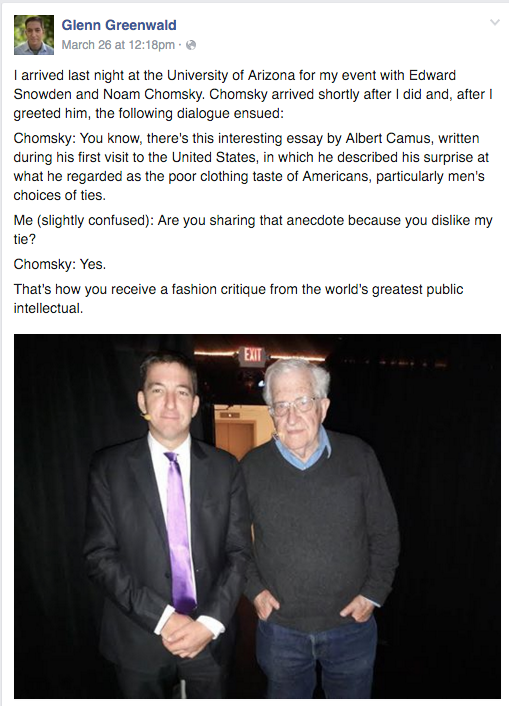
All of this sets up a lit­tle joke deliv­ered this week­end by Noam Chom­sky, as recalled on Face­book by jour­nal­ist Glenn Green­wald. Green­wald writes:

I arrived last night at the Uni­ver­si­ty of Ari­zona for my event with Edward Snow­den and Noam Chom­sky. Chom­sky arrived short­ly after I did and, after I greet­ed him, the fol­low­ing dia­logue ensued:

Chom­sky: You know, there’s this inter­est­ing essay by Albert Camus, writ­ten dur­ing his first vis­it to the Unit­ed States, in which he described his sur­prise at what he regard­ed as the poor cloth­ing taste of Amer­i­cans, par­tic­u­lar­ly men’s choic­es of ties.

Me (slight­ly con­fused): Are you shar­ing that anec­dote because you dis­like my tie?

Chom­sky: Yes.

That’s how you receive a fash­ion cri­tique from the world’s great­est pub­lic intel­lec­tu­al.

Ouch.

Note: The 70th anniver­sary of Camus’s trip to New York is being com­mem­o­rat­ed in “Camus: A Stranger in the City,” a month­long fes­ti­val of per­for­mances, read­ings, film screen­ings and events. If you’re in NYC, check it out. The full pro­gram is here.

via Crit­i­cal The­o­ry

Relat­ed Con­tent:

Albert Camus: The Mad­ness of Sin­cer­i­ty — 1997 Doc­u­men­tary Revis­its the Philosopher’s Life & Work

Sartre Writes a Trib­ute to Camus After His Friend-Turned-Rival Dies in a Trag­ic Car Crash: “There Is an Unbear­able Absur­di­ty in His Death”

Get to Know Socrates, Camus, Kierkegaard & Oth­er Great Philoso­phers with the BBC’s Intel­li­gent Radio Show, In Our Time

by | Permalink | Make a Comment ( 4 ) |

Peter Sellers Recites The Beatles’ “A Hard Day’s Night” in the Style of Shakespeare’s Richard III

“Now is the win­ter of our dis­con­tent….” If you know noth­ing else of Shakespeare’s Richard III, you’ll know this famous open­ing line, and it’s like­ly many of us know it through Lau­rence Olivier’s per­for­mance of Richard as a “melo­dra­mat­ic bad­die” in the famous 1955 film. If not, take a look at the clip below to famil­iar­ize your­self with Olivier’s dis­tinc­tive man­ner­isms and speech. The ref­er­ence may large­ly be lost these days, but in 1965, at the very height of The Bea­t­les’ fame, Olivier’s per­for­mance was still fresh in the minds of the TV view­ing pub­lic. And the mer­cu­r­ial Eng­lish come­di­an Peter Sell­ers put it to good use in a Bea­t­les-trib­ute vari­ety pro­gram called The Music of Lennon and McCart­ney that aired in the UK. In the clip above, Sell­ers recites the lyrics to “A Hard Day’s Night” in char­ac­ter as Olivier’s dandy­ish Richard.

Unsur­pris­ing­ly, Sell­ers and the Bea­t­les had hit it off right away when they were intro­duced by George Mar­tin, and as we showed you in a recent post, the come­di­an milked their lyrics for more mate­r­i­al, read­ing “She Loves You,” in a vari­ety of accents. Sell­ers’ ren­di­tion of “A Hard Day’s Night” was hard­ly the first Shake­speare­an turn for the band.

The pre­vi­ous year, they appeared in anoth­er vari­ety tele­vi­sion spe­cial called Around the Bea­t­les, “pro­duced con­cur­rent­ly,” writes Dan­ger­ous Minds, “while A Hard Day’s Night was being shot.” (Around the Bea­t­les was direct­ed by pro­duc­er and man­ag­er Jack Good, a “Shake­speare fan,” who also, it turns out, con­vinced rock­a­bil­ly star Gene Vin­cent to dress up like Richard III.) In this ear­li­er pro­gram, the band—always good sports about this kind of thing—dressed up in Shake­speare­an garb and staged a rau­cous per­for­mance of a scene from A Mid­sum­mer Night’s Dream.

Relat­ed Con­tent:

Peter Sell­ers Reads The Bea­t­les’ “She Loves You” in 4 Dif­fer­ent Accents: Dr. Strangelove, Cock­ney, Irish & Upper Crust

The Bea­t­les Sat­ur­day Morn­ing Car­toon Show: The Com­plete 1965–1969 Series

The 15 Worst Cov­ers of Bea­t­les Songs: William Shat­ner, Bill Cos­by, Tiny Tim, Sean Con­nery & Your Excel­lent Picks

Josh Jones is a writer and musi­cian based in Durham, NC. Fol­low him at @jdmagness

How to Sound Smart in a TED Talk: A Funny Primer by Saturday Night Live’s Will Stephen

Is there any sub­ject that can’t be cov­ered in a TED Talk?

Appar­ent­ly not. You can make a TED Talk about any­thing, even noth­ing, as vet­er­an impro­vis­er and rook­ie Sat­ur­day Night Live writer, Will Stephen, demon­strat­ed at a recent TEDx event in New York City.

What you shouldn’t do is devi­ate from TED’s estab­lished pre­sen­ta­tion tropes. Stephen may be punk­ing us with his How to Sound Smart in Your TEDx Talk, above, but aspi­rant TED speak­ers should take notes. One can’t prac­tice obser­va­tion­al humor with­out being a keen observ­er. Stephen’s insights are as good a play­book as any for that unmis­take­able TED-style deliv­ery:

Use your hands.

Engage the audi­ence by ask­ing them a ques­tion that will result in a show of hands…

By show of hands, how many of you have been asked a ques­tion before?

Hit ‘em with an endear­ing, per­son­al anec­dote.

Pro­jec­tions will enhance your cred­i­bil­i­ty.

Replay the clip with the sound down, as Stephen sug­gests, and it’s still obvi­ous what he’s doing — giv­ing a TED Talk.  (The famil­iar cam­era work and edit­ing don’t hurt either.)

Even if you’re not plan­ning on nom­i­nat­ing your­self to become a TED speak­er in the near future, Stephen’s les­son should prove handy next time you’re called upon to do some pub­lic speak­ing, whether run­ning for Pres­i­dent or deliv­er­ing the toast at your best friend’s wed­ding.

And noth­ing is cer­tain­ly not the only top­ic of sub­stance upon which Stephen can dis­course. Wit­ness his Tin­der Strat­e­gy Pow­er­point.

Hmm, maybe there are some TED-proof sub­jects  after all…

via Boing­Bo­ing

Relat­ed Con­tent:

Ben­jamin Brat­ton Explains “What’s Wrong with TED Talks?” and Why They’re a “Recipe for Civ­i­liza­tion­al Dis­as­ter”

1756 TED Talks List­ed in a Neat Spread­sheet

Your Favorite TED Talk Ever?

Ayun Hal­l­i­day is an author, illus­tra­tor, and Chief Pri­ma­tol­o­gist of the East Vil­lage Inky zine. Fol­low her @AyunHalliday

Peter Sellers Reads The Beatles’ “She Loves You” in 4 Different Accents: Dr. Strangelove, Cockney, Irish & Upper Crust

Back in the late 1950s, George Mar­tin (may he rest in peace) began his career as a pro­duc­er record­ing two albums with the come­di­an Peter Sell­ersThe Best Of Sell­ers and Songs for Swing­ing Sell­ers. When he joined forces with the Bea­t­les a few years lat­er, Mar­tin put the come­di­an in touch with the lads from Liv­er­pool, and they became fast friends. This rela­tion­ship paved the way for some good com­e­dy. As you might recall, Sell­ers made a cameo appear­ance on “The Music of Lennon and McCart­ney” in 1964, and read “A Hard Day’s Night” in a way that com­i­cal­ly recalls Lau­rence Olivier’s 1955 per­for­mance in Richard III. (Watch the spoof here.) And then, also dur­ing the mid 60s, Sell­ers record­ed a com­ic read­ing of “She Loves You” — once in the voice of Dr. Strangelove (above), again with cock­ney and upper-crusty accents (both right below), and final­ly with an Irish twist (the last item). The record­ings were all released posthu­mous­ly between 1981 and 1983 on albums no longer in cir­cu­la­tion. Sell­ers clear­ly had a thing for accents. Here you can also explore his Com­plete Guide to the Accents of the British Isles.

Cock­ney

Upper Crust

Irish

A ver­sion of this post first appeared on Open Cul­ture in Feb­ru­ary, 2012.

If you would like to sign up for Open Culture’s free email newslet­ter, please find it here. It’s a great way to see our new posts, all bun­dled in one email, each day.

If you would like to sup­port the mis­sion of Open Cul­ture, con­sid­er mak­ing a dona­tion to our site. It’s hard to rely 100% on ads, and your con­tri­bu­tions will help us con­tin­ue pro­vid­ing the best free cul­tur­al and edu­ca­tion­al mate­ri­als to learn­ers every­where. You can con­tribute through Pay­Pal, Patre­on, and Ven­mo (@openculture). Thanks!

Relat­ed Con­tent:

Peter Sell­ers Per­forms The Bea­t­les “A Hard Day’s Night” in Shake­speare­an Voice

Here Comes The Sun: The Lost Gui­tar Solo by George Har­ri­son

Gui­tarist Randy Bach­man Demys­ti­fies the Open­ing Chord of ‘A Hard Day’s Night’

Hear the Unique, Orig­i­nal Com­po­si­tions of George Mar­tin, Beloved Bea­t­les Pro­duc­er (RIP)

Peter Sell­ers Presents The Com­plete Guide To Accents of The British Isles

by | Permalink | Make a Comment ( 1 ) |

Hear 30 of the Greatest Standup Comedy Albums: A Playlist Chosen by Open Culture Readers

I knew such things as com­e­dy albums exist­ed. I’d spied a cou­ple of them in my par­en­t’s record col­lec­tion. But they seemed like such quaint and dat­ed things. After all, I’d grown up on Eddie Mur­phy’s scan­dalous HBO spe­cials, had seen George Car­lin and Richard Pry­or pace the stage deliv­er­ing epic com­ic com­men­tary. I had imbibed a steady stream of standup and sketch­es on Com­e­dy Cen­tral. What need had I of a com­e­dy album?! The facial expres­sions, rare props, ridicu­lous out­fits… weren’t these visu­al cues nec­es­sary to car­ry the jokes?

Then I heard Lenny Bruce’s live dou­ble album from his 1961 con­cert at Carnegie Hall and flipped out (hear an excerpt above). I did­n’t know very much about Bruce at the time—not much more than the name. But after lis­ten­ing to that record enough times to mem­o­rize every line and inflec­tion, I became very inter­est­ed in how come­di­ans brought lis­ten­ers to tears of laugh­ter with only their voic­es. Bruce was a mas­ter. “Onstage,” writes Richard Brody, “he was a one-man car­toon, doing all the voic­es and pos­es of movie par­o­dies that he infused with his own strin­gent and para­dox­i­cal moral­i­ty.” So car­toon­ish was his act at times that one joke became an actu­al car­toon—“Thank You Mask Man,” a NSFW clas­sic.

Bruce’s act swung like a jazz per­for­mance, some­times hit­ting a blue note, and pulling his audi­ence down with a seri­ous scene, then ramp­ing right up into wild, nasal runs of high-pitched com­ic vir­tu­os­i­ty. Oth­er comics, like the dead­pan Bob Newhart, hard­ly ever var­ied their vol­ume, tem­po, and tone, and there­in lay the under­stat­ed appeal of Newhart’s “But­ton-Down Mind.” Then there are the char­ac­ters and impres­sions of Lily Tom­lin, the unhinged rants of Richard Pry­or, the scream­ing of Sam Kin­i­son, the nar­colep­tic drone of Steven Wright, the child­like war­ble of Emo Philips… Every com­ic uses his or her voice as an instru­ment, tap­ping into the audi­ence’s musi­cal sense of rhythm and tim­ing as much as their intel­lec­tu­al sense of irony and absur­di­ty.

Today, we bring you a playlist of 30+ standup com­e­dy albums, rang­ing from cur­rent com­ic mas­ters like Amy Schumer, Tig Notaro, and Louis C.K. to beloved comics from decades past like Gil­da Rad­ner and Bill Hicks. (You can pur­chase copies of these clas­sic albums here.) We’ve got the famous duo of Mel Brooks and Carl Rein­er (yes, they do “2000 Year Old Man”), we’ve got Richard Pry­or, George Car­lin, Steve Mar­tin, Robin Williams, and even… hell, why not? Andrew Dice Clay. And Lenny Bruce’s Carnegie Hall Con­cert made the cut as well, an absolute must-hear. Most of these picks were cho­sen by Open Cul­ture read­ers on Twit­ter, with a few tak­en from this Spin list of the “40 Great­est Com­e­dy Albums of All Time.” If there’s an album you think we absolute­ly have to add to the playlist above, let us know in the com­ments. If you don’t have Spo­ti­fy, down­load it free here. And if you object to using the ser­vice, why not pre­view some of these, then go buy the ones that crack you up the hard­est? All of the albums on the playlist can be found on Ama­zon here.

Relat­ed Con­tent:

Lenny Bruce: Hear the Per­for­mances That Got Him Arrest­ed (NSFW)

Richard Pry­or Does Ear­ly Stand-Up Com­e­dy Rou­tine in New York, 1964

Sein­feld, Louis C.K., Chris Rock, and Ricky Ger­vais Dis­sect the Craft of Com­e­dy (NSFW)

Josh Jones is a writer and musi­cian based in Durham, NC. Fol­low him at @jdmagness

27 Movies References in The Simpsons Put Side-by-Side with the Movie Scenes They Paid Tribute To

If an entire gen­er­a­tion of Amer­i­can adults suf­fers from Cin­e­mat­ic Chick­en Vs. Egg Syn­drome, it’s The Simp­sons’ fault.

Edi­tor Celia Gómez’ side-by-side shot com­par­i­son above makes plain how a 30-year-old Cit­i­zen Kane vir­gin could expe­ri­ence a sense of deja vu on his or her inau­gur­al view­ing. The Simp­sons pulled from it for “Two Cars in Every Garage and Three Eyes on Every Fish” when said view­er was but a lit­tle tot. Three years lat­er, they did it again wit 1993’s “Rose­bud.”

Par­ents who would nev­er have allowed their sen­si­tive lit­tle dar­lings in the room while screen­ing Full Met­al Jack­et or Requiem for a Dream relaxed their vig­i­lance where the fam­i­ly from Spring­field was con­cerned.

When The Simp­sons’ kilt­ed Groundskeep­er Willie chaste­ly recross­es his legs in an inter­ro­ga­tion room, no kid is going to fix­ate on what lies beneath. (FYI, it’s a noto­ri­ous­ly com­man­do Sharon Stone in 1992’s NSFW thriller, Basic Instinct.)

What makes these homages so great is the atten­tion to detail. Be it Itchy and Scratchy or Michael Mad­sen and Kirk Baltz as his cop vic­tim in Reser­voir Dogs, count on the cam­era to drift to an emp­ty door­way when the action gets too intense.

Spoil­ers abound. Those who’ve not yet seen Thel­ma and Louise, Psy­cho, or One Flew Over the Cuckoo’s Nest can con­sid­er them­selves fore­warned.

Want a crash course in The God­fa­ther? Watch the Simp­sons.

No offense to the human actors who orig­i­nat­ed the roles, but it’s incred­i­ble how the ani­ma­tors can imbue their char­ac­ters with all the rel­e­vant emo­tions. Their eyes are lit­tle more than dots on ping­pong balls! (Check out Homer’s dead expres­sion on 1994’s Ter­mi­na­tor 2  par­o­dy, “Homer Loves Flan­ders.”)

The com­plete list of films fea­tured above:

Bram Stok­er’s Drac­u­la (1992)

A Clock­work Orange (1971)

Pulp Fic­tion (1994)

Requiem for a dream (2000)

The Gold Rush (1925)

Full Met­al Jack­et (1987)

The Fugi­tive (1993)

Ter­mi­na­tor 2 (1991)

Reser­voir Dogs (1992)

The Birds (1963)

Risky Busi­ness (1983)

Cit­i­zen Kane (1941)

Psy­cho (1960)

The silence of the lambs (1991)

Raiders of the Lost Ark (1981)

Basic Instinct (1992)

Offi­cial and Gen­tle­man (1982)

One flew over the cuck­oo’s nest (1975)

2001: A space Odis­sey (1968)

Trainspot­ting (1996)

Thel­ma and Louise (1991)

The God­fa­ther (1972)

Taxi Dri­ver (1976)

The Shin­ing (1980)

Spi­der­man (2002)

ET the Extra-Ter­res­tri­al (1982)

Dr. Strange Love (1964)

Relat­ed Con­tent:

The Simp­sons Present Edgar Allan Poe’s “The Raven,” and Teach­ers Now Use It to Teach Kids the Joys of Lit­er­a­ture

The Simp­sons Pay Won­der­ful Trib­ute to the Ani­me of Hayao Miyaza­ki

Thomas Pyn­chon Edits His Lines on The Simp­sons: “Homer is my role mod­el and I can’t speak ill of him.”

Ayun Hal­l­i­day is an author, illus­tra­tor, and Chief Pri­ma­tol­o­gist of the East Vil­lage Inky zine. Fol­low her @AyunHalliday

« Go BackMore in this category... »
Quantcast