Back in 2011, Adam Mansbach and Ricardo Cortés published the mock children’s book, Go the F**k to Sleep. And it gained national attention when pirated PDF copies circulated on the internet, and a reading by Werner Herzog made the rounds on YouTube, both of which turned the book into a #1 bestseller on Amazon. Now, three years later, Mansbach is back with a sequel, You Have to F–king Eat. The print edition went on sale today, and, even better, the audio edition, narrated by Breaking Bad star Bryan Cranston, can be downloaded for free over at Audible.com. The irreverent, 4‑minute NSFW reading will remain free through 12/12/14. You can hear a sample above.
Ricky Gervais’s first brush with fame, at least on the other side of the pond, was as the front man of the ‘80s synch pop band Seona Dancing. If you watch the music video below of the band’s near-hit “Bitter Heart” from 1983, you can see a skinnier, svelter Gervais with over-moussed hair crooning like he was David Bowie. He indeed does sounds a bit like Bowie. He moves like Bowie. And if you squint your eyes, you can almost convince yourself that Gervais even looks like Bowie (or the lead singer of A‑ha).
Seona Dancing folded in 1984 because they ultimately failed to crack the Top 40. So after drifting around the music industry, Gervais turned to comedy. But that didn’t mean that he forgot about Bowie. Before he struck fame and fortune with The Office, he made a one-off show called Golden Years in 1998. He played Clive Meadows, an oblivious, Bowie-obsessed corporate middle manager who prepares for an appearance on the British talent series Stars In Their Eyes by dressing up as the rock star during his Aladdin Sane period, complete with satin pants, red wig and lightning bolt face paint.
Not long after The Office premiered, Gervais got a chance to meet his idol when the BBC invited him to a concert. “David Bowie has been a hero of mine for 25 years,” he told the Daily Mirror. “He is quite special and you meet him and you think he is going to come out of some weird tube and say ‘hello, I’m a space boy’. But he doesn’t, he says ‘hello I’m David’.” Of course, when Gervais was introduced, Bowie had no idea who he was.
Then a few weeks later, Gervais received an email from Bowie, who clearly caught up on his TV viewing. “So I watched that Office. I laughed. What do I do now?”
That sparked a friendship between the two. As Gervais recounted in an interview in GQ Magazine:
I remember, I think, the first time that I knew him when it was his birthday, I sent him an e‑mail that said “57???? Isn’t it about time that you got a proper job? Ricky Gervais, 42, comedian.” He sent back: “I have a proper job. David Bowie, 57, Rock God.”
Their relationship culminated in a guest appearance on Gervais’s HBO series Extras. In the episode, which you can watch above, Gervais plays Andy Millman, an oblivious, desperate movie extra looking to break into the big time. When he annoys Bowie, playing himself, at a posh bar with his self-absorbed whining, the rock star turns to a piano and starts to toss off a damning, but catchy, little ditty on the spot about Gervais called “Little Fat Man.” (Lyrics include: ““Pathetic little fat man / No one’s bloody laughing / The clown that no one laughs at / They all just wish he’d die”)
While making the episode, he and Bowie worked together on making the song:
“Have you got the lyrics?” and he went, “Yeah.” I said, “Can you do something quite retro, like ‘Life on Mars’?” And he went [deadpan], “Oh, of course, yeah, sure. I’ll knock off a quick ‘Life on Mars,’ shall I?”
Jonathan Crow is a Los Angeles-based writer and filmmaker whose work has appeared in Yahoo!, The Hollywood Reporter, and other publications. You can follow him at @jonccrow. And check out his blog Veeptopus, featuring lots of pictures of vice presidents with octopuses on their heads. The Veeptopus store is here.
The result isNixon’s The One, a fly-on-the-wall web series in which virtuoso improviser Shearer sticks scrupulously to the script, recreating every pause and awkward chuckle. Compare Shearer’s lead up to Nixon’s televised resignation above, to the real thing, below.
It’s uncomfortable, uncanny, dissociative, and strangely human.
The only false note is Shearer’s glaringly obvious prosthetic nose, though given the professional, period-accurate set, this may have been a deliberate choice. Despite his insistence on authenticity, a biopic is clearly not what creator Shearer had in mind.
He’s been in training for this project for close to half a century, long before the idea itself was hatched. His first turn as Nixon came as a young, make-up free member of the L.A. comedy group, the Credibility Gap.
The next was on Sunday Best, a 1991 mid-season replacement on NBC. “I did a sketch I don’t think ever aired,” he told the Wall Street Journal, “Nixon as a guest on an infomercial demonstrating a magical teeth-whitening preparation.”
Le Show, Shearer’s extremely funny radio show, provided a forum for yet another ridiculous exercise at Tricky Dick’s expense.
The one-time political science major has elected to play it straight with this verbatim, long form labor of love, in order let the weird, unintentional comedy of Richard Nixon shine through. Find all the videos in the Nixon’s the One series here.
Ayun Halliday is an author, homeschooler, and Chief Primatologist of the East Village Inky zine. She embarrassed her parents on a childhood tour of the Nixon White House uncharacteristically boisterous demands to see Tricky Dick and a queasy stomach that healed itself in time for a visit to a Lafayette Square hot dog vendor. Follow her @AyunHalliday
Lenny Bruce: what comedian today — or countercultural public speaker of any kind — doesn’t name him as an influence? But history has remembered the cutting-edge funnyman of the 1940s, 50s, and 60s as not just an influential figure, but something of a martyr to that quintessentially American cause of free speech. One need only read the story of Bruce’s many legal troubles, a succinct version of which you can find at The Trials of Lenny Bruce Homepage, to understand that the authorities of the mid-20th century interpreted that cause quite differently than we do now. Doug Linder, the author of that piece, describes Bruce’s fall from the peak of his career — a 1959 appearance on national television (introduced by Steve Allen as “the most shocking comedian of our time, a young man who is skyrocketing to fame”), a packed house at Carnegie Hall two years later — to his early death, five years on, after the ravages of bankruptcy, drugs, and courtrooms.
What happened to this promising comedic luminary? All too many comedians flame out due to addiction and financial issues, but Bruce had the considerable burden of running afoul, again and again, of “obscenity” laws: at a San Francisco jazz club, at West Hollywood’s famous Troubadour, at Los Angeles’ Unicorn, in Chicago, and so on. Bruce may have thought himself safe in the comparatively un-Puritan setting of Greenwich Village, but even there, on the fateful night of March 31, 1964, a CIA agent sat in the audience of one of his performances and diligently collected evidence against him. An arrest, arduous, high-profile trial, and conviction followed. Though New York’s highest court would reverse this conviction in 1970, the damage had long since been done, and Bruce himself had died four years earlier.
You can hear the daring material that condemned Bruce above, from the out-of-print album What I Was Arrested For: The Performances that Got Lenny Bruce Busted. (His routine “To Is a Preposition; Come Is a Verb,” which especially ticked off the investigators, appears just above.) Fifty years after the trial, would any of this “obscene, indecent, immoral, and impure drama, play, exhibition, or entertainment,” as the law says, “tend to the corruption of the morals of youth and others”? As All Music Guide’s Sean Carruthers writes of the album, which first came out in 1969 and again in 1975, “It’s amazing what just a few years can accomplish in terms of changing social values — by the time this was re-released, there wasn’t really a whole lot here that would get people too upset.” And so, in perhaps the most telling testament to the ultimate victory of Lenny Bruce, that 20th-century Socrates, the world has become safe for any one of us to publicly utter words like — well, better to hear them straight from the sage of obscenity’s mouth, right?
Apparently, the bad part about scoring an interview with the President is it kind of makes you blasé for sitting down with anybody else. Not that Zach Galifianakis of Between Two Ferns deserved his tete-a-tete with Obama, or for that matter Bart Pit … Bradley Pitts … Brad Pitt, star of 2013’s 12 Years a Salve(sic).
Yes, this interviewer is petty, combative, and utterly lacking in grace, but his interviewee, the celebrity who turns stone-faced and sullen almost immediately is no prize either.
Everyone’s miserable, even comedian Louis CK, whom Galifianakis summons with a few bars of his popular sitcom’s theme song. Moods seem on the verge of lifting when Galifianakis brings up Pitts’ starring role in “Benjamin Buttons,” but it doesn’t last. Inevitably, there are references to Pitt’s famous wife, as well as his ex, an earlier Between Two Ferns guest. (She’s no Tila Tequila…)
This is a different dynamic than the one Borat shared with certain incredulous, intelligent subjects. It’s a given that Pitt’s in on the joke. And it would seem that both gentlemen have something they’d like to get across regarding the dirty business of celebrity interviews.
The game is you listen politely while they plug their film, bang on about their ‘method’, the brilliance of their co-stars and directors etc. Then in return you hope they will offer up — without you having to prod and pester like some celebrity stalker — the tiniest nugget of anecdote, a shard of light upon their real selves.
Because they hate the game too, and particularly since it is mainly conducted in hotel suites, you feel as if you’re engaged in an odd form of prostitution, one where it remains unclear who is the hooker and who the john.
Her perspective brings a certain purity to the Galifianakis-Pitt Ferns stand-off. Certainly, neither of them is playing the game.
If you want to learn how to conduct a horrible interview, watch Galifianakis.
If you want tips on how to make it worse, watch Pitt.
And if you want to be a movie star, seek ways to laugh at yourself without breaking character.
“I do the show in character, he’s an idiot, he’s willfully ignorant of what you know and care about, please honestly disabuse me of my ignorance and we’ll have a great time.”
This secret speaks to the heart of comedian and fake-pundit Stephen Colbert’s wildly popular Colbert Report. But how exactly does he manage to pull this rabbit from his hat, night after night grueling night?
The nuts and bolts of Colbert’s working day make for a fascinating inaugural episode of Working, a new Slate podcast hosted by David Plotz. It shares a title with radio personality Studs Terkel’s famous non-fictional examination, but Plotz’s project is more process oriented. Soup-to-nuts-and-bolts, if you will.
Colbert is happy to oblige with a Little Red Hen-like corn metaphor in which alcohol, not bread, is the ultimate goal.
His morning begins with a deep rummage through the headlines—Google News, Reddit, Slate, The Drudge Report, Fox News, Buzzfeed, The Huffington Post… imagine if this stack was made of paper. When does he have the time to google ex-girlfriends?
From pitch meeting through read-aloud and rewrites, the school hours portion of Colbert’s day resembles that of other deadline-driven shows. He’s quick to acknowledge the contributions of a dedicated and like-minded staff, including executive producer Tom Purcell and head writer Opus—as in Bloom County—Moreschi.
As showtime approaches, Colbert swaps his jeans for a Brooks Brothers suit, and leaves the homey, dog-friendly townhouse where the bulk of the writing takes place for the studio next door.
Ideally, he’ll get at least 10 minutes of headspace to become the monster of his own making, liberal America’s favorite willfully ignorant idiot. (Most of liberal America, anyway. My late-mother-in-law refused to believe it was an act, but it is.)
A bit of schtick with the makeup artist serves as a litmus test for audience responsiveness.
When the cameras roll, Colbert sticks close to his prompter, further proof that the character is a construct. Any improvisational impulses are unleashed during one-on-one interactions with the guest. With some 10,000 hours of comedy under his belt, his instincts tend toward the unerring.
At days end, he thanks the audience, the guest and everyone backstage except for one guy who gets a mere wave. The show is then edited at a zip squeal pace, and will hopefully fall into the “yay!” category. (The other choices are “solid” or “wrench to the head.”)
Colbert will only watch the show if there was a problem.
And then? The day begins again.
After peering through this window onto Colbert’s world, we’re stoked for future episodes of Working, when guests as varied as a rock musician, a hospice nurse, and porn star Jessica Drake walk Plotz through a typical day.
Ten years in academia gave me a healthy dislike of clichéd jargon, as well as an appreciation for jokes about it. There are a few, like the academic sentence generator and Ph.D. Comics, that capture a bit of what it’s like to go to school and work in higher ed. Corporate drones, of course, have Office Space and Dilbert. But what about the spooks, those nameless, faceless agents who work tirelessly away in the basement of Langley, doing who knows what to whom? Where does the C.I.A. go to laugh at its peculiar brand of hackneyed doublespeak? Not that we were supposed to know this, but perhaps many of them turn to an article called “the Bestiary of Intelligence Writing” in a 1982 copy of internal agency newsletter Studies in Intelligence.
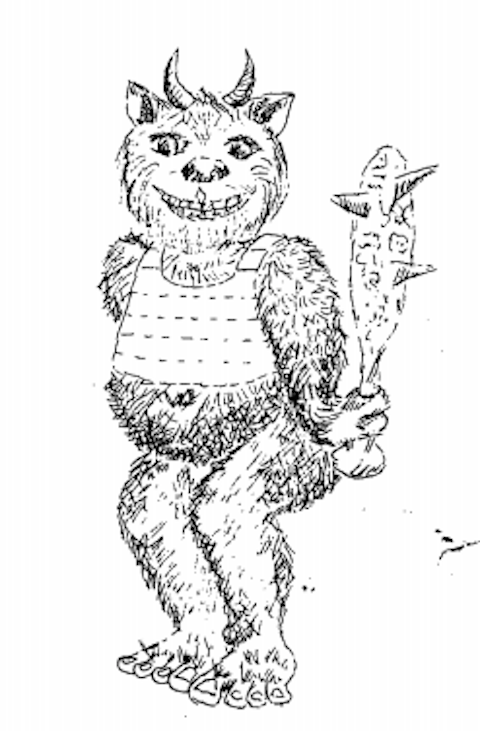
Medium describes this odd piece as a “zoo of fictional fauna,” and like that strange literary form, the medieval European bestiary (often a source of satire and critique), this 17-page article, with footnotes, singles out the most offensive spook buzzwords as though they were cardinal sins—naming 15 members of “the Collection” in all, each one represented by its own Maurice Sendak-like pencil-drawn beast and a description of its habits. The two-headed beast at the top, Multidisciplinary Analysis, is a “hybrid—the fruit of the casual mating of standard forms of Analysis.” Just above, we have Heightened Tensions, “the adult form of Conventional Tensions—Tensions that have acquired stilts by thriving on a rich diet of poverty, malnutrition and especially alienation.” Sounds like rough work, this spy game….
Most of the beasts are cuddly enough, some mischievous, some perhaps deadly. Above, we have Dire Straits and below, Parameters. “The Agency author and artist detailed 15 monsters in all—complete with illustrations,” writes Medium, “Both of their names are redacted in the document. We’ll never know just which CIA agents turned their hand towards snarky political satire.” The document comes to us via a cache of records declassified in a lawsuit filed by former agency employee Jeffry Scudder. We do know that the two anonymous lampoonists were inspired by A Political Bestiary, book by James Kilpatrick, cartoonist Jeff MacNelly, and former senator and presidential candidate Eugene McCarthy. See the full, bone dry article here, and think about the work talk that might drive you to such creative extremes.
Neil Young has a new book out — Special Deluxe: A Memoir of Life & Cars — which means he’s doing a quick media blitz. Tuesday morning, Young paid a 90 minute visit to the Stern Show, where they talked about, well, everything: polio, the rift with David Crosby, how he writes his music, the time he spent with Charles Manson, what went wrong at Woodstock, what’s gone wrong with music (and how the PonoPlayer will fix it), and how we’re trashing the environment. Young takes the environment and politics seriously. No doubt. But he could also work it all into a good joke. Just witness his performance later that day with Stephen Colbert.
We're hoping to rely on loyal readers, rather than erratic ads. Please click the Donate button and support Open Culture. You can use Paypal, Venmo, Patreon, even Crypto! We thank you!
Open Culture scours the web for the best educational media. We find the free courses and audio books you need, the language lessons & educational videos you want, and plenty of enlightenment in between.