Flannery O’Connor’s Satirical Cartoons: 1942–1945

Sci-fi author B.C. Kowal­s­ki recent­ly post­ed a short essay on why the advice to write every day is, for lack of a suit­able euphemism, “bull­shit.” Not that there’s any­thing wrong with it, Kowal­s­ki main­tains. Only that it’s not the only way. It’s said Thack­er­ay wrote every morn­ing at dawn. Jack Ker­ouac wrote (and drank) in binges. Every writer finds some method in-between. The point is to “do what works for you” and to “exper­i­ment.” Kowal­s­ki might have added a third term: diver­si­fy. It’s worked for so many famous writ­ers after all. James Joyce had his music, Sylvia Plath her art, Hem­ing­way his machis­mo. Faulkn­er drew car­toons, as did his fel­low South­ern writer Flan­nery O’Connor, his equal, I’d say, in the art of the Amer­i­can grotesque. Through both writ­ers ran a deep vein of pes­simistic humor, oblique, but detectable, even in scenes of high­est pathos.


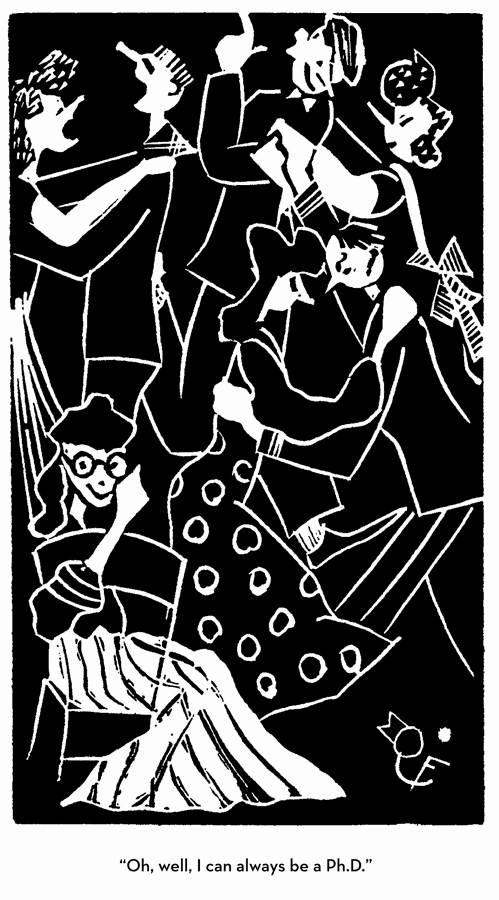
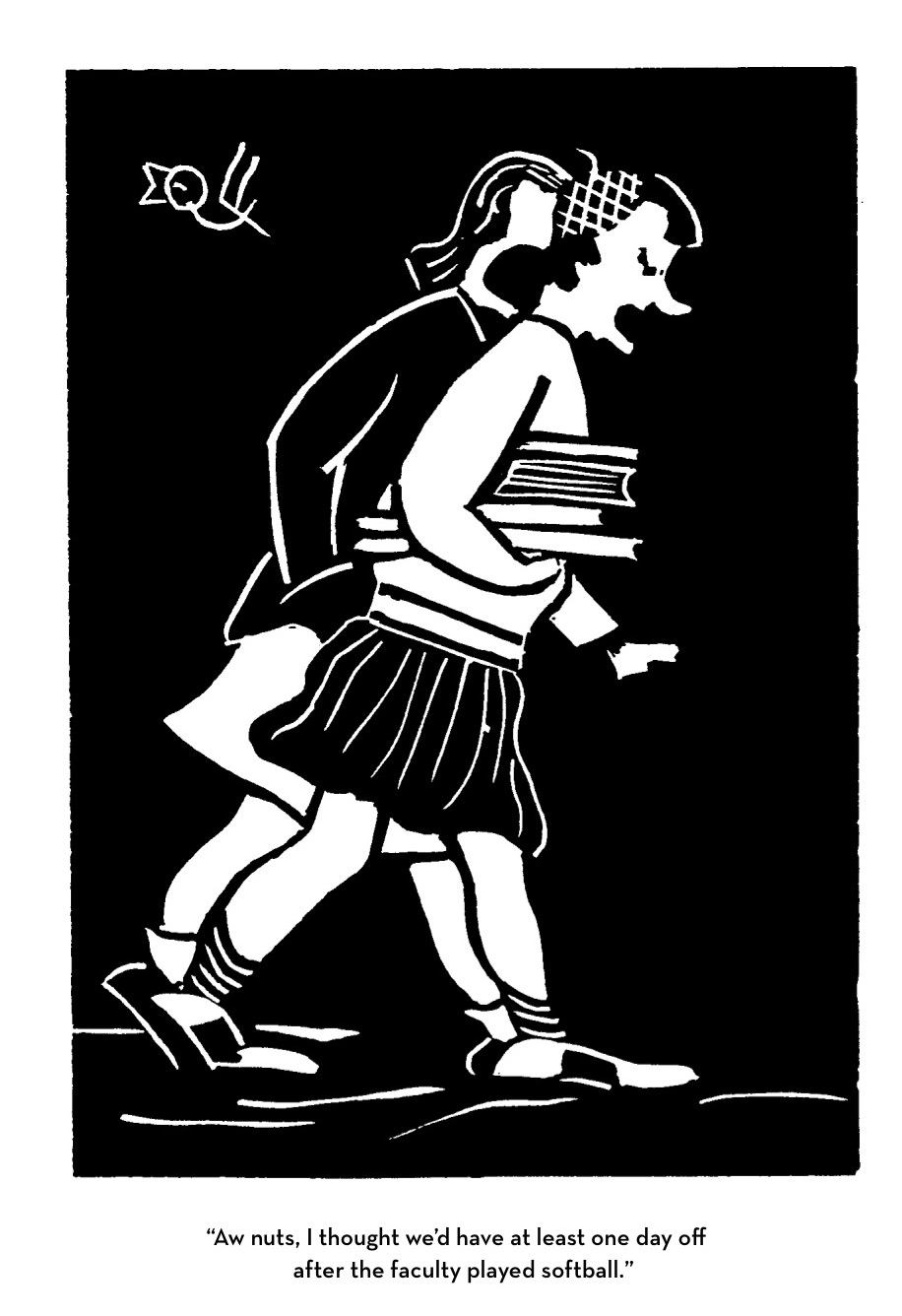
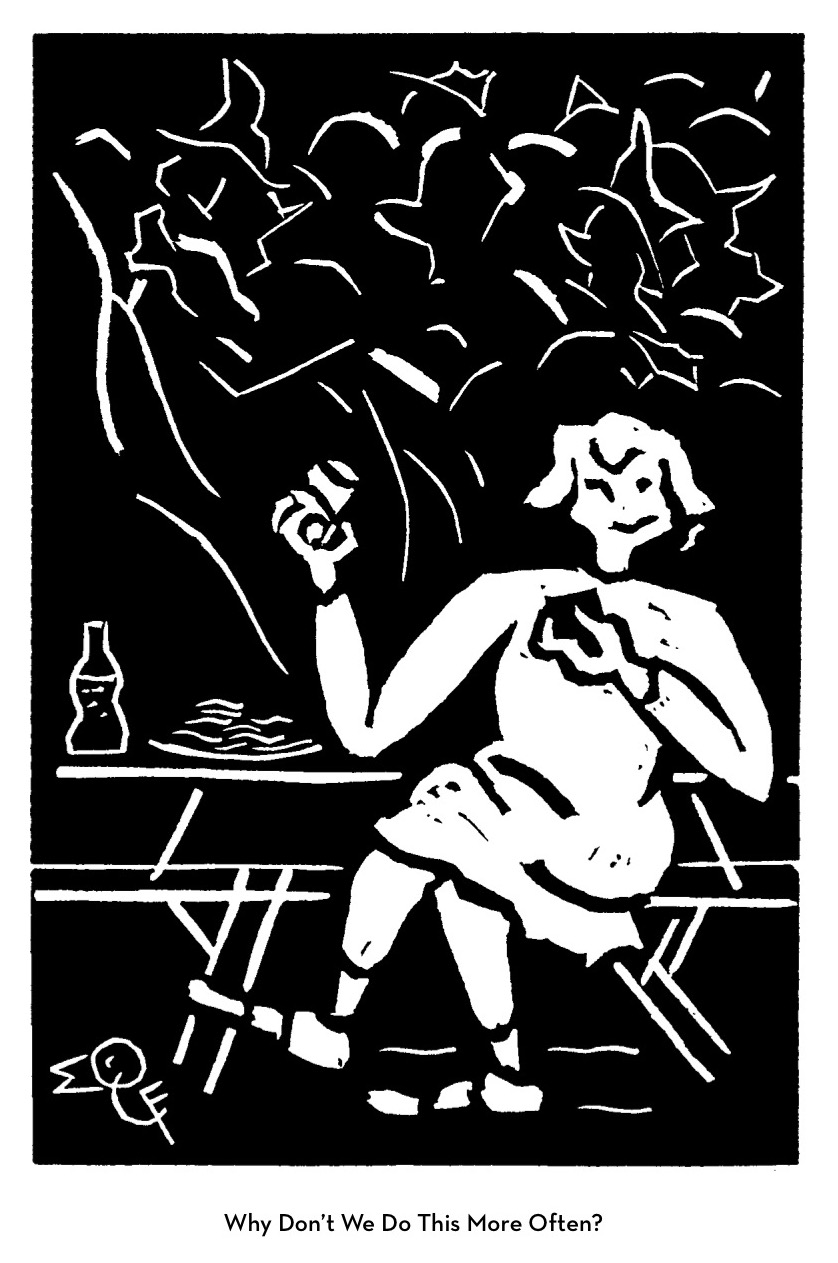
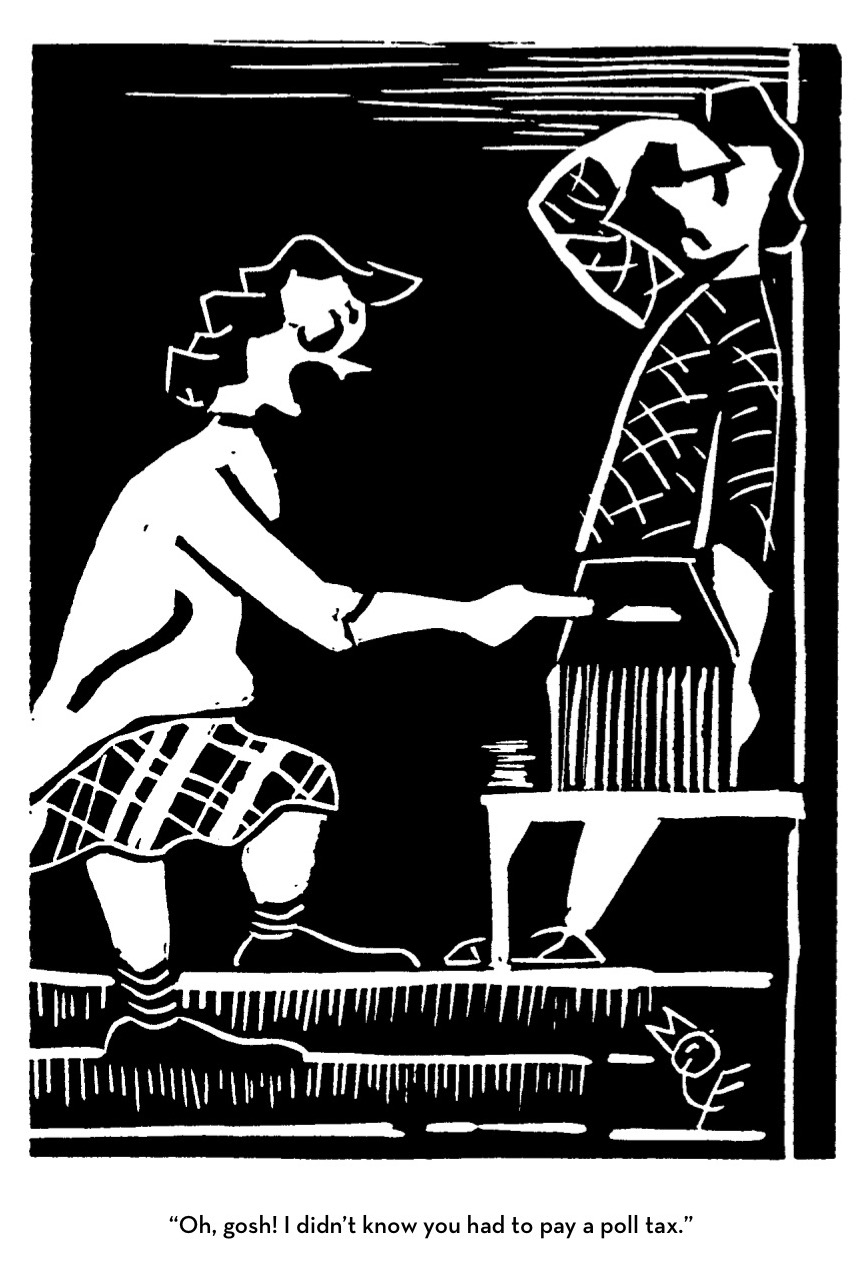
O’Connor’s visu­al work, writes Kel­ly Ger­ald in The Paris Review, was a “way of see­ing she described as part of the ‘habit of art’”—a way to train her fic­tion writer’s eye. Her car­toons hew close­ly to her autho­r­i­al voice: a lone sar­don­ic observ­er, supreme­ly con­fi­dent in her assess­ments of human weak­ness. Per­haps a bet­ter com­par­i­son than Faulkn­er is with British poet and doo­dler Ste­vie Smith, whose bleak vision and razor-sharp wit sim­i­lar­ly cut through moun­tains of… shall we say, bull­shit. In both pen & ink and linoleum cuts, O’Connor set dead­pan one-lin­ers against images of pre­ten­sion, con­for­mi­ty, and the banal­i­ty of col­lege life. In the car­toon at the top, she seems to mock the pur­suit of cre­den­tials as a refuge for the social­ly dis­af­fect­ed. Above, a cam­paign­er for a low-lev­el office deploys bom­bas­tic pseu­do-Lenin­ist rhetoric, and in the car­toon below, a cranky char­ac­ter escapes a horde of iden­ti­cal WAVES.

O’Connor was an intense­ly visu­al writer with, Ger­ald writes, a “nat­ur­al pro­cliv­i­ty for cap­tur­ing the humor­ous char­ac­ter of real peo­ple and con­crete sit­u­a­tions,” ful­ly cred­i­ble even at their most extreme (as in the increas­ing­ly hor­rif­ic self-lac­er­a­tions of Wise Blood’s Hazel Motes). She began draw­ing at five and pro­duced small books and sketch­es as a child, even­tu­al­ly pub­lish­ing car­toons in almost every issue of her high-school and college’s news­pa­pers and year­books. Her alma mater Geor­gia Col­lege, then known as Geor­gia State Col­lege for Women, has pub­lished a book fea­tur­ing her car­toons from her under­grad­u­ate years, 1942–45.

More recent­ly, Ger­ald edit­ed a col­lec­tion called Flan­nery O’Connor: The Car­toons for Fan­ta­graph­ics. In his intro­duc­tion, artist Bar­ry Moser describes in detail the tech­nique of her linoleum cuts, call­ing them “coarse in tech­ni­cal terms.” And yet, “her rudi­men­ta­ry han­dling of the medi­um notwith­stand­ing, O’Connor’s prints offer glimpses into the work of the writer she would become” with their “lit­tle O’Connor petards aimed at the walls of pre­ten­tious­ness, aca­d­e­mics, stu­dent pol­i­tics, and stu­dent com­mit­tees.” Had O’Connor con­tin­ued mak­ing car­toons into her pub­lish­ing years, she might have, like B.C. Kowal­s­ki, aimed one of those petards at those who dis­pense dog­mat­ic, cook­ie-cut­ter writ­ing advice as well.

via Geor­gia Col­lege/The Paris Review

Relat­ed Con­tent:

The Art of William Faulkn­er: Draw­ings from 1916–1925

The Art of Sylvia Plath: Revis­it Her Sketch­es, Self-Por­traits, Draw­ings & Illus­trat­ed Let­ters

The Art of Franz Kaf­ka: Draw­ings from 1907–1917

Rare 1959 Audio: Flan­nery O’Connor Reads ‘A Good Man is Hard to Find’

Flan­nery O’Connor: Friends Don’t Let Friends Read Ayn Rand (1960)

Josh Jones is a writer and musi­cian based in Durham, NC. Fol­low him at @jdmagness

Cartoonist Lynda Barry Reveals the Best Way to Memorize Poetry

Car­toon­ist and Patron Saint of Hon­or­ing the Cre­ative Impulse, Lyn­da Bar­ry, believes that the secret to under­stand­ing poet­ry is to com­mit it to mem­o­ry. Effort­less recall is key. Get that poem lodged inside your brain as if it were a Top 40 hit of your youth.

That’s all well and good, but is there a secret to mem­o­riz­ing poet­ry?

Accord­ing to Bar­ry (or Pro­fes­sor Chew­bac­ca, as she is known to stu­dents in her Mak­ing Comics course at the Uni­ver­si­ty of Wis­con­sin), the secret to mem­o­riz­ing poet­ry is to set it to music.

The work of Emi­ly Dick­in­son, a Bar­ry favorite, is par­tic­u­lar­ly well suit­ed to this tac­tic, as this Inter­net-sourced “hill­bil­ly ren­di­tion” of “I Felt a Funer­al in My Brain” proves.

As Bar­ry demon­strates, above, the Belle of Amherst also lends her­self well to “The Girl from Ipane­ma” and a cer­tain move­ment of Gersh­win’s “Rhap­sody in Blue”.

It does the soul good to see poet­ry offer­ing this lady the sort of joy­ful release her dog expe­ri­ences, rolling around in a dead squir­rel.

Per­haps you, too, are in need of such an out­let. Odds are, we all are. Bar­ry, who traces her pas­sion for poet­ry to the 1974 anthol­o­gy Mad Sad & Glad: Poems from Scholas­tic Cre­ative Writ­ing Awards, claims that the best poems deal with our dark­est feel­ings. Dick­in­son, she posits, wrote what she did to stay alive, a the­o­ry she sup­ports with a hilar­i­ous imper­son­ation of Dick­in­son’s per­ceived hand­writ­ing ver­sus Dick­in­son’s actu­al hand­writ­ing.

Dick­in­son wrote vol­umes, but as Bar­ry points out, she also wrote short. Look at how many there are to choose from, were you to chal­lenge your­self to learn one by heart today. (Don’t think about it. Just do it. What­ev­er hap­pens, it’s sure to be a more grat­i­fy­ing expe­ri­ence than lis­ten­ing to the female robot charged with recit­ing “A Day! Help! Help! Anoth­er Day!” here.)

- Ayun Hal­l­i­day believes that Lyn­da Bar­ry has enough milk of human kind­ness & funk pow­er supreme to be the Patron Saint of Every­thing. Fol­low her @AyunHalliday

Relat­ed Con­tent

Join Car­toon­ist Lyn­da Bar­ry for a Uni­ver­si­ty-Lev­el Course on Doo­dling and Neu­ro­science

The Sec­ond Known Pho­to of Emi­ly Dick­in­son Emerges

Bill Mur­ray Reads Poet­ry at a Con­struc­tion Site

Before The Simpsons, Matt Groening Illustrated a “Student’s Guide” for Apple Computers (1989)

A friend once told me of his old­er cousin who, for the freak­ish act of installing a com­put­er in his col­lege dorm room, found him­self imme­di­ate­ly and irrev­o­ca­bly dubbed “com­put­er Jon.” This hap­pened in the ear­ly 1980s, and boy, have times changed. They’d even changed by the late 1980s, by which time Apple’s col­lege mar­ket­ing efforts had become suf­fi­cient­ly advanced to require the tal­ents of Matt Groen­ing, best known as the man who cre­at­ed The Simp­sons. But that prime-time ani­mat­ed sit­com would­n’t begin its record-break­ing run (still with­out an end in sight) until Christ­mas 1989, while the Groen­ing-illus­trat­ed Who Needs a Com­put­er Any­way? (which you can flip through above) appeared ear­li­er that year. Back then, read­ers might well have known him first and fore­most as the cre­ator of the satir­i­cal alter­na­tive-week­ly com­ic strip Life in Hell, which had debuted in 1977. One of its stars, the hap­less but good-heart­ed young one-eared rab­bit Bon­go, even made his way to Apple brochure’s cov­er. Though com­put­ers them­selves had long since come to dom­i­nate Amer­i­ca’s cam­pus­es by the time I entered col­lege, he and Groen­ing’s oth­er now-less­er-known char­ac­ters did do their part to pre­pare me for acad­e­mia.

I refer, of course, to School is Hell, his 1987 Life in Hell book offer­ing sar­don­ic primers on each and every phase of mod­ern edu­ca­tion from kinder­garten to grad school (“when you haven’t had enough pun­ish­ment”). Groen­ing’s pages in Who Needs a Com­put­er Any­way? read like a less sharp-edged ver­sion of those car­toons, fol­low­ing Life in Hel­l’s sig­na­ture “The 9 Types of…” for­mat to present the read­er with their nine types of future col­lege class­mates, from “the stressed” to “the tech­noid” to “the unem­ployed.” Between these, you can read Apple’s pitch for why you’ll find a piece of equip­ment still some­what out­landish and expen­sive so essen­tial to every aspect of your col­lege career. Though dat­ed tech­ni­cal­ly — the text men­tions noth­ing of the inter­net, for instance, which this gen­er­a­tion of col­lege stu­dents would soon­er drop out than do with­out — it nev­er­the­less under­scores the design virtues of Apple com­put­ers — an intu­itive inter­face, appli­ca­tion inter­op­er­abil­i­ty, “every­thing you need in one small, trans­portable case” — that remain design virtues today. It also dis­plays an impres­sive pre­science of the per­son­al com­put­er’s com­ing indis­pens­abil­i­ty, a con­fi­dent pre­dic­tion that, if not for the slack­er’s lev­i­ty lent by Groen­ing’s hand, might, at the time, actu­al­ly have sound­ed implau­si­ble.

via Retro­naut/Dan­ger­ous Minds

Relat­ed Con­tent:

Hunter S. Thompson’s Edgy 1990s Com­mer­cial for Apple’s Mac­in­tosh Com­put­er

Every Apple Ad Ever Aired on TV

Rid­ley Scott Talks About Mak­ing Apple’s Land­mark “1984″ Com­mer­cial, Aired 30 Years Ago on Super Bowl Sun­day

Col­in Mar­shall hosts and pro­duces Note­book on Cities and Cul­ture and writes essays on cities, lan­guage, Asia, and men’s style. He’s at work on a book about Los Ange­les, A Los Ange­les Primer. Fol­low him on Twit­ter at @colinmarshall or on Face­book.

Batman Stars in an Unusual Cartoon Adaptation of Dostoyevsky’s Crime and Punishment

Dostoyevsky cvr

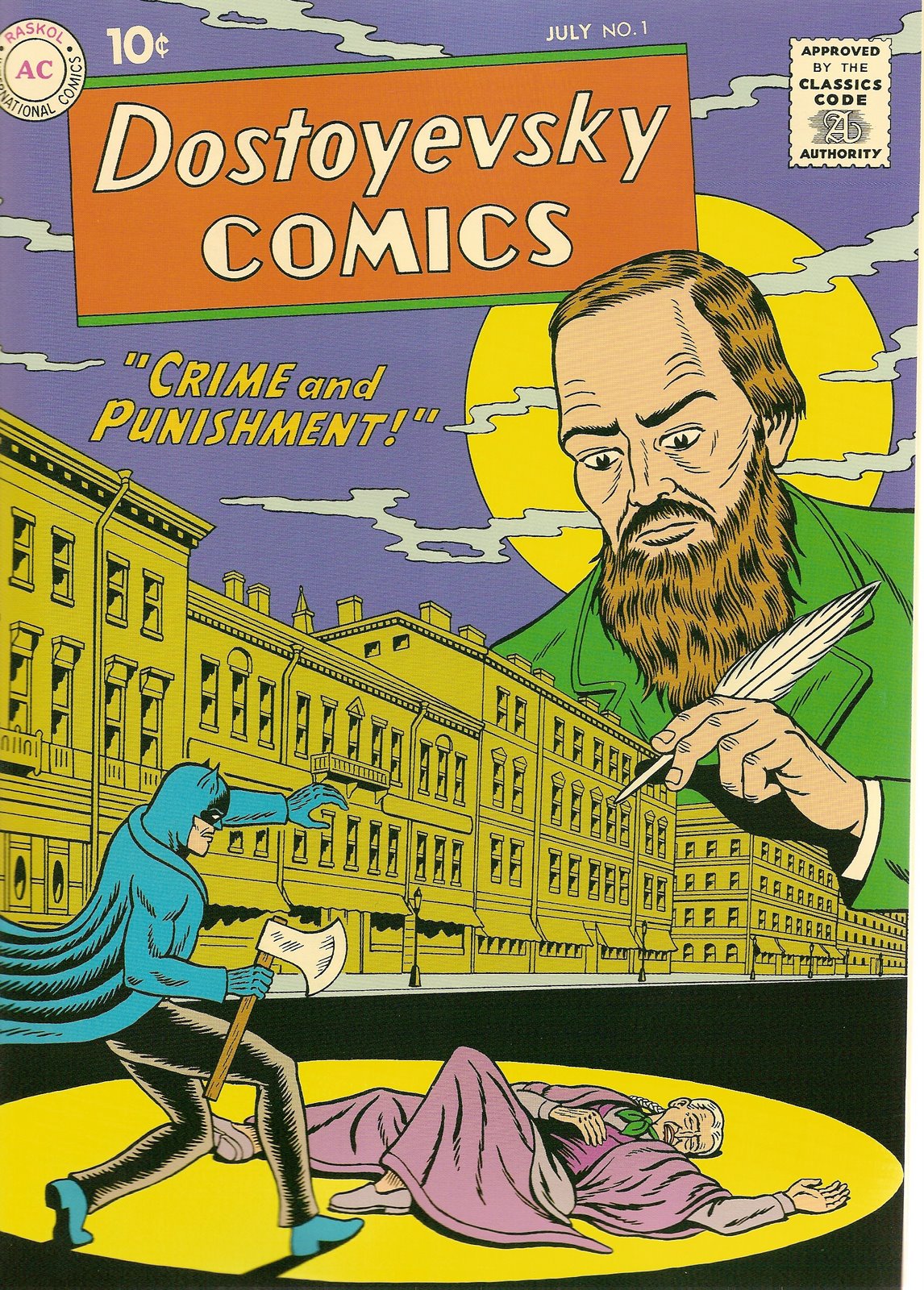
On Fri­day, Fyo­dor Dos­toyevsky’s Crime and Pun­ish­ment topped our crowd­sourced list of Books Intel­li­gent Peo­ple Should Read.  If you haven’t read Dos­toyevsky’s clas­sic nov­el of mur­der and guilt, you should give it a go. But if you’re look­ing for a lighter, more play­ful take on the nov­el, we give you Dos­toyevsky Comicsa short car­toon adap­ta­tion that some­how inserts Bat­man into the Russ­ian tale. The com­ic was authored by R. Siko­ryak, who spe­cial­izes in cre­at­ing com­ic par­o­dies of lit­er­ary clas­sics. You can pur­chase his Mas­ter­piece Comics on Ama­zon here.

If you would like to sign up for Open Culture’s free email newslet­ter, please find it here. It’s a great way to see our new posts, all bun­dled in one email, each day.

If you would like to sup­port the mis­sion of Open Cul­ture, con­sid­er mak­ing a dona­tion to our site. It’s hard to rely 100% on ads, and your con­tri­bu­tions will help us con­tin­ue pro­vid­ing the best free cul­tur­al and edu­ca­tion­al mate­ri­als to learn­ers every­where. You can con­tribute through Pay­Pal, Patre­on, and Ven­mo (@openculture). Thanks!

Relat­ed Con­tent:

Down­load 15,000+ Free Gold­en Age Comics from the Dig­i­tal Com­ic Muse­um

Free Com­ic Books Turn Kids Onto Physics: Start with the Adven­tures of Niko­la Tes­la

Read Mar­tin Luther King and The Mont­gomery Sto­ry: The Influ­en­tial 1957 Civ­il Rights Com­ic Book

The Pulp Fic­tion Archive: The Cheap, Thrilling Sto­ries That Enter­tained a Gen­er­a­tion of Read­ers (1896–1946) 

Bat­girl Fights for Equal Pay in a 1960s Tele­vi­sion Ad Sup­port­ing The Equal Pay Act


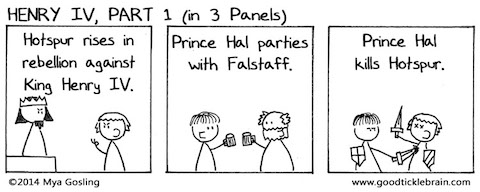
Great Shakespeare Plays Retold with Stick Figures in Three Simple Drawings

MacbethComic

Oth­er than Romeo and Juli­et and pos­si­bly Ham­let,  Shake­speare does­n’t exact­ly lend him­self to the ele­va­tor pitch. The same creaky plot devices and unfath­omable jokes that con­found mod­ern audi­ences make for long wind­ed sum­maries.

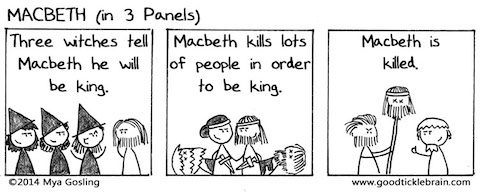
Not to say it can’t be done. Mya Gosling, a South­east Asia Copy Cat­a­loger at the Uni­ver­si­ty of Michi­gan, has been amus­ing her­self, and more recent­ly oth­ers, with “Good Tick­le Brain,” a web com­ic that reduces each of the com­plete works to a mere three pan­els. (Titus Andron­i­cus’ blood­bath required but one.)

Those of us who are semi-versed in the Bard should delight in the way major char­ac­ters and com­plex side plots are glibly strick­en from the record.

(Methinks Lady Mac­Beth would not be pleased…)

And what high school­er won’t expe­ri­ence a per­verse thrill, when the obscure and bor­ing text his class has been pars­ing for weeks is dis­patched with the swift­ness of your aver­age Garfield? (The wise teacher will be in no rush to share these rev­e­la­tions…)

HenryIV

Gosling, whose dad intro­duced her to Shake­speare at an ear­ly age, knows the mate­r­i­al well enough to sub­vert it. Who cares if her artis­tic tal­ent max­es out with stick fig­ures? Famil­iar­i­ty allows her to nail the end­ing of Troilus and Cres­si­da (“Home­r’s Ili­ad hap­pens”). The mid­dle pan­el of Win­ter’s Tale is devot­ed to “some poor guy” get­ting eat­en by a bear, and why should­n’t it be, when the author’s famous stage direc­tion is the only thing most peo­ple can dredge up with regard to that par­tic­u­lar play?

As for the title of her web com­ic, it’s an insult from one of her faves, Hen­ry IV, part 1. My kind of geek­ery, for­sooth.

H/T Michael Good­win, the author of Economix, a book that explains The His­to­ry of Eco­nom­ics & Eco­nom­ic The­o­ry with Comics. See a sam­ple by click­ing here.

Relat­ed Con­tent:

Free Course: A Sur­vey of Shakespeare’s Plays

Dis­cov­er What Shakespeare’s Hand­writ­ing Looked Like, and How It Solved a Mys­tery of Author­ship

The Bea­t­les Per­form a Fun Spoof of Shakespeare’s A Mid­sum­mer Night’s Dream (1964)

Ayun Hal­l­i­day’s 16-year-old daugh­ter plays a small part in Michael Almerey­da’s Cym­be­line. Fol­low her @AyunHalliday

Watch Seth Meyers’ Late Night Players Act Out the New Yorker’s Famous Cartoons

Along with its whim­si­cal, hand-drawn cov­ers and its sur­pris­ing­ly read­able arti­cles on unlike­ly sub­jects, like nick­el-min­ing, The New York­er mag­a­zine is known for its car­toons – sin­gle pan­el doo­dles that can be either wry com­men­taries on our cul­ture or, as a famous Sein­feld episode point­ed out, utter­ly inscrutable.

Trans­lat­ing the car­toons to tele­vi­sion seems a task doomed to fail­ure but Seth Mey­ers, the new­ly-installed host of Late Night, man­aged suc­cess­ful­ly to do just that. The show’s “the­ater group-in-res­i­dence, the late night play­ers” reen­act­ed some of the magazine’s more famous recent car­toons. Many of the magazine’s most endur­ing car­toon set ups are rep­re­sent­ed – a bar, a wed­ding recep­tion and, of course, a desert­ed island.

Pro­vid­ing dead­pan com­men­tary on the per­for­mances is The New York­er’s edi­tor-in-chief David Rem­nick. When select­ing car­toons for the mag­a­zine, he notes, the pri­ma­ry cri­te­ria is that they “should be fun­ny.” Check it out above.

Relat­ed Con­tent:

New York­er Car­toon Edi­tor Bob Mankoff Reveals the Secret of a Suc­cess­ful New York­er Car­toon

Improv with New York­er Car­toon­ists

Einstein’s Rel­a­tiv­i­ty: An Ani­mat­ed New York­er Car­toon

Jonathan Crow is a Los Ange­les-based writer and film­mak­er whose work has appeared in Yahoo!, The Hol­ly­wood Reporter, and oth­er pub­li­ca­tions. You can fol­low him at @jonccrow.

Download Over 22,000 Golden & Silver Age Comic Books from the Comic Book Plus Archive

HORIZONTALBESTCOMICS

The decade begin­ning with the late 1930s is known as the Gold­en Age of com­ic books. Many of the super­heroes from today’s block­buster fran­chis­es, includ­ing Bat­man, Super­man, and Cap­tain Amer­i­ca, emerged dur­ing this peri­od, and the indus­try grew into a com­mer­cial pow­er­house. Fol­low­ing a sales dip dur­ing the ear­ly 1950s that marked the end of the Gold­en Age, the Sil­ver Age began (cir­ca 1956) and last­ed for some fif­teen years.

Dur­ing this era, super­hero com­ic books ini­tial­ly lost steam — let­ting sto­ries of hor­ror, romance, and crime grow in pop­u­lar­i­ty — before emerg­ing tri­umphant­ly once more with char­ac­ters like Spi­der-Man and The Flash. While copy­right remains very much in effect for such titles, a slew of com­ic books from the same peri­od, many of which have nar­row­ly missed attain­ing such icon­ic sta­tus, are avail­able online at Com­ic Book Plus.

DAREDEVIL

Sim­i­lar to the Dig­i­tal Com­ic Muse­um, which we wrote about last week, Com­ic Book Plus con­tains a near inex­haustible quan­ti­ty of Gold­en and Sil­ver Age com­ic books. The collection’s times­pan ranges from the late 1930s through to the ear­ly 1960s, and includes many thou­sands of com­ic books in the Super­heroSci-Fi, and Hor­ror gen­res.

LINDALARK

Those han­ker­ing for some­thing a lit­tle more unusu­al will also be in luck. Des­per­ate to read about a hos­pi­tal romance? Why not give Lin­da Lark Stu­dent Nurse a read in the Med­ical Love cat­e­go­ry? Sick of land­lub­bers hog­ging all the atten­tion in com­ic books? Head to the Water/Boats sec­tion, where you can read all about Davy Jones, the navy lieu­tenant who lives in Atlantis and does bat­tle with the evil Dr. Fang, in Under­sea Agent.

UNDERSEAAGENT

Com­ic Book Plus also has a ter­rif­ic selec­tion of for­eign com­ic books, includ­ing impres­sive col­lec­tions in Ger­man, Hin­di, Ital­ian, Por­tuguese, and Span­ish. You can see Super Hombre here.

SUPERHOMBRE

Final­ly, the site con­tains a num­ber of U.S. gov­ern­ment edu­ca­tion­al pam­phlets, includ­ing Bert The Tur­tle Says Duck And Cov­er, a guide to sur­viv­ing atom­ic bomb blasts.

BERTTHETURTLE

For fur­ther read­ing, head on over to Com­ic Book Plus. You can pre­view all mate­ri­als with­out reg­is­tra­tion. But you will need to reg­is­ter (for free) if you want to down­load the var­i­ous com­ic books.

H/T to Yoc­itrus for mak­ing us aware of this archive.

Ilia Blin­d­er­man is a Mon­tre­al-based cul­ture and sci­ence writer. Fol­low him at @iliablinderman, or read more of his writ­ing at the Huff­in­g­ton Post.

Relat­ed Con­tent:

Down­load 15,000+ Free Gold­en Age Comics from the Dig­i­tal Com­ic Muse­um

Free Com­ic Books Turn Kids Onto Physics: Start with the Adven­tures of Niko­la Tes­la

Read Mar­tin Luther King and The Mont­gomery Sto­ry: The Influ­en­tial 1957 Civ­il Rights Com­ic Book

The Pulp Fic­tion Archive: The Cheap, Thrilling Sto­ries That Enter­tained a Gen­er­a­tion of Read­ers (1896–1946) 

Read Martin Luther King and The Montgomery Story: The Influential 1957 Civil Rights Comic Book

MLKComic

From the para­noid fun­da­men­tal­ist tracts of Jack Chick, to Ronald McDon­ald pro­mot­ing scout­ing, to an upcom­ing graph­ic nov­el explain­ing the sci­ence of cli­mate change, comics and graph­ic nov­els have long been a means of both pros­e­ly­tiz­ing and inform­ing, con­dens­ing com­plex nar­ra­tives into a digestible for­mat with broad appeal. The medi­um is so elas­tic, it can seem­ing­ly adapt itself to any kind of sto­ry, even the most sober­ly seri­ous and his­tor­i­cal­ly sig­nif­i­cant. For exam­ple, Geor­gia Con­gress­man John Lewis, vet­er­an of the Civ­il Rights move­ment, chose to tell his story—in col­lab­o­ra­tion with co-writer Andrew Aydin and artist Nate Powell—as a graph­ic nov­el called March (mak­ing him the first law­mak­er to appear at a Com­ic-Con). Part one of three was pub­lished late last year and rose to the top of the New York Times and Wash­ing­ton Post best­seller lists. March has also become an impor­tant resource for teach­ers and librar­i­ans (down­load a free 11-page teach­ers guide from pub­lish­er Top Shelf here).

MontgomeryMethod

Lewis’ choice of medi­um may seem moti­vat­ed by the cur­rent esteem in which the form is held in schol­ar­ly and pop­u­lar cir­cles alike, but he was pri­mar­i­ly influ­enced by a much ear­li­er civ­il rights com­ic book, Mar­tin Luther King and the Mont­gomery Sto­ry. (See cov­er up top. Read it online here.) Begun just five months after Rosa Parks’ his­toric refusal, the com­ic aimed to dis­sem­i­nate the epic tale of the Mont­gomery, AL bus boy­cott through­out the South. A sec­tion called “The Mont­gomery Method” (first page above) instructs read­ers on the non­vi­o­lent resis­tance tech­niques employed by civ­il rights work­ers in Alaba­ma, with a primer on Gand­hi and his influ­ence on King. In the short video below, see NYU pro­fes­sor and King schol­ar Sylvia Rhor explain the gen­e­sis of the com­ic in the work of Alfred Has­sler, then leader of Civ­il Rights orga­ni­za­tion Fel­low­ship of Rec­on­cil­i­a­tion. Has­sler, a lit­tle-known fig­ure who died in 1991, is now receiv­ing more recog­ni­tion through sim­i­lar means. He him­self recent­ly became the sub­ject of a graph­ic nov­el project (and now doc­u­men­tary) called The Secret of the 5 Pow­ers about his work with Bud­dhist peace activists Thich Nhat Hanh and Sis­ter Chan Khong dur­ing the Viet­nam War.

As Rhor notes above, the King com­ic has had tremen­dous influ­ence, not only in the past, and not only on Rep. Lewis in the present. In 2003–2004, The Mont­gomery Sto­ry was trans­lat­ed into Ara­bic, and Egypt­ian rev­o­lu­tion­ar­ies dur­ing the Arab Spring found inspi­ra­tion in the com­ic book that “turned Mar­tin Luther King into a super­hero”

Relat­ed Con­tent:

200,000 Mar­tin Luther King Papers Go Online

MLK’s Last Days and Final Speech

Nichelle Nichols Tells Neil deGrasse Tyson How Mar­tin Luther King Con­vinced Her to Stay on Star Trek

Josh Jones is a writer and musi­cian based in Durham, NC. Fol­low him at @jdmagness

« Go BackMore in this category... »
Quantcast