Artist Draws 9 Portraits While on LSD: Inside the 1950s Experiments to Turn LSD into a “Creativity Pill”

LSD was first syn­the­sized in 1938 by chemist Albert Hoff­man in a Swiss lab­o­ra­to­ry but only attained infamy almost two decades lat­er, when it became part of a series of gov­ern­ment exper­i­ments. At the same time, a UC Irvine psy­chi­a­trist, Oscar Janiger (“Oz” to his friends), con­duct­ed his own stud­ies under very dif­fer­ent cir­cum­stances. “Unlike most researchers, Janiger want­ed to cre­ate a ‘nat­ur­al’ set­ting,” writes Brandy Doyle for MAPS (the Mul­ti­dis­ci­pli­nary Asso­ci­a­tion for Psy­che­del­ic Stud­ies). He rea­soned that “there was noth­ing espe­cial­ly neu­tral about a lab­o­ra­to­ry or hos­pi­tal room,” so he “rent­ed a house out­side of LA, in which his sub­jects could have a rel­a­tive­ly non-direct­ed expe­ri­ence in a sup­port­ive envi­ron­ment.”

Janiger want­ed his sub­jects to make cre­ative dis­cov­er­ies in a state of height­ened con­scious­ness. The study sought, he wrote, to “illu­mi­nate the phe­nom­e­no­log­i­cal nature of the LSD expe­ri­ence,” to see whether the drug could effec­tive­ly be turned into a cre­ativ­i­ty pill. He found, over a peri­od last­ing from 1954 to 1962 (when the exper­i­ments were ter­mi­nat­ed), that among his approx­i­mate­ly 900 sub­jects, those who were in ther­a­py “had a high rate of pos­i­tive response,” but those not in ther­a­py “found the expe­ri­ence much less pleas­ant.” Janiger’s find­ings have con­tributed to the research that orga­ni­za­tions like MAPS have done on psy­choac­tive drugs in ther­a­peu­tic set­tings. The exper­i­ments also pro­duced a body of art­work made by study par­tic­i­pants on acid.

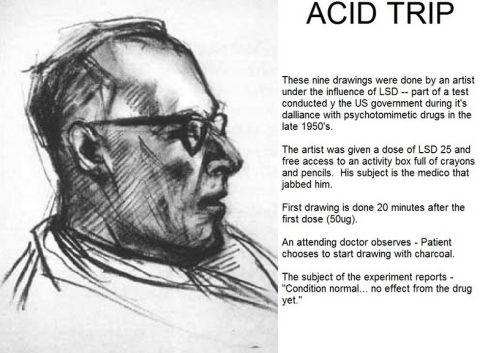
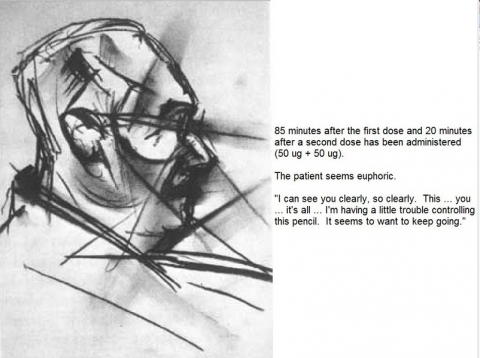
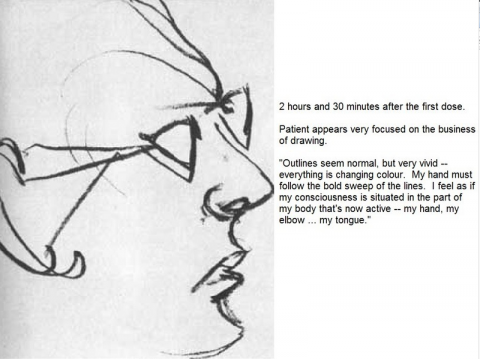
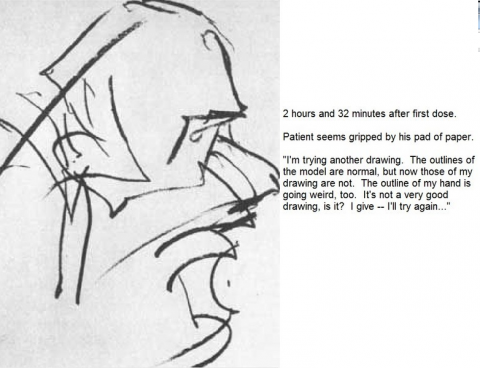
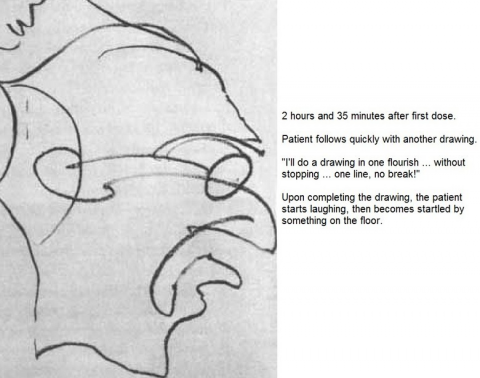
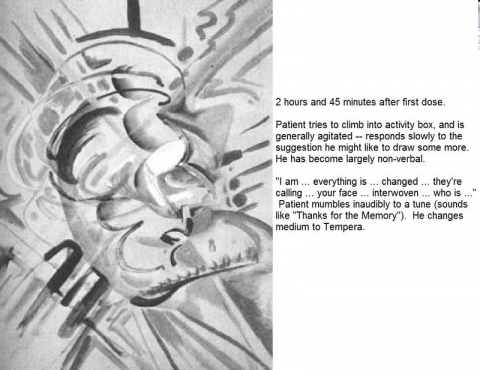
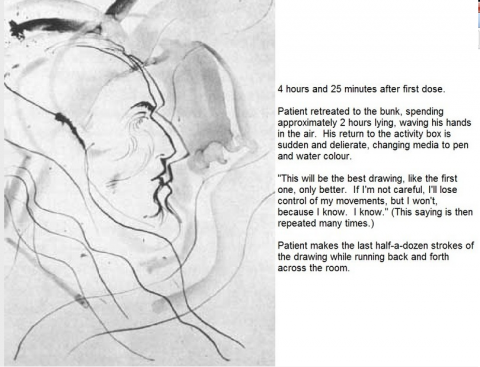
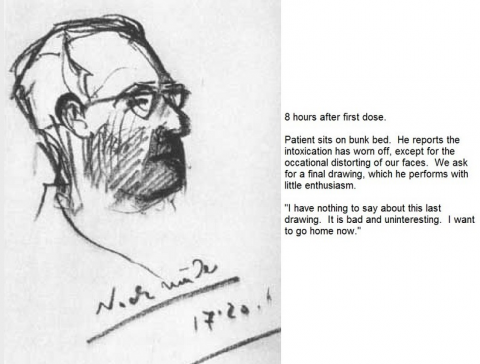
Janiger invit­ed over 100 pro­fes­sion­al artists into the study and had them pro­duce over 250 paint­ings and draw­ings. The series of eight draw­ings you see here most like­ly came from one of those artists (though “the records of the iden­ti­ty of the prin­ci­ple researcher have been lost,” writes Live­Science). In the psych-rock-scored video at the top see the pro­gres­sion of increas­ing­ly abstract draw­ings the artist made over the course of his 8‑hour trip. He report­ed on his per­cep­tions and sen­sa­tions through­out the expe­ri­ence, not­ing, at what seems to be the drug’s peak moment at 2.5 and 3 hours in, “I feel that my con­scious­ness is sit­u­at­ed in the part of my body that’s active—my hand, my elbow, my tongue…. I am… every­thing is… changed… they’re call­ing… your face… inter­wo­ven… who is….”

Trip­py, but there’s much more to the exper­i­ment than its imme­di­ate effects on artists’ brains and sketch­es. As Janiger’s col­league Mar­lene Dobkin de Rios writes in her defin­i­tive book on his work, “all of the artists who par­tic­i­pat­ed in Janiger’s project said that LSD not only rad­i­cal­ly changed their style but also gave them new depths to under­stand the use of col­or, form, light, or the way these things are viewed in a frame of ref­er­ence. Their art, they claimed, changed its essen­tial char­ac­ter as a con­se­quence of their expe­ri­ences.” Psy­chol­o­gist Stan­ley Kripp­n­er made sim­i­lar dis­cov­er­ies, and “defined the term psy­che­del­ic artist” to describe those who, as in Janiger’s stud­ies “gained a far greater insight into the nature of art and the aes­thet­ic idea,” Dobkin de Rios writes.

Artis­tic productions—paintings, poems, sketch­es, and writ­ings that stemmed from the experience—often show a rad­i­cal depar­ture from the artist’s cus­tom­ary mode of expres­sion… the artists’ gen­er­al opin­ion was that their work became more expres­sion­is­tic and demon­strat­ed a vast­ly greater degree of free­dom and orig­i­nal­i­ty.

The work of the unknown artist here takes on an almost mys­ti­cal qual­i­ty after a while. The project began “serendip­i­tous­ly” when one of Janiger’s vol­un­teers in 1954 insist­ed on being able to draw dur­ing the dos­ing. “After his LSD expe­ri­ence,” writes Dobkin de Rios, “the artist was very emphat­ic that it would be most reveal­ing to allow oth­er artists to go through this process of per­cep­tu­al change.” Janiger was con­vinced, as were many of his more famous test sub­jects.

Janiger report­ed­ly intro­duced LSD to Cary Grant, Anais Nin, Jack Nichol­son, and Aldous Hux­ley dur­ing guid­ed ther­a­py ses­sions. Still, he is not near­ly as well-known as oth­er LSD pio­neers like Ken Kesey and Tim­o­thy Leary, in part because, writes the psy­choac­tive research site Erowid, “his data remained large­ly unpub­lished dur­ing his life­time,” and he was not him­self an artist or media per­son­al­i­ty (though he was a cousin of Allen Gins­berg).

Janiger not only changed the con­scious­ness of unnamed and famous artists with LSD, but also exper­i­ment­ed with DMT with Alan Watts and fel­low psy­chi­a­trist Humphry Osmond (who coined the word “psy­che­del­ic”), and con­duct­ed research on pey­ote with Dobkin de Rios. To a great degree, we have him to thank (or blame) for the explo­sion of psy­che­del­ic art and phi­los­o­phy that flowed out of the ear­ly six­ties and indeli­bly changed the cul­ture. At Live­Science, you can see a slideshow of these draw­ings with com­men­tary from Yale physi­cian Andrew Sewell on what might be hap­pen­ing in the trip­ping artist’s brain.

Note: IAI Acad­e­my has just released a short course called The Sci­ence of Psy­che­delics. You can enroll in it here.

Relat­ed Con­tent:

Rare Footage Shows US and British Sol­diers Get­ting Dosed with LSD in Gov­ern­ment-Spon­sored Tests (1958 + 1964)

Hofmann’s Potion: 2002 Doc­u­men­tary Revis­its His­to­ry of LSD

Ken Kesey Talks About the Mean­ing of the Acid Tests

Aldous Huxley’s Most Beau­ti­ful, LSD-Assist­ed Death: A Let­ter from His Wid­ow

Josh Jones is a writer and musi­cian based in Durham, NC. Fol­low him at @jdmagness

How Information Overload Robs Us of Our Creativity: What the Scientific Research Shows

Flickr Com­mons pho­to by J Stimp

Every­one used to read Samuel John­son. Now it seems hard­ly any­one does. That’s a shame. John­son under­stood the human mind, its sad­ly amus­ing frail­ties and its dou­ble-blind alleys. He under­stood the nature of that mys­te­ri­ous act we casu­al­ly refer to as “cre­ativ­i­ty.” It is not the kind of thing one lucks into or mas­ters after a sem­i­nar or lec­ture series. It requires dis­ci­pline and a mind free of dis­trac­tion. “My dear friend,” said John­son in 1783, accord­ing to his biog­ra­ph­er and sec­re­tary Boswell, “clear your mind of cant.”

There’s no miss­ing apos­tro­phe in his advice. Inspir­ing as it may sound, John­son did not mean to say “you can do it!” He meant “cant,” an old word for cheap decep­tion, bias, hypocrisy, insin­cere expres­sion. “It is a mode of talk­ing in Soci­ety,” he con­ced­ed, “but don’t think fool­ish­ly.” Johnson’s injunc­tion res­onat­ed through a cou­ple cen­turies, became gar­bled into a banal affir­ma­tion, and was lost in a grave­yard of image macros. Let us endeav­or to retrieve it, and rumi­nate on its wis­dom.

We may even do so with our favorite mod­ern brief in hand, the sci­en­tif­ic study. There are many we could turn to. For exam­ple, notes Derek Beres, in a 2014 book neu­ro­sci­en­tist Daniel Lev­itin brought his research to bear in argu­ing that “infor­ma­tion over­load keeps us mired in noise.… This saps us of not only willpow­er (of which we have a lim­it­ed store) but cre­ativ­i­ty as well.” “We sure think we’re accom­plish­ing a lot,” Lev­itin told Susan Page on The Diane Rehm Show in 2015, “but that’s an illu­sion… as a neu­ro­sci­en­tist, I can tell you one thing the brain is very good at is self-delu­sion.”

Johnson’s age had its own ver­sion of infor­ma­tion over­load, as did that of anoth­er cur­mud­geon­ly voice from the past, T.S. Eliot, who won­dered, “Where is the wis­dom we have lost in knowl­edge? Where is the knowl­edge we have lost in infor­ma­tion?” The ques­tion leaves Eliot’s read­ers ask­ing whether what we take for knowl­edge or infor­ma­tion real­ly are such? Maybe they’re just as often forms of need­less busy­ness, dis­trac­tion, and over­think­ing. Stan­ford researcher Emma Sep­pälä sug­gests as much in her work on “the sci­ence of hap­pi­ness.” At Quartz, she writes,

We need to find ways to give our brains a break.… At work, we’re intense­ly ana­lyz­ing prob­lems, orga­niz­ing data, writing—all activ­i­ties that require focus. Dur­ing down­time, we immerse our­selves in our phones while stand­ing in line at the store or lose our­selves in Net­flix after hours.

Sep­pälä exhorts us to relax and let go of the con­stant need for stim­u­la­tion, to take longs walks with­out the phone, get out of our com­fort zones, make time for fun and games, and gen­er­al­ly build in time for leisure. How does this work? Let’s look at some addi­tion­al research. Bar-Ilan Uni­ver­si­ty’s Moshe Bar and Shi­ra Baror under­took a study to mea­sure the effects of dis­trac­tion, or what they call “men­tal load,” the “stray thoughts” and “obses­sive rumi­na­tions” that clut­ter the mind with infor­ma­tion and loose ends. Our “capac­i­ty for orig­i­nal and cre­ative think­ing,” Bar writes at The New York Times, “is marked­ly stymied” by a busy mind. “The clut­tered mind,” writes Jes­si­ca Still­man, “is a cre­ativ­i­ty killer.”

In a paper pub­lished in Psy­cho­log­i­cal Sci­ence, Bar and Baror describe how “con­di­tions of high load” fos­ter uno­rig­i­nal think­ing. Par­tic­i­pants in their exper­i­ment were asked to remem­ber strings of arbi­trary num­bers, then to play word asso­ci­a­tion games. “Par­tic­i­pants with sev­en dig­its to recall resort­ed to the most sta­tis­ti­cal­ly com­mon respons­es (e.g., white/black),” writes Bar, “where­as par­tic­i­pants with two dig­its gave less typ­i­cal, more var­ied pair­ings (e.g. white/cloud).” Our brains have lim­it­ed resources. When con­strained and over­whelmed with thoughts, they pur­sue well-trod paths of least resis­tance, try­ing to effi­cient­ly bring order to chaos.

“Imag­i­na­tion,” on the oth­er hand, wrote Dr. John­son else­where, “a licen­tious and vagrant fac­ul­ty, unsus­cep­ti­ble of lim­i­ta­tions and impa­tient of restraint, has always endeav­ored to baf­fle the logi­cian, to per­plex the con­fines of dis­tinc­tion, and burst the enclo­sures of reg­u­lar­i­ty.” Bar describes the con­trast between the imag­i­na­tive mind and the infor­ma­tion pro­cess­ing mind as “a ten­sion in our brains between explo­ration and exploita­tion.” Gorg­ing on infor­ma­tion makes our brains “’exploit’ what we already know,” or think we know, “lean­ing on our expec­ta­tion, trust­ing the com­fort of a pre­dictable envi­ron­ment.” When our minds are “unloaded,” on the oth­er hand, which can occur dur­ing a hike or a long, relax­ing show­er, we can shed fixed pat­terns of think­ing, and explore cre­ative insights that might oth­er­wise get buried or dis­card­ed.

As Drake Baer suc­cinct­ly puts in at New York Mag­a­zine’s Sci­ence of Us, “When you have noth­ing to think about, you can do your best think­ing.” Get­ting to that state in a cli­mate of per­pet­u­al, unsleep­ing dis­trac­tion, opin­ion, and alarm, requires anoth­er kind of dis­ci­pline: the dis­ci­pline to unplug, wan­der off, and clear your mind.

For anoth­er angle on this, you might want to check out Cal New­port’s 2016 book, Deep Work: Rules for Focused Suc­cess in a Dis­tract­ed World.

Relat­ed Con­tent:

The Neu­ro­science & Psy­chol­o­gy of Pro­cras­ti­na­tion, and How to Over­come It

Why You Do Your Best Think­ing In The Show­er: Cre­ativ­i­ty & the “Incu­ba­tion Peri­od”

How Walk­ing Fos­ters Cre­ativ­i­ty: Stan­ford Researchers Con­firm What Philoso­phers and Writ­ers Have Always Known

Josh Jones is a writer and musi­cian based in Durham, NC. Fol­low him at @jdmagness

Where Do Ideas Come From? David Lynch, Robert Krulwich, Susan Orlean, Chuck Close & Others Reveal Their Creative Sources

Ask any cre­ator sub­ject to fre­quent inter­views which ques­tions they dread, and one in par­tic­u­lar will come up more than any oth­er: “Where do you get your ideas?” Some have read­i­ly spo­ken and writ­ten on the sub­ject — Isaac Asi­mov, Neil Gaiman, David Lynch — but most, even if they’ve had tru­ly aston­ish­ing ideas, have giv­en the sub­ject of ideas in gen­er­al lit­tle thought. The video above, named after the infa­mous ques­tion, com­piles a vari­ety of answers from a vari­ety of peo­ple, younger and old­er, famous and less so, into a five-minute search for the source of human cre­ativ­i­ty.

“I get ideas in frag­ments,” says Lynch, whose voice we hear amid the many oth­ers in the video. “It’s as if, in the oth­er room, there’s a puz­zle and all the pieces are togeth­er. But in my room, they just flip one piece at a time into me.”

When a good idea comes along, says a twelve-year-old named Ursu­la, “that’s the feel­ing they call inspi­ra­tion.” But Radi­o­lab host Robert Krul­wich has a dim view of inspi­ra­tion: “I’m a lit­tle sus­pi­cious of the idea like, ‘In the begin­ning there was noth­ing and then there was light.’ I don’t think I’ve had that expe­ri­ence, and for oth­er peo­ple who’ve said that they’ve had that expe­ri­ence, I’m not sure I believe them.”

“Inspi­ra­tion is for ama­teurs,” says artist Chuck Close. “The rest of us just show up and get to work. Every great idea came out of work, every­thing.” Chalk up anoth­er point in favor of Thomas Edis­on’s famous break­down of genius as one per­cent inspi­ra­tion and 99 per­cent per­spi­ra­tion — but what kind of per­spi­ra­tion? As pro­fes­sion­al skate­board­er Ray Bar­bee sees it, “most peo­ple start off by mim­ic­k­ing some­thing, but then it turns into their own thing because they don’t real­ly have the abil­i­ty to mim­ic it pre­cise­ly,” a process that pro­duces “orig­i­nal­i­ty from copy­ing.”

“When­ev­er I fin­ish a sto­ry,” says New York­er writer Susan Orlean, “I go through a peri­od of time where I feel like I will nev­er again have an idea.” But it nev­er lasts as long as it feels: “One day you fall onto some­thing, and it just looks you in the face and says, ‘I’m the one.’ ” That “one” could take the form, accord­ing to the video’s con­trib­u­tors, of a chance encounter, a sen­tence in a sto­ry, a yel­low ball bounc­ing down the street, a soli­tary lawn chair seen from a train win­dow, a dump trick, or many oth­er even less expect­ed enti­ties besides. You just have to be primed and ready to con­nect it in an inter­est­ing man­ner to oth­er things in your head, in your envi­ron­ment, and in the cul­ture. “Luck is what hap­pens when prepa­ra­tion meets oppor­tu­ni­ty,” goes a well-known quote often attrib­uted to Seneca — and so, it seems, is cre­ativ­i­ty.

Relat­ed Con­tent:

An Ani­mat­ed David Lynch Explains Where He Gets His Ideas

Isaac Asi­mov Explains the Ori­gins of Good Ideas & Cre­ativ­i­ty in Nev­er-Before-Pub­lished Essay

Where Do Great Ideas Come From? Neil Gaiman Explains

John Cleese on the Ori­gin of Cre­ativ­i­ty

Rod Ser­ling: Where Do Ideas Come From?

Kurt Von­negut: Where Do I Get My Ideas From? My Dis­gust with Civ­i­liza­tion

Based in Seoul, Col­in Mar­shall writes and broad­casts on cities and cul­ture. He’s at work on the book The State­less City: a Walk through 21st-Cen­tu­ry Los Ange­les, the video series The City in Cin­e­ma, the crowd­fund­ed jour­nal­ism project Where Is the City of the Future?, and the Los Ange­les Review of Books’ Korea Blog. Fol­low him on Twit­ter at @colinmarshall or on Face­book.

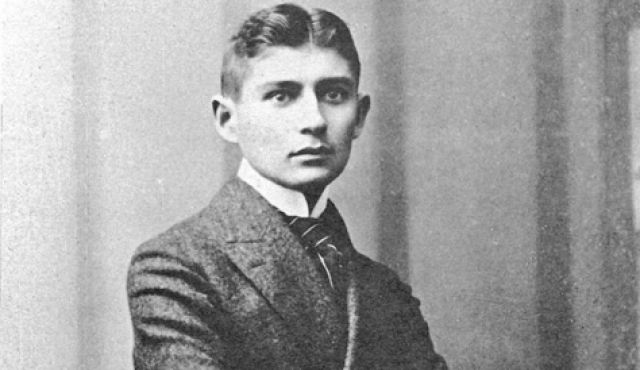
Franz Kafka Agonized, Too, Over Writer’s Block: “Tried to Write, Virtually Useless;” “Complete Standstill. Unending Torments” (1915)

No one sings as pure­ly as those who inhab­it the deep­est hell—what we take to be the song of angels is their song.

- Franz Kaf­ka, 1920

Poor Kaf­ka, born too ear­ly to blame his writer’s block on 21st-cen­tu­ry dig­i­tal excus­es:  social media addic­tion, cell phone addic­tion, stream­ing video… 

Would The Meta­mor­pho­sis have turned out dif­fer­ent­ly had its author had access to a machine that would have allowed him to self-pub­lish, com­mu­ni­cate face­less­ly, and dis­pense entire­ly with typ­ists, pens and paper? 

Had Kaf­ka had his way, his friend and fel­low writer, Max Brod, would have car­ried out instruc­tions to burn his unpub­lished work—including let­ters and jour­nal entries—upon his death

Instead Brod pub­lished them.

How hor­ri­fied would their author be to read The New Yorker’s opin­ion that his jour­nals should be regard­ed as one of his major lit­er­ary achieve­ments? A Kaf­ka-esque response might be the mildest reac­tion war­rant­ed by the sit­u­a­tion:

His life and per­son­al­i­ty were per­fect­ly suit­ed to the diary form, and in these pages he reveals what he cus­tom­ar­i­ly hid from the world.

These once-pri­vate pages (avail­able in book for­mat here) reveal a not-unfa­mil­iar writer­ly ten­den­cy to ago­nize over a per­ceived lack of out­put:

JANUARY 20, 1915: The end of writ­ing. When will it take me up again?

JANUARY 29, 1915: Again tried to write, vir­tu­al­ly use­less.

JANUARY 30, 1915: The old inca­pac­i­ty. Inter­rupt­ed my writ­ing for bare­ly ten days and already cast out. Once again prodi­gious efforts stand before me. You have to dive down, as it were, and sink more rapid­ly than that which sinks in advance of you.

FEBRUARY 7, 1915: Com­plete stand­still. Unend­ing tor­ments.

MARCH 11, 1915: How time flies; anoth­er ten days and I have achieved noth­ing. It doesn’t come off. A page now and then is suc­cess­ful, but I can’t keep it up, the next day I am pow­er­less.

MARCH 13, 1915: Lack of appetite, fear of get­ting back late in the evening; but above all the thought that I wrote noth­ing yes­ter­day, that I keep get­ting far­ther and far­ther from it, and am in dan­ger of los­ing every­thing I have labo­ri­ous­ly achieved these past six months. Pro­vid­ed proof of this by writ­ing one and a half wretched pages of a new sto­ry that I have already decid­ed to dis­card…. Occa­sion­al­ly I feel an unhap­pi­ness that almost dis­mem­bers me, and at the same time am con­vinced of its neces­si­ty and of the exis­tence of a goal to which one makes one’s way by under­go­ing every kind of unhap­pi­ness.

Psy­chol­o­gy Today iden­ti­fies five pos­si­ble under­ly­ing caus­es for such inac­tiv­i­ty, and tips for sur­mount­ing them. It seems like­ly the fas­tid­i­ous, self-absorbed Kaf­ka would have reject­ed them on their breezy tone alone, but per­haps oth­er less per­snick­ety indi­vid­u­als will find some­thing of use: 

1. You’ve Lost Your Way

If you’re stalled because you lost your way, try the oppo­site of what you usu­al­ly do—if you’re a plot­ter, give your imag­i­na­tion free rein for a day; if you’re a freewriter or a pantser, spend a day cre­at­ing a list of the next 10 scenes that need to hap­pen. This gives your brain a chal­lenge, and for this rea­son you can take heart, because your bil­lions of neu­rons love a chal­lenge and are in search of synaps­es they can form.

2. Your Pas­sion Has Waned

Remem­ber, your writ­ing brain looks for and responds to pat­terns, so be care­ful that you don’t make suc­cumb­ing to bore­dom or sur­ren­der­ing projects with­out a fight into a habit. Do your best to work through the rea­sons you got stalled and to fin­ish what you start­ed. This will lay down a neu­ronal path­way that your writ­ing brain will mer­ri­ly trav­el along in future work.

3. Your Expec­ta­tions Are Too High

Instead of set­ting your sights too high, give your­self per­mis­sion to write any­thing, on top­ic or off top­ic, mean­ing­ful or trite, use­ful or fol­ly. The point is that by attach­ing so much impor­tance to the work you’re about to do, you make it hard­er to get into the flow. Also, if your inner crit­ic sticks her nose in (which often hap­pens), tell her that her role is very impor­tant to you (and it is!) and that you will sum­mon her when you have some­thing wor­thy of her atten­tion.

4. You Are Burned Out

You aren’t blocked; you’re exhaust­ed. Give your­self a few days to real­ly rest. Lie on a sofa and watch movies, take long walks in the hour just before dusk, go out to din­ner with friends, or take a mini-vaca­tion some­where rest­ful. Do so with the inten­tion to give yourself—and your brain—a rest. No think­ing about your nov­el for a week! In fact, no heavy think­ing for a week. Lie back, have a mar­gari­ta, and chill.

5. You’re Too Dis­tract­ed

Take note that, unless you’re just one of those rare birds who always write no mat­ter what, you will expe­ri­ence times in your life when it’s impos­si­ble to keep to a writ­ing sched­ule. Peo­ple get sick, peo­ple have to take a sec­ond job, chil­dren need extra atten­tion, par­ents need extra atten­tion, and so on. If you’re in one of those emer­gency sit­u­a­tions (rais­ing small chil­dren counts), by all means, don’t berate your­self. Some­times it’s sim­ply nec­es­sary to put the actu­al writ­ing on hold. It is good, how­ev­er, to keep your hands in the water. For instance, in lieu of writ­ing your nov­el:

Read works sim­i­lar to what you hope to write.

Read books relat­ed to the sub­ject you’re writ­ing about.

Keep a des­ig­nat­ed jour­nal where you jot down ideas for the book (and oth­er works).

Write small vignettes or sketch­es relat­ed to the book

When­ev­er you find time to med­i­tate, envi­sion your­self writ­ing the book, bring­ing it to full com­ple­tion.

Make writ­ing the book a pri­or­i­ty.

Addi­tion­al­ly, you may find some mer­it in enlist­ing a friend to pub­lish, I mean, burn the above-men­tioned jour­nals posthu­mous­ly. Just don’t write any­thing you would­n’t want the pub­lic to see.

Read author Susan Reynolds’ com­plete Psy­chol­o­gy Today advice for blocked writ­ers here.

Have a peek at Kafka’s Diaries: 1910–1923 here.

via Austin Kleon

Relat­ed Con­tent:

Franz Kafka’s Kafkaesque Love Let­ters

Franz Kaf­ka: An Ani­mat­ed Intro­duc­tion to His Lit­er­ary Genius

Meta­mor­fo­s­is: Franz Kafka’s Best-Known Short Sto­ry Gets Adapt­ed Into a Tim Bur­tonesque Span­ish Short Film

Ayun Hal­l­i­day is an author, illus­tra­tor, the­ater mak­er and Chief Pri­ma­tol­o­gist of the East Vil­lage Inky zine, cur­rent­ly appear­ing onstage in New York City in Paul David Young’s Faust 3. Fol­low her @AyunHalliday.

Milton Glaser’s 10 Rules for Life & Work: The Celebrated Designer Dispenses Wisdom Gained Over His Long Life & Career

“None of us has real­ly the abil­i­ty to under­stand our path until it’s over,” the cel­e­brat­ed graph­ic design­er Mil­ton Glaser mus­es less than a minute into the above video.

The 86-year-old Glaser’s many con­tri­bu­tions to pop culture—the  I ❤ NY logo, the psy­che­del­ic por­trait of a rain­bow-haired Bob Dylan, DC Comics’ clas­sic bul­let logo—con­fer unde­ni­able author­i­ty. To the out­side eye, he seems to have a pret­ty firm han­dle on the path he’s been trav­el­ing for lo these many decades. Aspi­rant design­ers would do well to give extra con­sid­er­a­tion to any advice he might share.

As would the rest of us.

His “Ten Things I Have Learned,” orig­i­nal­ly deliv­ered as part of a talk to the AIGA—a ven­er­a­ble mem­ber­ship orga­ni­za­tion for design professionals—qualifies as sol­id life advice of gen­er­al inter­est.

Yes, the Inter­net spawns bul­let-point­ed tips for bet­ter liv­ing the way spring rains yield mush­rooms, but Glaser, a self-described “child of mod­ernism” who’s still a con­tender, does not truck in pithy Insta­gram-friend­ly apho­risms. Instead, his list is born of reflec­tion on the var­i­ous turns of a long and most­ly sat­is­fy­ing cre­ative career.

We’ve excerpt­ed some of his most essen­tial points below, and sug­gest that those read­ers who are still in train­ing give spe­cial empha­sis to num­ber sev­en. Don’t place too much weight on num­ber nine until you’ve estab­lished a sol­id work eth­ic. (See num­ber four for more on that.)

MILTON GLASER”S TEN RULES FOR WORK AND LIFE (& A BONUS JOKE ABOUT A RABBIT).

1. YOU CAN ONLY WORK FOR PEOPLE THAT YOU LIKE

Some years ago I real­ized that… all the work I had done that was mean­ing­ful and sig­nif­i­cant came out of an affec­tion­ate rela­tion­ship with a client.

2. IF YOU HAVE A CHOICE NEVER HAVE A JOB

Here, Glaser quotes com­pos­er John CageNev­er have a job, because if you have a job some­day some­one will take it away from you and then you will be unpre­pared for your old age. 

3. SOME PEOPLE ARE TOXIC AVOID THEM.

Glaser rec­om­mends putting a ques­tion­able com­pan­ion to a gestalt ther­a­py test. If, after spend­ing time with that per­son “you are more tired, then you have been poi­soned. If you have more ener­gy, you have been nour­ished. The test is almost infal­li­ble and I sug­gest that you use it for the rest of your life.”

4. PROFESSIONALISM IS NOT ENOUGH (or THE GOOD IS THE ENEMY OF THE GREAT)

Glaser con­cedes that a record of depend­able excel­lence is some­thing to look for in a brain sur­geon or auto mechan­ic, but for those in the arts, “con­tin­u­ous trans­gres­sion” is the qual­i­ty to cul­ti­vate. Pro­fes­sion­al­ism does not allow for that because trans­gres­sion has to encom­pass the pos­si­bil­i­ty of fail­ure and if you are pro­fes­sion­al your instinct is not to fail, it is to repeat suc­cess. 

5. LESS IS NOT NECESSARILY MORE

I have an alter­na­tive to the propo­si­tion that I believe is more appro­pri­ate. ‘Just enough is more.’

6. STYLE IS NOT TO BE TRUSTED

Style change is usu­al­ly linked to eco­nom­ic fac­tors, as all of you know who have read Marx. Also fatigue occurs when peo­ple see too much of the same thing too often.

7. HOW YOU LIVE CHANGES YOUR BRAIN

The brain is the most respon­sive organ of the body…. Thought changes our life and our behav­ior. I also believe that draw­ing works in the same way…. Draw­ing also makes you atten­tive. It makes you pay atten­tion to what you are look­ing at, which is not so easy.

8. DOUBT IS BETTER THAN CERTAINTY

One of the signs of a dam­aged ego is absolute cer­tain­ty. Schools encour­age the idea of not com­pro­mis­ing and defend­ing your work at all costs. Well, the issue at work is usu­al­ly all about the nature of com­pro­mise…. Ide­al­ly, mak­ing every­one win through acts of accom­mo­da­tion is desir­able.

9. IT DOESN’T MATTER

Glaser cred­its essay­ist Roger Rosenblatt’s Rules for Aging (misiden­ti­fy­ing the title as Aging Grace­ful­ly) with help­ing him artic­u­late his phi­los­o­phy here.  It doesn’t mat­ter what you think. It does not mat­ter if you are late or ear­ly, if you are here or there, if you said it or didn’t say it, if you are clever or if you were stu­pid. If you were hav­ing a bad hair day or a no hair day or if your boss looks at you cock­eyed or your boyfriend or girl­friend looks at you cock­eyed, if you are cock­eyed. If you don’t get that pro­mo­tion or prize or house or if you do – it doesn’t mat­ter.

10. TELL THE TRUTH

It’s inter­est­ing to observe that in the new AIGA’s code of ethics there is a sig­nif­i­cant amount of use­ful infor­ma­tion about appro­pri­ate behav­ior towards clients and oth­er design­ers, but not a word about a designer’s rela­tion­ship to the pub­lic. If we were licensed, telling the truth might become more cen­tral to what we do.

BONUS JOKE

A butch­er was open­ing his mar­ket one morn­ing and as he did a rab­bit popped his head through the door. The butch­er was sur­prised when the rab­bit inquired ‘Got any cab­bage?’ The butch­er said ‘This is a meat mar­ket – we sell meat, not veg­eta­bles.’ The rab­bit hopped off. The next day the butch­er is open­ing the shop and sure enough the rab­bit pops his head round and says ‘You got any cab­bage?’ The butch­er now irri­tat­ed says ‘Lis­ten you lit­tle rodent, I told you yes­ter­day we sell meat, we do not sell veg­eta­bles and the next time you come here I am going to grab you by the throat and nail those flop­py ears to the floor.’ The rab­bit dis­ap­peared hasti­ly and noth­ing hap­pened for a week. Then one morn­ing the rab­bit popped his head around the cor­ner and said ‘Got any nails?’ The butch­er said ‘No.’ The rab­bit said ‘Ok. Got any cab­bage?’’

Read Mil­ton Glaser’s “Ten Things I Have Learned” in its entire­ty here.

via Kot­tke

Relat­ed Con­tent:

Mil­ton Glaser Draws Shake­speare & Explains Why Draw­ing is the Key to Under­stand­ing Life

Mick­ey Mouse In Viet­nam: The Under­ground Anti-War Ani­ma­tion from 1968, Co-Cre­at­ed by Mil­ton Glaser

World-Renowned Graph­ic Design­er Mil­ton Glaser Has a Laugh on Old Jews Telling Jokes

Ayun Hal­l­i­day is an author, illus­tra­tor, the­ater mak­er and Chief Pri­ma­tol­o­gist of the East Vil­lage Inky zine.  Fol­low her @AyunHalliday.

Patti Smith, Umberto Eco & Richard Ford Give Advice to Young Artists in a Rollicking Short Animation


Note: There are a cou­ple brief not-safe-for-work moments in this film.

Patron­iz­ing, pon­der­ous, well-mean­ing, self-aggran­diz­ing, inco­her­ent… young artists are sub­ject­ed to a lot of unso­licit­ed advice, and not just from their par­ents.

But what hap­pens when a young artist active­ly seeks it out?

Daniel­la Shuh­man turned to the Louisiana Channel’s series, “Advice to the Young,” feast­ing on the col­lect­ed wis­dom of such heavy hit­ters as per­for­mance artist Mari­na Abramovic, author Umber­to Eco, artist Ola­fur Elias­son, and the mul­ti­tal­ent­ed God­moth­er of Punk, Pat­ti Smith in prepa­ra­tion for her final project at Jerusalem’s Beza­lel Acad­e­my of Arts and Design.

Her resul­tant short film, above, appears to be the work of a deliri­ous­ly aggro inner child, one with a keen bull­shit meter and an anar­chic sense of humor.

“The most impor­tant advice I have is to have fun,” coun­sels nov­el­ist Jonathan Franzen—a man who alleged­ly wrote The Cor­rec­tions while wear­ing earplugs, ear­muffs, and a blind­fold, then bust­ed on Oprah Win­frey when she chose it for for her Book Club.

Cue great spurts of ani­mat­ed arte­r­i­al blood.

At least Franzen both­ers to sound encour­ag­ing… much more so than Abramovic, or fel­low nov­el­ist Richard “Talk Your­self Out of It If You Pos­si­bly Can Because You’re Prob­a­bly Not Going to Be Very Good At It” Ford.

(Par­ents strug­gling to come up with tuition may be relieved to learn that Ford’s on leave from Colum­bia Uni­ver­si­ty this term.)

Mean­while, Shuh­man breaks for NSFW ter­ri­to­ry to visu­al­ize artist Eliasson’s advice, a move that would sure­ly please anoth­er Louisiana Chan­nel per­son­al­i­ty, car­toon­ist David Shrigley. Per­haps it can be his con­so­la­tion prize for not mak­ing the cut.

The pul­sat­ing repro­duc­tive organs aren’t entire­ly inap­pro­pri­ate. Lis­ten to Eliasson’s full inter­view to hear him equate mak­ing art with mak­ing the world. Now that’s the sort of advice that will put a young artist to work!

Some of the more gen­er­ous advice:

Build a good name, keep your name clean, don’t make com­pro­mis­es, don’t wor­ry about mak­ing a bunch of mon­ey or being suc­cess­ful.

Don’t be embar­rassed about what excites you.

If you are doing some­thing weird that every­body hates, that might be some­thing worth look­ing into and worth inves­ti­gat­ing.

Make your own way in the world. Wrap up warm. Eat prop­er­ly, sen­si­bly. Don’t smoke and phone your mom.

We love imag­in­ing the sort of unfet­tered advice Shuh­man will one day be in a posi­tion to dis­pense.

You can see some of her post grad­u­a­tion illus­tra­tion work on her Flickr page.

Relat­ed Con­tent:

21 Artists Give “Advice to the Young:” Vital Lessons from Lau­rie Ander­son, David Byrne, Umber­to Eco, Pat­ti Smith & More

Walt Whit­man Gives Advice to Aspir­ing Young Writ­ers: “Don’t Write Poet­ry” & Oth­er Prac­ti­cal Tips (1888)

Great Film­mak­ers Offer Advice to Young Direc­tors: Taran­ti­no, Her­zog, Cop­po­la, Scors­ese, Ander­son, Felli­ni & More

Ayun Hal­l­i­day is an author, illus­tra­tor, the­ater mak­er and Chief Pri­ma­tol­o­gist of the East Vil­lage Inky zine.  Fol­low her @AyunHalliday.

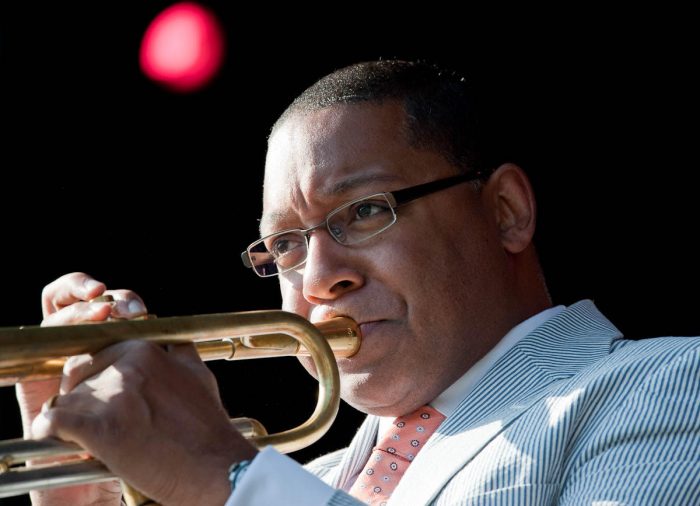
Wynton Marsalis Gives 12 Tips on How to Practice: For Musicians, Athletes, or Anyone Who Wants to Learn Something New

Image by Eric Del­mar, via Wiki­me­dia Com­mons

Prac­tic­ing for count­less hours before we can be good at some­thing seems bur­den­some and bor­ing. Maybe that’s why we’re drawn to sto­ries of instant achieve­ment. The monk real­izes satori (and Neo learns kung fu); the super­hero acquires great pow­er out of the blue; Robert John­son trades for genius at the cross­roads. At the same time, we teach chil­dren they can’t mas­ter a skill with­out dis­ci­pline and dili­gence. We repeat pop psych the­o­ries that spec­i­fy the exact num­ber hours required for excel­lence. The num­ber may be arbi­trary, but it com­forts us to believe that prac­tice might, even­tu­al­ly, make per­fect. Because in truth we know there is no way around it. As Wyn­ton Marsalis writes in “Wynton’s Twelve Ways to Prac­tice: From Music to School­work,” “prac­tice is essen­tial to learn­ing music—and any­thing else, for that mat­ter.”

For jazz musi­cians, the time spent learn­ing the­o­ry and refin­ing tech­nique finds elo­quent expres­sion in the con­cept of wood­shed­ding, a “hum­bling but nec­es­sary chore,” writes Paul Klem­per­er at Big Apple Jazz, “like chop­ping wood before you can start the fire.”

Yet retir­ing to the wood­shed “means more than just prac­tic­ing…. You have to dig deep into your­self, dis­ci­pline your­self, become focused on the music and your instru­ment.” As begin­ners, we tend to look at prac­tice only as a chore. The best jazz musi­cians know there’s also “some­thing philo­soph­i­cal, almost reli­gious” about it. John Coltrane, for exam­ple, prac­ticed cease­less­ly, con­scious­ly defin­ing his music as a spir­i­tu­al and con­tem­pla­tive dis­ci­pline.

Marsalis also implies a reli­gious aspect in his short arti­cle: “when you prac­tice, it means you are will­ing to sac­ri­fice to sound good… I like to say that the time spent prac­tic­ing is the true sign of virtue in a musi­cian.” Maybe this piety is intend­ed to dis­pel the myth of quick and easy deals with infer­nal enti­ties. But most of Marsalis’ “twelve ways to prac­tice” are as prag­mat­ic as they come, and “will work,” he promis­es “for almost every activity—from music to school­work to sports.” Find his abridged list below, and read his full com­men­tary at “the trumpeter’s bible,” Arban’s Method.

  1. Seek out instruc­tion: A good teacher will help you under­stand the pur­pose of prac­tic­ing and can teach you ways to make prac­tic­ing eas­i­er and more pro­duc­tive.
  1. Write out a sched­ule: A sched­ule helps you orga­nize your time. Be sure to allow time to review the fun­da­men­tals because they are the foun­da­tion of all the com­pli­cat­ed things that come lat­er.
  1. Set goals: Like a sched­ule, goals help you orga­nize your time and chart your progress…. If a cer­tain task turns out to be real­ly dif­fi­cult, relax your goals: prac­tice does­n’t have to be painful to achieve results.
  1. Con­cen­trate: You can do more in 10 min­utes of focused prac­tice than in an hour of sigh­ing and moan­ing. This means no video games, no tele­vi­sion, no radio, just sit­ting still and work­ing…. Con­cen­trat­ed effort takes prac­tice too, espe­cial­ly for young peo­ple.
  1. Relax and prac­tice slow­ly: Take your time; don’t rush through things. When­ev­er you set out to learn some­thing new – prac­tic­ing scales, mul­ti­pli­ca­tion tables, verb tens­es in Span­ish – you need to start slow­ly and build up speed.
  1. Prac­tice hard things longer: Don’t be afraid of con­fronting your inad­e­qua­cies; spend more time prac­tic­ing what you can’t do…. Suc­cess­ful prac­tice means com­ing face to face with your short­com­ings. Don’t be dis­cour­aged; you’ll get it even­tu­al­ly.
  1. Prac­tice with expres­sion: Every day you walk around mak­ing your­self into “you,” so do every­thing with the prop­er atti­tude…. Express your “style” through how you do what you do.
  1. Learn from your mis­takes: None of us are per­fect, but don’t be too hard on your­self. If you drop a touch­down pass, or strike out to end the game, it’s not the end of the world. Pick your­self up, ana­lyze what went wrong and keep going….
  1. Donʼt show off: It’s hard to resist show­ing off when you can do some­thing well…. But my father told me, “Son, those who play for applause, that’s all they get.” When you get caught up in doing the tricky stuff, you’re just cheat­ing your­self and your audi­ence.
  1. Think for your­self: Your suc­cess or fail­ure at any­thing ulti­mate­ly depends on your abil­i­ty to solve prob­lems, so don’t become a robot…. Think­ing for your­self helps devel­op your pow­ers of judg­ment.
  1. Be opti­mistic: Opti­mism helps you get over your mis­takes and go on to do bet­ter. It also gives you endurance because hav­ing a pos­i­tive atti­tude makes you feel that some­thing great is always about to hap­pen.
  1. Look for con­nec­tions: If you devel­op the dis­ci­pline it takes to become good at some­thing, that dis­ci­pline will help you in what­ev­er else you do…. The more you dis­cov­er the rela­tion­ships between things that at first seem dif­fer­ent, the larg­er your world becomes. In oth­er words, the wood­shed can open up a whole world of pos­si­bil­i­ties.

You’ll note in even a cur­so­ry scan of Marsalis’ pre­scrip­tions that they begin with the immi­nent­ly practical—the “chores” we can find tedious—and move fur­ther into the intan­gi­bles: devel­op­ing cre­ativ­i­ty, humil­i­ty, opti­mism, and, even­tu­al­ly, maybe, a grad­ual kind of enlight­en­ment. You’ll notice on a clos­er read that the con­scious­ness-rais­ing and the mun­dane dai­ly tasks go hand-in-hand.

While this may be all well and good for jazz musi­cians, stu­dents, ath­letes, or chess play­ers, we may have rea­son for skep­ti­cism about suc­cess through prac­tice more gen­er­al­ly. Researchers at Prince­ton have found, for exam­ple, that the effec­tive­ness of prac­tice is “domain depen­dent.” In games, music, and sports, prac­tice accounts for a good deal of improve­ment. In cer­tain oth­er “less sta­ble” fields dri­ven by celebri­ty and net­work­ing, for exam­ple, suc­cess can seem more depen­dent on per­son­al­i­ty or priv­i­leged access.

But it’s prob­a­bly safe to assume that if you’re read­ing this post, you’re inter­est­ed in mas­ter­ing a skill, not cul­ti­vat­ing a brand. Whether you want to play Carnegie Hall or “learn a lan­guage, cook good meals or get along well with peo­ple,” prac­tice is essen­tial, Marsalis argues, and prac­tic­ing well is just as impor­tant as prac­tic­ing often. For a look at how prac­tice changes our brains, cre­at­ing what we col­lo­qui­al­ly call “mus­cle mem­o­ry,” see the TED-Ed video just above.

Relat­ed Con­tent:

Wyn­ton Marsalis Takes Louis Armstrong’s Trum­pet Out of the Muse­um & Plays It Again

Son­ny Rollins Describes How 50 Years of Prac­tic­ing Yoga Made Him a Bet­ter Musi­cian

Play­ing an Instru­ment Is a Great Work­out For Your Brain: New Ani­ma­tion Explains Why

Josh Jones is a writer and musi­cian based in Durham, NC. Fol­low him at @jdmagness

The Fiction of the Science: A Meditation on How Artists & Storytellers Can Advance Technology

In ele­men­tary school, a play­ful teacher gave us an assign­ment. Every­one was to dream up some sort of amaz­ing inven­tion, then draw both a design and an adver­tise­ment for it.

It seemed most of my class­mates were primed for a future in which sneak­ers would come equipped with ful­ly oper­a­tional, built-in wings.

I suc­cumbed to peer pres­sure and turned in an ad show­ing a laugh­ing, air­borne boy, taunt­ing an earth­bound adult by dan­gling his be-winged sneak­er-clad foot just a few inch­es out of reach.

My Fleet Foot was award­ed a good grade, but I felt no pas­sion for it. The inven­tion that tru­ly cap­tured me was the one depict­ed in my favorite illus­tra­tion from Pat­apoufs et Fil­if­ers, the fun­ny French children’s book my father had passed down, about a war between fat and thin peo­ple. The thin char­ac­ters were indus­tri­ous and high­ly dri­ven, but the fat ones knew how to live, loung­ing in feath­er beds beside wall spig­ots dis­pens­ing hot choco­late.

Those spig­ots were—then and now—a tech­no­log­i­cal advance­ment I would love to see real­ized.

Robert Wong, are you lis­ten­ing?

In the Fic­tion of Sci­ence, the short film above, Wong, a graph­ic design­er and Google Cre­ative Lab’s VP, shows how sto­ry­telling can put the spurs to those with the train­ing and know-how to ush­er these wild-sound­ing advance­ments into the real world.

Case in point, the cell phone.

Mar­tin Coop­er, an engi­neer at Motoro­la, is wide­ly regard­ed as the father of the mobile phone, but when we take a broad­er view, the cell phone actu­al­ly has two dad­dies: Coop­er and Wah Ming Chang, the artist respon­si­ble for many of Star Trek’s icon­ic props, includ­ing the phas­er, the tri­corder and the com­mu­ni­ca­tor—a “portable trans­ceiv­er device in use by Starfleet crews since the mid-22nd cen­tu­ry.”

(Not sur­pris­ing­ly, Coop­er was a huge Star Trek fan.)

Touch screens and 3D fab­ri­ca­tions born of hand ges­tures are among the many cre­ative fic­tions that have quick­ly become real­i­ty as sci­ence and art inter­min­gle on movie sets and in the lab.

If you’re inspired to take an active part in this rev­o­lu­tion, Google Cre­ative Lab is cur­rent­ly tak­ing appli­ca­tions for The Five, a one-year paid pro­gram for five lucky inno­va­tors, drawn from a pool of artists, design­ers, film­mak­ers, devel­op­ers, and oth­er tal­ent­ed, mul­ti-dex­trous mak­ers.

Relat­ed Con­tent:

Pixar’s 22 Rules of Sto­ry­telling

Learn Python: A Free Online Course from Google

John Berg­er (RIP) and Susan Son­tag Take Us Inside the Art of Sto­ry­telling (1983)

Ayun Hal­l­i­day is an author, illus­tra­tor, and the­ater mak­er whose play Zam­boni Godot is play­ing in New York City through March 18. Fol­low her @AyunHalliday.

« Go BackMore in this category... »
Quantcast