I don’t know what time you’re reading this post but “What do you really want to do in life?” is a question that can wake you up right fast, or make you want to pack it in and sleep on it.
It’s also a question asked maybe a bit too early of our young people, which starts with fantasy (“What do you want to be when you grow up?” “A spaceman!”) and by our teens it turns into a more serious, fate-deciding inquiry by people who may not be happy with their station in life.
Actor Bryan Cranston takes on this question in this Big Think video, and extolls the virtues of travel and wandering.
“Traveling forces you to be social,” Cranston says. “You have to get directions.You have to learn where things are. You’re attuned to your environment.”
Cranston thought he was going to be a policeman when he entered college. Then he took an acting class. So, at 19, Cranston explored America for two years by motorcycle with his brother, in essence to find themselves by getting lost. He says he’s passed on this directionless wandering to his now 24 year-old daughter.
That idea of letting go and just wandering also dovetails nicely into his other advice about auditions. You don’t go there to get a job, you go to create a character and present it. The rest is out of your control.
Now, Cranston says that the period between high school/college and the “real world” is the best time to do it, but there’s really no time like right now. To quote Nigerian author Chimamanda Ngozi Adichie, “I think you travel to search and you come back home to find yourself there,” and the boats are always leaving. Just jump on.
Ted Mills is a freelance writer on the arts who currently hosts the artist interview-based FunkZone Podcast and is the producer of KCRW’s Curious Coast. You can also follow him on Twitter at @tedmills, read his other arts writing at tedmills.com and/or watch his films here.
The phone gives us a lot but it takes away three key elements of discovery: loneliness, uncertainty and boredom. Those have always been where creative ideas come from. — Lynda Barry
She demanded that all participating staff members surrender their phones and other such personal devices.
Her victims were as jangled by this prospect as your average iPhone-addicted teen, but surrendered, agreeing to write by hand, another antiquated notion Barry subscribes to:
The delete button makes it so that anything you’re unsure of you can get rid of, so nothing new has a chance. Writing by hand is a revelation for people. Maybe that’s why they asked me to NASA – I still know how to use my hands… there is a different way of thinking that goes along with them.
Barry—who told the Onion’s AV Club that she crafted her book What It Is with an eye toward bored readers stuck in a Jiffy Lube oil-change waiting room—is also a big proponent of doodling, which she views as a creative neurological response to boredom:
Boring meeting, you have a pen, the usual clowns are yakking. Most people will draw something, even people who can’t draw. I say “If you’re bored, what do you draw?” And everybody has something they draw. Like “Oh yeah, my little guy, I draw him.” Or “I draw eyeballs, or palm trees.” … So I asked them “Why do you think you do that? Why do you think you doodle during those meetings?” I believe that it’s because it makes having to endure that particular situation more bearable, by changing our experience of time. It’s so slight. I always say it’s the difference between, if you’re not doodling, the minutes feel like a cheese grater on your face. But if you are doodling, it’s more like Brillo. It’s not much better, but there is a difference. You could handle Brillo a little longer than the cheese grater.
Meetings and classrooms are among the few remaining venues in which screen-addicted moths are expected to force themselves away from the phone’s inviting flame. Other settings—like the Jiffy Lube waiting room—require more initiative on the user’s part.
Once, we were keener students of minor changes to familiar environments, the books strangers were reading in the subway, and those strangers themselves. Our subsequent observations were known to spark conversation and sometimes ideas that led to creative projects.
Now, many of us let those opportunities slide by, as we fill up on such fleeting confections as Candy Crush, funny videos, and all-you-can-eat servings of social media.
It’s also tempting to use our phones as defacto shields any time social anxiety looms. This dodge may provide short term comfort, especially to younger people, but remember, Barry and many of her cartoonist peers, including Daniel Clowes, Simon Hanselmann, and Ariel Schrag, toughed it out by making art. That’s what got them through the loneliness, uncertainty, and boredom of their middle and high school years.
The book you hold in your hands would not exist had high school been a pleasant experience for me… It was on those quiet weekend nights when even my parents were out having fun that I began making serious attempts to make stories in comics form.
Barry is far from alone in encouraging adults to peel themselves away from their phone dependency for their creative good.
Photographer Eric Pickersgill’sRemoved imagines a series of everyday situations in which phones and other personal devices have been rendered invisible. (It’s worth noting that he removed the offending articles from the models’ hands, rather that Photoshopping them out later.)
Computer Science Professor Calvin Newport’s recent book, Deep Work, posits that all that shallow phone time is creating stress, anxiety, and lost creative opportunities, while also doing a number on our personal and professional lives.
Author Manoush Zomorodi’s recent TED Talk on how boredom can lead to brilliant ideas, below, details a weeklong experiment in battling smartphone habits, with lots of scientific evidence to back up her findings.
But what if you wipe the slate of digital distractions only to find that your brain’s just… empty? A once occupied room, now devoid of anything but dimly recalled memes, and generalized dread over the state of the world?
The aforementioned 2010 AV Club interview with Barry offers both encouragement and some useful suggestions that will get the temporarily paralyzed moving again:
I don’t know what the strip’s going to be about when I start. I never know. I oftentimes have—I call it the word-bag. Just a bag of words. I’ll just reach in there, and I’ll pull out a word, and it’ll say “ping-pong.” I’ll just have that in my head, and I’ll start drawing the pictures as if I can… I hear a sentence, I just hear it. As soon as I hear even the beginning of the first sentence, then I just… I write really slow. So I’ll be writing that, and I’ll know what’s going to go at the top of the panel. Then, when it gets to the end, usually I’ll know what the next one is. By three sentences or four in that first panel, I stop, and then I say “Now it’s time for the drawing.” Then I’ll draw. But then I’ll hear the next one over on another page! Or when I’m drawing Marlys and Arna, I might hear her say something, but then I’ll hear Marlys say something back. So once that first sentence is there, I have all kinds of choices as to where I put my brush. But if nothing is happening, then I just go over to what I call my decoy page. It’s like decoy ducks. I go over there and just start messing around.
Those of us who can’t study in person with an educator whose department chair called her “the best classroom teacher” that he’s ever seen can happily follow along online.
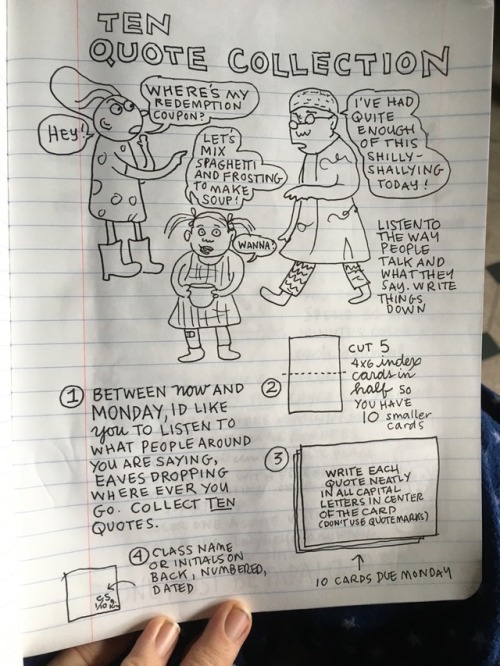
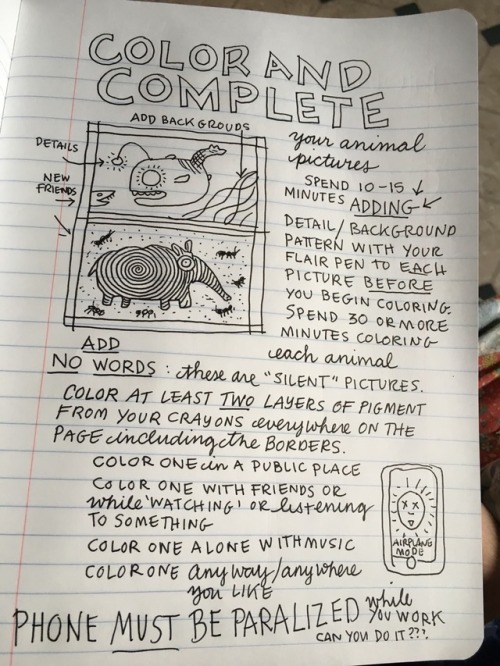
As always, her handwritten homework assignments will be posted to her Nearsighted Monkey tumblr account, along with in-class reflections and inspirational bits and bobs pulled off the Internet.
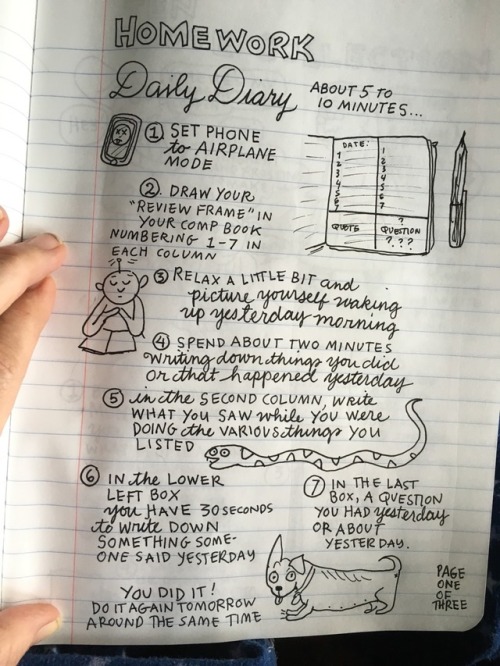
The first task, familiar to readers of her Syllabusworkbook, is to begin a daily diary practice, filling in a template frame of Barry’s own devising.
Begin by putting your phone on airplane mode. “The phone gives us a lot but it takes away three key elements of discovery: loneliness, uncertainty and boredom,” she stated last year, on a visit to NASA’s Goddard Space Flight Center. “Those have always been where creative ideas come from.”
Amen.
Any one of the exercises will renew your powers of observation and sense of connection with the world around you. Don’t be surprised if you find yourself getting up early or skipping some must-see TV in order to fully comply with Professor Skeletor’s feel-good assignments. There are no wrong answers, provided you go at the assignments with energy and a willingness to play. As Barry said in an interview:
Because we tend to give up on the arts so early in life, I became really interested in what would happen if we reintroduce the arts without the thought of ‘you’re going to do this to become a great writer or painter,’ but rather that it might help people with the other work in their field.
For added value, complete your first daily diary frame to an audio recording of Barry’s timed instruction here. (Ignore the background noise of your teacher’s life—her sneezing cat, her happy pet birds—or better yet, let her household’s zesty energy seep into your work.)
Oh sure, they look festive, but seriously, think twice before arming a blindfolded child (or a beer guzzling adult guest) with a sturdy stick and encouraging him to swing wildly.
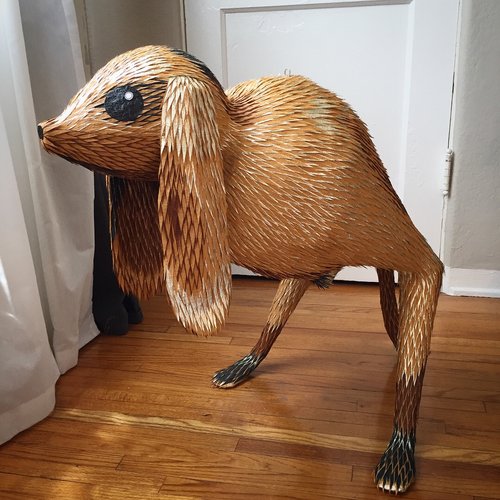
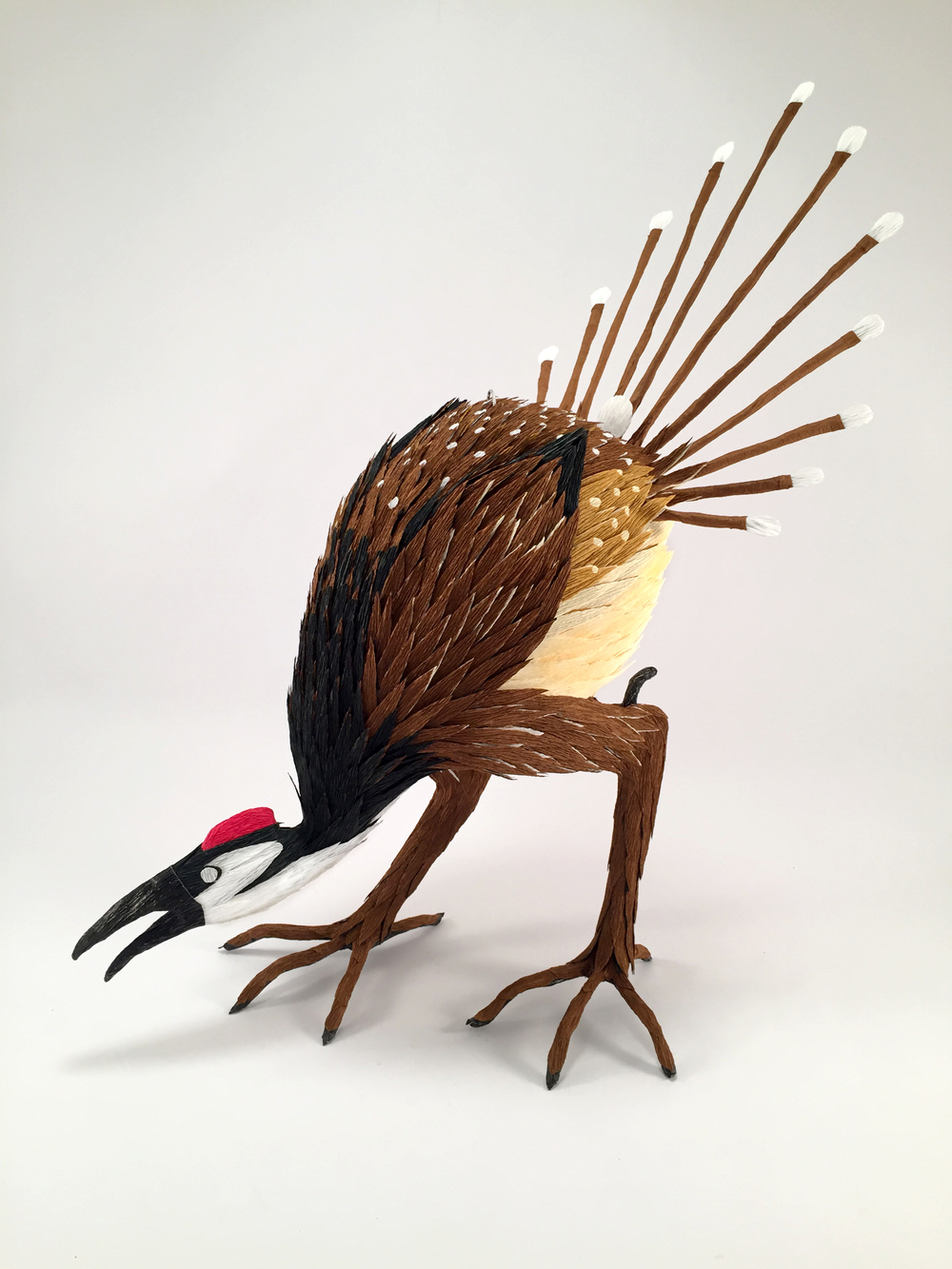
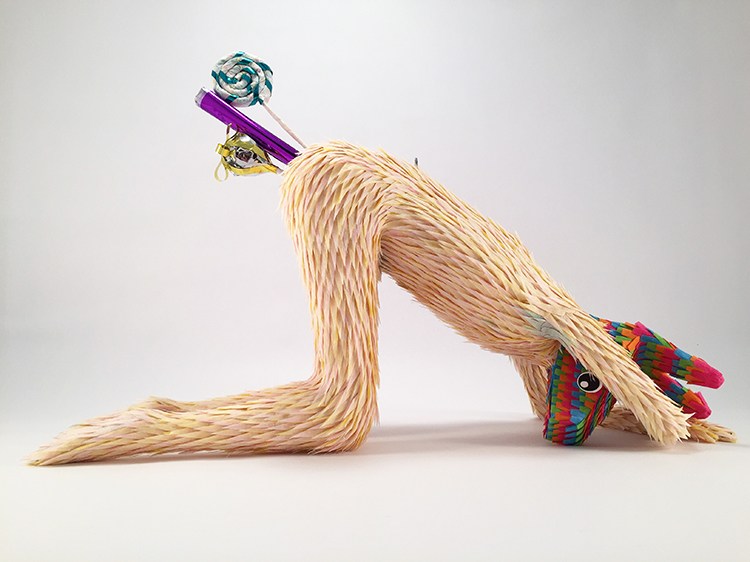
There’s no need to worry, however, about anyone taking a bat to the intricate Hieronymus Bosch-inspired piñatas of Roberto Benavidez, a self-described half-breed, South Texan, queer figurative sculptor.
Even if you filled them with candy, the exteriors would be far more valuable than any treasures contained within.
Bosch, of course, excelled at scenarios far more nightmarish than anything one might encounter in a backyard party. Benavidez seems less drawn to that aspect than the beauty of the fantastical creatures populating The Garden of Earthly Delights.
In fact, the majority of his papier-mâché homages are drawn from the paradisiacal left panel of the famous triptych.
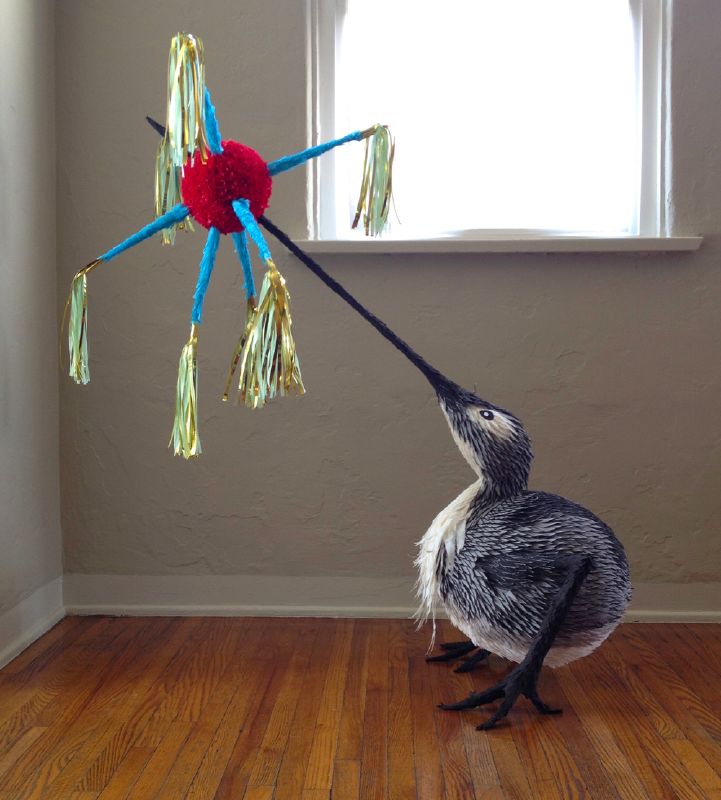
Not so the first in the series, 2013’s superbly titled Piñata of Earthly Delights #1, above
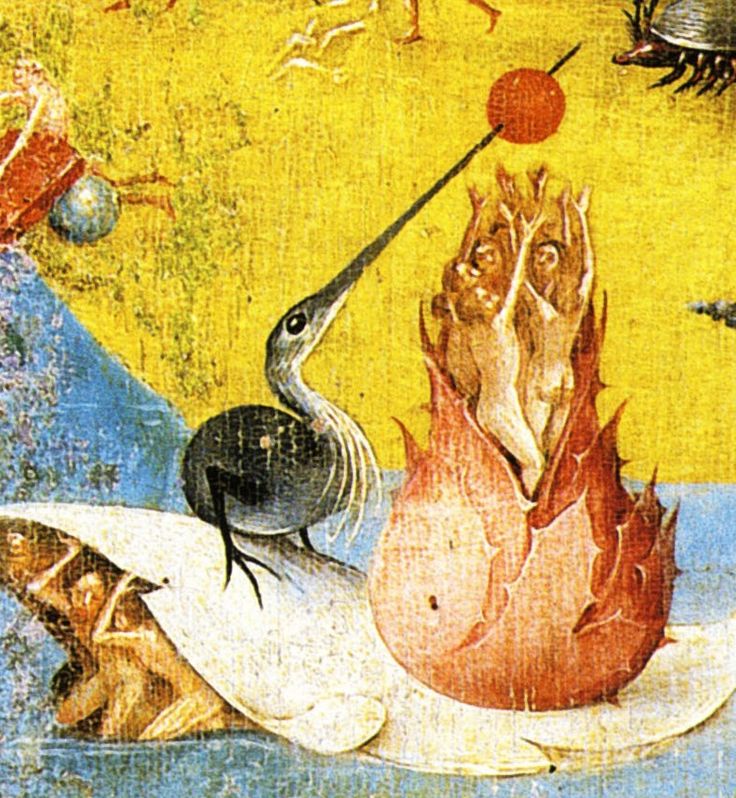
In the original, a misshapen waterbird uses its long beak to spear a cherry with which it tempts a passel of weak-willed mortals, crowded together inside a spiky pink blossom.
In Benavidez’s version the lack of naked humans allows us to focus on the creature, whose beak now pierces a simple star-shaped piñata of its own.
Those with a fascination for the antics of Bosch’s party people are invited to play a variation of Where’s Waldo, scouring the painting for the inspiration behind Candy Ass Bottom, above.
While little is known about Bosch’s artistic training, Benavidez majored in acting, before returning to his childhood fascination for sculpting, taking classes in drawing, painting, and bronze casting at Pasadena City College. Thrift and portability led him to begin exploring paper as his primary medium.
As he remarked on the blog of the crepe paper manufacturer Cartotecnica Rossi:
I was intrigued by the idea of taking the piñata form, something seen as cheap and disposable, and moving it into the arena of fine art. I feel that my sculptural forms and fringing techniques set my work apart from what most people think of as a typical piñata and the themes are more complex than is typical.
Definitely.
View more of Roberto Benavidez’ fine art piñatas, including those inspired by Hieronymus Bosch on his website or Instagram feed.
In his top-grossing comedies, actor Jim Carrey displayed an antic quality that seemed to rule over his personal life as well. While other stars used interviews as opportunities to normalise themselves to the civilians in the audience, clown prince Carrey was relentless, an uncontrollable fire hose of funny faces and voices that felt not unlike demons.
All that output was exhausting, and caused many to wonder if the man was capable of calming down long enough to receive any meaningful input.
As did the revelation that he spent a lot of his childhood in his bedroom drawing — the flip side to his crazy living room performances, staged, in part, to keep an emotionally troubled family from sinking any lower. He also drew in school, aggravating teachers with unauthorised portraits.
After I became famous, my sixth-grade teacher sent me sketches she had confiscated. She kept them because she thought they were cute. She also knew how to harness the energy. If I was quiet, she would give me 15 minutes at the end of class to perform. Today, I’d be on Ritalin, and Ace Ventura would have never been made.
These days, the funny man seems to have turned his back on performing in favor of a more contemplative visual arts practice. His most recent acting credit is over a year old. As David Bushell’s documentary short, I Needed Color, above reveals, the quantity of Carrey’s output is still impressive, but there’s a qualitative difference where the artist is concerned.
His face and body are calm, and the crazed imperative to entertain seems to have left him. Watching him go about his work, one is reminded of cartoonist and educator Lynda Barry’s observations about the neurological connection between the ability to go down the rabbit hole of art and a child’s mental health:
I think it’s what keeps us sane. I think about how, if I’m sitting here with a kid who’s four years old and I have all these markers and I say, do you want to draw, and that kid’s too freaked out to draw, we’d be worried about that kid a little bit, wouldn’t you? We’d be worried about them emotionally. OK, on this side I have a 40-year-old, same situation, she’s too scared to draw, but we’re not worried about her. Why? Because there is a tacit understanding that something is going on when kids are playing or [drawing] that has something to do with their mental health. All of us know that if a kid is not allowed to play till he’s 21, he’s going to be a nut. He’s going to be a psychopath, actually. The brain studies they’ve done of kids in deep play show that their brains are identical to an adult’s brain that is in creative concentration. We know that play is essential for mental health. I would argue that so is drawing.
Art saves lives, right?
Carrey’s earlier success affords him the luxury of time and money to immerse himself in his new vocation without limiting himself to any one style or medium. Giant paintings, tiny sculptures, works that involve black light, squeegees, or shredded canvas stitched back together with wire are all cricket.
Given his movie star status, nasty reviews are to be expected, but approval is no longer what Carrey is seeking:
When I paint and sculpt it stops the world for me, as if all time has been suspended. My spirit is completely engaged, my heart is engaged, and I feel completely free. I think I just like creating. All of it is a portal into present, into absolute, quiet, gentle, stillness. This involvement, this presence, is freedom from concern. That’s harmony with the universe.
LSD was first synthesized in 1938 by chemist Albert Hoffman in a Swiss laboratory but only attained infamy almost two decades later, when it became part of a series of government experiments. At the same time, a UC Irvine psychiatrist, Oscar Janiger (“Oz” to his friends), conducted his own studies under very different circumstances. “Unlike most researchers, Janiger wanted to create a ‘natural’ setting,” writes Brandy Doyle for MAPS (the Multidisciplinary Association for Psychedelic Studies). He reasoned that “there was nothing especially neutral about a laboratory or hospital room,” so he “rented a house outside of LA, in which his subjects could have a relatively non-directed experience in a supportive environment.”
Janiger wanted his subjects to make creative discoveries in a state of heightened consciousness. The study sought, he wrote, to “illuminate the phenomenological nature of the LSD experience,” to see whether the drug could effectively be turned into a creativity pill. He found, over a period lasting from 1954 to 1962 (when the experiments were terminated), that among his approximately 900 subjects, those who were in therapy “had a high rate of positive response,” but those not in therapy “found the experience much less pleasant.” Janiger’s findings have contributed to the research that organizations like MAPS have done on psychoactive drugs in therapeutic settings. The experiments also produced a body of artwork made by study participants on acid.
Janiger invited over 100 professional artists into the study and had them produce over 250 paintings and drawings. The series of eight drawings you see here most likely came from one of those artists (though “the records of the identity of the principle researcher have been lost,” writes LiveScience). In the psych-rock-scored video at the top see the progression of increasingly abstract drawings the artist made over the course of his 8‑hour trip. He reported on his perceptions and sensations throughout the experience, noting, at what seems to be the drug’s peak moment at 2.5 and 3 hours in, “I feel that my consciousness is situated in the part of my body that’s active—my hand, my elbow, my tongue…. I am… everything is… changed… they’re calling… your face… interwoven… who is….”
Trippy, but there’s much more to the experiment than its immediate effects on artists’ brains and sketches. As Janiger’s colleague Marlene Dobkin de Rios writes in her definitive book on his work, “all of the artists who participated in Janiger’s project said that LSD not only radically changed their style but also gave them new depths to understand the use of color, form, light, or the way these things are viewed in a frame of reference. Their art, they claimed, changed its essential character as a consequence of their experiences.” Psychologist Stanley Krippner made similar discoveries, and “defined the term psychedelic artist” to describe those who, as in Janiger’s studies “gained a far greater insight into the nature of art and the aesthetic idea,” Dobkin de Rios writes.
Artistic productions—paintings, poems, sketches, and writings that stemmed from the experience—often show a radical departure from the artist’s customary mode of expression… the artists’ general opinion was that their work became more expressionistic and demonstrated a vastly greater degree of freedom and originality.
The work of the unknown artist here takes on an almost mystical quality after a while. The project began “serendipitously” when one of Janiger’s volunteers in 1954 insisted on being able to draw during the dosing. “After his LSD experience,” writes Dobkin de Rios, “the artist was very emphatic that it would be most revealing to allow other artists to go through this process of perceptual change.” Janiger was convinced, as were many of his more famous test subjects.
Janiger reportedly introduced LSD to Cary Grant, Anais Nin, Jack Nicholson, and Aldous Huxley during guided therapy sessions. Still, he is not nearly as well-known as other LSD pioneers like Ken Kesey and Timothy Leary, in part because, writes the psychoactive research site Erowid, “his data remained largely unpublished during his lifetime,” and he was not himself an artist or media personality (though he was a cousin of Allen Ginsberg).
Janiger not only changed the consciousness of unnamed and famous artists with LSD, but also experimented with DMT with Alan Watts and fellow psychiatrist Humphry Osmond (who coined the word “psychedelic”), and conducted research on peyote with Dobkin de Rios. To a great degree, we have him to thank (or blame) for the explosion of psychedelic art and philosophy that flowed out of the early sixties and indelibly changed the culture. At LiveScience, you can see a slideshow of these drawings with commentary from Yale physician Andrew Sewell on what might be happening in the tripping artist’s brain.
Everyone used to read Samuel Johnson. Now it seems hardly anyone does. That’s a shame. Johnson understood the human mind, its sadly amusing frailties and its double-blind alleys. He understood the nature of that mysterious act we casually refer to as “creativity.” It is not the kind of thing one lucks into or masters after a seminar or lecture series. It requires discipline and a mind free of distraction. “My dear friend,” said Johnson in 1783, according to his biographer and secretary Boswell, “clear your mind of cant.”
There’s no missing apostrophe in his advice. Inspiring as it may sound, Johnson did not mean to say “you can do it!” He meant “cant,” an old word for cheap deception, bias, hypocrisy, insincere expression. “It is a mode of talking in Society,” he conceded, “but don’t think foolishly.” Johnson’s injunction resonated through a couple centuries, became garbled into a banal affirmation, and was lost in a graveyard of image macros. Let us endeavor to retrieve it, and ruminate on its wisdom.
We may even do so with our favorite modern brief in hand, the scientific study. There are many we could turn to. For example, notes Derek Beres, in a 2014 book neuroscientist Daniel Levitin brought his research to bear in arguing that “information overload keeps us mired in noise.… This saps us of not only willpower (of which we have a limited store) but creativity as well.” “We sure think we’re accomplishing a lot,” Levitin told Susan Page on The Diane Rehm Show in 2015, “but that’s an illusion… as a neuroscientist, I can tell you one thing the brain is very good at is self-delusion.”
Johnson’s age had its own version of information overload, as did that of another curmudgeonly voice from the past, T.S. Eliot, who wondered, “Where is the wisdom we have lost in knowledge? Where is the knowledge we have lost in information?” The question leaves Eliot’s readers asking whether what we take for knowledge or information really are such? Maybe they’re just as often forms of needless busyness, distraction, and overthinking. Stanford researcher Emma Seppälä suggests as much in her work on “the science of happiness.” At Quartz, she writes,
We need to find ways to give our brains a break.… At work, we’re intensely analyzing problems, organizing data, writing—all activities that require focus. During downtime, we immerse ourselves in our phones while standing in line at the store or lose ourselves in Netflix after hours.
Seppälä exhorts us to relax and let go of the constant need for stimulation, to take longs walks without the phone, get out of our comfort zones, make time for fun and games, and generally build in time for leisure. How does this work? Let’s look at some additional research. Bar-Ilan University’s Moshe Bar and Shira Baror undertook a study to measure the effects of distraction, or what they call “mental load,” the “stray thoughts” and “obsessive ruminations” that clutter the mind with information and loose ends. Our “capacity for original and creative thinking,” Bar writes at The New York Times, “is markedly stymied” by a busy mind. “The cluttered mind,” writes Jessica Stillman, “is a creativity killer.”
In a paper published in Psychological Science, Bar and Baror describe how “conditions of high load” foster unoriginal thinking. Participants in their experiment were asked to remember strings of arbitrary numbers, then to play word association games. “Participants with seven digits to recall resorted to the most statistically common responses (e.g., white/black),” writes Bar, “whereas participants with two digits gave less typical, more varied pairings (e.g. white/cloud).” Our brains have limited resources. When constrained and overwhelmed with thoughts, they pursue well-trod paths of least resistance, trying to efficiently bring order to chaos.
“Imagination,” on the other hand, wrote Dr. Johnson elsewhere, “a licentious and vagrant faculty, unsusceptible of limitations and impatient of restraint, has always endeavored to baffle the logician, to perplex the confines of distinction, and burst the enclosures of regularity.” Bar describes the contrast between the imaginative mind and the information processing mind as “a tension in our brains between exploration and exploitation.” Gorging on information makes our brains “’exploit’ what we already know,” or think we know, “leaning on our expectation, trusting the comfort of a predictable environment.” When our minds are “unloaded,” on the other hand, which can occur during a hike or a long, relaxing shower, we can shed fixed patterns of thinking, and explore creative insights that might otherwise get buried or discarded.
As Drake Baer succinctly puts in at New York Magazine’s Science of Us, “When you have nothing to think about, you can do your best thinking.” Getting to that state in a climate of perpetual, unsleeping distraction, opinion, and alarm, requires another kind of discipline: the discipline to unplug, wander off, and clear your mind.
Ask any creator subject to frequent interviews which questions they dread, and one in particular will come up more than any other: “Where do you get your ideas?” Some have readily spoken and written on the subject — Isaac Asimov, Neil Gaiman, David Lynch — but most, even if they’ve had truly astonishing ideas, have given the subject of ideas in general little thought. The video above, named after the infamous question, compiles a variety of answers from a variety of people, younger and older, famous and less so, into a five-minute search for the source of human creativity.
“I get ideas in fragments,” says Lynch, whose voice we hear amid the many others in the video. “It’s as if, in the other room, there’s a puzzle and all the pieces are together. But in my room, they just flip one piece at a time into me.”
When a good idea comes along, says a twelve-year-old named Ursula, “that’s the feeling they call inspiration.” But Radiolab host Robert Krulwich has a dim view of inspiration: “I’m a little suspicious of the idea like, ‘In the beginning there was nothing and then there was light.’ I don’t think I’ve had that experience, and for other people who’ve said that they’ve had that experience, I’m not sure I believe them.”
“Inspiration is for amateurs,” says artist Chuck Close. “The rest of us just show up and get to work. Every great idea came out of work, everything.” Chalk up another point in favor of Thomas Edison’s famous breakdown of genius as one percent inspiration and 99 percent perspiration — but what kind of perspiration? As professional skateboarder Ray Barbee sees it, “most people start off by mimicking something, but then it turns into their own thing because they don’t really have the ability to mimic it precisely,” a process that produces “originality from copying.”
“Whenever I finish a story,” says New Yorker writer Susan Orlean, “I go through a period of time where I feel like I will never again have an idea.” But it never lasts as long as it feels: “One day you fall onto something, and it just looks you in the face and says, ‘I’m the one.’ ” That “one” could take the form, according to the video’s contributors, of a chance encounter, a sentence in a story, a yellow ball bouncing down the street, a solitary lawn chair seen from a train window, a dump trick, or many other even less expected entities besides. You just have to be primed and ready to connect it in an interesting manner to other things in your head, in your environment, and in the culture. “Luck is what happens when preparation meets opportunity,” goes a well-known quote often attributed to Seneca — and so, it seems, is creativity.
We're hoping to rely on loyal readers, rather than erratic ads. Please click the Donate button and support Open Culture. You can use Paypal, Venmo, Patreon, even Crypto! We thank you!
Open Culture scours the web for the best educational media. We find the free courses and audio books you need, the language lessons & educational videos you want, and plenty of enlightenment in between.