How to be creative? There’s no simple answer to that question, and no shortage of people offering answers. Comic genius John Cleese will tell you it’s all about creating “oases for childlike play.” Filmmaker David Lynch finds a great source of creativity in meditation. Novelist Amy Tan sees creativity flowing from a kind of cosmic empathy (gotta watch the video to see what I mean). And Stanford educator Tina Seelig offers her own set of answers in a recent book, MOOC, and a TED Talk.
Now let us give you a little more food for thought. The latest episode of PBS’ Off Book video series features four figures — an author, cognitive psychologist, filmmaker, and computer scientist — all trying to put their fingers on the elusive things that make creativity happen. Their thoughts and advice are varied. But if you put them all together, you may make strides in your own creative life.
Ever wonder how famous philosophers from the past spent their many hours of tedium between paradigm-smashing epiphanies? I do. And I have learned much from the biographical morsels on “Daily Routines,” a blog about “How writers, artists, and other interesting people organize their days.” (The blog has also now yielded a book, Daily Rituals: How Artists Work.) While there is much fascinating variety to be found among these descriptions of the quotidian habits of celebrity humanists, one quote found on the site from V.S. Pritchett stands out: “Sooner or later, the great men turn out to be all alike. They never stop working. They never lose a minute. It is very depressing.” But I urge you, be not depressed. In these précis of the mundane lives of philosophers and artists, we find no small amount of meditative leisure occupying every day. Read these tiny biographies and be edified. The contemplative life requires discipline and hard work, for sure. But it also seems to require some time indulging carnal pleasures and much more time lost in thought.
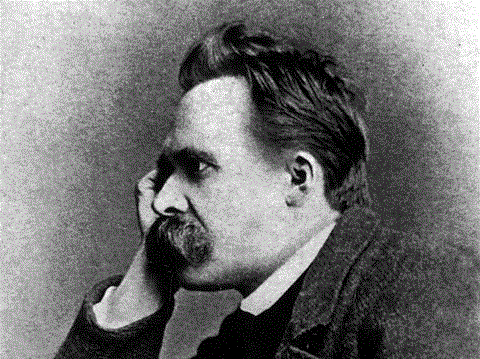
Let’s take Friedrich Nietzsche (above). While most of us couldn’t possibly reach the great heights of iconoclastic solitude he scaled—and I’m not sure that we would want to—we might find his daily balance of the kinetic, aesthetic, gustatory, and contemplative worth aiming at. Though not featured on Daily Routines, an excerpt from Curtis Cate’s eponymous Nietzsche biography shows us the curious habits of this most curious man:
With a Spartan rigour which never ceased to amaze his landlord-grocer, Nietzsche would get up every morning when the faintly dawning sky was still grey, and, after washing himself with cold water from the pitcher and china basin in his bedroom and drinking some warm milk, he would, when not felled by headaches and vomiting, work uninterruptedly until eleven in the morning. He then went for a brisk, two-hour walk through the nearby forest or along the edge of Lake Silvaplana (to the north-east) or of Lake Sils (to the south-west), stopping every now and then to jot down his latest thoughts in the notebook he always carried with him. Returning for a late luncheon at the Hôtel Alpenrose, Nietzsche, who detested promiscuity, avoided the midday crush of the table d’hôte in the large dining-room and ate a more or less ‘private’ lunch, usually consisting of a beefsteak and an ‘unbelievable’ quantity of fruit, which was, the hotel manager was persuaded, the chief cause of his frequent stomach upsets. After luncheon, usually dressed in a long and somewhat threadbare brown jacket, and armed as usual with notebook, pencil, and a large grey-green parasol to shade his eyes, he would stride off again on an even longer walk, which sometimes took him up the Fextal as far as its majestic glacier. Returning ‘home’ between four and five o’clock, he would immediately get back to work, sustaining himself on biscuits, peasant bread, honey (sent from Naumburg), fruit and pots of tea he brewed for himself in the little upstairs ‘dining-room’ next to his bedroom, until, worn out, he snuffed out the candle and went to bed around 11 p.m.
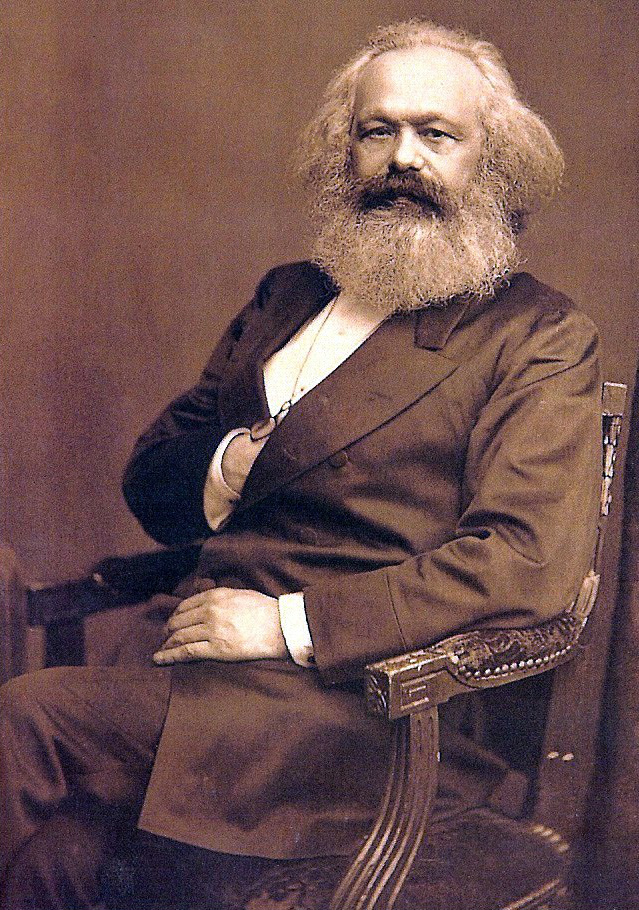
This comes to us via A Piece of Monologue, who also provide some photographs of Nietzsche’s favorite Swiss vistas and his austere accommodations. No doubt this life, however lonely, led to the production of some of the most world-shaking philosophical texts ever produced, perhaps rivaled in the nineteenth century only by the work of the prodigious Karl Marx.
So how did Marx’s daily life compare to the morose and monkish Nietzsche? According to Isaiah Berlin, Marx also had his daily habits, though not quite so well-balanced.
His mode of living consisted of daily visits to the British Museum reading-room, where he normally remained from nine in the morning until it closed at seven; this was followed by long hours of work at night, accompanied by ceaseless smoking, which from a luxury had become an indispensable anodyne; this affected his health permanently and he became liable to frequent attacks of a disease of the liver sometimes accompanied by boils and an inflammation of the eyes, which interfered with his work, exhausted and irritated him, and interrupted his never certain means of livelihood. “I am plagued like Job, though not so God-fearing,” he wrote in 1858.
Marx’s money worries contributed to his physical complaints, surely, as much as Nietzsche’s social anxiety did to his. Not all philosophers have had such dramatic emotional lives, however.
Smoking plays a significant role as a daily aid, for good or ill, in the daily lives of many philosophers, such as that of giant of 18th century thought, Immanuel Kant. But Kant suffered from neither penury nor some severe case of unrequited love. He seems, indeed, to have been a rather dull person, at least in the biographical sketch below by Manfred Kuehn.
His daily schedule then looked something like this. He got up at 5:00 A.M. His servant Martin Lampe, who worked for him from at least 1762 until 1802, would wake him. The old soldier was under orders to be persistent, so that Kant would not sleep longer. Kant was proud that he never got up even half an hour late, even though he found it hard to get up early. It appears that during his early years, he did sleep in at times. After getting up, Kant would drink one or two cups of tea — weak tea. With that, he smoked a pipe of tobacco. The time he needed for smoking it “was devoted to meditation.” Apparently, Kant had formulated the maxim for himself that he would smoke only one pipe, but it is reported that the bowls of his pipes increased considerably in size as the years went on. He then prepared his lectures and worked on his books until 7:00. His lectures began at 7:00, and they would last until 11:00. With the lectures finished, he worked again on his writings until lunch. Go out to lunch, take a walk, and spend the rest of the afternoon with his friend Green. After going home, he would do some more light work and read.
For all of their various complaints and ailments, throughout their most productive years these highly productive writers embraced Gustave Flaubert’s maxim, “Be regular and orderly in your life, so that you may be violent and original in your work.” I have always believed that these are words to live and work by, with the addition of a little vice or two to spice things up.
If you would like to support the mission of Open Culture, consider making a donation to our site. It’s hard to rely 100% on ads, and your contributions will help us continue providing the best free cultural and educational materials to learners everywhere. You can contribute through PayPal, Patreon, and Venmo (@openculture). Thanks!
Though he became known for the physical comedy of characters like the irate owner of a dead parrot, a minister of silly walks, and the always buffoonish Basil Fawlty, John Cleese is actually a very deep thinker. This will probably come as no surprise to fans of Monty Python’s intellectual humor, but it’s still a treat to see him, out of character, getting serious about ideas, even if he can’t resist the odd joke or ten. His subject? Creativity. His forum? Well, in the video above, we see Cleese at the 2009 World Creativity Forum in Germany. In a 2010 guest post on this talk, Maria Popova of Brain Pickings called the event “part critique of modernity’s hustle-and-bustle, part handbook for creating the right conditions for creativity.” What does John Cleese have to say about creating those conditions?
By combining another talk from Cleese from 1991 (below), we are able to piece together a Cleese philosophy of creativity. He begins in his ’91 talk by telling people what creativity is not, and why lecturing on it is “a complete waste of time.” The reason? It cannot be explained. “It is literally inexplicable.”
Drawing on research from his friend Brian Bates, a psychologist as Sussex University, Cleese claims that those considered more creative do not differ in any significant way from their equally intelligent and talented peers, and therefore, they do not possess any special skills or abilities that would qualify as “creativity.” As a onetime student of the sciences at Cambridge, Cleese has a high regard for data and observation, and in each of these talks, he applies a scientific method to his subject.
What, then, has he learned from observing his own work habits and looking at the research? What can he positively say about creativity? For one thing, it is not a skill or an aptitude, it is a “mood,” one Cleese describes as “childlike” in that it aids one in the ability to play. Cleese makes a similar point in his 2009 talk at the top, emphasizing that acquiring this mood is difficult but not impossible. As all artists know, genuine creative insights occur when rational thought ceases—during dreamstates or moments of absorption so intense that self-consciousness, anxiety, and the needling cares of the day drop away. As Cleese put it at the World Creativity Forum, “if you’re racing around all day, ticking things off a list, looking at your watch, making phone calls and generally just keeping all the balls in the air, you are not going to have any creative ideas.” This explains why the offices of companies like Google are full of toys, why the workdays of the Mad Men “creatives” often resemble preschool, and why artists’ work spaces tend to be so intriguing to peer into. They are, as Cleese terms them, “oases” from the punishing pace of the workaday world.
In Cleese’s considered opinion, such oases, both physical and mental, are the preconditions for childlike wonder to override adult routine ways of thinking. Of course as Cleese and his hard-working co-creators also show us, a great deal of grown-up discipline is required to bring creative ideas to fruition. The trick, Cleese says, is in making the space to engage in childlike play without relying on childish spontaneity—he recommends scheduling time to be creative, giving oneself a “starting time and a finish time” and thereby setting “boundaries of space, boundaries of time.” Of course, this kind of mindful structuring is something only a mature adult mind can do. Seeing this grown-up side of Cleese gives us a new appreciation for the consistently childlike characters he’s created over the years, and for the role of conscious attention in safeguarding and nurturing unconscious insight.
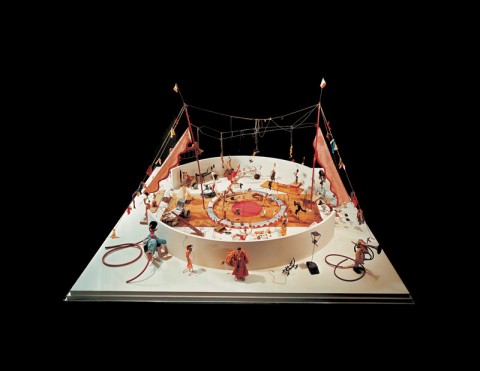
Alexander Calder’s Calder’s Circus, a toy theater piece the artist constructed between 1926 and 1931, and performed for decades, has the rag bag appeal of a much-repaired stuffed animal who’s loved into a state of baldness. This charm presented conservators at the Whitney Museum of American Art with a unique set of challenges. Not only were the cloth and wire structures fragile with age, they’d taken a beating during the period when they were on active duty. Should the work be restored to its pristine state or should the artist’s clumsy, on-the-fly patch jobs be preserved as evidence of use?
As part of the restoration effort, the Whitney’s team of conservators, archivists and historians delved into circus history, learning that Calder’s ringmaster, tightrope dancer, bareback rider, and lion tamer were all based on circus stars of the period.
They also leaned on two films depicting the work in motion, Jean Painleve’s Le Grand Cirque Calder 1927 andLe Cirque de Calderby Carlos Vilardebo. But with more than two hundred live performances, it seemed a good bet that the characters could be manipulated in ways other than the ones captured on film. An acrobat who was consulted agreed, but also concluded that some of the moves of which these little wire figures were capable would be impossible for human beings.
As archivist Anita Duquette notes above, even in its restored state the Circus will now be a static affair, partly from the ongoing effort to conserve its delicate materials, but more because the master who apparently took such pleasure in bringing it to life is not available for an encore performance.
- Ayun Halliday will take a cork-wire-and-fabric-scrap tabletop circus over a 3D CGI any old day. Follow her @AyunHalliday
As an arty, unathletic only child in the 70s, I refused to buy into the idea that science could be fun. This despite a wealth of zippy educational programming, and the efforts of at least two cute young teachers whose hands-on approach included throwing eggs off of a railroad trestle, demolishing toothpick bridges and dipping things into liquid nitrogen for the sheer pleasure of seeing them explode when they hit the wall. Nice try. As far as I was concerned, those dullsville black-and-white films from the ’50s embodied the subject’s general vibe far more honestly than any attempt to force it down our throats with a fashionable Honeycomb Kids-style spin.
Having by now met dozens of scientists and science enthusiasts who are left cold by the arts, I’m not ashamed to be plainspoken here. I certainly don’t begrudge them their passion, and appreciate it when they don’t belittle mine. Different strokes, you know?
Stegerfor’s method for capturing big brained innovators in a light frame of mind resembles a well run experiment. His unsuspecting specimens were apprehended at Germany’s annual Lindau Nobel Laureate Meeting. Thus secured, they were led one at a time into a temporary studio where each was invited to draw whatever it was that had earned him or her the Nobel prize. The results weren’t much as art, but they’re unmistakably playful, bristling with arrows, exclamation points, smiley faces, and word bubbles. The photographer let his subjects pick the pose, at which points things did become art.
I’m going to award 1996 Chemistry laureate Sir Harold Kroto Best in Show for his well warranted action pose. Apparently, his discovery’s molecular structure looks like a soccer ball.
It’s not exactly Breaking Bad, but it does bring Chemistry alive for me as a subject others might find enjoyable in the empirical sense.
View a gallery of Volker Stegerfor’s Sketches of Science. If you’re really into it, the Nobel Museum is heralding a traveling exhibition of Stegerfor’s work with audio recordings of the scientists on the subject of their discoveries.
Actually, LSD ABC, defies neat categorization. Beyond the fact that they’re both spelled out using letters, what could Dim Sum possibly have in common with VHS? Not much prior serving as inspirational prompts for graphic designers Laurent & Françoise (otherwise known as Laura Sicouri and Kadavre Exquis). Now they’re 1/13th of a delightfully twisted animated whole, one of those deadline-free pet projects that goes on to spawn a limited edition vinyl album.
The duo is prone to fetishizing the anachronistic technologies of the recent past, in a manner slightly more elegant than comedians Tim Heidecker and Eric Wareheim. They toss in a foot similar to the one Terry Gilliam used to such effect on Monty Python. H and S are subjected to the sort of indignities Wile E. Coyote used to suffer at the hands of the Road Runner. It’s all tied together with AT&T Lab’s decidedly unnatural-sounding Natural Voice text-to-speech narration.
While it’s difficult to pick a favorite from such a mind bending array, I’m going to have to go with P…for Pet Piano, natch. You?
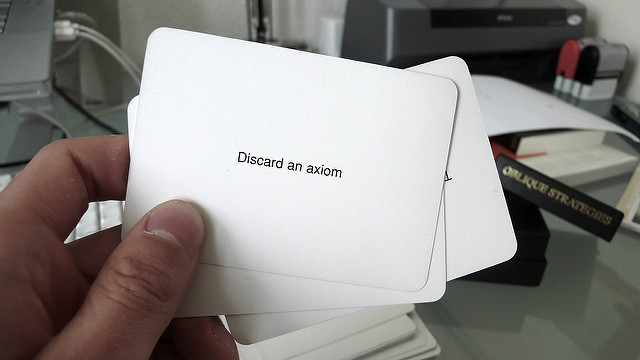
The likes of U2, Coldplay, and David Bowie can afford to hire producer, artist, and thinker Brian Eno to shake up their creative processes. You and I, alas, probably can’t. We can, however, afford to consult the Oblique Strategies, a deck of cards invented by Eno and painter Peter Schmidt in 1975. Each card offers, in its own oblique fashion, a strategy you can follow when you find yourself at an impasse in your own work, be it music, painting, or any form at all: “Honor thy error as a hidden intention.” “State the problem in words as clearly as possible.” “Remember those quiet evenings.” “Once the search is in progress, something will be found.” “Work at a different speed.” “Look closely at the most embarrassing details and amplify them.”
“The Oblique Strategies evolved from me being in a number of working situations when panic, particularly in studios, tended to make me quickly forget that there were others ways of working,” said Eno in a 1980 radio interview, “and that there were tangential ways of attacking problems that were in many senses more interesting than the direct head-on approach.”
Should you feel the need for just such a break with the obvious approach, you can track down one of the official physical editions of the Oblique Strategies deck. Or you can consult one of its many virtual versions available on the internet. Eno talks about how the deck of cards came into being. Vintage sets can be found on Amazon here.
It may be a misconception, it may be a cliché: I’m not a German speaker—but reading translator’s introductions to, say, Kant, Hegel or Goethe has convinced me that their language does a much better job than English at capturing those oddly specific twilight moods and compound feelings that so often escape definition. Then again, English absorbs, cannibalizes, appropriates, steals, and bastardizes words wherever it can find them, driving lexicographers and grammar purists mad.
Graphic designer and filmmaker John Koenig does all of these things in his “Dictionary of Obscure Sorrows,” a blog project in which he names emotions that otherwise leave us speechless. In his short video above, he illustrates one of his words, “Sonder,” or “the realization that each random passerby is living a life as vivid and complex as your own…”—something like the shock of sudden empathy that shakes us out of navel-gazing. It’s an emotion I’ve experienced, without knowing what to call it.
This being an “obscure sorrow,” there’s more to it than empathy—in Koenig’s poetic video, “sonder” relates to the infinite number of overlapping stories, in which each of us feels we are the hero, others supporting cast or extras. In a state of “sonder,” we suddenly occupy all of those roles at once, our screen time diminishing as others take the lead. After watching Koenig’s film, I’m thinking “sonder” is a portmanteau of “sublime” and “wonder.” It’s a mystical philosophy contained within a single made-up word.
Some other Koenig coinages: “Ruckkehrunruhe,” “nodus tollens,” “adronitis,” “rigor samsa”.…. I leave it to you to visit Koenig’s Dictionary and learn what these words mean. It’s an experience well worth your time.
We're hoping to rely on loyal readers, rather than erratic ads. Please click the Donate button and support Open Culture. You can use Paypal, Venmo, Patreon, even Crypto! We thank you!
Open Culture scours the web for the best educational media. We find the free courses and audio books you need, the language lessons & educational videos you want, and plenty of enlightenment in between.