
DEVO Is Now Selling COVID-19 Personal Protective Equipment: Energy Dome Face Shields
According to DEVO’s co-principle songwriter and bassist Gerald Casale, the experimental art band turned early MTV pop-punk darlings were “pro-information, anti stupid conformity and knew that the struggle for freedom against tyranny is never-ending.”
Their singular performance garb also set them apart, and none more so than the bright red plastic Energy Dome helmets they donned 40 years ago this month, upon the release of their third album, Freedom of Choice.
The record, which the band conceived of as a funk album, exploded into mainstream consciousness. The visuals may have made an even more lasting impact than the music, which included the chart topping “Whip It.”
Even the most anti-New Wave metalhead could identify the source of those domes, which have been likened to upturned flower pots, dog bowls, car urinals, and lamp shades.
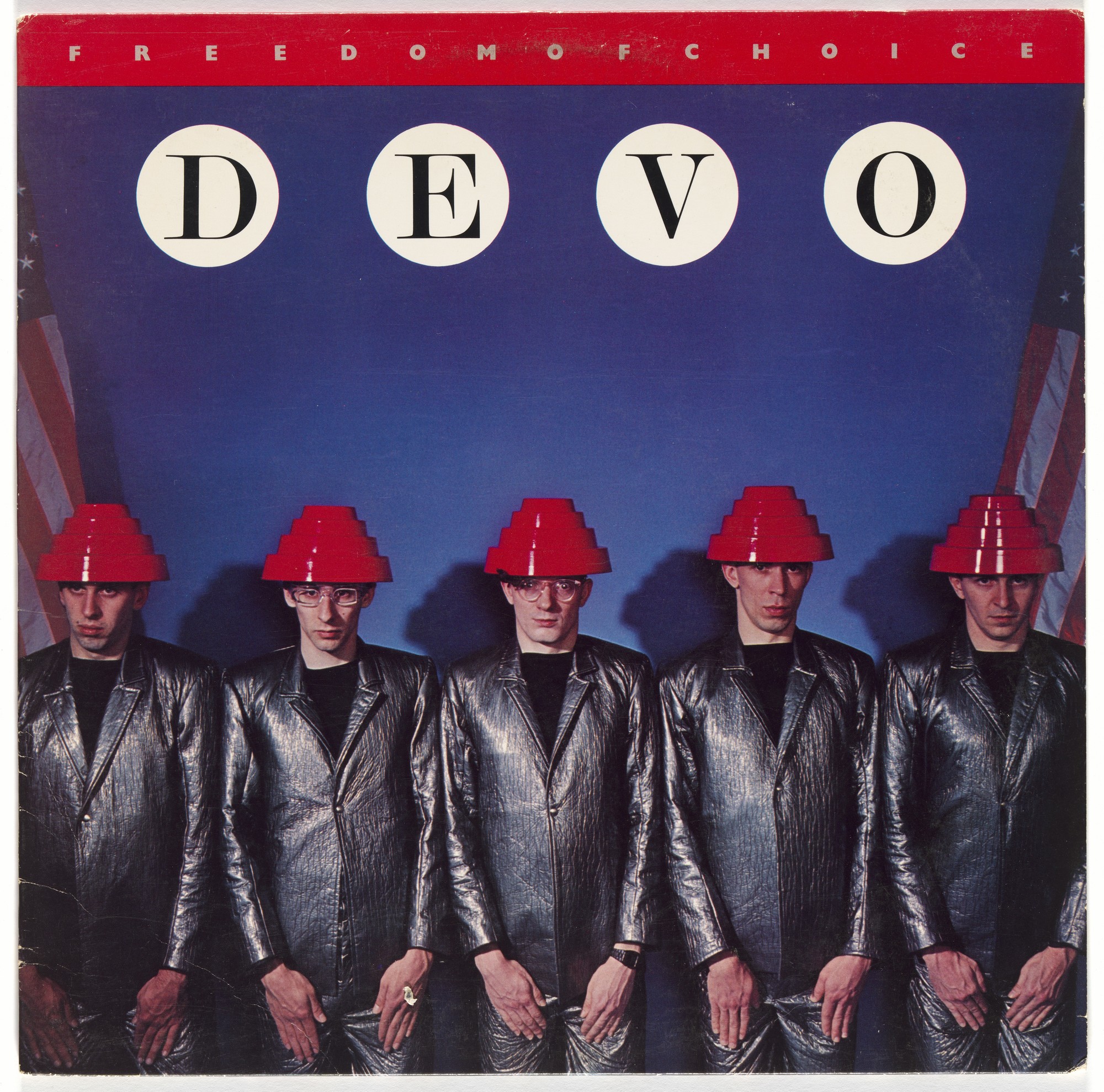
What they probably don’t know is the Energy Dome was “designed according to ancient ziggurat mount proportions used in votive worship. Like the mounds, it collects energy and recirculates it. In this case, the dome collects energy that escapes from the crown of the human head and pushes it back into the Medula Oblongata for increased mental energy.”
Thus sayeth Casale, anyway.
DEVO’s 2020 concert plans were, of course, scotched by the coronavirus pandemic, but the band has found an alternative way to mark the 40th anniversary of Freedom of Choice and the birth of its iconic headgear.
In addition to face masks emblazoned with the familiar red tiered shape, DEVOtees with money and confidence to spare can ante up for a DIY Personal Protective Equipment kit that transforms a standard-issue Energy Dome into a face shield.
It’s worth noting that before taking your converted energy dome out for a particle deflecting spin, you’ll have to truffle up a hard hat suspension liner and install it for a proper fit.


Casale heralded the opening of DEVO’s merch store in a Facebook post:
Here we are 40 years later, living in the alternate reality nightmare spawned by Covid 19 and the botched response of our world “leaders” to do the right thing quickly. We are not exaggerating when we say that 2020 could be the last time you might be able to exercise your freedom of choice. If you don’t use it, you can certainly lose it.
Uh, he’s talking about voting, right, rather than storming the capitol building to demand the premature reopening of inessential businesses or making outsized threats in response to grocery store mask policies?
Perhaps the power of the Energy Dome is such that it could reawaken the pro-information, anti-stupidity sensibilities of some dormant DEVO fans among the unmasked rank and file.
As Casale himself posited in an interview with American Songwriter: “You make it taste good so that they don’t realize there’s medicine in it.”
Pre-order masks and PPE kits from DEVO’s official merch store.
Download instructions for installing a hard hat suspension replacement inside the Energy Dome prior to attaching the shield.
Related Content:
The Mastermind of Devo, Mark Mothersbaugh, Presents His Personal Synthesizer Collection
Ayun Halliday is an author, illustrator, theater maker and Chief Primatologist of the East Village Inky zine. Here latest project is an animation and a series of free downloadable posters, encouraging citizens to wear masks in public and wear them properly. Follow her @AyunHalliday.
David Lynch Creates Daily Weather Reports for Los Angeles: How the Filmmaker Passes Time in Quarantine
David Lynch hasn’t directed a feature film in thirteen years, but that doesn’t mean he’s been idle. Quite the opposite, in fact: in addition to the acclaimed Showtime series Twin Peaks: The Return, he’s recorded an album, written a memoir, taught a Masterclass, overseen the development of a Twin Peaks virtual reality game, and made a short film about ants devouring a piece of cheese. In his home studio, he’s also continued the visual art practice he started before turning to filmmaker in the 1970s. We may know Lynch best as the man behind Eraserhead, Blue Velvet, and Mulholland Drive, but he seems equally comfortable working in whichever form or medium is at hand. In this time of COVID-19 quarantine, which has suspended filmmaking, filmgoing, and other kinds of human activity, one such medium is the weather report.
“Here in L.A.… kind of cloudy… some fog this morning,” says the respected filmmaker in his weather-report video for May 11, 2020. “64 degrees Fahrenheit; around seventeen Celsius. This all should burn off pretty soon, and we’ll have sunshine and 70 degrees.” All just what one would expect from the climate of Los Angeles, the southern Californian metropolis where Lynch lives and which he often praises — and which, it’s recently been reported, will likely extend its stay-at-home order for at least three more months.
The sudden lack of movement in this famously mobile city has done wonders for the air quality, but so far that element hasn’t figured explicitly into Lynch’s reports. “We’ve got clouds and kind of foggy weather, with some blue shining through,” he says on the morning of May 12th. But just as the day before, that fog “should burn off later, and we’ll have sunshine.” Longtime followers of Lynch’s internet projects will recognize these as a sequel to the daily video weather reports he posted in 2008:
They’ll also recognize most of the objects that surround Lynch in his office, from his set of drawers to his wall-mounted phone to his angular-handled black coffee cup. But the dramatic increase in the resolution of internet video over the past dozen years has made everything visible in a newly crisp detail, right down to the steam rising from Lynch’s hot beverage of choice. More daily weather reports will presumably appear on the David Lynch Theater Youtube channel, each one colored by his signature (and, given the unrelentingly disturbing qualities of his best-known work, seemingly incongruous) optimism. “It’s going to be a different world on the other side,” he told Vice last month. “It’s going to be a much more intelligent world. Solutions to these problems are going to come and life’s going to be very good. The movies will come back. Everything will spring back and in a much better way, probably.”
Find a playlist of Lynch’s weather reports here.
If you would like to support the mission of Open Culture, consider making a donation to our site. It’s hard to rely 100% on ads, and your contributions will help us continue providing the best free cultural and educational materials to learners everywhere. You can contribute through PayPal, Patreon, and Venmo (@openculture). Thanks!
Related Content:
David Lynch’s New ‘Crazy Clown Time’ Video: Intense Psychotic Backyard Craziness (NSFW)
Based in Seoul, Colin Marshall writes and broadcasts on cities, language, and culture. His projects include the book The Stateless City: a Walk through 21st-Century Los Angeles and the video series The City in Cinema. Follow him on Twitter at @colinmarshall, on Facebook, or on Instagram.
The Case for a Universal Basic Income in the Time of COVID-19
The idea of Universal Basic Income (UBI) has been the subject of much debate in the past few years. The candidacy of Andrew Yang for U.S. President brought the issue to national prominence, where it has remained during the spread of COVID-19. What is UBI? Put simply, it proposes that the government give every citizen a certain amount of money each month to cover, at the least, basic living expenses. As the video above by YouTube channel Kurzgesagt explains, those citizens are then free to live their lives as they like.
Unlike most welfare state models, UBI usually does not involve any means testing. In most schemes, every citizen, no matter their current wealth or income, receives the benefit. (Though most studies of the program have only given it to poor or unemployed beneficiaries.) Those who do not need the money can do whatever they want with it, but so too can those who need it. UBI ensures that people do not have go homeless or hungry if they lose their livelihood, and that they can survive without paternalist state agencies breathing down their necks.
UBI is not a new idea but dates back at least to Thomas Paine, whose Common Sense inspired the American Revolution and whose Rights of Man defended the French a few years later. As Paine argued in another, little-read, pamphlet, Agrarian Justice, no one could be truly free if they had no means of subsistence. Since capitalism had placed most of those means under private ownership, he reasoned, citizens should be compensated for being deprived of resources that belonged to them by natural right as much as to anyone else.
This philosophical justification doesn’t always enter into the conversation, which is often framed in more pragmatic terms as a political and economic expedient in times of capitalist crisis: in times, for example, like the present moment. The COVID-19 crisis has intensified calls for a UBI, as millions of layoffs point toward the inevitability of a depression. Pushing people back to work during the pandemic seems to be the only thing the U.S. government plans to do, but no amount of coercion can stop the virus from forcing closures all over again.
Even the famously libertarian economist Milton Friedman once embraced a version of UBI—as an alternative to the liberal social programs he loathed. Under Richard Nixon, of all people, such a policy almost came into being in 1969. Neither Friedman nor Nixon believed in the natural right of all citizens to a share in the profits of a state’s natural resources. But they could see the wisdom of ensuring millions of U.S. citizens weren’t relegated to living in destitution.
The program required testing, so the administration set up a trial run. “Tens of millions of dollars were budgeted to provide a basic income for more than 8,500 Americans” in five states across the country, writes Rutger Bregman at The Correspondent. Researchers wanted to know: 1. if those who received a basic income would work significantly less, 2. if the program would be too expensive, and 3. if it would prove “politically unfeasible.” The findings? “No, no, and maybe.”
The chief objection, idleness, held no water. As the chief data analyst for the Denver experiment put it at the time, “The ‘laziness’ contention is just not supported by our findings.” The two groups who did cut back on hours, 20-somethings and mothers of young children, were people who most needed the money so they could go to college or devote time to their kids. Otherwise, recipients did not quit their jobs and lay around watching TV.
Yet there remains a powerful species of human busybody who cannot rest until they’re sure everyone’s working. Such people continue to object—whether in good faith or not—that “just giving people money” will turn everyone into a slacker, as though most people were only motivated by the threat of starvation. And so, trials continue decades later. Researchers at the University of Helsinki recently conducted a two-year study in Finland with a random selection of 2,000 unemployed people across the country. Each participant was given €560 (about $607) a month to ease their burden, and received the funds whether or not they sought or found a job.
“The scheme was not strictly speaking a universal basic income trial because the recipients came from a restricted group and the payments were not enough to live on,” points out Guardian correspondent Jon Henley. Nonetheless, the researchers found that recipients were significantly less stressed than a control group—and that they could make different choices than they might otherwise. “Some said the basic income allowed them to go back to the life they had before they became unemployed,” the study authors write. “While others said it gave them the power to say no to low-paid insecure jobs, and thus increased their sense of autonomy.”
Other findings also showed how UBI could radicalize our relationship to work. “Freelancers and artists and entrepreneurs had more positive views on the effects of the basic income, which some felt had created opportunities for them to start businesses.” People providing unpaid care for others felt their time was more valued. “The security of the basic income allowed them to do more meaningful things, as they felt it legitimized this kind of care work.” The findings are being taken seriously by many European governments.
In Spain, Scotland, and elsewhere, leaders are proposing or considering some form of UBI to combat massive unemployment due to the pandemic. While the idea may have little political future in the U.S. at the moment, where priorities are to use the country’s wealth to further enrich the wealthy, UBI is becoming tremendously popular elsewhere. (A recent poll found support among 71% of Europeans surveyed.) No one believes UBI is a panacea for the world’s ills, but as the Wired video above argues, there may be no better time than now to make the case for it.
Related Content:
Hear Alan Watts’s 1960s Prediction That Automation Will Necessitate a Universal Basic Income
Josh Jones is a writer and musician based in Durham, NC. Follow him at @jdmagness
Drive-In Concerts and Even Raves Are Becoming the Rage in Europe
If we are to remain socially distant in the coming months of the pandemic—and nearly every reputable health expert says we should—at least 21st century technology has prepared us for life lived in isolation. If we insist on going out, we may see a 20th century innovation become even more popular. The drive-in theater has returned as a safe venue for movies, concerts, and even raves, at least in Denmark, where the city of Aarhus recently staged a drive-in concert by singer-songwriter Mads Langer. “500 tickets sold out in minutes,” reports Forbes. “The following day, the stage became a drive-in cinema” showing Star Wars Episode IX.
The first in a series, the drive-in shows are part of a larger trend in Europe. Promoters in Lithuania have launched similar events outside Vilnius. And if you’re wondering what a drive-in rave looks like, wonder no more—Germany held the first of many a few days back.
Does it look like a precursor to the world of Mad Max: Fury Road? As some commenters have suggested, enough events like these around the world might be just what we need to accelerate desertification. But it’s a fun idea, with undeniably nostalgic built-in branding.
Drive-in theaters are distinctly tied to teenage romances of the 1950s and environmentally monstrous vehicles large enough for very comfortable double dates. Their origins are less romantic than the stereotype. “The first patented drive-in was opened on June 6, 1933 by Richard Hollingshead in New Jersey,” notes the New York Film Academy. “He created it as a solution for people unable to comfortably fit into smaller movie theater seats after creating a mini drive-in for his mother. Appealing to families, Hollingshead advertised his drive-in as a place where ‘The whole family is welcome, regardless of how noisy the children are.’”
Peak time at the drive-in rave in Germany pic.twitter.com/GLXStx5k63
— Mixmag (@Mixmag) May 2, 2020
It is unlikely many parents today would sit through a drive-in show with noisy children, when everyone can stay home with their own private screen. But for Matt Langer fan Signe Nygaard, a parent and former gymnast, the drive-in made a dream come true. The singer invited her onstage. “A few years ago,” she says, “I was supposed to dance at a convention where Mads Langer sang live, but I couldn’t because I was pregnant. Now I finally got the chance.” There will be feelgood stories in the pandemic, but I do hope they stayed six feet apart.
Related Content:
Free: Austin City Limits Opens Up Video Archives During COVID-19 Pandemic
Soothing, Uplifting Resources for Parents & Caregivers Stressed by the COVID-19 Crisis
Josh Jones is a writer and musician based in Durham, NC. Follow him at @jdmagness
Watch Jean-Luc Godard’s Filmmaking Masterclass on Instagram
As the last living major French New Wave director, Jean-Luc Godard has become a kind of oracle for younger filmmakers and cinéastes. Despite having turned 89 last December, he remains in a sense what film scholar David Bordwell not long ago called “the youngest filmmaker at work today.” When Godard started working in cinema just about 65 years ago, it didn’t take him long to make his name by breaking its rules. Ever since, he’s warded off complacency by continuing to rethink, at the most fundamental level, not just film but the nature of images, sounds and words themselves. And he pursues this line of thinking in any available medium, including, as demonstrated in the conversation above on “images in the time of the coronavirus,” Instagram Live.
This form, as a filmmaker like Godard would surely appreciate, suits the substance. No venue could be more of the moment than Instagram Live, as performers of all kinds have taken to streaming themselves from home in the midst of the global pandemic. But where many such figures use the opportunity to take viewers’ minds off the coronavirus, Godard and his interviewer Lionel Baier, head of the cinema department at Lausanne’s ECAL University of Art and Design, use it as a starting point. What begins as a discussion of Godard’s news-watching habits turns into a conversational journey across such subjects as filmmaking, writing, painting, philosophy, science, medicine, law, and language. “I don’t believe in language,” goes one of Godard’s characteristic pronouncements. “What needs to be changed is the alphabet. There are too many letters and we should delete lots of them.”
Perhaps that doesn’t come as a surprise from a director whose recent pictures include one called Goodbye to Language. But spoken or filmed, Godard’s ideas on the matter also reflect his personal experience: he tells of having for a time lost the memory of names of certain fruits and vegetables, and consequently developing a visual method of remembering his grocery lists. Such everyday stories come along with references to a wide range of artists, scientists, philosophers, and “adventurers” in history, especially from the history of the Francophone world. More than once arises the name of Nicéphore Niépce, the 19th-century French inventor responsible for the first known photograph ever taken (previously featured here on Open Culture) and a subject of one of Godard’s current works-in-progress.
“In the film I’m going to make,” Godard explains, “I ask what Niépce believed he was doing or what his intentions were when he simply wanted to copy reality.” All throughout his decades as a filmmaker, Godard has clearly kept asking the same question about himself: in making films, does he want to “copy reality” or do something more interesting? Fortunately for cinema, he always seems to have opted for the latter, back to his days with his Nouvelle Vague compatriots François Truffaut, Jacques Rivette, Claude Chabrol, and Éric Rohmer, all of whom figure into his reminiscences here. And will COVID-19 figure in a future Godard film? “It’ll have an influence but not directly,” he says. “The virus should definitely be talked about once or twice. With everything that comes with it, the virus is a form of communication. It doesn’t mean we’re going to die from it, but we might not live very well with it either.”
Related Content:
An Introduction to Jean-Luc Godard’s Innovative Filmmaking Through Five Video Essays
Jean-Luc Godard Takes Cannes’ Rejection of Breathless in Stride in 1960 Interview
Based in Seoul, Colin Marshall writes and broadcasts on cities, language, and culture. His projects include the book The Stateless City: a Walk through 21st-Century Los Angeles and the video series The City in Cinema. Follow him on Twitter at @colinmarshall, on Facebook, or on Instagram.
A Michigan Family Makes Everyone Passing Their House Do Monty Python Silly Walks, and Then Puts Recordings on Instagram
Even if you don’t know the Beatles, you know “Love Me Do.” Even if you don’t know the Rolling Stones, you know “Satisfaction.” Even if you don’t know Monty Python, you know “The Ministry of Silly Walks.” Like an AM radio hit, the sketch works on several different aesthetic and intellectual levels while captivating audiences of disparate ages and cultures, all within the span of a few minutes. As a satire of British government bureaucracy it compares, in its way, to Antony Jay and Jonathan Lynn’s series Yes Minister, which would debut on the BBC a decade later. As sheer physical comedy, it draws its power, as all those old songs do, from the innate characteristics of its performers. Or rather, from John Cleese, who not only looks the part of a born establishment figure, but stands nearly six and a half feet tall.
Though few of us can sing like Paul McCartney or Mick Jagger, it doesn’t stop us from joining in when their songs come on the radio. By the same token, though few of us possess the sheer leg length to walk as silly as Cleese does, we can all generate our own kind of levity by giving our best. And much of the United States, locked down by the coronavirus pandemic, levity is just what’s needed. Hence the establishment of Yorkshire Silly Walks, which announces itself in no uncertain terms: “YOU HAVE ENTERED THE JURISDICTION OF THE MINISTRY OF SILLY WALKS,” reads its signs. “COMMENCE SILLY WALKING IMMEDIATELY.” All who pass through this territory are captured by a video camera, and some will later find themselves posted to Yorkshire Silly Walks’ Instagram page — as long as they’ve walked with sufficient silliness.
They don’t have to do it for long: the jurisdiction of this Ministry of Silly Walks extends only across the sidewalk in front of a single house in Grosse Pointe Park, Michigan. The home’s Yorkshire Road address will conjure up memories of another beloved sketch in the minds of serious Python fans — a group to which Liz Koto and her family, the house’s occupants, must belong. They’ve posted to Instagram well over 100 videos, each capturing a different silly walk executed by the people of their suburban neighborhood out for a stroll — just about the only thing many Americans can do to get out of the house these days. And they do it more joyfully than Cleese himself, who has spoken of how, like a rock star condemned to play the same hit over and over again, he grew deeply weary of playing the Minister of Silly Walks on stage for Monty Python’s live shows over the decades. After having undergone two hip replacements, he’s surely happy to leave silly-walking to the fans.
via Laughing Squid
Related Content:
John Cleese on The Importance of Making and Embracing Mistakes
Based in Seoul, Colin Marshall writes and broadcasts on cities, language, and culture. His projects include the book The Stateless City: a Walk through 21st-Century Los Angeles and the video series The City in Cinema. Follow him on Twitter at @colinmarshall, on Facebook, or on Instagram.
How to Find Emotional Strength & Resilience During COVID-19: Advice from Elizabeth Gilbert, Jack Kornfield, Susan David & Other Experts
There are many roads through the coronavirus crisis. One is denial, which only makes things worse. Another is service and self-sacrifice, a choice we honor in the medical professionals putting their lives at risk every day. For most of us, however, the best course of action is non-action—staying home and isolating ourselves from others. Days bleed into weeks, weeks into months. It can seem like life has come to a complete halt. It hasn’t, of course. All sorts of things are happening inside us. We don’t know how long this will last; current courses of action don’t bode well. What do we do with the fear, anger, loneliness, grief, and buzzing, ever-present anxiety?
Maybe the first thing to do is to accept that we have those feelings and feel them, instead of stuffing them down, covering them up, or pushing them onto someone else. Then we can recognize we aren’t by any means alone. That’s easier said than done in quarantine, but psychologists and inspirational writers and speakers like Elizabeth Gilbert have come together under the auspices of the TED Connect series, hosted by the head of TED Chris Anderson, to help.
TED, known for showcasing “thinkers and doers [giving] the talk of their lives in 18 minutes (or less),” has wisely recognized the need to dig much deeper. Anderson and head of curation Helen Walters’ conversation with Gilbert, above, runs a little over an hour.
As for that ceaseless anxiety, Gilbert suggests we should all give ourselves “a measure of mercy and compassion.” We might feel like we need permission to do so in societies that demand we constantly justify our existence. But admitting vulnerability is the beginning of strength. Then we find constructive ways forward. The kind of resilience we can build in isolation is the kind that can outlast a crisis. Still, it is hard won. As Anderson says above, in addition to the external battle we must fight with the virus and our own governments, “there’s this other battle as well, that is probably equally as consequential. It’s a battle that’s going on right inside our minds.”
Rather than killing time waiting fitfully for some acceptable form of normal to return, we can build what psychologist Susan David calls “emotional courage.” In conversation with TED’s Whitney Pennington Rogers, above, David reveals that she herself has good reason to fear: her husband is a physician. She also understands the consequences of a collective denial of suffering and death. “The circumstance that we are in now is not something that we asked for, but life is calling on every single one of us to move into the place of wisdom in ourselves… into the space of wisdom and fortitude, solidarity, community, courage.” We move into that space by recognizing that “life’s beauty is inseparable from its fragility.”
Themes of courage and connection come up again and again in other TED Connects interviews, such as that above with Rabbi Lord Jonathan Sacks and below with author Priya Parker. Elsewhere on the internet, you’ll find similar kinds of advice.
On the Tim Ferris show, you can hear interviews with Jack Kornfield on finding peace in the pandemic, Esther Perel on navigating relationships in quarantine, and Ryan Holiday on using Stoicism to choose “alive time over dead time.”
Stoicism has gathered a particularly rich store of wisdom about how to live in crisis. In his own meditation on isolation, Michel de Montaigne drew on the Stoics in advising readers to “reserve a backshop, wholly our own and entirely free, wherein to settle our true liberty, our principle solitude and retreat…. We have a mind pliable in itself, that will be company; that has wherewithal to attack and to defend, to receive and to give: let us not then fear in this solitude to languish under an uncomfortable vacuity.” In other words, the road through isolation, though fraught with painful emotions and uncertainties, can be, if we choose, one of significant personal and collective growth.
Related Content:
Free Courses on the Coronavirus: What You Need to Know About the Emerging Pandemic
How Stress Can Change Your Brain: An Animated Introduction
Josh Jones is a writer and musician based in Durham, NC. Follow him at @jdmagness
Support Us
We're hoping to rely on loyal readers, rather than erratic ads. Please click the Donate button and support Open Culture. You can use Paypal, Venmo, Patreon, even Crypto! We thank you!

About Us

Open Culture scours the web for the best educational media. We find the free courses and audio books you need, the language lessons & educational videos you want, and plenty of enlightenment in between.
Advertise With Us



