All of this provides a good excuse to post another favorite video of ours — CSN’s one-time bandmate Neil Young playing Ohio, a now canonical song from the protest movement songbook. The haunting clip was recorded live at Massey Hall in 1971, and appears on one of the finer acoustic guitar LPs.
Noam Chomsky joined the faculty of MIT in 1955, and, soon enough established himself as “the father of modern linguistics.” (Watch him debate Michel Foucault in 1971.) During the 60s, he also firmly positioned himself as a leading public intellectual taking aim at American foreign policy and global capitalism, and we regularly saw him engaging with figures like William F. Buckley.
All of these years later, it’s quite fitting that Chomsky, now 82 years old, would pay a visit to Occupy Boston and deliver a talk in the Howard Zinn Memorial Lecture Series. Why has our political system become more responsive to corporations than citizens? How has wealth become increasingly concentrated in the hands of an ever smaller elite — a plutocracy, to put it simply? And why do billionaire hedge fund managers enjoy a lower tax rate than maligned school teachers and pretty much everyone else? Chomsky explains how we got to this point, and what’s to be done about it. Find his talk in three parts: Part 1 (above), Part 2 and Part 3. via Dangerous Minds.
According to United Nations demographers, the world’s population likely topped 7 billion on Monday, and we’ll now steam forward, hitting 9.3 billion by 2050. 7 billion is a newsworthy milestone, to be sure. But what does this number really mean? To put things in perspective, we’re featuring a recent TED Talk by Hans Rosling, a professor of global health who presents data in imaginative ways. His presentations can get wildly digital. (Just watch 200 Countries & 200 Years in 4 Minutes). But not so in this case. The props are simple goods bought at IKEA, and they do more than an adequate job explaining the past, present and future of global population growth.
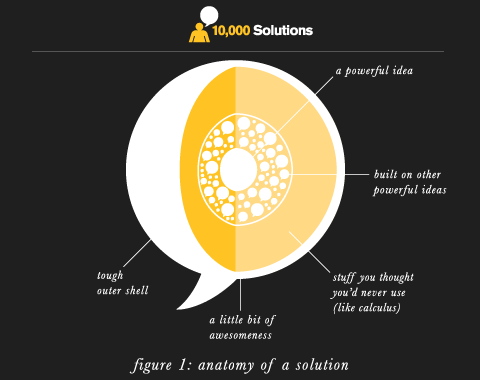
Arizona State University has launched a new contest called 10,000 Solutions open to anyone over 18, anywhere in the world, and it offers a $10,000 prize. Entries can take on one of the eight greatest challenges facing the world, like sustainability and the future of education. What makes the contest unusual is that participants are encouraged to collaborate and build on one another’s solutions. ASU wants to create an open solutions bank that others can use to generate new ideas, and some students at ASU have already met up in person to talk over things they shared on the site. The school is promoting 10,000 Solutions as an experiment in collaborative invention and the National Science Foundation is funding a team of ASU researchers to study the contest and see how ideas are shared and developed.
The contest is off to a strong start, getting some high-profile entries like this one from Dan Ariely.
While many of the solutions share questions or ideas at the brainstorming stage, some groups are using the platform to promote working prototypes. This group of ASU student engineers is working on a low-cost smartboard technology based on the Wii that could be set up anywhere you can run a projector.
ASU hopes 10,000 Solutions will bring some fresh energy to problems that often seem overwhelming. If you have a minute to spare and a bright idea for making the world a better place, why not share it?
Ed Finn is an occasional contributor to Open Culture. He recently started working at Arizona State University in University Initiatives, an office focused on developing new projects and thinking big about the future of public university education. 10,000 Solutions is a project his team is helping to launch this year.
There’s something happening here
What it is ain’t exactly clear…
The intellectuals have paid a visit to Occupy Wall Street (Joseph Stiglitz, Lawrence Lessig, Slavoj Zizek, etc.). And so have some iconic cultural figures. This week, Willie Nelson and his wife wrote and read a poem supporting the surging movement.
Near 1:00 a.m., the festivities were capped off at Columbus Circle with Arlo Guthrie and friends leading a singalong to the folk classic, “This Little Light of Mine.” As more cultural figures pay a visit, we’ll post them…
The money quote from his appearance had less to do with economics per se and more with democracy: “We have too many regulations stopping democracy, and not enough regulations stopping Wall Street from misbehaving.” No bullhorns, are you serious?
You probably know Lawrence Lessig because of his work founding Creative Commons and promoting “Free Culture.” (Watch his final speech on Free Culture here.) Several years ago, Lessig moved from Stanford to Harvard, where he took up a new focus — government corruption. That’s what he grapples with in his new book, Republic, Lostand this related video. Given Lessig’s focus on how corporate money corrupts our political system, it’s not surprising that he would have something to say about the potential of the Wall Street protests.
When Slovenia’s hip Marxist/Lacanian critical theorist takes center stage at a Wall Street protest, it’s news for a culture site. No doubt. How can we not observe a rare moment of praxis? But, what it all means for the Occupy Wall Street movement, we’ll let you wrestle with that. Part 2 appears here. H/T Biblioklept.
We’re tackling another big question today with the help of Harvard economic historian Niall Ferguson. And the question goes like this: Why has the West created so much prosperity and stability over the past several centuries, when the rest of the world did not? For Ferguson, the “great divergence” can be explained by six big ideas, or what he calls killer apps for the benefit of his technophile TED audience:
1. Competition
2. The Scientific Revolution
3. Property Rights
4. Modern Medicine
5. The Consumer Society
6. Work Ethic
These apps, it turns out, are open source. Anyone can download and use them. And that’s precisely what Asia has done. The great divergence is over (baby blue)…
We're hoping to rely on loyal readers, rather than erratic ads. Please click the Donate button and support Open Culture. You can use Paypal, Venmo, Patreon, even Crypto! We thank you!
Open Culture scours the web for the best educational media. We find the free courses and audio books you need, the language lessons & educational videos you want, and plenty of enlightenment in between.