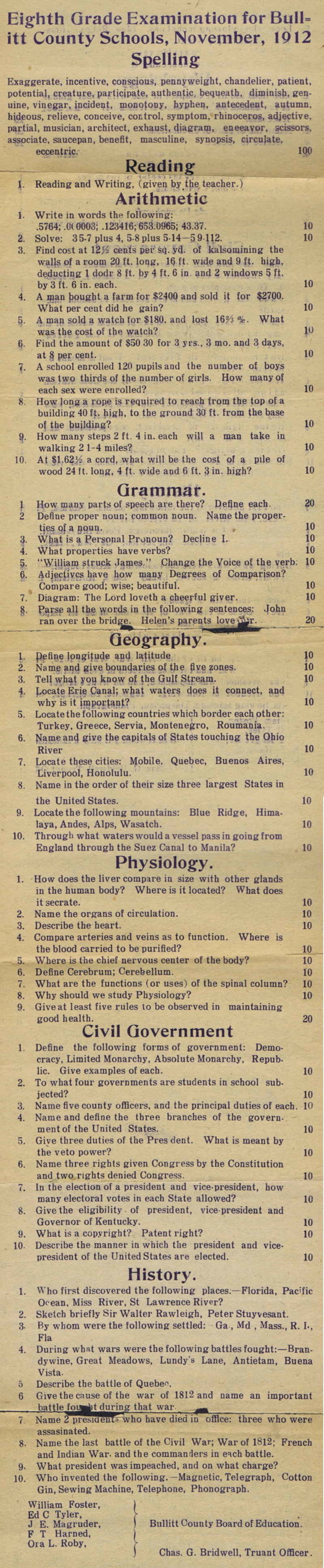
Of course you can! All it takes is a device with a built-in spelling app, an innovation of which no eighth grader in the far western reaches of bluegrass area Kentucky could have conceived back in 1912.
They were, however, expected to be able to name the waters though which an English vessel would pass en route to Manila via the Suez Canal.
Can you?
While we’re at it, how much do you really know about the human liver? Enough to locate it, identify its secretions, and discourse on its size relative to other bodily glands?
If you answered yes, congratulations. There’s a good chance you’d be promoted to high school back in 1912. Not bad for a kid attending a one-room school in rural Bullit County.
And now for some extra credit, name the last battles of the Civil War, the War of 1812, and the French and Indian War. Commanding officers, too…
That’s the sort of multipart question that awaited the eighth graders converging on the Bullit County courthouse for 1912’s common exam, above. The very same courthouse in which the modern day Bullitt County History Museum is located. A civic-minded individual donated a copy of the test to this institution, and the staff put it online, thinking it might be fun for latter-day specimens like you and me to see how we measure up.
So—just for fun—try typing the phrase “commanding officer last battle french & indian war” into your search engine of choice. Forget instant gratification. Embrace the anxiety!
Thank god the Internet was there to define “kalsomining” for me. Even with the aid of a calculator, math is not my strong suit. That said, I’m usually good enough with words to get the narrative gist of any story problem.
Usually.
I confess, I was so demoralized by my ignorance, I couldn’t have dreamed of attempting to figure out how much it would cost to “kalsomine” a 20 x 16 x 9 foot room, especially with a door and window involved.
Fortunately, the Bullit County Genealogical Society has seen fit to provide an online answer sheet, a digital luxury that would have gobsmacked their forebears.
SPOILER: $8.01. That’s the amount it would’ve cost to kalsomine your room at 1912 prices. (A steal, considering that a quart of White Wash Pickling Water Based Stain will run you $12.37 a quart at a nationally known hardware superstore today.)
Go ahead, take that test.
If you quail at the prospect of faring poorly against a rural 1912 eighth grader, just imagine how well he or she would do, teleported to 2016, and forced to contend with such mysteries as cyber bullying, gender politics, and offensive eggplant emojis…
Ayun Halliday is an author, illustrator, and Chief Primatologist of the East Village Inky zine. She lives in fear that her youngest child will pen a memoir titled I Was a Homeschooled 8th Grader and Other Chillling True Life Tales. Follow her @AyunHalliday
FYI: If you sign up for a MasterClass course by clicking on the affiliate links in this post, Open Culture will receive a small fee that helps support our operation.
One hears much, these days, about the missions of new tech companies to “disrupt” existing industries, from retail to publishing to taxi cabs to education. We’ve regarded that as primarily the domain of Silicon Valley twentysomethings, but why can’t a German filmmaker with a nearly 55-year career under his belt get in on the action? Werner Herzog, having already done much to disrupt film as we know it, has in recent years turned his attention toward disrupting film schools, which compose an industry not especially compatible with his own vision of the honest and rigorous craft of cinema.
We’ve featured Herzog’s in-person Rogue Film School workshops before, but now, according to Entertainment Weekly’s Derek Lawrence, “online education platform MasterClass announced that Herzog is teaching an online class on feature and documentary filmmaking, where the various lessons will include storytelling, cinematography, interview techniques, and how to work with actors.” The article quotes the maker of features like Fitzcarraldo and Aguirre, the Wrath of God and documentaries like Little Dieter Needs to Fly and Grizzly Man offering something like a mission statement: “Ultimately, my own goal is to be a good soldier of cinema and if I can inspire one or two of you out there, to become a good soldier, then I have done everything I should do here.”
“You spend way too much time in the film school, it costs way too much money,” says the self-taught filmmaker in the course’s trailer above. “You can learn the essentials of filmmaking on your own within two weeks.” Or, in the format that MasterClass has developed as they go along just like Herzog did when he first began making movies (and, given his enduring inventiveness, continues to do today), you can ostensibly learn it in five hours of online video. You may not capture any of Herzog’s beloved “ecstatic truth” immediately afterward, but you’ll surely get your fee’s worth of thrilling stories of the filmmaking life along the way. Sign up for Herzog’s class here.
You can take this class by signing up for a MasterClass’ All Access Pass. The AllAccessPass will give you instant access to this course and 85 others for a 12-month period.
From the time my daughter was born, my wife and I took her out to restaurants—not to annoy the other diners, mind you, she was usually very well behaved—but to expose her palate to as much variety as possible and socialize her early to new and unfamiliar environments. At one establishment, during her second year, another toddler her age approached us, her mother trailing behind. “Can we say hi?” the mother asked. We said, “of course.” “What languages does your child speak?” the woman politely inquired.
We looked at each other, a little chagrined. Parents of young children often play subtle games of one-upsmanship, whether they mean to or not, and most parents fret over whether they’re offering their kids the richest learning experiences they can.
At that moment we felt slightly inadequate. “She just knows the one language,” we mumbled, turning back to our menus after a few more pleasantries. I may have studied Latin for several years, learned to read a little French and Italian and speak enough Spanish for some halting small talk, but for all intents and purposes, we’re a monolingual household.
And according to current research on infant brain development, this may put our poor preschooler at a disadvantage to children who can greet her in two or more tongues. That’s not only because those children will grow up able to easily conduct business across countries and continents, but also because, Big Think reports, “a new study shows that babies raised in bilingual environments develop more cognitive skills like decision-making and problem-solving—before they can even speak.” The brains of bilingual (and trilingual, etc.) people “look and act differently,” the TED-Ed video at the top of the post claims, than those of the monolingual. (The New York Timesputs things more bluntly: “Being bilingual, it turns out, makes you smarter.”)
Is this really so? Princeton University neuroscientist Sam Wang explains why it may be in the short Big Think video further up. Wang and other researchers have acquired their findings by conducting research on some of the most adorable scientific subjects ever. One study, conducted at the University of Washington, tested 16 babies—half from only English-speaking families and half from English- and Spanish-speaking households. As you can see in the video clip above, the tots were monitored via a magnetoencephalographic helmet designed specially for babies, as they listened to sounds specific to one or both languages.
Lead author of the study Naja Ferjan Ramirez writes, “results suggest that before they even start talking, babies raised in bilingual households are getting practice at tasks related to executive function.” Her co-author Patricia Kuhl elaborates:
Babies raised listening to two languages seem to stay ‘open’ to the sounds of novel languages longer than their monolingual peers, which is a good and highly adaptive thing for their brains to do.
The University of Washington researchers are but one team among several dozen who have drawn these kinds of conclusions about the benefits of growing up bilingual. Both The New York Times and The New Yorker survey and link to much of this research. The New Yorker also profiles a skeptical study by psychologist Angela de Bruin that undercuts some of the enthusiasm and possible overstatement of the benefits of bilingualism; and yet her research doesn’t deny that they exist. Whatever their degree, the question might arise for anxious parents like myself: Is there anything we can do to help our monolingual children catch up?
Never fear, they can still profit from exposure to other languages, though you may not speak them fluently at home. Big Think offers a couple pointers for raising a bilingual child, even if you’re not bilingual yourself.
Lots of foreign words make their way into English. You can point out foreign foods every time you have them, or watch a bilingual show with your child. As long as you expose them to the foreign words in a consistent way with the same context, they’ll reap the benefits.
Try using a Language Exchange community, where you and your child can speak another language with native speakers together. You’ll both reap the benefits with constant practice.
Every little bit of exposure helps, and no amount of language training will ever do any harm. “Basically,” writes Big Think, “there is no downside to being bilingual.” The earlier we start, the better, but there’s no reason not to engage with other languages at any age. We can help you do that here with our expansive collection of lessons in 48 languages. And to learn even more about bilingualism and its prevalence amidst rapidly changing demographics in the U.S. and around the world, see the University of Illinois Spanish linguistics professor Kim Potowski’s TEDx talk below, “No Child Left Monolingual.”
Who can now deny that, in the internet, we have the greatest educational tool ever conceived by mankind? Surely no Open Culture reader would deny it, anyway, nor could they fail to take an interest in a new startup aiming to increase the internet’s educational power further still: Pindex, which calls itself “a Pinterest for education.” No other company has yet staked that territory out, and certainly no other company has done it with the support of Stephen Fry.
The Telegraph’s Cara McCoogan describes Pindex, which launched just last month (visit it here), as “a self-funded online platform that creates and curates educational videos and infographics for teachers and students,” founded and run by a four-person team.
Fry’s role in the quartet includes offering “creative direction,” but he’s also put his unmistakable voice to one of Pindex’s first videos, an “explainer about the Large Hadron Collider, dark matter and extra dimensions. Other videos will focus on science and technology, including ones on the Hyperloop, colonising Mars, and robots and drones. Mr Fry is expected to do the voiceovers for several of these.”
Vlogbrothers and “Nerdfighter” online personalities Hank and John Green set about conquering the world of educational media a few years ago—while also writing bestselling novels, recording popular albums, and creating startups and charitable organizations on the side. They’ve almost succeeded, with their “Crash Course” video series steamrolling its way through U.S. History, World History, and the History of Everything Else, as well as Psychology, Literature, the Sciences, and, now, Philosophy, just above, with Hank taking on the professorial duties. “It’s gonna be hard,” he says in the intro video above, “and enlightening, and frustrating, and if I do my job properly it’s going to stick with you long after you and I have parted ways.”
Hank begins where we generally do, in ancient Greece, and introduces the three main branches of philosophy: metaphysics, epistemology, and ethics. Next up, in episode two above, he dives into logic and argumentation, subjects dear to the heart of an internet-based educator, whose audience is quite familiar with the contentious online commentariat. Hank’s style, like his brother’s, is hip, fast-paced, and full of witty editorial asides, enhanced by clever editing, pop-culture references, and animated visual aids. In short, he’s exactly what you wish your college professors were like in the classroom.
Is taking one of the Green’s “crash courses” the equivalent of a college intro course? I guess it would depend on the college, the class, and the instructor. Your mileage may vary with any educational experience, and everyone has their own way of learning. If you’re comfortable having information delivered at the speed of advertising—which I do not mean as an insult, but as an accurate description of their pacing—then you may find that the Green’s methods work perfectly well. If you need to mull things over, take careful notes, hear in-depth explanations, etc., you may consider these videos as fun ways to get your feet wet. Then when you’re ready to dive in, consider taking one of the many free online philosophy courses we feature on the site, and supplementing with podcasts, free eBooks, and other resources.
If you follow this playlist, you can find more Crash Course Philosophy videos as they become available.
In a recent entry in the New York Times’ philosophy blog “The Stone,” Robert Frodeman and Adam Briggle locate a “momentous turning point” in the history of philosophy: its institutionalization in the research university in the late 19th century. This, they argue, is when philosophy lost its way—when it became subject to the dictates of the academy, placed in competition with the hard sciences, and forced to prove its worth as an instrument of profit and progress. Well over a hundred years after this development, we debate a wider crisis in higher education, as universities (writes Mimi Howard in the Los Angeles Review of Books) “increasingly resemble global corporations with their international campuses and multibillion dollar endowments. Tuition has skyrocketed. Debt is astronomical. The classrooms themselves are more often run on the backs of precarious adjuncts and graduate students than by real professors.”
It’s a cutthroat system I endured for many years as both an adjunct and graduate student, but even before that, in my early undergraduate days, I remember well watching public, then private, colleges succumb to demand for leaner operating budgets, more encroachment by corporate donors and trustees, and less autonomy for educators. Universities have become, in a word, high-priced, high-powered vocational schools where every discipline must prove its value on the open market or risk massive cuts, and where students are treated, and often demand to be treated, like consumers. Expensive private entities like for-profit colleges and corporate educational companies thrive in this environment, often promising much but offering little, and in this environment, philosophy and the liberal arts bear a crushing burden to demonstrate their relevance and profitability.
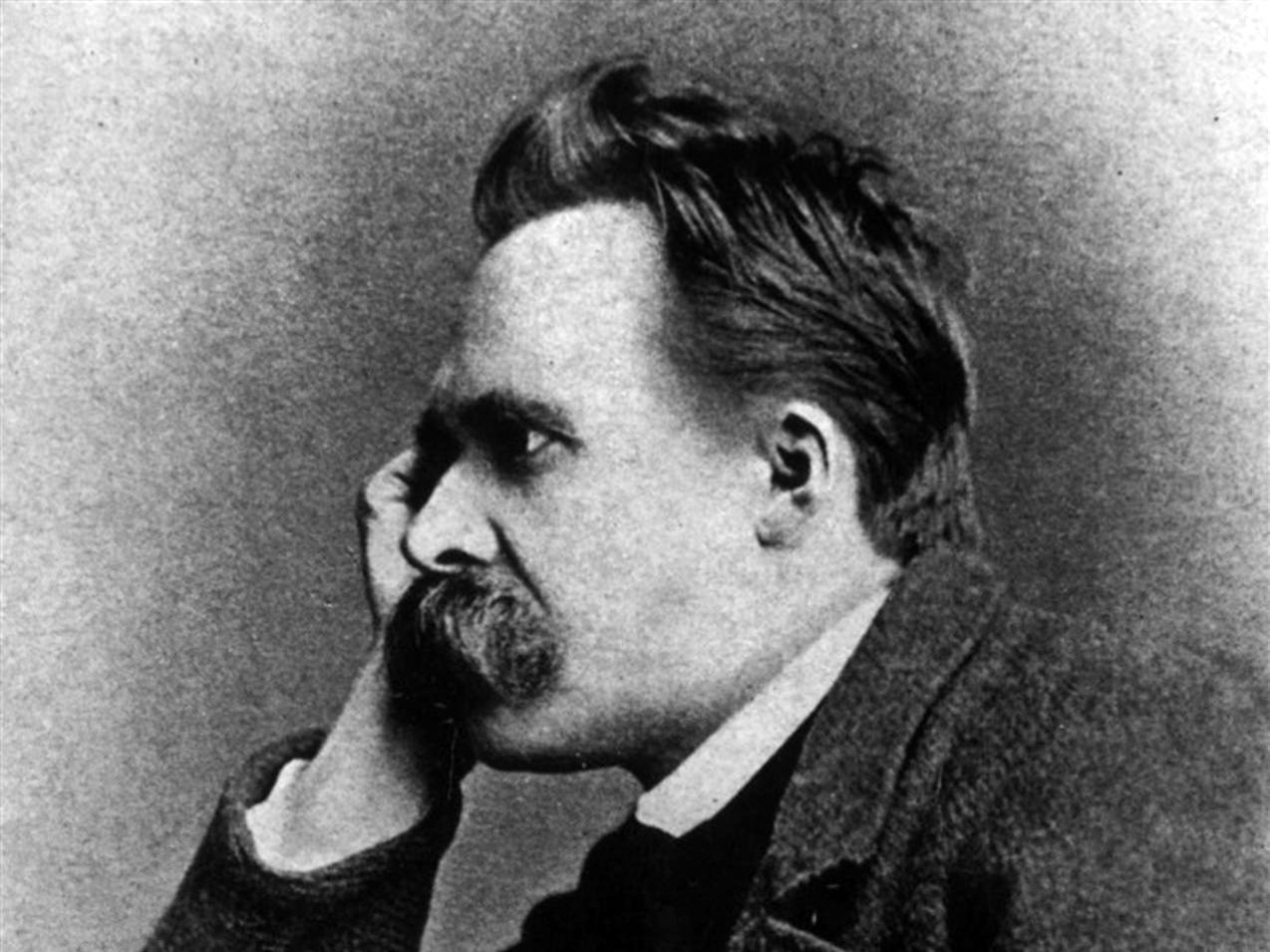
Howard writes about this situation in the context of her review of Friedrich Nietzsche’s little-known, 1872 series of lectures, On the Future of Our Educational Institutions, published in a new translation by Damion Searls with the pithy title Anti-Education. Nietzsche, an academic prodigy, had become a professor of classical philology at the University of Basel at only 24 years of age. By 27, when he wrote his lectures, he was already disillusioned with teaching and the strictures of professional academia, though he stayed in his appointment until illness forced him to retire in 1878. In the lectures, Nietzsche excoriates a bourgeois higher education system in terms that could come right out of a critical article on the higher ed of our day. In a Paris Review essay, his translator Searls quotes the surly philosopher on what “the state and the masses were apparently clamoring for”:
as much knowledge and education as possible—leading to the greatest possible production and demand—leading to the greatest happiness: that’s the formula. Here we have Utility as the goal and purpose of education, or more precisely Gain: the highest possible income … Culture is tolerated only insofar as it serves the cause of earning money.
Perhaps little has changed but the scale and the appearance of the university. However, Nietzsche did admire the fact that the school system “as we know it today… takes the Greek and Latin languages seriously for years on end.” Students still received a classical education, which Nietzsche approvingly credited with at least teaching them proper discipline. And yet, as the cliché has it, a little knowledge is a dangerous thing; or rather, a little knowledge does not an education make. Though many pursue an education, few people actually achieve it, he believed. “No one would strive for education,” wrote Nietzsche, “if they knew how unbelievably small the number of truly educated people actually was, or ever could be.” For Nietzsche, the university was a scam, tricking “a great mass of people… into going against their nature and pursuing an education” they could never truly achieve or appreciate.
While it’s true that Nietzsche’s critiques are driven in part by his own cultural elitism, it’s also true that he seeks in his lectures to define education in entirely different terms than the utilitarian “state and masses”—terms more in line with classical ideals as well as with the German concept of Bildung, the term for education that also means, writes Searls, “the process of forming the most desirable self, as well as the end point of the process.” It’s a resonance that the English word has lost, though its Latin roots—e ducere, “to lead out of” or away from the common and conventional—still retain some of this sense. Bildung, Searls goes on, “means entering the realm of the fully formed: true culture is the culmination of an education, and true education transmits and creates culture.”
Nietzsche the philologist took the rich valence of Bildung very seriously. In the years after penning his lectures on the educational system, he completed the essays that would become Untimely Meditations(including one of his most famous, “On the Use and Abuse of History for Life”). Among those essays was “Schopenhauer as Educator,” in which Nietzsche calls the gloomy philosopher Arthur Schopenhauer his “true educator.” However, writes Peter Fitzsimons, the “image” of Schopenhauer “is more a metaphor for Nietzsche’s own self-educative process.” For Nietzsche, the process of a true education consists not in rote memorization, or in attaining cultural signifiers consistent with one’s class or ambitions, or in learning a set of practical skills with which to make money. It is, Fitzsimons observes, “rather an exhortation to break free from conventionality, to be responsible for creating our own existence, and to overcome the inertia of tradition and custom”—or what Nietzsche calls the universal condition of “sloth.” In “Schopenhauer as Educator,” Nietzsche defines the role of the educator and explicates the purpose of learning in deliberately Platonic terms:
…for your true nature lies, not concealed deep within you, but immeasurably high above you, or at least above that which you usually take yourself to be. Your true educators and formative teachers reveal to you what the true basic material of your being is, something in itself ineducable and in any case difficult of access, bound and paralysed: your educators can be only your liberators.
As in Plato’s notion of innate knowledge, or anamnesis, Nietzsche believed that education consists mainly of a clearing away of “the weeds and rubbish and vermin” that attack and obscure “the real groundwork and import of thy being.” This kind of education, of course, cannot be formalized within our present institutions, cannot be marketed to a mass audience, and cannot serve the interests of the state and the market. Hence it cannot be obtained by simply progressing through a system of grades and degrees, though one can use such systems to obtain access to the liberatory materials one presumably needs to realize one’s “true nature.”
For Nietzsche, in his example of Schopenhauer, achieving a true education is an enterprise fraught with “three dangers”—those of isolation, of crippling doubt, and of the pain of confronting one’s limitations. These dangers “threaten us all,” but most people, Nietzsche thinks, lack the fortitude and vigor to truly brave and conquer them. Those who acquire Bildung, or culture, those who realize their “true selves,” he concludes “must prove by their own deed that the love of truth has itself awe and power,” though “the dignity of philosophy is trodden in the mire,” and one will likely receive little respite, recompense, or recognition for their labors.
After a long hiatus, the RSA (The Royal Society for the Encouragement of Arts, Manufactures and Commerce) has returned with another one of the whiteboard animated-lectures they pioneered five years ago.
The animated reboot (above) brings to life the thoughts of another Stanford psychology professor, Carol S. Dweck. The author of Mindset: The New Psychology of Success(a book that appeared on Bill Gates’s Best of 2015 list), Dweck has looked closely at how our beliefs/mindsets strongly influence the paths we take in life. And, in this clip, she talks about how well-meaning parents, despite their best intentions, might be creating the wrong mindsets in their kids, paving the way for problems down the road. You can watch the complete, unanimated lecture here.
If you would like to support the mission of Open Culture, consider making a donation to our site. It’s hard to rely 100% on ads, and your contributions will help us continue providing the best free cultural and educational materials to learners everywhere. You can contribute through PayPal, Patreon, and Venmo (@openculture). Thanks!
Astrophysicist Neil deGrasse Tyson, the most prominent public defender of science education and funding, frequently comes in for some good-natured ribbing for his genial pedantry, ascension to Carl Sagan’s unofficial spokesmanship, and downgrading of the beloved Pluto from planet status. But he takes it all in stride. As another science communicator, Phil Plate the “Bad Astronomer,” has written, “The man is brilliant, charming, a pillar of science education, and a glutton for punishment. But I think he secretly revels in it.” If you follow Tyson’s Twitter account and watch him engage with cranks, or if you’ve seen him in any of the hundreds of public debates and panels he attends, it seems he more than revels in it; he’s totally in his element, so to speak, publicly modeling the mix of confidence, humility, and curiosity that drives science forward.
In the video above, Tyson dares to try and fill the shoes of another great communicator—and no, I don’t mean Ronald Reagan, but the president whose most famous speech Charles Sumner called “a monumental act.” And though Abraham Lincoln was not nearly as comfortable in front of an audience as Tyson is, Lincoln’s Gettysburg Address set the bar for how to get a point across with the maximum amount of eloquence and minimum of redundancy and rambling. Can Tyson deliver the goods like Lincoln did with only 272 words to work with? Is the attempt to “reply” to the “Gettysburg Address” an act of hubris or the ultimate tribute? Decide for yourself as you listen to Tyson’s April, 2015 acceptance speech at the National Academy of Science for the Public Welfare Medal, the Academy’s “most prestigious award.”
Tyson’s speech has been enhanced with a dramatic animation and sound effects for a technological impact Lincoln never could have achieved, though by most accounts he didn’t need it. Not a solemn occasion like Gettysburg, the awards ceremony nonetheless called for at least a little pomp, as well as some history. Tyson points out that “during the bloody year of his Gettysburg Address, President Lincoln chartered the National Academy of Sciences.” For more of that story, see the short video above, where you’ll learn, among other things, that Lincoln was the first and only American president to hold a patent on a scientific invention.
We're hoping to rely on loyal readers, rather than erratic ads. Please click the Donate button and support Open Culture. You can use Paypal, Venmo, Patreon, even Crypto! We thank you!
Open Culture scours the web for the best educational media. We find the free courses and audio books you need, the language lessons & educational videos you want, and plenty of enlightenment in between.