The Atlantic Slave Trade Visualized in Two Minutes: 10 Million Lives, 20,000 Voyages, Over 315 Years

Not since the six­ties and sev­en­ties, with the black pow­er move­ment, flow­er­ing of Afro­cen­tric schol­ar­ship, and debut of Alex Haley’s Roots, nov­el and mini-series, has there been so much pop­u­lar inter­est in the his­to­ry of slav­ery. We have seen Roots remade; award-win­ning books like Edward Baptist’s The Half Has Nev­er Been Told climb best­seller lists; and The Freedman’s Bureau Project’s dig­i­ti­za­tion of 1.5 mil­lion slav­ery-era doc­u­ments gives cit­i­zen-schol­ars the tools to research the his­to­ry on their own.

In addi­tion to these devel­op­ments, Slate mag­a­zine has designed a mul­ti­part, mul­ti­me­dia course, “The His­to­ry of Amer­i­can Slav­ery,” as part of its online edu­ca­tion­al ini­tia­tive, “Slate Acad­e­my.” Host­ed by Slate’s Jamelle Bouie and Rebec­ca Onion and fea­tur­ing guest his­to­ri­ans like Bap­tist, Hen­ry Louis Gates, Jr., Annette Gor­don-Reed, Eric Fon­er and more, this thor­ough sur­vey con­sists of a nine-part pod­cast, with copi­ous sup­ple­men­tary essays, book excerpts, and oth­er resources draw­ing on pri­ma­ry doc­u­ments and arti­facts. One sup­ple­ment, the ani­ma­tion above, shows us the “The Atlantic Slave Trade in Two Min­utes.”

Visu­al­iz­ing 315 years—“from the trade’s begin­ning in the 16th cen­tu­ry to its con­clu­sion in the 19th”—the ani­ma­tion dis­plays slave ships as increas­ing num­bers of black dots zip­ping across the Atlantic to the Amer­i­c­as from the African coasts. The dots “also cor­re­spond to the size of each voy­age. The larg­er the dot, the more enslaved peo­ple on board.” The Youtube video above pro­vides only a par­tial rep­re­sen­ta­tion of this impres­sive graph­ic. The full ani­ma­tion at Slate allows users to pause, click on indi­vid­ual dots, and get detailed infor­ma­tion, when avail­able, about the name of the ship, num­ber of enslaved peo­ple trans­port­ed, and points of ori­gin and entry in the New World.

In all, we see ani­mat­ed “more than 20,000 voy­ages cat­a­logued in the Trans-Atlantic Slave Trade Data­base.” And though we typ­i­cal­ly, with typ­i­cal U.S. solip­sism, think of Amer­i­can slav­ery as a most­ly North Amer­i­can phe­nom­e­non, the truth is quite the con­trary:

Of the more than 10 mil­lion enslaved Africans to even­tu­al­ly reach the West­ern Hemi­sphere, just 388,747—less than 4 per­cent of the total—came to North Amer­i­ca. This was dwarfed by the 1.3 mil­lion brought to Span­ish Cen­tral Amer­i­ca, the 4 mil­lion brought to British, French, Dutch, and Dan­ish hold­ings in the Caribbean, and the 4.8 mil­lion brought to Brazil.

Ear­ly slave expe­di­tions were con­duct­ed by the Span­ish and Por­tuguese. “In the 1700s,” writes Bouie, “Span­ish trans­port dimin­ish­es and is replaced (and exceed­ed) by British, French, Dutch, and—by the end of the century—American activ­i­ty. This hun­dred years—from approx­i­mate­ly 1725 to 1825—is also the high-water mark of the slave trade, as Euro­peans send more than 7.2 mil­lion peo­ple to forced labor, dis­ease and death in the New World.” Sur­pris­ing­ly, Por­tu­gal remained one of the lead­ing nations among enslavers for most of the slave-trade’s his­to­ry.

The ani­ma­tion and short explana­to­ry essay by Bouie show us the stag­ger­ing his­tor­i­cal scope of the immense­ly prof­itable and pro­found­ly inhu­mane enter­prise that shaped not only the Unit­ed States, but also—in many ways more so—Central and South Amer­i­ca and the Caribbean. There is no his­to­ry of the Amer­i­c­as, and no growth of many of the colonies into wealthy, world-his­tor­i­cal nations, with­out slav­ery, nor can the wealth of Europe be in any way divorced from the prof­its of the slave trade and slave indus­try. Bouie and Onion explain in the short video above why they decid­ed to pro­duce the course.

For a sense of how his­to­ri­ans’ and the public’s under­stand­ing of slav­ery have changed over many decades—for all kinds of ide­o­log­i­cal reasons—read this excerpt from Baptist’s ground­break­ing book. As he says in an inter­view with Salon, most his­to­ries and recre­ations of the peri­od of enslave­ment attempt to hide the facts: “The resis­tance to reck­on­ing with the role of slav­ery in the tra­jec­to­ry that makes the U.S. the most pow­er­ful nation on earth, that’s real; that’s very, very deep…. What­ev­er we say about the role of the U.S. in glob­al his­to­ry, it’s absolute­ly clear to me that slav­ery is essen­tial to the rise of U.S. pow­er.” Slate’s series goes a long way toward telling us the true his­to­ry of slav­ery, from the mouths of writ­ers and schol­ars who engage with it dai­ly.

Relat­ed Con­tent:

1.5 Mil­lion Slav­ery Era Doc­u­ments Will Be Dig­i­tized, Help­ing African Amer­i­cans to Learn About Their Lost Ances­tors

The “Slave Bible” Removed Key Bib­li­cal Pas­sages In Order to Legit­imize Slav­ery & Dis­cour­age a Slave Rebel­lion (1807)

Mas­sive New Data­base Will Final­ly Allow Us to Iden­ti­fy Enslaved Peo­ples and Their Descen­dants in the Amer­i­c­as

Crowd­sourced Data­base Will Locate the Bur­ial Sites of For­got­ten US Slaves

Josh Jones is a writer and musi­cian based in Durham, NC. Fol­low him at @jdmagness

The Battle to Finish a PhD: World War I Soldier Completes His Dissertation in the Trenches (1916)

phd in trenches

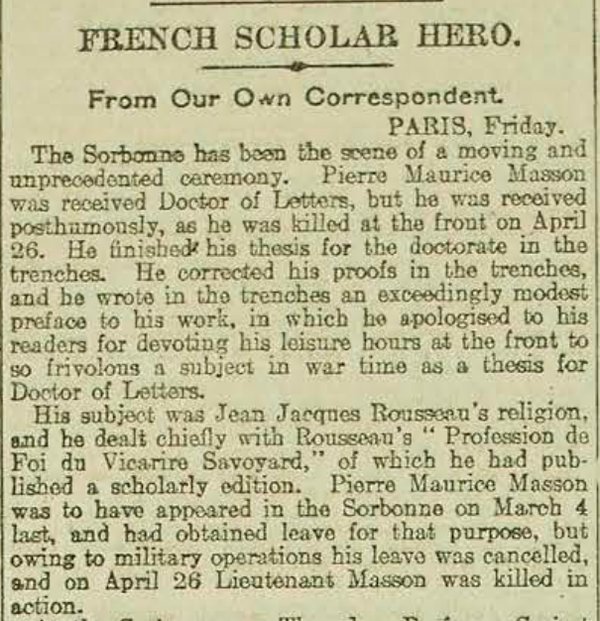
Con­nie Ruzich, a WWI poet­ry blog­ger, recent­ly high­light­ed on Twit­ter a his­toric news­pa­per clip­ping that will put the tra­vails of acad­eme into per­spec­tive. Get­ting a Ph.D. is always hard. But hard is rel­a­tive.

Case in point…

100 years ago, Pierre Mau­rice Mas­son, a young schol­ar, found him­self fight­ing in north-east­ern France. Draft­ed in 1914, Mas­son rose through the mil­i­tary ranks, mov­ing from sergeant, to sub-lieu­tenant, to lieu­tenant. Mean­while, in the dis­com­fort of the trench­es, he con­tin­ued work­ing on his doc­tor­al thesis–a long dis­ser­ta­tion on the reli­gious train­ing of Jean-Jacques Rousseau. By the spring of 1916, he had com­plet­ed the text, cor­rect­ed the proofs, and draft­ed an intro­duc­tion (of course, that comes last). Final­ly, he announced to friends, “The mon­ster is ready!” And he sought a leave of absence to return to the Sor­bonne to receive his doc­tor­ate.

Alas, that did­n’t hap­pen. The news­pa­per clip above tells the rest of the poignant sto­ry.

You can read Mas­son’s posthu­mous­ly pub­lished the­sis, La for­ma­tion religieuse de Rousseaufree online.

via Ted Gioia/Con­nie Ruzich

If you would like to sign up for Open Culture’s free email newslet­ter, please find it here. It’s a great way to see our new posts, all bun­dled in one email, each day.

If you would like to sup­port the mis­sion of Open Cul­ture, con­sid­er mak­ing a dona­tion to our site. It’s hard to rely 100% on ads, and your con­tri­bu­tions will help us con­tin­ue pro­vid­ing the best free cul­tur­al and edu­ca­tion­al mate­ri­als to learn­ers every­where. You can con­tribute through Pay­Pal, Patre­on, and Ven­mo (@openculture). Thanks!

Relat­ed Con­tent:

The Illus­trat­ed Guide to a Ph.D.

Read John Nash’s Super Short PhD The­sis with 26 Pages & 2 Cita­tions: The Beau­ty of Invent­ing a Field

Ser­i­al Entre­pre­neur Damon Horowitz Says “Quit Your Tech Job and Get a Ph.D. in the Human­i­ties”

by | Permalink | Make a Comment ( 2 ) |

Mad Magazine’s Al Jaffee & Other Cartoonists Create Animations to End Distracted Driving


Mod­el Ts were the aver­age American’s car of choice in 1921, when car­toon­ist Al Jaf­fee was born.

The father of MAD Mag­a­zine’s fold-ins was but sev­en when the T’s suc­ces­sor, the Mod­el A, was intro­duced.

It would be a long time before such inno­va­tions as seat belts, baby seats, and airbags were intro­duced. These safe­ty mea­sures do a fine job of min­i­miz­ing human dam­age in motor vehi­cle acci­dents, but they can’t pre­vent the col­li­sions them­selves.

To rem­e­dy this, Ford, the com­pa­ny respon­si­ble for the Mod­el T and hun­dreds of motor vehi­cles since, recent­ly enlist­ed Jaf­fee and his fel­low car­toon­ists, MK Brown and Bill Plymp­ton, to edu­cate the pub­lic on the dan­gers of dis­tract­ed dri­ving. Turns out this pre­ventable scourge rivals intox­i­ca­tion and haz­ardous road con­di­tions as a lead­ing cause of acci­dents.

Jaffee’s take, ani­mat­ed by J.J. Sedel­maier, above, will nev­er be mis­tak­en for film­mak­er Wern­er Her­zog’s har­row­ing anti-tex­ting doc­u­men­tary PSA, From One Sec­ond to the Next, or even Jaffee’s own anti-drunk dri­ving fold-in from MAD’s March 1975 issue.

Instead, he offers a gen­tle, child-friend­ly metaphor in which an uncaged bird becomes a hav­oc-wreak­ing dis­trac­tion. (For­tu­nate­ly, everyone’s wear­ing his seat­belt, and the lit­tle boy is rid­ing in back, in com­pli­ance with CDC rec­om­men­da­tions.)


Nation­al Lam­poon alum, Brown, tip­toes clos­er to the true caus­es of dis­trac­tion, with the alien-themed seg­ment, above, also ani­mat­ed by Sedel­maier. If it seems like­li­er that the alien’s earth­ling wife might do her hen­peck­ing via text rather than actu­al call these days—well, some­times dra­mat­ic lib­er­ties are war­rant­ed to get the mes­sage across.


Unsur­pris­ing­ly, Plympton’s self-ani­mat­ed con­tri­bu­tion is the most graph­ic, a direct descen­dent of his fab­u­lous­ly grotesque car­toon primers 25 Ways To Quit Smok­ing and How To Kiss. Moral? Assum­ing you want to keep your teeth in your head, the veg­etable mat­ter wedged in between can wait ’til you reach your des­ti­na­tion.

Relat­ed Con­tent:

Wern­er Herzog’s Eye-Open­ing New Film Reveals the Dan­gers of Tex­ting While Dri­ving

Al Jaf­fee, the Longest Work­ing Car­toon­ist in His­to­ry, Shows How He Invent­ed the Icon­ic “Folds-Ins” for Mad Mag­a­zine

Read­ing While Dri­ving, Seri­ous­ly?

Ayun Hal­l­i­day is an author, illus­tra­tor, and Chief Pri­ma­tol­o­gist of the East Vil­lage Inky. Her plan for avoid­ing acci­dents is to refrain from dri­ving when­ev­er pos­si­ble. Fol­low her @AyunHalliday

Learning How to Learn: The Most Popular MOOC of All Time

When MOOCs (Mas­sive Open Online Cours­es) first start­ed mak­ing head­lines in 2012, we read sto­ries about thou­sands of peo­ple enrolling in cours­es on Arti­fi­cial Intel­li­gence and Com­put­er Sci­ence. Since then, the MOOC providers have dou­bled down on pro­mot­ing tech­ni­cal and util­i­tar­i­an courses–courses that will get stu­dents jobs, and even­tu­al­ly make the MOOC providers mon­ey. Peruse this list of the 50 most pop­u­lar MOOCs of all time, and you’ll seen plen­ty of mar­ket-ori­ent­ed cours­es top­ping the list–e.g., #4) Intro­duc­tion to Finance #3) R Pro­gram­ming, and #2) Machine Learn­ing. But what’s the most pop­u­lar course? Some­thing not entire­ly career-focused. Some­thing not imme­di­ate­ly mon­e­ti­z­able. Some­thing that can ben­e­fit us all. Ladies and gen­tle­men, the #1 course, Learn­ing How to Learn: Pow­er­ful men­tal tools to help you mas­ter tough sub­jects.

Cre­at­ed by Bar­bara Oak­ley (Uni­ver­si­ty of Oak­land) and Ter­ry Sejnows­ki (the Salk Insti­tute), Learn­ing How to Learn uses neu­ro­science to fine-tune our abil­i­ty to learn. And the course is being offered again, start­ing today, through Cours­era. You can enroll here (the course is free) and read what ground the course will cov­er below.

This course gives you easy access to the invalu­able learn­ing tech­niques used by experts in art, music, lit­er­a­ture, math, sci­ence, sports, and many oth­er dis­ci­plines. We’ll learn about the how the brain uses two very dif­fer­ent learn­ing modes and how it encap­su­lates (“chunks”) infor­ma­tion. We’ll also cov­er illu­sions of learn­ing, mem­o­ry tech­niques, deal­ing with pro­cras­ti­na­tion, and best prac­tices shown by research to be most effec­tive in help­ing you mas­ter tough sub­jects. Using these approach­es, no mat­ter what your skill lev­els in top­ics you would like to mas­ter, you can change your think­ing and change your life. If you’re already an expert, this peep under the men­tal hood will give you ideas for: tur­bocharg­ing suc­cess­ful learn­ing, includ­ing counter-intu­itive test-tak­ing tips and insights that will help you make the best use of your time on home­work and prob­lem sets. If you’re strug­gling, you’ll see a struc­tured trea­sure trove of prac­ti­cal tech­niques that walk you through what you need to do to get on track. If you’ve ever want­ed to become bet­ter at any­thing, this course will help serve as your guide.

This course gives you easy access to the invalu­able learn­ing tech­niques used by experts in art, music, lit­er­a­ture, math, sci­ence, sports, and many oth­er dis­ci­plines. We’ll learn about the how the brain uses two very dif­fer­ent learn­ing modes and how it encap­su­lates (“chunks”) infor­ma­tion. We’ll also cov­er illu­sions of learn­ing, mem­o­ry tech­niques, deal­ing with pro­cras­ti­na­tion, and best prac­tices shown by research to be most effec­tive in help­ing you mas­ter tough sub­jects. Using these approach­es, no mat­ter what your skill lev­els in top­ics you would like to mas­ter, you can change your think­ing and change your life. If you’re already an expert, this peep under the men­tal hood will give you ideas for: tur­bocharg­ing suc­cess­ful learn­ing, includ­ing counter-intu­itive test-tak­ing tips and insights that will help you make the best use of your time on home­work and prob­lem sets. If you’re strug­gling, you’ll see a struc­tured trea­sure trove of prac­ti­cal tech­niques that walk you through what you need to do to get on track. If you’ve ever want­ed to become bet­ter at any­thing, this course will help serve as your guide.

To find reviews of Learn­ing How to Learn, vis­it Class Cen­tral. To keep tabs on new MOOCs, see our list of MOOCs from Great Uni­ver­si­ties.

If you would like to sign up for Open Culture’s free email newslet­ter, please find it here. It’s a great way to see our new posts, all bun­dled in one email, each day.

If you would like to sup­port the mis­sion of Open Cul­ture, con­sid­er mak­ing a dona­tion to our site. It’s hard to rely 100% on ads, and your con­tri­bu­tions will help us con­tin­ue pro­vid­ing the best free cul­tur­al and edu­ca­tion­al mate­ri­als to learn­ers every­where. You can con­tribute through Pay­Pal, Patre­on, and Ven­mo (@openculture). Thanks!

Can You Pass This Test Originally Given to 8th Graders Living in Kentucky in 1912?

bcschoolexam1912sm--1-

Can you spell “con­ceive”?

Of course you can! All it takes is a device with a built-in spelling app, an inno­va­tion of which no eighth grad­er in the far west­ern reach­es of blue­grass area Ken­tucky could have con­ceived back in 1912.

They were, how­ev­er, expect­ed to be able to name the waters though which an Eng­lish ves­sel would pass en route to Mani­la via the Suez Canal.

Can you?

While we’re at it, how much do you real­ly know about the human liv­er? Enough to locate it, iden­ti­fy its secre­tions, and dis­course on its size rel­a­tive to oth­er bod­i­ly glands?

If you answered yes, con­grat­u­la­tions. There’s a good chance you’d be pro­mot­ed to high school back in 1912. Not bad for a kid attend­ing a one-room school in rur­al Bul­lit Coun­ty.

And now for some extra cred­it, name the last bat­tles of the Civ­il War, the War of 1812, and the French and Indi­an War. Com­mand­ing offi­cers, too…

That’s the sort of mul­ti­part ques­tion that await­ed the eighth graders con­verg­ing on the Bul­lit Coun­ty cour­t­house for 1912’s com­mon exam, above. The very same cour­t­house in which the mod­ern day Bul­litt Coun­ty His­to­ry Muse­um is locat­ed. A civic-mind­ed indi­vid­ual donat­ed a copy of the test to this insti­tu­tion, and the staff put it online, think­ing it might be fun for lat­ter-day spec­i­mens like you and me to see how we mea­sure up.

So—just for fun—try typ­ing the phrase “com­mand­ing offi­cer last bat­tle french & indi­an war” into your search engine of choice. For­get instant grat­i­fi­ca­tion. Embrace the anx­i­ety!

Com­mon wis­dom holds that stan­dard­ized tests are a lot hard­er than they used to be. But look­ing at the sort of stuff your aver­age eighth grad­er had to regur­gi­tate two years pri­or to the start of WW1, I’m not so sure…

Thank god the Inter­net was there to define “kalso­min­ing” for me. Even with the aid of a cal­cu­la­tor, math is not my strong suit. That said, I’m usu­al­ly good enough with words to get the nar­ra­tive gist of any sto­ry prob­lem.

Usu­al­ly.

I con­fess, I was so demor­al­ized by my igno­rance, I couldn’t have dreamed of attempt­ing to fig­ure out how much it would cost to “kalsomine” a 20 x 16 x 9 foot room, espe­cial­ly with a door and win­dow involved.

For­tu­nate­ly, the Bul­lit Coun­ty Genealog­i­cal Soci­ety has seen fit to pro­vide an online answer sheet, a dig­i­tal lux­u­ry that would have gob­s­macked their fore­bears.

SPOILER: $8.01. That’s the amount it would’ve cost to kalsomine your room at 1912 prices. (A steal, con­sid­er­ing that a quart of White Wash Pick­ling Water Based Stain will run you $12.37 a quart at a nation­al­ly known hard­ware super­store today.)

Go ahead, take that test.

If you quail at the prospect of far­ing poor­ly against a rur­al 1912 eighth grad­er, just imag­ine how well he or she would do, tele­port­ed to 2016, and forced to con­tend with such mys­ter­ies as cyber bul­ly­ing, gen­der pol­i­tics, and offen­sive egg­plant emo­jis

via The Paris Review.

Relat­ed Con­tent:

The Open Syl­labus Project Gath­ers 1,000,000 Syl­labi from Uni­ver­si­ties & Reveals the 100 Most Fre­quent­ly-Taught Books

Take the 146-Ques­tion Knowl­edge Test Thomas Edi­son Gave to Prospec­tive Employ­ees (1921)

Take The Near Impos­si­ble Lit­er­a­cy Test Louisiana Used to Sup­press the Black Vote (1964)

Ayun Hal­l­i­day is an author, illus­tra­tor, and Chief Pri­ma­tol­o­gist of the East Vil­lage Inky zine. She lives in fear that her youngest child will pen a mem­oir titled I Was a Home­schooled 8th Grad­er and Oth­er Chillling True Life Tales. Fol­low her @AyunHalliday

Werner Herzog Teaches His First Online Course on Filmmaking

FYI: If you sign up for a Mas­ter­Class course by click­ing on the affil­i­ate links in this post, Open Cul­ture will receive a small fee that helps sup­port our oper­a­tion.

One hears much, these days, about the mis­sions of new tech com­pa­nies to “dis­rupt” exist­ing indus­tries, from retail to pub­lish­ing to taxi cabs to edu­ca­tion. We’ve regard­ed that as pri­mar­i­ly the domain of Sil­i­con Val­ley twen­tysome­things, but why can’t a Ger­man film­mak­er with a near­ly 55-year career under his belt get in on the action? Wern­er Her­zog, hav­ing already done much to dis­rupt film as we know it, has in recent years turned his atten­tion toward dis­rupt­ing film schools, which com­pose an indus­try not espe­cial­ly com­pat­i­ble with his own vision of the hon­est and rig­or­ous craft of cin­e­ma.

We’ve fea­tured Her­zog’s in-per­son Rogue Film School work­shops before, but now, accord­ing to Enter­tain­ment Week­ly’s Derek Lawrence, “online edu­ca­tion plat­form Mas­ter­Class announced that Her­zog is teach­ing an online class on fea­ture and doc­u­men­tary film­mak­ing, where the var­i­ous lessons will include sto­ry­telling, cin­e­matog­ra­phy, inter­view tech­niques, and how to work with actors.” The arti­cle quotes the mak­er of fea­tures like Fitz­car­ral­do and Aguirre, the Wrath of God and doc­u­men­taries like Lit­tle Dieter Needs to Fly and Griz­zly Man offer­ing some­thing like a mis­sion state­ment: “Ulti­mate­ly, my own goal is to be a good sol­dier of cin­e­ma and if I can inspire one or two of you out there, to become a good sol­dier, then I have done every­thing I should do here.”

You can learn more about Mas­ter­class from the New York Times’ Lau­ra M. Hol­son, who describes the enter­prise, the brain­child of Los Ange­les-raised Sil­i­con Val­ley entre­pre­neur David Rogi­er, as “a series of online cours­es taught by peo­ple who are the best in the world at what they do,” includ­ing Annie Lei­bovitz on Pho­tog­ra­phy, Her­bie Han­cock on Jazz, Jane Goodall on Con­serv­ing the Envi­ron­ment and Wern­er Her­zog on film­mak­ing. Her­zog’s course can be tak­en by sign­ing up for an All Access Pass, which gives you access to every course in the Mas­ter­class course cat­a­logue, includ­ing cours­es from many oth­er film­mak­ers.

“You spend way too much time in the film school, it costs way too much mon­ey,” says the self-taught film­mak­er in the course’s trail­er above. “You can learn the essen­tials of film­mak­ing on your own with­in two weeks.” Or, in the for­mat that Mas­ter­Class has devel­oped as they go along just like Her­zog did when he first began mak­ing movies (and, giv­en his endur­ing inven­tive­ness, con­tin­ues to do today), you can osten­si­bly learn it in five hours of online video. You may not cap­ture any of Her­zog’s beloved “ecsta­t­ic truth” imme­di­ate­ly after­ward, but you’ll sure­ly get your fee’s worth of thrilling sto­ries of the film­mak­ing life along the way. Sign up for Her­zog’s class here.

You can take this class by sign­ing up for a Mas­ter­Class’ All Access Pass. The All Access Pass will give you instant access to this course and 85 oth­ers for a 12-month peri­od.

Relat­ed Con­tent:

Wern­er Her­zog Cre­ates Required Read­ing & Movie View­ing Lists for Enrolling in His Film School

Wern­er Herzog’s Rogue Film School: Apply & Learn the Art of Gueril­la Film­mak­ing & Lock-Pick­ing

Wern­er Her­zog Picks His 5 Favorite Films

Por­trait Wern­er Her­zog: The Director’s Auto­bi­o­graph­i­cal Short Film from 1986

Wern­er Her­zog Gets Shot Dur­ing Inter­view, Doesn’t Miss a Beat

Based in Seoul, Col­in Mar­shall writes and broad­casts on cities, lan­guage, and style. He’s at work on a book about Los Ange­les, A Los Ange­les Primer, the video series The City in Cin­e­ma, the crowd­fund­ed jour­nal­ism project Where Is the City of the Future?, and the Los Ange­les Review of Books’ Korea Blog. Fol­low him on Twit­ter at @colinmarshall or on Face­book.

Becoming Bilingual Can Give Your Brain a Boost: What Recent Research Has to Say

From the time my daugh­ter was born, my wife and I took her out to restaurants—not to annoy the oth­er din­ers, mind you, she was usu­al­ly very well behaved—but to expose her palate to as much vari­ety as pos­si­ble and social­ize her ear­ly to new and unfa­mil­iar envi­ron­ments. At one estab­lish­ment, dur­ing her sec­ond year, anoth­er tod­dler her age approached us, her moth­er trail­ing behind. “Can we say hi?” the moth­er asked. We said, “of course.” “What lan­guages does your child speak?” the woman polite­ly inquired.

We looked at each oth­er, a lit­tle cha­grined. Par­ents of young chil­dren often play sub­tle games of one-ups­man­ship, whether they mean to or not, and most par­ents fret over whether they’re offer­ing their kids the rich­est learn­ing expe­ri­ences they can.

At that moment we felt slight­ly inad­e­quate. “She just knows the one lan­guage,” we mum­bled, turn­ing back to our menus after a few more pleas­antries. I may have stud­ied Latin for sev­er­al years, learned to read a lit­tle French and Ital­ian and speak enough Span­ish for some halt­ing small talk, but for all intents and pur­pos­es, we’re a mono­lin­gual house­hold.

And accord­ing to cur­rent research on infant brain devel­op­ment, this may put our poor preschool­er at a dis­ad­van­tage to chil­dren who can greet her in two or more tongues. That’s not only because those chil­dren will grow up able to eas­i­ly con­duct busi­ness across coun­tries and con­ti­nents, but also because, Big Think reports, “a new study shows that babies raised in bilin­gual envi­ron­ments devel­op more cog­ni­tive skills like deci­sion-mak­ing and problem-solving—before they can even speak.” The brains of bilin­gual (and trilin­gual, etc.) peo­ple “look and act dif­fer­ent­ly,” the TED-Ed video at the top of the post claims, than those of the mono­lin­gual. (The New York Times puts things more blunt­ly: “Being bilin­gual, it turns out, makes you smarter.”)

Is this real­ly so? Prince­ton Uni­ver­si­ty neu­ro­sci­en­tist Sam Wang explains why it may be in the short Big Think video fur­ther up. Wang and oth­er researchers have acquired their find­ings by con­duct­ing research on some of the most adorable sci­en­tif­ic sub­jects ever. One study, con­duct­ed at the Uni­ver­si­ty of Wash­ing­ton, test­ed 16 babies—half from only Eng­lish-speak­ing fam­i­lies and half from Eng­lish- and Span­ish-speak­ing house­holds. As you can see in the video clip above, the tots were mon­i­tored via a mag­ne­toen­cephalo­graph­ic hel­met designed spe­cial­ly for babies, as they lis­tened to sounds spe­cif­ic to one or both lan­guages.

Lead author of the study Naja Fer­jan Ramirez writes, “results sug­gest that before they even start talk­ing, babies raised in bilin­gual house­holds are get­ting prac­tice at tasks relat­ed to exec­u­tive func­tion.” Her co-author Patri­cia Kuhl elab­o­rates:

Babies raised lis­ten­ing to two lan­guages seem to stay ‘open’ to the sounds of nov­el lan­guages longer than their mono­lin­gual peers, which is a good and high­ly adap­tive thing for their brains to do.

The Uni­ver­si­ty of Wash­ing­ton researchers are but one team among sev­er­al dozen who have drawn these kinds of con­clu­sions about the ben­e­fits of grow­ing up bilin­gual. Both The New York Times and The New York­er sur­vey and link to much of this research. The New York­er also pro­files a skep­ti­cal study by psy­chol­o­gist Angela de Bru­in that under­cuts some of the enthu­si­asm and pos­si­ble over­state­ment of the ben­e­fits of bilin­gual­ism; and yet her research doesn’t deny that they exist. What­ev­er their degree, the ques­tion might arise for anx­ious par­ents like myself: Is there any­thing we can do to help our mono­lin­gual chil­dren catch up?

Nev­er fear, they can still prof­it from expo­sure to oth­er lan­guages, though you may not speak them flu­ent­ly at home. Big Think offers a cou­ple point­ers for rais­ing a bilin­gual child, even if you’re not bilin­gual your­self.

Lots of for­eign words make their way into Eng­lish. You can point out for­eign foods every time you have them, or watch a bilin­gual show with your child. As long as you expose them to the for­eign words in a con­sis­tent way with the same con­text, they’ll reap the ben­e­fits.

Try using a Lan­guage Exchange com­mu­ni­ty, where you and your child can speak anoth­er lan­guage with native speak­ers togeth­er. You’ll both reap the ben­e­fits with con­stant prac­tice.

Every lit­tle bit of expo­sure helps, and no amount of lan­guage train­ing will ever do any harm. “Basi­cal­ly,” writes Big Think, “there is no down­side to being bilin­gual.” The ear­li­er we start, the bet­ter, but there’s no rea­son not to engage with oth­er lan­guages at any age. We can help you do that here with our expan­sive col­lec­tion of lessons in 48 lan­guages. And to learn even more about bilin­gual­ism and its preva­lence amidst rapid­ly chang­ing demo­graph­ics in the U.S. and around the world, see the Uni­ver­si­ty of Illi­nois Span­ish lin­guis­tics pro­fes­sor Kim Potows­ki’s TEDx talk below, “No Child Left Mono­lin­gual.”

via Big Think

Relat­ed Con­tent:

Learn 48 Lan­guages Online for Free: Span­ish, Chi­nese, Eng­lish & More 

Learn Latin, Old Eng­lish, San­skrit, Clas­si­cal Greek & Oth­er Ancient Lan­guages in 10 Lessons

200 Free Kids Edu­ca­tion­al Resources: Video Lessons, Apps, Books, Web­sites & More 

Josh Jones is a writer and musi­cian based in Durham, NC. Fol­low him at @jdmagness

Stephen Fry Launches Pindex, a “Pinterest for Education”

Who can now deny that, in the inter­net, we have the great­est edu­ca­tion­al tool ever con­ceived by mankind? Sure­ly no Open Cul­ture read­er would deny it, any­way, nor could they fail to take an inter­est in a new start­up aim­ing to increase the inter­net’s edu­ca­tion­al pow­er fur­ther still: Pin­dex, which calls itself “a Pin­ter­est for edu­ca­tion.” No oth­er com­pa­ny has yet staked that ter­ri­to­ry out, and cer­tain­ly no oth­er com­pa­ny has done it with the sup­port of Stephen Fry.

The Tele­graph’s Cara McCoogan describes Pin­dex, which launched just last month (vis­it it here), as “a self-fund­ed online plat­form that cre­ates and curates edu­ca­tion­al videos and info­graph­ics for teach­ers and stu­dents,” found­ed and run by a four-per­son team.

Fry’s role in the quar­tet includes offer­ing “cre­ative direc­tion,” but he’s also put his unmis­tak­able voice to one of Pin­dex’s first videos, an “explain­er about the Large Hadron Col­lid­er, dark mat­ter and extra dimen­sions. Oth­er videos will focus on sci­ence and tech­nol­o­gy, includ­ing ones on the Hyper­loop, colonis­ing Mars, and robots and drones. Mr Fry is expect­ed to do the voiceovers for sev­er­al of these.”

Have a look around the site and you’ll also find a col­lec­tion of mate­r­i­al on grav­i­ta­tion­al waves, some cre­ative writ­ing resources, an info­graph­ic guide to nutri­tion, details on a vari­ety of fun sci­ence exper­i­ments, and much more besides. There’s even a guide to Pin­dex itself, which explains how to use the site and what you can get out of it going for­ward, whether as a teacher, a stu­dent, or just some­one into learn­ing as much as pos­si­ble — a pur­suit that, even in what Fry calls “a time when it is easy to lose faith in an online world that seems to cen­tre around trolling, bul­ly­ing, hat­ing, triv­i­al­iz­ing and belit­tling,” gets more reward­ing by the day.

via The Tele­graph

Relat­ed Con­tent:

The Hig­gs Boson and Its Dis­cov­ery Explained with Ani­ma­tion

Stephen Fry Hosts “The Sci­ence of Opera,” a Dis­cus­sion of How Music Moves Us Phys­i­cal­ly to Tears

Start Your Start­up with Free Stan­ford Cours­es and Lec­tures

Stephen Fry: What I Wish I Knew When I Was 18

Stephen Fry Explains Human­ism in 4 Ani­mat­ed Videos: Hap­pi­ness, Truth and the Mean­ing of Life & Death

Stephen Fry Explains the Rules of Crick­et in 10 Ani­mat­ed Videos

Based in Seoul, Col­in Mar­shall writes and broad­casts on cities, lan­guage, and style. He’s at work on a book about Los Ange­les, A Los Ange­les Primer, the video series The City in Cin­e­ma, the crowd­fund­ed jour­nal­ism project Where Is the City of the Future?, and the Los Ange­les Review of Books’ Korea Blog. Fol­low him on Twit­ter at @colinmarshall or on Face­book.

« Go BackMore in this category... »
Quantcast